

Introduction:
Extractables and Leachables Testing for Ophthalmic Drug Products is not simply a regulatory checkbox — it is a critical patient safety imperative. The human eye is among the most sensitive organs in the body, with delicate corneal epithelium, the conjunctiva, and intraocular structures that are directly exposed to every drop instilled or injected. Even sub-microgram quantities of chemical migrants from packaging materials can provoke irritation, inflammation, or toxicity.
Unlike oral drug products, where the gastrointestinal tract provides a protective metabolic barrier, ophthalmic drugs are directly absorbed through ocular tissues with limited dilution or detoxification. Multi-dose eye drops, unit-dose ampoules, ophthalmic inserts, and prefilled syringes for intravitreal injection all present unique challenges for controlling and characterizing chemical leachables throughout shelf life.
At ResolveMass Laboratories Inc., we work alongside pharmaceutical manufacturers and drug developers every day to design and execute E&L programs that are scientifically rigorous, regulatory-compliant, and practical. This article details the analytical complexities that make ophthalmic E&L testing a discipline unto itself — and explains how a well-structured testing strategy safeguards both patients and regulatory submissions.
Summary:
- Extractables and Leachables (E&L) Testing for Ophthalmic Drug Products is one of the most analytically demanding areas in pharmaceutical safety testing due to the eye’s extreme sensitivity, small dose volumes, and complex packaging systems.
- Ophthalmic formulations face stricter safety thresholds than oral or even parenteral drugs because ocular tissues are highly susceptible to irritation and toxicity from trace chemical contaminants.
- Key challenges include ultra-low detection limits, a wide range of container-closure materials, multi-component packaging, and complex aqueous matrices.
- Regulatory guidance from ICH Q3E, ISO 10993-17, and the USP chapters on container-closure systems collectively govern E&L studies for ophthalmic products.
- A robust E&L study requires an integrated analytical strategy: exhaustive extraction studies, controlled migration studies, and highly sensitive detection methods such as GC-MS, LC-MS/MS, ICP-MS, and headspace analysis.
- ResolveMass Laboratories Inc. brings deep scientific expertise, validated methods, and regulatory knowledge to help pharmaceutical manufacturers navigate every stage of E&L testing for ophthalmic drug products.
1: What Are Extractables and Leachables?
Extractables are chemical compounds that can be forced out of packaging materials under aggressive laboratory conditions; leachables are the subset that actually migrate into the drug product under real-world storage and use conditions.
- Extractables are identified by treating packaging components (closures, containers, droppers, gaskets, films) with aggressive solvents such as hexane, isopropanol, water, or ethanol under elevated temperature and extended contact time.
- Leachables are identified by analysing the actual drug product after contact with its packaging over time — simulating or monitoring real storage conditions.
- The extractables profile serves as a “worst-case inventory” from which the leachables risk assessment is built.
This distinction is especially important in ophthalmic products: a compound identified in extractables may or may not appear in the final product, depending on the formulation matrix, storage conditions, and migration kinetics. A scientifically sound E&L program must bridge both studies with quantitative correlation.
2: Unique Challenges in Extractables and Leachables Testing for Ophthalmic Drug Products
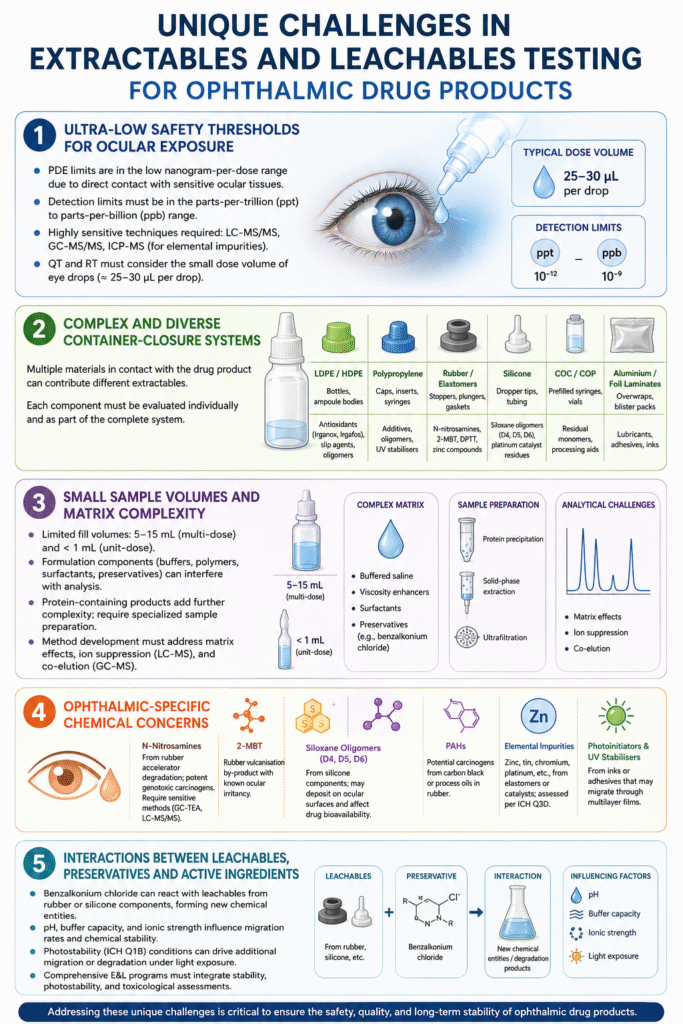
1. Ultra-Low Safety Thresholds for Ocular Exposure
The permissible daily exposure (PDE) limits for leachables in ophthalmic products are among the lowest of any dosage form, often in the low nanogram-per-dose range. This is because direct ocular contact bypasses systemic absorption barriers and places chemicals immediately adjacent to sensitive tissues.
- Analytical methods must achieve detection limits in the parts-per-trillion (ppt) to parts-per-billion (ppb) range.
- Conventional analytical approaches used for oral dosage forms are often insufficient — highly sensitive and selective techniques such as LC-MS/MS, GC-MS/MS, and ICP-MS (for elemental impurities) are typically required.
- Qualification thresholds (QT) and reporting thresholds (RT) must be set with consideration of the small daily dose volumes typical of eye drops (approximately 25–30 µL per drop).
2. Complex and Diverse Container-Closure Systems
Ophthalmic products are packaged in a remarkably diverse range of materials — each presenting a distinct extractables profile. A single multi-dose eye drop bottle may contain a low-density polyethylene (LDPE) body, a polypropylene cap, a silicone or rubber dropper insert, and an aluminium foil overwrap. Each component must be evaluated independently and in combination.
Common ophthalmic packaging materials and their associated analytical concerns:
| Material | Common Components | Key Extractables of Concern |
|---|---|---|
| LDPE / HDPE | Bottles, ampoule bodies | Antioxidants (Irganox, Irgafos), slip agents, oligomers |
| Polypropylene | Caps, inserts, syringes | Additives, oligomers, UV stabilisers |
| Rubber / Elastomers | Stoppers, plungers, gaskets | N-nitrosamines, 2-MBT, DPTT, zinc compounds |
| Silicone | Dropper tips, tubing | Siloxane oligomers (D4, D5, D6), platinum catalyst residues |
| Cyclic Olefin Copolymer (COC/COP) | Prefilled syringes, vials | Residual monomers, processing aids |
| Aluminium / Foil Laminates | Overwraps, blister packs | Lubricants, adhesives, inks |
3. Small Sample Volumes and Matrix Complexity
Ophthalmic drug products typically have very small fill volumes — often 5 to 15 mL for multi-dose bottles and less than 1 mL for unit-dose ampoules — which limits the amount of drug product available for leachables testing.
- The drug matrix itself (buffered saline, viscosity-enhancing polymers, preservatives such as benzalkonium chloride) can interfere with chromatographic and spectroscopic analyses.
- Protein-containing ophthalmic biologics add another layer of matrix complexity requiring specialised sample preparation (e.g., protein precipitation, solid-phase extraction).
- Method development must account for matrix effects, ion suppression in LC-MS, and co-elution in GC-MS.
4. Ophthalmic-Specific Chemical Concerns
Certain classes of chemical leachables pose particular risks in the ophthalmic context that may not be prioritised in E&L testing for other routes of administration.
Key chemical concerns unique to ophthalmic E&L:
- N-Nitrosamines: Formed from rubber accelerator degradation; potent genotoxic carcinogens at very low doses. Require dedicated sensitive methods (GC-TEA, LC-MS/MS).
- 2-Mercaptobenzothiazole (2-MBT): A rubber vulcanisation by-product with known ocular irritancy.
- Siloxane oligomers (D4, D5, D6): From silicone components; can deposit on ocular surfaces and potentially affect drug bioavailability.
- Polycyclic aromatic hydrocarbons (PAHs): Potential carcinogens from carbon black or process oils in rubber.
- Elemental impurities: Zinc, tin, chromium, and platinum from elastomers or catalysts, assessed per ICH Q3D.
- Photoinitiators and UV stabilisers: From label inks or adhesives that may migrate through multilayer films.
5. Interaction Between Leachables and Preservatives or Active Ingredients
In preserved multi-dose ophthalmic products, chemical interactions between leachables and the preservative system (commonly benzalkonium chloride) can generate secondary degradation products or alter their toxicological profile.
- Benzalkonium chloride can interact with leachables from rubber stoppers or silicone components, forming new chemical entities not present in the original extractables profile.
- The formulation pH, buffer capacity, and ionic strength all influence migration rates and chemical stability of leachables.
- Photostability (ICH Q1B) conditions during stability studies must also be correlated with leachables data, as light exposure can drive additional chemical migration or degradation.
3: The Regulatory Landscape Governing E&L Testing for Ophthalmic Drug Products
Multiple regulatory frameworks apply to E&L studies for ophthalmic drug products, and a comprehensive program must satisfy all of them simultaneously. Key guidance documents include:
- ICH Q3E (Guideline for Extractables and Leachables): Provides a risk-based framework for E&L studies across dosage forms, with specific considerations for different routes of administration.
- ICH Q3D: Establishes PDEs for elemental impurities by route of administration, including ocular.
- USP <661>, <1661>, <660>: Address plastic and glass containers for pharmaceutical use.
- USP <381>: Covers elastomeric closures for injectables and is often applied to ophthalmic closures.
- ISO 10993-17 & ISO 10993-18: Biological evaluation standards used when packaging is in contact with the eye, particularly for medical device combination products (e.g., contact lens care solutions).
- FDA Guidance on Container-Closure Systems (1999, updated guidance): Requires detailed extractables data and leachables qualification for all container-closure systems used with ophthalmic drug products.
4: A Best-Practice Analytical Strategy for Ophthalmic E&L Studies
A successful E&L program for ophthalmic products combines a structured extractables study, a targeted leachables monitoring program, and a rigorous safety risk assessment. At ResolveMass Laboratories Inc., we structure ophthalmic E&L programs around the following workflow:
- Material Identification & Risk Assessment — Characterise all packaging components; prioritise by direct contact, surface area, and material type.
- Exhaustive Extraction Studies — Use multiple solvents (aqueous at physiological pH, acidic, basic, and organic solvents) under ICH-aligned conditions.
- Multi-Technique Analytical Characterisation:
- GC-MS / GC-MS/MS for volatile and semi-volatile organics
- LC-UV / LC-MS/MS for non-volatile organic compounds
- Headspace GC-MS for residual solvents and volatiles
- ICP-MS / ICP-OES for elemental impurities
- LC-HRMS (High-Resolution Mass Spectrometry) for unknown compound identification
- Leachables Studies on Drug Product — Real-time and accelerated stability samples analysed at defined intervals; method transfer from extractables study where appropriate.
- Safety Qualification — Each identified leachable assessed against PDE thresholds using the Threshold of Toxicological Concern (TTC) approach, available toxicological data, or dedicated in vitro/in vivo studies.
- Regulatory Documentation — Preparation of E&L summary reports compliant with ICH Q3E, FDA, and EMA submission requirements.
5: How ResolveMass Laboratories Inc. Solves Ophthalmic E&L Challenges
Our team at ResolveMass Laboratories Inc. has directly executed E&L programs for multi-dose and preservative-free ophthalmic solutions, intravitreal injectables, ophthalmic ointments, and combination device-drug products. We understand that each product has a unique formulation, packaging configuration, and regulatory history — and we tailor our analytical strategies accordingly.
Our capabilities include:
- Validated, method-specific LOQs in the ppt–ppb range for trace leachables in ophthalmic matrices
- Nitrosamine-specific testing protocols aligned with FDA and EMA nitrosamine guidance
- Full elemental impurity profiling by ICP-MS per ICH Q3D ocular route PDEs
- Unknown compound identification using LC-HRMS and database matching
- Toxicological risk assessment by qualified toxicologists familiar with ocular exposure thresholds
- End-to-end project management from initial packaging risk assessment to regulatory submission support
We don’t just run tests — we interpret data in its full scientific and regulatory context, helping you make informed decisions about packaging selection, shelf-life claims, and safety qualification.
Conclusion:
Extractables and Leachables Testing for Ophthalmic Drug Products requires a specialised, science-first approach that accounts for the eye’s unique sensitivity, ultra-low safety thresholds, complex packaging materials, and stringent regulatory expectations. The consequences of an inadequate E&L program are serious: patient harm, clinical delays, regulatory rejection, and costly reformulation or repackaging.
Choosing a laboratory partner with proven expertise in Extractables and Leachables Testing for Ophthalmic Drug Products — one that combines state-of-the-art instrumentation with deep regulatory knowledge and toxicological understanding — is one of the most important decisions a pharmaceutical manufacturer can make in the product development lifecycle.
ResolveMass Laboratories Inc. is committed to delivering the scientific rigour and regulatory confidence you need to bring safe, effective ophthalmic products to patients worldwide.
Frequently Asked Questions:
Ophthalmic products are administered directly to the eye, one of the body’s most sensitive organs. Even trace levels of contaminants can cause irritation, toxicity, inflammation, or affect vision. Therefore, ophthalmic products often require more stringent extractables and leachables assessments than many other dosage forms.
Leachables can originate from multiple packaging components, including plastic bottles, rubber stoppers, silicone dropper tips, polypropylene caps, adhesives, inks, and foil laminates. Each material contains additives, processing aids, or degradation products that may migrate into the drug product over time.
Ophthalmic products have much lower safety thresholds because they directly contact ocular tissues. Small dose volumes, complex packaging systems, matrix interferences, and the need to detect compounds at parts-per-trillion levels make ophthalmic E&L testing significantly more demanding than testing for oral dosage forms.
High-risk leachables include N-nitrosamines, 2-mercaptobenzothiazole (2-MBT), siloxane oligomers, polycyclic aromatic hydrocarbons (PAHs), photoinitiators, UV stabilisers, and elemental impurities such as zinc, chromium, tin, and platinum. These compounds may pose toxicological, carcinogenic, or ocular irritation risks.
Preservatives such as benzalkonium chloride can interact with leachables from packaging materials and generate secondary degradation products. These newly formed compounds may not be detected during extractables studies, making comprehensive leachables testing under stability conditions essential.
Silicone components can release siloxane oligomers such as D4, D5, and D6 into the formulation. These compounds may deposit on ocular surfaces, potentially affecting patient comfort, drug delivery performance, and long-term product quality. Sensitive analytical methods are often required to monitor their presence.
Regulatory agencies expect a science-based E&L program that includes extractables studies, leachables monitoring, toxicological risk assessment, stability evaluation, and justification of analytical thresholds. Studies are generally conducted in alignment with USP <1663>, USP <1664>, PQRI recommendations, and applicable ICH guidelines.
Reference
- Houston CT, Rodrigues AD, Smith BB, Wang T, Richardson M. Principles for management of extractables and leachables in ophthalmic drug products. PDA Journal of Pharmaceutical Science and Technology. 2022 May 1;76(3):278-94.https://journal.pda.org/content/76/3/278.abstract
- Ramamoorthy S, Chong NS, Hotha KK. Strengthening extractable & leachable study submissions: best practices to avoid regulatory deficiencies. American Journal of Analytical Chemistry. 2024;15(12):368-94.https://www.researchgate.net/profile/Subathra-Ramamoorthy-2/publication/387503864_Strengthening_Extractable_Leachable_Study_Submissions_Best_Practices_to_Avoid_Regulatory_Deficiencies/links/678dbc981ec9f9589f51a2bb/Strengthening-Extractable-Leachable-Study-Submissions-Best-Practices-to-Avoid-Regulatory-Deficiencies.pdf
- Smith EJ, Paskiet DM, Tullo EJ. The management of extractables and leachables in pharmaceutical products. InParenteral Medications, Fourth Edition 2019 Jul 19 (pp. 535-573). CRC Press.https://www.taylorfrancis.com/chapters/edit/10.1201/9780429201400-29/management-extractables-leachables-pharmaceutical-products-edward-smith-diane-paskiet-erica-tullo
- Jahn M. Leachables and extractables: from regulatory expectations to laboratory assessment. InChallenges in protein product development 2018 Jun 21 (pp. 337-351). Cham: Springer International Publishing.https://link.springer.com/chapter/10.1007/978-3-319-90603-4_16
- Mihalchik-Burhans AL, Rogers EN, Mihalchik-Burhans AL, Rogers EN, Mihalchik-Burhans AL, Rogers EN. Considerations for Leachables and Extractables Testing. InIntegrated Safety and Risk Assessment for Medical Devices and Combination Products 2020 Feb 25 (pp. 239-263). Cham: Springer International Publishing.https://link.springer.com/chapter/10.1007/978-3-030-35241-7_4
About the Author


