


Introduction: Why Leachables Monitoring Must Be Central to Your Stability Program
Many sponsors still approach stability studies primarily as a shelf-life determination exercise. In reality, a properly designed stability program serves a much broader function. It also operates as a long-term product safety surveillance system, and this becomes especially important when evaluating leachables during stability studies.
Leachables are chemical compounds that migrate from a container closure system (CCS), delivery device, or packaging material into a drug product under actual storage and usage conditions. Unlike extractables, which are identified under aggressive laboratory extraction conditions, leachables represent the compounds to which patients may truly be exposed. This distinction is critically important from both a toxicological and regulatory standpoint.
Global regulatory authorities, including the U.S. Food and Drug Administration, European Medicines Agency, and Health Canada, have steadily increased their expectations regarding leachables characterization and monitoring. Sponsors that fail to incorporate comprehensive leachables monitoring into their stability strategies frequently encounter deficiency letters, clinical delays, additional toxicological studies, and costly reformulation efforts that could have been avoided through early planning.
This article is intended for pharmaceutical sponsors, CMC leaders, and regulatory affairs professionals who already possess a foundational understanding of leachables and require a more advanced framework for designing scientifically sound and regulator-ready stability programs.
Explore Comprehensive Solutions: Discover standard-setting protocols and advanced analytical strategies by visiting our core extractables and leachables testing resource portal.
Share via:
1. The Regulatory Architecture Governing Leachables in Stability Studies
The regulatory landscape governing leachables is layered, interconnected, and often misunderstood. Sponsors must understand not only what each guidance document states individually, but also how these guidances interact within the broader regulatory framework.
| Guidance Document | Primary Scope | Key Leachables Implication |
|---|---|---|
| ICH Q1A(R2) | Stability testing of new drug substances and products | Stability protocols must address packaging interactions and adequately describe the CCS |
| ICH Q3E (Draft) | Elemental impurities in drug products | Metallic leachables must be monitored throughout stability timepoints |
| USP <1664> | Assessment of extractables and leachables from packaging | Defines AET, SCT, and analytical qualification thresholds |
| ISO 10993-17 | Toxicological risk assessment for medical devices | Relevant for combination products and prefilled delivery systems |
| FDA Guidance on CCS (1999 and 2016 updates) | Container closure integrity and compatibility | Leachables data are required within NDA/BLA submissions as part of CCS safety evaluation |
| EMA Guideline on Plastic Immediate Packaging | European submission requirements | Sponsors must demonstrate that packaging materials do not compromise drug quality or patient safety |
One of the most important regulatory insights is that ICH Q1A(R2) does not explicitly define specific leachables testing intervals. However, it clearly requires sponsors to address interactions between the drug product and the packaging system. This is where many development programs fail. Sponsors often design stability studies that technically comply with the wording of ICH Q1A(R2) while overlooking the broader expectations outlined in CCS-specific guidance documents. Regulatory reviewers consistently identify and question these gaps during submission review.
Align with Compendial Standards: To understand how these expectations apply to United States Pharmacopeia compliance, read our comprehensive guide on USP requirements for extractables and leachables.
2. Designing the Stability Protocol to Capture Meaningful Leachables Data
A robust stability protocol should generate scientifically meaningful leachables trend data rather than isolated endpoint measurements. Stability programs that only evaluate leachables at the end of shelf life frequently miss critical migration trends that develop earlier in storage.
2.1 Timepoint Selection for Leachables Pulls
Leachables monitoring should never be limited solely to the final shelf-life timepoint. Migration from packaging materials is a dynamic kinetic process. Depending on the formulation composition and packaging materials, leachables concentrations may increase gradually, plateau, fluctuate, or even decline over time.
Recommended General Leachables Pull Schedule
- T=0 (Baseline): Establishes the initial pre-storage baseline and confirms the absence of pre-existing contamination within the drug product matrix.
- T=3 Months: Provides an early migration assessment and is particularly sensitive for volatile and semi-volatile compounds.
- T=6 Months: Corresponds to the accelerated condition endpoint commonly required for IND-stage risk evaluations.
- T=12 Months: Serves as a critical real-time intermediate timepoint for trend evaluation and AET decision-making.
- T=18 Months: Confirms long-term profile stability and supports migration trend consistency.
- T=24 Months and Beyond: Generates complete qualification data necessary for NDA/BLA submissions and supports the proposed shelf-life claim.
For high-risk CCS configurations, including multilayer polymer films, complex elastomer systems, or rubber closures containing multiple compounding additives, monthly sampling during the first three months is strongly recommended. Early monitoring significantly reduces the risk of discovering problematic leachables late in development.
2.2 Storage Condition Strategy
Accelerated stability conditions such as 40°C/75% RH are not always predictive of real-time leachables behavior. Elevated temperatures may artificially accelerate oxidative degradation of packaging materials and generate degradation products that would never form under normal storage conditions.
Sponsors should therefore:
- Conduct both accelerated and real-time leachables studies in parallel rather than relying solely on accelerated data.
- Clearly justify whether accelerated conditions are representative of real-time migration behavior.
- Exercise additional caution when evaluating aqueous formulations stored in contact with elastomeric components, since elevated temperatures significantly increase partitioning and migration rates.
Failure to contextualize accelerated data properly is a common source of regulatory concern during submission review.
2.3 Orientation and Fill Volume Considerations
The surface-area-to-volume ratio is one of the most overlooked variables in leachables risk assessment. A vial filled to 90% capacity presents a substantially different migration profile than the same vial filled to only 30% capacity.
Similarly, storage orientation directly affects the extent of drug product contact with elastomeric or polymeric surfaces. Inverted storage conditions maximize contact between liquid formulations and container closures such as rubber stoppers. For injectable products, stability protocols should evaluate both upright and inverted orientations as separate study arms whenever stopper-derived leachables are considered a potential risk.
Mitigate Risks for Complex Injections: Learn how to address orientation and component risks for delivery systems by reading our article on analytical evaluation strategies for pre-filled syringes.
3. Threshold Hierarchy: Making Risk-Based Decisions During Stability Review
Understanding the leachables threshold hierarchy is essential for making scientifically defensible decisions when compounds are detected during stability testing.
| Threshold | Acronym | Value (Oral) | Value (Inhalation) | Required Action |
|---|---|---|---|---|
| Safety Concern Threshold | SCT | 1.5 µg/day TDI | 0.15 µg/day TDI | No further qualification required below SCT |
| Analytical Evaluation Threshold | AET | Calculated using SCT, daily dose, and analytical uncertainty | More stringent for inhalation products | Compounds above AET must be identified and reported |
| Qualification Threshold | QT | 5 µg/day (oral, non-carcinogens) | 0.15 µg/day | Full toxicological assessment required above QT |
TDI = Tolerable Daily Intake, based on USP <1664> and PQRI recommendations.
Practical Stability Review Scenarios
- If a compound is detected at T=6 months at 0.8 µg/day while the calculated AET is 1.5 µg/day, the finding should be documented and trended, but immediate qualification is not required.
- If the same compound later reaches 2.2 µg/day at T=12 months, the AET has been exceeded, requiring structural identification and toxicological evaluation before regulatory submission.
- If a completely new compound appears at T=18 months that was absent during earlier intervals, a formal root cause investigation should be initiated immediately to determine whether packaging degradation pathways or secondary migration mechanisms are involved.
Leachables trending should always be treated as a dynamic risk-management activity rather than a static reporting exercise.
Master Threshold Calculations: For an in-depth guide on determining your baseline limits, see our comprehensive breakdown of AET determination protocols for leachables studies.
4. Analytical Methods That Actually Work: Fit-for-Purpose Validation
Analytical method selection is one of the most important determinants of leachables study quality. An inadequately validated method can create uncertainty, false negatives, or regulatory questions that undermine the entire stability program.
Analytical methods should be selected based on the anticipated leachable profile associated with the CCS materials and formulation characteristics, not based on laboratory convenience or instrument availability.
4.1 Recommended Analytical Platforms by Leachable Class
| Leachable Class | Preferred Analytical Method | Typical Detection Requirement |
|---|---|---|
| Organic extractables (semi-volatiles) | HPLC-MS/MS (Orbitrap or QToF) | Low ppb range (≤0.1 µg/mL) |
| Volatile organic compounds (VOCs) | GC-MS (headspace or SPME) | Low ppb range |
| Non-volatile organics | LC-UV/DAD with LC-MS confirmation | Sub-ppm range |
| Elemental impurities | ICP-MS per ICH Q3D | ppt to ppb range depending on element |
| N-nitrosamines | LC-MS/MS (preferably HRMS) | Sub-ppb range with FDA-specific sensitivity requirements |
| Antioxidants and plasticizers | HPLC-DAD or HPLC-MS | ppb to low ppm range |
4.2 Validation Requirements Specific to Leachables Matrices
Drug product matrices can significantly interfere with leachables analysis if methods are not appropriately validated. The following validation elements are particularly critical:
- Matrix Spike Recovery: Recovery studies must be performed in the actual drug product matrix at T=0 rather than in surrogate solvents.
- Selectivity: Drug substance peaks and excipient peaks must be fully resolved from leachables signals to avoid co-elution and false-negative results.
- Analytical Standard Stability: Many leachables reference standards are inherently unstable and require demonstrated stability throughout the analytical study period.
- Formulation Additive Interference: Preservatives, antioxidants, and surfactants may either mask or mimic leachables peaks and must therefore be assessed carefully.
- Limit of Quantitation (LOQ): The LOQ must remain below the AET, not merely below the QT. Regulatory reviewers frequently cite this deficiency.
Evaluate Instrumental Options: Compare the strengths of primary separation and detection platforms by reading our technical review of GC-MS vs LC-MS in analytical testing chemistry.
5. The Extractables-to-Leachables Correlation: Why Early Establishment Matters
Extractables studies and leachables monitoring programs should never be treated as independent scientific exercises. They represent two interconnected components of the same overall packaging safety strategy.
Regulatory agencies expect sponsors to demonstrate a logical and scientifically justified relationship between compounds extracted under exaggerated conditions and those actually observed migrating into the drug product during stability.
When the Correlation Fails
The appearance of a leachable compound during stability that was absent from the original extractables profile raises serious scientific and regulatory concerns. Such discrepancies may indicate:
- Insufficient extractables study design, including inappropriate solvent systems, extraction temperatures, or contact durations.
- Newly activated degradation pathways triggered by interactions with the formulation itself, such as acid-catalyzed polymer additive degradation.
- Secondary migration originating from external packaging layers that were not included within the extractables assessment.
Each scenario requires a documented root cause investigation and, in many situations, additional extractables characterization before the leachables data can be considered acceptable for regulatory qualification.
Best Practice Recommendation
Extractables studies should always be completed before initiating long-term stability studies. This approach establishes a scientifically justified “leachables watch list” consisting of compounds expected to migrate during storage.
Any compound detected during stability that was not previously identified within the watch list should immediately be treated as an investigation trigger rather than simply another analytical observation.
Optimize Initial Solvent Selection: For guidance on setting up appropriate early extraction frameworks, read about solvent optimization strategies for extractables mapping.
6. High-Risk Drug-CCS Combinations Requiring Enhanced Monitoring
Not all drug products carry the same leachables risk profile. Certain drug-packaging combinations require more intensive monitoring strategies, expanded analytical coverage, and earlier toxicological assessment.
High-Risk Combinations Include:
- Aqueous Liquid Injectables in Prefilled Syringes with Rubber Plungers: Common concerns include silicone oil, vulcanization residues such as 2-mercaptobenzothiazole and thiurams, and tungsten residues from needle manufacturing.
- Inhalation Products (MDIs, DPIs, Nasal Sprays): Because pulmonary exposure significantly lowers the SCT, virtually every detectable compound requires evaluation. Plasticizer migration from actuator materials remains a persistent issue.
- Ophthalmic Products: Interactions between preservatives such as benzalkonium chloride and LDPE packaging may generate secondary leachables unexpectedly.
- Biologics in Glass Vials with Bromobutyl Stoppers: Frequently observed leachables include tungsten, zinc, barium, BHT, and Irganox compounds. Leachables-induced protein aggregation represents an additional biologics-specific concern.
- Topical Products in Flexible Tubes: Adhesive residues, ink-derived compounds, and phthalate plasticizers from laminate structures require monitoring, particularly when formulations contain high concentrations of organic solvents.
Enhanced monitoring protocols are strongly recommended for these product categories because even low-level migration events may significantly impact patient safety, product stability, or immunogenicity.
Protect Advanced Therapeutic Approvals: Review specialized monitoring approaches for complex modern modalities by accessing our report on testing considerations for biologics and advanced therapies.
7. Regulatory Submission: What Reviewers Expect in a Leachables Data Package
A comprehensive leachables submission package for an NDA, BLA, or MAA undergoes intensive regulatory scrutiny. Reviewers expect scientifically complete, internally consistent, and fully traceable documentation.
1. CCS Description and Scientific Justification
Sponsors should provide detailed specifications for every packaging component that contacts the drug product, including materials of construction, manufacturing suppliers, and documented change histories.
2. Complete Extractables Profile
All compounds detected above the AET should include complete chromatographic and spectral characterization data, including MS fragmentation information and NMR characterization where necessary for novel structures.
3. Comprehensive Leachables Data Tables
Leachables summary tables should include:
- Compound identity
- Initial detection timepoint
- Concentration at every stability interval
- Daily exposure calculations
- Applicable threshold comparisons
- Final disposition status
4. Toxicological Qualification Documentation
Any compound exceeding the QT requires a formal Toxicological Risk Assessment (TRA) aligned with the PQRI framework. This assessment should include:
- Literature review
- Read-across analyses where direct toxicology data are unavailable
- Acceptable Daily Exposure (ADE) determination
5. Extractables-to-Leachables Correlation Narrative
Regulatory reviewers expect a clear scientific explanation demonstrating how the observed leachables profile correlates with the original extractables data or, where discrepancies exist, why those differences occurred.
6. Risk Assessment for Unidentified Leachables
Any unidentified compound detected above the AET must be supported through a Threshold of Toxicological Concern (TTC)-based evaluation using the Cramer classification framework.
Streamline NDA and ANDA Filings: Ensure your regulatory submission data package meets all current reviewer expectations by visiting our guide on testing protocols for NDA and ANDA filings.
8. Common Deficiencies That Delay Regulatory Approval
Based on publicly available FDA Complete Response Letters and EMA Day 120 questions, several recurring deficiencies continue to delay product approvals.
Frequent Regulatory Findings Include:
- Incorrect AET Calculations: Sponsors often use inaccurate maximum daily dose assumptions or fail to include analytical uncertainty factors, commonly around ±30%.
- Missing Real-Time Stability Data: Accelerated data alone are insufficient. Reviewers expect supporting real-time stability data at submission.
- Insufficient Structural Characterization: Reporting compounds merely as “unknown peak at RT 14.3 min” is unacceptable. High-resolution MS with fragmentation analysis is expected.
- Failure to Qualify Rubber-Derived Leachables: N-nitrosamines originating from vulcanization accelerants remain a major regulatory focus area.
- Lack of Cross-Validation Between Stability and Leachables Methods: Drug product stability methods and leachables methods are frequently developed independently without confirming mutual analytical compatibility or interference.
These deficiencies are among the most common causes of avoidable regulatory delays.
Review Regulatory Precedents: Learn from historical regulatory roadblocks by exploring our compilation of historical FDA extractables and leachables case studies.
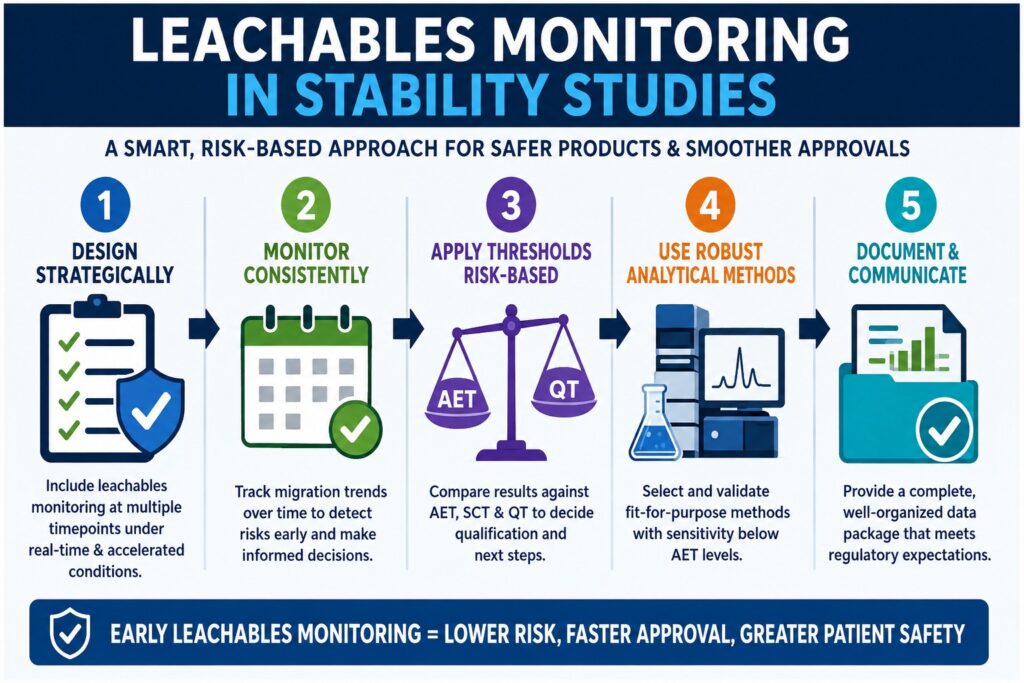
Conclusion: Leachables Monitoring During Stability Studies Is a Strategic Investment
Integrating leachables monitoring into stability programs from the earliest stages of development is not merely conservative risk management. It is a scientifically necessary and strategically critical component of modern pharmaceutical development that directly protects both regulatory timelines and patient safety.
The financial investment required to establish a well-designed leachables monitoring program is minimal compared with the cost of delayed approvals, additional toxicological studies, or Complete Response Letters citing inadequate packaging safety evaluation.
Sponsors that incorporate leachables strategy into their development programs from IND through NDA/BLA submission — supported by fit-for-purpose analytical methods, rigorous threshold evaluations, and scientifically justified extractables-to-leachables correlations — consistently position themselves for smoother regulatory review and faster approvals than organizations that attempt to address these issues late in development.
Partner with Top-Tier Experts: Work with an experienced laboratory partner to design your stability program. Find out more about partnering with Canada’s premier extractables and leachables CRO.
Frequently Asked Questions: Leachables Monitoring During Stability Studies
Leachables monitoring should be incorporated early in development, particularly for products with higher packaging interaction risks such as injectables, inhalation therapies, and biologics. For most high-risk formulations, monitoring is expected by Phase 2, while broader implementation is generally anticipated by Phase 3 for all dosage forms. Delaying leachables evaluation until NDA or BLA submission stages can create significant regulatory concerns because agencies expect long-term trending data across multiple stability intervals. Early integration also helps sponsors identify packaging-related safety issues before they become costly development problems.
Leachables analysis does not always need to be conducted at every single stability interval, but critical timepoints must be strategically selected. Most programs include testing at baseline, 6 months, 12 months, 18 months, and 24 months to establish migration trends over time. Higher-risk products such as parenterals and inhalation therapies often require additional early-stage monitoring at 1-month and 3-month intervals due to stricter toxicological thresholds and increased regulatory scrutiny. The testing schedule should always be supported by a documented scientific risk assessment.
The Analytical Evaluation Threshold (AET) is determined using the Safety Concern Threshold (SCT), the maximum daily dose of the drug product, and a correction factor that accounts for analytical variability. In practice, the SCT is divided by the daily dose volume to establish a theoretical reporting threshold. Sponsors then apply an uncertainty adjustment, commonly ranging between 50% and 70%, to compensate for analytical method variability and instrument limitations. This approach ensures that analytical methods remain sufficiently sensitive to detect compounds that could pose toxicological concern during stability studies.
The appearance of a previously undetected leachable during mid- or late-stage stability testing should immediately trigger a formal investigation. This type of finding may indicate packaging degradation, formulation-induced chemical reactions, supplier-related material changes, or sample handling issues during storage. Sponsors are expected to conduct a documented root cause analysis to determine why the compound emerged only after prolonged storage. In many cases, additional extractables studies or expanded analytical characterization may also be required before the data can support regulatory submissions.
When toxicological information is unavailable for a detected leachable, sponsors generally apply the Threshold of Toxicological Concern (TTC) approach combined with Cramer structural classification principles. This framework categorizes compounds according to structural complexity and predicted toxicological risk. Simpler structures with minimal toxicological concern are assigned higher allowable exposure limits, while more reactive or structurally complex compounds receive stricter limits. If a compound demonstrates potential genotoxic characteristics, the TTC approach is no longer sufficient, and a compound-specific toxicological assessment becomes necessary.
In certain limited situations, extractables data may partially support a regulatory submission without extensive leachables data, but only when the scientific justification is strong. This approach is generally limited to low-risk solid dosage forms packaged in relatively inert container closure systems. Sponsors must demonstrate that the extraction conditions used during extractables studies were significantly more aggressive than actual product storage conditions. However, for liquid formulations, semi-solids, inhalation therapies, and complex delivery systems, regulators almost always require direct leachables data generated from the final marketed packaging configuration.
Elemental leachables are evaluated as part of the broader elemental impurities program governed by ICH Q3D requirements. Stability studies for parenteral, ophthalmic, and inhalation products frequently include ICP-MS testing to monitor trace metal migration throughout the product shelf life. Common elemental leachables may originate from glass containers, rubber closures, stainless steel manufacturing equipment, or processing components. Metals such as zinc, aluminum, chromium, nickel, tin, and barium are routinely monitored because even low-level exposure can present toxicological or product quality concerns over extended storage periods.
A comprehensive leachables qualification package should contain detailed documentation covering every aspect of packaging safety evaluation. Regulatory reviewers expect a complete CCS description, scientifically justified extractables studies, fully characterized leachables profiles, and stability trend data across defined timepoints. Sponsors must also provide AET calculations, compound identification data, and toxicological assessments for any compounds exceeding qualification thresholds. Finally, the submission should include a clear scientific conclusion demonstrating that the packaging system does not create an unacceptable safety risk throughout the proposed product shelf life.
Reference:
- International Conference on Harmonisation of Technical Requirements for Registration of Pharmaceuticals for Human Use. (2003). Q1A(R2): Stability testing of new drug substances and products. ICH Database PDF
- United States Pharmacopeial Convention. (2023). 〈711〉 Dissolution. In USP–NF. United States Pharmacopeial Convention. https://doi.org/10.31003/USPNF_M99470_03_01
- U.S. Food and Drug Administration. (1997). Dissolution testing of immediate release solid oral dosage forms: Guidance for industry. Center for Drug Evaluation and Research. https://www.fda.gov/media/70788/download
- International Council for Harmonisation of Technical Requirements for Pharmaceuticals for Human Use. (2022). Q3D(R2): Guideline for elemental impurities. https://database.ich.org/sites/default/files/Q3D-R2_Guideline_Step4_2022_0308.pdf
- International Council for Harmonisation of Technical Requirements for Pharmaceuticals for Human Use. (2025). ICH Q3E: Guideline for extractables and leachables (Step 2 draft guideline). https://database.ich.org/sites/default/files/ICH_Q3E_EWG_Step2_DraftGuideline_2025_0704.pdf
- European Medicines Agency. (2005). Guideline on plastic immediate packaging materials (CPMP/QWP/4359/03; EMEA/CVMP/205/04). https://www.ema.europa.eu/en/documents/scientific-guideline/guideline-plastic-immediate-packaging-materials_en.pdf
Get In Touch With Us
About The Author


