

Introduction:
Choosing an FDA registered testing laboratory can look like a simple checkbox exercise, but the terminology around registration, approval, certification, and accreditation is widely misunderstood — even inside regulated industries. FDA itself is explicit that establishment registration does not mean a facility or its products have been approved, cleared, or authorized. For pharmaceutical, biotechnology, and medical-device organizations, that distinction has real consequences: a lab can be legitimately registered and still be the wrong choice for a specific analytical program if its accreditation scope, methods, or quality systems don’t match the work required. This article breaks down exactly what FDA registration covers, what it doesn’t, and what else sponsors should check before relying on a lab’s data.
Summary:
- An FDA registered testing laboratory has completed a registration process with the FDA — this is not the same as being “FDA-approved,” “FDA-certified,” or FDA-endorsed.
- FDA has several separate registration systems (drugs, medical devices, food, biologics), so the right question is: registered for what activity, product category, and purpose?
- Registration confirms an establishment submitted required information to FDA — it does not by itself prove analytical competence, method suitability, or accreditation.
- Laboratory accreditation (e.g., ISO/IEC 17025) is a separate, scope-specific evaluation of technical competence, distinct from FDA registration.
- For medical-device testing, FDA’s ASCA program adds another specific layer — accredited labs testing to FDA-recognized standards, which is different again from general registration.
- Sponsors should evaluate a lab on registration status, accreditation scope, analytical capabilities, method validation, quality systems, data integrity, and regulatory experience together — not on the registration claim alone.
1: What Is an FDA Registered Testing Laboratory?
An FDA registered testing laboratory is a facility that has completed registration under one of FDA’s applicable establishment programs — but there is no single universal registration that makes every lab “FDA approved” across the board.
FDA maintains separate registration and listing systems depending on the regulated product and activity, including systems for drug establishments, medical device establishments, food facilities, and biologics. A lab’s drug establishment registration, for instance, has nothing to do with medical-device registration requirements. That’s why the first question worth asking isn’t “is this lab FDA registered?” but rather:
- Registered under which FDA program?
- For which product category?
- Covering which specific activity (testing, manufacturing, repackaging, relabeling)?
That framing is far more useful than treating “FDA registered” as a single, self-explanatory credential.
2: What FDA Registration Actually Covers
FDA registration primarily supplies regulatory information about an establishment when registration is required — it identifies who the facility is and what it does, not how well it does it.
Depending on the applicable program, registration typically involves submitting:
- Establishment identity and physical location
- Responsible contact and, for foreign establishments, a U.S. agent
- The business or manufacturing/testing activities performed
- Product or device listings, where applicable
- Facility identifiers (e.g., FEI/DUNS numbers)
- Periodic renewal or update obligations
Foreign establishments manufacturing, repacking, relabeling, or testing drugs for U.S. distribution generally must register before the product is offered for import, subject to applicable exemptions. Medical device establishments go through a related but separate registration-and-listing process.
Registration can reasonably demonstrate that:
- The establishment completed the relevant FDA registration process
- It disclosed the information required by that specific FDA system
- It can be found in the appropriate FDA registration database, when publicly searchable
- Certain regulatory obligations tied to that registration now apply to it
It should not be read as a broader statement about laboratory quality or analytical competence.
3: What FDA Registration Does NOT Mean
This is where marketing language most often gets ahead of the facts. FDA has stated directly, in the medical-device context, that registration and listing does not constitute approval, clearance, or authorization of the establishment or its products. The same principle applies to how “FDA registered” gets used to describe laboratories.
| Registration Is Sometimes Assumed to Mean… | Why That’s Not Accurate |
|---|---|
| FDA approval of the laboratory | Registration and approval are separate regulatory concepts entirely |
| FDA certification of every analytical method | Registration doesn’t validate or review individual methods |
| FDA approval of every test result | Individual results aren’t automatically reviewed by FDA |
| ISO/IEC 17025 accreditation | Accreditation is a distinct, third-party conformity-assessment process |
| FDA endorsement of the laboratory | Registration is not an endorsement of quality or reputation |
| Approval of a specific product | Product approval follows its own separate regulatory pathway |
| Guaranteed acceptance in a submission | Acceptability depends on the specific requirements and evidence provided |
| Proof of competence for every test performed | Competence must be assessed through scope, validation, equipment, and personnel |
Any lab describing itself with terms like “FDA approved laboratory” or “FDA certified laboratory” should be asked to clarify exactly what regulatory status is actually being claimed.
4: FDA Registered Testing Laboratory vs. FDA-Approved Laboratory
FDA registration and FDA approval answer two different questions, and the phrases should never be used interchangeably.
- Registration asks: Has the applicable establishment completed the required FDA registration process?
- Approval/clearance/authorization asks: Has FDA reviewed and made a specific regulatory decision about a product, device, application, or submission?
FDA’s own consumer guidance separates these terms explicitly, noting that establishment registration does not itself represent approval, clearance, or authorization. A registered lab can absolutely support FDA-related submissions — but the registration itself isn’t what makes the data acceptable; the underlying science and documentation are.
5: FDA Registration vs. Laboratory Accreditation
Accreditation evaluates whether a lab meets defined technical and quality requirements within a specific scope — registration does not do this at all.
For analytical laboratories, ISO/IEC 17025 accreditation is the relevant standard, addressing competence requirements for testing and calibration work. Critically, accreditation is scope-specific: a lab may be accredited for certain techniques, methods, matrices, or measurement ranges, but not others performed at the same facility. A lab could, for example, run:
- HPLC assay and related substances testing
- GC residual solvents analysis
- LC-MS impurity profiling
- ICP-MS elemental analysis
- Extractables and leachables studies
- Stability testing
…with different accreditation or regulatory coverage applying to each activity. The right question isn’t “is this lab accredited?” but “is the specific test I need included in the lab’s documented accreditation scope?”
6: What Is FDA’s ASCA Program?
For medical-device testing specifically, FDA’s Accreditation Scheme for Conformity Assessment (ASCA) provides a defined framework layered on top of general registration — and it’s a good example of why “FDA registered” is too broad a label to rely on by itself.
Under ASCA, participating laboratories must hold accreditation from an ASCA-recognized accreditation body, applied to FDA-recognized versions of specific standards and test methods. FDA maintains a public database of ASCA-accredited labs and their scopes — and FDA has previously updated that database to flag laboratories whose ASCA accreditation was withdrawn following FDA audits. That’s a useful reminder: regulatory status should always be verified against the current, official database, not assumed from a website claim.
For device sponsors, the relevant questions are:
- Is the laboratory ASCA accredited?
- Which standards and test methods are covered?
- Is the specific test you need within that scope?
- Is the accreditation currently active?
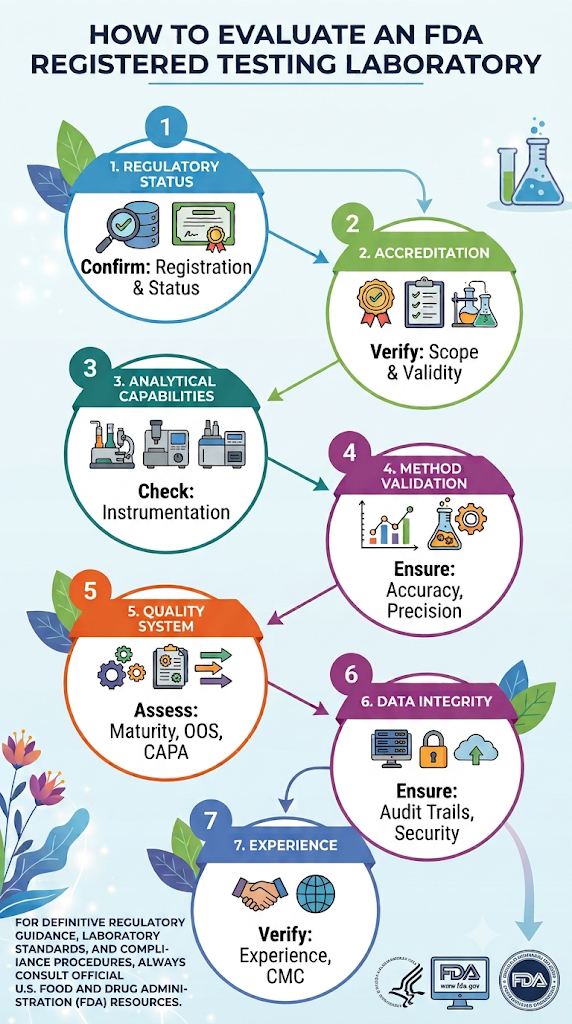
7: How to Evaluate an FDA Registered Testing Laboratory
A proper qualification process looks well beyond the registration number itself.
1. Regulatory status — Confirm the applicable registration, establishment identity, current status, product category, and activity covered.
2. Accreditation and scope — Review the accrediting body, certificate validity, and whether the specific methods, techniques, and matrices you need are actually within scope.
3. Analytical capabilities — Confirm suitable instrumentation and expertise: HPLC/UHPLC, GC/GC-MS, LC-MS/MS, ICP-MS/ICP-OES, Karl Fischer analysis, dissolution testing, spectroscopy, stability testing, extractables and leachables.
4. Method validation — Ask whether the lab can demonstrate accuracy, precision, specificity, linearity, range, detection/quantitation limits, robustness, and system suitability for the relevant method.
5. Quality system maturity — Look for controlled SOP management, training, equipment qualification/calibration, deviation and OOS handling, CAPA, change control, and document control.
6. Data integrity — Check for audit trails, controlled access, electronic records, raw data retention, instrument integration, review workflows, and backup/archival controls.
7. Regulatory experience — Ask about direct experience with the relevant program: ANDA support, generic-drug testing, CMC studies, stability programs, impurity characterization, E&L testing, device testing, or bioanalytical work.
8: Documentation Sponsors Should Request
Before engaging a lab, ask for documentation that lets you verify these claims independently rather than take them at face value:
- FDA registration information, where applicable
- Current accreditation certificate and scope of accreditation
- Relevant SOP or quality-system summaries
- Method validation summaries
- Equipment qualification and calibration records
- Example analytical reports
- Quality agreements
- Data integrity procedures
- Deviation/OOS/CAPA process descriptions
- Evidence of relevant regulatory experience
Not every document is needed for every project — the right qualification package scales with the regulatory risk and intended use of the data.
Common Misunderstandings, Corrected
- “FDA registered means FDA approved.” Not necessarily — FDA explicitly separates registration from approval, clearance, or authorization.
- “Registration means every test is compliant.” No — compliance depends on the applicable requirements, method, quality system, and intended use.
- “Registration proves competence.” No — competence is demonstrated through accreditation scope, personnel, equipment, validated methods, and quality controls.
- “A lab can call itself ‘FDA certified’ because it’s registered.” This is misleading terminology — registration is not certification, and sponsors should ask for the specific regulatory status being claimed.
Practical Qualification Checklist
Before selecting a laboratory, sponsors can work through this list:
- Verify the lab’s applicable FDA registration and current status
- Confirm exactly what that registration covers
- Review accreditation and its specific scope
- Confirm your required test method falls within that scope
- Evaluate method development and validation capabilities
- Assess relevant equipment and instrumentation
- Review data integrity and quality-system controls
- Confirm experience with your specific regulatory pathway
- Put responsibilities in writing via a quality agreement
- Clarify reporting, raw-data, deviation, and record-retention expectations upfront
9: How ResolveMass Laboratories Approaches This
At ResolveMass Laboratories Inc., we start laboratory engagements with the scientific and regulatory requirements of the study — not with a registration claim used as shorthand for trust. As a contract research organization supporting pharmaceutical and biotechnology clients, our work spans nitrosamine impurity testing, extractables & leachables (E&L) studies, polymer characterization, and peptide–oligonucleotide conjugate analysis, using LC-MS, GC-MS, NMR, HPLC, and complementary spectroscopic techniques.
We operate under a fully implemented ISO 9001:2015 certified Quality Management System, governing documentation control, traceability, and data integrity across every project. When clients ask about our FDA registration status, we walk them through exactly what it does and doesn’t confirm, and point them to the accreditation scope, validated methods, and quality documentation that actually demonstrate whether we’re the right fit for their specific analytical program — aligning the strategy to the sample matrix, target analytes, sensitivity requirements, and intended regulatory purpose.
Conclusion:
An FDA registered testing laboratory should never be treated as shorthand for “FDA-approved laboratory.” Registration confirms an establishment completed a required regulatory process and disclosed specific information to the FDA — it does not, by itself, establish approval, analytical competence, accreditation, or acceptance of every test result the lab produces. The more useful approach for sponsors is evaluating the full picture: FDA registration status, accreditation and its scope, analytical capabilities, method validation, quality systems, data integrity, and relevant regulatory experience — together, not in isolation.
Frequently Asked Questions:
No. FDA registration and FDA approval are separate regulatory concepts.
Registration generally identifies an establishment within an applicable FDA regulatory system.
It does not mean FDA has reviewed and approved the laboratory itself.
It also does not represent FDA endorsement of the laboratory or all its testing activities.
No. FDA does not use one universal registration program for every testing laboratory.
Requirements vary depending on the regulated product, establishment type, and activity.
Different FDA systems apply to areas such as drugs, medical devices, food, and biologics.
The applicable registration should therefore be verified based on the laboratory’s specific activities.
No. FDA registration alone does not establish a laboratory’s analytical competence.
Sponsors should evaluate accreditation, testing scope, validated methods, equipment, and personnel expertise.
Quality systems, data integrity, calibration, and equipment qualification are also important.
The laboratory’s capabilities should be matched to the specific testing requirements.
No. ISO/IEC 17025 accreditation and FDA registration serve different purposes.
ISO/IEC 17025 focuses on laboratory competence within a defined accreditation scope.
FDA registration generally relates to an establishment’s applicable regulatory registration.
Having one does not automatically mean that the laboratory has the other.
ASCA stands for Accreditation Scheme for Conformity Assessment, an FDA program for certain medical-device testing activities.
It provides a framework involving accredited laboratories, FDA-recognized standards, and specified test methods.
Laboratories participating in ASCA must meet applicable accreditation requirements.
ASCA accreditation is therefore distinct from general FDA establishment registration.
No. FDA registration alone does not establish suitability for an ANDA analytical program.
Sponsors should evaluate relevant analytical capabilities, methods, validation, equipment, and quality systems.
Experience with pharmaceutical testing and applicable regulatory requirements should also be considered.
The laboratory should demonstrate that its capabilities match the specific ANDA testing requirements.
Reference
- Rubin R. What to know about the first FDA-cleared blood test for Alzheimer biomarkers.https://jamanetwork.com/journals/jama/article-abstract/2835490
- Henry C. LDT FDA Ruling: a Conundrum for Laboratories Across the USA.https://digitalcommons.andrews.edu/msmls/2/
- Florko N. FDA Lays Out Possible Risk-Based Approach To LDT Oversight. InsideHealthPolicy. com’s FDA Week. 2017 Jan 20;23(3):1-4.https://www.jstor.org/stable/26701848
- Sharkey CM. Direct-to-consumer genetic testing: The FDA’s dual role as safety and health information regulator. DePaul L. Rev.. 2018;68:343.https://access.heinonline.com/hol-cgi-bin/get_pdf.cgi?handle=hein.journals/deplr68§ion=20
About the Author


