

Introduction:
FDA Sameness for Complex Generic Drugs is a scientific and regulatory assessment used to determine whether a proposed generic drug shares the relevant characteristics of its Reference Listed Drug (RLD) and can meet the requirements for approval through an Abbreviated New Drug Application (ANDA). For conventional oral generics, sameness can often be shown fairly directly through active ingredient, strength, dosage form, route, pharmaceutical equivalence, and a standard bioequivalence study. Complex products — injectables, topicals, inhaled products, and drug-device combinations — require a far more extensive, product-specific evaluation, because two products can share the same nominal active ingredient and still differ in the physical, structural, or performance characteristics that actually determine how the drug is delivered.
Summary:
- FDA Sameness for Complex Generic Drugs goes well beyond matching the active ingredient — FDA evaluates pharmaceutical equivalence, bioequivalence, quality, and ultimately therapeutic equivalence.
- Complex generics include injectables, topicals, liposomes, suspensions, emulsions, long-acting formulations, peptides, inhaled products, and drug-device combinations.
- FDA uses a tiered characterization framework — Q1 (qualitative sameness), Q2 (quantitative sameness), Q3 (physicochemical/structural sameness), and, where relevant, performance-based sameness — layered with in vitro and, when necessary, in vivo studies.
- For complex injectables, FDA may examine particle size, morphology, polymer characteristics, drug loading, impurities, sterility, container closure integrity, and release behavior.
- For complex topicals, Q3 characterization, In Vitro Release Testing (IVRT), and In Vitro Permeation Testing (IVPT) are central tools, with in vivo studies reserved for cases where in vitro methods cannot adequately predict clinical performance.
- Product-Specific Guidances (PSGs) are the single most important resource for understanding exactly what evidence FDA expects for a given complex generic drug, and FDA continues to revise them as characterization science advances.
- Getting the sameness strategy right — and choosing the right analytical/regulatory partner — early in development is what keeps ANDA and, where applicable, EMA submissions on schedule.
1: Sameness, Pharmaceutical Equivalence, Bioequivalence, and Therapeutic Equivalence: What’s the Difference?
These four terms are related but not interchangeable, and FDA’s overall approval decision depends on how they fit together.
| Concept | What It Addresses |
|---|---|
| Active ingredient sameness | Whether the proposed generic contains the same active ingredient as the RLD |
| Pharmaceutical equivalence | Same active ingredient(s), dosage form/route, and identical strength or concentration |
| Bioequivalence | Whether the products demonstrate comparable performance under the applicable BE approach for that product |
| Therapeutic equivalence | FDA’s overall determination that pharmaceutically equivalent products are bioequivalent and can be expected to produce the same clinical effect and safety profile under labeled conditions |
For complex generics, sameness is therefore not a single laboratory test — it is a scientific evidence package tailored to the specific drug, built up from active ingredient characterization, formulation comparison, in vitro performance data, and (where required) in vivo bioequivalence studies.
2: How Does FDA Evaluate Sameness for Complex Generic Drugs, Step by Step?
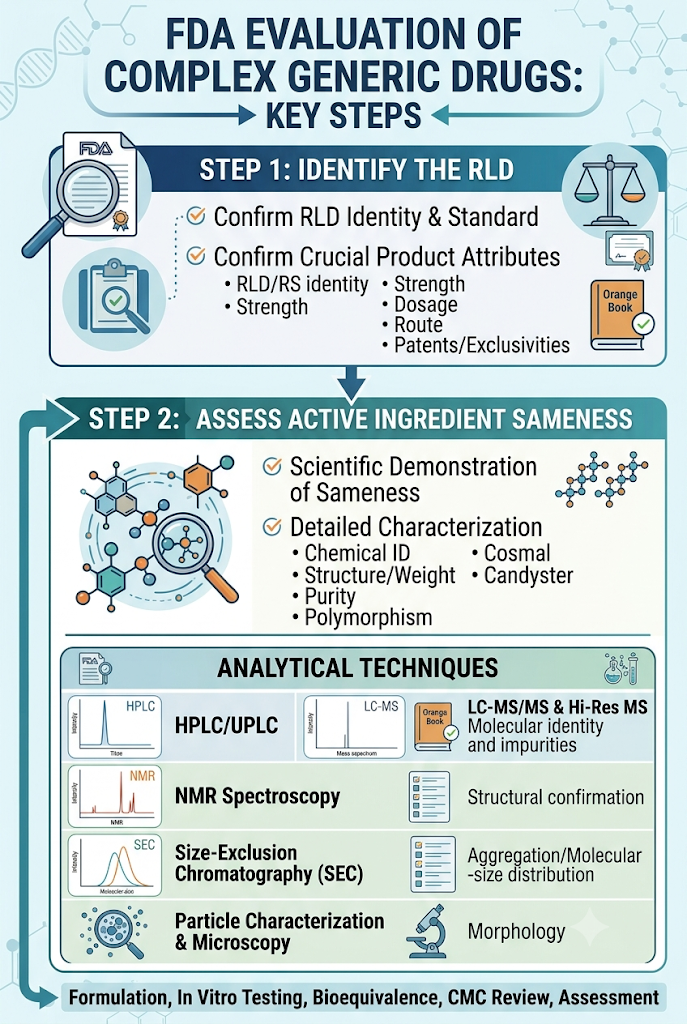
FDA evaluates complex generic sameness through a sequence that moves from reference product identification, to active ingredient characterization, to formulation/product characterization, to in vitro performance testing, to bioequivalence evidence, to CMC and manufacturing review, ending in an integrated agency assessment.
Step 1: Identify the Correct Reference Listed Drug
The first step is establishing the correct RLD and reference standard (RS), because every comparative study depends on having the right comparator. FDA’s Orange Book lists approved drug products along with application numbers, active ingredients, dosage forms, routes, and therapeutic equivalence codes.
Early in development, a sponsor should confirm:
- RLD and RS identity
- Strength and dosage form
- Route of administration and conditions of use
- Whether a current Product-Specific Guidance (PSG) exists
- Applicable bioequivalence recommendations
- Relevant patents and exclusivities
- Product-specific analytical expectations
Step 2: How Does FDA Assess Active Ingredient Sameness?
For complex active ingredients, FDA may require substantially more evidence than a simple confirmation of chemical identity — the applicant must scientifically demonstrate that the active ingredient in the proposed generic is the same as the active ingredient in the RLD. Depending on the molecule, this characterization can include chemical identity, molecular structure and weight, primary (and for peptides, higher-order) sequence, purity and impurity profile, stereochemistry, polymorphism, aggregation, and degradation products.
Because no single method can fully characterize a complex API, FDA and industry both favor an orthogonal combination of analytical techniques, such as:
- HPLC/UPLC for purity and related substances
- LC-MS/MS and high-resolution mass spectrometry for molecular identity and impurities
- NMR spectroscopy for structural confirmation
- Size-exclusion chromatography (SEC) for aggregation or molecular-size distribution
- Particle characterization and microscopy for morphology
3: FDA Sameness for Complex Generic Drugs: Injectable Products
Complex injectables can require particularly extensive comparative characterization because their performance often depends on physical and structural properties as much as chemical composition. FDA classifies extended-release injectables, complex formulations, and certain drug-device combinations as complex products requiring product-specific evidence rather than a one-size-fits-all bioequivalence study.
What Does FDA Examine in Complex Injectables?
FDA evaluates the attributes that control drug delivery, release, stability, and performance, with the exact tests determined by the product type and applicable PSG.
| Attribute | Examples of Analytical Considerations |
|---|---|
| Active ingredient | Identity, assay, purity, structure |
| Particle characteristics | Particle-size distribution, morphology |
| Suspension properties | Particle distribution, aggregation, sedimentation |
| Liposomal characteristics | Vesicle size, encapsulation, structural properties |
| Polymer characteristics | Molecular weight distribution, composition, degradation |
| Drug loading | Total and/or encapsulated drug |
| Impurities | Process-related and degradation impurities |
| Release behavior | In vitro release profile |
| Sterility-related quality | Sterility assurance and microbiological quality |
| Container closure | Compatibility and integrity where relevant |
A conventional injectable solution and a PLGA microsphere depot can require substantially different evidence packages, which is why aligning early with the current PSG for that specific product matters so much.
Sterility, container closure integrity, and material compatibility also raise the importance of a well-designed extractables and leachables (E&L) program for injectable products — a step that is easy to underestimate but can significantly affect both safety assessment and ANDA timelines. For a closer look at how this fits into an injectable development program, see ResolveMass Laboratories’ guide to EL testing for generic injectable drugs.
Why Are Long-Acting Injectables More Difficult?
Long-acting injectables (LAIs) can be difficult to establish as equivalent because formulation structure and drug-release mechanisms strongly influence in vivo exposure. For microspheres, liposomes, suspensions, or other extended-release systems, characterization typically needs to investigate particle-size distribution, morphology, drug loading, surface characteristics, polymer properties, encapsulation efficiency, release kinetics, degradation behavior, impurity profile, and physical stability. Matching assay results and active ingredient identity alone is not sufficient to demonstrate equivalence for these products.
4: FDA Sameness for Complex Generic Drugs: Topical Products
For complex topical products, FDA increasingly relies on comparative physicochemical and structural characterization together with appropriate bioequivalence studies to determine whether a generic performs the way the reference product does. Topical products are often classified as complex because the drug acts locally on or in the skin rather than being absorbed systemically in a way that a blood-level study could meaningfully capture.
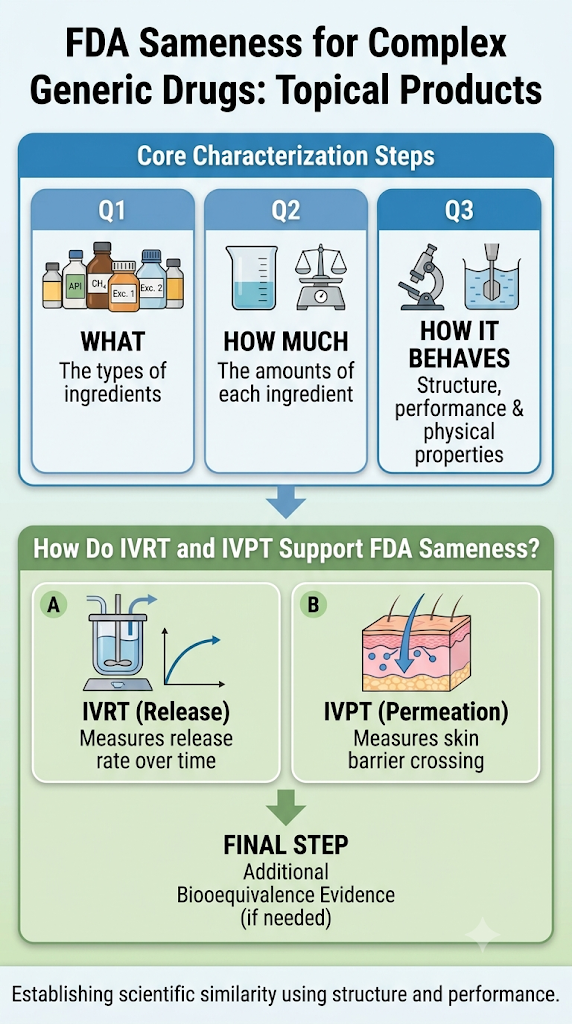
What Are Q1, Q2, and Q3 in Topical Sameness?
- Q1 – Qualitative composition: the types of ingredients/components present.
- Q2 – Quantitative composition: the amounts or concentrations of those components.
- Q3 – Physicochemical and structural characteristics: properties describing the physical structure and performance-relevant characteristics of the formulation.
Q1/Q2/Q3 should not be treated as a rigid, universal formula for every topical product — the appropriate comparison depends on the formulation type and FDA’s current product-specific recommendations. FDA’s finalized guidance on Physicochemical and Structural (Q3) Characterization of Topical Drug Products describes both basic and comprehensive Q3 characterization approaches and explains how Q3 sameness, similarity, or difference affects the additional evidence needed to support bioequivalence.
Depending on the formulation, Q3 characterization can include appearance and physical state, globule or particle characteristics, pH, rheological properties, viscosity, specific gravity, solubility, water activity, microscopic characteristics, droplet- or particle-size distribution, and phase behavior. The goal isn’t simply to show that two creams “look the same” — it’s to establish scientifically relevant similarities or differences that could affect how the product performs on skin.
How Do IVRT and IVPT Support FDA Sameness?
In Vitro Release Testing (IVRT) evaluates the rate at which drug is released from a topical formulation over time, and In Vitro Permeation Testing (IVPT) uses skin membranes to measure how much drug actually crosses the skin barrier under controlled laboratory conditions — together these provide comparative evidence that can support a topical bioequivalence determination, though the appropriate study still depends on the specific product and FDA’s recommendations. A typical analytical strategy moves from Q1/Q2 characterization, to Q3 characterization, to IVRT/IVPT, and on to additional bioequivalence evidence only where necessary. In vivo studies remain the fallback where in vitro methods cannot adequately predict clinical performance — for example, for some complex multiphase emulsions or drug classes lacking a validated IVRT/IVPT method.
5: Complex Generics Extend Beyond Injectables and Topicals
Injectables and topicals are the most frequently discussed complex dosage forms, but the same sameness logic — layered characterization plus tailored in vitro and in vivo evidence — applies across other complex delivery routes as well. Inhaled products, for instance, raise their own device-performance and deposition questions that go beyond simple formulation matching; developers working in this space should review the specific considerations for generic drug development for inhaled drug products.
6: What Role Do Product-Specific Guidances Play?
FDA Product-Specific Guidances (PSGs) are one of the most important resources for determining the evidence expected for a particular complex generic drug, because they describe FDA’s current thinking on how to develop a generic product and generate evidence supporting ANDA approval. PSGs can specify recommendations covering active ingredient sameness, comparative characterization, in vitro studies, in vivo BE studies, PK endpoints, clinical endpoint studies, device comparisons, release testing, and formulation characterization. FDA continues to add and revise PSGs for complex products as characterization science evolves, which is why a sponsor’s testing strategy should always be checked against the current PSG rather than an older or assumed approach.
7: What Happens When the Generic Differs From the Reference Product?
A difference between the generic and the reference product does not automatically block approval — the significance of the difference depends on what differs and whether it can still be supported by the applicable regulatory requirements. FDA permits certain differences, including in some inactive ingredients and labeling, subject to applicable rules. For complex products, however, a formulation or structural difference may call for additional evidence if it could plausibly affect performance:
- Topical cream: a different formulation structure produces a Q3 difference → potentially additional BE evidence is needed.
- Depot injectable: different particle or polymer characteristics could change release behavior → additional comparative evidence may be required.
Developers should learn to distinguish a difference that is permitted and scientifically insignificant, from one that requires additional characterization, from one that creates a genuine bioequivalence concern, from one that may make the ANDA pathway inappropriate altogether.
8: Common Challenges in FDA Sameness for Complex Generic Drugs
Most sameness-related setbacks trace back to insufficient characterization, an incorrect reference-product strategy, an incomplete understanding of critical quality attributes, or an evidence package that doesn’t align with the current PSG. Recurring issues include:
- Limited understanding of RLD batch-to-batch variability
- Inadequate active ingredient characterization
- Incomplete Q3 characterization for topical products
- Insufficient particle or structural characterization for complex injectables
- Poor impurity identification
- Inadequate reference-standard qualification
- Inappropriate IVRT/IVPT study design
- PSG recommendations changing mid-development
- Weak integration between analytical data and the overall bioequivalence strategy
FDA’s Pre-ANDA Program exists specifically to help developers of complex generic products work through these questions with the agency before an ANDA is submitted, and it’s a step worth using rather than skipping.
9: A Practical FDA Sameness Strategy for Complex Generics
A development program can be organized around a simple set of questions at each stage:
| Development Stage | Key Question |
|---|---|
| RLD selection | Are we using the correct reference product? |
| Regulatory assessment | Is a current PSG available? |
| API characterization | Is the active ingredient demonstrably the same? |
| Formulation characterization | Which attributes control product performance? |
| Comparative testing | How does the generic compare with the RLD? |
| In vitro performance | Can laboratory studies demonstrate relevant equivalence? |
| BE strategy | What additional evidence is required? |
| CMC | Can the product be manufactured consistently? |
| Stability | Does performance remain controlled throughout shelf life? |
| Submission | Is the evidence package aligned with FDA’s expectations? |
Stability data deserves particular attention in this framework, since a sameness argument built on strong day-zero characterization can still unravel if the product doesn’t hold up over its shelf life. See ResolveMass Laboratories’ overview of stability testing for generic drug products at a CDMO for how this fits into a complete program.
Sameness Isn’t Just an FDA Question
Many sponsors developing a complex generic for the U.S. market are also planning a parallel European submission, and the underlying sameness and characterization work often supports both. If an EMA filing is part of your strategy, it’s worth reviewing what’s involved in EU generic drug dossier development and EMA submission and how CDMO support for EU generic drug registrations can help align the analytical package across both regions rather than duplicating the work later.
10: How ResolveMass Laboratories Supports Complex Generic Drug Development
ResolveMass Laboratories Inc. provides analytical and CMC support for pharmaceutical companies developing complex generic products, including advanced analytical characterization, impurity profiling, mass spectrometry, chromatographic testing, particle and structural characterization, formulation support, and regulatory-oriented analytical documentation. For complex generic programs, this support can include comparative RLD characterization, API and drug-product characterization, LC-MS/MS and HPLC/UPLC method development, particle-size and morphology characterization, polymer characterization for depot formulations, stability-related testing, extractables and leachables assessment, and data packages built to support CMC and regulatory submissions.
If your organization is evaluating whether to build this expertise in-house or bring in an experienced partner, it’s worth reading through the considerations in outsourcing your first generic drug project to a CDMO before committing to a development path.
Conclusion:
FDA Sameness for Complex Generic Drugs is a multidimensional assessment that goes far beyond matching the active ingredient and strength. For complex injectables, FDA evidence may need to cover particle characteristics, polymer or vesicle properties, drug loading, sterility, container closure, release behavior, and impurities. For complex topicals, the current Q3 framework provides a structured way to compare physicochemical and structural characteristics, with IVRT, IVPT, and in vivo studies layered in according to the specific product and regulatory strategy. In both cases, Product-Specific Guidances remain the clearest signal of what FDA expects, and a rigorous, guidance-aligned combination of reference-product characterization, orthogonal analytical methods, and appropriate bioequivalence studies is what gives a complex-generic development program a defensible foundation.
Frequently Asked Questions:
IVRT (In Vitro Release Testing) evaluates the rate at which a drug is released from a topical formulation, while IVPT (In Vitro Permeation Testing) evaluates drug permeation through a skin membrane. Both can provide comparative evidence for topical drug development when appropriate.
Q3 characterization evaluates the physicochemical and structural properties of a topical drug product that may affect its performance. Depending on the formulation, attributes can include particle or globule size, rheology, viscosity, pH, microscopic characteristics, and other product-specific properties.
No. Matching the active ingredient alone does not necessarily establish equivalence. Depending on the product, FDA may also require evidence involving formulation characteristics, physicochemical properties, product performance, bioequivalence, and other critical quality attributes.
A Product-Specific Guidance (PSG) provides FDA’s recommendations for developing a generic version of a particular drug. It may describe recommended approaches for bioequivalence studies, analytical characterization, in vitro testing, or other evidence needed for an ANDA.
Potentially, yes. Certain differences in inactive ingredients may be permitted, provided the applicable regulatory requirements are satisfied and the differences do not compromise safety, effectiveness, or bioequivalence.
Reference
- Shaikh R, Yadav K, Thummar K, Maheriya B, Chauhan S. Development of complex generics: Insights into trends, challenges, and market opportunities. Journal of Generic Medicines. 2025 Mar;21(1):4-16.https://journals.sagepub.com/doi/abs/10.1177/17411343251313962
- Patil S, Kumar S, Rao DM, Rewatkar K. Current regulatory framework and challenges for the approval of complex generics in the US and the EU. Current Indian Science. 2024 Jan;2(1):E2210299X269535.https://www.benthamdirect.com/content/journals/cis/10.2174/012210299X269535231203164108
- Choi SH, Wang Y, Conti DS, Raney SG, Delvadia R, Leboeuf AA, Witzmann K. Generic drug device combination products: Regulatory and scientific considerations. International Journal of Pharmaceutics. 2018 Jun 15;544(2):443-54.https://www.sciencedirect.com/science/article/pii/S0378517317310955
- Charoo NA. Q1 and Q2 Sameness: Complex Parenteral, Ophthalmic and Otic Generic pharmaceutical Products. Journal of Pharmaceutical Innovation. 2026 Dec;21(6):625.https://link.springer.com/article/10.1007/s12247-026-10811-8
- Lourenço D, Miranda M, Sousa JJ, Vitorino C. Therapeutic-driven framework for bioequivalence assessment of complex topical generic drug products. International Journal of Pharmaceutics. 2024 Aug 15;661:124398.https://www.sciencedirect.com/science/article/pii/S037851732400632X
About the Author


