

Introduction:
First-in-human peptide drug manufacturing is the process of developing, manufacturing, testing, documenting, and releasing a peptide drug substance or drug product suitable for an initial human clinical study. For a virtual biotech, the hardest part isn’t just producing the peptide — it’s connecting development, manufacturing, analytical testing, quality systems, and regulatory documentation into one controlled workflow, often across several external partners.
Case-study note: The biotech and product described below are presented as a representative development scenario to illustrate how a virtual biotech can structure FIH peptide manufacturing support. They are not presented as a named client engagement or as a claim of a specific commercial manufacturing outcome.
Peptide therapeutics can introduce development challenges involving synthesis-related impurities, deletion sequences, stereochemical impurities, aggregation, oxidation, deamidation, residual reagents, and storage-related degradation. The right controls depend on the peptide, manufacturing route, dosage form, clinical stage, and intended use — which is why outsourcing selected CMC activities to a specialized partner is a common strategy for lean, early-stage teams.
Summary:
- ResolveMass Laboratories Inc. supported a virtual biotech’s peptide candidate through first-in-human peptide drug manufacturing, connecting process development, analytical testing, and CMC documentation into one workflow.
- The company had no internal manufacturing or lab infrastructure and needed a phase-appropriate CMC strategy that met FDA’s Phase 1 expectations without over-building controls too early.
- Key activities included peptide process development, impurity profiling, risk-based quality management, clinical batch release, and stability testing.
- ResolveMass’s North American peptide CDMO services and cGMP peptide manufacturing services gave the client a single accountable partner across manufacturing and analytics.
- A documented, risk-based quality strategy and a phase-appropriate CMC checklist helped the program move toward Phase 1 with a defensible data package.
1: What Was the Virtual Biotech Trying to Achieve?
The virtual biotech’s primary objective was to move a promising peptide candidate from late preclinical development toward a Phase 1 first-in-human study while maintaining appropriate manufacturing and analytical controls.
The company had a small scientific team and relied on external specialists for several CMC activities. Its immediate priorities were:
- Establish a reproducible peptide manufacturing process.
- Generate clinical-grade peptide drug substance.
- Establish suitable analytical methods.
- Characterize impurities and degradation products.
- Develop appropriate specifications.
- Generate stability information.
- Establish batch documentation and traceability.
- Support the CMC section of the IND package.
- Build a scalable development strategy for later clinical phases.
The challenge was therefore broader than simply manufacturing a peptide.
The company needed a connected CMC workflow in which manufacturing decisions and analytical results could be translated into defensible quality documentation.
2: What Were the Major Challenges in First-in-Human Peptide Drug Manufacturing?
The main challenges were process reproducibility, impurity control, analytical characterization, documentation, and maintaining phase-appropriate CMC expectations without unnecessarily building a commercial-scale control strategy at the FIH stage.
| Challenge | Potential impact | Required response |
|---|---|---|
| Peptide synthesis variability | Batch-to-batch differences | Controlled synthesis process |
| Process-related impurities | Reduced purity or safety concerns | Impurity profiling and process controls |
| Difficult purification | Yield and quality variability | Purification development |
| Peptide degradation | Loss of potency or formation of impurities | Stability-indicating analytical strategy |
| Limited internal CMC resources | Delays and coordination gaps | Specialized external support |
| Insufficient documentation | Regulatory questions | Controlled CMC documentation |
| Limited stability history | Uncertainty during clinical supply | Phase-appropriate stability program |
| Future scale-up | Rework during later phases | Development with scalability in mind |
FDA’s Phase 1 guidance recognizes that CGMP controls for investigational drugs should be appropriate to the clinical stage while maintaining controls necessary to protect trial participants.
3: How Was the Manufacturing Strategy Structured?
The strategy treated manufacturing as one stage in a connected development-to-clinical-supply pathway, not an isolated activity: peptide design → process development → synthesis → cleavage/deprotection → purification → characterization → clinical batch manufacture → QC testing → QA review → release → stability monitoring.
At each stage, analytical data fed directly into manufacturing decisions, creating a traceable link between process, material, results, specifications, and quality decisions. This is the same structured approach ResolveMass applies through its peptide CDMO in Canada and peptide CDMO in the United States programs, aligned with ICH Q7 GMP expectations for API manufacturing.
4: How Was Peptide Process Development Approached?
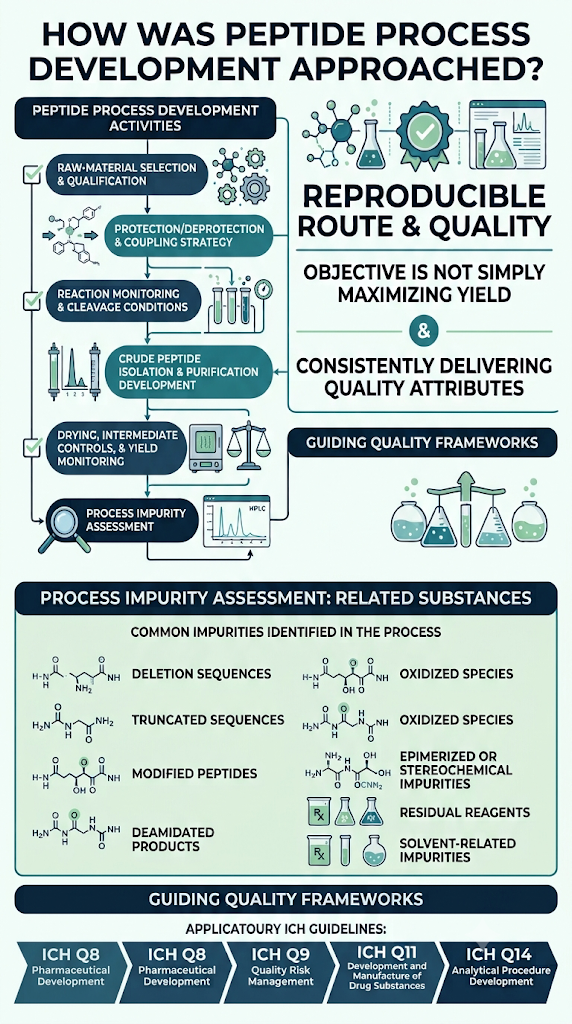
Peptide process development focused on building a reproducible route capable of consistently delivering material that met the required quality attributes — not simply maximizing yield.
Development activities typically covered:
- Raw-material selection and qualification
- Protection/deprotection and coupling strategy
- Reaction monitoring and cleavage conditions
- Crude peptide isolation and purification development
- Drying, intermediate controls, and yield monitoring
- Process impurity assessment
For synthetic peptides, the process can generate a variety of related substances, including:
- Deletion sequences
- Truncated sequences
- Modified peptides
- Oxidized species
- Deamidated products
- Epimerized or stereochemical impurities
- Residual reagents
- Solvent-related impurities
The objective is not simply to maximize yield. The process must consistently produce material meeting scientifically justified quality requirements.
Synthetic peptide processes can generate deletion sequences, truncated sequences, oxidized or deamidated species, epimerized impurities, and residual reagents — all of which need to be understood before the process is locked in. ResolveMass structures this work under its specialized peptide CDMO services, guided by the ICH quality framework (Q8 for pharmaceutical development, Q9 for risk management, Q10 for quality systems, Q11 for drug-substance development, and Q14 for analytical procedures).
5: How Did Analytical Testing Support First-in-Human Peptide Drug Manufacturing?
Analytical testing determined whether the manufactured peptide met predefined quality requirements and helped investigate any unexpected results found during development.
| Attribute | Example Analytical Approach |
|---|---|
| Identity | LC-MS / mass confirmation |
| Assay | HPLC/UPLC |
| Related substances | HPLC/UPLC |
| Molecular mass | LC-MS |
| Residual solvents | GC |
| Water content | Karl Fischer |
| Elemental impurities | ICP-MS, when appropriate |
| Stability | Stability-indicating chromatographic methods |
| Endotoxin | Applicable method for parenteral products |
The exact panel is chosen based on the peptide, dosage form, manufacturing process, and regulatory strategy — a single technique rarely tells the whole story, since chromatography can reveal multiple peaks while mass spectrometry supplies the molecular detail behind them.
6: How Were Peptide Impurities Investigated?
Impurity investigation combined chromatographic separation with structural information and manufacturing knowledge.
A practical investigation could follow this sequence:
Unexpected peak detected → Determine retention behavior → Obtain mass information → Compare with expected peptide modifications → Review manufacturing history → Evaluate potential formation pathway → Compare against stability/forced-degradation data → Assign and control impurity
This approach can help differentiate process-related impurities from degradation products.
Process-related impurities
These may originate during synthesis or purification, such as:
- Incomplete coupling products
- Deletion sequences
- Truncated peptides
- Protected intermediates
- Residual process-related materials
Product-related degradation impurities
These may arise during storage or handling, such as:
- Oxidation
- Deamidation
- Hydrolysis
- Aggregation
- Other chemically or physically induced changes
The distinction matters because the control strategy may differ depending on how an impurity is formed.
7: How Was a Risk-Based Quality Strategy Applied?
A risk-based approach focused development resources on the attributes and process steps most likely to affect clinical product quality, rather than treating every parameter as equally critical.
Potential critical quality attributes (CQAs) included identity, assay, purity, related substances, physicochemical characteristics, and stability. Potential process risks included coupling efficiency, deprotection efficiency, cleavage conditions, purification performance, and storage exposure to oxygen, light, or moisture. A documented risk assessment then linked each risk to a CQA, a process parameter, a control, an analytical test, and an acceptance criterion — consistent with ICH Q9 quality risk management and ICH Q10’s lifecycle quality system model.
8: How Was the FIH Clinical Batch Controlled?
The clinical batch required controlled manufacturing and quality oversight before release, following approved raw materials through manufacturing, in-process monitoring, QC testing, deviation assessment, QA review, and final disposition. This controlled chain matters most for a virtual biotech, since several external organizations may be involved in manufacturing, testing, packaging, and storage — a coordination challenge ResolveMass addresses directly through its dedicated peptide CDMO vs CMO model, where one accountable partner manages development and manufacturing together rather than treating them as separate contracts.
9: What CMC Documentation Was Developed?
CMC documentation created the evidence trail connecting development work to the clinical manufacturing process, including the manufacturing process description, batch records, specifications, analytical procedures and results, certificates of analysis, stability protocols, and risk assessments.
FDA’s current FIH CMC framework specifically supports a phase-appropriate approach — meaning some information can be developed later in the lifecycle rather than requiring full commercial-stage detail before an initial Phase 1 IND. This does not make quality controls optional; it means the CMC package should match the stage and risk of the clinical program.
How Was Stability Considered for the Peptide Clinical Supply?
Stability testing determined whether the peptide maintained its required quality characteristics over the proposed storage period, accounting for temperature, light and oxygen exposure, container-closure system, formulation, and storage duration.
FDA’s current FIH CMC guidance notes that initial stability data may not need to cover the entire proposed clinical study duration at the time of the initial submission, depending on the circumstances — an important consideration for timeline planning.
10: What Role Did a Specialized CDMO/Analytical Partner Play?
A specialized partner functions as an extension of the internal development team, combining manufacturing support, analytical testing, quality oversight, and regulatory documentation into one workflow rather than several disconnected vendor relationships.
For this program, that support spanned:
- Manufacturing: process development, optimization, clinical batch coordination, and scale-up planning through peptide CDMO in the United States
- Analytics: HPLC/UPLC testing, LC-MS characterization, impurity profiling, and method development/validation
- Quality: specifications, risk assessments, deviation investigations, and batch documentation review
- Regulatory: CMC data organization and IND-supporting documentation
Key Lessons From the Case Study
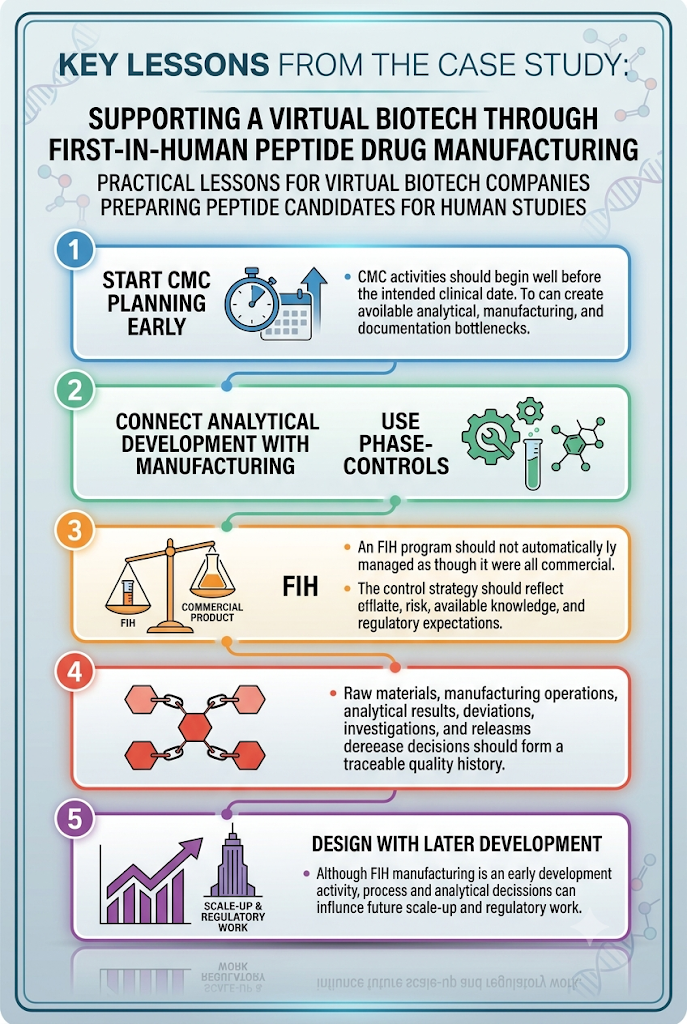
The case demonstrates several practical lessons for virtual biotech companies preparing peptide candidates for human studies.
1. Start CMC planning early
CMC activities should begin well before the intended clinical manufacturing date. Waiting until the clinical trial is imminent can create avoidable analytical, manufacturing, and documentation bottlenecks.
2. Connect analytical development with manufacturing
Analytical methods should answer meaningful questions about the manufacturing process and product quality rather than exist independently from the process.
3. Use phase-appropriate controls
An FIH program should not automatically be managed as though it were already a commercial product. The control strategy should reflect clinical stage, risk, available knowledge, and regulatory expectations.
4. Maintain traceability
Raw materials, manufacturing operations, analytical results, deviations, investigations, and release decisions should form a traceable quality history.
5. Design with later development in mind
Although FIH manufacturing is an early development activity, process and analytical decisions can influence future scale-up and regulatory work.
11: First-in-Human Peptide Drug Manufacturing: Key CMC Checklist
Before clinical supply is manufactured, a virtual biotech can review:
- Peptide synthesis route defined
- Raw materials identified and controlled
- Manufacturing process documented
- Critical process risks and CQAs identified
- Purification process established
- Analytical methods available (identity, purity, related substances)
- Specifications established
- Clinical batch documentation prepared
- Stability program established
- Packaging/storage conditions defined
- QA release process defined
- CMC information organized for regulatory submission
12: Why Partner with ResolveMass for First-in-Human Peptide Drug Manufacturing
ResolveMass Laboratories Inc. operates under a fully implemented ISO 9001:2015 certified Quality Management System, with LC-MS, GC-MS, NMR, and HPLC capabilities purpose-built for peptide characterization, impurity profiling, and stability testing. Through its North American peptide CDMO services, the company connects analytical and CMC support in a way that’s designed for virtual biotechs that don’t have — and don’t need — in-house manufacturing infrastructure.
Conclusion:
First-in-human peptide drug manufacturing requires far more than producing a peptide at the right quantity — it requires connecting process development, purification, analytical characterization, impurity control, risk management, clinical batch manufacturing, stability testing, and regulatory documentation into one coherent strategy. For virtual biotechs, a phase-appropriate approach supported by an experienced analytical and CMC partner can make that connection possible without the cost and time of building internal infrastructure.
Frequently Asked Questions:
Impurity profiling helps establish an understanding of substances present in the peptide material and provides information needed to develop appropriate manufacturing controls and specifications. This is particularly important when the peptide will be administered to humans for the first time.
Process development focuses on establishing and optimizing a reproducible manufacturing process, while clinical manufacturing involves producing the peptide under appropriate controlled conditions for use in a clinical study, supported by required testing, documentation, and quality oversight.
CMC planning should begin early enough to identify manufacturing, analytical, stability, material, and documentation requirements before clinical supply is needed. Early planning can also help identify potential development risks and future scale-up considerations.
Quality risk management helps identify manufacturing steps and product attributes that could affect quality. Risks can then be connected to appropriate process controls, analytical tests, specifications, and monitoring strategies.
Reference
- Gonlepa MK, Osotuyi TB, Ofuonye CG, Durojaye OA. Protein engineering as a driver of innovation in therapeutics biotechnology and the global bioeconomy. Discover Chemistry. 2025 Sep 27;2(1):226.https://link.springer.com/article/10.1007/s44371-025-00313-w
- Goel VY. Simulation Modeling of Drug Substance Tech Transfer Timelines at Amgen (Doctoral dissertation, Massachusetts Institute of Technology).https://dspace.mit.edu/entities/publication/d23054e4-999a-4d6a-a434-6eaa3d75c0f7
- Burt T, John CS, Ruckle JL, Vuong LT. Phase-0/microdosing studies using PET, AMS, and LC-MS/MS: a range of study methodologies and conduct considerations. Accelerating development of novel pharmaceuticals through safe testing in humans–a practical guide. Expert Opinion on Drug Delivery. 2017 May 4;14(5):657-72.https://www.tandfonline.com/doi/abs/10.1080/17425247.2016.1227786
- Sheng J, Zhang T. Advancing drug development with “Fit-for-Purpose” modeling informed approaches. Journal of Pharmacokinetics and Pharmacodynamics. 2025 Oct;52(5):52.https://link.springer.com/article/10.1007/s10928-025-09995-2
- Colagiovanni DB, Peraza MA. The Preparation of a Preclinical Dossier to Support an Investigational New Drug Application and First-In-Human Clinical Trial. InA comprehensive guide to toxicology in nonclinical drug development 2024 Jan 1 (pp. 199-226). Academic Press.https://www.sciencedirect.com/science/article/pii/B9780323857048000207
About the Author


