

Introduction
Formulating a Lyophilized Peptide Injectable involves the strategic design of a solid-state glass matrix capable of maintaining peptide chemical stability and preserving native molecular conformation throughout freezing, drying, and long-term storage. By removing water through carefully controlled sublimation and desorption processes, this pharmaceutical stabilization approach minimizes hydrolytic and conformational degradation pathways while ensuring efficient reconstitution when a diluent is added. ResolveMass Laboratories Inc. employs advanced thermal characterization and formulation development methodologies to convert highly unstable peptide drug candidates from delicate aqueous solutions into robust, shelf-stable parenteral products.
Peptide therapeutics formulated in aqueous environments often experience rapid degradation during storage due to physical aggregation, precipitation, and various covalent modifications. Freeze-drying transforms the drug solution into a dry, porous matrix that significantly restricts molecular mobility and slows degradation kinetics. Nevertheless, the lyophilization process itself introduces substantial freezing and drying stresses, including cold denaturation, freeze-concentration effects, pH fluctuations caused by buffer crystallization, adsorption at the ice-water interface, and dehydration-induced structural strain. Addressing these challenges requires a carefully engineered formulation strategy that integrates disaccharides, crystalline bulking agents, non-crystallizing buffer systems, and interfacial surfactants.
This case study examines the systematic development of a lyophilized parenteral formulation for a model therapeutic peptide characterized by significant chemical and physical instability in solution. The discussion covers degradation pathway assessment, excipient selection rationale, determination of critical thermal properties, optimization of the lyophilization cycle, and the resulting long-term stability and reconstitution performance.
Discover how our outsourcing peptide manufacturing services help biopharmaceutical teams transition complex formulations from early development to commercial scale.
Share via:
Article Summary:
- Lyophilization improves peptide stability by removing water and reducing chemical degradation, aggregation, and conformational instability during storage.
- Key formulation challenges include cold denaturation, freeze-concentration, pH shifts, ice–water interface adsorption, dehydration stress, deamidation, oxidation, and aggregation.
- Excipient selection is critical: sucrose/trehalose provide molecular protection, mannitol/glycine support cake structure, histidine maintains pH, and polysorbate 20 reduces interfacial aggregation.
- Thermal characterization using DSC and freeze-drying microscopy helps determine Tg′, Tc, and Teut, allowing the product temperature to remain safely below the collapse temperature during primary drying.
- An optimized lyophilization cycle uses controlled freezing, annealing, primary drying, and secondary drying to produce a porous cake with <1% residual moisture and rapid reconstitution.
- RP-72 case study: the optimized sucrose–mannitol–histidine formulation improved stability dramatically, achieving >24 months stability at 2–8°C, 98.6% purity, <0.5% aggregates, and 0.8% deamidation.
- Overall outcome: optimized lyophilized peptide formulations can transform unstable liquid peptide candidates into stable, potent, shelf-ready injectables with rapid reconstitution (18 seconds).
Degradation Pathways Addressed when Formulating a Lyophilized Peptide Injectable
Formulating a Lyophilized Peptide Injectable enhances peptide stability by eliminating free water, which is a primary contributor to covalent modifications such as deamidation and oxidation, as well as physical self-association. Although lyophilization effectively suppresses many liquid-state degradation mechanisms, the process also exposes the peptide to distinct thermal and mechanical stresses during various stages of freezing and drying. These stresses must be mitigated through targeted excipient selection and formulation design.
Chemical and Physical Degradation Mechanisms
Peptide-based injectable products in liquid form degrade through multiple chemical pathways influenced by amino acid composition, formulation pH, ionic strength, and oxygen exposure. Asparagine (Asn) and Glutamine (Gln) residues can undergo deamidation through the formation of cyclic succinimide intermediates, generating isoaspartic acid and aspartic acid derivatives. Methionine (Met), Cysteine (Cys), and Tryptophan (Trp) residues are particularly vulnerable to oxidation, resulting in sulfoxides, disulfide-linked species, or hydroxylated photodegradation products following exposure to oxygen or light. Furthermore, peptide bonds adjacent to Aspartic acid (Asp) residues may experience acid-catalyzed cleavage, while flexible N-terminal sequences can form diketopiperazine structures through cyclization reactions.
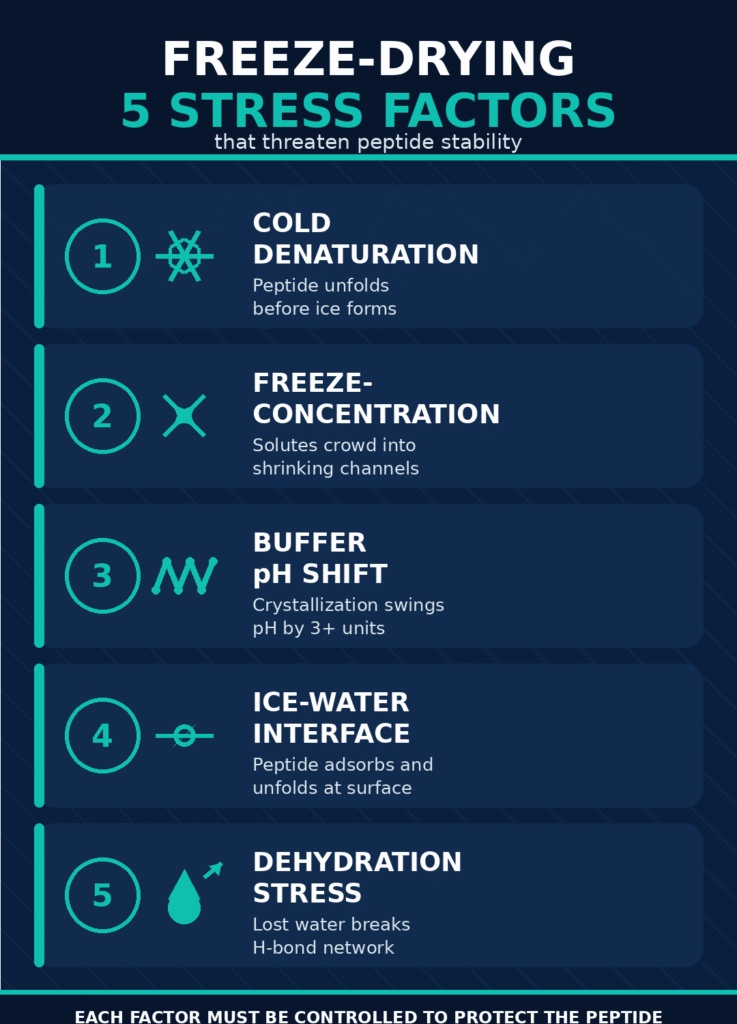
Physical degradation generally arises from non-covalent self-association, alterations in hydrophobic folding patterns, and aggregation triggered by surface interactions. These instabilities become more pronounced during freezing and drying because of several process-specific stress factors:
Cold Denaturation
Reduced processing temperatures diminish hydrophobic interaction energies, leading to partial unfolding of peptide structures before complete ice crystallization occurs.
Freeze-Concentration
As ice crystals develop, dissolved solutes become concentrated within interstitial channels. This cryoconcentration effect increases local concentrations of salts and active pharmaceutical ingredients, accelerating aggregation and chemical degradation reactions.
pH Shifts from Buffer Crystallization
Selective crystallization of certain buffer components, such as disodium phosphate, can generate significant pH changes during freezing, sometimes exceeding three pH units.
Ice-Water Interface Adsorption
The rapid expansion of ice surfaces during freezing creates extensive hydrophobic interfaces where peptides may adsorb, unfold, and subsequently form insoluble aggregates.
Dehydration Stress
Removal of hydration-shell water molecules disrupts native hydrogen-bonding networks, potentially causing structural collapse during storage or upon reconstitution.
Protect your active ingredients by evaluating our comprehensive peptide analytical characterization services designed to detect structural and chemical degradation early.
Excipient Selection Strategies for Formulating a Lyophilized Peptide Injectable
Selecting suitable excipients when Formulating a Lyophilized Peptide Injectable requires the integration of non-reducing disaccharides for amorphous-state protection together with crystalline polyols that provide structural integrity to the dried cake. This multifaceted formulation approach preserves peptide activity through hydrogen-bond replacement mechanisms while creating porous pathways that facilitate rapid penetration of reconstitution diluents.
Function of Lyoprotectants, Bulking Agents, and Buffers
Disaccharides such as sucrose and trehalose stabilize peptides through two widely accepted mechanisms: the Water Replacement Theory and the Vitrification Theory. According to the Water Replacement Theory, hydroxyl groups on sugar molecules establish hydrogen bonds with polar peptide residues, effectively substituting for hydration-shell water lost during drying. Under the Vitrification Theory, highly viscous sugar matrices characterized by elevated Tg’ values immobilize peptide molecules within an amorphous glass structure, reducing molecular motion and limiting conformational changes.
Crystalline bulking agents, including mannitol and glycine, crystallize during freezing and create a rigid structural framework that supports the dried cake. This framework minimizes shrinkage and collapse during primary drying while allowing efficient escape of water vapor. Non-crystallizing buffers such as L-histidine help maintain the desired formulation pH without precipitating during freezing. Non-ionic surfactants, including Polysorbate 20, preferentially occupy ice-water interfaces, reducing surface-induced peptide aggregation. Additionally, short synthetic dipeptides and tripeptides can serve as multifunctional co-excipients by reducing solution viscosity and enhancing glass transition characteristics.
| Excipient Class | Representative Compounds | Primary Function in Matrix | Impact on Thermal Transition (Tg′/Tc) |
|---|---|---|---|
| Disaccharides | Sucrose, Trehalose | Water replacement via hydrogen bonding; amorphous vitrification | Forms stable amorphous glass and establishes baseline Tg’ |
| Crystalline Polyols | Mannitol, Sorbitol | Structural bulking agent; prevents physical cake collapse | Promotes eutectic crystallization (Teut); may lower Tg’ if unannealed |
| Amino Acids | L-Histidine, Glycine, Arginine | pH stabilization; bulking support; anti-aggregation activity | Modulates glass transition temperature and minimizes phase separation |
| Non-ionic Surfactants | Polysorbate 20, Polysorbate 80 | Ice-water interface displacement; prevents surface adsorption | Minimal direct effect on Tg’; protects structural interfaces |
| Short Synthetic Peptides | Dipeptides, Tripeptides | Modular hydrogen bonding; antioxidant protection; viscosity control | Fine-tunes Tg’ and aggregation thresholds |
Understanding how small molecules differ from biomolecules is critical when picking excipients. Read our guide on the difference between a peptide and a small molecule drug.
Characterization of Critical Thermal Parameters: Tg’, Tc, and Teut
Critical thermal parameters—including the glass transition temperature of the maximally freeze-concentrated solute (Tg’), collapse temperature (Tc), and eutectic melting temperature (Teut)—establish the upper temperature limits that can be safely maintained during primary drying. Accurate determination of these parameters using Differential Scanning Calorimetry (DSC) and Freeze-Drying Microscopy (FDM) is essential for preventing structural collapse and ensuring robust process performance.
Target Product Temperature Margin:
Tproduct ≤ Tc − (2°C to 5°C)
Thermal characterization defines the operational boundaries for freeze-drying:
Freeze-Concentrated Glass Transition (Tg’)
This temperature represents the transition of the freeze-concentrated amorphous phase from a rigid glassy state to a more mobile rubbery state. Exceeding Tg’ increases molecular mobility, which can accelerate phase separation and chemical degradation.
Collapse Temperature (Tc)
Tc is the critical product temperature during primary drying above which the dried matrix loses structural integrity. Exceeding this threshold can lead to cake collapse, poor appearance, and prolonged reconstitution times. In amorphous sugar-based formulations, Tc is typically 1°C to 3°C higher than Tg’.
Eutectic Temperature (Teut)
Teut represents the melting point of crystalline excipient-ice systems. Drying above this temperature may result in localized melting and severe structural defects within the cake.
Differential Scanning Calorimetry identifies Tg’ and Teut by monitoring changes in heat capacity associated with phase transitions. Freeze-Drying Microscopy provides direct visualization of micro-collapse events by exposing thin samples to controlled temperature and vacuum conditions. Maintaining product temperatures approximately 2°C to 5°C below Tc allows efficient sublimation while preserving cake structure and appearance.
For a deeper dive into metabolic candidates and complex characterization workflows, view our GLP-1 peptide analytical characterization solutions.
Lyophilization Cycle Optimization for Formulating a Lyophilized Peptide Injectable
Optimizing the freeze-drying process when Formulating a Lyophilized Peptide Injectable requires precise management of shelf temperature, chamber pressure, and temperature ramp rates throughout freezing, primary drying, and secondary drying. Achieving the appropriate balance between sublimation efficiency and thermal stability results in uniform cakes with residual moisture levels below 1.0% w/w.
Freezing and Thermal Annealing Dynamics
The freezing stage determines ice crystal morphology and ultimately influences pore structure and vapor transport during primary drying. Controlled cooling rates ranging from 0.5°C/min to 1.0°C/min down to -45°C promote the formation of continuous ice channels that reduce mass-transfer resistance. Incorporating an annealing step at -15°C to -20°C for 2 to 4 hours facilitates Ostwald ripening of ice crystals and supports complete crystallization of bulking agents such as mannitol. This process minimizes the risk of post-lyophilization crystallization events that could compromise long-term product stability.
Moving from laboratory lyophilization to commercial manufacturing requires optimized scale-up kinetics. See how our peptide CDMO scale-up services streamline this transition.
Sublimation and Desorption Process Control
Primary drying removes frozen water through sublimation under reduced pressure conditions. Chamber pressures are generally maintained between 50 mTorr and 150 mTorr to optimize heat transfer and vapor removal. Excessively low pressures may limit heat input, whereas higher pressures can increase product temperatures beyond Tc. Completion of primary drying is typically confirmed when product thermocouple readings converge with shelf temperatures and chamber pressure stabilizes at baseline levels.
Secondary drying focuses on the removal of non-frozen water molecules that remain associated with the amorphous matrix. Shelf temperatures are gradually increased at rates of approximately 0.1°C/min to 0.3°C/min until reaching +25°C to +40°C under high vacuum conditions. This desorption process reduces residual moisture to below 1.0% w/w and significantly decreases the likelihood of long-term hydrolysis and deamidation.
| Freeze-Drying Stage | Key Operating Parameters | Target Ranges | Process Objective |
|---|---|---|---|
| Freezing Phase | Cooling Ramp Rate | 0.5°C/min to 1.0°C/min | Establishes uniform ice crystal nucleation |
| Terminal Freeze Temperature | -45°C to -50°C (Hold 2–4 h) | Ensures complete matrix solidification below Tg’ | |
| Annealing Phase | Annealing Hold Temperature | -15°C to -20°C (Hold 2–4 h) | Promotes Ostwald ripening and complete mannitol crystallization |
| Primary Drying | Chamber Vacuum Pressure | 50 mTorr to 150 mTorr | Optimizes heat and mass transfer during sublimation |
| Shelf Operating Temperature | -25°C to -10°C | Supports sublimation while maintaining Tproduct < Tc | |
| Secondary Drying | Desorption Temperature | +25°C to +40°C | Removes bound water from the amorphous matrix |
| Target Residual Moisture | < 1.0% w/w | Suppresses residual hydrolysis and deamidation |
Case Study Analysis: Formulating a Lyophilized Peptide Injectable for Model Peptide RP-72
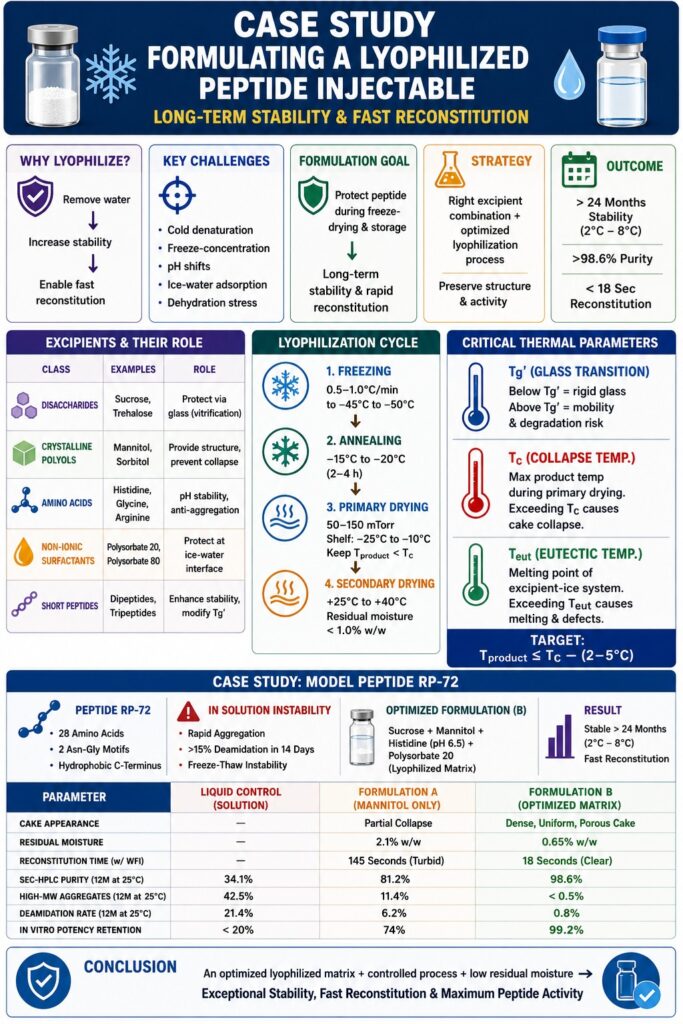
A formulation development program evaluating the model peptide RP-72 demonstrated that Formulating a Lyophilized Peptide Injectable using an optimized sucrose-mannitol-histidine matrix can extend product shelf life from approximately 14 days in solution to more than 24 months when stored at 2°C–8°C. The optimized formulation maintained greater than 98.6% monomer purity, limited deamidation to below 0.8%, and achieved complete reconstitution in less than 18 seconds.
Model Peptide RP-72 Degradation Profile
RP-72 is a synthetic therapeutic peptide composed of 28 amino acids and contains two labile Asparagine-Glycine (Asn-Gly) motifs along with a hydrophobic C-terminal region. When formulated in phosphate-buffered saline (PBS, pH 7.2), RP-72 demonstrates rapid degradation in the liquid state:
Physical Aggregation
The peptide rapidly self-associates into soluble oligomeric species that subsequently form irreversible fibrillar precipitates within 48 hours at room temperature.
Chemical Degradation
More than 15% deamidation occurs at susceptible Asn residues within 14 days when stored at 2°C–8°C.
Freeze-Thaw Instability
Exposure to repeated freeze-thaw cycles promotes structural unfolding and aggregation due to interactions at the ice-water interface.
Compare these findings with real analytical data in our detailed peptide characterization case study of Semaglutide.
Matrix Engineering and Process Optimization
ResolveMass Laboratories Inc. conducted a three-arm comparative study to evaluate formulation performance:
Liquid Control Solution: RP-72 (10 mg/mL) in PBS (pH 7.2)
Formulation A (Unoptimized Lyophilized): RP-72 (10 mg/mL) + 5% w/v Mannitol (crystalline bulking agent only)
Formulation B (Optimized Lyophilized Matrix): RP-72 (10 mg/mL) + 4% w/v Sucrose + 2% w/v Mannitol + 20 mM L-Histidine (pH 6.5) + 0.05% w/v Polysorbate 20
Thermal analysis of Formulation B identified a Tg’ value of -28.5°C and a collapse temperature (Tc) of -25.2°C. A 36-hour lyophilization cycle was subsequently developed, incorporating an annealing stage at -18°C for 3 hours. Primary drying was performed at a shelf temperature of -15°C and a chamber pressure of 80 mTorr, maintaining Tproduct at -28.0°C. Secondary drying was then conducted at +30°C.
Comparative Stability and Reconstitution Results
Formulation performance was assessed over a 12-month period under accelerated (40°C / 75% RH) and real-time (25°C / 60% RH and 2°C–8°C) storage conditions. Analytical testing included SEC-HPLC for monomer purity determination, mass spectrometry for quantification of deamidation, Karl Fischer titration for moisture analysis, and standardized reconstitution evaluations.
| Evaluated Parameter | Liquid Control Solution | Formulation A (Mannitol Only) | Formulation B (Optimized Matrix) |
|---|---|---|---|
| Freeze-Dried Cake Appearance | N/A (Liquid Solution) | Partial cake collapse and shrinkage | Dense, uniform, highly porous cake |
| Residual Moisture Content | N/A | 2.1% w/w | 0.65% w/w |
| Reconstitution Speed (w/ WFI) | N/A | 145 seconds (turbid suspension) | 18 seconds (clear solution) |
| SEC-HPLC Purity (12M at 25°C) | 34.1% | 81.2% | 98.6% |
| High-MW Aggregates (12M at 25°C) | 42.5% | 11.4% | < 0.5% |
| Deamidation Rate (12M at 25°C) | 21.4% | 6.2% | 0.8% |
| In Vitro Potency Retention | < 20% retention | 74% retention | 99.2% retention |
Formulation B successfully minimized both chemical degradation and physical aggregation. The combination of sucrose and histidine generated a protective amorphous glass matrix that preserved peptide structural integrity, while crystalline mannitol contributed a porous cake architecture that enabled rapid penetration of diluent and complete reconstitution within 18 seconds.
Choosing between distinct CDMO and CRO capabilities is crucial for project success. Read our breakdown on peptide CDMO vs CRO options to determine your formulation strategy.
Conclusion
Formulating a Lyophilized Peptide Injectable offers a scientifically validated strategy for overcoming liquid-state chemical and physical instability, enabling the transformation of sensitive peptide candidates into commercially practical parenteral drug products. As demonstrated by the RP-72 case study, the combination of non-reducing disaccharides and crystalline bulking agents, strict control of product temperature below Tc, and maintenance of residual moisture levels below 1.0% w/w collectively support exceptional long-term stability and rapid reconstitution characteristics.
ResolveMass Laboratories Inc. applies these advanced formulation development and lyophilization process optimization principles to assist biopharmaceutical innovators throughout all phases of lyophilized drug product development.
Evaluate your development roadmap by reading our expert guide on how to choose a peptide CDMO in the US
or explore localized manufacturing benefits with our guide on Canadian vs US peptide CDMOs.
To discuss custom formulation development, thermal characterization, and scale-up strategies for lyophilized parenteral drug products, contact the formulation team at ResolveMass Laboratories Inc.:
Frequently Asked Questions
Disaccharides such as sucrose and trehalose serve as essential stabilizing excipients during freeze-drying. They interact with peptide molecules through hydrogen bonding, helping preserve native structural features that might otherwise be disrupted during dehydration. In addition, these sugars form an amorphous glass matrix that restricts molecular movement, thereby reducing the risk of unfolding, aggregation, and long-term chemical degradation.
Collapse temperature (Tc) is typically established through specialized thermal characterization techniques, including Light Transmission Freeze-Drying Microscopy (LT-FDM). During analysis, a frozen sample is exposed to controlled temperature and vacuum conditions while being visually monitored. The temperature at which the structure begins losing its mechanical stability is identified as the collapse temperature, which becomes a critical parameter for designing a robust lyophilization cycle.
Annealing is incorporated into the freeze-drying process to improve ice crystal growth and promote complete crystallization of selected excipients such as mannitol. Larger and more uniform ice crystals create wider channels within the frozen matrix, enhancing water vapor removal during primary drying. This step also improves cake appearance, reduces drying resistance, and contributes to better product consistency during long-term storage.
Delayed reconstitution often results from structural defects within the lyophilized cake, excessive residual moisture, or insufficient pore formation during freeze-drying. Cake collapse, shrinkage, or dense matrix structures can restrict liquid penetration and prolong dissolution times. Proper formulation design, along with the use of suitable bulking agents and surfactants, helps create an open porous structure that supports rapid and complete reconstitution.
Residual moisture is a critical quality attribute because excess water can increase molecular mobility within the dried matrix. Elevated moisture levels may lower the glass transition temperature and accelerate degradation pathways such as hydrolysis, deamidation, and aggregation. Maintaining low residual moisture content helps preserve peptide stability and supports extended shelf life under recommended storage conditions.
Sodium phosphate buffer systems can undergo selective crystallization during freezing, causing significant shifts in the formulation pH. These pH fluctuations may negatively affect peptide stability by increasing the risk of hydrolysis, deamidation, or conformational changes. For this reason, alternative buffering agents such as L-histidine are frequently selected because they provide greater pH stability throughout the freeze-drying process.
Primary drying is commonly performed within a chamber pressure range of approximately 50 mTorr to 150 mTorr. Operating within this range provides an effective balance between heat transfer to the product and efficient removal of sublimated water vapor. Maintaining appropriate pressure conditions helps maximize drying efficiency while ensuring that product temperature remains below the critical collapse threshold.
Non-ionic surfactants, including Polysorbate 20 and Polysorbate 80, help protect peptides from interfacial stress during freezing and drying. These surfactants preferentially occupy ice-water and air-liquid interfaces, reducing peptide adsorption to these surfaces. By limiting surface-induced unfolding and aggregation, they contribute to improved product stability and enhanced recovery following reconstitution.
The development and evaluation of lyophilized injectable products are guided by internationally recognized standards such as ICH Q1A(R2) for stability testing and other applicable ICH quality guidelines. Residual moisture content is commonly determined using Karl Fischer titration in accordance with pharmacopeial requirements. Together, these regulatory expectations help ensure product quality, safety, efficacy, and long-term stability throughout the product lifecycle.
Reference:
- Mukalel, A. J., Evans, B. C., Kilchrist, K. V., Dailing, E. A., Burdette, B., Cheung-Flynn, J., Brophy, C. M., & Duvall, C. L. (2018). Excipients for the lyoprotection of MAPKAP kinase 2 inhibitory peptide nano-polyplexes. Journal of Controlled Release, 282, 110–119. https://doi.org/10.1016/j.jconrel.2018.04.045
- Chen, Y., Mutukuri, T. T., Wilson, N. E., & Zhou, Q. (2021). Pharmaceutical protein solids: Drying technology, solid-state characterization and stability. Advanced Drug Delivery Reviews, 172, 211–233. https://doi.org/10.1016/j.addr.2021.02.016
- Lale, S. V., Goyal, M., & Bansal, A. K. (2011). Development of lyophilization cycle and effect of excipients on the stability of catalase during lyophilization. International Journal of Pharmaceutical Investigation, 1(4), 214–221. https://doi.org/10.4103/2230-973X.93007
- Holm, T. P., Meng-Lund, H., Rantanen, J., Jorgensen, L., & Grohganz, H. (2021). Screening of novel excipients for freeze-dried protein formulations. European Journal of Pharmaceutics and Biopharmaceutics, 160, 55–64. https://doi.org/10.1016/j.ejpb.2021.01.008
- Butreddy, A., Dudhipala, N., Janga, K. Y., & Gaddam, R. P. (2020). Lyophilization of small-molecule injectables: An industry perspective on formulation development, process optimization, scale-up challenges, and drug product quality attributes. AAPS PharmSciTech, 21(7), Article 252. https://doi.org/10.1208/s12249-020-01787-w
- Greco, K., Mujat, M., Galbally-Kinney, K. L., Hammer, D. X., Ferguson, R. D., Iftimia, N., Mulhall, P., Sharma, P., Kessler, W. J., & Pikal, M. J. (2013). Accurate prediction of collapse temperature using optical coherence tomography-based freeze-drying microscopy. Journal of Pharmaceutical Sciences, 102(6), 1773–1785. https://doi.org/10.1002/jps.23516
Get In Touch With Us
About The Author


