

Introduction
A comprehensive peptide purity testing report must include validated chromatographic and mass spectrometric data to verify both chemical sequence identity and organic purity before any research or formulation activities begin. Proper evaluation of these parameters requires a thorough understanding of liquid chromatography (LC) separation capabilities, mass-to-charge (m/z) confirmation, and advanced trace impurity characterization methods, including GC-MS vs LC-MS/MS for Nitrosamine Testing, to meet stringent regulatory expectations.
Need expert guidance on regulatory standards for impurities? Learn more about ICH M7 Nitrosamine testing.
For scientists involved in drug discovery, structural biology, and preclinical development, the ability to accurately interpret a Certificate of Analysis (COA) is essential for maintaining study reproducibility and data integrity. A well-prepared COA provides a scientific foundation for evaluating peptide datasheets, calculating absolute peptide mass, and identifying potential process-related mutagenic contaminants.
Confused about regulatory requirements? Check if all drugs need a nitrosamine risk assessment.
Share via:
Article Summary:
- Peptide quality assessment relies on multiple analytical techniques, including HPLC, mass spectrometry, and impurity testing, to verify peptide identity, purity, and compliance with regulatory expectations before research or formulation work begins.
- HPLC purity measures the proportion of the target peptide relative to other peptide-related impurities by comparing chromatographic peak areas. Advanced RP-HPLC methods improve separation efficiency and help distinguish closely related peptide impurities.
- Mass spectrometry confirms peptide identity by matching the observed molecular mass to the theoretical peptide sequence. Techniques such as ESI-MS and MALDI-MS provide accurate molecular characterization and help differentiate genuine impurities from common ionization-related adducts.
- HPLC purity and Net Peptide Content (NPC) are different quality attributes. While HPLC purity reflects the quality of the peptide fraction, NPC determines the actual amount of peptide present in the final material, enabling accurate concentration calculations for research applications.
- Residual counterions and moisture significantly influence peptide quality and stability. Analytical methods such as ion chromatography and Karl Fischer titration are used to quantify these components and establish a complete material mass balance.
- Choosing between GC-MS and LC-MS/MS for nitrosamine testing depends on the properties of the target analytes. GC-MS is highly effective for volatile nitrosamines, whereas LC-MS/MS is better suited for complex, polar, and non-volatile nitrosamines while minimizing thermal degradation risks.
- Nitrosamine impurities can form during peptide synthesis when residual amines react with nitrosating agents under acidic conditions. Regulatory agencies therefore require risk assessments and, when necessary, confirmatory testing to ensure product safety and compliance.
Evaluating HPLC Chromatographic Purity in Peptide Datasheets
High-Performance Liquid Chromatography (HPLC) chromatographic purity quantifies the relative peak area of the target peptide sequence compared with all other UV-absorbing peptidic species detected within the sample. This value reflects the organic purity of the peptide fraction under specific chromatographic conditions and does not account for non-peptidic components such as counterions, residual solvents, or absorbed moisture.
                     [UV Absorbance (214 nm)]
                                |
                                |        _/\_  <-- Target Peptide Peak (RT = 18.5 min)
                                |       /    \
                                |      /      \      _/\_  <-- Deletion Peptide Impurity
                                |_____/________\____/____\_____
                                +-----------------------------> [Retention Time]
Most analytical laboratories employ Reversed-Phase HPLC (RP-HPLC), which utilizes a hydrophobic stationary phase, commonly octadecyl silane (C18) bonded to silica particles with pore sizes ranging from 100–300 Å. These pore dimensions are selected to accommodate the hydrodynamic volume of peptide molecules. Separation is achieved through a linear gradient consisting of a polar mobile phase A, typically 0.1% trifluoroacetic acid in water, and a less polar mobile phase B, generally 0.1% trifluoroacetic acid in acetonitrile.
Modern analytical workflows frequently incorporate advanced stationary phases such as Ascentis Express AQ-C18 and superficially porous Poroshell columns. These technologies help reduce peak tailing, improve chromatographic efficiency, and enhance resolution between closely related impurities.
The determination of HPLC purity is based on peak area integration at a specified detection wavelength. Because peptide backbone carbonyl groups strongly absorb light in the far-UV region, wavelengths between 214 and 220 nm are commonly used for detection. For peptides containing aromatic amino acids such as tryptophan, tyrosine, or phenylalanine, additional monitoring at 280 nm can provide supplementary confirmation of peak homogeneity and peptide identity.
Purity (%) = (Area of Target Peak / Σ Area of All Integrated Peaks) × 100
This calculation assumes that all eluting components possess identical UV absorption coefficients, meaning the Relative Response Factor (RRF) equals 1. In practice, however, this assumption may not always hold true. Certain impurities may lack UV-absorbing chromophores or exhibit substantially different molar absorptivities, resulting in underestimation or overestimation of their actual concentrations.
Chromatographic resolution may be further improved by optimizing operational parameters such as column temperature, which is typically maintained between 30–40 °C to enhance mass-transfer kinetics, and by adjusting the slope of the acetonitrile gradient to achieve better separation of structurally similar species.
Optimize your analytical workflow with our nitrosamine method development and validation services.
Deciphering Mass Spectrometry and Identity Verification on a Peptide COA
Mass spectrometry (MS) serves as a definitive tool for peptide identity verification by measuring the mass-to-charge (m/z) ratio of ions generated from the sample. This technique confirms that the target peak observed during HPLC analysis corresponds to the theoretical molecular weight of the intended peptide sequence. While HPLC separates compounds based on hydrophobic interactions, mass spectrometry provides an orthogonal confirmation that the isolated peak represents the correct molecular entity rather than an isomeric species or structurally modified byproduct.
For synthetic peptide characterization, soft ionization techniques such as Electrospray Ionization (ESI) and Matrix-Assisted Laser Desorption/Ionization (MALDI) are considered standard analytical approaches. ESI-MS is often directly coupled with HPLC systems in LC-MS configurations, allowing real-time mass analysis of eluting peaks and facilitating the identification of co-eluting impurities.
During the ESI process, peptides undergo multiple protonation events in solution, producing a characteristic distribution of multiply charged ions represented as [M+nH]ⁿ⁺. This phenomenon enables accurate analysis of large peptide molecules using instruments with limited mass ranges.
One important aspect of mass spectral interpretation is the identification of sodium [M+Na]⁺ and potassium [M+K]⁺ adducts. These species arise when ionized peptides associate with trace alkali metal ions originating from solvents, glassware, reagents, or buffer systems.
Observed Adduct Mass = M + 22.99 Da (for Na⁺)
Observed Adduct Mass = M + 38.10 Da (for K⁺)
The appearance of these adducts reflects normal ionization chemistry and should not be interpreted as evidence of poor synthesis quality. However, analysts must distinguish such adduct peaks from genuine sequence-related impurities, including deletion sequences generated by incomplete amino acid coupling during solid-phase synthesis or incompletely deprotected side chains that retain tert-butyl or trityl protecting groups.
Ensure your impurity identification is accurate. Review the difference between nitrosamine impurities and nitrosamine leachables.
Understanding Purity vs. Net Peptide Content (NPC)
Chromatographic purity and Net Peptide Content (NPC) represent separate analytical measurements that evaluate different characteristics of a peptide preparation. HPLC purity reflects the quality of the peptide fraction itself, whereas NPC indicates the actual weight percentage of peptidic material present in the lyophilized powder.
A peptide vial received in a laboratory rarely contains only the target peptide. It typically includes residual water, counterions, trace solvents, and other components incorporated during synthesis, purification, and lyophilization.
To determine the absolute amount of target peptide present in a delivered vial, both HPLC purity and NPC must be applied to the gross powder weight:
True Target Mass = Gross Weight × (Net Peptide Content (%) / 100) × (HPLC Purity (%) / 100)
For example, if a vial contains 100.0 mg of lyophilized material with an HPLC purity of 98.0% and an NPC value of 85.0%, the actual amount of target peptide can be calculated as follows:
True Target Mass = 100.0 mg × 0.850 × 0.980 = 83.3 mg
Accurate interpretation of these values is critical for preparing precise molar concentrations in quantitative pharmacological, biochemical, and biophysical studies.
Net Peptide Content is typically determined through quantitative Amino Acid Analysis (AAA) or total nitrogen analysis using elemental composition measurements. During AAA, the peptide undergoes hydrolysis under strongly acidic conditions, commonly 6 M HCl at 110 °C for 24 hours, producing individual amino acid residues.
These amino acids are subsequently separated using reversed-phase liquid chromatography, chemically derivatized, and quantified against primary standards of known concentration. This process enables accurate determination of peptide concentration within the bulk material.
Quantifying Residual Counterions and Moisture in Peptide Preparations
Residual counterions and moisture content are commonly measured using ion chromatography and Karl Fischer titration, respectively. These analyses contribute to establishing a complete mass balance while also helping to verify the stability of lyophilized peptide products.
Peptides frequently contain basic residues such as lysine, arginine, and histidine, along with an N-terminal amino group. These positively charged functionalities require counterions to maintain electrical neutrality and thermodynamic stability.
Trifluoroacetate (TFA) is the most commonly encountered counterion because it originates from both TFA-based cleavage cocktails and TFA-containing HPLC purification systems. Highly basic peptide sequences, including many cell-penetrating peptides, can retain substantial amounts of TFA, potentially lowering the pH of weakly buffered biological assays and causing enzymatic inhibition or cellular toxicity.
The theoretical contribution of counterions to peptide mass can be estimated from the number of protonated nitrogen centers (N):
Theoretical NPC (%) = [MW of Peptide / (MW of Peptide + (N × 114))] × 100
In this equation, 114 g/mol corresponds to the molecular weight of the trifluoroacetate ion.
When residual TFA presents biological compatibility concerns, manufacturers may perform ion-exchange procedures using sodium acetate or ammonium acetate systems to replace TFA with more biocompatible acetate or hydrochloride counterions. This process can reduce residual TFA concentrations to below 1%.
Residual TFA (Synthesized Salt Form) ===> High acidity, potential cytotoxicity
              |
              v (Ion-Exchange Chromatography)
              |
Biocompatible Salt (Acetate / HCl Form) ===> Neutral pH, assay-ready (<1% TFA)
Residual moisture must also be carefully monitored because lyophilized peptide powders are highly hygroscopic and readily absorb atmospheric water during storage and handling. Karl Fischer titration is the preferred method for moisture determination, and moisture levels below 5% are generally considered appropriate for high-quality research-grade materials.
A complete and scientifically rigorous mass balance should account for all components present in the bulk material:
% Target Peptide + % Peptidic Impurities + % Counterions + % Residual Water = 100%
Any substantial deviation from 100% may indicate the presence of unmeasured non-peptidic contaminants, including residual organic solvents such as acetonitrile or DMF, as well as toxic cleavage scavengers such as DTT or thioanisole.
Need to understand the risks in your API synthesis? Learn more about nitrosamine formation pathways.
Analytical Platforms: GC-MS vs LC-MS/MS for Nitrosamine Testing
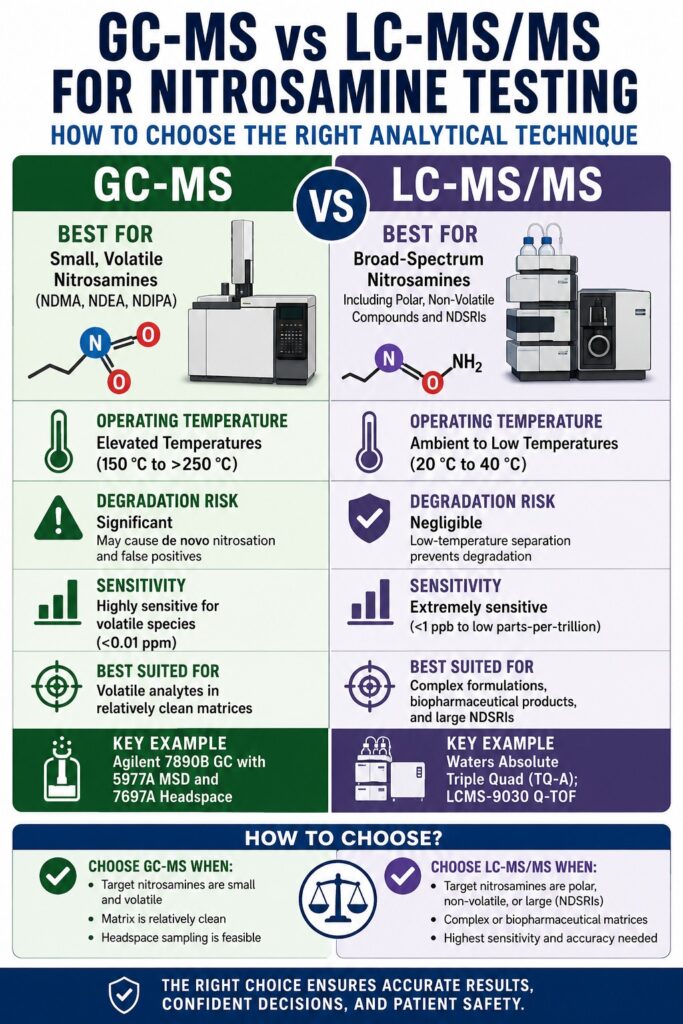
The decision to utilize GC-MS vs LC-MS/MS for Nitrosamine Testing depends primarily on the volatility of the target nitrosamines and the thermal stability of the sample matrix. Selecting an inappropriate analytical technique can result in inaccurate measurements, including underreporting non-volatile impurities or generating false-positive results through thermal degradation processes.
Gas Chromatography-Mass Spectrometry (GC-MS), particularly when combined with headspace sampling technology, is highly effective for detecting small volatile nitrosamines such as N-nitrosodimethylamine (NDMA) and N-nitrosodiethylamine (NDEA).
Headspace sampling transfers volatile nitrosamines directly from a heated sample vial into the gas phase, preventing non-volatile peptide components from entering the GC system. This minimizes matrix contamination and reduces chromatographic interference.
Despite these advantages, GC-MS has a significant limitation related to thermal degradation. Elevated temperatures, often exceeding 200 °C within injection ports or column ovens, can promote unwanted chemical reactions. When residual secondary or tertiary amines coexist with trace nitrites, these conditions may facilitate de novo nitrosamine formation, producing false-positive analytical results.
Additionally, highly polar or non-volatile nitrosamines, including N-nitroso-N-methyl-4-aminobutyric acid (NMBA) and larger Nitrosamine Drug Substance-Related Impurities (NDSRIs), cannot be effectively analyzed using GC-MS without extensive derivatization procedures that increase analytical complexity and potential error.
Facing complex drug matrices? Learn why nitrosamine testing in biologics requires specialized approaches.
Liquid Chromatography-Tandem Mass Spectrometry (LC-MS/MS) eliminates these thermal concerns by performing separations at relatively low temperatures, typically between 30–40 °C. As a result, LC-MS/MS has become the preferred analytical platform for complex and non-volatile pharmaceutical matrices.
Modern instruments such as the Waters Absolute Triple Quad Mass Spectrometer (TQ-A) and high-resolution Orbitrap systems achieve extremely low detection limits in the parts-per-billion and parts-per-trillion range through Multiple Reaction Monitoring (MRM) and High-Resolution Accurate-Mass (HRAM) methodologies.
One challenge associated with LC-MS/MS analysis is ion suppression, which occurs when co-eluting peptide molecules interfere with the ionization efficiency of trace nitrosamine analytes within the electrospray source. This issue is typically mitigated through advanced chromatographic separation strategies employing specialized stationary phases such as Ascentis Express Biphenyl or polar end-capped C18 columns.
Analytical Performance Comparison
| Analytical Performance Parameter | Headspace / Liquid Injection GC-MS/MS | ESI / APCI LC-MS/MS or LC-HRMS |
|---|---|---|
| Applicable Target Analytes | Small, volatile nitrosamines (NDMA, NDEA, NDIPA) | Broad-spectrum nitrosamines, including volatile, polar, non-volatile compounds and NDSRIs |
| Operating Temperature Range | Elevated temperatures (150 °C to >250 °C) | Ambient to low temperatures (20 °C to 40 °C) |
| Matrix-Induced Degradation Risk | Significant; may produce de novo nitrosation and false positives | Negligible due to low-temperature separation |
| Analytical Limits of Quantitation | Highly sensitive for volatile species (<0.01 ppm) | Extremely sensitive (<1 ppb and low parts-per-trillion levels) |
| Key Instrument Examples | Agilent 7890B GC with 5977A MSD and 7697A Headspace | Waters Absolute Triple Quad (TQ-A); LCMS-9030 Q-TOF |
| Primary Method Suitability | Volatile analytes in relatively clean matrices | Complex formulations, biopharmaceutical products, and large NDSRIs |
Get your project started on time. Review our nitrosamine testing timeline.
Assessing Nitrosamine Formation Pathways in Peptide Synthesis
Nitrosamine impurities can form during peptide synthesis when secondary or tertiary amines react with nitrous acid or other nitrosating agents under acidic conditions. Both Solid-Phase Peptide Synthesis (SPPS) and downstream processing operations may create opportunities for the formation of these potentially genotoxic contaminants.
In Fmoc-based SPPS, piperidine represents one of the primary risk factors because it is used repeatedly and in excess to remove the N-alpha Fmoc protecting group during each synthesis cycle. Other compounds, including morpholine, diethylamine, and tertiary amine bases such as diisopropylethylamine (DIPEA), may also serve as nitrosatable precursors.
If these amines are not effectively removed during washing operations, they may react with trace nitrites (NO₂⁻) or nitrates (NO₃⁻) originating from raw materials, solvents, reagents, or recycled process streams.
During the final peptide cleavage stage, which commonly employs trifluoroacetic acid, nitrites can be converted into nitrous acid (HNO₂) and subsequently into highly reactive nitrosonium ions (NO⁺). These reactive intermediates can then react with residual amines to generate stable N-nitrosamines:
HNO₂ + H⁺ ⇌ H₂O + NO⁺
R₂NH + NO⁺ → R₂N-NO + H⁺
Residual Base (e.g., Piperidine) + Nitrite Impurities (Solvents/Reagents)
                                 |
                 [Acidic TFA Cleavage Environment]
                                 |
                     [Active Nitrosonium Ion]
                                 |
               ===> Genotoxic Nitrosamine Contamination
Need help with specialized testing? Explore our outsourcing options for nitrosamine testing to a CRO.
To manage these risks, regulatory authorities such as the US FDA and the European Medicines Agency (EMA) require comprehensive risk assessments and, where appropriate, confirmatory testing of high-risk materials.
Although routine nitrosamine release testing is not universally required for every peptide product, formal risk assessments are expected whenever nitrosatable reagents, vulnerable process conditions, or recycled solvents are incorporated into manufacturing operations.
ResolveMass Laboratories Inc. assists manufacturers by developing validated, matrix-specific analytical methodologies designed to identify trace nitrosamines and secondary amine precursors while supporting compliance with international regulatory standards and pharmacopeial requirements.
Are you working with specific drug classes? We provide targeted nitrosamine testing for beta-blockers.
A Scientist’s Checklist for Auditing Peptide Datasheets
A thorough audit of a peptide Certificate of Analysis (COA) involves confirming that all reported purity values originate from genuine analytical data rather than edited templates or non-verifiable summaries. Applying a structured review process enables analytical chemists and quality assurance professionals to assess the authenticity, reliability, and scientific validity of incoming peptide batches.
| Checklist Parameter | Target Specifications | Red Flags to Watch For |
| HPLC Chromatogram | Sharp, symmetrical primary peak with clearly resolved impurity peaks | Missing chromatograms, excessively smoothed baselines, absent injection dates, or missing column information |
| Purity Percentage | ≥95.0% to ≥98.0%, depending on application requirements | Exact values such as “99.00%” or other suspiciously rounded numbers |
| Mass Spectrometry | Molecular ion peak matches theoretical average or monoisotopic mass | Missing mass spectrum, incorrect molecular weight calculations, or absent sodium/potassium adduct assignments |
| Net Peptide Content | NPC value reported explicitly, typically between 60–85%, based on quantitative AAA | Confusion between HPLC purity and actual peptide content, or calculations based solely on gross powder weight |
| Salt Form / Counterions | Counterion identity confirmed with quantitative chromatography data | Acidic dissolved peptide solutions, absent counterion percentages, or unquantified solvent peaks |
| Water Content | Residual moisture ≤5% confirmed by Karl Fischer titration | Missing moisture data for hygroscopic peptides or reliance on weight-loss measurements alone |
| Batch Identification | Unique lot or batch number linked to manufacturing and purification records | Identical chromatograms across different lots or lack of traceability to reference standards |
Conclusion
Comprehensive verification of peptide datasheets is essential for ensuring research reproducibility and preventing analytical interference from unrecognized contaminants. While HPLC and mass spectrometry provide the primary foundation for assessing peptide purity and confirming molecular identity, a complete understanding of material quality also requires accurate measurement of residual counterions and moisture through ion chromatography and Karl Fischer titration.
Furthermore, evaluating process-related mutagenic impurities remains a critical component of biological safety assessments. In this context, selecting between GC-MS vs LC-MS/MS for Nitrosamine Testing represents an important analytical decision that balances sensitivity for volatile compounds against the risk of matrix-induced thermal degradation.
Still have questions about the basics? Read our guide on what are nitrosamines.
ResolveMass Laboratories Inc. offers highly specialized, validated analytical testing platforms capable of delivering the high-resolution data required to verify absolute purity, confirm exact molecular identity, and support comprehensive regulatory compliance for both therapeutic and research-grade peptides.
To consult with analytical specialists or request customized testing protocols, researchers are encouraged to visit the ResolveMass Laboratories Contact Page.
Frequently Asked Questions on Peptide Purity and Impurity Testing
Net Peptide Content (NPC) represents the percentage of actual peptide material present within a lyophilized sample after accounting for moisture, counterions, and other non-peptidic components. When researchers calculate concentrations based solely on the gross powder weight, the resulting values may not reflect the true peptide amount. This discrepancy can introduce substantial errors in dosing, assay preparation, and quantitative analysis. Accurate NPC data helps ensure consistency and reproducibility across experimental studies.
Trifluoroacetic acid (TFA) is widely used throughout peptide manufacturing because it efficiently cleaves peptides from solid-phase resins and improves chromatographic separation during RP-HPLC purification. As a result, many synthetic peptides are naturally recovered in their TFA salt form. Unless an additional ion-exchange process is performed, residual TFA remains associated with the peptide. Its widespread use makes it the most common counterion found in commercial peptide preparations.
Karl Fischer titration is a highly specific analytical technique that quantifies water content through a chemical reaction that selectively targets moisture molecules. In contrast, Loss on Drying (LOD) measures the total reduction in sample weight after heating. Because volatile substances such as residual solvents can evaporate during LOD testing, the method may overestimate actual moisture content. For hygroscopic peptides, Karl Fischer titration is generally considered the more accurate and reliable approach.
Shoulder peaks and peak tailing can arise when peptide molecules interact with residual silanol groups present on silica-based chromatographic stationary phases. These chromatographic distortions may also occur when structurally similar impurities, such as deletion sequences or diastereomers, are not completely separated from the main peptide peak. Inadequate chromatographic resolution can make interpretation more challenging. Careful optimization of column chemistry and mobile-phase conditions often improves peak shape and separation efficiency.
LC-MS/MS is generally favored when analyzing non-volatile, highly polar nitrosamines or complex Nitrosamine Drug Substance-Related Impurities (NDSRIs). The technique operates at relatively low temperatures, making it suitable for thermally sensitive samples that could degrade under GC-MS conditions. This reduces the possibility of artifact formation during analysis. As a result, LC-MS/MS is frequently selected for pharmaceutical matrices that require highly sensitive and accurate nitrosamine detection.
NDSRIs are a specialized class of nitrosamine contaminants formed when nitrosation occurs directly on secondary or tertiary amine groups within an active pharmaceutical ingredient. These compounds attract significant regulatory attention because of their potential genotoxic and carcinogenic properties. Regulatory agencies evaluate their risk using toxicological data and established safety frameworks. Consequently, strict limits are enforced to minimize patient exposure throughout a product’s lifecycle.
The selection of a mobile-phase modifier can significantly influence ionization efficiency during mass spectrometric analysis. Although TFA often improves chromatographic peak shape and separation quality, it can suppress signal intensity in electrospray ionization sources. Volatile additives such as formic acid are commonly used when higher MS sensitivity is required. Choosing the appropriate modifier helps achieve a balance between chromatographic performance and analytical detection capability.
Amino Acid Analysis (AAA) provides a quantitative assessment of peptide composition by hydrolyzing the molecule into its constituent amino acids. The resulting amino acids are measured and compared with theoretical values to verify composition and concentration. Because AAA relies on a different analytical principle than mass spectrometry, it serves as an important orthogonal technique for peptide characterization. It is also commonly used to determine Net Peptide Content with high accuracy.
Reference:
- Muttenthaler, M., King, G. F., Adams, D. J., & Alewood, P. F. (2015). Characterization of cyclic peptides containing disulfide bonds. Journal of Natural Products, 78(4), 967–976. https://doi.org/10.1021/acs.jnatprod.5b00182
- Kim, H., Sung, D., Yu, H., Jang, D., Koo, Y., Lee, S., Lim, K., & Choi, D. (2021). Comparison of EI-GC-MS/MS, APCI-LC-MS/MS, and ESI-LC-MS/MS for the simultaneous analysis of nine nitrosamines eluted from synthetic resins into artificial saliva and health risk assessment. Toxics, 9(10), 230. https://doi.org/10.3390/toxics9100230
- Manchuri, K. M., Shaik, M. A., Gopireddy, V. S. R., Sultana, N., & Gogineni, S. (2024). Analytical methodologies to detect N-nitrosamine impurities in active pharmaceutical ingredients, drug products and other matrices. Chemical Research in Toxicology, 37(9), 1456–1483. https://doi.org/10.1021/acs.chemrestox.4c00234
- United States Pharmacopeia. (n.d.). USP 1469 nitrosamines impurities with laboratory demonstration (classroom & laboratory). USP. https://www.usp.org/events-training/course/usp-1469-nitrosamines-impurities-laboratory-demonstration-classroom
- U.S. Food and Drug Administration. (2025). CDER nitrosamine impurity acceptable intake limits. U.S. Department of Health and Human Services. https://www.fda.gov/regulatory-information/search-fda-guidance-documents/cder-nitrosamine-impurity-acceptable-intake-limits
- ResearchGate. (n.d.). What are the acceptable validation limits for nitrosamine impurity testing and which regulatory references define them? https://www.researchgate.net/post/What_Are_the_Acceptable_Validation_Limits_for_Nitrosamine_Impurity_Testing_and_Which_Regulatory_References_Define_Them
Get In Touch With Us
About The Author


