

Introduction:
Generic Drug Development for Inhaled Drug Products requires a development strategy that connects formulation science, device engineering, analytical characterization, manufacturing controls, and bioequivalence. Unlike conventional tablets or capsules, an inhaled or nasal generic product must reproduce not only the chemical composition of the reference product but also the way the drug is emitted, dispersed, deposited, and delivered to the intended site of action.
The challenge is particularly important for locally acting orally inhaled and nasal drug products (OINDPs). FDA notes that traditional systemic pharmacokinetic approaches may not directly demonstrate equivalence for products that deliver drug locally to the lung or nose.
For a CDMO supporting an ANDA program, this means development cannot stop at matching assay and impurities. The generic drug development process for ANDA must establish a scientifically defensible relationship between formulation attributes, device performance, delivered dose, particle or droplet characteristics, and bioequivalence requirements.
Summary:
- Generic Drug Development for Inhaled Drug Products is more complex than conventional oral-solid-dose development because formulation, device, aerosol performance, and patient-use factors can all influence drug delivery.
- MDIs, DPIs, and nasal sprays each have distinct critical quality attributes (CQAs), analytical requirements, device considerations, and bioequivalence (BE) strategies.
- For MDIs and DPIs, aerodynamic particle size distribution (APSD), delivered dose uniformity (DDU), fine particle dose/fraction, spray or plume characteristics, formulation properties, and device performance can be critical to demonstrating equivalence.
- For nasal sprays, spray pattern, plume geometry, droplet/particle size distribution, priming/repriming, delivered dose, formulation properties, and device dimensions can affect product performance.
- FDA recognizes that conventional systemic PK approaches are not always sufficient for locally acting orally inhaled and nasal drug products, making scientifically justified in vitro, in vivo, and in silico BE approaches increasingly important.
- A CDMO or analytical development partner must integrate formulation development, analytical method development, device characterization, comparative performance testing, stability, and regulatory strategy rather than treating these as isolated studies.
- A successful ANDA strategy starts with reference product characterization and regulatory gap assessment, followed by formulation/device matching and a risk-based analytical and BE program.
1: What Makes Generic Drug Development for Inhaled Drug Products Different?
Generic inhaled product development is different because the drug product and delivery device work together as a single performance system — small differences in formulation, particle properties, actuator geometry, device resistance, or manufacturing process can change the amount and location of drug delivered. FDA’s MDI/DPI quality guidance addresses development and manufacturing considerations for both locally and systemically acting products.
Key development variables can include:
- API particle size and morphology
- API polymorphic form and crystallinity
- Particle engineering and micronization
- Excipient grade and functionality
- Suspension stability
- Propellant characteristics for MDIs
- Powder flow and dispersion for DPIs
- Device resistance and airflow
- Metering valve performance
- Actuator geometry
- Delivered dose
- Aerodynamic particle size distribution
- Fine particle dose/fraction
- Spray pattern and plume geometry
- Priming and repriming behavior
- Container-closure compatibility
- Extractables and leachables
- Microbiological quality
- Stability and in-use performance
The interaction among these variables is one reason inhaled products are often considered complex generics, and why sponsors frequently weigh working with a specialized CRO for ANDA development rather than building this capability in-house.
2: MDI Generic Development: What Are the Major ANDA Challenges?
MDI development focuses on achieving equivalence in formulation, metering, aerosol generation, and aerodynamic performance while controlling the interactions between the formulation and device. A pressurized metered-dose inhaler generally contains the drug formulation, container, metering valve, actuator, and associated components — so an MDI cannot be evaluated solely as a conventional pharmaceutical formulation.
Key MDI development considerations
| Development area | Typical consideration |
|---|---|
| API | Particle size, morphology, polymorphism, purity |
| Formulation | Suspension/solution behavior, concentration, excipient compatibility |
| Propellant | Composition, compatibility, vapor pressure and performance |
| Metering valve | Metering volume, consistency and compatibility |
| Actuator | Orifice geometry and spray characteristics |
| Delivered dose | Dose consistency across actuations |
| APSD | Aerodynamic distribution and fine particle performance |
| Device performance | Actuation and dose delivery consistency |
| Stability | Chemical, physical, and device stability |
| Packaging | Container-closure compatibility and leachables |
FDA recommends detailed characterization of APSD for MDIs and DPIs and notes that APSD should not be characterized only by MMAD and GSD, or only by fine particle mass/fraction.
Why APSD Is Critical for MDI ANDA Development
APSD is critical because it provides direct information about the aerodynamic behavior of inhaled particles and helps demonstrate whether the test product produces a comparable aerosol to the reference product. A CDMO analytical program may therefore evaluate:
- Mass deposited across cascade impactor stages
- Fine particle dose
- Fine particle fraction
- MMAD
- GSD
- Emitted dose
- Actuation-to-actuation variability
- Beginning-of-life and end-of-life performance
FDA’s draft quality guidance specifically recommends consideration of initial and final doses for MDIs and certain DPIs where appropriate.
3: DPI Generic Development: Why Is Powder Performance So Important?
DPI development depends heavily on powder properties, device resistance, airflow, de-agglomeration, and aerodynamic behavior — and because a DPI relies on patient-generated airflow rather than a propellant, powder performance and device resistance carry more weight than in MDI development. Critical variables may include:
- Particle size distribution
- Particle morphology
- Surface properties
- Moisture content
- Powder flowability
- Cohesive forces
- Carrier-particle interactions
- Drug-carrier blending
- Device resistance
- Airflow rate
- De-agglomeration efficiency
- Delivered dose
- APSD
For a DPI, simply achieving the correct API concentration does not establish equivalent performance — the formulation must generate a comparable aerosol under the relevant test conditions. FDA’s guidance recommends that APSD testing be performed using appropriately described equipment and controlled parameters such as airflow rate, airflow duration, temperature, and relative humidity.
DPI formulation risks a CDMO should evaluate
A development program should consider whether:
- API particles agglomerate during storage
- Moisture changes powder flow
- Carrier interactions affect drug detachment
- Device resistance changes dispersion
- Manufacturing changes alter particle morphology
- Dose delivery changes over the labeled device life
- APSD changes between beginning and end of unit life
These factors demonstrate why formulation development and analytical characterization must be closely integrated, and this same tight integration between particle engineering and analytical strategy is equally important in generic drug development for poorly soluble APIs, where particle properties similarly drive product performance.
4: Nasal Spray ANDA Development: What Makes It Challenging?
Nasal spray development requires control of both formulation and pump/actuator performance, because device geometry and spray characteristics can directly influence nasal deposition. FDA’s nasal spray guidance addresses CMC information for nasal sprays and inhalation solutions, suspensions, and sprays submitted in NDAs and ANDAs.
Important attributes can include:
- Delivered dose
- Spray content uniformity
- Droplet size distribution
- Spray pattern
- Plume geometry
- Priming
- Repriming
- Pump delivery characteristics
- Actuator orifice dimensions
- Formulation viscosity
- Surface tension
- pH
- Osmolality, where applicable
- Microbial quality
- Preservative content, where applicable
- Container-closure compatibility
FDA has also noted that pump and actuator design features can influence spray characteristics — for nasal sprays, factors such as actuator geometry, orifice characteristics, and swirl chamber design can affect performance. Device-dependent product complexity of this kind is not unique to nasal sprays either; long-acting parenteral depot systems such as those covered in leuprolide depot generic development present a comparable challenge, where the delivery system is inseparable from the drug’s release performance.
5: What Are the Major Bioequivalence Challenges for Inhaled ANDA Products?
The major BE challenge is demonstrating that the generic delivers drug to the relevant site in a manner sufficiently equivalent to the reference product, since for locally acting inhaled and nasal products, systemic plasma concentration alone may not adequately represent local drug delivery. FDA research has therefore focused on developing clinically relevant in vitro methods and alternative BE approaches.
Depending on the specific product and current FDA Product-Specific Guidance (PSG), a development program may involve combinations of:
- In vitro performance testing
- Pharmacokinetic studies
- Pharmacodynamic studies
- Comparative clinical endpoint studies
- Device characterization
- Comparative physicochemical characterization
- Additional product-specific studies
FDA has increasingly developed alternative approaches for certain OINDPs, and its FY2025 research report describes continued work to optimize in vitro characterization and modeling approaches for generic inhalation and nasal products. The critical point for an ANDA sponsor is that the BE strategy should be determined from the applicable product-specific guidance rather than assumed from another inhaled product.
6: How Should a CDMO Approach Generic Inhaled Product Development?
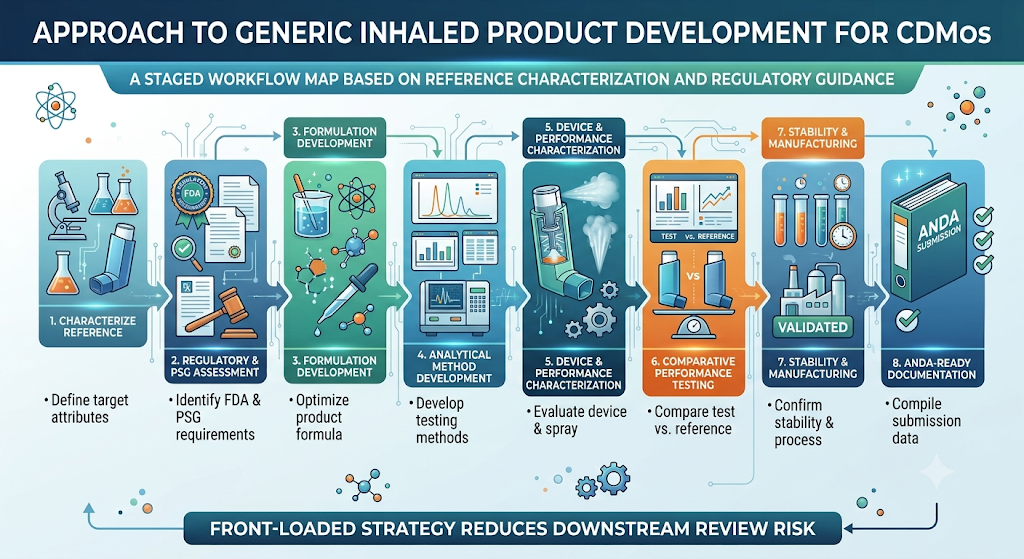
A strong CDMO strategy begins with reference product characterization and regulatory mapping before committing to formulation or analytical development. A practical development workflow is:
- Reference product characterization — Characterize multiple batches, where appropriate, to understand API identity and assay, related substances, formulation composition, particle characteristics, device characteristics, delivered dose, APSD, spray performance, and stability profile.
- Regulatory and PSG assessment — Identify the current FDA Product-Specific Guidance and determine recommended BE studies, in vitro and in vivo requirements, comparative product attributes, device considerations, and additional characterization expectations. FDA specifically publishes PSGs to describe its current thinking on methodologies for demonstrating therapeutic equivalence for individual generic products.
- Formulation development — Optimize the formulation to reproduce critical reference-product characteristics while maintaining manufacturability and stability.
- Analytical method development — Develop or optimize methods for assay, related substances, degradation products, API identification, particle characterization, delivered dose, APSD, spray performance, formulation attributes, and extractables and leachables where relevant.
- Device and performance characterization — Evaluate device-related attributes alongside formulation CQAs, since the delivery system can independently influence product performance.
- Comparative performance testing — Evaluate test and reference products using scientifically justified comparative methods aligned with the applicable regulatory strategy.
- Stability and manufacturing verification — Confirm the selected formulation and manufacturing process maintain critical attributes throughout the proposed shelf life and relevant in-use conditions.
- ANDA-ready documentation — Compile traceable data, validated or appropriately qualified methods, specifications, batch results, stability data, and scientifically justified conclusions for the CMC and BE sections of the submission.
This staged approach also maps closely onto the broader generic drug development timeline at a CDMO, where reference product characterization and regulatory gap assessment are similarly front-loaded to reduce downstream review risk.
7: What Analytical Testing Is Important for MDI, DPI, and Nasal Spray Products?
A CDMO should build the analytical package around the specific product and regulatory requirements rather than applying a generic testing panel — the applicable analytical requirements for ANDA generic drugs vary meaningfully by dosage form and device type.
| Testing category | MDI | DPI | Nasal spray |
|---|---|---|---|
| Assay | ✓ | ✓ | ✓ |
| Related substances | ✓ | ✓ | ✓ |
| API identification | ✓ | ✓ | ✓ |
| Delivered dose | ✓ | ✓ | ✓ |
| APSD | ✓ | ✓ | — |
| Fine particle performance | ✓ | ✓ | — |
| Spray pattern | ✓ | — | ✓ |
| Plume geometry | ✓ | — | ✓ |
| Droplet/particle size | ✓ | ✓ | ✓ |
| Device performance | ✓ | ✓ | ✓ |
| Priming/repriming | As applicable | As applicable | ✓ |
| Microbial quality | As applicable | As applicable | ✓ |
| Extractables & leachables | As applicable | As applicable | As applicable |
| Stability | ✓ | ✓ | ✓ |
This testing matrix should be refined against the reference product, dosage form, device configuration, and current regulatory expectations. Nitrosamine control is also part of that refinement for many inhaled and nasal formulations, and a structured nitrosamine risk assessment is increasingly expected as part of the overall impurity strategy.
8: Common CDMO Challenges in Generic Inhaled Product Development
The biggest CDMO challenge is managing the interdependence between formulation, device, analytical testing, and regulatory requirements without letting these become disconnected development activities. Common challenges include:
- Limited reference-product information
- Batch-to-batch variability in the reference
- Difficult API particle engineering
- Device equivalence limitations
- Complex suspension behavior
- Powder agglomeration
- Challenging APSD measurements
- Low-dose impurity characterization
- Extractables and leachables concerns
- Method transfer between laboratories
- Stability-indicating method development
- Alignment between CMC and BE strategies
- Changes introduced during scale-up
A scientifically experienced development team can reduce these risks by establishing critical quality attributes and critical process parameters early, then linking them to measurable product performance. This is one of the reasons sponsors weigh a CRO vs. in-house ANDA development decision carefully — the specialized equipment and cross-functional expertise required for complex generics rarely exists fully in-house.
9: How ResolveMass Laboratories Can Support Inhaled Product Development
ResolveMass Laboratories supports pharmaceutical development programs through analytical characterization and method-development expertise designed to generate scientifically defensible data for complex drug products. For inhaled and nasal product programs, an analytical partner adds value by helping sponsors connect:
Reference Product → Analytical Characterization → Formulation/Device Understanding → Method Development → Comparative Testing → Stability → Regulatory Documentation
A development program may benefit from integrated capabilities such as:
- Analytical method development and optimization
- Assay and impurity profiling
- LC-MS/MS and high-resolution mass spectrometry
- Unknown impurity characterization
- Forced degradation and stability-indicating methods
- Extractables and leachables investigations
- Comparative analytical characterization
- Pharmaceutical development support
- Regulatory-oriented analytical documentation
The value of a specialized analytical partner is not simply the generation of test results — the greater value comes from interpreting analytical data in the context of formulation performance, device behavior, manufacturing risk, and ANDA expectations.
10: Regulatory Considerations for an Inhaled Product ANDA
An inhaled-product ANDA should be built around the current FDA regulatory framework and the specific requirements applicable to the reference product. Relevant FDA resources include:
- Product-Specific Guidances for Generic Drug Development
- MDI and DPI quality considerations
- Nasal spray CMC guidance
- Nasal aerosol and nasal spray BE guidance
- FDA resources concerning locally acting orally inhaled and nasal products
- Current ANDA submission requirements
FDA’s ANDA resources also provide specific summary tables for areas including aqueous nasal spray products and pressurized metered-dose inhaler products. Because guidance and PSG recommendations can evolve, sponsors should verify current regulatory expectations before finalizing the development and BE strategy.
11: Key Takeaways for Pharmaceutical Companies
For companies evaluating Generic Drug Development for Inhaled Drug Products, the most important considerations are:
- Start with the reference product — understand its formulation, device, and performance characteristics
- Review the current PSG early, since the BE pathway can be product-specific
- Treat the device as part of the drug product, since device performance can directly influence delivery
- Prioritize APSD and delivered-dose performance for MDIs and DPIs
- Characterize spray and pump performance for nasal products
- Build analytical methods around actual product risks
- Connect CMC development with BE strategy
- Use orthogonal analytical techniques when conventional methods cannot adequately characterize impurities or product attributes
- Control manufacturing variability, since small changes can affect aerosol or spray performance
- Generate traceable, regulatory-ready analytical documentation
Conclusion:
Generic Drug Development for Inhaled Drug Products requires a multidisciplinary approach that combines pharmaceutical formulation science, device understanding, advanced analytical characterization, comparative performance testing, and regulatory strategy. MDIs, DPIs, and nasal sprays each present different challenges, but all require developers to look beyond assay and conventional impurity testing.
For a successful ANDA program, sponsors should characterize the reference product early, identify critical quality attributes, review the applicable FDA Product-Specific Guidance, establish fit-for-purpose analytical methods, and develop a BE strategy supported by scientifically relevant comparative data. As FDA continues to advance in vitro, in vivo, and in silico approaches for complex inhaled products, development programs that integrate analytical science, formulation/device knowledge, and regulatory thinking from the beginning are better positioned for efficient development and submission.
Frequently Asked Questions:
Important DPI CQAs include API particle size, morphology, crystallinity, moisture content, and powder flow properties. Drug-carrier interactions can influence powder dispersion and drug detachment. Device resistance and airflow can affect aerosol generation and lung deposition. Delivered dose, emitted dose, APSD, and fine particle performance are commonly evaluated. These attributes should remain controlled during manufacturing and stability studies.
APSD determines how aerosolized particles are distributed according to their aerodynamic size. It provides important information about potential respiratory deposition and aerosol performance. Comparable APSD results can support the assessment of equivalence between test and reference products. Testing commonly uses cascade impactors followed by quantitative drug analysis. APSD should be evaluated together with other relevant product-performance attributes.
APSD is commonly measured using cascade impactors such as the Next Generation Impactor (NGI). The inhaler is operated under controlled conditions, and aerosol particles are separated according to aerodynamic size. Drug deposited on individual impactor stages is then recovered and quantitatively analyzed. Parameters such as MMAD, GSD, fine particle dose, and fine particle fraction can be calculated. Proper control of airflow, sampling time, recovery, and analytical precision is essential.
Nasal spray performance depends on both the formulation and the pump/actuator system. Important attributes include delivered dose, spray content uniformity, spray pattern, and plume geometry. Droplet size can influence where the formulation is deposited within the nasal cavity. Priming and repriming performance may also require evaluation. Therefore, formulation and device characteristics should be assessed together during development.
Bioequivalence requirements depend on the specific inhaled or nasal product and applicable regulatory guidance. For some products, in vitro performance testing can provide an important component of the BE strategy. Other products may require pharmacokinetic, pharmacodynamic, clinical, or additional comparative studies. The FDA Product-Specific Guidance should be reviewed before establishing the development strategy. The appropriate BE approach should be determined on a product-specific basis.
For certain inhaled products, appropriately designed in vitro studies can contribute significantly to demonstrating equivalence. These studies may compare formulation and aerosol performance between test and reference products. Parameters can include delivered dose, APSD, fine particle performance, and other relevant attributes. However, the suitability of an in vitro approach depends on the specific product and regulatory requirements. The current FDA Product-Specific Guidance should be reviewed before relying on an in vitro BE strategy.
An FDA Product-Specific Guidance provides recommendations for developing a specific generic drug product. It describes FDA’s current expectations for demonstrating therapeutic equivalence. For inhaled products, it may identify recommended in vitro, pharmacokinetic, clinical, or other studies. Reviewing the PSG early can help identify critical development requirements and avoid unnecessary studies. Sponsors should verify the current guidance before finalizing their ANDA strategy.
Reference
- Cipolla D, Gruenloh CJ, Kadrichu N, Kuehl PJ, Mao L, Li BV, Lyapustina S, Mansour HM, Rehmann FJ, Rossi I, Singh GJ. Inhalable and nasal biologics: analytical, formulation, development, and regulatory considerations. Journal of Aerosol Medicine and Pulmonary Drug Delivery. 2025 Oct 1;38(5):284-303.https://journals.sagepub.com/doi/abs/10.1089/jamp.2024.0058
- Newman B, Witzmann K. Addressing the Regulatory and Scientific Challenges with Generic Orally Inhaled Drug Products: B. Newman, K. Witzmann. Pharmaceutical medicine. 2020 Apr;34(2):93-102.https://link.springer.com/article/10.1007/s40290-020-00327-y
- Lyapustina S. Regulatory Considerations for Medical Aerosol Products. Journal of Aerosol Medicine and Pulmonary Drug Delivery. 2026 Apr 1;39(2):114-28.https://journals.sagepub.com/doi/abs/10.1177/19412711261420095
- Sawarkar S, Suman J. Nasal drug delivery system: Regulatory perspective. InNasal Drug Delivery: Formulations, Developments, Challenges, and Solutions 2023 Mar 18 (pp. 393-416). Cham: Springer International Publishing.https://link.springer.com/chapter/10.1007/978-3-031-23112-4_19
- Noriega-Fernandes B, Ibrahim M, Cruz R, Kuehl PJ, Shepard KB. Navigating the development of dry powder for inhalation: a CDMO perspective. Pharmaceuticals. 2025 Mar 19;18(3):434.https://www.mdpi.com/1424-8247/18/3/434
About the Author


