

Introduction
Comprehensive GLP-1 Receptor Agonist Characterization Services for ANDA submissions generate the critical physicochemical, structural, and biological evidence necessary to establish active pharmaceutical ingredient (API) sameness with reference listed drugs (RLDs). To obtain Abbreviated New Drug Application (ANDA) approval under Section 505(j) of the Federal Food, Drug, and Cosmetic (FD&C) Act, manufacturers developing generic versions of synthetic glucagon-like peptide-1 (GLP-1) receptor agonists, including semaglutide and liraglutide, must demonstrate that the synthetic active ingredient matches the reference product in primary sequence, higher-order structure (HOS), and bioactivity. The generic product must also maintain an impurity profile that is equivalent to or better controlled than that of the rDNA-derived innovator product.
Learn more about our comprehensive peptide physicochemical characterization services.
Demand for long-acting GLP-1 receptor agonists has increased substantially worldwide because of their established clinical utility in the management of type 2 diabetes and obesity. Nevertheless, therapeutic peptides containing approximately 30 to 40 amino acids and incorporating hydrophobic fatty acid acylations occupy a technically complex analytical category positioned between conventional small-molecule pharmaceuticals and large biological proteins. The regulatory pathway for synthetic peptide generics that reference recombinant DNA (rDNA) reference listed drugs therefore involves stringent analytical characterization requirements. Unlike biological biosimilars regulated under Section 351(k) of the Public Health Service (PHS) Act, synthetic peptides that qualify for the ANDA pathway must establish active ingredient identity using complementary and orthogonal high-resolution characterization approaches. Contract analytical laboratories, including ResolveMass Laboratories Inc., utilize advanced mass spectrometry, nuclear magnetic resonance (NMR) spectroscopy, chromatographic, and bioassay platforms to develop comprehensive analytical data packages aligned with United States Food and Drug Administration (FDA) regulatory expectations.
Share via:
Quick Summary:
- GLP-1 receptor agonist characterization is essential for ANDA submissions to demonstrate that synthetic semaglutide or liraglutide matches the reference listed drug (RLD) in identity, structure, purity, and biological activity.
- FDA impurity requirements are stringent: common impurities must remain at or below RLD levels, new impurities above 0.5% are generally unacceptable for ANDA, and impurities at 0.10–0.5% require identification, characterization, and immunogenicity risk assessment.
- Primary sequence and mass confirmation use complementary UHPLC-HRMS/MS, Glu-C, and chymotrypsin mapping to achieve complete sequence coverage, accurate mass measurement, and confirmation of lipid-acylation sites.
- Higher-order structure (HOS) is evaluated directly in the finished formulation using 1D/2D NMR, PCA, and Mahalanobis distance, with supporting techniques such as circular dichroism, SEC-MALS, and DLS.
- Impurity and immunogenicity assessment identifies degradation and process-related variants such as deamidation, oxidation, deletion sequences, and D-amino acid variants, followed by computational and experimental immune-risk testing when necessary.
- Biological sameness and potency are demonstrated through GLP-1 receptor cell-based assays measuring cAMP production, dose-response behavior, and relative potency, with an acceptance range of 80–125% versus the RLD.
- A comprehensive ANDA characterization package combines orthogonal mass spectrometry, NMR, chromatography, impurity profiling, immunogenicity assessment, and bioassays to provide scientifically robust evidence of API sameness, safety, efficacy, and regulatory compliance.
Regulatory Requirements for GLP-1 Receptor Agonist Characterization Services for ANDA
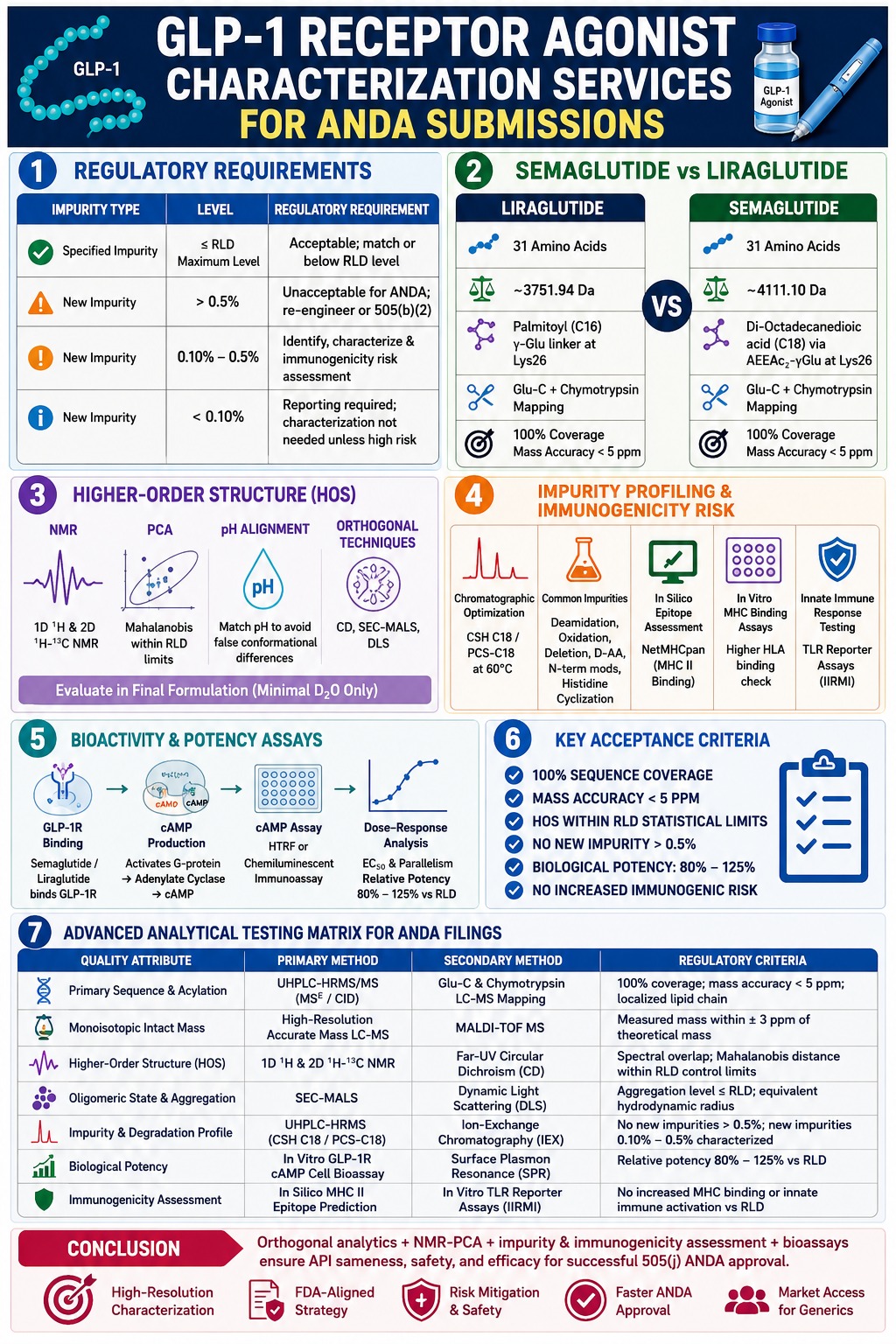
The regulatory framework applicable to GLP-1 Receptor Agonist Characterization Services for ANDA submissions requires applicants to demonstrate API sameness while meeting peptide-specific impurity control requirements established by the FDA. Under FDA guidance, a new peptide-related impurity present at a concentration greater than 0.5% can prevent approval through the ANDA pathway, whereas new impurities occurring between 0.10% and 0.5% require comprehensive structural identification, characterization, and scientific justification addressing potential immunogenicity and safety concerns.
Explore the detailed regulatory expectations for GLP-1 peptide characterization.
The FDA final guidance, ANDAs for Certain Highly Purified Synthetic Peptide Drug Products That Refer to Listed Drugs of rDNA Origin, describes the criteria under which synthetic generic peptides, including liraglutide and semaglutide, may reference previously approved rDNA-derived drug products. Although International Council for Harmonisation (ICH) Q3A and Q3B guidelines provide the conventional framework for impurities associated with small-molecule drug substances and drug products, synthetic peptides require additional regulatory consideration because trace peptide-related impurities may potentially contribute to immunogenicity or other safety concerns.
- Specified Common Impurities: Peptide-related impurities detected in both the generic synthetic peptide and the reference listed drug must be controlled at concentrations less than or equal to the corresponding levels observed in the RLD.
- New Peptide-Related Impurities (>0.5%): A new peptide-related impurity present at a concentration exceeding 0.5% of the full-length product is considered unacceptable for an ANDA filing and may necessitate product re-engineering or consideration of the 505(b)(2) NDA pathway.
- New Peptide-Related Impurities (0.10%–0.5%): New peptide-related impurities occurring from 0.10% to 0.5% require structural identification and characterization, together with a scientifically supported assessment demonstrating that they do not adversely affect product safety, efficacy, or immunogenic potential.
- Reporting Threshold (0.10%): Peptide-related impurities present at or above 0.10% must be appropriately identified and quantified.
| Impurity Classification | Concentration Threshold | Regulatory Mandate for ANDA Approval |
|---|---|---|
| Specified Impurity (Common with RLD) | Less than or equal to the Maximum Level in RLD | Acceptable; the impurity profile must match or remain below the corresponding RLD levels |
| New Peptide-Related Impurity | Greater than 0.5% | Unacceptable for ANDA; requires product re-engineering or consideration of the 505(b)(2) pathway |
| New Peptide-Related Impurity | 0.10%–0.5% | Requires structural identification, characterization, and immunogenicity risk assessment |
| New Peptide-Related Impurity | Less than 0.10% | Reporting is required; characterization is generally not required unless the impurity presents a high level of concern |
Primary Sequence and Mass Spectrometric Strategies for Semaglutide and Liraglutide
Demonstrating primary sequence sameness for semaglutide and liraglutide requires complete amino acid sequence coverage together with accurate mass determination using ultra-high-performance liquid chromatography coupled with high-resolution mass spectrometry (UHPLC-HRMS/MS). Orthogonal enzymatic digestion strategies are used to maximize sequence coverage and provide independent confirmation of the peptide backbone. High-resolution mass spectrometry enables confirmation of the expected amino acid sequence while also supporting precise localization of complex hydrophobic lipid moieties and their attachment sites.
Read about our precision capabilities for peptide sequencing of GLP-1.
Liraglutide contains a 31-amino acid backbone with a modification at Lys26 consisting of a palmitoyl (C16) fatty acid chain connected through a γ-glutamyl (γ-Glu) spacer. This structure results in a theoretical monoisotopic molecular weight of approximately 3751.94 Da. Semaglutide exhibits structural homology with liraglutide but incorporates two important synthetic modifications. At position 8, native alanine is replaced with 2-aminoisobutyric acid (Aib), which contributes to resistance against dipeptidyl peptidase-4 (DPP-4)-mediated enzymatic degradation. In addition, a di-fatty acid acyl chain is attached to Lys26. This modification consists of a di-octadecanedioic acid (C18) di-acid linked through a bi-antennary polyethylene glycol-like (AEEAc2-γGlu) linker and produces a theoretical monoisotopic mass of approximately 4111.10 Da.
A single-enzyme digestion approach may not provide sufficient sequence coverage because the bulky hydrophobic acylation at Lys26 can introduce steric hindrance and resistance to enzymatic cleavage. Consequently, establishing primary sequence sameness requires complementary enzymatic digestion strategies using endoproteinase Glu-C and chymotrypsin. The resulting peptide fragments can be analyzed independently to provide overlapping sequence information and strengthen the overall structural assignment.
- Enzymatic Mapping Strategy: Glu-C digestion cleaves the peptide backbone at glutamic acid residues and generates characteristic peptide fragments. Chymotrypsin provides complementary cleavage patterns by targeting aromatic and bulky hydrophobic residues. Combining both digestion strategies increases sequence coverage and reduces the possibility that cleavage-resistant regions remain uncharacterized.
- Mass Accuracy Limits: Tandem mass spectrometry (MS/MS or MS^E) performed using Orbitrap or Time-of-Flight (Q-ToF) instruments should provide high mass accuracy, with an error window below 5 ppm for both intact monoisotopic mass measurements and individual sequence fragment ions.
- Acylation Site Confirmation: Fragment ion spectra, including y- and b-type ions, should confirm the Aib8 substitution in semaglutide and accurately localize the modified Lys26 residue carrying the fatty acid linker. The analytical assessment should also exclude evidence of sequence transposition, incomplete acylation, or unacylated peptide intermediates.
| Parameter | Liraglutide Analytical Profile | Semaglutide Analytical Profile |
| Monoisotopic Molecular Mass | Approximately 3751.94 Da | Approximately 4111.10 Da |
| Backbone Modifications | Native GLP-1 (7-37) sequence backbone | Position 8: Alanine replaced by 2-aminoisobutyric acid (Aib) |
| Lys26 Side-Chain Structure | Palmitoyl (C16) fatty acid via γ-Glu linker | Di-octadecanedioic acid (C18) via AEEAc2-γGlu linker |
| Digest Chemistry | Parallel Glu-C and Chymotrypsin mapping | Parallel Glu-C and Chymotrypsin mapping |
| Sequence Acceptance Criteria | 100% coverage; mass accuracy below 5 ppm | 100% coverage; mass accuracy below 5 ppm |
Higher-Order Structure (HOS) Evaluation in GLP-1 Receptor Agonist Characterization Services for ANDA
Higher-order structure (HOS) sameness is assessed directly in the finished drug product using non-destructive one-dimensional (1D) and two-dimensional (2D) NMR spectroscopy, together with principal component analysis (PCA), to quantitatively evaluate conformational similarity with the reference listed drug. NMR spectroscopy provides information about the structural environment of peptide residues and can capture secondary alpha-helical folding and tertiary self-association states without substantially disrupting the native solution conformation of the peptide.
Learn how we utilize 2D NMR for peptide characterization.
FDA regulatory expectations require HOS sameness to be evaluated directly in the final drug formulation, with only minimal addition of deuterium oxide (D2O) permitted for lock signal alignment. High-field one-dimensional (1H) and two-dimensional (1H-13C or 1H-1H) NMR spectroscopy produce characteristic spectral fingerprints that reflect the local spatial environments of peptide backbone amide protons and side-chain methyl groups. Spectral datasets obtained from generic test batches and multiple commercial RLD lots can subsequently be evaluated using Principal Component Analysis (PCA) and Mahalanobis distance calculations to determine whether the generic product falls within the established statistical confidence limits for the reference product.
Sample pH alignment is a particularly important technical parameter during NMR-based HOS characterization. Even relatively minor differences in sample pH between generic formulations and RLD lots can produce chemical shift changes in proton resonances associated with histidine (His7) and carboxylic acid side chains because of changes in their fractional protonation states. These reversible chemical shift differences may be incorrectly interpreted as physical conformational changes and can potentially result in false-positive statistical failures when evaluated against a Mahalanobis distance benchmark. Applying controlled, non-disruptive pH alignment procedures helps ensure that spectral differences and similarities primarily represent genuine conformational characteristics rather than simple variations in ionization state. Orthogonal biophysical techniques, including Far-UV Circular Dichroism (CD) for secondary structure assessment, Dynamic Light Scattering (DLS), and Size-Exclusion Chromatography with Multi-Angle Light Scattering (SEC-MALS), can provide additional evidence concerning structural sameness and oligomeric aggregation state.
See our application of CD spectroscopy for peptide secondary structure characterization.
Impurity Profiling and Immunogenicity Risk Mitigation
Impurity profiling of synthetic GLP-1 agonists requires high-resolution chromatographic separation capable of resolving process-related and degradation-related peptide variants. These analytical evaluations should be complemented by appropriate, multi-tiered immunogenicity assessments when novel impurities are detected. Comprehensive impurity characterization helps demonstrate that the synthetic manufacturing process does not introduce unique peptide sequences or potentially immunogenic epitopes that are absent from the rDNA-derived reference product.
Get in-depth insights into GLP-1 peptide impurity characterization.
Solid-phase peptide synthesis (SPPS), formulation, and storage of hydrophobic acylated peptides can result in characteristic degradation products and process-related impurities. Frequently encountered peptide-related variants include deamidation (+0.984 Da) at asparagine or glutamine residues, oxidation (+16 Da) involving methionine or tryptophan residues, deletion sequences (n-1), D-amino acid diastereomers, and N-terminal modifications. A critical quality attribute (CQA) associated with semaglutide and liraglutide is the potential reaction of the N-terminal histidine residue with trace formaldehyde or formulation excipients, which may result in imidazopyrimidine ring cyclization.
- Chromatographic Optimization: The presence of hydrophobic acyl chains can result in strong adsorption to chromatographic columns and increased peak tailing when conventional C18 stationary phases are used. High-resolution separation may therefore require charged surface hybrid (CSH C18) or peptide PCS-C18 stationary phases operated at elevated temperatures, such as 60°C, with mobile phases containing 0.1% formic acid. Optimization of stationary phase chemistry and chromatographic conditions is important for resolving closely related peptide variants and degradation products.
- In Silico Epitope Assessment: New peptide impurities occurring between 0.10% and 0.5% should be evaluated using suitable computational algorithms, such as NetMHCpan, to predict MHC Class II binding affinity and assess potential T-cell epitope activity.
- In Vitro MHC Binding Assays: Physical cell-free or cell-based MHC binding assays can be used to determine whether identified impurity sequences interact with human leukocyte antigen (HLA) alleles with greater affinity than the parent peptide. These assessments provide experimental support for computational immunogenicity predictions.
- Innate Immune Response Testing: Formulated drug products and isolated impurities can be evaluated using cell-based reporter gene assays to identify Innate Immune Response Modulatory Impurities (IIRMIs), including trace endotoxins or flagellin, through assessment of Toll-like receptor (TLR) stimulation.
Bioactivity and Functional Potency Assays
Biological functional sameness for generic GLP-1 receptor agonists is established through cell-based in vitro assays that evaluate receptor binding and downstream intracellular cyclic adenosine monophosphate (cAMP) production in comparison with the reference listed drug. Bioactivity testing provides an important functional assessment because confirmation of primary sequence identity and higher-order structural similarity must ultimately translate into comparable biological activity and potency at the intended target receptor.
Binding of semaglutide or liraglutide to the extracellular domain of the GLP-1 receptor (GLP-1R) produces a conformational change that activates intracellular G-protein signaling. This signaling pathway stimulates adenylate cyclase, which catalyzes the conversion of ATP into cAMP. Quantitative bioactivity evaluation can be performed using recombinant cell lines, such as CHO-K1 or HEK293 cells, that stably express human GLP-1R.
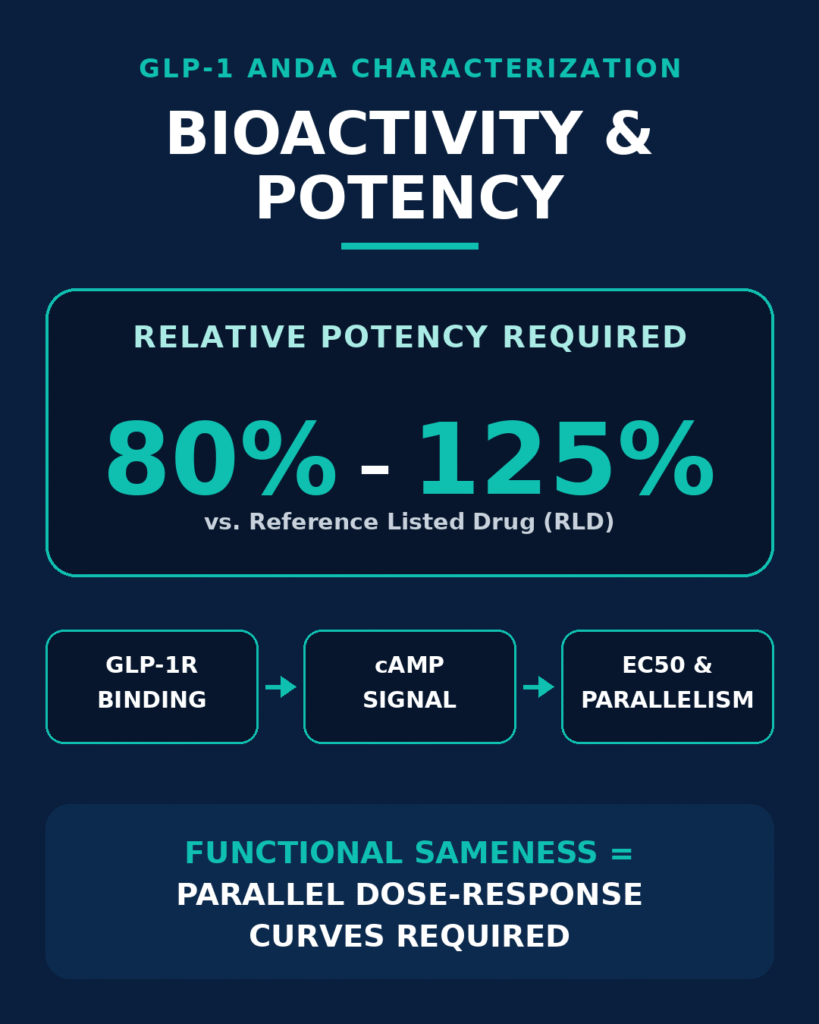
Cells are exposed to a serial dilution gradient of the generic candidate and RLD reference standards. Intracellular cAMP concentrations are subsequently quantified using homogeneous time-resolved fluorescence (HTRF) or chemiluminescent immunoassays. Concentration-response data are fitted using four-parameter logistic models to determine the half-maximal effective concentration (EC50) and assess curve parallelism. Functional sameness acceptance criteria require the generic peptide to demonstrate comparable and parallel dose-response kinetics, together with a relative potency within 80% to 125% of the reference listed drug.
Advanced Analytical Testing Matrix for ANDA Filings
A comprehensive ANDA filing for a generic semaglutide or liraglutide product requires an integrated analytical testing matrix incorporating mass spectrometry, NMR spectroscopy, chromatographic impurity profiling, and functional bioassays across multiple generic batches and reference listed drug lots. Contract testing facilities, including ResolveMass Laboratories Inc., can structure characterization programs around these complementary analytical platforms to address the relevant FDA regulatory requirements and establish a scientifically defensible comparability package.
| Quality Attribute | Primary Analytical Method | Secondary / Orthogonal Method | Regulatory Acceptance Criteria |
| Primary Sequence & Acylation | UHPLC-HRMS/MS (MS^E/CID) | Glu-C & Chymotrypsin LC-MS Mapping | 100% sequence coverage; mass accuracy below 5 ppm; localized lipid chain |
| Monoisotopic Intact Mass | High-Resolution Accurate Mass LC-MS | MALDI-TOF MS | Measured mass within ±3 ppm of theoretical molecular weight |
| Higher-Order Structure (HOS) | 1D 1H & 2D 1H-13C NMR | Far-UV Circular Dichroism (CD) | Spectral overlap; Mahalanobis distance within RLD control limits |
| Oligomeric State & Aggregation | SEC-MALS | Dynamic Light Scattering (DLS) | Aggregation level less than or equal to RLD; equivalent hydrodynamic radius |
| Impurity & Degradation Profile | UHPLC-HRMS (CSH C18 / PCS-C18) | Ion-Exchange Chromatography (IEX) | No new impurities greater than 0.5%; new impurities from 0.10% to 0.5% characterized |
| Biological Potency | In Vitro GLP-1R cAMP Cell Bioassay | Surface Plasmon Resonance (SPR) | Relative potency of 80% to 125% relative to RLD |
| Immunogenicity Assessment | In Silico MHC II Epitope Prediction | In Vitro TLR Reporter Assays (IIRMI) | No increased MHC binding or innate immune activation versus RLD |
Find out more about our specialized peptide aggregation analysis.
Conclusion: Implementing GLP-1 Receptor Agonist Characterization Services for ANDA Approval
Establishing active ingredient sameness for synthetic GLP-1 receptor agonists requires specialized GLP-1 Receptor Agonist Characterization Services for ANDA submissions that combine high-resolution analytical characterization with rigorous assessments of immunogenicity and biological activity. Successfully navigating the 505(j) generic approval pathway for complex acylated peptides such as semaglutide and liraglutide requires scientifically defensible evidence demonstrating primary sequence identity, equivalent higher-order structural characteristics, comparable functional potency, and compliance with applicable synthetic peptide impurity requirements.
By implementing orthogonal analytical strategies, including multi-enzyme LC-HRMS/MS sequence mapping, non-destructive NMR-PCA higher-order structure profiling, detailed impurity characterization, and cell-based cAMP potency bioassays, generic drug developers can generate a comprehensive characterization package aligned with FDA regulatory expectations. Combining complementary analytical methodologies provides greater confidence that the synthetic peptide matches the reference listed drug across critical quality attributes rather than relying on a single analytical technique.
Download our peptide characterization CRO deliverables checklist to ensure a successful submission.
Partnering with experienced analytical testing laboratories can further support the development of robust peptide characterization programs. Laboratories with appropriate expertise can perform complex analytical evaluations using validated or suitably qualified protocols, interpret orthogonal datasets, identify and characterize peptide-related impurities, and assemble scientifically defensible data packages. A well-designed characterization strategy can therefore help generic developers address regulatory expectations efficiently, facilitate the ANDA review process, and support successful access to the generic pharmaceutical market.
To consult with specialized peptide characterization experts or request GLP-1 Receptor Agonist Characterization Services for ANDA submissions, visit the ResolveMass Laboratories Inc. Contact Us Page.
Frequently Asked Questions
API sameness means establishing that a generic GLP-1 receptor agonist has the same primary amino acid sequence and corresponding side-chain modifications as the reference listed drug. The assessment also considers higher-order structure, aggregation characteristics, and the overall impurity profile. Analytical evidence should demonstrate that these critical attributes are comparable to those of the RLD.
FDA guidance permits certain highly purified synthetic peptide drug products to use the 505(j) ANDA pathway when they meet the applicable requirements for referencing an rDNA-derived listed drug. For eligible peptides, applicants must demonstrate active ingredient sameness through comprehensive analytical characterization. The assessment must also address peptide-related impurities and potential differences in immunogenicity.
For synthetic peptide ANDA submissions, peptide-related impurities common to the generic and RLD should not exceed the corresponding RLD levels. A new peptide-related impurity above 0.5% is generally inconsistent with the ANDA pathway. New impurities in the 0.10% to 0.5% range require identification, characterization, and an appropriate scientific assessment of their safety and immunogenicity implications.
HOS evaluation can be performed directly on the finished drug product using non-destructive NMR spectroscopy. One-dimensional 1H and two-dimensional 1H-13C NMR techniques generate spectral fingerprints that can be compared between generic batches and RLD lots. Principal component analysis (PCA) and Mahalanobis distance calculations can then be applied to evaluate the degree of structural similarity.
Careful pH matching is essential because even small differences in sample pH can change the protonation state of ionizable amino acid residues. These changes may produce measurable chemical shift differences in the NMR spectrum without representing an actual alteration in peptide conformation. Proper pH alignment therefore helps distinguish genuine HOS differences from reversible ionization-related spectral changes.
Liraglutide and semaglutide contain distinct structural modifications that must be accurately resolved during peptide mapping. Semaglutide includes an Aib8 substitution and a di-carboxylic C18 fatty acid modification, while liraglutide contains its characteristic C16 palmitoyl group. Because the hydrophobic modification near Lys26 can interfere with enzymatic cleavage, complementary Glu-C and chymotrypsin digestion strategies are useful for obtaining comprehensive sequence coverage.
Potential N-terminal histidine modifications can be investigated using high-resolution UHPLC-HRMS methods capable of detecting small mass changes and characterizing modified peptide species. Chromatographic separation may utilize charged surface hybrid (CSH C18) or peptide PCS-C18 stationary phases to improve resolution of closely related variants. The resulting accurate-mass and fragmentation data can support identification and structural characterization of the modification.
New peptide-related impurities in the 0.10% to 0.5% range may require a tiered assessment of their potential immunogenicity. Computational approaches can evaluate MHC Class II binding and potential T-cell epitope activity, while in vitro HLA binding assays can provide experimental evidence. Cell-based assays, including TLR reporter systems, may additionally be used to investigate potential innate immune activation associated with specific impurities.
In vitro bioactivity can be assessed using recombinant cell systems, such as CHO-K1 or HEK293 cells, engineered to express the human GLP-1 receptor (GLP-1R). Exposure to serial concentrations of the test and reference products allows measurement of receptor-mediated intracellular cAMP production. Concentration-response curves are then compared to evaluate potency, dose-response behavior, and functional similarity relative to the reference listed drug.
Hydrophobic acylated peptides can exhibit strong interactions with conventional chromatographic stationary phases, which may cause adsorption, broad peaks, or peak tailing. Charged surface hybrid (CSH C18) and peptide PCS-C18 stationary phases can provide improved chromatographic behavior for these structurally complex molecules. Elevated column temperatures and appropriately optimized mobile-phase conditions can further improve separation and resolution of acylated peptide variants.
Reference:
- U.S. Food and Drug Administration, Center for Drug Evaluation and Research. (2021, May). ANDAs for certain highly purified synthetic peptide drug products that refer to listed drugs of rDNA origin: Guidance for industry. U.S. Department of Health and Human Services. http://resource.nlm.nih.gov/9918350982606676
- U.S. Food and Drug Administration, Center for Drug Evaluation and Research. (2022, November). Sameness evaluations in an ANDA—Active ingredients: Guidance for industry [Draft guidance]. U.S. Department of Health and Human Services. https://www.fda.gov/media/163018/download
- Wasilewska, B., & Petruczynik, A. (2025). Semaglutide—Properties, action and chromatographic analysis. Journal of Diabetes & Metabolic Disorders, 24(2), 197. https://doi.org/10.1007/s40200-025-01711-8
- United States Pharmacopeial Convention. (2018, February 2). USP comments to FDA on draft guidance: Certain highly purified synthetic peptide drug products that refer to listed drugs of rDNA origin. https://www.usp.org/sites/default/files/usp/document/public-policy/comment-letter/USP-comments-on-GFI-synthetic-peptides.pdf
- Arbogast, L. W., Delaglio, F., Brinson, R. G., & Marino, J. P. (2020). Assessment of the higher-order structure of formulated monoclonal antibody therapeutics by 2D methyl correlated NMR and principal component analysis. Current Protocols in Protein Science, 100(1), e105. https://doi.org/10.1002/cpps.105
- Zhang, X., Zhang, L., Wang, B., Zhang, X., Gu, L., Guo, K., Zhang, X., & Zhou, Z. (2023). GLP-1 receptor agonist liraglutide inhibits the proliferation and migration of thyroid cancer cells. Cellular and Molecular Biology, 69(14), 221–225. https://doi.org/10.14715/cmb/2023.69.14.37
Get In Touch With Us
About The Author


