


Introduction:
GMP-Grade PLGA for Phase II/III Clinical Supply is a critical CMC decision for pharmaceutical companies developing long-acting injectables, microspheres, implants, nanoparticles, and other controlled-release drug delivery systems. At these stages, the polymer is no longer simply a development material — its quality and consistency can directly affect manufacturing reproducibility, drug release, stability, and regulatory submissions.
Poly(lactic-co-glycolic acid), or PLGA, is one of the most widely used biodegradable polymers in pharmaceutical drug delivery, but it should never be treated as a generic commodity. Two polymers described as having the same nominal lactide:glycolide ratio and molecular-weight range can still behave differently because of differences in end-group chemistry, molecular-weight distribution, residual monomers, moisture content, manufacturing history, and degradation characteristics.
The central question for CMC teams is straightforward: what should be evaluated when sourcing GMP-grade PLGA for Phase II/III clinical supply? The answer combines GMP manufacturing controls, polymer critical quality attributes, orthogonal analytical characterization, documentation depth, supply-chain reliability, change-control systems, and demonstrated lot-to-lot consistency.
Summary:
- GMP-Grade PLGA for Phase II/III Clinical Supply requires tighter control of material identity, molecular weight, composition, end-group chemistry, residual solvents, impurities, and lot-to-lot consistency than early-stage development materials.
- PLGA characteristics such as lactide:glycolide ratio, molecular weight, molecular-weight distribution, end-group chemistry, and inherent viscosity directly influence drug release, degradation rate, and finished-product performance.
- Vendor selection should weigh GMP controls, manufacturing consistency, analytical capability, change control, supply continuity, and regulatory documentation — not price per kilogram.
- A robust PLGA qualification strategy connects polymer specifications to the critical quality attributes (CQAs) and performance requirements of the finished drug product.
- Supplier requirements evolve across the development lifecycle — Phase III and commercial supply demand far more rigorous documentation and change control than early feasibility work.
- ResolveMass Laboratories Inc. supports PLGA characterization, comparative lot assessment, and vendor-qualification testing to help developers make informed sourcing decisions.
1: Why PLGA Sourcing Becomes Critical at Phase- II/III
Small variations in PLGA raw material that were tolerable in early feasibility work can shift drug release kinetics, degradation rate, and burst release enough to compromise a pivotal trial’s bioequivalence or exposure data.
Phase I supply is often made from a single, hand-picked lot of polymer, sometimes even research-grade material qualified informally. That approach breaks down at Phase II/III for several reasons:
- Batch size increases, which usually means sourcing multiple polymer lots rather than one.
- Regulatory scrutiny increases, with agencies expecting CMC data that demonstrates the process — including raw materials — is under control.
- Tolerance for unexplained variability decreases, since the development team must demonstrate the selected polymer and manufacturing process repeatedly produce material with predictable performance.
- Bridging risk increases, since any formulation or polymer change between Phase I and later trials may require additional comparability data.
Poorly controlled polymer variability can contribute to changes in initial burst release, differences in degradation rate, altered drug-release duration, changes in particle morphology, encapsulation-efficiency variability, manufacturing-process variability, stability differences, unexpected impurity profiles, difficulties during technology transfer, and clinical supply interruptions. For long-acting injectable products in particular, relatively small changes in polymer properties can meaningfully influence the release kinetics of the finished dosage form.
2: What “GMP-Grade” Actually Means for PLGA
GMP-grade PLGA means the polymer is manufactured and controlled under an appropriate pharmaceutical quality system, with defined specifications, traceability, documentation, and manufacturing controls suitable for its intended clinical use — not simply a “pharmaceutical” label on a supplier’s product sheet.
Important characteristics to evaluate include:
- Polymer identity
- Lactide:glycolide composition
- Molecular weight and molecular-weight distribution
- End-group chemistry
- Inherent or intrinsic viscosity
- Residual solvents and residual monomers
- Water/moisture content
- Elemental impurities, where applicable
- Bioburden and microbiological controls, where applicable
- Appearance and physical characteristics
- Lot-to-lot consistency
- Packaging and storage controls
- Manufacturing traceability
At minimum, GMP-grade material for clinical supply should come with a Certificate of Analysis (CoA) carrying numerical specifications (not “meets requirements” language), traceable raw materials, defined change-control commitments, TSE/BSE and elemental impurity statements, access to a Drug Master File (DMF) or equivalent regulatory support, and defined shelf-life and storage/stability data.
3: Which PLGA Quality Attributes Should Be Controlled?
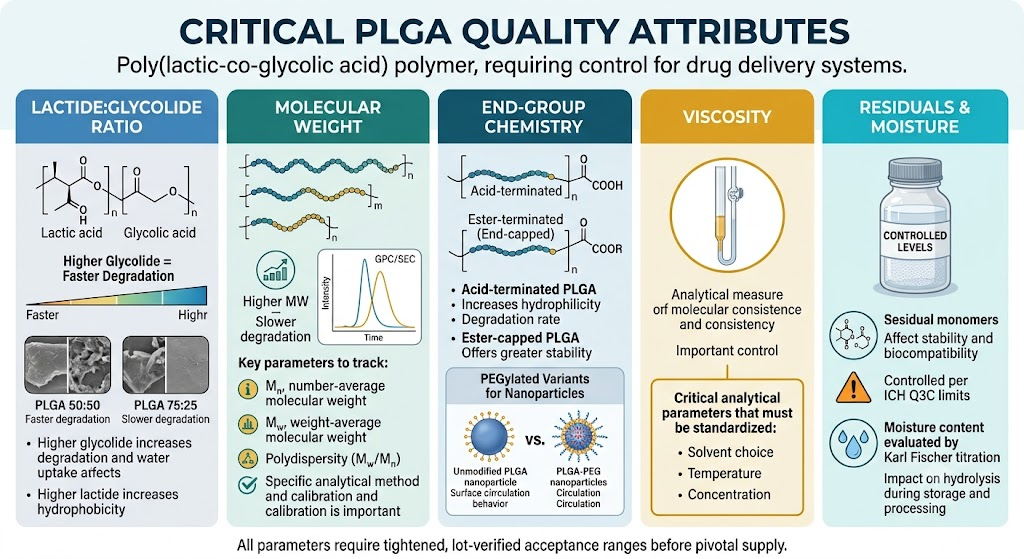
The most important PLGA quality attributes depend on the drug-delivery system, but lactide:glycolide ratio, molecular weight, molecular-weight distribution, end-group chemistry, viscosity, moisture, and impurity profile are commonly critical parameters that need tightened, lot-verified acceptance ranges before pivotal supply begins.
Lactide:Glycolide Ratio
The ratio of lactic acid–derived units to glycolic acid–derived units strongly influences polymer degradation and hydrophilicity.
| PLGA Characteristic | Potential Formulation Impact |
|---|---|
| Higher glycolide content | Can influence degradation rate and water uptake |
| Higher lactide content | Can influence hydrophobicity and degradation behavior |
| Approximately 50:50 composition | Often associated with relatively rapid degradation compared with many other ratios |
| 75:25 or similar compositions | May provide slower degradation depending on other polymer attributes |
The selected ratio should be linked to the desired drug-release profile rather than treated as an isolated specification — see this comparison of PLGA 50:50 vs. PLGA 75:25 for how composition differences translate into degradation and release behavior.
Molecular Weight and Molecular-Weight Distribution
Molecular weight is one of the most important PLGA attributes affecting mechanical properties, viscosity, degradation, and drug-release behavior. Higher molecular-weight PLGA generally has longer polymer chains and can exhibit slower degradation under otherwise comparable conditions.
Developers should track number-average molecular weight (Mn), weight-average molecular weight (Mw), molecular-weight distribution, polydispersity parameters, and the analytical method used for determination. A supplier’s molecular-weight value is only meaningful when the analytical method and acceptance criteria are appropriately defined — two suppliers can report different values simply because they use different GPC/SEC conditions or calibration approaches.
End-Group Chemistry
PLGA may contain different terminal groups — acid-terminated (free carboxylic acid end group) or ester-terminated (end-capped) — and this distinction can affect polymer hydrophilicity, degradation rate, molecular interactions, and drug-release behavior. Acid-terminated PLGA generally degrades faster and can accelerate encapsulated drug release compared with ester-capped polymer, so end-group chemistry should be explicitly defined during supplier qualification rather than assumed from the nominal grade name.
For nanoparticle applications, some programs also evaluate PEGylated variants; this comparison of PLGA vs. PLGA-PEG for nanoparticle drug delivery outlines how PEGylation changes surface characteristics and circulation behavior relative to unmodified PLGA.
Inherent or Intrinsic Viscosity
Viscosity measurements provide useful information about polymer molecular characteristics and consistency, and can serve as an important release specification or incoming-material control. However, the analytical procedure must be standardized, since solvent choice, temperature, polymer concentration, instrumentation, and calculation method can all influence the reported value.
Residual Solvents, Monomers, and Moisture
Residual solvent and monomer levels are controlled per ICH Q3C limits; residual lactide/glycolide monomer can affect both stability and biocompatibility. Moisture content, evaluated by Karl Fischer titration or TGA, can influence polymer hydrolysis during storage and processing.
4: What Analytical Testing Should Be Performed for GMP-Grade PLGA?
A robust PLGA qualification program uses orthogonal analytical techniques rather than relying on a single test, since no single method fully captures polymer identity, composition, and performance-relevant behavior.
| Attribute | Example Analytical Approach | Purpose |
|---|---|---|
| Identity | FTIR, NMR | Confirm polymer identity |
| Molecular weight | GPC/SEC | Determine Mw, Mn, and distribution |
| Composition | NMR, chromatography | Evaluate lactide:glycolide composition |
| End groups | NMR/appropriate chemical analysis | Confirm terminal-group chemistry |
| Thermal properties | DSC/TGA | Evaluate Tg and thermal characteristics |
| Residual solvents | GC | Quantify volatile residues |
| Residual monomers | Chromatographic methods | Evaluate unreacted starting materials |
| Moisture | Karl Fischer/TGA | Assess water content |
| Degradation behavior | Controlled degradation studies | Compare polymer performance |
| Elemental impurities | ICP-MS/ICP-OES, where appropriate | Evaluate inorganic impurities |
For Phase II/III programs, analytical methods should be sufficiently controlled and scientifically justified for their intended purpose. Sponsors who rely solely on a supplier’s CoA — without independent verification — are the ones most likely to discover a release-profile shift only after a clinical batch has already been manufactured.
5: How Should PLGA Suppliers Be Qualified?
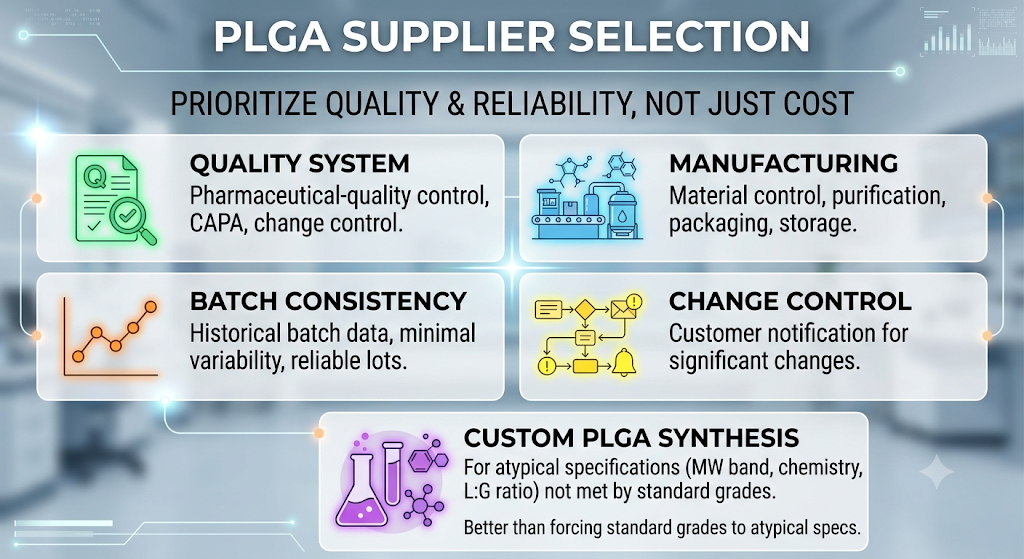
PLGA supplier qualification should be based on quality, technical capability, manufacturing controls, documentation, and supply reliability — not simply cost per kilogram.
Quality system. Evaluate whether the supplier has an established pharmaceutical-quality system covering deviations, CAPA, change control, OOS investigations, complaints, training, document control, batch release, and supplier qualification.
Manufacturing controls. Ask how the supplier controls raw materials, polymerization, reaction conditions, purification, drying, milling or processing, packaging, storage, and environmental conditions.
Batch consistency. Request historical batch data where appropriate to understand variability, with the goal of determining whether multiple production lots consistently meet the required specifications.
Change-control process. Late-stage clinical programs are particularly sensitive to uncontrolled changes. A qualified supplier should have a defined process for notifying customers about significant changes involving raw materials, manufacturing location, manufacturing process, equipment, specifications, analytical methods, packaging, or subcontractors.
Some programs also require polymer attributes outside a supplier’s standard catalog — a tightened molecular-weight band, a specific end-group chemistry, or a non-standard L:G ratio. In those cases, custom PLGA synthesis services can be a more reliable path than trying to force a standard-grade polymer to meet an atypical specification.
6: What Documentation Should Be Requested from a PLGA Vendor?
A Phase II/III supplier should be capable of providing documentation supporting material identity, quality, and traceability, including:
- Certificate of Analysis (CoA) and Certificate of Conformance
- Material specification and manufacturing batch information
- Residual-solvent, molecular-weight, composition, and end-group data
- Storage requirements and retest/expiry information
- Safety and traceability documentation
- Change-control commitments and a signed Quality Agreement
- Audit documentation, where applicable
The exact documentation package should be established based on the product’s regulatory strategy and risk assessment. A formal Quality Agreement — covering change notification, deviation reporting, and audit rights — should be in place before the first GMP lot is ordered for clinical supply, not negotiated after a formulation problem has already appeared.
7: GMP-Grade PLGA for Phase II/III Clinical Supply: Vendor Selection Checklist
| Selection Criterion | Key Question |
|---|---|
| GMP quality system | Does the supplier operate an appropriate pharmaceutical-quality system? |
| Polymer specification | Are critical polymer attributes clearly defined? |
| Lot consistency | Can the supplier demonstrate consistent historical performance? |
| Analytical capability | Are relevant polymer characteristics routinely measured? |
| Traceability | Can raw materials and manufacturing lots be traced? |
| Change control | Will significant changes be communicated before implementation? |
| Supply capacity | Can the supplier support Phase III and potential commercial demand? |
| Documentation | Is sufficient quality documentation available? |
| Technical support | Can the supplier investigate material-related issues? |
| Regulatory support | Can documentation support regulatory submissions? |
| Packaging and storage | Are temperature and humidity requirements controlled? |
| Business continuity | Are contingency and supply-risk controls established? |
8: How Does PLGA Lot-to-Lot Variability Affect Drug Product Performance?
PLGA lot variability translates into drug-product variability when polymer characteristics are not adequately controlled, and it is the most common root cause of unexpected burst release or failed dissolution/in vitro release testing (IVRT) results in late-stage PLGA programs — even when every lot technically passes the supplier’s own CoA.
Changes in molecular weight or end-group chemistry can influence polymer degradation, which subsequently affects the chain from polymer characteristics to particle structure, water penetration, polymer erosion, and drug diffusion/release. This relationship is particularly important for long-acting formulations where the polymer controls drug release over weeks or months.
Potential consequences of uncontrolled lot variability include a higher or lower initial burst, changes in release duration, an altered degradation profile, different particle morphology, changes in residual drug, different processability, and batch-to-batch dissolution differences. Because of this, tracking encapsulation efficiency in PLGA microspheres alongside standard polymer release testing gives an earlier signal of lot-driven performance drift than dissolution testing alone.
A practical incoming-QC program for clinical supply typically includes independent GPC confirmation of Mw/PDI on every incoming lot, NMR confirmation of L:G ratio and end-group identity, FTIR fingerprinting for chemical identity, residual solvent and monomer testing, and a small-scale formulation trial or accelerated release test to flag performance drift before committing an entire lot to GMP manufacturing.
9: Manufacturing and Processing Considerations
The polymer processing method chosen for a given delivery system also interacts with lot-to-lot polymer variability. For microsphere and microparticle products, the choice between spray drying and solvent evaporation affects particle size distribution, residual solvent levels, and encapsulation efficiency — and can amplify or mask underlying polymer variability depending on process sensitivity. Formulation development activities, including PLGA microsphere formulation development, should therefore account for the specific polymer lot’s attributes rather than assuming interchangeability across “equivalent” grades.
Delivery-route-specific applications add further considerations. PLGA-based inhalable microparticle development for pulmonary delivery imposes tighter particle-size and aerodynamic requirements that make polymer consistency especially important, while PLGA used in vaccine and antigen delivery applications often requires additional attention to protein/antigen stability during encapsulation and release.
10: What Is the Role of PLGA Characterization in Regulatory Development?
PLGA characterization provides important CMC evidence for demonstrating material understanding and controlling critical material attributes. For regulated pharmaceutical development, developers should be prepared to explain why the selected PLGA grade was chosen, which polymer characteristics are considered critical, how specifications were established, how supplier lots are qualified, how incoming material is tested, how changes in polymer attributes could affect product performance, how supplier changes are managed, and how material consistency is demonstrated across the clinical program.
A scientifically justified PLGA control strategy strengthens the overall pharmaceutical development package and is often what separates a smooth CMC review from an agency information request that delays a Phase II/III start date.
11: Phase II vs. Phase III: How PLGA Supplier Requirements Evolve
The importance of supplier control generally increases as a development program progresses.
| Development Stage | Primary Focus |
|---|---|
| Early development | Polymer screening and formulation feasibility |
| Phase I | Initial material qualification and process understanding |
| Phase II | Greater control of polymer variability and clinical consistency |
| Phase III | Robust supplier qualification, documentation, supply continuity, and change control |
| Commercial | Long-term supply strategy, validated processes, and lifecycle management |
By Phase III, developers should have a well-defined strategy for polymer sourcing and contingency planning, including confirming that a supplier’s PLGA microsphere scale-up services can carry a formulation from clinical to commercial volumes without a disruptive site or process transfer.
12: Common Mistakes When Selecting a PLGA Supplier
- Choosing based only on price. The lowest-cost polymer may not provide the consistency, documentation, or supply security required for Phase III development.
- Using nominal specifications only. A label such as “50:50 PLGA” does not fully describe polymer behavior — molecular weight, end-group chemistry, molecular-weight distribution, moisture, and impurity levels also matter.
- Failing to compare multiple lots. One conforming batch does not necessarily demonstrate long-term supplier consistency.
- Ignoring analytical method differences. Two suppliers may report different molecular-weight values because they use different GPC/SEC conditions or calibration approaches.
- Weak change-control agreements. Unexpected changes in polymer manufacturing can create substantial comparability and regulatory challenges.
- Delaying supplier qualification. Qualification should occur early enough to support technology transfer, process validation planning, and clinical supply continuity.
13: Key Questions to Ask Before Signing a PLGA Supply Agreement
- What is the manufacturing site for the PLGA, and is it controlled under an appropriate quality system?
- What are the critical raw materials, and how are molecular weight, L:G ratio, and end-group chemistry each controlled and confirmed?
- What residual solvents are routinely monitored, and what are typical batch-to-batch variations?
- What is the supplier’s annual production capacity and typical lead time?
- What happens if a manufacturing change is proposed, and how are deviations and OOS results handled?
- Can historical CoAs be reviewed, and can the supplier support regulatory documentation?
- What is the business-continuity plan if a manufacturing site becomes unavailable?
14: How Can ResolveMass Support PLGA Supplier Qualification?
ResolveMass Laboratories Inc. supports pharmaceutical developers with analytical characterization and comparative evaluation of PLGA materials, helping teams understand whether polymer lots meet predefined requirements and whether differences between suppliers or batches could be relevant to formulation performance. Depending on project requirements, characterization strategies can include molecular-weight characterization, polymer composition assessment, structural characterization, end-group evaluation, thermal characterization, residual-solvent analysis, impurity profiling, comparative lot analysis, polymer degradation studies, and analytical method development and optimization.
For companies evaluating multiple PLGA suppliers, an independent analytical assessment provides an additional layer of technical confidence before material is introduced into critical clinical manufacturing activities.
Conclusion:
GMP-Grade PLGA for Phase II/III Clinical Supply should be selected through a risk-based combination of polymer characterization, supplier qualification, quality-system assessment, lot-to-lot consistency evaluation, regulatory documentation, and supply-chain planning. PLGA is a critical material whose molecular and chemical characteristics can influence manufacturing and product performance, so selecting a supplier based only on nominal polymer grade or price can create unnecessary CMC and clinical-supply risk.
A strong sourcing strategy establishes scientifically justified specifications for molecular weight, molecular-weight distribution, lactide:glycolide ratio, end-group chemistry, viscosity, moisture, residual solvents, and impurities, supported by appropriate analytical methods and linked, where relevant, to finished-product CQAs. For Phase II/III programs, developers should also evaluate the supplier’s quality system, change-control process, manufacturing capacity, documentation, traceability, technical support, and long-term supply reliability.
Frequently Asked Questions:
There is no universal number applicable to every product. A risk-based approach should be used based on the polymer’s criticality, development stage, historical variability, intended use, and regulatory strategy. Evaluating multiple representative lots generally provides more meaningful information about supplier consistency than testing only one lot.
PLGA testing can support the CMC package by demonstrating material identity, characterization, quality, and consistency. Data can help establish scientifically justified specifications and demonstrate understanding of critical material attributes. The extent of characterization should be appropriate to the product, development stage, and regulatory expectations.
Supplier qualification should begin early enough to support formulation development, process development, technology transfer, and clinical manufacturing. Waiting until late Phase III can increase the risk of supply constraints, comparability challenges, and delays if the original supplier cannot meet long-term requirements.
One of the biggest challenges is maintaining consistent polymer quality and supply while the formulation and manufacturing process become increasingly established. A supplier that cannot reliably maintain specifications, provide documentation, communicate changes, or meet increasing demand can create significant clinical and CMC risks.
The best approach is to use a risk-based, data-driven supplier qualification strategy. Define critical polymer attributes, establish scientifically justified specifications, characterize representative lots, evaluate the supplier’s quality system and manufacturing capabilities, assess supply continuity, and establish robust change-control and documentation requirements before committing to long-term clinical supply.
Reference
- Ehtezazi T. Regulatory Aspects to be Considered in the Development of Drug Delivery Systems to the Brain. InBrain Drug Delivery for the Treatment of Neurological Disorders 2027 (pp. 272-346). CRC Press.https://api.taylorfrancis.com/content/chapters/edit/download?identifierName=doi&identifierValue=10.1201/9781003482406-14&type=chapterpdf
- Tomar M. Parenteral Nanocarriers for mRNA and Gene Therapy: Emerging Trends and Future Perspectives: A Narrative Review. Science. 2025;14:100186.https://premierscience.com/wp-content/uploads/2025/12/5-pjs-25-1405.pdf
- Li X, Li J, Wei J, Du W, Su C, Shen X, Zhao A, Xu M. Design strategies for novel lipid nanoparticle for mRNA vaccine and therapeutics: current understandings and future perspectives. MedComm. 2025 Oct;6(10):e70414.https://onlinelibrary.wiley.com/doi/abs/10.1002/mco2.70414
- Vasanthi G, Ramachandran B, Vasimalla Y, Kumar S. Recent progress in nanoscale optical sensor technologies for early cancer detection and diagnosis. Discover Surfaces. 2026 Jul 24;1(1):6.https://link.springer.com/article/10.1007/s44507-026-00007-5
About the Author


