


Introduction
To accurately measure encapsulation efficiency in PLGA microspheres, analytical scientists employ either direct organic extraction techniques that dissolve the polymer matrix and quantify the encapsulated payload, or indirect mass-balance approaches that determine the amount of unentrapped drug remaining in the manufacturing supernatant. Poly(lactic-co-glycolic acid) (PLGA) microspheres are sophisticated biodegradable drug delivery systems widely used to provide the long-acting and sustained release of small-molecule drugs, peptides, and proteins. The therapeutic performance, initial burst release profile, and degradation behavior of these depot formulations are closely associated with their internal microstructure and the exact quantity of encapsulated active ingredient. As a result, precise analytical quantification is considered a critical regulatory requirement.
Obtaining an accurate measurement involves overcoming several complex physicochemical challenges, including polymer-drug interactions, peptide instability within acidic microenvironments, and analytical interference caused by polymeric stabilizers. Advanced analytical testing laboratories and contract research organizations must establish and validate these measurements to demonstrate formulation equivalence, product quality, and patient safety. This report outlines the advanced analytical methodologies, mathematical calculations, instrumentation platforms, and regulatory acceptance criteria required to validate encapsulation efficiency in accordance with International Council for Harmonisation (ICH) and U.S. Food and Drug Administration (FDA) expectations.
Share via:
Article Summary:
- Encapsulation efficiency (EE) measures how much drug is successfully trapped inside PLGA microspheres, making it a critical quality attribute that influences drug loading, release profile, stability, and therapeutic performance.
- Two primary analytical methods are used to determine EE: the direct extraction method, which measures the drug released from dissolved microspheres, and the indirect supernatant method, which estimates EE by quantifying the unencapsulated drug remaining after manufacturing.
- Drug Loading (DL), Theoretical Loading (TL), and Encapsulation Efficiency (EE) calculations, together with mass balance analysis, help verify API recovery and identify drug loss caused by degradation, adsorption, or processing errors.
- Advanced analytical techniques such as RP-HPLC, LC-MS/MS, and Size Exclusion Chromatography (SEC) provide accurate API quantification, detect peptide degradation or modification, and evaluate protein aggregation for complex formulations.
- Method validation must comply with ICH Q2(R2) and USP <1225>, demonstrating acceptable accuracy, precision, specificity, robustness, and system suitability to ensure reliable analytical performance.
- FDA Q3 microstructural equivalence requires generic PLGA microspheres to achieve encapsulation efficiency and drug loading values comparable to the reference product, as these directly affect microsphere structure, degradation, and drug release behavior.
- Reliable encapsulation efficiency data support formulation optimization, manufacturing consistency, regulatory approval, and the development of safe, effective, and bioequivalent long-acting PLGA drug delivery systems.
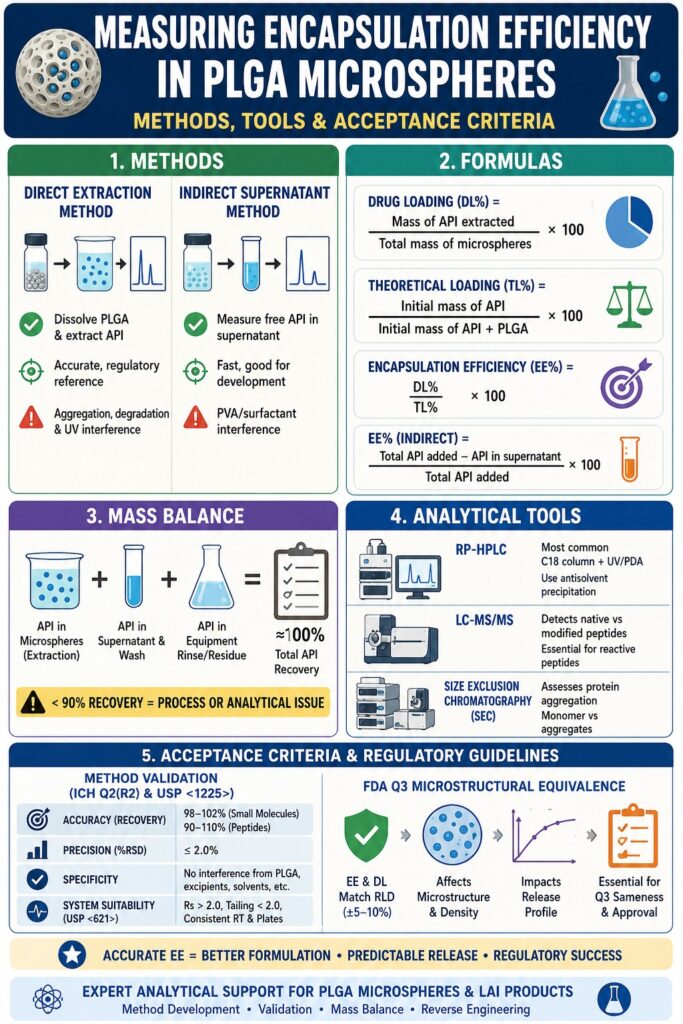
Methodologies to Measure Encapsulation Efficiency in PLGA Microspheres
Analytical laboratories generally determine encapsulation efficiency using two principal approaches: the direct method, which quantifies the drug contained within the microspheres, and the indirect method, which measures the amount of drug lost during the manufacturing process. The choice between these techniques depends largely on the physicochemical characteristics and stability profile of the Active Pharmaceutical Ingredient (API), as well as the excipients incorporated into the formulation.
The Direct Extraction Method
The direct extraction method determines encapsulation efficiency by completely dissolving the PLGA microsphere matrix in an appropriate organic solvent and subsequently extracting and quantifying the released API through chromatographic analysis.
In this procedure, analysts typically expose a precisely weighed amount of lyophilized PLGA microspheres (for example, 10 mg) to organic solvents such as dichloromethane (DCM), dimethyl sulfoxide (DMSO), or acetonitrile. Since PLGA exhibits excellent solubility in halogenated solvents and polar aprotic solvents, the polymer matrix readily dissolves under these conditions. However, the extraction strategy employed afterward is highly dependent on the physicochemical properties of the encapsulated API.
Hydrophobic Small Molecules:
These compounds can frequently be quantified directly within the organic phase using High-Performance Liquid Chromatography (HPLC), provided that the dissolved polymer does not produce overlapping UV absorbance at the selected analytical wavelength.
Hydrophilic Peptides and Proteins:
Large biomolecules commonly precipitate when exposed to aggressive solvents such as DCM. Consequently, a secondary extraction step involving phosphate-buffered saline (PBS) is often required to transfer the protein into the aqueous phase before quantification.
Alkaline Hydrolysis:
As an alternative strategy, researchers may use sodium hydroxide (NaOH) solutions (for example, 0.1 N or 1.0 N NaOH) to simultaneously hydrolyze the PLGA polymer backbone and release the entrapped protein into solution for analysis.
Learn more about handling hydrophilic versus hydrophobic APIs in PLGA formulations: 🔗 Strategies for Encapsulating Hydrophilic vs Hydrophobic APIs in PLGA
Although direct extraction approaches are widely regarded as the gold standard for final product release testing and regulatory submissions, they are associated with several analytical limitations. Insoluble protein aggregation during solvent extraction can result in incomplete recovery, leading to artificially reduced encapsulation efficiency values. For example, comparative investigations have shown that DCM extraction may produce an apparent encapsulation efficiency of only 12.62% for bovine serum albumin (BSA), whereas optimized NaOH hydrolysis can achieve a measured encapsulation efficiency of 86.36%. This substantial difference illustrates how solvent-induced aggregation can significantly compromise analytical accuracy. In addition, highly alkaline conditions may degrade sensitive peptide molecules, making it essential to carefully control hydrolysis conditions and establish validated recovery procedures.
The Indirect Supernatant Method
The indirect method determines encapsulation efficiency by measuring the quantity of unencapsulated (free) API present in the continuous aqueous phase and wash solutions following the primary W/O/W emulsification and solvent evaporation processes. This measured quantity is then subtracted from the theoretical drug input to calculate the amount successfully encapsulated.
This approach is particularly attractive during early-stage formulation development because it can be performed rapidly and avoids the risk of protein aggregation associated with organic solvent extraction. During water-in-oil-in-water (W/O/W) double emulsion or solid-in-oil-in-water (S/O/W) manufacturing processes, any drug that does not become incorporated into the PLGA droplets is transferred into the external aqueous phase. By analyzing the resulting supernatant using UV-Vis spectrophotometry, colorimetric assays, or HPLC, analysts can determine the amount of drug lost during processing and subsequently calculate encapsulation efficiency.
Discover solutions to common obstacles in microsphere fabrication:🔗 Key Challenges in PLGA Microsphere Development and Scaling
Despite its convenience, the indirect method is highly vulnerable to matrix-related interference. The continuous phase used in PLGA microsphere manufacturing typically contains emulsifying agents, most commonly polyvinyl alcohol (PVA) or poloxamers. PVA, in particular, can introduce significant baseline interference in conventional colorimetric protein assays, including the Bicinchoninic Acid (BCA) assay. This interference is known to produce highly variable encapsulation efficiency values, with reported results ranging from 20% to 80% due to surfactant-related masking effects. As a consequence, indirect calculations may overestimate encapsulation efficiency when small quantities of free drug remain undetected because of surfactant interference or become irreversibly adsorbed onto manufacturing equipment and glassware.
Read how emulsifiers affect stability, baseline signals, and microsphere assembly: 🔗 Role of Surfactants and Emulsifiers in PLGA Microsphere Fabrication
| Methodology Feature | Direct Extraction Method | Indirect Supernatant Method |
|---|---|---|
| Primary Analytical Principle | Dissolution of the PLGA matrix followed by isolation and quantification of the entrapped API. | Measurement of free API in wash solutions and supernatants to estimate encapsulated drug content. |
| Common Extraction Solvents | Dichloromethane, Acetonitrile, DMSO, NaOH. | Aqueous buffers and HPLC mobile phases. |
| Primary Analytical Advantage | Provides a direct measurement of final product payload and serves as the regulatory reference method. | Rapid implementation and avoidance of solvent-induced protein aggregation. |
| Primary Analytical Challenge | Incomplete extraction, peptide degradation, and polymer-related UV interference. | PVA and surfactant interference; assumes all unmeasured drug has been successfully encapsulated. |
| Optimal Application | Final product release testing, Q3 sameness assessments, and stability evaluations. | In-process quality control and high-throughput formulation screening studies. |
Mathematical Formulas and Mass Balance Validation
To accurately measure encapsulation efficiency in PLGA microspheres, analysts determine the relationship between the actual drug content present within the microspheres and the theoretical amount expected from the formulation design. This calculation is then supported by a comprehensive mass balance assessment to verify that no portion of the API has been lost through degradation, adsorption, or other unaccounted pathways during manufacturing and analysis.
Drug Loading and Encapsulation Efficiency Formulas
Encapsulation Efficiency (EE%) refers to the percentage of the initial drug input that is successfully incorporated into the PLGA microspheres. This parameter is closely associated with Drug Loading (DL%), which represents the proportion of drug contained within the final recovered microsphere mass.
The standard analytical equations are presented below:
Drug Loading (DL%) = [(Mass of API extracted from microspheres) / (Total mass of recovered microspheres)] × 100
Theoretical Loading (TL%) = [(Initial mass of API added) / (Initial mass of API + Initial mass of PLGA)] × 100
Encapsulation Efficiency (EE%) = [Actual Drug Loading (DL%) / Theoretical Drug Loading (TL%)] × 100
When the indirect analytical approach is employed, the calculation is modified to account for the quantity of unencapsulated drug measured in the manufacturing supernatant:
Encapsulation Efficiency (Indirect Method) = [(Total API added − API quantified in supernatant) / Total API added] × 100
The Critical Role of Mass Balance
Mass balance serves as a comprehensive accounting mechanism for the API throughout the manufacturing process and subsequent analytical evaluation. It is an essential validation tool that confirms encapsulation efficiency calculations are not distorted by hidden drug losses or undetected degradation events.
A compliant mass balance assessment requires the summation of all measurable API fractions, including the drug recovered from the microspheres through direct extraction, the drug quantified in supernatants and wash solutions through indirect analysis, and any drug recovered from equipment rinses or process residues. Under ideal conditions, the combined recovery should correspond to 100% of the original drug input.
Learn how erosion pathways influence mass balance and continuous drug release:🔗 Bulk Erosion vs. Surface Erosion Mechanisms in PLGA Systems
When the calculated mass balance deviates substantially from complete recovery—for example, falling below 90%—it often indicates the presence of significant process-related or analytical issues. Common causes include peptide acylation within the acidic microenvironment generated by PLGA degradation, irreversible adsorption of hydrophobic drug molecules onto processing equipment, API degradation caused by intense shear forces during homogenization, or analytical interference that prevents accurate quantification.
Regulatory agencies place considerable emphasis on mass balance data during the review of complex generic drug products and long-acting injectable formulations. Demonstrating an acceptable mass balance provides evidence that the analytical procedures are stability-indicating and capable of detecting the API across all relevant chemical and physical forms encountered during product development and testing.
Analytical Tools to Measure Encapsulation Efficiency in PLGA Microspheres
Accurate determination of the API released from PLGA microspheres requires advanced analytical technologies capable of distinguishing the target compound from polymer residues, degradation products, excipients, and other matrix-related interferences. The choice of analytical platform depends on the physicochemical properties of the encapsulated drug and the specific objectives of the study.
Reversed-Phase High-Performance Liquid Chromatography (RP-HPLC)
RP-HPLC remains the most commonly utilized analytical technique for measuring encapsulation efficiency. The method relies on high-pressure chromatographic separation to isolate the API from dissolved PLGA oligomers and formulation-related impurities before detection through UV-Vis or Photodiode Array (PDA) systems.
For small-molecule drugs and structurally stable peptides, a conventional C18 analytical column coupled with a PDA detector provides highly reproducible and accurate quantification. However, direct extraction procedures often introduce dissolved PLGA polymers into the analytical sample, creating substantial background interference, particularly at lower UV wavelengths such as 210 nm, which are frequently required for peptide analysis.
To minimize chromatographic interference and prevent instrument contamination, analysts commonly employ antisolvent precipitation strategies. In this workflow, PLGA microspheres are first dissolved in a small volume of acetonitrile or DCM, after which a significantly larger volume of aqueous buffer is added. The hydrophobic PLGA rapidly precipitates from solution and is subsequently removed through high-speed centrifugation. This process leaves the liberated and soluble API within the supernatant, allowing for a cleaner chromatographic injection and improved analytical performance.
Liquid Chromatography-Tandem Mass Spectrometry (LC-MS/MS)
LC-MS/MS is considered essential when analyzing highly reactive peptides that may undergo chemical modifications during encapsulation, storage, or release. Unlike UV-based detection methods, LC-MS/MS can distinguish between the native peptide and structurally modified degradation products based on their precise molecular masses.
Peptide formulations such as leuprolide depot and octreotide depot products are particularly vulnerable to acylation reactions caused by glycolic acid and lactic acid degradation products generated from PLGA hydrolysis. Within the acidic microenvironment of the microsphere core, amino acid residues such as serine and lysine can react with polymer degradation products, resulting in the formation of acylated peptide species.
Explore testing protocols for extended-release peptide and depot technologies: 🔗 Analytical Techniques for PLGA Depot Formulation Testing
Because these modified peptides often exhibit UV absorbance characteristics nearly identical to those of the native drug, conventional HPLC-UV analysis may quantify both forms collectively, thereby overestimating the amount of therapeutically active peptide present in the formulation. LC-MS/MS provides the molecular specificity and isotopic resolution necessary to detect these mass shifts, enabling analysts to distinguish native peptides from acylated adducts and accurately determine the true encapsulation efficiency of the active pharmaceutical component.
Size Exclusion Chromatography (SEC)
Size Exclusion Chromatography (SEC) is particularly valuable for protein-based formulations because it enables the determination of encapsulation efficiency while simultaneously assessing the extent of protein aggregation induced during formulation and processing.
Proteins are highly sensitive to the various stresses encountered during the double-emulsion W/O/W manufacturing process, including exposure to hydrophobic interfaces, organic solvents, and high-shear homogenization conditions. These stresses can promote protein unfolding, physical denaturation, and irreversible aggregate formation.
SEC separates molecular species according to their hydrodynamic size rather than their chemical interactions with the stationary phase. This separation mechanism allows analysts to quantify the proportion of monomeric, biologically active protein relative to high-molecular-weight aggregates and other degraded species.
Without evaluating protein aggregation, encapsulation efficiency values may fail to accurately represent the true therapeutic payload contained within the microspheres. By combining payload quantification with aggregate assessment, SEC provides a more comprehensive understanding of formulation quality, protein stability, and overall product performance.
Review analytical frameworks designed for complex, long-acting macromolecular therapeutics:🔗 Characterization Strategies for Long-Acting Biologics
Acceptance Criteria and FDA Q3 Sameness Guidelines
Validation of analytical procedures used to measure encapsulation efficiency requires strict compliance with internationally recognized compendial and regulatory standards. These requirements are designed to ensure that the generated data are accurate, precise, reliable, and suitable for supporting regulatory submissions, bioequivalence assessments, and product quality evaluations.
ICH Q2(R2) and USP <1225> Method Validation
According to ICH Q2(R2) and USP <1225> guidelines, an encapsulation efficiency assay is categorized as a quantitative analytical procedure for determining the active moiety. Consequently, the method must undergo comprehensive validation to demonstrate accuracy, precision, specificity, robustness, and system suitability before it can be considered appropriate for regulatory use.
Advanced analytical laboratories typically evaluate the following critical validation parameters:
Accuracy (Recovery):
The extraction and quantification procedure must demonstrate the ability to recover the API completely without introducing degradation or analytical bias. Accuracy studies are generally performed by spiking known concentrations of the API into blank PLGA microsphere matrices and subsequently analyzing recovery. Acceptance criteria commonly require recoveries between 98.0% and 102.0% for small-molecule drugs. However, broader recovery ranges, such as 90.0% to 110.0%, may be scientifically justified for highly complex peptide formulations or low-concentration extractions where complete recovery presents additional analytical challenges.
Precision:
Precision is evaluated at multiple levels, including system precision, method precision, and intermediate precision. For repeated analyses of the same PLGA microsphere batch, the Relative Standard Deviation (%RSD) is generally expected to remain below 2.0%, demonstrating consistent and reproducible analytical performance.
Specificity:
The analytical method must clearly distinguish the target API from all potential interferences, including PLGA degradation products, residual organic solvents, excipients, stabilizers such as polyvinyl alcohol (PVA), and any degradation-related impurities. Adequate chromatographic separation is essential to ensure reliable quantification.
System Suitability (USP <621>):
Before each analytical sequence, system suitability testing must confirm that the chromatographic system is functioning within predefined performance limits. Typical acceptance criteria include a chromatographic resolution factor (Rs > 2.0), a USP tailing factor of less than 2.0, acceptable theoretical plate counts, and highly consistent retention times across replicate injections.
FDA Q3 Microstructural Equivalence
For manufacturers developing generic complex long-acting injectable (LAI) microsphere products, encapsulation efficiency is a critical regulatory parameter used to establish Q3 microstructural equivalence with the Reference Listed Drug (RLD).
Understand the regulatory criteria required to establish polymer equivalence in generic filings:🔗 Demonstrating PLGA Polymer Sameness for ANDA Filings
The FDA recommends a comprehensive, tiered approach for demonstrating equivalence between a proposed generic product and its reference counterpart. Within this framework, Encapsulation Efficiency and Drug Loading are considered essential attributes that must closely align with those of the RLD. In most cases, the values for the test product are expected to remain within a tightly controlled range, generally within ±5–10% of the reference product.
Encapsulation efficiency extends far beyond a simple measurement of drug content. It directly influences the internal architecture of the microsphere, including drug distribution, pore formation, and matrix density. Variations in encapsulation efficiency can significantly alter the physical microstructure of the PLGA system.
When encapsulation efficiency differs substantially from that of the RLD, the resulting microsphere structure may exhibit altered water penetration characteristics, polymer hydration behavior, and degradation kinetics. These microstructural changes can subsequently affect drug release performance, preventing the generic formulation from reproducing the intended triphasic release profile consisting of the burst phase, lag phase, and erosion-controlled release phase.
Because of these potential impacts on therapeutic performance, substantial deviations in encapsulation efficiency can result in failure to demonstrate Q3 sameness and may ultimately lead to regulatory deficiencies or rejection during the review process.
Review comparative degradation profiles for PLGA, PLA, and PCL matrices:🔗 Comparing Degradation Rates of PLGA, PLA, and PCL Polymers
Conclusion
Successfully measuring encapsulation efficiency in PLGA microspheres requires the integration of advanced extraction strategies, sophisticated chromatographic technologies, and rigorously validated analytical methodologies. Whether analysts are utilizing direct polymer dissolution techniques to quantify hydrophobic small molecules or employing advanced LC-MS/MS workflows to distinguish native peptides from acylated degradation products, the reliability of encapsulation efficiency data remains fundamental to both product performance and regulatory acceptance.
Accurate encapsulation efficiency measurements provide critical insight into drug loading, formulation stability, release kinetics, and microstructural integrity. Furthermore, comprehensive mass balance assessments, robust ICH Q2(R2) method validation, and adherence to FDA Q3 microstructural equivalence requirements collectively ensure that PLGA-based depot formulations deliver consistent, predictable, bioequivalent, and safe therapeutic outcomes.
As the development of complex long-acting injectable products continues to advance, the importance of precise analytical characterization becomes increasingly significant. High-quality encapsulation efficiency data not only support successful regulatory submissions but also contribute directly to formulation optimization, manufacturing consistency, and long-term product quality.
For specialized analytical support, ICH-compliant method validation, and formulation reverse-engineering services tailored to complex PLGA microspheres and long-acting injectable products, collaboration with experienced scientific experts can play a pivotal role in accelerating development timelines and reducing regulatory risk.
Contact Us to Discuss Your PLGA Analytical Needs
Whether you require encapsulation efficiency testing, advanced LC-MS/MS characterization, method development, method validation, mass balance investigations, or comparative Q3 microstructural assessments, our scientific team can provide customized analytical solutions designed to support every stage of PLGA formulation development and regulatory submission. Contact us today to discuss your specific analytical challenges and project requirements.
10 Frequently Asked Questions on How to Measure Encapsulation Efficiency in PLGA Microspheres
Encapsulation efficiency is determined by comparing the amount of drug successfully incorporated into the microspheres with the total amount of drug initially added during formulation. The result is expressed as a percentage and reflects how effectively the manufacturing process entrapped the API. This calculation is commonly supported by drug loading measurements and verified through mass balance assessments to ensure analytical reliability.
Mass balance serves as an important quality check that accounts for the total amount of API throughout manufacturing and testing. By combining the drug measured inside the microspheres with the drug recovered from supernatants, washings, and equipment rinses, analysts can determine whether the total recovery is consistent with the initial drug input. Significant discrepancies may indicate degradation, adsorption losses, or analytical limitations that require further investigation.
Reversed-Phase High-Performance Liquid Chromatography (RP-HPLC) offers superior selectivity because it separates the API from polymer fragments, excipients, and degradation products before quantification. UV-Vis spectrophotometry, while simple and cost-effective, can be affected by overlapping absorbance from PLGA degradation products and formulation additives. As a result, RP-HPLC generally provides more accurate and reproducible encapsulation efficiency data.
Extraction solvents play a critical role in determining protein recovery during analysis. Certain organic solvents may cause proteins to unfold, aggregate, or precipitate, reducing the amount of protein available for quantification and leading to underestimated encapsulation efficiency values. To improve recovery, researchers often employ optimized hydrolysis procedures or carefully selected extraction conditions that preserve protein integrity while effectively dissolving the PLGA matrix.
Polyvinyl alcohol (PVA), commonly used as an emulsifying and stabilizing agent during microsphere preparation, can interfere with analytical measurements of free drug in the supernatant. It may affect colorimetric assays by generating background signals or masking the response of the target analyte. In some cases, residual PVA can also complicate chromatographic analyses, making proper sample preparation and method validation essential for obtaining accurate results.
ICH Q2(R2) requires analytical methods to demonstrate acceptable levels of accuracy, precision, specificity, linearity, and robustness. For encapsulation efficiency assays, recovery studies should confirm reliable drug extraction, while replicate analyses should show consistent results with low variability. Additionally, the method must effectively distinguish the API from excipients, degradation products, and polymer-related interferences to ensure reliable quantification.
Peptide-based formulations present unique analytical challenges because peptides can undergo chemical modifications during encapsulation and storage within PLGA microspheres. Reactions such as acylation may generate peptide variants that possess different biological activity but similar chromatographic behavior. Advanced analytical techniques such as LC-MS/MS are therefore often required to distinguish intact peptides from modified species and accurately assess true encapsulation efficiency.
FDA Q3 microstructural equivalence focuses on demonstrating that a generic long-acting injectable product possesses a microstructure comparable to that of the Reference Listed Drug (RLD). Encapsulation efficiency and drug loading are key attributes because they directly influence drug distribution within the microsphere matrix, release kinetics, and overall product performance. Matching these parameters helps support equivalence in therapeutic behavior and in vitro release characteristics.
The solvent evaporation stage has a significant influence on the amount of drug retained within PLGA microspheres. If solvent removal occurs too slowly, water-soluble drugs may diffuse out of the polymer droplets and enter the surrounding aqueous phase before solidification is complete. Optimizing evaporation conditions, polymer properties, and processing parameters helps minimize drug loss and improves overall encapsulation efficiency.
Reference:
- Park, H., Ha, D.-H., Ha, E.-S., Kim, J.-S., Kim, M.-S., & Hwang, S.-J. (2019). Effect of stabilizers on encapsulation efficiency and release behavior of exenatide-loaded PLGA microsphere prepared by the W/O/W solvent evaporation method. Pharmaceutics, 11(12), 627. https://doi.org/10.3390/pharmaceutics11120627
- International Council for Harmonisation of Technical Requirements for Pharmaceuticals for Human Use. (2025). ICH Q2(R2)/Q14 training module 7: Additional case studies and examples. ICH. https://database.ich.org/sites/default/files/ICH_Q2%28R2%29Q14_TrainingMat_Module7_2025_0620.pdf
- Amini, Y., Amel Jamehdar, S., Sadri, K., Zare, S., Musavi, D., & Tafaghodi, M. (2017). Different methods to determine the encapsulation efficiency of protein in PLGA nanoparticles. Bio-Medical Materials and Engineering, 28(6), 613–620. https://doi.org/10.3233/BME-171705
- Günday Türeli, N., Türeli, A. E., & Schneider, M. (2022). Optimization of encapsulation efficiency and drug release of PLGA nanoparticles loaded with protein drugs: A review of preparation and analytical methods. Pharmaceutics, 14(4), 814. https://doi.org/10.3390/pharmaceutics14040814
- Park, H., Ha, D.-H., Ha, E.-S., Kim, J.-S., Kim, M.-S., & Hwang, S.-J. (2019). Effect of stabilizers on encapsulation efficiency and release behavior of exenatide-loaded PLGA microsphere prepared by the W/O/W solvent evaporation method. Pharmaceutics, 11(12), 627. https://doi.org/10.3390/pharmaceutics11120627
- International Conference on Harmonisation of Technical Requirements for Registration of Pharmaceuticals for Human Use. (2005). ICH harmonised tripartite guideline Q2(R1): Validation of analytical procedures: Text and methodology. ICH. https://database.ich.org/sites/default/files/Q2%28R1%29%20Guideline.pdf
Get In Touch With Us
About The Author


