


Introduction
Engaging specialized GMP Release and Stability Testing Services at a CDMO enables biopharmaceutical developers to access validated analytical testing, reliable batch disposition support, and regulatory-compliant shelf-life verification necessary for global market authorization. In the modern pharmaceutical industry, regulatory authorities such as the U.S. Food and Drug Administration (FDA) and the European Medicines Agency (EMA) require drug substances, raw materials, excipients, and finished products to undergo comprehensive Quality Control (QC) assessments under current Good Manufacturing Practice (cGMP) requirements. These requirements include 21 CFR Parts 210/211 and EU GMP Annex 16, which establish essential controls before clinical or commercial distribution. Contract Development and Manufacturing Organizations (CDMOs) maintain specialized analytical infrastructure to evaluate Critical Quality Attributes (CQAs), maintain analytical data integrity, and meet harmonized technical requirements established by the International Council for Harmonisation (ICH).
Discover how integrated pharmaceutical CDMO services support compliant manufacturing and quality control through pharmaceutical CDMO capabilities in the US and Canada.
Compliant batch release and stability testing depend on effective coordination between sponsor Quality Assurance (QA) teams and CDMO Quality Control departments. Before analytical methods are used to generate official release or stability data, they must be validated according to applicable ICH Q2 requirements. This validation evaluates parameters such as specificity, linearity, range, accuracy, precision, including repeatability and intermediate precision, limit of detection (LOD), limit of quantitation (LOQ), and robustness. In addition, testing facilities must implement data integrity frameworks based on ALCOA+ principles: Attributable, Legible, Contemporaneous, Original, Accurate, Complete, Consistent, Enduring, and Available. These controls are supported by 21 CFR Part 11-compliant audit trails across computerized chromatographic and spectroscopic instruments.
Share via:
Quick Summary:
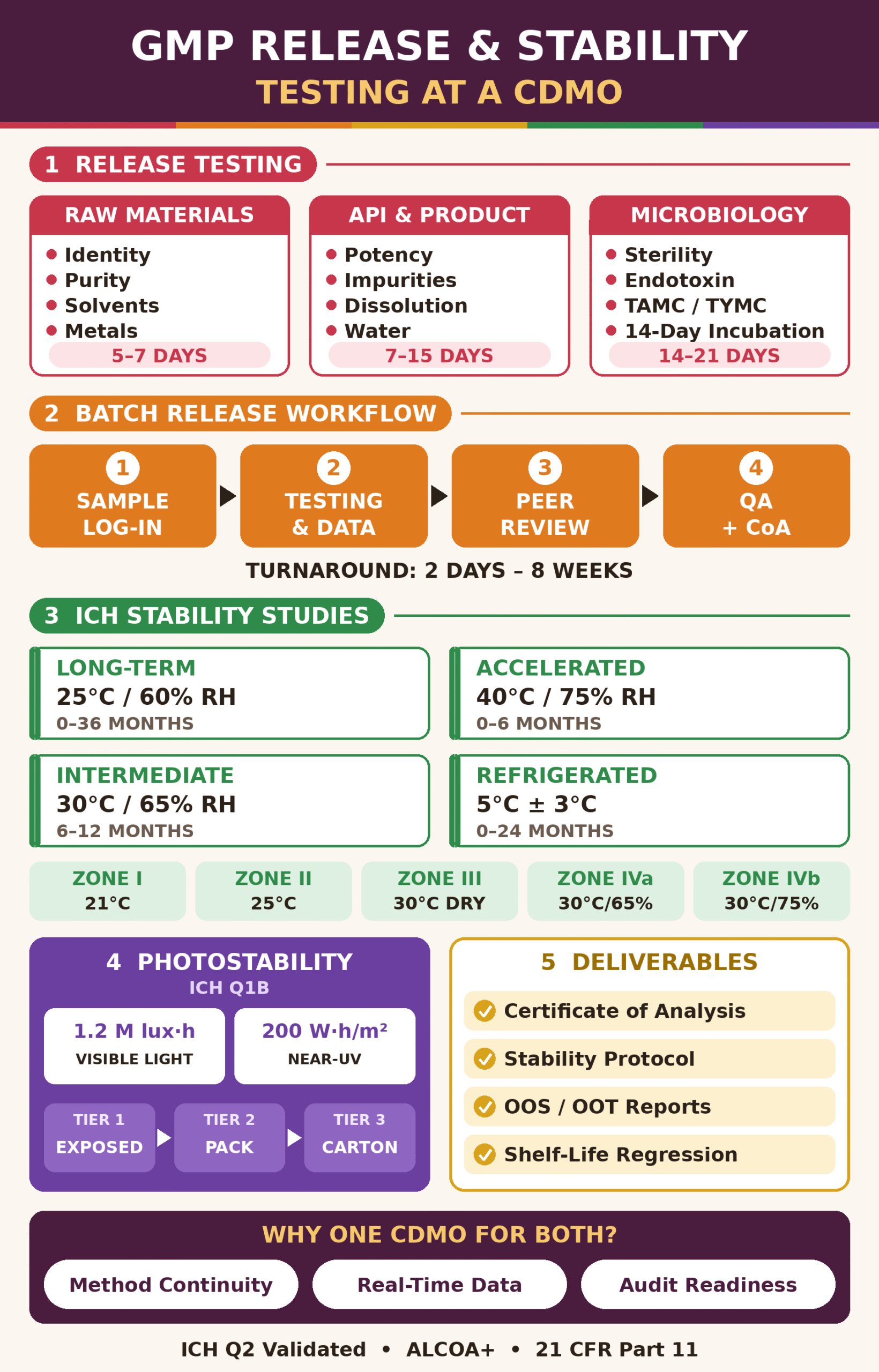
- Purpose: CDMOs provide validated GMP release and stability testing so drug products meet FDA, EMA and ICH requirements, including 21 CFR 210/211, EU GMP Annex 16 and ICH Q2, before clinical or commercial distribution.
- Release testing scope: It covers raw materials (identity, purity, residual solvents, elemental impurities), API and finished product (potency, impurities, dissolution, uniformity, water content), and microbiology (sterility, endotoxin, TAMC/TYMC).
- Turnaround and workflow: Timelines range from about 2 days to 8 weeks, depending on method readiness, incubation periods, OOS investigations and QA review, which takes about 30–40% of the time. The workflow runs in four steps: sample log-in, testing, peer review, and QA approval with CoA issuance.
- ICH stability studies: Long-term (25°C/60% RH), accelerated (40°C/75% RH), intermediate (30°C/65% RH) and refrigerated studies establish shelf life. Storage conditions are matched to climatic Zones I–IVb of the target markets.
- Photostability (ICH Q1B): Samples receive at least 1.2 million lux-hours of visible light and 200 W·h/m² of near-UV light, with dark controls. Testing follows a three-tier cascade: exposed product, then immediate pack, then commercial carton.
- Key deliverables: These are Certificates of Analysis, master stability protocols, OOS/OOT investigation reports, and shelf-life regression reports based on ICH Q1E. Together they support IND, NDA and ANDA submissions.
- Integrated advantage: Doing release and stability testing at one CDMO avoids method transfers and reduces variability between labs. It also links release data directly to stability tracking and makes audits and inspections easier.
Scope and Technical Parameters of GMP Release and Stability Testing Services at a CDMO
The technical scope of GMP Release and Stability Testing Services at a CDMO includes raw material qualification, drug substance release testing, finished drug product quality control, and compendial microbiological assays performed within stringent regulatory frameworks. A CDMO’s analytical workflow encompasses compendial monograph verification, high-resolution chromatographic impurity profiling, and sterility assurance assessments adapted to the specific requirements of different dosage forms.
Raw Material and Excipient Testing
Raw material and excipient release testing establishes the identity, purity, and compliance of incoming chemical components with applicable pharmacopoeial monographs before manufacturing begins. CDMOs conduct compendial assessments according to United States Pharmacopeia (USP), European Pharmacopoeia (Ph. Eur.), and Japanese Pharmacopoeia (JP) standards. The principal analytical approaches include:
- Identity Testing: Rapid spectroscopic identification using Fourier-Transform Infrared Spectroscopy (FTIR), Raman Spectroscopy, and Nuclear Magnetic Resonance (NMR).
- Assay and Purity: Titrimetric assessments and High-Performance Liquid Chromatography (HPLC) to determine the purity and concentration of active components.
- Impurity Profiling: Gas Chromatography-Headspace (GC-HS) for analyzing volatile organic residual solvents in accordance with ICH Q3C, and Inductively Coupled Plasma Mass Spectrometry (ICP-MS) for evaluating elemental impurities according to ICH Q3D.
Explore specialized analytical approaches through peptide characterization services.
API and Finished Drug Product Release Assays
Active pharmaceutical ingredient (API) and finished drug product testing determines active ingredient potency, the accumulation of degradation products, and relevant physical performance characteristics to verify compliance with established batch specifications. These procedures assess both physical properties and chemical quality attributes through the following methods:
- Potency Assay and Related Substances: Reversed-Phase Ultra-High-Performance Liquid Chromatography (RP-UPLC), coupled with UV-Vis detection or Mass Spectrometry (LC-MS), to quantify the API and trace degradants according to applicable ICH Q3A/Q3B guidelines.
- Dissolution and Release Profiling: USP Apparatus 1 (Basket), Apparatus 2 (Paddle), and Apparatus 4 (Flow-Through Cell) to evaluate drug release kinetics under biorelevant pH conditions.
- Uniformity of Dosage Units: Content uniformity testing using HPLC or weight variation assessments according to applicable USP criteria.
- Water and Moisture Determination: Volumetric or Coulometric Karl Fischer titration, following applicable USP requirements, to measure moisture levels that may promote hydrolytic degradation.
Understand the analytical requirements for GLP-1 products with this guide to GLP-1 peptide characterization.
Microbiological Quality Control Assays
Microbiological quality control testing establishes sterility assurance, bacterial endotoxin compliance, and acceptable microbial contamination levels for sterile and non-sterile dosage forms. The selected tests depend on the intended route of administration and the product’s microbiological risk profile.
- Sterility Testing: Membrane filtration or direct inoculation according to applicable USP sterility testing requirements, generally involving a mandatory 14-day incubation period.
- Bacterial Endotoxin Testing: Limulus Amebocyte Lysate (LAL) chromogenic or kinetic turbidimetric assays performed according to applicable USP requirements.
- Microbial Enumeration and Specified Microorganisms: Total Aerobic Microbial Count (TAMC) and Total Combined Yeasts and Molds Count (TYMC), performed according to applicable USP requirements for non-sterile formulations.
| Testing Category | Target Attributes & Quality Metrics | Key Analytical Instrumentation | Standard Turnaround Time |
|---|---|---|---|
| Raw Materials & Excipients | Identity, Monograph Purity, Residual Solvents, Heavy Metals | FTIR, GC-HS, ICP-MS, Titrators | 5–7 Business Days |
| API Release Testing | Assay Potency, Organic Impurities, Polymorphic Form, Water Content | RP-UPLC-UV, XRPD, Karl Fischer, LC-MS | 7–10 Business Days |
| Finished Drug Product | Potency, Degradants, Dissolution Rate, Uniformity, Appearance | UPLC, USP Dissolution Bath (I/II/IV), UV-Vis | 10–15 Business Days |
| Microbiological Assays | Sterility Assurance, Endotoxin Levels, TAMC/TYMC | Isolators, Incubators, Microplate Readers | 14–21 Business Days |
Turnaround Time Parameters and Operational Workflow Optimization
Operational turnaround time (TAT) for cGMP release testing can range from approximately 2 business days for expedited raw material assays to 8 weeks for complex biological products or finished products requiring extensive sterility testing. CDMOs improve operational efficiency by coordinating analytical activities with concurrent Quality Unit reviews and compliance assessments.
Determinants of Laboratory Turnaround Timelines
Several critical factors influence the time required to complete release and stability testing workflows:
- Method Transfer and Readiness: Established and fully validated analytical methods support faster batch testing. Newly transferred methods, however, may require protocol execution, method verification, or co-validation before formal testing can begin.
- Incubation Durations: Biological and sterility assays require specified incubation periods. For example, USP sterility testing generally requires 14 days of incubation, which cannot be shortened arbitrarily without compromising the applicable testing requirements.
- Out-of-Specification (OOS) Investigations: Analytical results that fall outside established acceptance criteria trigger a structured investigation. The investigation may involve laboratory and manufacturing assessments, extending the release timeline while the root cause is determined.
- Quality Unit Capacity: Data package compilation, independent analyst verification, chromatographic reintegration audits, and final QA approval may account for approximately 30% to 40% of the overall turnaround time, depending on the complexity of the testing program and the organization’s review procedures.
Compare development and manufacturing support options in this overview of peptide CDMO versus CRO services.
Step-by-Step Batch Release Operational Workflow
Phase 1: Sample Intake, Chain of Custody, and Log-In: Incoming samples undergo physical inspection, temperature recording, and verification against the sample submission form. Each sample receives a unique Laboratory Information Management System (LIMS) tracking number before being transferred to the appropriate storage conditions.
Phase 2: Analytical Execution and Chromatographic Data Integration: Analysts perform validated testing procedures using qualified instruments. Chromatographic data are processed and integrated using predefined processing methods to minimize the risk of subjective or inconsistent manual integration.
Phase 3: Dual-Analyst Peer Review and Data Integrity Auditing: A second independent senior analyst reviews raw data, instrument logs, calculation formulas, and 21 CFR Part 11 audit trails to confirm the accuracy, traceability, and regulatory compliance of the analytical results.
Phase 4: Quality Assurance Disposition and Certificate of Analysis (CoA) Issuance: The CDMO Quality Unit conducts a final compliance assessment of the complete testing package, verifies adherence to approved specifications, and authorizes the Certificate of Analysis. The resulting batch disposition documentation is then provided to the sponsor in accordance with the agreed quality procedures.
See how coordinated analytical support contributes to generic drug submissions through integrated CDMO analytical services for ANDA.
Environmental Storage Conditions and ICH Stability Testing Protocols
ICH-compliant stability protocols at a CDMO assess product quality over time under controlled temperature and humidity conditions representative of the climatic zones of intended commercial markets. These studies generate the data needed to establish shelf life, retest intervals, and labeled storage instructions for pharmaceutical products distributed across different regions.
Climatic Zones and Storage Regimes
The international climatic classification system divides commercial markets into different zones based on prevailing temperature and humidity conditions. The appropriate stability conditions depend on the intended market, product characteristics, and applicable regulatory requirements.
- Zone I (Temperate): Approximately 21°C ± 2°C / 45% ± 5% relative humidity (RH), historically associated with temperate climatic conditions, including parts of Canada and Northern Europe.
- Zone II (Subtropical/Mediterranean): Approximately 25°C ± 2°C / 60% ± 5% RH, traditionally associated with conditions in regions such as Southern Europe and Japan. The appropriate conditions for the USA depend on the applicable regulatory framework and product-specific requirements.
- Zone III (Hot and Dry): Approximately 30°C ± 2°C / 35% ± 5% RH, representing hot and dry climatic environments.
- Zone IVa (Hot and Humid): Approximately 30°C ± 2°C / 65% ± 5% RH, representing hot and humid environments, including parts of Southeast Asia.
- Zone IVb (Hot and Higher Humidity): Approximately 30°C ± 2°C / 75% ± 5% RH, representing hot and very humid environments, including certain equatorial regions.
Review formulation considerations for injectable peptides in this guide to lyophilized peptide injectable formulation.
Stability Study Types and Testing Frequencies
CDMOs operate environmental stability chambers equipped with continuous monitoring systems, redundant temperature or humidity sensors where appropriate, emergency power provisions, and automated alarms for detecting environmental deviations. These systems help maintain the specified storage conditions and protect the integrity of stability study data.
- Long-Term Stability Testing: Assesses drug product quality throughout the proposed shelf life. Typical storage conditions include 25°C ± 2°C / 60% ± 5% RH or, where applicable, 30°C ± 2°C / 65% ± 5% RH. A typical testing schedule may include 0, 3, 6, 9, 12, 18, 24, and 36 months, depending on the protocol and proposed shelf life.
- Accelerated Stability Testing: Exposes samples to elevated conditions of 40°C ± 2°C / 75% ± 5% RH for six months, with testing commonly scheduled at 0, 3, and 6 months. These studies help identify potential degradation pathways, assess packaging performance, and support the evaluation of long-term stability.
- Intermediate Stability Testing: May be conducted at 30°C ± 2°C / 65% ± 5% RH for 6 to 12 months when a significant change occurs during accelerated testing and intermediate testing is required under the applicable guidance. Depending on the protocol, sampling may occur at 0, 6, 9, and 12 months.
- Refrigerated and Frozen Storage: Products intended for refrigerated storage at 5°C ± 3°C undergo long-term stability testing under the specified refrigerated conditions. Accelerated or excursion studies may use 25°C / 60% RH when appropriate to the product and protocol. Products stored at −20°C ± 5°C are monitored under the specified frozen conditions, while short-term temperature excursion studies may assess exposure at 5°C or 25°C to support transportation and handling assessments.
- Semi-Permeable Packaging: Aqueous products packaged in semi-permeable containers, such as IV bags and blow-fill-seal ampoules, may require long-term testing under lower humidity conditions, including 25°C / 40% RH or 30°C / 35% RH, as applicable. These studies evaluate water loss, changes in product concentration, and the effects of moisture transfer through the packaging material.
| Study Type | Primary Storage Conditions | Alternative Conditions | Testing Frequency | Regulatory Objective |
|---|---|---|---|---|
| Long-Term (General) | 25°C ± 2°C / 60% RH ± 5% | 30°C ± 2°C / 65% RH ± 5% | 0, 3, 6, 9, 12, 18, 24, 36 months | Establishes formal shelf life and retest date |
| Intermediate | 30°C ± 2°C / 65% RH ± 5% | Not applicable when 30°C is the long-term condition | 0, 6, 9, 12 months | Evaluates changes observed under accelerated conditions |
| Accelerated | 40°C ± 2°C / 75% RH ± 5% | Not applicable | 0, 3, 6 months | Identifies degradants and supports the assessment of shipping excursions |
| Refrigerated | 5°C ± 3°C for long-term storage | 25°C ± 2°C / 60% RH for accelerated testing, where appropriate | Long-term: 0, 3, 6, 9, 12, 18, 24 months; accelerated: 0, 3, 6 months | Supports stability assessment of cold-chain pharmaceutical formulations |
| Semi-Permeable | 25°C ± 2°C / 40% RH ± 5% | 30°C ± 2°C / 35% RH ± 5% | 0, 3, 6, 9, 12, 18, 24 months | Measures water loss and changes in formulation concentration |
Learn how manufacturing scale-up affects process consistency through peptide CDMO scale-up services.
ICH Q1B Photostability Testing Frameworks
ICH Q1B photostability testing determines the inherent sensitivity of a drug substance or finished drug product to visible and near-ultraviolet radiation under controlled conditions. Photostability chambers must provide controlled spectral output, continuous monitoring of light exposure in lux and watt-hours per square meter, and appropriate temperature regulation to distinguish photochemical degradation from changes caused by heat.
Exposure Parameters and Light Quality Requirements
To meet applicable regulatory expectations, samples must receive standardized light exposure that satisfies the specified cumulative exposure requirements.
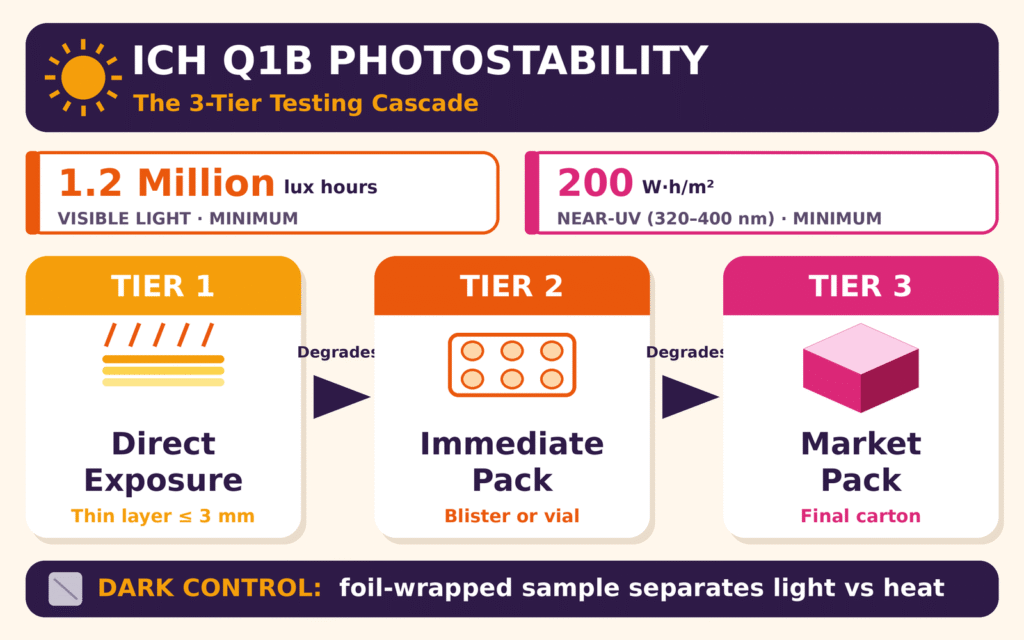
- Visible Light Exposure: A minimum cumulative exposure of 1.2 × 10⁶ lux hours.
- Near-Ultraviolet Energy: A minimum integrated near-UV exposure of 200 watt hours/m² within the 320–400 nm spectral range.
CDMOs can select between two validated light source options, provided that the selected system meets the applicable spectral and exposure requirements.
Option 1 uses lamps that produce an emission spectrum comparable to the D65/ID65 emission standard, such as suitable xenon or metal halide lamps with appropriate filters to eliminate radiation below 320 nm.
Option 2 combines cool white fluorescent lamps with near-UV fluorescent lamps operating within the 320–400 nm spectral range.
Control Samples and Actinometric Verification
Dark Control Samples: To distinguish photolytic degradation from thermal effects associated with light exposure, equivalent control samples are wrapped in aluminum foil and placed alongside the irradiated samples in the photostability chamber. Comparing the results from exposed and protected samples helps determine whether observed changes are primarily attributable to light or temperature.
Actinometric Verification: CDMOs use chemical actinometers, such as a 2% w/v aqueous quinine monohydrochloride solution, where appropriate, to verify the delivered light exposure. An absorbance change (ΔA) of at least 0.5 at 400 nm is used in the specified actinometric procedure to confirm adequate near-UV exposure. The selected actinometric method and its acceptance criteria must be appropriate for the light source and exposure system.
Tiered Testing Cascade
Tier 1 (Directly Exposed Material): The drug substance or unpackaged drug product is distributed in a thin layer no greater than 3 mm thick and exposed directly to the specified light conditions. This initial assessment helps identify the intrinsic photochemical sensitivity of the material.
Tier 2 (Immediate Packaging): If significant degradation occurs during Tier 1 testing, the assessment proceeds with the drug product enclosed in its immediate container, such as a blister card or clear glass vial. This stage determines the extent to which the primary packaging protects the product from light exposure.
Tier 3 (Commercial Marketing Packaging): If degradation continues during Tier 2 testing, the product is evaluated in its final secondary commercial packaging. Persistent degradation may indicate a need for additional light protection, such as amber glass, light-blocking foil blisters, or protective secondary packaging, depending on the findings and the product’s intended use.
Understand how peptide development programs progress from early development toward manufacturing with peptide drug development CDMO services.
Regulatory Deliverables, Quality Documentation, and Data Integrity
The principal deliverables associated with CDMO release and stability testing services include approved Certificates of Analysis (CoAs), formal stability protocols, statistical regression reports, and thoroughly investigated Out-of-Specification (OOS) records. These documents provide traceable evidence of product quality and support regulatory submissions, including Investigational New Drug (IND) applications, New Drug Applications (NDAs), and Abbreviated New Drug Applications (ANDAs).
See how coordinated analytical testing supports regulatory documentation and generic drug development with integrated CDMO analytical services for ANDA submissions.
Core Deliverables from a Quality System Perspective
Certificate of Analysis (CoA): This official document records lot identity, batch size, manufacturing date, test parameters, analytical methods, specification limits, observed numerical results, pass/fail determinations, and final QA release authorization. It provides documented evidence of the analytical results obtained for a specific batch and supports the applicable batch disposition process.
Master Stability Protocol: This document defines the objectives of the stability study, batch selection criteria, container closure configurations, storage orientations, such as upright or inverted, testing timepoints, validated stability-indicating methods, and acceptance criteria. It establishes the study framework and helps ensure that stability data are collected consistently throughout the planned testing period.
Out-of-Specification (OOS) and Out-of-Trend (OOT) Investigation Reports: These reports document systematic investigations into unexpected analytical results or trends. Phase I focuses on identifying potential laboratory errors, including system suitability failures, instrument malfunctions, and sample preparation errors. If no assignable laboratory cause is identified, a Phase II investigation evaluates potential manufacturing-related factors, batch records, environmental controls, and raw material histories. The investigation process must follow applicable procedures and document the scientific rationale for its conclusions.
Stability Trend Reports and Shelf-Life Regression: These reports provide statistical assessments of stability data, including linear regression analyses performed in accordance with applicable ICH Q1E principles. Statistical models may support shelf-life estimation using 95% one-sided confidence limits for changes in assay potency or impurity accumulation, where appropriate to the data and the applicable statistical approach. The resulting evaluation helps determine whether the proposed shelf life remains supported by the available stability evidence.
Compare regional manufacturing options in this guide to Canadian versus US peptide CDMOs.
Strategic Advantages of Integrated GMP Release and Stability Testing Services at a CDMO
Integrating release testing and stability storage within a single specialized CDMO can simplify analytical method transfer, reduce inter-laboratory variability, and improve the efficiency of regulatory submission preparation. Managing these activities under a unified quality management system can also reduce duplicative method qualification activities, minimize analytical bias between laboratories, and streamline regulatory documentation.
Understand how to evaluate a CDMO partner for development and manufacturing with this guide to selecting a peptide CDMO in the United States.
A coordinated analytical approach offers several advantages throughout the product commercialization lifecycle.
Method Transfer Continuity: Performing method validation, batch release testing, and stability monitoring within the same quality infrastructure can reduce the need for transfers between laboratories and help minimize method transfer-related discrepancies. This continuity also supports consistent application of analytical procedures, instrument qualification requirements, and data review practices.
Real-Time Data Integration: Transferring baseline batch release data collected at time zero (t = 0) directly into long-term stability tracking systems establishes a consistent starting point for subsequent comparisons. This integration improves the traceability of analytical results and supports the timely identification of degradation trends or potential quality concerns.
Audit Readiness: Maintaining raw data records, chromatographic integrations, audit trails, and instrument calibration documentation within a unified cGMP testing environment simplifies sponsor supplier audits and regulatory inspections. Centralized documentation also facilitates data retrieval, supports investigations, and strengthens oversight of analytical quality throughout the product lifecycle.
Conclusion
Selecting an experienced partner for GMP Release and Stability Testing Services at a CDMO supports regulatory compliance, analytical data integrity, and the efficient execution of pharmaceutical product launches. Implementing structured stability monitoring in accordance with ICH Q1A(R2) and ICH Q1B requirements helps protect product quality, reduce the risk of avoidable regulatory delays, and maintain a reliable supply of pharmaceutical products. Consistent analytical oversight, comprehensive quality documentation, and robust environmental controls are essential to demonstrating that biopharmaceutical products meet applicable global quality standards.
Explore a practical example of peptide characterization with this semaglutide characterization case study.
For comprehensive analytical support, stability chamber storage, analytical method validation, and cGMP-compliant batch release testing tailored to specialized development programs, contact the technical team at ResolveMass Laboratories Inc. through the ResolveMass Contact Us Page.
Frequently Asked Questions
When an OOS result occurs, the CDMO initiates a documented investigation to identify the underlying cause. The initial laboratory assessment examines instrument performance, system suitability, standard solutions, and sample preparation procedures. If no laboratory error is established, a broader investigation evaluates manufacturing records, storage conditions, and historical stability data, with further actions taken according to applicable procedures and regulatory requirements.
Under ICH Q1A(R2), significant change in a drug product can include an assay result that differs by 5% from its initial value, a degradation product exceeding its acceptance criterion, or failure to meet specifications for appearance, physical attributes, or functionality. Failure to meet the specified dissolution acceptance criteria can also qualify. These findings help determine whether intermediate stability testing is necessary.
Routine compendial raw material testing generally takes 5–7 business days, although expedited services may provide results within 2–3 business days when the required methods and laboratory capacity are available. API release testing commonly requires 7–10 business days, particularly when the assessment includes UPLC assays, residual solvent analysis by GC-HS, and elemental impurity testing using ICP-MS. Actual timelines depend on method readiness, sample complexity, and quality review requirements.
ICH Q1B photostability testing evaluates whether exposure to visible and near-ultraviolet light affects a drug substance or finished drug product. The study identifies potential changes in potency, chemical composition, appearance, and other relevant quality attributes. Its findings help determine whether light-resistant packaging, such as amber glass or opaque blister materials, or specific light-protection instructions are needed.
Matrixing and bracketing help reduce the number of samples and tests required in a stability program when the study design and supporting scientific rationale permit their use. Bracketing focuses testing on selected extremes, such as the highest and lowest strengths or the largest and smallest container sizes. Matrixing evaluates a planned subset of sample combinations at particular timepoints, with the overall design established to provide adequate stability information.
Refrigerated drug substances and drug products are generally evaluated under long-term conditions of 5°C ± 3°C, while additional temperature studies are selected according to product characteristics and the approved protocol. Frozen products may be stored at −20°C ± 5°C or under other product-specific frozen conditions. Temperature excursion and freeze-thaw studies, where relevant, help assess product sensitivity during transportation, handling, and temporary storage outside the recommended range.
Drug product stability studies commonly monitor assay potency, degradation products, physical appearance, moisture content, dissolution performance, and pH, where applicable. Depending on the formulation, testing may also include microbial quality, preservative content, and container closure integrity. The selected parameters and acceptance criteria are established according to the product’s characteristics, dosage form, and applicable regulatory requirements.
Drug products in semi-permeable packaging, including plastic bags and flexible containers, may lose water through the packaging material during storage. Stability studies therefore assess changes in product concentration, water content, and other relevant quality attributes under suitable low-humidity conditions. Depending on the formulation and applicable guidance, storage conditions may include 25°C/40% RH or 30°C/35% RH.
A regulatory stability package generally contains the stability protocol, batch manufacturing information, initial release results, analytical methods, and relevant method validation reports. It also includes stability results collected at scheduled timepoints, photostability data when applicable, and statistical evaluations supporting the proposed shelf life. The submission should additionally provide the proposed storage conditions, shelf-life justification, and appropriate product labeling statements in accordance with applicable regulatory guidance.
Reference:
- International Council for Harmonisation of Technical Requirements for Pharmaceuticals for Human Use. (2003). Stability testing of new drug substances and products (ICH Q1A(R2)) . U.S. Food and Drug Administration. https://www.fda.gov/regulatory-information/search-fda-guidance-documents/q1ar2-stability-testing-new-drug-substances-and-products
- International Conference on Harmonisation of Technical Requirements for Registration of Pharmaceuticals for Human Use. (2003). Stability testing of new drug substances and products (Q1A(R2)).
https://database.ich.org/sites/default/files/Q1A%28R2%29%20Guideline.pdf - International Conference on Harmonisation of Technical Requirements for Registration of Pharmaceuticals for Human Use. (2003). Stability testing of new drug substances and products (Q1A(R2)). European Medicines Agency. https://www.ema.europa.eu/en/documents/scientific-guideline/ich-q-1-r2-stability-testing-new-drug-substances-and-products-step-5_en.pdf
- International Conference on Harmonisation of Technical Requirements for Registration of Pharmaceuticals for Human Use. (1996). Stability testing: Photostability testing of new drug substances and products (Q1B). https://database.ich.org/sites/default/files/Q1B%20Guideline.pdf
Get In Touch With Us
About The Author