

Introduction:
Goserelin PLGA implant characterization is one of the most technically demanding challenges in long-acting parenteral development — and also one of the most consequential. Goserelin acetate, a GnRH agonist used in prostate cancer, breast cancer, and endometriosis management, is commercially formulated as a subcutaneous rod implant in a PLGA matrix. The implant must deliver a precisely defined drug load over 28 days (3.6 mg) or 12 weeks (10.8 mg) with a release profile that is tightly coupled to the rate of polymer degradation. Any deviation in polymer composition, processing conditions, or storage can translate directly into clinically significant under- or over-exposure.
For formulation scientists and regulatory affairs teams developing PLGA-based implants, understanding the mechanistic relationship between polymer degradation and drug release is not optional — it is the scientific foundation of the entire development program. This case study, drawn from ResolveMass Laboratories’ characterization work with PLGA implant systems, illustrates the integrated analytical approach required to establish that degradation–release correlation with confidence.
Summary:
- Goserelin PLGA implants (e.g., Zoladex®) release drug over 1–3 months via polymer hydrolysis-driven degradation — not simple diffusion alone.
- Accurate goserelin PLGA implant characterization requires a multi-method approach: GPC/SEC for molecular weight loss, SEM/micro-CT for morphology, DSC for thermal transitions, and biorelevant in vitro release testing.
- A strong degradation–release correlation (IVIVC) validates the release mechanism and underpins regulatory submissions to FDA and Health Canada.
- Polymer composition (LA:GA ratio, end-cap status, inherent viscosity) is the primary formulation lever controlling degradation rate and triphasic release profile.
- ResolveMass Laboratories applies a systematic, data-driven characterization workflow tailored to implant and LAI platforms, supporting sponsors from feasibility through NDA/ANDS filing.
1. The Science of PLGA Degradation in Subcutaneous Implants
PLGA degrades in vivo primarily through bulk hydrolysis of ester bonds, producing lactic acid and glycolic acid — a mechanism that directly gates goserelin release. Unlike surface-eroding polymers, PLGA undergoes bulk erosion: water penetrates the matrix throughout, and degradation proceeds relatively uniformly from the inside out, though autocatalysis by acidic degradation products accelerates local breakdown in the implant core.
The degradation rate is heavily influenced by polymer properties, making PLGA polymer grade selection one of the most important formulation decisions in implant development.
Key Degradation Variables in Goserelin Implants
| Parameter | Impact on Degradation Rate | Typical Range for 1-Month Implants |
|---|---|---|
| LA:GA molar ratio | Higher GA content → faster degradation | 50:50 to 75:25 |
| End-cap status (ester vs. acid) | Acid end-cap accelerates degradation | Acid-terminated preferred for faster release |
| Inherent viscosity (IV) | Lower IV → lower Mw → faster degradation | 0.15–0.25 dL/g |
| Water uptake rate | Higher uptake → faster hydrolysis | Influenced by porosity and drug loading |
| Drug loading (% w/w) | High loading may create channels affecting erosion | 10–40% typical |
| Implant geometry | Surface area : volume ratio drives water ingress rate | Rod diameter: 1–2 mm |
In subcutaneous tissue, the goserelin implant is exposed to a physiological aqueous environment at 37°C. Over weeks, molecular weight (Mw) decreases progressively as ester bonds cleave. The matrix loses mechanical integrity, porosity increases, and drug diffusion pathways open — eventually transitioning to a predominantly erosion-driven release phase.
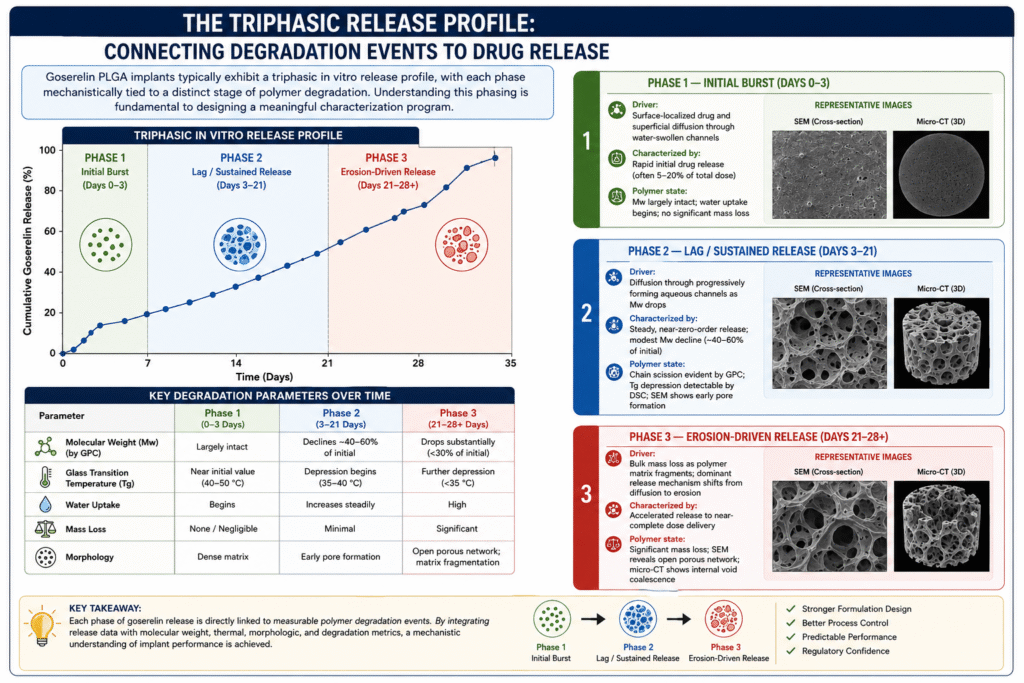
2. The Triphasic Release Profile: Connecting Degradation Events to Drug Release
Goserelin PLGA implants typically exhibit a triphasic in vitro release profile, with each phase mechanistically tied to a distinct stage of polymer degradation. Understanding this phasing is fundamental to PLGA microsphere formulation development and successful implant optimization.
Phase 1 — Initial Burst (Days 0–3)
- Driver: Surface-localized drug and superficial diffusion through water-swollen channels
- Characterized by: Rapid initial drug release (often 5–20% of total dose)
- Polymer state: Mw largely intact; water uptake begins; no significant mass loss
Phase 2 — Lag / Sustained Release (Days 3–21)
- Driver: Diffusion through progressively forming aqueous channels as Mw drops
- Characterized by: Steady, near-zero-order release; modest Mw decline (~40–60% of initial)
- Polymer state: Chain scission evident by GPC; Tg depression detectable by DSC; SEM shows early pore formation
Phase 3 — Erosion-Driven Release (Days 21–28+)
- Driver: Bulk mass loss as polymer matrix fragments; dominant release mechanism shifts from diffusion to erosion
- Characterized by: Accelerated release to near-complete dose delivery
- Polymer state: Significant mass loss; SEM reveals open porous network; micro-CT shows internal void coalescence
3. Goserelin PLGA Implant Characterization: The Multi-Method Analytical Framework
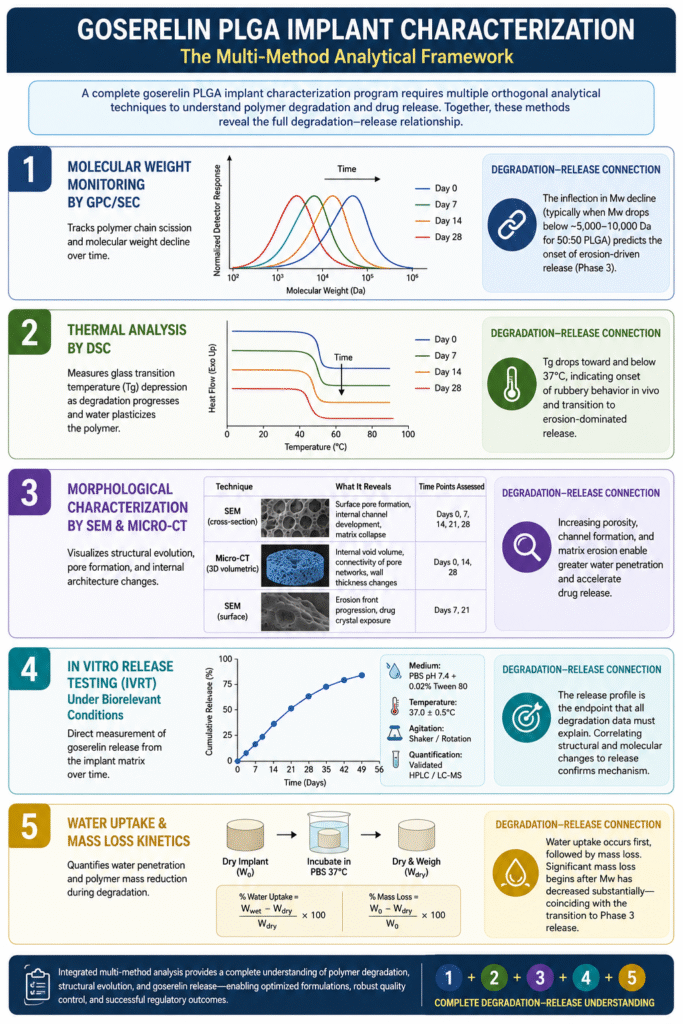
A complete goserelin PLGA implant characterization program requires at least five orthogonal analytical methods to capture the full degradation–release relationship. No single technique is sufficient on its own.
3.1 Molecular Weight Monitoring by GPC/SEC
Gel permeation chromatography (GPC), also called size-exclusion chromatography (SEC), is the workhorse method for tracking polymer chain scission over time. These measurements are a core component of modern PLGA characterization methods and are essential for understanding polymer degradation kinetics.
For developers pursuing generic products, molecular weight analysis is also a critical aspect of PLGA polymer characterization for generics.
Critical parameters tracked:
- Weight-average molecular weight (Mw) and number-average molecular weight (Mn)
- Polydispersity index (PDI = Mw/Mn) — PDI broadening signals onset of bulk degradation
- Shift of GPC trace toward lower Mw over time
Degradation-release connection: The inflection point in Mw decline (typically when Mw drops below ~5,000–10,000 Da for 50:50 PLGA) reliably predicts the onset of Phase 3 erosion-driven release.
3.2 Thermal Analysis by DSC
DSC tracks the depression of the glass transition temperature (Tg) as polymer chains shorten and water acts as a plasticizer. Understanding PLGA glass transition temperature is therefore essential when evaluating implant stability and release performance.
- Fresh goserelin implants typically show PLGA Tg at 40–50°C
- As degradation proceeds, Tg drops toward 37°C and below, indicating onset of rubber-state behavior in vivo
- Tg below 37°C in vivo correlates with transition to erosion-dominated release
3.3 Morphological Characterization by SEM and Micro-CT
SEM and micro-CT provide orthogonal views of structural evolution within the implant matrix. Similar analytical approaches have been successfully applied in this Dexamethasone Implant PLGA Characterization Case Study, where polymer degradation and drug release were correlated through advanced imaging techniques.
The same characterization strategies are increasingly important for PLGA-based oncology implants, where precise control of drug release is critical.
Scanning electron microscopy (SEM) and X-ray microtomography (micro-CT) provide orthogonal views of structural evolution:
| Technique | What It Reveals | Time Points Assessed |
|---|---|---|
| SEM (cross-section) | Surface pore formation, internal channel development, matrix collapse | Days 0, 7, 14, 21, 28 |
| Micro-CT (3D volumetric) | Internal void volume, connectivity of pore networks, wall thickness changes | Days 0, 14, 28 |
| SEM (surface) | Erosion front progression, drug crystal exposure | Days 7, 21 |
Micro-CT is particularly powerful for goserelin implants because it quantifies internal porosity without destructive sectioning — enabling the same implant to be imaged at multiple time points.
3.4 In Vitro Release Testing (IVRT) Under Biorelevant Conditions
The in vitro release test is the direct measurement of drug liberation from the implant matrix as a function of time. Because goserelin is a peptide therapeutic, many of the formulation principles described in PLGA peptide delivery systems are directly applicable.
For highly potent compounds, additional considerations discussed in formulating highly potent APIs using PLGA microspheres may also become relevant.
ResolveMass employs a purpose-designed IVRT method for subcutaneous implant simulation:
- Medium: PBS pH 7.4 with 0.02% Tween 80 (to maintain sink conditions for the hydrophilic goserelin)
- Temperature: 37.0 ± 0.5°C
- Agitation: Horizontal shaker or tube rotation to simulate physiological tissue movement
- Sampling: Daily or every 2–3 days with full medium replacement to maintain sink
- Quantification: Validated RP-HPLC or LC-MS/MS method for goserelin acetate
Accelerated IVRT at 45°C or 50°C may be explored during early development to compress the timeline — but any accelerated method must be validated against real-time data to confirm mechanistic equivalence.
3.5 Water Uptake and Mass Loss Kinetics
Water uptake and mass loss provide the simplest yet most mechanistically direct degradation indicators:
Protocol:
- Weigh implants dry (W₀)
- Incubate in PBS 37°C; remove at defined intervals; blot dry; weigh (Wwet)
- Lyophilize to remove residual water; weigh (Wdry)
- Calculate: % water uptake = (Wwet − Wdry) / Wdry × 100
- Calculate: % mass loss = (W₀ − Wdry) / W₀ × 100
Water uptake precedes mass loss. For 50:50 PLGA, substantial mass loss typically begins only after Mw has dropped significantly — correlating precisely with the Phase 3 transition observed in the release profile.
4. Establishing the Degradation–Release Correlation: Case Study Data Overview
Establishing a robust degradation–release correlation requires integrating multiple orthogonal analytical datasets. Similar methodologies have been applied in this Exenatide PLGA Microsphere Characterization Case Study, which highlights the importance of understanding peptide–polymer interactions during long-acting formulation development.
Many of these principles also apply to Buprenorphine Depot PLGA Characterization programs where high drug loading influences release behavior.
| Time Point | Mw (Da) | PDI | Tg (°C) | Mass Loss (%) | Water Uptake (%) | Cumulative Release (%) |
|---|---|---|---|---|---|---|
| Day 0 (baseline) | ~18,000 | 1.45 | 48 | 0 | 0 | 0 |
| Day 7 | ~14,500 | 1.55 | 44 | <1 | 8 | 6–10 |
| Day 14 | ~10,200 | 1.70 | 40 | 2–4 | 18 | 20–28 |
| Day 21 | ~5,800 | 2.10 | 37 | 8–12 | 32 | 42–52 |
| Day 28 | ~3,200 | 2.50 | 33 | 18–25 | 55 | 68–78 |
| Day 42 | ~1,800 | 3.20 | <30 | 40–55 | >80 | 88–95 |
| Day 84 | <500 | — | — | >90 | — | >97 |
Note: Values are representative ranges for illustrative purposes, consistent with published PLGA degradation literature and ResolveMass internal development experience.
Key correlations observed:
- The sharp increase in PDI between Days 14 and 21 (1.70 → 2.10) coincides with the transition from sustained to erosion-accelerated release
- Tg crossing 37°C between Days 21 and 28 marks the onset of rapid mass loss and corresponding spike in release rate
- Water uptake exceeding 30% is a reliable predictor of imminent significant mass loss
5. Regulatory Expectations for PLGA Implant Characterization Packages
Regulatory agencies expect comprehensive polymer characterization and mechanistic understanding. Sponsors should ensure compliance with GMP PLGA requirements when selecting materials for development.
For generic and follow-on products, demonstrating PLGA polymer sameness for ANDA submissions is often a major challenge. Reverse engineering studies such as those discussed in PLGA Reverse Engineering for ANDA can help establish critical quality attributes and target product profiles.
Comprehensive PLGA polymer characterization for generics can significantly strengthen regulatory submissions.
FDA / Health Canada Expectations Include:
- Polymer characterization: Certificate of analysis including LA:GA ratio (by ¹H-NMR), IV, Mw/PDI (by GPC), residual monomers, and end-group identity
- Implant physicochemical attributes: Drug content uniformity, implant dimensions and mass, drug solid-state form (amorphous vs. crystalline by XRPD and DSC)
- IVRT method validation: Discriminating power, robustness, and relevance to degradation mechanism
- Degradation characterization: Mw loss kinetics, water uptake/mass loss data, morphological changes at representative time points
- IVIVC or in vitro–in vivo relationship: Even a Level C correlation (single time point) adds significant regulatory support; Level A (full profile) is ideal for biowaiver justification
- Extractables from the implant applicator: Device-related impurities assessed per ISO 10993 and ICH Q3E
6. Common Characterization Pitfalls — and How ResolveMass Addresses Them
Many challenges encountered during implant development are similar to those addressed through specialized PLGA reverse engineering CRO projects, where detailed polymer and formulation analysis is required.
Lessons learned from reverse engineering risperidone PLGA microspheres further demonstrate how subtle formulation differences can significantly impact release kinetics.
- Incomplete sink conditions in IVRT: Goserelin is hydrophilic; without adequate surfactant and volume, drug accumulates in media and suppresses apparent release — generating falsely low release rates. ResolveMass validates sink maintenance throughout the entire test duration.
- GPC without polymer-specific calibration: PLGA Mw values vary substantially depending on calibration standards (polystyrene vs. PMMA vs. PLGA). ResolveMass uses PLGA-specific narrow standards or universal calibration with viscometry.
- Single-timepoint morphology: A single SEM snapshot captures only a snapshot of the evolving matrix. ResolveMass schedules ≥5 morphology time points to track structural evolution.
- Ignoring autocatalytic core degradation: PLGA implants degrade faster at the core than at the surface due to acid accumulation. ResolveMass images cross-sections at each time point to detect inside-out degradation gradients.
- Neglecting drug–polymer interactions: Goserelin’s basic character can interact with acid end-cap PLGA groups, affecting both initial burst and long-term release. ResolveMass routinely includes solid-state characterization (DSC, FTIR) to detect drug–polymer miscibility changes.
7. ResolveMass Laboratories: Specialized Expertise in Goserelin PLGA Implant Characterization
Our scientists bring direct experience with GnRH agonist implant platforms. Many analytical challenges encountered with goserelin are similar to those discussed in Leuprolide Depot Formulation Challenges and PLGA Characterization of Lupron Depot.
For organizations pursuing generic development pathways, our experience in Reverse Engineering of PLGA Polymer in Lupron Depot provides valuable insight into establishing polymer sameness and product equivalence.
In addition to small molecules and peptides, ResolveMass also supports Characterization of Long-Acting Biologics, extending our expertise across a broad range of controlled-release platforms.
- GPC/SEC with RI and UV detection, PLGA-calibrated
- DSC and TGA for thermal analysis
- FTIR-ATR for solid-state characterization and polymer end-group analysis
- SEM with cryo and cross-section preparation capabilities
- Validated IVRT stations with temperature control and automated sampling
- RP-HPLC and LC-MS/MS for goserelin quantification
- ¹H-NMR for polymer composition verification
Our scientists bring direct experience with GnRH agonist implant platforms and understand the regulatory landscape for both innovator and generic/biosimilar 505(b)(2) development pathways. We work closely with sponsors to design characterization programs that are not only scientifically rigorous but directly aligned with the data packages required by FDA’s ONDQA and Health Canada’s Bureau of Pharmaceutical Sciences.
Conclusion:
Rigorous goserelin PLGA implant characterization is not merely a regulatory checkbox — it is the scientific engine that drives rational formulation optimization, predicts clinical performance, and builds regulatory confidence. Successful programs begin with appropriate material selection, and developers should carefully evaluate factors discussed in PLGA Supplier Benefits.
The analytical principles described in this case study are equally relevant to PLGA for Oncology Implants and highly potent API PLGA microsphere formulations.
For developers evaluating alternative delivery platforms, understanding PLGA Nanoparticles vs. Microspheres can help guide technology selection. Similar controlled-release principles have also been successfully applied in PLGA-Based Ocular Drug Delivery systems, demonstrating the versatility of PLGA technology across multiple therapeutic areas.
Frequently Asked Questions:
Scanning Electron Microscopy (SEM) provides detailed images of implant surfaces and internal cross-sections. It helps visualize pore formation, channel development, erosion fronts, and matrix collapse during degradation. These structural changes often explain shifts in release kinetics observed during IVRT studies. SEM is especially useful for correlating morphology changes with polymer degradation. It offers visual confirmation of degradation mechanisms.
Goserelin PLGA Implant Characterization provides detailed insights into how polymer degradation affects drug release. By understanding degradation mechanisms, scientists can optimize polymer selection, molecular weight, implant composition, and manufacturing parameters. This helps achieve target release profiles while maintaining product stability and consistency. The resulting data support both development and regulatory objectives. Ultimately, characterization helps ensure predictable therapeutic performance.
A comprehensive characterization program typically includes:
-GPC/SEC for molecular weight analysis
-HPLC or LC-MS for drug release testing
-DSC for thermal characterization
-SEM for morphology assessment
-Micro-CT for internal structural analysis
-Water uptake and mass loss studies
-FTIR or NMR for chemical characterization
Most goserelin PLGA implants exhibit three release phases:
-Initial burst release from surface-associated drug
-Sustained diffusion-controlled release
-Erosion-driven release as the polymer matrix degrades and collapses
Several factors affect degradation, including:
-Lactide-to-glycolide ratio
-Polymer molecular weight
-End-group chemistry
-Implant geometry
-Drug loading
-Residual solvent content
-Storage conditions
Common challenges include:
-Long study durations
-Complex release mechanisms
-Polymer variability
-Peptide stability concerns
-Establishing meaningful in vitro–in vivo correlations
-Detecting subtle structural changes during early degradation stages
Reference
- Huang D, Tian Y, Zheng Y, Li M, Xu X, Chen H, Rui W. Development and Validation for the Estimation of Assay and Forced Degradation Impurities of Goserelin Acetate Sustained-Release Implant Using HPLC and LC–MS. Chromatographia. 2023 Sep;86(8):595-603.https://link.springer.com/article/10.1007/s10337-023-04272-1
- Collier O. Polymer Degradation Hormone Delivery Implant (Master’s thesis, University of Cincinnati).https://rave.ohiolink.edu/etdc/view?acc_num=ucin1758729080430233
- Shafiee K, Bazraei S, Mashak A, Mobedi H. The impact of temperature on the formation, release mechanism, and degradation of PLGA-based in-situ forming implants. Journal of Polymers and the Environment. 2024 Aug;32(8):3591-608.https://link.springer.com/article/10.1007/s10924-023-03173-6
- Enayati M, Mobedi H, Hojjati‐Emami S, Mirzadeh H, Jafari‐Nodoushan M. In situ forming PLGA implant for 90 days controlled release of leuprolide acetate for treatment of prostate cancer. Polymers for Advanced Technologies. 2017 Jul;28(7):867-75.https://onlinelibrary.wiley.com/doi/abs/10.1002/pat.3991
- Joiner JB, Prasher A, Young IC, Kim J, Shrivastava R, Maturavongsadit P, Benhabbour SR. Effects of drug physicochemical properties on in-situ forming implant polymer degradation and drug release kinetics. Pharmaceutics. 2022 Jun 1;14(6):1188.https://www.mdpi.com/1999-4923/14/6/1188
- Ren T, Chen J, Qi P, Xiao P, Wang P. Goserelin/PLGA solid dispersion used to prepare long-acting microspheres with reduced initial release and reduced fluctuation of drug serum concentration in vivo. International Journal of Pharmaceutics. 2022 Mar 5;615:121474.https://www.sciencedirect.com/science/article/pii/S0378517322000278
About the Author


