

Introduction
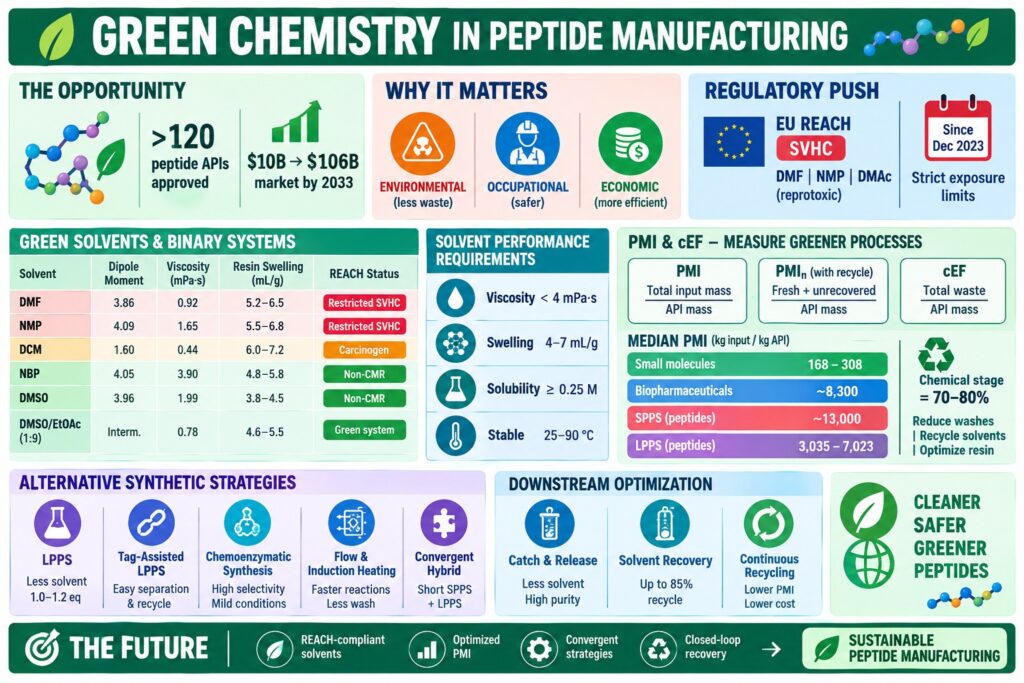
Green Chemistry in Peptide Manufacturing offers a strategic approach to addressing the significant environmental, occupational, and economic challenges associated with conventional solid-phase peptide synthesis. It focuses on replacing hazardous dipolar aprotic solvents, decreasing overall solvent consumption, and systematically reducing Process Mass Intensity (PMI). More than 120 peptide active pharmaceutical ingredients (APIs) have received approval for commercial use, while the global peptide therapeutics market is expected to grow from 10 billion in 2023 to more than 106 billion by 2033. This expansion is being driven substantially by high-demand metabolic therapies, including GLP-1 receptor agonists. Despite this growth, traditional Solid-Phase Peptide Synthesis (SPPS) has a median baseline PMI of approximately 13,000 kg of total material per kilogram of isolated API, positioning peptides among the most solvent-intensive and waste-generating therapeutic modalities in the pharmaceutical industry. Solvents may contribute as much as 90% of this overall mass burden, largely because of repeated coupling, deprotection, and resin-washing cycles. Increasing regulatory pressure under European Union REACH guidelines, particularly restrictions affecting legacy solvents such as N,N-dimethylformamide (DMF), is accelerating a fundamental transition toward more sustainable manufacturing processes. Applying green chemistry principles to commercial peptide production therefore requires an integrated strategy involving compliant alternative solvents, alternative synthetic methodologies, and optimized downstream solvent recovery and purification protocols.
Looking for a scalable peptide synthesis strategy tailored to your sequence?
Explore Custom Peptide Synthesis Services
Share via:
Quick Summary:
- Green chemistry is becoming essential in peptide manufacturing to reduce environmental impact, occupational hazards, solvent use, and production costs.
- Conventional SPPS has a very high material footprint, with a median PMI of ~13,000 kg input/kg peptide API, largely driven by repeated solvent washing and purification.
- DMF, NMP, and DMAc face increasing regulatory pressure under EU REACH due to their reprotoxic classification, accelerating the search for safer solvent alternatives.
- Green solvents and binary systems such as NBP, DMSO/EtOAc, NBP/2-MeTHF, Cyrene/DEC, and propylene carbonate can provide suitable solubility, resin swelling, viscosity, and process performance.
- PMI, PMIᵣ, and cEF provide measurable sustainability metrics, helping manufacturers identify major waste sources and quantify improvements from solvent recovery and process optimization.
- Alternative synthesis technologies including LPPS, tag-assisted LPPS, chemoenzymatic synthesis, convergent hybrid approaches, continuous flow, and induction heating can reduce solvent consumption, reagent excess, and processing time.
- Downstream optimization and solvent recycling are critical, with catch-and-release purification and recovery of up to 85% of process solvents supporting lower waste, reduced PMI, and more sustainable large-scale peptide manufacturing.
Regulatory Impetus for Green Chemistry in Peptide Manufacturing: Replacing DMF
The movement toward Green Chemistry in Peptide Manufacturing is strongly influenced by European Union REACH restrictions, under which N,N-dimethylformamide (DMF), N-methyl-2-pyrrolidone (NMP), and N,N-dimethylacetamide (DMAc) are classified as Substances of Very High Concern (SVHC) because of their reprotoxic properties. Since December 2023, binding regulatory requirements have imposed strict operational exposure limits for these substances across European drug substance manufacturing facilities. As a result, uncontrolled industrial use of neat dipolar aprotic solvents has become increasingly difficult to justify from both regulatory and operational perspectives.
DMF has been the conventional solvent of choice for SPPS for several decades because of its favorable physical and chemical properties. Its high dielectric constant and dipole moment of 3.86 D facilitate effective dissolution of Fmoc-protected amino acid synthons at concentrations of ≥0.25 M while also supporting substantial swelling of cross-linked polystyrene (PS) and polyethylene glycol (PEG) resins, typically within the range of 5.2–6.5 mL/g. These properties provide efficient reagent diffusion throughout the swollen polymer matrix and support rapid coupling kinetics. Nevertheless, DMF has important chemical stability limitations. At elevated processing temperatures, it can undergo thermal decomposition to form dimethylamine, a secondary amine capable of causing premature Fmoc deprotection and increasing the potential for enantiomeric racemization. Such degradation pathways can contribute to complex impurity profiles and subsequently make downstream purification more challenging. The combined toxicological, regulatory, and chemical limitations associated with DMF therefore support the development and implementation of more sustainable solvent alternatives.
Need to evaluate peptide manufacturing requirements from development through GMP production?
Explore GMP Peptide API Manufacturing Services
| Solvent System | Dipole Moment (D) | Viscosity at 25 °C (mPa·s) | PS Resin Swelling (mL/g) | REACH Status & Occupational Risk |
|---|---|---|---|---|
| N,N-Dimethylformamide (DMF) | 3.86 | 0.92 | 5.2–6.5 | Restricted SVHC; Reprotoxic (CMR) |
| N-Methyl-2-pyrrolidone (NMP) | 4.09 | 1.65 | 5.5–6.8 | Restricted SVHC; Reprotoxic (CMR) |
| Dichloromethane (DCM) | 1.60 | 0.44 | 6.0–7.2 | Suspected Carcinogen; Volatile Pollutant |
| N-Butyl-2-pyrrolidinone (NBP) | 4.05 | 3.90 | 4.8–5.8 | Non-CMR Alternative; high viscosity neat |
| Dimethyl Sulfoxide (DMSO) | 3.96 | 1.99 | 3.8–4.5 | Non-CMR; benign polar aprotic alternative |
| DMSO / Ethyl Acetate (1:9 v/v) | Intermediate | 0.78 | 4.6–5.5 | Green Binary System; highly recyclable |
Next-Generation Green Solvents and Binary Systems for SPPS
Replacing DMF in solid-phase peptide synthesis requires the use of bio-derived single solvents or specifically engineered binary solvent systems that can preserve adequate synthon solubility and resin swelling while reducing toxicity concerns. For alternative solvent platforms to function effectively in automated synthesis equipment, they must satisfy several critical physical and chemical performance requirements.
Physical Criteria for High-Efficiency SPPS Solvents
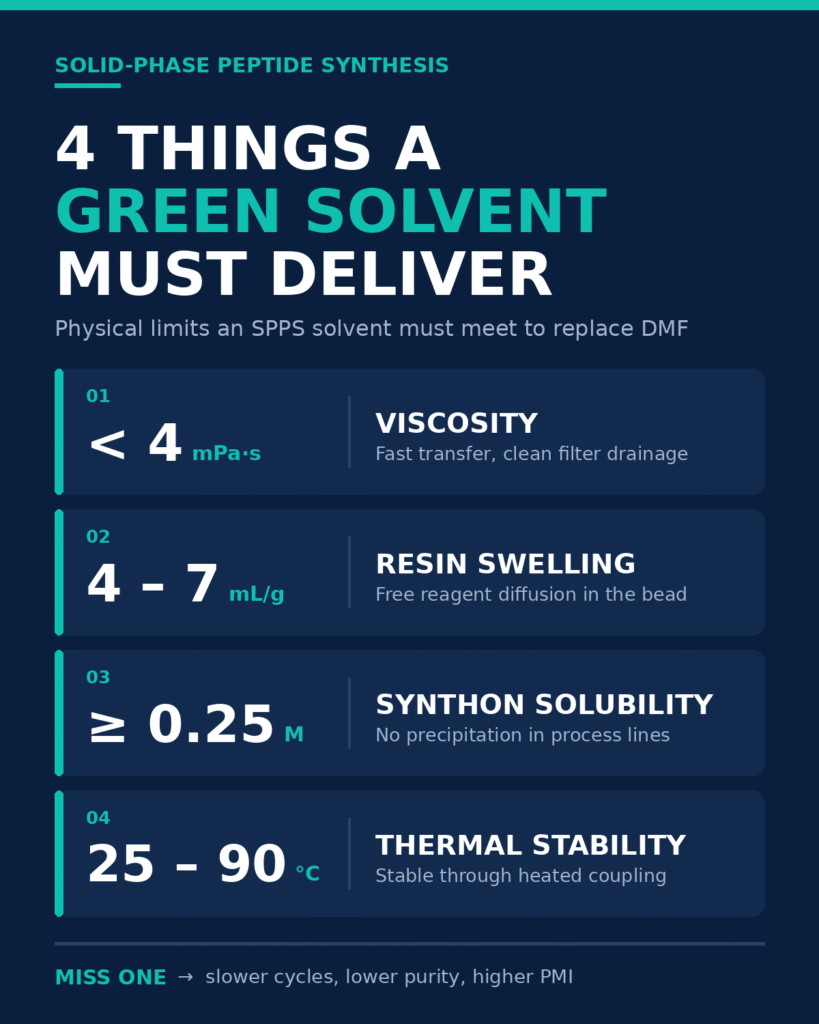
- Viscosity Threshold: Kinematic viscosity should remain below 4 mPa·s at the operating temperature to facilitate rapid fluid transfer, effective permeation through the resin bed, and efficient filter drainage in large-scale reactors.
- Resin Swelling Capacity: Solvents should provide sufficient swelling of standard polystyrene (1–2% DVB) or PEG-based supports, generally within the range of 4–7 mL/g, to permit unrestricted diffusion of reagents throughout the polymer network.
- Synthon Solubility: Fmoc-amino acids and coupling additives, including Oxyma Pure and DIC, should remain soluble at concentrations of ≥0.25 M to minimize the risk of precipitation within process lines.
- Thermal Stability: Solvents should remain chemically stable across operational temperatures ranging from 25 °C to 90 °C, particularly during heated coupling and deprotection operations.
Several single-component bio-based alternatives, including N-butyl-2-pyrrolidinone (NBP), N-octyl-2-pyrrolidone (NOP / Surfadone™), Cyrene™ (dihydrolevoglucosenone), γ-valerolactone (GVL), and propylene carbonate, have demonstrated effective performance during laboratory-scale peptide assembly. Neat NBP can produce crude peptide purities comparable to or greater than those achieved with DMF. However, its relatively high viscosity of 3.9 mPa·s can prolong filtration operations in large-scale batch reactors exceeding 100 L. In addition, the cost associated with NBP can restrict its use as a sole solvent for commercial-scale manufacturing.
To address these physical and economic limitations, process developers have increasingly investigated engineered binary solvent mixtures. Combining a polar aprotic solvent with a low-viscosity bio-based ester or ether can establish a cooperative solvation environment that balances fluid-dynamic properties with peptide coupling performance. Binary systems based on dimethyl sulfoxide and ethyl acetate (DMSO/EtOAc), commonly used at ratios ranging from 1:9 to 2:8 v/v, have emerged as effective options for industrial applications. Ethyl acetate decreases the viscosity of the overall solvent mixture and reduces its boiling point, whereas DMSO supports efficient dissolution of hydrophobic synthons. Other binary systems that have demonstrated potential include NBP/2-methyltetrahydrofuran (NBP/2-MeTHF), NBP/1,3-dioxolane (NBP/DOL), and Cyrene/diethyl carbonate (Cyrene/DEC).
Scaling a peptide process requires more than selecting a greener solvent; reaction performance, impurity formation, equipment compatibility, and downstream processing must also be evaluated.
See GLP-1 Analog Scale-Up and GMP Manufacturing Considerations
| Green Solvent System | Swelling Capacity (mL/g PS Resin) | Fmoc-AA Solubility (0.2 M) | Viscosity Profile | Industrial Performance & Feasibility |
|---|---|---|---|---|
| NBP (Neat) | 4.8–5.8 | High (>0.25 M) | High (3.9 mPa·s) | High crude purity; slow reactor filtration. |
| DMSO / Ethyl Acetate (1:9) | 4.6–5.5 | Moderate to High | Low (<1.0 mPa·s) | Low cost; recyclable via fractional distillation. |
| Cyrene / Diethyl Carbonate (3:7) | 4.4–5.2 | Moderate | Moderate | Bio-derived; requires optimized coupling temperatures. |
| NBP / 2-MeTHF (1:1) | 5.0–6.1 | High (>0.25 M) | Moderate (~1.5 mPa·s) | Excellent resin swelling; cuts NBP material costs by 50%. |
| Propylene Carbonate | 3.5–4.2 | Low to Moderate | Moderate | Exceptional safety profile; lower swelling on standard PS. |
Quantifying Green Chemistry in Peptide Manufacturing: Process Mass Intensity (PMI) and Complete E-Factor (cEF)
Process Mass Intensity (PMI) and Complete Environmental Factor (cEF) are key quantitative metrics used to evaluate resource efficiency and overall material waste during peptide synthesis. Standardized through the ACS Green Chemistry Institute Pharmaceutical Roundtable (ACS GCIPR), PMI represents the total mass of material entering a process relative to the mass of isolated API obtained from that process.
Process Mass Intensity is mathematically defined as:
PMI = Σ Mass of Raw Materials, Solvents, and Reagents (kg) Mass of Isolated Active Pharmaceutical Ingredient (kg)
To incorporate the effects of waste-reduction measures such as solvent recovery, process engineers can use Process Mass Intensity with Recycling (PMIr) together with the Complete Environmental Factor (cEF). The cEF accounts for the overall waste generated by the process, including aqueous waste streams:
cEF = Total Mass of Waste Generated (kg) Mass of Isolated Active Pharmaceutical Ingredient (kg)
PMIr = Mass of Fresh Materials (kg) + Mass of Unrecovered Recycled Materials (kg) Mass of Isolated Active Pharmaceutical Ingredient (kg)
A comprehensive assessment conducted by fourteen member companies of the ACS GCIPR, covering 40 industrial synthetic peptide manufacturing processes, demonstrated substantial differences in material efficiency between peptides and other therapeutic modalities.
| Therapeutic Modality / Process Strategy | Median PMI (kg input / kg API) | Dominant Waste Contributor | Primary Target for Optimization |
|---|---|---|---|
| Small Molecules | 168 – 308 | Reaction Solvents & Reagents | Reaction concentration, yield optimization |
| Biopharmaceuticals (Recombinant) | ~8,300 | Aqueous Media & Buffers | Cell culture density, water treatment & recovery |
| Solid-Phase Peptide Synthesis (SPPS) | ~13,000 | Wash Solvents (DMF, DCM) | Wash volume reduction, green solvent recycling |
| Liquid-Phase Peptide Synthesis (LPPS) | 3,035 – 7,023 | Extractions & Salts | Stoichiometric reduction, group-assisted isolation |
The baseline median PMI of approximately 13,000 for SPPS demonstrates that conventional peptide manufacturing can consume thousands of kilograms of materials and resources for every kilogram of therapeutic drug produced. The chemical assembly stage is responsible for approximately 70–80% of this overall mass burden, primarily because large quantities of solvent are required to wash unreacted synthons and excess coupling agents from the resin bed after individual synthesis steps. Therefore, reducing the frequency and volume of washing operations, optimizing resin substitution capacity, and implementing recyclable binary solvent systems are among the key strategies for decreasing overall process mass intensity.
Analytical characterization is essential when changing synthesis conditions or introducing alternative solvents because process modifications can affect impurity profiles and product quality attributes.
Explore Peptide Analytical Testing Services
Alternative Synthetic Strategies to Drive Green Chemistry in Peptide Manufacturing
Alternative synthetic platforms, including Liquid-Phase Peptide Synthesis (LPPS), tag-assisted technologies, chemoenzymatic assembly, and continuous flow reactors, can substantially decrease solvent consumption and reduce the need for excessive reagent quantities compared with conventional SPPS.
Liquid-Phase Peptide Synthesis (LPPS) and Hybrid Fragment Condensation
Liquid-Phase Peptide Synthesis is performed homogeneously in solution without the use of an insoluble polymeric support. This configuration enables coupling reactions to be conducted using reagent quantities closer to stoichiometric requirements, typically 1.0–1.2 equivalents of amino acids compared with approximately 3.0–5.0 equivalents commonly used in SPPS. For short-to-medium peptide sequences containing approximately 5–10 amino acids, LPPS can provide improved material efficiency, with median PMI values ranging from 3,000 to 7,000. Rather than relying on repeated resin washing, LPPS uses liquid-liquid extraction or controlled precipitation procedures for product isolation and impurity removal.
For longer peptide sequences exceeding 20 amino acids, convergent hybrid approaches have become an important strategy. In these processes, short protected peptide fragments are efficiently synthesized using Green SPPS (GSPPS) on acid-labile resins, such as chlorotrityl chloride resin. These fragments are subsequently isolated and coupled in solution through LPPS fragment condensation. By limiting solid-phase operations to relatively short peptide sequences, this strategy reduces cumulative wash solvent requirements while retaining favorable overall synthetic yields.
For programs progressing from laboratory synthesis to GMP production, process transfer must preserve critical quality attributes while adapting the chemistry to commercial manufacturing equipment.
Learn About Technology Transfer to a GMP CDMO
Soluble Tag-Assisted LPPS (PA-LPPS)
Peptide-Anchored or Tag-Assisted Liquid-Phase Peptide Synthesis uses hydrophobic, fluorinated, or ionic liquid tags that are attached to the C-terminus of the growing peptide chain. These tags provide controlled solubility characteristics that enable the target peptide sequence to remain soluble during coupling reactions conducted in green organic solvents while allowing the product to precipitate quantitatively when a polar anti-solvent, such as water or alcohols, is introduced. The resulting material can then be isolated through straightforward filtration. This hybrid methodology combines the homogeneous reaction kinetics and improved stoichiometric control of liquid-phase synthesis with the efficient separation characteristics associated with solid-phase approaches.
Chemoenzymatic Peptide Synthesis (CEPS) and Recombinant Technologies
Chemoenzymatic assembly reduces dependence on conventional chemical coupling reagents, including carbodiimides, phosphonium salts, and uronium salts, by incorporating engineered peptide ligases such as modified subtilisin or trypsiligase. Enzymatic ligation reactions can proceed under mild aqueous conditions and at ambient temperature while providing high regioselectivity and stereospecificity. This approach minimizes racemization risks and can reduce or eliminate the need for extensive side-chain protecting group strategies. When CEPS is combined with recombinant expression systems, including E. coli or Pichia pastoris systems for producing precursor fragments, it provides a potentially sustainable platform for long-chain peptide manufacturing and can reduce organic solvent consumption by up to 90%.
For peptide programs entering clinical development, manufacturing strategy must also account for material requirements, batch planning, and timely supply of clinical-grade drug substance.
Explore Clinical Trial Material Supply for Peptide Programs
Induction Heating and Continuous Flow Synthesis
Process intensification technologies such as induction heating and continuous flow chemistry can directly address kinetic limitations encountered during SPPS. Induction heating can supply thermal energy across a range of approximately 25 °C to 90 °C, accelerating sterically hindered coupling reactions and Fmoc deprotection cycles. By increasing reaction rates, these technologies can reduce processing times from hours to minutes. The resulting improvement in reaction kinetics can allow process engineers to decrease reagent excesses and reduce wash solvent requirements by approximately 50–60% while continuing to achieve the required target purity.
Downstream Optimization: Reducing Purification and Isolation Footprints
Downstream purification and isolation can represent a considerable proportion of the total solvent consumption associated with peptide manufacturing. This burden can be reduced through approaches such as catch-and-release affinity purification and continuous solvent recycling. Preparative Reverse-Phase High-Performance Liquid Chromatography (RP-HPLC) is traditionally a major contributor to downstream PMI. Industrial HPLC purification commonly requires substantial quantities of mobile phases containing acetonitrile (ACN), water, and trifluoroacetic acid (TFA). These operations generate significant aqueous-organic waste streams that can be challenging to recover and recycle because of azeotropic behavior.
Peptide purification and analytical control should be evaluated together because changes in downstream processing can influence purity, impurity clearance, and product quality.
Explore Peptide Stability Testing Services
To reduce the environmental burden associated with downstream purification, manufacturers are investigating catch-and-release purification platforms. This approach incorporates reversible covalent interactions or affinity tags introduced during synthesis. The crude cleavage solution is passed through a functionalized solid-support bed designed to selectively retain the desired peptide sequence, while truncated sequences and other modified impurities remain unbound and pass through the system. The retained target peptide can subsequently be released using a mild green cleavage reagent. This process can generate purified peptide while requiring only a fraction of the solvent volume typically associated with preparative HPLC gradients.
In parallel with purification improvements, on-site solvent recovery using continuous fractional distillation enables the capture and subsequent reuse of volatile green solvents, including ethyl acetate and 2-MeTHF. Recovery and recycling of up to 85% of process solvents can substantially decrease the effective Process Mass Intensity (PMIr). This combination of solvent recovery and reuse can therefore improve both the economic efficiency and environmental performance of large-scale peptide manufacturing operations.
When peptide manufacturing involves single-use equipment or injectable drug products, solvent and process optimization should also be evaluated alongside extractables and leachables risks.
Learn About Extractables and Leachables Testing for Peptide Injectables
Conclusion: The Future of Green Chemistry in Peptide Manufacturing
The advancement of Green Chemistry in Peptide Manufacturing requires an integrated operational framework that brings together REACH-compliant green solvents, optimized PMI metrics, convergent synthetic strategies, and closed-loop solvent recovery systems. Replacing hazardous dipolar aprotic solvents such as DMF with engineered binary mixtures such as DMSO/EtOAc can help manufacturers preserve effective synthetic performance while addressing evolving regulatory requirements. In addition, the implementation of convergent technologies, including tag-assisted LPPS, chemoenzymatic ligation, and continuous-flow process intensification, can substantially decrease baseline solvent consumption and overall Process Mass Intensity.
Need to assess potential nitrosamine risks within a peptide API manufacturing process?
Explore Nitrosamine Risk Assessment for Peptide APIs
Designing greener synthetic routes at an early stage of clinical development can help reduce regulatory risks, lower waste-management expenditures, and strengthen long-term supply chain security. Drug developers and research institutions seeking specialized support for sustainable peptide synthesis programs, including expert guidance, custom analytical development, or process optimization, can consult directly with specialists through the ResolveMass Contact Portal.
Frequently Asked Questions (FAQs)
N-butyl-2-pyrrolidinone (NBP) and DMSO/EtOAc binary systems can provide resin swelling performance within a range suitable for SPPS. DMSO/EtOAc at a 1:9 v/v ratio provides approximately 4.6–5.5 mL/g swelling, while NBP provides about 4.8–5.8 mL/g. Adequate resin swelling is essential for maintaining effective reagent diffusion and coupling performance.
Binary solvent systems allow individual solvents to contribute complementary physical and chemical properties. For example, DMSO can support synthon dissolution, while ethyl acetate lowers viscosity and improves fluid-handling characteristics. This combination can provide an effective balance between resin swelling, reagent solubility, process performance, and solvent efficiency.
PMI represents the total material input required to obtain one kilogram of isolated API, including solvents, reagents, synthons, and water. PMIr, or Process Mass Intensity with Recycling, accounts for material recovery and reuse when determining effective resource consumption. It therefore provides a more representative measure when substantial solvent recycling is incorporated into the manufacturing process.
Liquid-Phase Peptide Synthesis (LPPS) can offer improved material efficiency for short-to-medium peptide sequences compared with conventional SPPS. LPPS typically uses amino acids closer to stoichiometric quantities, around 1.0–1.2 equivalents, and avoids repeated resin washing. Reported median PMI values of approximately 3,035–7,023 are lower than the approximately 13,000 associated with standard SPPS.
Catch-and-release purification uses selective interactions to retain the desired peptide from a crude process mixture while allowing unwanted components to pass through. The captured peptide is subsequently released under controlled conditions using a suitable cleavage or elution system. This strategy can reduce dependence on solvent-intensive preparative RP-HPLC and decrease downstream purification waste.
Cyrene can be considered for automated peptide synthesis, but its relatively high viscosity may affect fluid transfer and filtration when used without modification. Blending Cyrene with lower-viscosity co-solvents, such as diethyl carbonate (DEC) or dimethyl carbonate (DMC), can improve its processing characteristics. The selected formulation must still be evaluated for resin swelling, synthon solubility, and synthesis performance.
Induction heating provides rapid and controlled thermal input that can accelerate coupling and Fmoc deprotection reactions. Higher operating temperatures, commonly within the 60–90 °C range, can substantially reduce reaction durations compared with conventional processing. Faster kinetics may allow reductions in reagent excess and wash-solvent requirements while maintaining the desired peptide quality.
An effective green solvent for SPPS should combine suitable physical properties with an acceptable toxicological and regulatory profile. Important benchmarks include viscosity below 4 mPa·s, resin swelling of approximately 4–7 mL/g, and Fmoc-amino acid solubility of ≥0.25 M. The solvent should also remain stable between 25 °C and 90 °C and satisfy applicable REACH requirements without a CMR classification.
Reference:
- Kekessie, I., Wegner, K., Martinez, I., Kopach, M. E., White, T. D., Tom, J. K., Kenworthy, M. N., Gallou, F., Lopez, J., Koenig, S. G., Payne, P. R., Eissler, S., Arumugam, B., Li, C., Mukherjee, S., Isidro-Llobet, A., Ludemann-Hombourger, O., Richardson, P., Kittelmann, J., Pedersen, D. S., & van den Bos, L. J. (2024). Process mass intensity (PMI): A holistic analysis of current peptide manufacturing processes informs sustainability in peptide synthesis. The Journal of Organic Chemistry, 89(7), 4261–4282. https://doi.org/10.1021/acs.joc.3c01494
- Scognamiglio, A., Magli, E., Caliendo, G., Perissutti, E., Santagada, V., & Severino, B. (2026). Once upon a time without DMF: Greener paths in peptide and organic synthesis. Molecules, 31(3), 536. https://doi.org/10.3390/molecules31030536
- Martin, V., Egelund, P. H. G., Johansson, H., Le Quement, S. T., Wojcik, F., & Pedersen, D. S. (2020). Greening the synthesis of peptide therapeutics: An industrial perspective. RSC Advances, 10(69), 42457–42492. https://doi.org/10.1039/D0RA07204D
- Pacini, L., Muthyala, M., Aguiar, L., Zitterbart, R., Rovero, P., & Papini, A. M. (2024). Optimization of peptide synthesis time and sustainability using novel eco-friendly binary solvent systems with induction heating on an automated peptide synthesizer. Journal of Peptide Science, 30(9), e3605. https://doi.org/10.1002/psc.3605
Get In Touch With Us
About The Author


