

Introduction
Hydrogen-Deuterium Exchange Mass Spectrometry (HDX-MS) is a high-resolution, solution-phase analytical technique that enables dynamic characterization of backbone hydrogen-bonding patterns and supports the assessment of Higher-Order Structure (HOS) fidelity for Investigational New Drug (IND) filings. The application of HDX-MS for Higher-Order Structure Confirmation allows biopharmaceutical developers to establish conformational identity, demonstrate batch-to-batch consistency, and assess structural sameness under conditions that closely approximate the native physiological environment. As the biopharmaceutical sector increasingly adopts sophisticated peptide modalities—including glucagon-like peptide-1 (GLP-1) receptor agonists, dual/triple incretin mimetics, and constrained macrocyclic peptides—regulatory authorities such as the US Food and Drug Administration (FDA) and European Medicines Agency (EMA) have increased their focus on structural comparability. Even minor alterations in secondary or tertiary folding may influence biological potency, affect pharmacokinetic behavior, or contribute to the development of significant anti-drug antibody (ADA) immunogenic responses.
Conventional biophysical approaches involve important analytical limitations when they are used to characterize peptide HOS. Techniques including Circular Dichroism (CD) and Fourier-Transform Infrared (FTIR) spectroscopy generate broad, low-resolution ensemble measurements that may not adequately reveal localized conformational changes. In contrast, high-resolution approaches such as Nuclear Magnetic Resonance (NMR) spectroscopy and X-ray crystallography have their own constraints, including requirements for relatively high sample concentrations, limitations associated with molecular size, spectral sensitivity to small pH changes, or dependence on solid-state crystal lattices that may not accurately represent the structural behavior of a peptide in a liquid formulation.
Explore Circular Dichroism Spectroscopy for Peptide Secondary Structure Characterization to see how CD evaluates secondary structure fidelity.
Hydrogen-Deuterium Exchange Mass Spectrometry addresses this analytical limitation by examining solvent exchange behavior across backbone amide hydrogens with peptide- and residue-level resolution. Monitoring isotope incorporation over defined time intervals allows HDX-MS to distinguish flexible regions, rigid helical domains, turn segments, and higher-order self-association states under solution-phase conditions. This case study describes an IND-enabling biophysical characterization approach in which differential HDX-MS was used to establish rigorous conformational comparability between a synthetic therapeutic peptide candidate and its reference control. The resulting analytical evidence supported critical Quality by Design (QbD) and Chemistry, Manufacturing, and Controls (CMC) requirements for regulatory filing.
Learn more about Peptide Physicochemical Characterization Services for IND regulatory filings.
Share via:
Quick Summary:
- HDX-MS is a high-resolution, solution-phase technique used to confirm the higher-order structure (HOS), conformational identity, and structural consistency of therapeutic peptides.
- Compared with CD, FTIR, X-ray crystallography, and NMR, HDX-MS offers peptide-level resolution, ultra-low sample requirements, near-native conditions, and dynamic structural information.
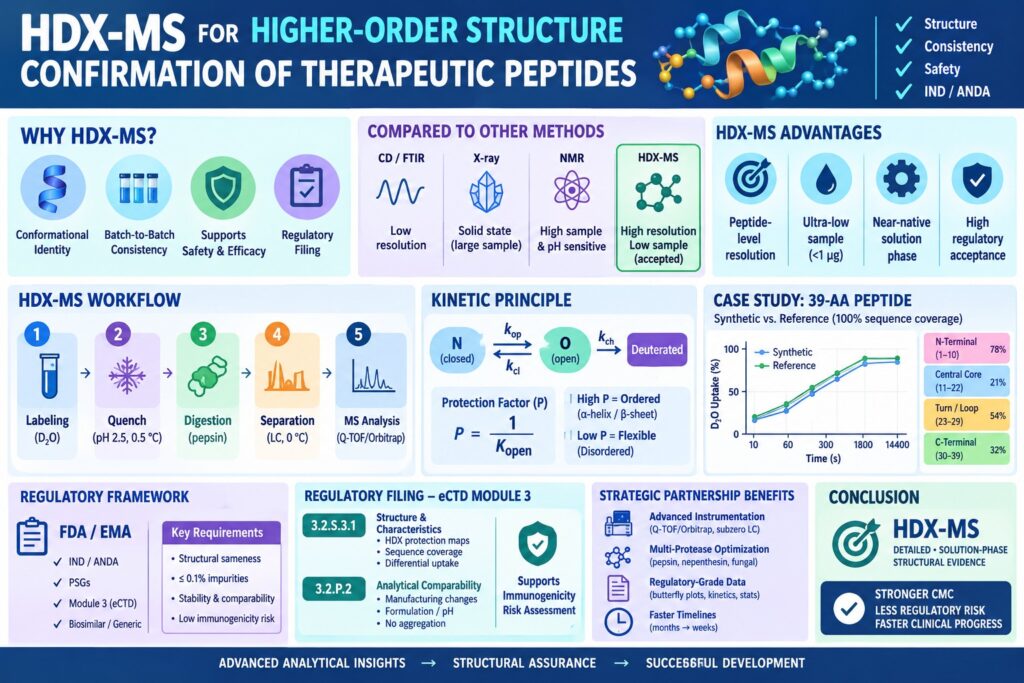
- The HDX-MS workflow involves D₂O labeling → acid quenching → proteolytic digestion → cold LC separation → high-resolution MS analysis, enabling detailed mapping of solvent accessibility and hydrogen-bonding patterns.
- Exchange kinetics and Protection Factors (P) reveal structural stability: high P indicates ordered, hydrogen-bonded regions, while low P indicates flexible or solvent-exposed regions. EX1 behavior can indicate conformational heterogeneity or aggregation.
- In the 39-amino-acid peptide case study, comparison of 3 synthetic batches vs. 3 reference lots achieved 100% sequence coverage with 28 overlapping peptides, demonstrating highly comparable regional dynamics and structural profiles.
- HDX-MS data can strengthen FDA/EMA IND and ANDA submissions, particularly within eCTD Module 3, supporting structural characterization, analytical comparability, CMC documentation, and immunogenicity risk assessment.
- Overall, HDX-MS provides detailed structural evidence, improved comparability confidence, and stronger regulatory support, helping biopharmaceutical developers advance complex peptide programs toward clinical development and approval.
Regulatory Framework and Analytical Demands for Peptide HOS Characterization
Establishing higher-order structural identity and demonstrating batch-to-batch comparability are important regulatory expectations for peptide IND and Abbreviated New Drug Application (ANDA) submissions because structural consistency is closely associated with clinical safety, efficacy, and immunogenicity risk. Regulatory expectations for advanced biophysical characterization are intended to demonstrate that generic or biosimilar peptides are structurally comparable to reference listed drugs (RLDs) and that manufacturing-process variations have not produced meaningful changes in solution-phase secondary or tertiary structures.
Review the Regulatory Requirements for GLP-1 Peptide Characterization for comprehensive guidance on compliance strategies.
Within regulatory frameworks that include FDA draft product-specific guidances (PSGs) and ANDA/IND requirements applicable to synthetic peptides referencing recombinant origin drug products, applicants are expected to establish that the active pharmaceutical ingredient (API) retains its intended structural sameness throughout the proposed shelf life. For peptides containing up to 40 amino acids, comprehensive characterization may encompass primary sequence confirmation, secondary and tertiary folding, oligomeric aggregation states, and in vitro biological potency. Any newly observed peptide-related impurity above 0.1%, as well as any conformational change that affects solvent accessibility, requires appropriate characterization, scientific assessment, and justification.
Access the complete Peptide Characterization CRO Deliverables Checklist to streamline your submission package.
One of the principal analytical difficulties in peptide HOS characterization arises from the dynamic and highly flexible behavior of mid-sized peptides in liquid formulations. In contrast to relatively rigid globular proteins, therapeutic peptides can continuously interconvert among several conformational states that exist in equilibrium. Characterizing these dynamic structural ensembles therefore requires complementary analytical techniques capable of examining the molecule without significantly disturbing its native solution-phase equilibrium.
| Analytical Methodology | Solution Phase | Spatial Resolution | Sample Consumption | Dynamic Flexibility | Regulatory Acceptability for IND/ANDA |
|---|---|---|---|---|---|
| Circular Dichroism (CD) | Yes | Bulk / Low (Ensemble average) | Low (µg) | Low | Standard (Secondary structure only) |
| Fourier-Transform Infrared (FTIR) | Yes / Solid | Bulk / Low (Ensemble average) | Moderate | Low | Standard (Secondary structure only) |
| X-Ray Crystallography | No (Solid state) | Atomic (0.1–0.2 nm) | High (mg) | None (Static crystal) | High (Requires crystallization) |
| Nuclear Magnetic Resonance (NMR) | Yes | Atomic / Residue-level | High (mg) | High | High (Sensitive to matrix pH shifts) |
| Bottom-Up HDX-MS | Yes (Near-native) | Sub-molecular / Peptide-level (1–5 residues) | Ultra-low (<1 µg) | High (Dynamic kinetics) | High (Accepted by FDA/EMA) |
As demonstrated by the comparative matrix, HDX-MS combines low sample requirements with peptide-level spatial resolution and near-native solution-phase measurements. This combination makes the technique a highly valuable orthogonal analytical method for establishing structural comparability in regulatory submissions.
Evaluate 2D NMR for Peptide Characterization as a complementary technique for residue-level structural validation.
Methodological Architecture of HDX-MS for Higher-Order Structure Confirmation
Bottom-up HDX-MS determines backbone amide exchange behavior in solvent D₂O through a controlled sequence involving isotopic labeling, acid quenching, online proteolytic digestion, subzero or sub-ambient chromatographic separation, and high-resolution mass spectrometric detection. This integrated analytical design enables the localization of hydrogen-bonding patterns and conformational differences without requiring isotopic labeling of the peptide matrix itself.
Kinetic Principles of HDX-MS for Higher-Order Structure Confirmation
The exchange kinetics of backbone amide protons provide direct information regarding local folding stability and solvent accessibility and can be interpreted using Linderstrøm-Lang kinetic models. Within a solution environment, backbone amide hydrogens continuously exchange with deuterium atoms present in the surrounding heavy water (D₂O) buffer. The rate of this exchange is governed by factors including local structural protection and hydrogen-bond formation.
The Linderstrøm-Lang model describes hydrogen-deuterium exchange as a sequential two-step mechanism. A peptide segment reversibly transitions between a closed state (N), in which backbone amides are protected from solvent, and an open state (O), in which exchange with deuterium can occur:
N kop ⇄ kcl O → kch Deuterated
The overall exchange rate constant, k_ex, can be represented mathematically as:
kex = (kop × kch) / (kop + kcl + kch)
Where:
- k_op represents the rate constant associated with local structural opening or unfolding.
- k_cl represents the rate constant for structural re-closing.
- k_ch represents the intrinsic chemical exchange rate constant, which is strongly influenced by solution pH, temperature, and the identities of neighboring amino acid side chains.
Under physiological conditions, hydrogen-deuterium exchange commonly follows the EX2 kinetic regime, in which structural re-closing occurs substantially faster than the intrinsic chemical exchange process (k_cl ≫ k_ch). Under these circumstances, the exchange equation can be simplified to:
kex = (kop / kcl) × kch = Kopen × kch
The relationship between the intrinsic chemical exchange rate and the experimentally observed exchange rate is used to determine the Protection Factor (P), which serves as an important thermodynamic indicator of local structural stability:
P = kch / kex = 1 / Kopen
High Protection Factors are associated with structurally ordered and hydrogen-bonded regions, including α-helices and β-sheets, whereas low Protection Factors generally indicate disordered or highly solvent-accessible regions. When substantial structural unfolding occurs and chemical exchange becomes faster than structural closing (k_ch ≫ k_cl), the system can enter the EX1 regime. This behavior produces bimodal isotopic mass envelopes and can provide an analytical indication of structural instability, conformational heterogeneity, or aggregation.
Discover how Native Mass Spectrometry for Therapeutic Peptide Characterization captures non-covalent higher-order states.
Analytical Workflow Optimization for Sub-Molecular Resolution
Obtaining high spatial resolution together with consistent deuterium recovery requires stringent control of every major analytical step, including labeling, quenching, digestion, and chromatographic separation. Optimized operational procedures incorporate multiple isotopic labeling time points and sub-ambient liquid chromatography to minimize deuterium loss and preserve the original exchange information.
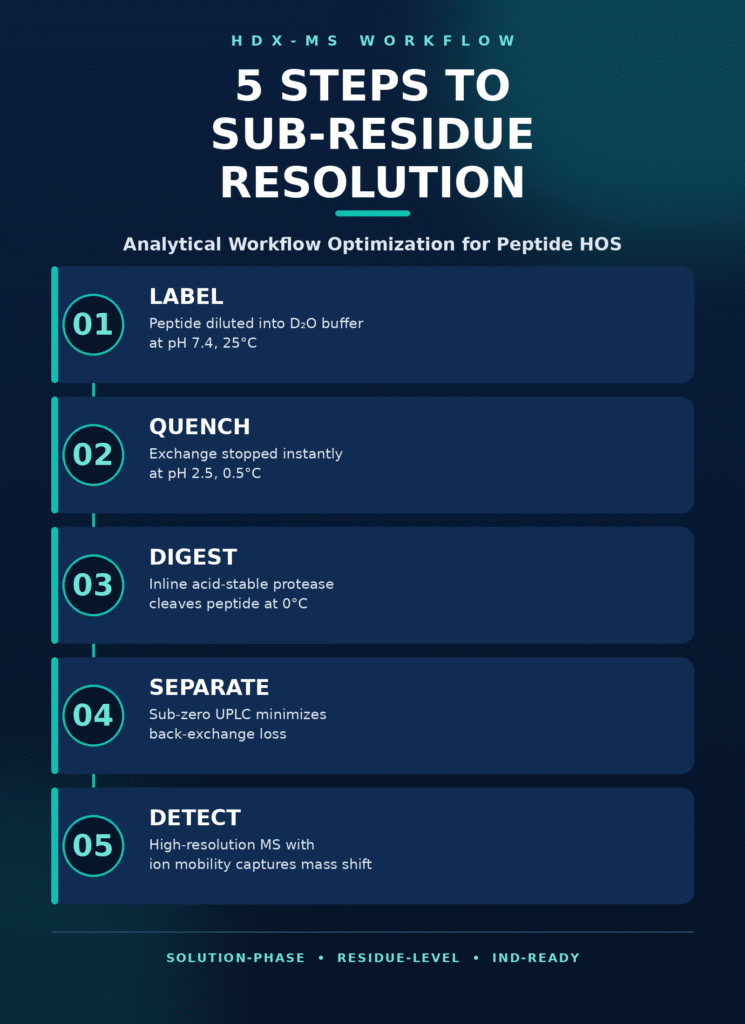
The optimized bottom-up workflow consists of five interconnected stages:
- Isotopic On-Exchange Labeling: The therapeutic peptide is diluted 10- to 20-fold into a deuterated physiological buffer (D₂O, pH 7.4) under a controlled temperature of 25.0 °C ± 0.1 °C. Labeling is performed over a logarithmically distributed time series, such as 10 s, 60 s, 300 s, 1800 s, and 14400 s. This time-course design captures both rapidly exchanging flexible loops and slowly exchanging regions stabilized by hydrogen bonding.
- Acid Quenching and Denaturation: Exchange is rapidly terminated by lowering the sample pH to 2.50 and reducing the temperature to 0.5 °C with a quench buffer containing 100 mM phosphate, 2 M Guanidine Hydrochloride (or Urea), and 0.5 M TCEP. At approximately pH 2.5, the intrinsic chemical exchange rate, k_ch, reaches a minimum, allowing the deuterium label incorporated into backbone amides to be preserved as effectively as possible.
- Inline Proteolytic Digestion: Quenched samples are introduced into an online column containing immobilized acid-stable proteases operated at 0 °C. Porcine pepsin is commonly used as the industry baseline, while dual-enzyme configurations, including combinations such as pepsin with Nepenthesin I/II or fungal acid proteases, can produce densely overlapping peptide fragments. This increased peptide overlap can improve spatial localization to approximately 1–3 amino acid residues.
- Sub-Ambient Chromatographic Separation: The resulting peptic fragments are rapidly trapped, desalted, and separated using a C18 reverse-phase column. Hydrogen back-exchange, in which incorporated deuterium is replaced by hydrogen during exposure to protonated solvents, is minimized by performing chromatography at 0 °C or under subzero conditions such as −30 °C in climate-controlled chambers. Rapid organic gradients of approximately 4–8 minutes further reduce the time available for back-exchange.
- High-Resolution Mass Spectrometry and Centroiding: Following separation, peptide fragments are introduced through Electrospray Ionization (ESI) and analyzed using high-resolution Q-TOF or Orbitrap mass spectrometers equipped with Ion Mobility Separation (IMS). IMS provides an additional separation dimension by distinguishing isobaric fragments according to collisional cross-section, thereby improving signal-to-noise performance and supporting accurate centroid mass determination.
Explore our tailored GLP-1 Analog Peptide Sequencing Workflow for detailed sub-molecular mapping.
Case Study: IND-Enabling HDX-MS for Higher-Order Structure Confirmation of a Synthetic Peptide
A comprehensive comparative HDX-MS investigation was performed to establish the higher-order structural equivalence of a 39-amino-acid synthetic therapeutic peptide candidate relative to a recombinant reference listed drug (RLD) intended for an IND submission. Comparative deuterium uptake profiles demonstrated equivalent backbone hydrogen-bonding behavior and comparable localized dynamics throughout 100% of the primary sequence, thereby fulfilling the study’s structural identity objectives.
Experimental Parameters and Comparative Sampling
The investigation evaluated three commercial manufacturing batches of the synthetic API against three separate lots of the recombinant reference product across five primary exchange time points. The study design was intended to identify even minor structural differences, localized unfolding events, or tendencies toward self-association.
The principal operational parameters were as follows:
- Target Molecule: 39-amino-acid synthetic peptide candidate (MW ~4.2 kDa, GLP-1 receptor agonist analogue).
- Comparative Batches: 3 independent synthetic candidate API batches versus 3 commercial RLD lots.
- Deuterium Labeling: D₂O buffer (99.9 atom % D, 20 mM phosphate, 150 mM NaCl, pH 7.40) maintained at 25.0 °C ± 0.1 °C. Time points included 0 s (unlabeled control), 10 s, 60 s, 300 s, 1800 s, 14400 s, and fully deuterated controls.
- Quench Conditions: 100 mM Potassium Phosphate, 2 M Guanidine-HCl, 0.5 M TCEP, pH 2.50, maintained at 0.5 °C.
- Digestion Setup: Inline immobilized Pepsin/Nepenthesin digestion column operated at 150 µL/min.
- LC-MS Setup: UPLC system maintained at 0.0 °C ± 0.05 °C; C18 analytical column (1.7 µm, 2.1 × 50 mm); 6-minute linear gradient from 8% to 40% Acetonitrile + 0.1% Formic Acid. Mass spectrometric analysis was performed using a high-resolution Q-TOF mass spectrometer operated in MS^E mode with ion mobility.
Read more about Peptide Sequencing of GLP-1 Peptide for detailed primary sequence verification.
Comparative Conformational Profiling and Regional Dynamics
Analysis of deuterium uptake kinetics and differential butterfly plots demonstrated comparable backbone protection factors across all four functional regions of the therapeutic peptide. Centroid mass measurements obtained from the synthetic batches and reference drug remained within the predefined statistical tolerance of ±0.15 Da, supporting the conclusion of structural sameness.
Proteolytic digestion generated 28 overlapping peptic peptides and achieved 100% sequence coverage, with a redundancy score of 3.4 peptides per amino acid residue. Differential deuterium uptake (ΔD = DSynthetic − DReference) was determined for each peptide at every kinetic time point.
- N-Terminal Region (Residues 1–10): This region showed rapid deuterium incorporation within 10 seconds (>75%), followed by near-saturation at 300 seconds. The rapid exchange behavior is consistent with an unstructured and highly dynamic coil region exhibiting limited backbone hydrogen bonding. The difference in uptake between synthetic and reference batches was +0.04 Da, demonstrating comparable conformational flexibility.
- Central Core Helical Domain (Residues 11–22): The central region displayed substantial protection from solvent-mediated exchange. Deuterium uptake remained below 22% at 300 seconds, consistent with a well-organized α-helical structure stabilized by persistent intra-molecular i → i+4 backbone hydrogen bonds. No statistically significant difference was observed between the candidate and reference batches, with a ΔD value of −0.02 Da.
- Turn / Loop Segment (Residues 23–29): Intermediate exchange kinetics were observed in this region, with approximately 54% deuteration at 60 seconds. This behavior is consistent with a flexible loop or β-turn connector segment. The differential uptake profile remained stable across all evaluated lots, with a ΔD of +0.05 Da.
- C-Terminal Amphipathic Segment (Residues 30–39): The C-terminal region exhibited moderate structural protection, with approximately 31% uptake at 60 seconds. This profile is consistent with an amphipathic secondary structure participating in localized folding. The exchange patterns of the synthetic and reference materials remained comparable throughout the full time-course experiment.
| Peptide Region | Amino Acid Sequence Range | Primary Secondary Structure | Mean D₂O Uptake at 60s (%) | Centroid Mass Difference (ΔDa) | Structural Conformation Assessment |
|---|---|---|---|---|---|
| N-Terminal Region | Residues 1–10 | Unstructured / Flexible Coil | 78.4 ± 1.2% | +0.04 Da | Highly Solvent Exposed; Equivalent Dynamics |
| Central Core | Residues 11–22 | α-Helical Backbone | 21.3 ± 0.8% | −0.02 Da | Strongly Hydrogen-Bonded; Protected |
| Turn / Loop Segment | Residues 23–29 | Dynamic β-Turn | 54.1 ± 1.1% | +0.05 Da | Intermediate Solvent Exposure; Comparable |
| C-Terminal Segment | Residues 30–39 | Amphipathic α-Helix | 31.6 ± 0.9% | +0.01 Da | Well-Ordered; Identical Protection Factors |
Across the evaluated peptic fragments, the maximum observed centroid mass difference was 0.05 Da. This value was substantially lower than the regulatory repeatability standard threshold of ≤0.15 Da specified for HDX-MS comparability, supporting the conclusion that the structural profiles of the synthetic and reference materials were highly comparable.
Examine Sequence Confirmation Services for Synthetic Therapeutic Peptides to ensure full primary structural validation.
Isotopic Ensemble Metrics and EX1/EX2 Statistical Validation
Statistical fitting of isotopic mass distributions using binomial modeling provides a means of assessing structural population homogeneity and identifying potential non-native aggregates or misfolded proteoforms. A unimodal Gaussian-like mass distribution is generally consistent with stable EX2 exchange behavior, whereas a bimodal distribution may indicate structural heterogeneity, coexisting conformational populations, or aggregation.
To determine whether the synthetic API contained low-level populations of misfolded conformers or soluble aggregates, raw isotopic mass spectra were analyzed using HX-Express binomial fitting tools. When non-native oligomers or EX1-type unfolding kinetics are present, isotopic mass envelopes can separate into distinct bimodal populations. Such profiles reflect the simultaneous presence of folded and more extensively unfolded structural states.
For all 28 fragments examined across the synthetic API and reference samples, the isotopic profiles were consistent with single-population unimodal distributions (p > 0.05 by F-test fitting). These findings indicated that the observed exchange behavior was consistent with EX2 kinetics and supported a high degree of structural homogeneity. The results also provided evidence against the presence of detectable trace non-native aggregates or misfolded proteoforms within the evaluated synthetic API batches.
Learn more about managing self-association risks with Peptide Aggregation Analysis.
Regulatory Dossier Integration: eCTD Module 3 Structuring
Incorporating comparative HDX-MS characterization results into Module 3 of an electronic Common Technical Document (eCTD) provides regulatory reviewers with detailed biophysical evidence supporting higher-order structural sameness. Appropriate placement of these data within structural characterization and comparability sections can strengthen IND documentation and help address potential regulatory questions concerning molecular structure and manufacturing consistency.
When preparing an IND dossier or an ANDA submission under section 505(j) or 505(b)(2), comparative HDX-MS information can be incorporated into relevant eCTD Module 3 sections, including:
- Module 3.2.S.3.1 (Elucidation of Structure and Other Characteristics): Comparative HDX-MS results can be reported together with primary sequence characterization, intact mass analysis, and CD/NMR data. Differential deuterium uptake curves, sequence coverage maps, and residue-level protection profiles provide detailed evidence addressing expectations related to higher-order structural sameness.
- Module 3.2.P.2 (Pharmaceutical Development / Analytical Comparability): Differential HDX-MS measurements can function as supporting biophysical evidence demonstrating that manufacturing-process modifications, synthesis scale-up, or formulation changes—including excipient additions and pH adjustments—have not produced meaningful changes in peptide conformation or promoted aggregation.
- Immunogenicity Risk Mitigation Rationale: Non-native peptide conformations and soluble oligomeric species may contribute to anti-drug antibody (ADA) generation. Demonstrating structural comparability using HDX-MS therefore provides valuable supporting evidence for clinical safety evaluations and immunogenicity risk assessments.
Regulatory submissions that include comprehensive HDX-MS protection maps, butterfly plots, centroid shift tables, and kinetic models allow reviewers to evaluate the structural evidence in a transparent and scientifically interpretable manner. Collectively, these datasets can provide strong biophysical support for higher-order structural identity.
Explore our Full Characterization Data Package for a GLP-1 Receptor Agonist ANDA for submission readiness.
Strategic Value of Advanced Structural Mass Spectrometry Partnerships
Working with specialized analytical CROs can provide biopharmaceutical developers with access to automated HDX platforms, advanced subzero liquid chromatography capabilities, and regulatory-oriented analytical data packages. Access to these specialized resources can help accelerate IND preparation while maintaining the analytical depth required for robust biophysical characterization.
Because HDX-MS requires specialized instrumentation, customized robotic workflows, controlled-temperature environments, and experienced structural mass spectrometry personnel, establishing these capabilities internally may require substantial investment. Collaborating with dedicated laboratories such as ResolveMass Laboratories Inc. can provide several strategic advantages:
- Advanced Instrumentation Infrastructure: Specialized climate-controlled robotic liquid handlers, subzero chromatography cabinets (−30 °C), and ultra-high-resolution MS platforms, including Q-TOF/Orbitrap systems with ion mobility, can support efficient control of back-exchange and precise temperature regulation at ±0.05 °C.
- Multi-Protease Optimization Capabilities: Access to customized libraries of immobilized acid proteases, including pepsin, nepenthesin, and fungal proteases, facilitates rapid optimization of digestion conditions. These capabilities can improve sequence coverage while increasing spatial resolution for structurally complex therapeutic targets.
- Regulatory-Grade Data Packages: Specialized analytical laboratories can produce standardized regulatory documentation incorporating butterfly plots, kinetic uptake curves, residual error statistical charts, and comprehensive method validation information. These datasets can be structured for incorporation into IND, BLA, or ANDA filing packages.
- Accelerated Timelines: Automated HDX workflows can potentially reduce biophysical characterization timelines from months to weeks. This acceleration allows bio-innovators to address structural characterization requirements within demanding regulatory development schedules while maintaining analytical rigor.
Biopharmaceutical developers can use the structural bioanalysis capabilities of ResolveMass Laboratories Inc. to establish robust evidence of structural sameness and reduce regulatory uncertainty associated with complex peptide and biotherapeutic development programs.
Leverage specialized GLP-1 Peptide Sequencing CRO Services to accelerate your biopharmaceutical characterization goals.
Conclusion
Hydrogen-Deuterium Exchange Mass Spectrometry delivers the analytical resolution necessary for evaluating the secondary and tertiary structural integrity of complex therapeutic peptides. Applying HDX-MS for Higher-Order Structure Confirmation generates detailed, solution-phase comparability data that can support stringent FDA and EMA regulatory expectations for structural characterization.
Depending exclusively on low-resolution bulk biophysical techniques can leave important localized conformational changes undetected, potentially creating uncertainty during regulatory review and contributing to development delays or clinical hold concerns. Bottom-up HDX-MS addresses these limitations by directly examining backbone amide hydrogen-bonding dynamics under solution-phase conditions. The technique provides detailed protection profiles, supports evaluation of conformational sameness, and can identify evidence consistent with or against non-native aggregation. Integrating differential HDX-MS results into eCTD Module 3 submission packages can strengthen CMC documentation, support immunogenicity risk assessments, and provide objective biophysical evidence of structural equivalence. Through these advanced structural bioanalysis approaches, biopharmaceutical developers can strengthen the analytical foundation of therapeutic peptide programs and facilitate progression toward clinical development and approval.
Review Multi-Attribute Monitoring (MAM) for Peptide Characterization to implement continuous quality monitoring across peptide workflows.
To discuss specialized biophysical characterization and regulatory mass spectrometry solutions for your pipeline, visit ResolveMass Laboratories Inc. Contact Us Page.
Frequently Asked Questions
HDX-MS comparability is generally assessed by comparing deuterium uptake patterns for corresponding peptides across multiple API batches and reference lots. Key evaluation parameters may include centroid mass differences within predefined analytical variability, consistent isotopic distributions, and closely overlapping uptake kinetics. High sequence coverage and statistically comparable profiles strengthen the overall demonstration of structural sameness.
Back-exchange is controlled by rapidly lowering the sample pH and temperature immediately after the labeling period. Digestion is performed under cold acidic conditions, followed by rapid sub-ambient or subzero LC separation using short chromatographic gradients. These measures reduce the time available for incorporated deuterium to exchange back with hydrogen and help preserve the original labeling pattern.
EX2 kinetics generally produce gradual changes in isotopic mass distributions and are associated with repeated structural opening and closing before chemical exchange occurs. EX1 behavior can generate bimodal isotopic envelopes when unfolding persists long enough for extensive exchange before structural re-closing. Consequently, EX1 patterns may indicate conformational heterogeneity, partial unfolding, or increased structural instability.
HDX-MS can provide evidence of conformational changes associated with oligomerization and aggregation by identifying altered solvent accessibility and protection patterns. Self-association can shield backbone regions from solvent, resulting in measurable differences in deuterium incorporation. When combined with appropriate experimental designs and isotopic distribution analysis, HDX-MS can help distinguish heterogeneous structural populations.
Pepsin is frequently selected for HDX-MS because it remains active under the acidic and low-temperature conditions used to quench hydrogen-deuterium exchange. Its broad cleavage specificity makes it useful for generating peptides suitable for structural mapping. Additional acid-stable enzymes, including Aspergillus saitoi protease, Rhizopus protease, and Nepenthesin I/II, can be incorporated into complementary digestion strategies to improve sequence coverage and spatial resolution.
Sample pH has a major influence on intrinsic chemical exchange rates and therefore directly affects measured deuterium uptake. Even relatively small pH differences between a test sample and reference product can produce apparent uptake changes unrelated to actual structural differences. Accurate pH matching before D₂O labeling is therefore essential for generating reliable and scientifically meaningful comparability results.
HDX-MS regulatory packages can include sequence coverage maps, peptide-specific deuterium uptake curves, differential butterfly plots, uptake heat maps, and statistical variability assessments. These graphical outputs allow reviewers to compare structural behavior across the candidate and reference materials. Presenting the data in an organized format also facilitates identification of localized conformational differences and overall structural consistency.
HDX-MS can be used as a complementary biophysical characterization technique to support higher-order structural assessments in regulatory development programs. Its results can be evaluated alongside orthogonal techniques such as CD, NMR, mass spectrometry, and biological assays. The suitability and regulatory relevance of HDX-MS data depend on the specific product, study design, analytical validation, and expectations applicable to the individual submission.
HDX-MS is generally considered a sample-efficient technique because modern LC-MS platforms can obtain detailed structural information from relatively small amounts of material. Depending on the instrument configuration, peptide properties, and study design, individual analyses may require only microgram-level quantities of API. Working concentrations are commonly optimized within the micromolar range to provide adequate analytical sensitivity while minimizing sample consumption.
Reference:
- Rogers-Crovak, J. A., Delaney, E. J., & Detlefsen, D. J. (2025). Recommendation for clarifying FDA policy in evaluating “sameness” of higher order structure for generic peptide therapeutics. The AAPS Journal, 27(1), 9. https://doi.org/10.1208/s12248-024-00994-8
- Marciano, D. P., Dharmarajan, V., & Griffin, P. R. (2014). HDX-MS guided drug discovery: Small molecules and biopharmaceuticals. Current Opinion in Structural Biology, 28, 105–111. https://doi.org/10.1016/j.sbi.2014.08.007
- U.S. Food and Drug Administration. (2022, November). Sameness evaluations in an ANDA—Active ingredients: Guidance for industry [Draft guidance]. Center for Drug Evaluation and Research. https://www.fda.gov/media/163018/download
- Narang, D., Lento, C., & Wilson, D. J. (2020). HDX-MS: An analytical tool to capture protein motion in action. Biomedicines, 8(7), 224. https://doi.org/10.3390/biomedicines8070224
- Hydrogen deuterium exchange and other mass spectrometry-based approaches for epitope mapping. (2023). Molecules, 28. https://pmc.ncbi.nlm.nih.gov/articles/PMC10512744/
Get In Touch With Us
About The Author


