
Introduction
Selecting a Health Canada–Compliant Peptide CDMO requires a comprehensive assessment that goes well beyond basic synthesis capabilities or general claims of compliance with Good Manufacturing Practices (GMP). Sponsors must verify active Drug Establishment Licence (DEL) coverage, compliance with Health Canada’s Active Pharmaceutical Ingredient (API) and sterile drug annexes, peptide-specific impurity thresholds, orthogonal analytical validation, and comprehensive data-lifecycle governance. Synthetic peptides occupy a complex regulatory position between small-molecule chemical entities and biologics. Consequently, partnering with a facility that fails to address counter-ion control, sequence-related isomer resolution, or Canadian Master File governance can create significant obstacles during a Clinical Trial Application (CTA) or New Drug Submission (NDS).
Drawing on Canadian cGMP regulatory experience, including the operation of an integrated quality system at ResolveMass Laboratories Inc. that is Health Canada–licensed (DEL 3-002945-A), FDA-registered (FEI 3042696771), and ISO 9001:2015–certified, this guide examines the specific regulatory, analytical, and engineering criteria that sponsors should assess before entering into a manufacturing agreement.
Explore our peptide CDMO versus CMO comparison to better understand the responsibilities and capabilities involved in each model.
Share via:
Quick Summary:
- Licensing comes first. A Canadian peptide CDMO needs an active Drug Establishment Licence (DEL) that covers its exact building, activities and dosage forms. It should also have a “compliant” rating in Health Canada’s Inspections Database and current GUI-0080 evidence for any foreign sites it relies on.
- The right GMP rules must apply. Non-sterile peptide APIs fall under GUI-0104, while sterile processing, filling and lyophilization fall under GUI-0119 (Annex 1). That includes a site-wide Contamination Control Strategy.
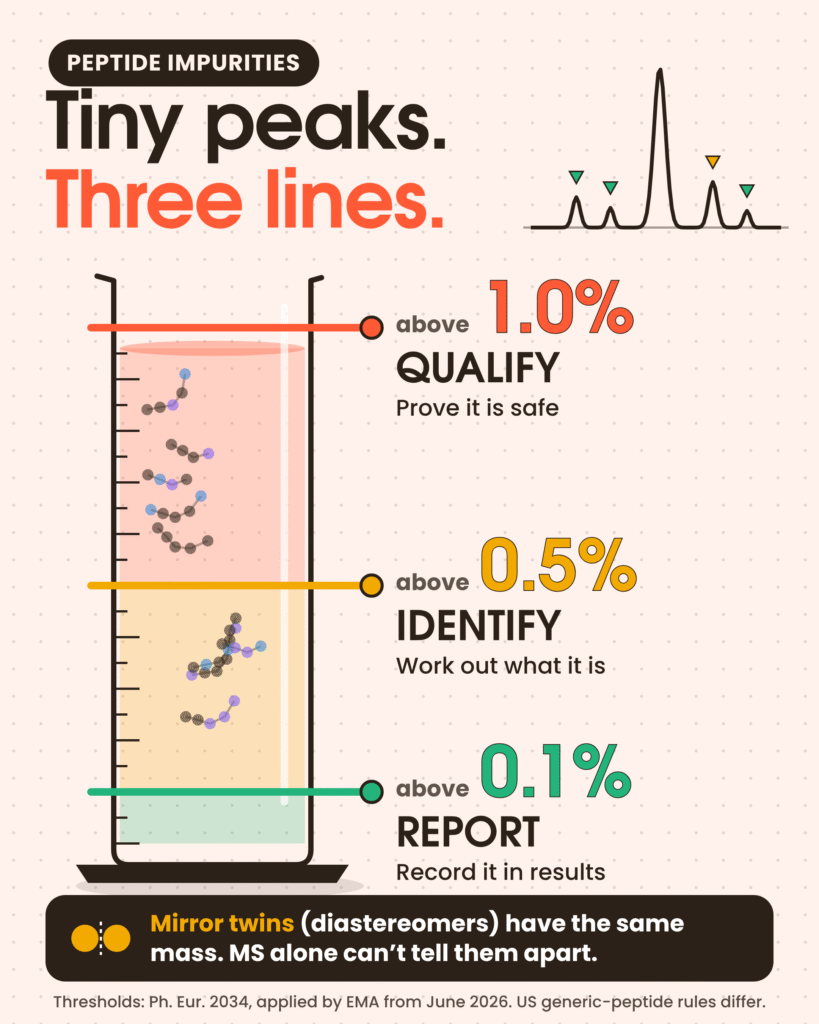
- Peptide impurities need peptide-specific control. Standard small-molecule ICH rules don’t fully cover peptides. The EMA guideline applies Ph. Eur. thresholds: report above 0.1%, identify above 0.5%, qualify above 1.0%. Diastereomers and isobaric variants need selective separation methods, because mass spectrometry alone can’t tell them apart.
- Salts and trace impurities must be measured, not assumed. Residual TFA and counter-ion content should be quantified directly, for example by ¹⁹F-NMR or HPLC-ELSD, usually after exchange to acetate or chloride. Nitrosamine risk needs a formal assessment, with LC-MS/MS testing where a risk is found. Elemental impurities and residual solvents also need routine testing.
- Analytics must be orthogonal and validated. Use at least two independent identity methods and procedures validated per ICH Q2(R2)/Q14. Accurate Net Peptide Content (by AAA or qNMR) is essential, since dosing is based on the actual peptide rather than the salt weight.
- Scale-up, containment and cost should be planned early. Assess preparative HPLC scale-up, lyophilization cycles, high-potency containment and HBEL-based MACO cleaning limits. Small early-phase batches cost far more per gram, because QC and retain samples use a fixed amount of material.
- Data integrity and submission readiness close the deal. Look for validated computerized systems with audit trails and qualified QA staff. The CDMO should have experience writing Canadian QOS and Module 3 sections, and should hold Master Files that come with a Letter of Access. A standalone Quality Agreement should be signed before manufacturing starts.
Drug Establishment Licensing and Regulatory Scope in a Health Canada–Compliant Peptide CDMO
A compliant Canadian partner must maintain an active Drug Establishment Licence (DEL) under Part C, Division 1A of the Food and Drug Regulations. This licence must explicitly cover the specific building, drug category, dosage form, and licensable activities required for the intended program. According to Health Canada’s Guidance on Drug Establishment Licences (GUI-0002), every Canadian facility involved in fabricating, packaging/labelling, testing, importing, distributing, or wholesaling an API or finished dosage form must hold a valid DEL. The licence must identify every applicable physical location, including separate storage warehouses.
Before qualifying a potential manufacturing partner, sponsors should examine four fundamental licensing requirements:
Inspections Database Rating: Verify that the facility has received a “compliant” rating rather than a “non-compliant” rating in Health Canada’s publicly accessible Drug and Health Products Inspections Database.
Activity and Sterile Authorization: Ensure that the DEL covers all outsourced operations, including API fabrication and third-party release testing under Part C, Division 2. If the CDMO performs sterile processing, confirm that its licence explicitly authorizes the relevant sterile dosage forms.
Annual Licence Review (ALR) Standing: All DEL holders must submit an ALR application before April 1 each year for Health Canada’s review. A facility without an active and valid DEL is not permitted to undertake licensable drug activities in Canada.
Foreign Supply Chain Evidence (GUI-0080): When a CDMO imports starting APIs or intermediates, or engages foreign third-party testing laboratories located outside Canada, the relevant foreign buildings must be included in the importer’s DEL Foreign Building Annex. Under Health Canada’s updated GUI-0080, published July 2, 2025, sponsors should verify that the CDMO maintains inspection reports without paragraph-level redactions. These reports should generally fall within the applicable three-year validity period and originate from Health Canada, a Mutual Recognition Agreement (MRA) or qualified authority, the WHO, or the EDQM for API-related activities. Alternatively, valid Letters of Access (LoAs) should establish the necessary regulatory connection to those foreign facilities.
Review our Canadian peptide CDMO services to understand the considerations involved in qualifying a manufacturing partner in Canada.
Mapping Peptide Operations Across GUI-0104, GUI-0001, and GUI-0119
Non-sterile synthetic peptide APIs and intermediates are subject to Health Canada’s GUI-0104, the Good Manufacturing Practices Guidelines for Active Pharmaceutical Ingredients, Version 2, implemented on February 10, 2022. In contrast, sterile processing and finished injectable dosage forms fall under GUI-0001 and Annex 1 (GUI-0119). Clearly identifying the boundaries of a CDMO’s regulatory responsibilities is essential to preventing compliance gaps when manufacturing transitions from bulk peptide powder to sterile parenteral drug products.
| Health Canada Guidance | Regulatory Citation & Effective Vintage | Peptide CDMO Scope | Key Inspection Focus Areas |
|---|---|---|---|
| GUI-0002 (Drug Establishment Licences) | Part C, Division 1A; updated 2020 | Domestic fabrication, testing, packaging/labelling, importing, and storage | Site-specific DEL annexes, sterile authorization, and Annual Licence Review before April 1 |
| GUI-0104 (API GMP Guidelines, Version 2) | Part C, Division 2 / ICH Q7; implemented February 10, 2022 | Non-sterile peptide APIs, intermediates, and sterile API steps before sterilization | Premises and equipment cleaning, university-degreed QA/manufacturing leads, impurity control, and data governance |
| GUI-0001 (GMP Guide for Drug Products) | Part C, Division 2; 2020 edition | Finished dosage forms, physical processing, and parenteral formulation | Segregated production/R&D areas, sealed and cleanable surfaces, and cross-contamination controls |
| GUI-0119 (Annex 1 – Sterile Drugs) | Section C.02.029 / PIC/S Annex 1; effective April 1, 2024 (lyophilization effective August 25, 2024) | Sterile APIs/intermediates, aseptic filtration, sterile filling, and lyophilization | Contamination Control Strategy (CCS), Quality Risk Management (QRM), and Grade A/B aseptic zones |
| GUI-0080 (Foreign Building Compliance) | Part C, Division 1A & Section C.02.025(1); published July 2, 2025 | Foreign API fabrication, testing, or packaging facilities used by Canadian importers | Inspection reports no more than three years old without paragraph-level redactions, MRA versus non-MRA evidence, and Letters of Access |
For parenteral peptides, which represent a substantial proportion of therapeutic development pipelines, sponsors must establish whether a CDMO performing aseptic filtration, sterile compounding, or sterile lyophilization complies with the updated GUI-0119 requirements that came into effect in April and August 2024. Important indicators include a documented, site-wide Contamination Control Strategy (CCS), validated sterilizing-grade filtration studies that assess peptide adsorption and filter extractables, and Grade A environments supported by Grade B backgrounds wherever sterilized components or exposed bulk solutions are handled.
Even when non-sterile peptide APIs are intended for subsequent sterile formulation, GUI-0119 recognizes that manufacturers may implement relevant Annex 1 principles to minimize contamination risks. These measures can include appropriate premises design, cleanroom classification, and environmental monitoring to control microbial, particulate, and endotoxin/pyrogen contamination. However, any adopted controls must be formally documented to demonstrate their implementation and regulatory justification.
Explore our guidance on formulating a lyophilized peptide injectable to review relevant formulation and manufacturing considerations.
Peptide-Specific Impurity Control and Counter-Ion Management
Synthetic peptides fall partially or entirely outside the conventional scope of standard small-molecule ICH Q3A/Q3B and ICH M7 protocols. Therefore, a qualified CDMO must establish peptide-specific reporting, identification, and qualification thresholds while maintaining effective control over sequence variants. Solid-phase peptide synthesis (SPPS) involves repeated deprotection, washing, coupling, and capping cycles to construct the desired amino acid sequence. During these operations, various synthesis-related by-products can form. Such impurities may differ from the target API by only one amino acid deletion or insertion, oxidation, deamidation, aspartimide rearrangement, or chiral inversion (diastereomer).
When reviewing a CDMO’s impurity control strategy, sponsors should verify its alignment with internationally recognized peptide-specific regulatory benchmarks. These include the European Medicines Agency (EMA) Guideline on the Development and Manufacture of Synthetic Peptides (2025, effective June 1, 2026) and the U.S. FDA’s revised draft product-specific guidances issued in July 2026. These guidelines establish reporting, identification, and qualification thresholds of 0.1%, 0.5%, and 1.0%, respectively, for peptide-related impurities.
Diastereomers and isobaric sequence variants present particular analytical challenges because they have identical molecular weights and may co-elute with the parent peptide during conventional chromatographic analysis. Consequently, standard mass spectrometry alone is insufficient to reliably differentiate these impurities. A technically capable CDMO should use selective chromatographic gradients, enzymatic peptide mapping, and additional chiral or isomeric separation techniques specifically developed to resolve epimers and closely eluting related substances.
Read our overview of impurity control strategies under ICH Q3A for additional context on impurity assessment and control.
Residual TFA, Counter-Ion Exchange, and Nitrosamine Controls
A compliant CDMO must establish effective controls for counter-ion stoichiometry, residual trifluoroacetic acid (TFA), elemental impurities, and nitrosamine formation risks. These parameters should be incorporated into the overall quality control strategy rather than treated as secondary analytical checks.
During Fmoc SPPS resin cleavage and preparative reversed-phase HPLC purification, basic peptide side chains commonly become isolated as trifluoroacetate salts. Industry and CDMO specifications frequently set residual TFA limits in finished peptide APIs at ≤0.5% or ≤0.1%. In November 2026, the European Chemicals Agency (ECHA) committee recommended classifying TFA as a reprotoxic and persistent substance. Excessive TFA can also interfere with infrared-based structural characterization and adversely affect cell viability in biological assays.
Sponsors should therefore determine whether the CDMO follows validated counter-ion exchange procedures, generally involving the conversion of trifluoroacetate salts into acetate or chloride salts. These procedures should be supported by direct analytical quantification using appropriate techniques, including ¹⁹F-NMR, HPLC with evaporative light-scattering detection (ELSD), FT-IR, or pharmacopoeial acetic acid assays. Reliance solely on theoretical salt stoichiometry is insufficient to establish the actual counter-ion composition of the final API.
In addition, sponsors should examine the CDMO’s approach to Health Canada’s Guidance on nitrosamine impurities in medications, adopted and effective May 31, 2024. Chemically synthesized peptides may contain secondary or tertiary amine functionalities and involve amide coupling reagents and solvents that can contribute to nitrosation under certain conditions. Accordingly, CDMOs must conduct formal Step 1 root-cause risk assessments that evaluate starting materials, catalysts, reagents, and packaging components. The findings should be suitable for inclusion in CTD Module 2 and section 3.2.P.2 submissions.
When potential risks are identified, the manufacturing partner should proceed with Step 2 confirmatory testing using high-sensitivity LC-MS/MS. This testing must establish whether nitrosamine concentrations remain below Health Canada’s Acceptable Intake (AI) limits or the applicable limits determined through the Carcinogenic Potency Categorization Approach (CPCA). In parallel, routine ICH Q3D elemental impurity testing should be performed using ICP-MS, while residual solvents should be quantified in accordance with ICH Q3C / USP requirements using GC-MS or GC-FID.
Orthogonal Analytical Capabilities and Method Lifecycle Validation
Chromatographic purity determined through a single analytical method cannot independently establish peptide identity, potency, or microbiological safety. Sponsors should therefore require at least two orthogonal identity methods and validated analytical procedures that comply with ICH Q2(R2) and contemporary ICH Q14 lifecycle principles.
Regulatory expectations require analytical procedures to be appropriately validated for their intended purposes, particularly their ability to distinguish the active peptide from process-related impurities and degradation products. The methods should also demonstrate suitable sensitivity, with limits of quantification (LOQ) at or below the 0.1% reporting threshold.
Another important consideration is the accurate determination of Net Peptide Content (NPC). Peptide therapeutics are generally dosed according to the active free-base peptide content rather than the total weight of the lyophilized salt. Therefore, inaccurate NPC measurement can result in incorrect formulation calculations and potential clinical under-dosing. A qualified CDMO must use reliable analytical procedures to determine the actual peptide content and distinguish it from the contributions of counter-ions, residual solvents, and bound moisture.
Explore our GLP-1 peptide analytical characterization capabilities to review the analytical considerations involved in these programs.
Analytical Release Benchmarks for a Health Canada–Compliant Peptide CDMO
To determine whether a potential manufacturing partner’s quality control laboratory satisfies Health Canada–Compliant Peptide CDMO expectations, sponsors should compare its analytical release testing capabilities against the multi-platform specifications outlined below.
| Quality Attribute | Recommended Analytical Method(s) | Regulatory / CDMO Specification Benchmarks | Functional Purpose & Risk Mitigated |
|---|---|---|---|
| Identity (Orthogonal) | HRMS / LC-MS plus Peptide Mapping, NMR, or AAA | Exact mass match and sequence/structure confirmation using at least two orthogonal methods | Confirms the primary sequence and helps identify isobaric isomers or amino acid insertions |
| Chromatographic Purity | Validated RP-HPLC / UHPLC (UV 214 nm) per ICH Q2(R2) | Phase-dependent CDMO benchmarks, typically ≥95.0% to ≥98.0% total area | Separates truncated sequences, oxidation products, and deamidation products |
| Peptide-Related Impurities | Orthogonal UHPLC-MS / LC-MS/MS; isomer-selective methods | Report at ≥0.1%; identify at ≥0.5%; qualify at ≥1.0% (EMA/FDA); unspecified impurities below 0.10% (CDMO target) | Monitors deletion peptides, diastereomers, and aspartimide variants |
| Net Peptide Content (NPC) | Quantitative Amino Acid Analysis (AAA), Elemental Analysis (EA), or qNMR | CDMO release targets typically range from ≥70% to ≥80.0% (dry weight basis, depending on sequence) | Prevents under-dosing resulting from bound water and counter-ion mass |
| Counter-Ion & Residual TFA | ¹⁹F-NMR, HPLC-ELSD, FT-IR, Ph. Eur. acetic acid assay | Residual TFA ≤0.1% to ≤0.5% (CDMO/regulatory targets); specified salt stoichiometry | Reduces cellular toxicity and potential exposure to substances with reprotoxic concerns |
| Trace Genotoxins & Solvents | LC-MS/MS (nitrosamines); GC-MS/GC-FID (USP / ICH Q3C) | Below Health Canada AI / CPCA limits and applicable ICH Q3C limits | Controls carcinogenic nitrosamines and residual solvents from synthesis and purification |
| Elemental Impurities & Moisture | ICP-MS (ICH Q3D); Karl Fischer titration | Compliance with ICH Q3D PDE limits; moisture typically ≤10% (CDMO target) | Verifies catalyst removal and supports solid-state hydrolytic stability |
| Microbiological & Endotoxin | USP LAL endotoxin and bioburden testing | Within applicable parenteral/API specification limits | Independently verifies the absence of unacceptable pyrogen levels, beyond chemical purity assessment |
Note: The purity, peptide content, and moisture values presented above represent published CDMO specification benchmarks rather than universally applicable statutory limits. Health Canada and EMA expectations require phase-appropriate acceptance criteria supported by relevant batch data and toxicological justification.
Evaluating Peptide Sameness and Complex Conjugate Analytics
For generic peptide developers pursuing ANDS/ANDA submissions and sponsors developing modified constructs, including lipidated GLP-1 analogs and peptide-oligonucleotide conjugates (POCs), analytical characterization becomes a critical factor in regulatory approval. These complex molecules require a more extensive analytical assessment to establish structural identity, purity, and comparability.
Sponsors should prioritize CDMOs with advanced analytical capabilities, including high-resolution mass spectrometry (HRMS), NMR, FTIR, and Raman spectroscopy, to evaluate secondary and higher-order structural characteristics and establish comparability. Additional techniques, such as Gel Permeation Chromatography (GPC) and SDS-PAGE, can help identify aggregation and other structural variations.
Facilities operating under an integrated one-lab, one-quality-system model offer additional operational advantages. Under this approach, discovery scientists and GMP analytical teams work with shared, validated HRMS, qNMR, and stability testing platforms. Such an arrangement can reduce the risks associated with transferring analytical methods between external laboratories when transitioning from initial sameness characterization to clinical release testing. It also supports greater analytical continuity throughout development and manufacturing.
Review our semaglutide peptide characterization case study for an example of peptide-focused analytical assessment.
Scalable Synthesis Engineering, Containment, and Batch Economics
A dependable peptide CDMO must demonstrate strong engineering capabilities across synthetic route selection, preparative chromatographic scale-up, high-potency containment, and multi-product cleaning validation. Depending on the peptide’s characteristics and manufacturing requirements, suitable synthesis approaches may include SPPS, liquid-phase peptide synthesis (LPPS), or hybrid fragment condensation.
As peptide chain length increases, several manufacturing challenges become more pronounced. Resin loading limitations, incomplete coupling reactions, and sequence aggregation can substantially increase crude impurity levels and complicate downstream purification. Sponsors should therefore evaluate how a prospective CDMO manages preparative RP-HPLC scale-up. In particular, they should determine whether the facility maintains consistent linear mobile-phase velocity, bed length, particle size, and column-volume gradient duration when transitioning from analytical columns to preparative columns measuring 15–100 cm.
Lyophilization capabilities also require careful assessment. Validated secondary drying cycles performed under high-vacuum conditions, such as 10–50 mTorr, are important for removing bound water and maintaining the stability of the lyophilized cake. The CDMO should be able to demonstrate that its drying parameters are appropriately validated for the specific peptide formulation and intended storage conditions.
Equally important under Health Canada’s GUI-0104 and GUI-0028 (Cleaning Validation Guidelines) are equipment containment and cross-contamination prevention measures. Health Canada requires dedicated or appropriately risk-segregated facilities for certain categories of products, including hormones, cytotoxic agents, sensitizing materials, and highly potent APIs. To manage these risks, leading CDMOs may employ OEB5 potency containment isolators.
When shared multi-product synthesis or purification equipment is used, sponsors should confirm that the CDMO calculates Maximum Allowable Carryover (MACO) using toxicological Health-Based Exposure Limits (HBEL). The calculation follows the formula below:
MACO = (HBEL_previous × MBS_next × PF) / (TDD_next × SF)
In this HBEL-based equation, HBEL_previous represents the Permitted or Acceptable Daily Exposure (mg/day) of the preceding peptide API, while MBS_next refers to the minimum batch size (mg) of the subsequent product manufactured using the shared equipment. The remaining parameters account for the subsequent product’s dosing requirements and applicable safety factors, allowing the CDMO to establish an appropriate carryover limit based on toxicological risk.
Explore our peptide CDMO scale-up services to review the engineering considerations involved in moving peptide processes toward larger production volumes.
Assessing Minimum Batch Sizes and Clinical-to-Commercial Cost Drivers
Understanding the relationship between batch size, equipment hold-up losses, and mandatory GMP release-testing requirements is essential for preventing unexpectedly high Cost of Goods Sold (COGS) during early clinical development. Analytical release testing, retain samples, and stability studies consume relatively consistent quantities of peptide, irrespective of the overall manufacturing campaign size. As a result, very small GMP batches experience disproportionately high material losses, which can significantly increase the effective manufacturing cost per gram of isolated peptide.
| Clinical Phase & Supply Tier | Typical Phase Batch Range | Scale-Up Cost Benchmark | Estimated Net Isolation Yield | QC Release Material Loss Share | Fixed Overhead Share of COGS | Primary Engineering & Regulatory Drivers |
|---|---|---|---|---|---|---|
| Phase 1 Clinical Supply | 10 g – 250 g | 20-Gram GMP Benchmark | ~12% – 18% (high hold-up impact) | 20% – 40% of isolated lot | >80% of total batch cost | Safety, sequence identity, basic stability, and high unit QC cost |
| Phase 2 / Phase 3 Pivotal Trials | 250 g – 5 kg | 1-Kilogram GMP Benchmark | ~25% – 35% (optimized downstream) | 0.5% – 1.0% of isolated lot | ~35% – 45% of total batch cost | Impurity profiling, column loading capacity, and hold-time validation |
| Commercial Supply (Niche / Rare Disease) | 1 kg – 10 kg | 25-Kilogram GMP Benchmark | ~35% – 45% (hybrid SPPS/LPPS route) | <0.05% of isolated lot | <15% of total batch cost | Process Validation (PV), MACO limits, and cleanroom scheduling |
Note: The batch ranges, isolation yields, QC material loss percentages, and COGS estimates presented above are based on ResolveMass scale-up engineering modeling benchmarks rather than regulatory minimum requirements. Actual manufacturing performance may differ depending on peptide sequence length, hydrophobicity, and the efficiency of the selected synthesis and purification route.
When assessing CDMOs for early-phase clinical supply, sponsors should determine whether the facility employs low-dead-volume micro-preparative HPLC systems, continuous multi-column chromatography technologies such as MCSGP, and optimized sampling procedures. These approaches can reduce fixed material consumption, minimize equipment-related losses, and improve the economic feasibility of GMP manufacturing campaigns involving less than 100 grams of peptide.
Learn more about peptide API scale-up and the manufacturing considerations that can influence clinical and commercial supply economics.
Data Integrity, Quality Systems, and Submission Readiness
Even technically successful peptide synthesis can encounter significant regulatory obstacles during a Health Canada review if the CDMO cannot demonstrate reliable lifecycle data integrity, appropriately qualified personnel, and submission-ready regulatory documentation. Under GUI-0104 Version 2, Health Canada established formal expectations for maintaining data accuracy and reliability throughout the complete data lifecycle. These requirements align with PIC/S definitions, which emphasize that all data must remain complete, consistent, and accurate.
Computerized systems used for chromatography, mass spectrometry, and automated synthesis must undergo validation based on documented and justified risk assessments. This validation should comply with Health Canada’s GUI-0050 (Annex 11: Computerized Systems) and GUI-0029. Appropriate controls must preserve electronic audit trails, role-based access permissions, and original raw electronic records to ensure data traceability, security, and reliability throughout manufacturing and analytical operations.
During due diligence, sponsors should evaluate four essential quality and regulatory governance criteria.
First, personnel qualifications and GMP training: As outlined in regulatory interpretations of GUI-0104 Version 2, individuals responsible for quality functions, except in the case of wholesalers, and personnel overseeing manufacturing activities at fabricators or packagers/labellers must possess relevant university degrees. These qualifications should be supported by documented, position-specific GMP training to demonstrate that personnel have the necessary technical knowledge and regulatory understanding to perform their assigned responsibilities.
Second, Quality Unit procedures and oversight: Sponsors should examine the Quality Unit’s Standard Operating Procedures (SOPs) and determine whether they adequately address Out-of-Specification (OOS) investigations, deviation root-cause analysis, Change Control, Annual Product Quality Reviews (APQR), recall preparedness under POL-0016, and drug shortage reporting requirements under GUI-0120. These procedures should be supported by clear documentation, defined responsibilities, and established escalation mechanisms to ensure that quality-related issues are investigated, resolved, and appropriately reported.
Third, Canadian regulatory submission experience: Verify that the CDMO has direct experience preparing and supporting Canadian regulatory submissions. Relevant capabilities should include authoring Quality Overall Summaries (QOS-CE) adapted to Health Canada’s Phase I, II, and III CTA templates under Division C.05. The manufacturing partner should also demonstrate experience preparing Module 3 Quality sections, particularly S.2 and P.1–P.8, in accordance with Health Canada’s Quality (Chemistry and Manufacturing) Guidance for NDS and ANDS, revised December 18, 2024.
When a CDMO needs to protect proprietary synthetic routes or confidential facility information, sponsors should confirm that it maintains current drug substance Master Files or Type V (Facilities and Equipment) Master Files with Health Canada. The CDMO must also be capable of issuing a signed Letter of Access (LoA) promptly before regulatory submission. Additionally, its regulatory team should understand and manage Post-Notice of Compliance (NOC) Level I–IV quality change notifications to support ongoing regulatory compliance following product approval.
Fourth, Quality Agreement and sponsor oversight: Under ICH Q10 and international cGMP frameworks, the sponsor retains ultimate legal responsibility for product quality. Therefore, sponsors should require a separate, standalone, and severable Quality Agreement that is independent of the commercial manufacturing contract. This agreement should clearly establish responsibilities and expectations concerning batch-record review timelines, change-notification periods, OOS escalation procedures, and audit rights. Clearly defined contractual quality obligations help prevent disagreements and ensure that both parties understand their respective regulatory responsibilities throughout the manufacturing relationship.
Review our guidance on CMC documentation at a CDMO for ANDA submissions to understand the documentation considerations involved in regulatory preparation.
Technical Evaluation Checklist for Selecting a Health Canada–Compliant Peptide CDMO
Sponsors should organize their CDMO qualification process around a 12-to-18-month pre-GMP development timeline. This approach allows sufficient time to distinguish an initial technical facility assessment from a comprehensive formal quality qualification audit. A structured evaluation also helps identify potential regulatory, analytical, and manufacturing limitations before committing to production capacity.
The following ten-point technical checklist can help sponsors systematically evaluate and compare potential manufacturing partners:
- Verify licensing and inspection status: Confirm the DEL number, physical facility address, authorized manufacturing and testing activities, and “compliant” inspection rating in Health Canada’s publicly accessible Inspections Database.
- Evaluate the complete manufacturing and testing supply chain: Establish whether synthesis, purification, lyophilization, analytical release testing, and stability studies are performed entirely at one facility or involve subcontracted domestic or foreign laboratories. Where foreign facilities are involved, verify the availability of the necessary GUI-0080 compliance evidence.
- Audit raw-material sourcing and supplier qualification: Examine the supply chains for protected amino acids, resins, solvents, and other critical starting materials. Confirm that qualified alternative suppliers are available for essential materials, consistent with the recommendations outlined in GUI-0104.
- Review impurity separation and analytical validation: Examine validation protocols, analytical reports, and chromatograms to confirm that the target peptide achieves adequate baseline separation from deletion, insertion, oxidized, and diastereomeric impurities.
- Confirm peptide-specific analytical capabilities: Verify that the CDMO can perform counter-ion exchange, residual TFA quantification against the ≤0.1%–0.5% benchmarks, nitrosamine testing using LC-MS/MS, and Net Peptide Content determination through AAA/qNMR using appropriate validated procedures.
- Assess sterile manufacturing compliance: If sterile API processing or injectable fill-finish activities are included in the project, confirm that the facility meets the applicable 2024 GUI-0119 (Annex 1) requirements, particularly those concerning the Contamination Control Strategy (CCS) and lyophilization.
- Inspect cleaning validation and containment measures: Review MACO cleaning validation calculations and evaluate high-potency containment systems, including OEB5 isolators where applicable, to determine whether shared equipment can be operated without unacceptable cross-contamination risks.
- Evaluate technical transparency and scientific expertise: Engage directly with the CDMO’s technical team and ask them to identify the most significant scale-up, analytical method transfer, and stability challenges associated with the specific peptide sequence. Their ability to explain potential risks and propose technically justified solutions provides valuable insight into their scientific capabilities and transparency.
- Obtain clear manufacturing and project timelines: Secure specific scheduling commitments covering project initiation, engineering batches, analytical method transfer, the first available GMP manufacturing slot, and analytical release testing turnaround times. These commitments should be realistic and aligned with the sponsor’s clinical development schedule.
- Define intellectual property and contractual responsibilities: Clearly establish ownership of process improvements, financial liability in the event of failed batches, and exit or technology-transfer obligations within the commercial agreement. Clearly documented responsibilities can help protect the sponsor’s intellectual property and reduce potential disputes during or after the manufacturing relationship.
A structured qualification process helps sponsors compare technical capabilities, regulatory experience, and quality-system readiness before committing to a manufacturing partner. You can also review our guide on how to choose a peptide CDMO in the US for additional considerations when evaluating manufacturing partners across North American markets.
Conclusion
Selecting a Health Canada–Compliant Peptide CDMO requires a thorough evaluation of actual regulatory licensing, sequence-specific impurity management, orthogonal analytical capabilities, and robust data governance rather than dependence on general GMP compliance claims. By systematically assessing DEL authorization under GUI-0002, API and sterile manufacturing compliance under GUI-0104 and GUI-0119, counter-ion management, nitrosamine risk mitigation, manufacturing scale-up economics, and QOS/Master File readiness, biotechnology and pharmaceutical sponsors can substantially reduce the likelihood of clinical development delays and regulatory deficiency notices.
For organizations planning synthetic peptide characterization, analytical method validation, sameness studies, or clinical-stage GMP manufacturing in North America, ResolveMass Laboratories Inc. offers an integrated Canadian quality system supported by Health Canada DEL 3-002945-A, FDA FEI 3042696771, and ISO 9001:2015 certification.
Explore our comparison of Canadian and US peptide CDMOs when assessing manufacturing options for North American development programs.
Connect with our scientific and regulatory specialists to discuss your peptide development and manufacturing requirements, evaluate your project needs, and identify suitable analytical and GMP manufacturing strategies.
Frequently Asked Questions
Sponsors can consult Health Canada’s public Drug and Health Products Inspections Database to review the inspection history and compliance rating of a manufacturing facility. They should also obtain the CDMO’s current DEL and associated annexes to verify that the exact facility address, storage locations, and required activities, including fabrication, testing, packaging/labelling, and importing, are covered by the licence.
Under Part C, Division 1A of the Food and Drug Regulations and GUI-0080, published July 2, 2025, applicable foreign facilities involved in manufacturing, packaging/labelling, or testing drugs and APIs imported into Canada must be identified in the Canadian importer’s DEL Foreign Building Annex. Appropriate GMP evidence must also be maintained, such as a qualifying inspection report issued within the applicable three-year period by a recognized regulatory authority, WHO, or EDQM, or a valid Letter of Access.
Synthetic peptides have impurity profiles that are not fully addressed by conventional small-molecule ICH Q3A/Q3B guidelines. Therefore, peptide-specific regulatory benchmarks include reporting impurities at 0.1%, identifying them at 0.5%, and qualifying them at 1.0%, as outlined in the EMA synthetic peptide guideline and reflected in FDA guidance. Analytical procedures should also demonstrate sufficient sensitivity to achieve limits of quantification (LOQ) at or below the 0.1% reporting threshold.
A chromatographic purity result cannot independently establish the complete identity, structural characteristics, or microbiological quality of a peptide API. Closely related impurities, including diastereomers, may co-elute with the target peptide, while counter-ions, moisture, and endotoxins require separate evaluation. A reliable release strategy should combine at least two orthogonal identity techniques, such as HRMS and peptide mapping or NMR, with dedicated NPC, counter-ion, and microbiological testing.
TFA is commonly introduced during peptide synthesis and purification, particularly through Fmoc SPPS cleavage and reversed-phase HPLC processes. Excessive residual TFA can affect structural characterization, interfere with biological assays, and contribute to cellular toxicity. CDMOs should therefore use validated counter-ion exchange procedures, typically converting TFA salts into acetate or chloride salts, and quantify residual TFA through methods such as ¹⁹F-NMR, HPLC-ELSD, or FT-IR.
Yes. Synthetic and semi-synthetic APIs must be evaluated under Health Canada’s Guidance on nitrosamine impurities in medications, effective May 31, 2024, wherever nitrosamine formation is a potential risk. Peptide manufacturing can involve amine-containing starting materials, coupling reagents, and solvents that require careful assessment. CDMOs should conduct documented Step 1 risk evaluations and, when necessary, perform Step 2 confirmatory testing using sensitive LC-MS/MS methods.
Sponsors should ideally initiate CDMO qualification approximately 12–18 months before their planned first GMP manufacturing campaign. This period provides time for technical evaluations, facility visits, quality audits, Quality Agreement discussions, analytical method development or transfer, and manufacturing scale-up activities. Early engagement also allows potential process limitations and regulatory challenges to be addressed before they affect clinical development timelines.
A technical site visit primarily determines whether the CDMO has the necessary manufacturing infrastructure and scientific capabilities for the proposed peptide program. This includes reviewing synthesis equipment, preparative HPLC capacity, batch-size flexibility, and available development resources. A formal GMP quality audit is a separate qualification exercise that examines regulatory compliance, data integrity, OOS investigations, CAPA procedures, personnel training, and adherence to applicable Health Canada guidelines.
Yes. Health Canada’s Master File (MF) system allows CDMOs to protect confidential manufacturing processes and facility information while supporting a sponsor’s regulatory submission. The CDMO can submit proprietary information within the restricted section of an applicable drug substance or Type V (Facilities and Equipment) Master File and provide the sponsor with a signed Letter of Access (LoA). This authorization permits Health Canada reviewers to consult the confidential information when evaluating the sponsor’s CTA, NDS, or ANDS without requiring the complete proprietary manufacturing details to be disclosed directly to the sponsor.
Reference:
- Health Canada. (2022, February 10). Good manufacturing practices guidelines for active pharmaceutical ingredients (GUI-0104). Government of Canada. https://www.canada.ca/en/health-canada/services/drugs-health-products/compliance-enforcement/information-health-product/drugs/guidelines-active-pharmaceutical-ingredients-0104/document.html
- Health Canada. (2023, September 11). Annex 1 to the Good manufacturing practices guide – Manufacture of sterile drugs (GUI-0119). Government of Canada. https://www.canada.ca/en/health-canada/services/drugs-health-products/compliance-enforcement/good-manufacturing-practices/guidance-documents/gmp-guidelines-annex-1-manufacture-sterile-drugs-0119.html
- Health Canada. (n.d.). Drug establishment licences. Government of Canada. https://www.canada.ca/en/health-canada/services/drugs-health-products/compliance-enforcement/establishment-licences/drug-establishment-licences.html
- Health Canada. (2009, March 12). Quality (chemistry and manufacturing) guidance: Clinical trial applications (CTAs) for pharmaceuticals. Government of Canada. https://www.canada.ca/en/health-canada/services/drugs-health-products/drug-products/applications-submissions/guidance-documents/clinical-trials/quality-chemistry-manufacturing-guidance-clinical-trial-applications-pharmaceuticals.html
- Health Canada. (2023, June). Master files (MFs) – Procedures and administrative requirements. Government of Canada. https://www.canada.ca/content/dam/hc-sc/documents/services/drugs-health-products/drug-products/applications-submissions/guidance-documents/master-files-procedures-administrative-requirements/mf-procedures-requirements-gd-ld-fm-procedures-exigences-eng.pdf
- European Medicines Agency. (2025, December 4). Guideline on the development and manufacture of synthetic peptides (EMA/CHMP/CVMP/QWP/367182/2025). https://www.ema.europa.eu/en/documents/scientific-guideline/guideline-development-manufacture-synthetic-peptides_en.pdf
- International Council for Harmonisation of Technical Requirements for Pharmaceuticals for Human Use. (n.d.). Quality guidelines. https://www.ich.org/page/quality-guidelines
Get In Touch With Us
About The Author