
Introduction
For US biopharmaceutical sponsors outsourcing peptide synthesis, characterization, or release testing across the border, working with a Canadian Contract Development and Manufacturing Organization (CDMO) that holds both a Health Canada Drug Establishment Licence (DEL) and US FDA Registration provides an important regulatory foundation. The DEL authorizes the facility to conduct specific pharmaceutical activities in Canada under Good Manufacturing Practice (GMP) requirements, while FDA registration establishes the facility’s identity within the US regulatory system under 21 CFR Part 207. Together, these credentials indicate that the CDMO operates within a government-regulated Pharmaceutical Quality System (PQS), overseen by a qualified Quality Assurance Person (QAP), and has completed the required electronic establishment registration before its peptide APIs or finished drug products are imported into the United States or offered for import.
Nevertheless, dual regulatory standing is often misunderstood during US Chemistry, Manufacturing, and Controls (CMC) planning. Possessing both credentials does not establish inspection reciprocity between Health Canada and the US Food and Drug Administration (FDA). It also does not transfer or eliminate the US sponsor’s non-delegable legal responsibility for final batch release. Successfully managing cross-border peptide development, whether for a 505(j) generic peptide ANDA, a 505(b)(2) application, or an Investigational New Drug (IND)-stage candidate, requires a clear understanding of how Canadian GMP licensing interacts with US cGMP enforcement, peptide-specific impurity thresholds, and Quality Agreement responsibilities.
For additional insight into the regulatory and analytical considerations involved in peptide characterization, review this semaglutide peptide characterization case study.
Share via:
Quick Summary:
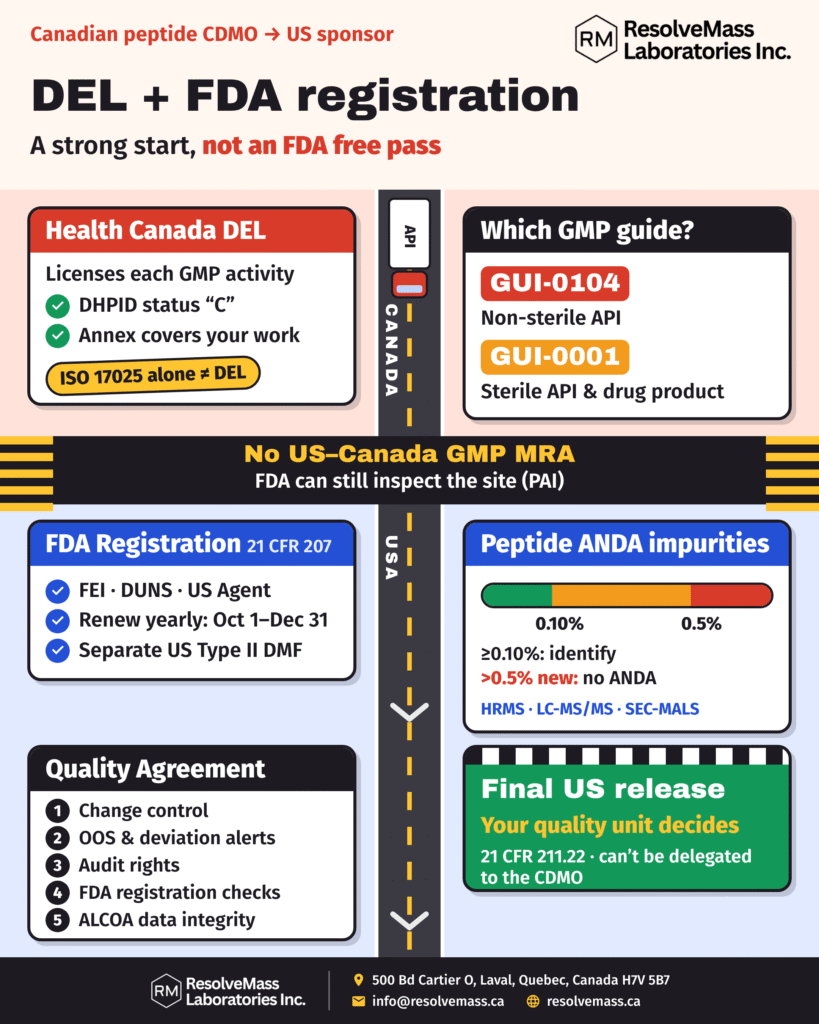
- Two separate credentials, two separate jobs: A Health Canada Drug Establishment Licence (DEL) authorizes specific GMP activities in Canada, such as fabricating, testing and packaging/labelling. FDA registration under 21 CFR Part 207 identifies the foreign site to the US system through its FEI, DUNS number and US Agent, and must be renewed every year between October 1 and December 31.
- No exemption from FDA inspections: Canada has no human drug GMP Mutual Recognition Agreement with the US. The FDA’s only such agreements are with the EU, Switzerland and the UK. A dual-registered Canadian CDMO can therefore still face FDA Pre-Approval Inspections and surveillance inspections. The DEL’s real value is that the site stays inspection-ready.
- Match the right Canadian GMP guide to the work: GUI-0104 covers non-sterile APIs. GUI-0001 covers sterile APIs and finished drug products. ISO/IEC 17025 accreditation shows technical competence, but it does not replace a DEL for GMP release testing in Canada.
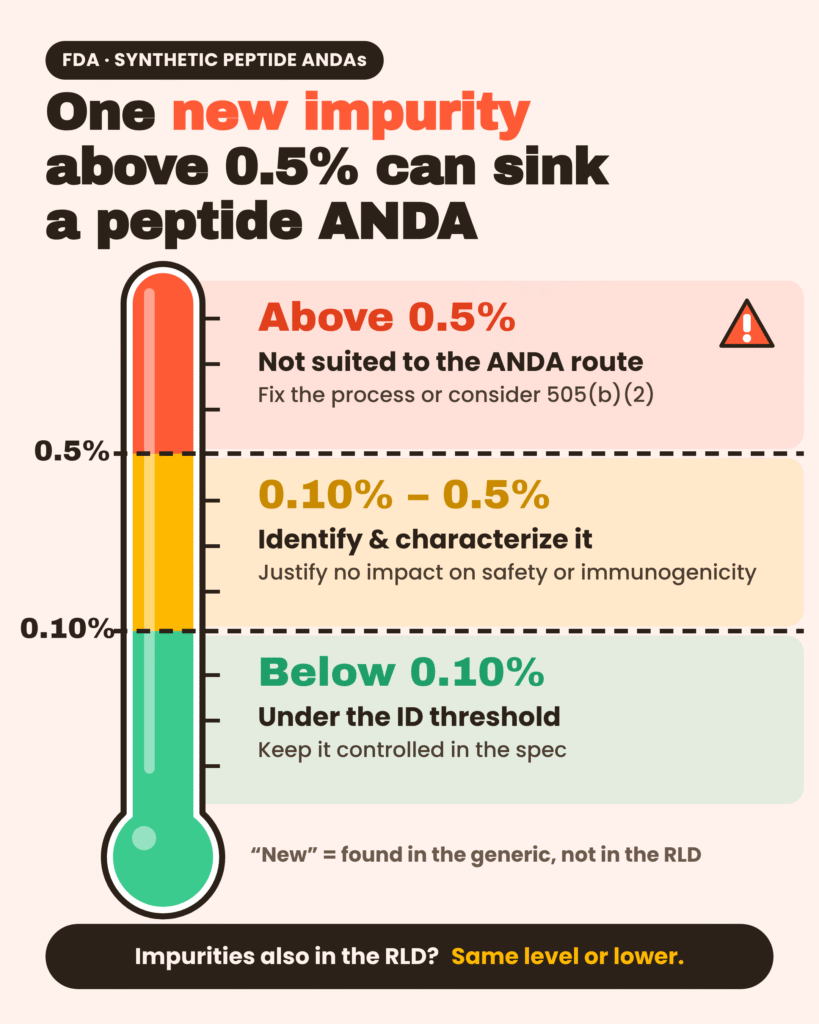
- Peptide impurity thresholds drive the US pathway: Under FDA’s May 2021 guidance for synthetic peptide ANDAs, peptide-related impurities at or above 0.10% must be identified. Any new impurity not found in the reference drug must not exceed 0.5%. Above 0.5%, the sponsor may need to change the process or consider a 505(b)(2) application. Meeting these thresholds requires methods such as HRMS, LC-MS/MS peptide mapping, SEC-MALS and forced degradation studies.
- Separate confidential dossiers: A Health Canada Master File does not carry over to the US. The CDMO needs a separate US Type II DMF to support the sponsor’s IND, NDA or ANDA without revealing its proprietary chemistry.
- The sponsor keeps final release authority: Under 21 CFR 211.22 and FDA’s 2016 Quality Agreements guidance, the US sponsor’s quality unit cannot delegate final batch release to the CDMO. The Quality Agreement should cover five things: change control, OOS and deviation reporting, audit rights, registration and supply-chain checks, and ALCOA data integrity.
- Verify before you commit: Before technology transfer, US QA teams should confirm the CDMO’s “Compliant (C)” rating in DHPID and check that its DEL annexes cover the work. They should also confirm the FEI, DUNS number and US Agent, verify that any foreign subcontract labs are listed on the DEL, and assess whether the CDMO’s peptide capabilities sit under one quality system.
Operational Impact of Health Canada DEL + FDA Registration on US Peptide Supply Chains
Holding both a Health Canada DEL and FDA Registration establishes two independent regulatory controls within a cross-border peptide development and manufacturing program: domestic GMP authorization under Canadian federal legislation and foreign establishment identification under US federal law. Under Part C, Division 1A and Division 2 of Canada’s Food and Drug Regulations, a Drug Establishment Licence (DEL) permits a facility to perform specifically authorized activities, including fabricating, packaging/labelling, and testing. Obtaining and maintaining this licence requires the establishment to demonstrate continuous GMP compliance through an ICH Q10-aligned PQS, routine Product Quality Reviews (PQRs), and supervision by a qualified QAP. The QAP must possess an appropriate scientific degree and generally have 2 to 5 years of relevant pharmaceutical quality assurance experience, as described in Canadian regulatory compliance guidance.
Separately, FDA establishment registration under Section 510 of the Federal Food, Drug, and Cosmetic Act (FD&C Act) and 21 CFR Part 207 requires foreign facilities to submit electronic Structured Product Labeling (SPL) filings, maintain a valid DUNS number and FDA Establishment Identifier (FEI), appoint a US Agent, and complete annual registration renewal between October 1 and December 31. These requirements must be fulfilled before drugs manufactured at the facility are imported into the United States or offered for import.
Since the two regulatory systems address different statutory requirements, US sponsors should evaluate them as complementary safeguards rather than treating them as equivalent approvals. Table 1 outlines the regulatory responsibilities and practical significance of each credential for a Canadian peptide CDMO supplying a US drug development or commercial program.
Comparison of Health Canada DEL and US FDA Establishment Registration
| Regulatory Dimension | Health Canada Drug Establishment Licence (DEL) | US FDA Establishment Registration (21 CFR Part 207) |
|---|---|---|
| Legal Authority | Part C, Division 1A and Division 2 of Canada’s Food and Drug Regulations | Section 510 of the FD&C Act and 21 CFR Part 207 |
| Core Regulatory Role | Authorizes specific licensable activities, including fabricating, testing, packaging/labelling, and importing, subject to verified GMP compliance | Registers foreign establishment information, including FEI, DUNS number, US Agent, and drug listings, for US import and inspection tracking |
| Applicable GMP Guidance | GUI-0104 (non-sterile APIs, aligned with ICH Q7) and GUI-0001 (drug products and sterile operations) | US cGMP requirements under 21 CFR Parts 210 and 211 and Section 501(a)(2)(B) of the FD&C Act |
| Inspection & Renewal Cadence | Domestic inspections are generally targeted at approximately 24-month intervals for testing and fabricating sites. Initial DEL review may take approximately 250 calendar days, according to compliance guides | Annual registration renewal is required between October 1 and December 31. Facilities may also undergo FDA Pre-Approval Inspections (PAIs) and foreign surveillance inspections |
| Verification Mechanism | Health Canada Drug and Health Products Inspections Database (DHPID), showing a “Compliant (C)” status, together with the physical DEL annex | Public registration disclosures under 21 CFR 207.81 and verification of FEI and DUNS number alignment |
| Direct Value to US Sponsor | Demonstrates the existence of a government-audited PQS, QAP oversight, and controlled analytical and manufacturing operations | Helps prevent import-related noncompliance under 21 CFR 207.17 and establishes an active FEI for pending US marketing applications |
Why Health Canada DEL + FDA Registration Does Not Exempt a Site from FDA Inspections
A Canadian CDMO holding both a Health Canada DEL and FDA Registration remains subject to direct FDA inspections because Canada does not have an active human drug GMP Mutual Recognition Agreement (MRA) with the United States. According to the FDA’s official MRA registry, active human drug GMP MRAs are currently in place with the European Union, Switzerland, and the United Kingdom. Even under these arrangements, the scope of regulatory reliance primarily concerns routine surveillance inspections and does not eliminate the need for independent reviews of application data packages.
Although the FDA and Health Canada maintain a bilateral cooperative arrangement for exchanging information about pharmaceutical establishment inspections, both regulatory authorities also participate in the Pharmaceutical Inspection Co-operation Scheme (PIC/S). However, PIC/S is a non-binding international cooperation framework designed to promote consistency in GMP standards and inspection practices. Participation does not remove either authority’s independent inspection rights or regulatory responsibilities.
For US sponsors, including a Canadian peptide CDMO in a pending NDA, ANDA, or BLA may still result in an FDA on-site Pre-Approval Inspection (PAI). Such inspections evaluate the establishment’s cGMP compliance, adherence to the submitted application, data integrity practices, batch manufacturing records, and validation documentation. Public FDA compliance records demonstrate that inspections continue to take place in Canada, including an inspection conducted in Montreal in January 2024. Furthermore, industry regulatory analysts referring to an FDA announcement from May 2025 have highlighted plans for a substantial expansion of unannounced inspections at foreign manufacturing facilities.
Therefore, the primary inspection-related advantage of holding a Health Canada DEL is sustained operational preparedness rather than exemption from FDA oversight. A facility subject to recurring Health Canada inspections under Division 2 and ICH Q10 is expected to maintain controlled SOPs, validated analytical methods, documented deviations, and supporting quality records. These practices also support readiness for FDA PAI requirements and help reduce potential compliance gaps during cross-border regulatory reviews.
For a closer look at the differences in regulatory expectations and operational considerations between Canadian and American manufacturing partners, read this comparison of Canadian vs. US peptide CDMOs.
Navigating GUI-0104 vs. GUI-0001 Boundaries for Synthetic and Sterile Peptide APIs
US sponsors must determine which Canadian GMP guidance applies to the specific peptide manufacturing and testing activities being outsourced. Health Canada’s GUI-0104 governs non-sterile APIs and intermediates through the stage immediately preceding sterilization. In contrast, sterilization of sterile APIs, aseptic processing, and finished dosage form manufacturing fall within the scope of GUI-0001.
Revised in February 2022 to align with ICH Q7, GUI-0104 establishes expectations for starting material qualification, API intermediates, manufacturing controls, retesting, stability testing, and analytical method verification. For peptide APIs manufactured for early-stage clinical trials, the guidance also emphasizes that manufacturing controls should be appropriate to the product’s development stage and consistent with the underlying principles of ICH Q7. This approach allows suitable flexibility during early development while maintaining appropriate quality oversight and process control.
Another important consideration for US sponsors outsourcing analytical characterization or commercial release testing is the distinction between ISO/IEC 17025 accreditation and a Health Canada DEL. ISO/IEC 17025 accreditation demonstrates a laboratory’s technical competence to perform specified testing activities. However, analytical results generated by a laboratory holding only ISO 17025 accreditation cannot independently satisfy the Canadian regulatory requirements for commercial drug release unless the laboratory also maintains an active DEL covering the applicable licensable activities under Division 2 of the Food and Drug Regulations.
Requiring an appropriate and active DEL helps ensure that commercial release testing, impurity investigations, and stability studies are conducted within an inspected pharmaceutical quality system rather than an environment operating solely for research and development purposes. For US sponsors, verifying the laboratory’s licensing scope is therefore an important part of supplier qualification and cross-border quality oversight.
When evaluating a Canadian manufacturing partner, sponsors should also consider its capabilities across peptide development, GMP manufacturing, and analytical support. Learn more about the operational considerations involved in selecting a peptide CDMO in Canada.
Dual-Jurisdiction Quality Systems, Peptide Impurity Control, and Batch Disposition
A Canadian CDMO’s dual regulatory standing can support US peptide development only when its analytical capabilities and quality management systems also meet the FDA’s expectations for peptide characterization, impurity control, and stability assessment. Unlike structurally rigid small molecules, therapeutic peptides can exhibit conformational flexibility and complex degradation pathways. These characteristics may lead to process-related and degradation-related impurities, including truncated peptides, oxidized forms, isomeric species, and high-molecular-weight aggregates.
Under the FDA’s May 2021 guidance addressing synthetic peptide ANDAs referencing rDNA-origin listed drugs, including glucagon, liraglutide, nesiritide, teriparatide, and teduglutide, synthetic peptides containing 40 or fewer amino acids that seek approval through the 505(j) pathway must demonstrate API sameness. Sponsors must also characterize new peptide-related impurities present at levels of 0.10% or higher and ensure that any new impurity not found in the reference listed drug does not exceed 0.50%.
Exceeding the 0.50% threshold for a new impurity can make a product unsuitable for the 505(j) ANDA pathway. In such circumstances, the sponsor may need to modify the chemical manufacturing process to reduce the impurity level or consider a 505(b)(2) application supported by appropriate nonclinical or clinical safety justification.
Demonstrating compliance with these impurity requirements calls for complementary analytical characterization techniques within the CDMO’s GMP testing environment. Important capabilities include the following:
Sequence and Identity Verification: High-resolution mass spectrometry (HRMS), LC-MS/MS peptide mapping, and amino acid sequencing are used to establish peptide sequence identity and confirm structural fidelity. These techniques also help identify unexpected chemical modifications, sequence-related variants, and other deviations that may affect the quality or comparability of the API.
Aggregation and Higher-Order Structure: Size-exclusion chromatography coupled with multi-angle light scattering (SEC-MALS), analytical ultracentrifugation (AUC), and dynamic light scattering (DLS) can be applied to investigate peptide self-association and monitor oligomeric species. These methods help evaluate aggregation behavior and support the identification and control of high-molecular-weight aggregates that may influence product quality and stability.
Immunogenicity Risk Assessment: In silico epitope screening can be combined with in vitro immunogenicity assessments (IVISIA) and specialized Bystander Assays to investigate the potential biological effects of peptide-related impurities. These assessments help determine whether trace impurities could contribute to unwanted immune activation, systemic inflammatory responses, or T-cell-related pathways.
Compendial Safety and ICH Stability: A comprehensive analytical program may include bacterial endotoxin testing using Limulus Amebocyte Lysate (USP), residual solvent analysis by GC-MS (USP), elemental impurity assessment using ICP-MS (USP), and analytical methods validated in accordance with ICH Q2(R2). Forced degradation studies are also important for understanding peptide degradation pathways, identifying potential degradation products, and establishing appropriate stability-indicating analytical procedures.
Explore the technical considerations involved in peptide API scale-up to understand how manufacturing processes can be transferred and optimized at larger production volumes.
Cross-border regulatory submissions also require separate confidential regulatory documentation. A Canadian CDMO may protect its proprietary manufacturing processes and technical information in Canada through a Health Canada Master File (MF), previously referred to as a Canadian Drug Master File (DMF). However, US FDA reviewers require a separate US Type II Drug Master File (DMF) containing relevant information about the drug substance, intermediates, and starting materials. This documentation enables the CDMO to provide confidential manufacturing and quality information in support of the US sponsor’s IND, NDA, or ANDA without disclosing proprietary chemistry directly to the sponsor.
Quality Agreements and Final Batch Release Under 21 CFR 211.22
Even when a Canadian CDMO’s Quality Assurance Person approves manufacturing or testing activities at the facility and issues a Certificate of Analysis under its DEL, the US sponsor retains its own regulatory responsibilities. Under 21 CFR 211.22, the sponsor’s quality control unit must maintain the authority and responsibility to approve or reject drug products, including decisions relating to final US batch release. These obligations cannot be transferred entirely to an external manufacturing or testing partner.
The FDA’s November 2016 guidance, Contract Manufacturing Arrangements for Drugs: Quality Agreements, clarifies that statutory cGMP responsibilities remain with the regulated parties and cannot be eliminated through contractual arrangements. The guidance also recommends keeping the Quality Agreement separate from, or severable from, the commercial Master Services Agreement (MSA). This separation helps distinguish pharmaceutical quality obligations from commercial provisions involving pricing, confidentiality, delivery schedules, and liability limitations.
To minimize the risk of FDA inspectional observations, quality disagreements, or cross-border batch disposition delays, a US sponsor’s Quality Agreement with a dual-registered Canadian peptide CDMO should establish five clearly defined and enforceable controls:
Cross-Border Change Control: The agreement should require advance written notification and approval from the sponsor’s quality unit before implementing changes to qualified amino acid suppliers, peptide synthesis parameters, analytical methods, or established specifications. Each proposed change should undergo documented impact assessment to determine whether it could require an FDA submission, supplement, or annual report.
Time-Bound OOS and Deviation Reporting: Specific reporting timelines should be established for out-of-specification (OOS) impurity results, adverse stability trends, manufacturing deviations, and relevant regulatory inspection notifications involving the Canadian facility. Prompt communication allows the sponsor to investigate quality events, evaluate potential product impact, and determine whether additional regulatory action is necessary.
Scheduled and For-Cause Audit Rights: The Quality Agreement should define routine cGMP audit intervals and provide the sponsor with the right to conduct additional for-cause audits when significant quality concerns arise. FDA investigators may examine whether the sponsor follows its documented supplier qualification and audit schedule. The agreement should also provide appropriate audit access before an anticipated PAI when additional verification is warranted.
Annual Registration and Supply-Chain Traceability: The sponsor should require periodic verification of the CDMO’s FDA registration renewal during the October 1–December 31 renewal period, confirmation of active US Agent coverage, and maintenance of applicable Drug Supply Chain Security Act (DSCSA) product tracing and serialization requirements. These controls help maintain regulatory visibility and support the integrity of the cross-border pharmaceutical supply chain.
ALCOA Data Integrity and Batch Record Review: The agreement should establish requirements for data integrity in accordance with ALCOA principles, including attributable, legible, contemporaneous, original, and accurate records. Appropriate dual-review procedures, validated electronic systems, and complete transmission of executed Batch Manufacturing Records (BMRs) should be required before the sponsor’s quality unit makes its final US lot disposition decision.
Sponsors evaluating external manufacturing arrangements should also understand how service scope, technical responsibilities, and quality oversight differ between manufacturing partners. This comparison of peptide CDMO vs. CMO explains the distinctions that can influence outsourcing decisions.
Auditing a Dual-Registered Canadian CDMO: Verification Checklist for US Sponsors
Before initiating technology transfer or identifying a Canadian manufacturing partner in a US regulatory submission, US Quality Assurance (QA) teams should independently verify the facility’s current regulatory status and authorized operational scope. This includes reviewing Health Canada’s Drug and Health Products Inspections Database (DHPID) and the relevant FDA establishment registration records.
Accepting general compliance statements without examining the actual DEL annexes can expose sponsors to significant regulatory risks. A facility may hold a DEL but lack authorization for specific commercial testing activities, particular dosage forms, or certain subcontracted laboratory operations. Such gaps can lead to regulatory observations, product recalls, licence suspensions, or other enforcement actions.
During supplier qualification, US sponsors should verify the following four essential areas:
1. Confirm Health Canada DEL Status and Authorized Activities: Verify that the facility has an active “Compliant (C)” rating in Health Canada’s DHPID. Review the physical DEL and its applicable annexes to establish whether the site is authorized to perform the required activities, including fabricating, testing, and packaging/labelling. The review should also confirm that the authorized product and activity scope covers the proposed peptide program.
2. Verify FDA Establishment Registration: Confirm the facility’s active FDA Establishment Identifier (FEI), associated DUNS number, and current annual registration status under 21 CFR Part 207. The sponsor should also verify that the establishment has an appropriate US Agent designation and that its registration information is consistent with the intended manufacturing and supply-chain arrangements.
3. Audit Cross-Border Subcontracting Controls: If any testing activities involving materials imported into Canada are outsourced to a laboratory located outside Canada, the sponsor should verify that the foreign laboratory is appropriately identified on the Canadian DEL’s Foreign Building (FB) Annex. Current GMP supporting evidence should be maintained and submitted before the applicable Next Evidence Required By (NERBY) date in accordance with GUI-0080. This verification helps ensure that outsourced testing activities remain within the required regulatory oversight framework.
4. Assess Integrated Peptide Capabilities Under a Unified Quality System: Evaluate whether the CDMO can manage peptide characterization, GMP analytical testing, impurity investigations, stability studies, and release support through an integrated quality system. For example, ResolveMass Laboratories Inc., located in Laval, Québec, operates under Health Canada DEL 3-002945-A and US FDA Registration FEI 3042696771, alongside an ISO 9001:2015-certified Quality Management System. Its integrated capabilities include GMP analytical testing, release support, nitrosamine quantification, forced degradation, and CMC characterization for complex generic peptides, including semaglutide, liraglutide, lanreotide, and tirzepatide.
For sponsors comparing potential manufacturing locations, it is also useful to examine the differences between domestic and international outsourcing models. Read more about US versus overseas peptide CDMOs when assessing regulatory oversight, manufacturing coordination, and supply-chain considerations.
Conclusion
Selecting a CDMO that holds both a Health Canada DEL and FDA Registration provides US peptide sponsors with a valuable foundation for cross-border regulatory compliance. This combination brings together government-regulated Canadian GMP operations under GUI-0104 and GUI-0001 with the US establishment registration requirements of 21 CFR Part 207. However, dual registration should be regarded as an operational and regulatory starting point rather than an automatic guarantee of FDA acceptance or approval.
Since no US–Canada human drug GMP Mutual Recognition Agreement is currently in force, sponsors must continue to ensure that their Canadian manufacturing and analytical partners are prepared for direct FDA Pre-Approval Inspections. They must also verify compliance with applicable FDA synthetic peptide impurity requirements, including the 0.50% threshold for new impurities under the relevant ANDA guidance, and establish a comprehensive Quality Agreement consistent with 21 CFR 211.22. Most importantly, the sponsor’s quality unit must retain its independent authority and responsibility for final US batch disposition.
For a broader understanding of the factors involved in selecting a manufacturing partner, explore the considerations outlined in this guide to choosing a peptide CDMO in the United States.
For CMC and quality teams evaluating cross-border analytical characterization, impurity profiling, stability testing, or GMP release support for a novel or generic peptide development program, working with an experienced analytical partner can help strengthen quality oversight and regulatory preparedness. To discuss your peptide development and analytical testing requirements, connect with the scientific team at ResolveMass Laboratories Inc. through the Contact Us page.
Frequently Asked Questions
No. FDA Establishment Registration under 21 CFR Part 207 identifies a pharmaceutical facility and supports regulatory tracking; it does not represent FDA approval or cGMP certification. An FEI confirms establishment identification within the FDA system, while GMP compliance must be demonstrated through appropriate quality controls, validated processes, accurate manufacturing records, and regulatory inspection outcomes.
GUI-0104 establishes GMP expectations for non-sterile peptide APIs and chemical intermediates through the stage immediately before sterilization. GUI-0001 addresses sterile API operations, sterilization procedures, aseptic processing, and finished drug products. Sponsors outsourcing both activities should verify that their Canadian CDMO holds the appropriate DEL authorization for every manufacturing and testing operation involved.
No. ISO/IEC 17025 accreditation demonstrates a laboratory’s technical ability to perform specified analytical procedures, but it does not replace the licensing requirements applicable to commercial pharmaceutical testing in Canada. An appropriate active Health Canada DEL is necessary to bring the relevant testing activities under an inspected pharmaceutical quality system with QAP supervision and applicable GMP controls.
The US sponsor’s quality unit retains responsibility for final batch approval or rejection under 21 CFR 211.22, even when the Canadian CDMO’s QAP has approved manufacturing activities and issued a Certificate of Analysis. The CDMO provides manufacturing and analytical quality documentation, but the sponsor must independently review the relevant records and authorize final disposition before US distribution.
Foreign establishments must renew their FDA registration annually between October 1 and December 31 to maintain compliance with applicable registration requirements under 21 CFR Part 207. Failure to complete renewal can create regulatory complications for importing products into the United States and may interrupt clinical or commercial supply arrangements until the registration issue is resolved.
Dual registration provides a regulatory framework for combining Canadian GMP oversight with analytical procedures designed to address FDA requirements for synthetic peptide ANDAs. Techniques such as HRMS, LC-MS/MS, SEC-MALS, and IVISIA can support peptide identity confirmation and impurity assessment. These capabilities help sponsors characterize relevant impurities at 0.10% or higher and evaluate compliance with the applicable 0.50% threshold for new peptide-related impurities.
No. A Health Canada Master File (MF) is intended to protect confidential manufacturing and technical information submitted for Canadian regulatory purposes. It cannot replace the documentation required by the US FDA. For a US IND, NDA, or ANDA, the CDMO must maintain a separate US Type II Drug Master File (DMF) containing the relevant drug substance, intermediate, and starting material information.
The sponsor should first confirm that the facility has an active “Compliant (C)” status in Health Canada’s DHPID. It should then examine the physical DEL and its annexes to ensure that the authorized activities, product categories, and testing scope correspond to the proposed peptide program. The facility’s current FDA FEI, DUNS number, and registration status should also be independently verified before finalizing the Quality Agreement.
When a Canadian licensed establishment relies on a foreign laboratory for applicable testing activities involving products or materials imported into Canada, the laboratory must be appropriately declared through the Foreign Building (FB) Annex of the DEL. The establishment must also maintain the required GMP documentation and provide updated compliance evidence before the applicable Next Evidence Required By (NERBY) deadline, following Health Canada’s GUI-0080 requirements.
Reference:
- U.S. Food and Drug Administration. (2016, November). Contract manufacturing arrangements for drugs: Quality agreements—Guidance for industry. U.S. Department of Health and Human Services. https://www.fda.gov/media/86193/download
- U.S. Food and Drug Administration. (n.d.). Mutual recognition agreements (MRA). https://www.fda.gov/international-programs/international-arrangements/mutual-recognition-agreements-mra
- Health Canada. (2022, February 10). Good manufacturing practices guidelines for active pharmaceutical ingredients (GUI-0104). Government of Canada. https://www.canada.ca/en/health-canada/services/drugs-health-products/compliance-enforcement/information-health-product/drugs/guidelines-active-pharmaceutical-ingredients-0104.html
- Hussain, T. (2024, September 12). Complying with establishment registration requirements. U.S. Food and Drug Administration. https://www.fda.gov/media/184336/download
- Health Canada. (2022, February 10). Good manufacturing practices guidelines for active pharmaceutical ingredients (GUI-0104). Government of Canada. https://www.canada.ca/en/health-canada/services/drugs-health-products/compliance-enforcement/information-health-product/drugs/guidelines-active-pharmaceutical-ingredients-0104/document.html
- U.S. Food and Drug Administration. (2026, April 14). Prelicense and preapproval inspections of CDER-regulated biological product manufacturers (Compliance Program 7346.832M). U.S. Department of Health and Human Services. https://www.fda.gov/media/191983/download
- U.S. Food and Drug Administration. (n.d.). FDA–Canadian Department of National Health and Welfare, agreement of cooperation. U.S. Department of Health and Human Services. https://www.fda.gov/international-programs/cooperative-arrangements/fda-canadian-department-national-health-and-welfare-agreement-cooperation
- Health Canada. (2017, May 4). PIC/S – Pharmaceutical Inspection Co-operation Scheme. Government of Canada. https://www.canada.ca/en/health-canada/services/drugs-health-products/compliance-enforcement/international/partnerships/pharmaceutical-inspection-operation-scheme.html
Get In Touch With Us
About The Author