


Introduction
The immunogenicity of peptide-oligonucleotide conjugates is a multifaceted biological phenomenon resulting from the synergistic interplay of immunogenic peptide epitopes, pattern-recognition receptor (PRR)-activating nucleic acid backbones, chemical linkers, and process-related impurities. Peptide-oligonucleotide conjugates (POCs) are targeted therapeutic modalities developed to address the delivery limitations associated with standalone nucleic acids, including poor membrane permeability and endosomal entrapment. They achieve this by covalently linking antisense oligonucleotides (ASOs), small interfering RNAs (siRNAs), or peptide nucleic acids (PNAs) to cell-penetrating peptides (CPPs) or receptor-specific peptide ligands. With their compact molecular architecture, POCs generally have molecular weights ranging from 3 to 10 kDa, placing them structurally between small-molecule drugs and monoclonal antibodies or antibody-oligonucleotide conjugates (AOCs, approximately 150 kDa).
Explore how POCs compare to traditional conjugates in performance and delivery: Peptide vs. Antibody-Oligonucleotide Conjugates
The combination of two distinct biopolymer classes within a single chimeric molecule introduces unique immunological liabilities. Protein therapeutics primarily induce adaptive humoral responses through Major Histocompatibility Complex (MHC) Class II antigen presentation to CD4+ T-helper cells, whereas POCs can simultaneously engage both adaptive and innate immune pathways. The oligonucleotide component may function as an intrinsic adjuvant by binding to endosomal Toll-like receptors (TLRs 3, 7, 8, and 9). This interaction can increase the expression of co-stimulatory markers on professional antigen-presenting cells (APCs) and accelerate the development of anti-drug antibodies (ADAs) directed against the peptide, linker, or nucleic acid sequence. Assessing and mitigating the immunogenicity of peptide-oligonucleotide conjugates therefore requires an integrated bioanalytical strategy incorporating computational epitope modeling, ex vivo immunopeptidomics, cell-based functional assays, and high-resolution mass spectrometry (LC-MS/MS) characterization.
Share via:
Article Summary:
- Peptide-oligonucleotide conjugates (POCs) combine a peptide delivery or targeting component with an oligonucleotide payload, creating unique immunogenicity risks that may involve both innate and adaptive immune pathways.
- The peptide portion can generate foreign T-cell epitopes after intracellular processing. These fragments may be presented through HLA Class II molecules, activating CD4+ T cells and potentially promoting anti-drug antibody formation.
- The oligonucleotide component may stimulate endosomal Toll-like receptors, particularly TLR3, TLR7, TLR8, and TLR9, leading to cytokine release, dendritic-cell activation, and amplification of immune responses.
- Linker chemistry and conjugation heterogeneity can create non-native molecular structures or neo-epitopes that may be recognized by the immune system and contribute to linker- or conjugate-specific antibody responses.
- Manufacturing-related impurities, truncated sequences, aggregates, and other product variants can increase immunogenicity by enhancing innate immune activation or presenting repeated antigenic structures.
- A comprehensive immunogenicity assessment should combine computational epitope prediction, MHC-associated peptide proteomics (MAPPs), T-cell and cytokine-release assays, multi-tiered ADA testing, and advanced mass spectrometry characterization.
- Immunogenicity risk can be reduced through rational peptide sequence optimization, nucleic acid chemical modifications, stereopure linkages, site-specific conjugation, steric shielding, impurity control, and continuous monitoring of critical quality attributes throughout development.
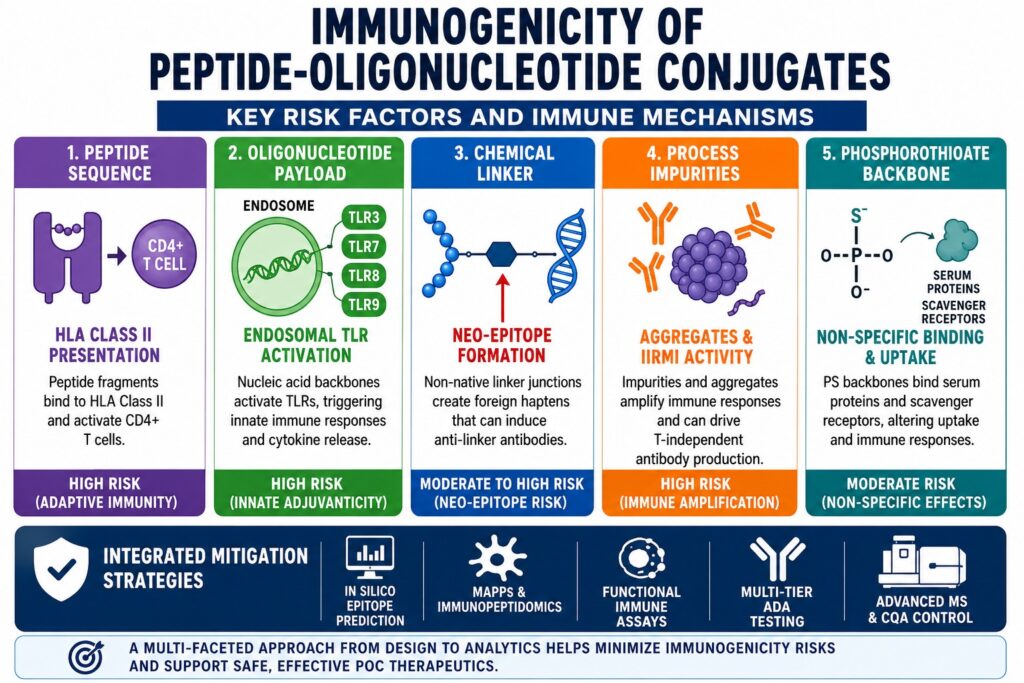
Molecular and Product-Related Risk Factors in the Immunogenicity of Peptide-Oligonucleotide Conjugates
Product-related risk factors contributing to the immunogenicity of peptide-oligonucleotide conjugates arise from the inherent immunogenic potential of the peptide ligand, toll-like receptor (TLR) activation caused by the oligonucleotide payload, novel haptenic epitopes generated at linker junctions, and manufacturing-related impurities. A detailed understanding of these structural factors enables drug developers to introduce targeted sequence and chemical modifications during the early stages of lead optimization.
Learn more about biological mechanism of action and cell uptake pathways: Peptide-Oligonucleotide Conjugates Mechanism of Action
Peptide Sequence Foreignness and HLA Class II Epitope Presentation
Peptide components within conjugates may initiate adaptive immune responses when fragments generated through cathepsin-mediated cleavage bind to human leukocyte antigen (HLA) Class II molecules and are presented as T-cell epitopes to CD4+ T-helper cells. Cationic or amphipathic cell-penetrating peptides (CPPs), including Tat-derived sequences, penetratin, and poly-arginine motifs, as well as targeting ligands such as bicyclic peptides like BCY17901 targeting transferrin receptor 1, depend on specific charge distributions to facilitate passage across cell membranes. Cationic sequences enriched in arginine and lysine can readily interact with negatively charged cell-surface proteoglycans, promoting rapid endocytosis into APCs, including dendritic cells, macrophages, and B cells.
Within the endolysosomal compartment, cathepsins and other proteolytic enzymes break down the peptide component into short fragments. Non-self sequence regions or modified synthetic amino acids may generate linear peptides capable of binding with high affinity to HLA-DR, HLA-DP, or HLA-DQ molecules. Once these peptide-MHC complexes are expressed on the surface of APCs, they can interact with T-cell receptors (TCRs) on naive CD4+ T cells. This interaction may initiate T-cell proliferation, the release of pro-inflammatory cytokines such as IL-2 and IFN-γ, and subsequent B-cell class switching, resulting in the production of high-affinity ADAs. Greater sequence divergence from self-proteins increases the likelihood of generating immunodominant effector T-cell epitopes.
Learn how structural variations influence delivery efficiency and cell targeting: Types of Peptide-Oligonucleotide Conjugates
Oligonucleotide Backbone Structure and Toll-Like Receptor Activation
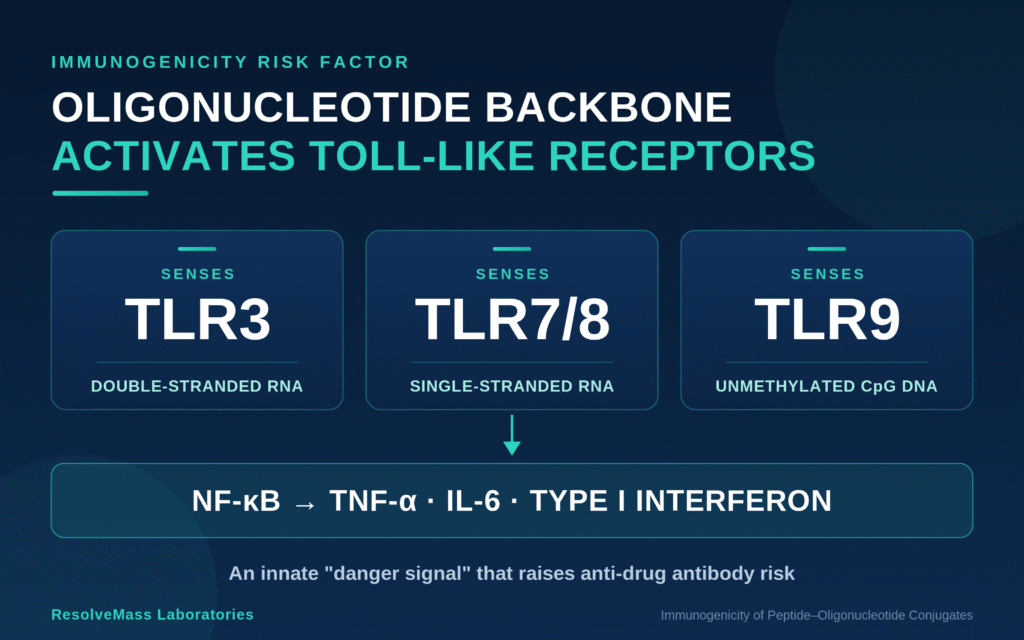
Oligonucleotide backbones can function as potent innate immune adjuvants by directly activating endosomal Toll-like receptors (TLR3, TLR7, TLR8, and TLR9) after cellular internalization. Unmodified or partially modified single-stranded DNA sequences containing unmethylated cytosine-phosphate-guanine (CpG) motifs can bind to endosomal TLR9. Single-stranded RNA structures activate TLR7 and TLR8, whereas double-stranded RNA architectures engage TLR3.
When APCs internalize POCs through endocytosis, the conjugate comes into contact with these endosomal PRRs. TLR ligation initiates intracellular signaling cascades mediated by MyD88 or TRIF adapter proteins, leading to the nuclear translocation of NF-κB and the production of pro-inflammatory cytokines, including TNF-α, IL-6, and Type I interferons. This innate immune activation provides a “danger signal” that promotes dendritic cell maturation, increases the expression of CD80/CD86 co-stimulatory molecules, and reduces the activation threshold required for naive CD4+ T cells to respond to weak peptide epitopes present on the conjugate. In addition, phosphorothioate (PS) backbone modifications, which are commonly incorporated to improve nuclease resistance, can exhibit non-specific interactions with serum proteins and cell-surface scavenger receptors, including SCARA1/2 and stabilin-1/2. These interactions can alter cellular uptake kinetics and tissue retention.
Discover optimization strategies for systemic transport and cellular delivery: Peptide-Oligonucleotide Conjugates Drug Delivery
Chemical Linker Architecture, Stoichiometry, and Neo-Epitopes
The chemical linker connecting the peptide with the nucleic acid payload can create non-native structural junctions that function as immunogenic neo-epitopes. Bioconjugation approaches may involve stochastic coupling across primary amines or carboxyl groups or site-specific orthogonal reaction schemes. Stochastic conjugation can generate heterogeneous drug populations with variable drug-to-peptide ratios, thereby changing the molecule’s physical surface charge, hydrodynamic radius, and spatial conformation.
Synthetic, non-cleavable linkers, including maleimide-thiol adducts or triazole rings generated through click chemistry, may function as foreign haptens. Incomplete degradation within lysosomes can result in hybrid peptide-linker-nucleotide fragments that are subsequently displayed on HLA molecules. These distinctive structural junctions constitute neo-epitopes that are not present within the host proteome. B-cell receptors (BCRs) that recognize these non-native structural features can internalize the conjugate, receive assistance from CD4+ T cells, and generate linker- or conjugate-specific ADAs. The resulting immune response may accelerate the removal of the drug from systemic circulation.
Discover advanced bio-orthogonal coupling techniques for custom linkers: Peptide-Oligonucleotide Conjugate Linker Chemistry
Manufacturing Impurities and Aggregate-Induced Immune Amplification
Process- and product-related impurities, including truncated synthetic peptides, failure oligonucleotides, and sub-visible aggregates, can substantially increase immunogenic risk by presenting multivalent epitopes or functioning as innate immune response-modulating impurities (IIRMIs). The manufacture of complex chimeric molecules using solid-phase peptide synthesis (SPPS) and solid-phase oligonucleotide synthesis (SPOS) produces a broad range of chemical variants. Synthetic peptide impurities may include truncation sequences, deletion variants, racemized amino acids, deamidated species, and β-alanine insertions. Oligonucleotide synthesis can produce $n-1$ and $n-2$ short failure sequences, depurinated species, and incompletely deprotected products.
Product-related aggregates represent a significant immunogenicity liability. The high-density, multivalent presentation of peptide epitopes on aggregated particles can directly cross-link B-cell receptors, potentially bypassing the requirement for T-cell help and inducing T-independent antibody responses. In addition, trace process impurities, including host-cell proteins, residual reagents, and bacterial endotoxins, may function as extrinsic IIRMIs. These impurities can promote dendritic cell maturation at sub-nanogram concentrations and increase the immunogenicity of the active pharmaceutical ingredient (API).
Address common downstream processing and synthesis hurdles: Challenges in Peptide-Oligonucleotide Conjugates
| Structural Component | Primary Immune Mechanism | Associated Biomarkers / Assays | Relative Risk Impact |
|---|---|---|---|
| Peptide Sequence | HLA Class II loading and CD4+ T-cell activation | MAPPs, CD4+ T-cell proliferation, ELISpot | High (Adaptive Immunity) |
| Oligonucleotide Payload | Endosomal TLR (3, 7, 8, 9) activation | Cytokine release (TNF-α, IFN-γ), NF-κB activation | High (Innate Adjuvanticity) |
| Chemical Linker | Creation of foreign haptenic neo-epitopes | Linker-specific ADA screening, SPR kinetics | Moderate to High |
| Process Impurities | Enhanced aggregation and IIRMI activity | LC-MS/MS impurity profiling, cell-based CRA | High (Immune Amplification) |
| Phosphorothioate Backbone | Non-specific protein and scavenger receptor binding | Plasma protein binding, SCARA uptake assays | Moderate |
Comprehensive Assessment Platforms for Evaluating the Immunogenicity of Peptide-Oligonucleotide Conjugates
A comprehensive evaluation of the immunogenicity of peptide-oligonucleotide conjugates requires a complementary testing matrix that integrates computational epitope prediction, ex vivo immunopeptidomics, cell-based functional immune assays, and multi-tiered bioanalytical anti-drug antibody (ADA) detection. This tiered assessment framework supports the systematic de-risking of therapeutic candidates throughout the drug development pathway, beginning with early discovery and continuing through preclinical and clinical development.
Plan robust early-stage evaluation strategies for candidates: Peptide-Oligonucleotide Conjugates Preclinical Services
In Silico Computational Modeling and T-Cell Epitope Prediction
In silico algorithms assess 9-mer frame sliding windows across peptide sequences to estimate their binding affinities for prevalent HLA Class II alleles represented across diverse patient populations. Advanced computational platforms, including EpiMatrix, ClustiMer, and JanusMatrix, evaluate peptide sequences against panels of global HLA-DRB1, DQB1, and DPB1 alleles and generate normalized Z-scores to characterize predicted binding potential. Sequences that fall within the top 5% of normal distribution curves are generally classified as high-affinity binding “hits” and may warrant further immunogenicity evaluation.
JanusMatrix extends conventional affinity-based predictions by assessing the potential cross-reactivity of predicted T-cell epitopes against the reference human proteome. Epitopes that demonstrate substantial sequence conservation with endogenous human proteins or recognized regulatory T-cell epitopes (Tregitopes) may be classified as potentially tolerogenic. In contrast, peptide sequences exhibiting limited homology with human proteins while retaining high HLA binding affinity are identified as potential immunogenicity risks. Although in silico tools can accelerate the initial ranking and prioritization of candidates, they cannot fully reproduce cellular proteolysis, the effects of non-natural amino acid modifications, or steric hindrance caused by the oligonucleotide payload attached to the peptide.
Major Histocompatibility Complex-Associated Peptide Proteomics (MAPPs)
MHC-Associated Peptide Proteomics (MAPPs) provides a direct LC-MS/MS-based assessment of the peptide fragments that are naturally processed and presented on HLA Class II molecules by human dendritic cells. In contrast to predictive computational algorithms, MAPPs directly measures cellular processing events, including endolysosomal cleavage, peptide trimming, and HLA loading, within primary human immune cells. This makes the approach particularly valuable for determining whether the actual processing of a peptide-oligonucleotide conjugate corresponds with computationally predicted epitopes.
The MAPPs analytical workflow involves the following structured stages:
- Primary monocytes are isolated from peripheral blood mononuclear cells (PBMCs) obtained from healthy, HLA-typed donors selected to represent diverse HLA Class II alleles.
- The isolated monocytes are differentiated over a period of 5 days into monocyte-derived dendritic cells (moDCs) using GM-CSF and IL-4.
- Immature moDCs are pulsed with the peptide-oligonucleotide conjugate test article, typically at concentrations ranging from 0.3 to 3.0 µM, and are subsequently matured overnight using lipopolysaccharide (LPS).
- Following maturation, the moDCs are harvested and lysed using non-denaturing detergent buffers supplemented with protease inhibitors to preserve the integrity of the HLA-peptide complexes.
- Membrane-associated HLA-DR, HLA-DP, and HLA-DQ complexes are immunoprecipitated using magnetic beads conjugated with pan-anti-HLA antibodies, including clones L243, B7.21, and 1a3.
- The presented immunopeptides are eluted under mildly acidic conditions, desalted using C18 solid-phase extraction, and analyzed by high-resolution LC-MS/MS using Orbitrap or timsTOF mass spectrometers.
- The resulting mass spectra are searched against human proteome databases supplemented with the target conjugate sequence. MAPPs analysis identifies presented peptide cluster boundaries and can determine whether the attached oligonucleotide backbone obstructs specific proteolytic cleavage sites or changes HLA loading patterns compared with unconjugated peptides.
Ex Vivo Functional T-Cell and Cytokine Release Assays
Functional cell-based assays provide a means of quantifying human immune cell activation following exposure to peptide-oligonucleotide conjugates. These assays typically use donor panels selected to represent the HLA frequencies of the intended target population, thereby improving the relevance of the resulting immunogenicity assessment.
T-Cell Proliferation Assays: Donor PBMCs or co-cultured moDC/CD4+ T-cell populations are incubated with the peptide-oligonucleotide conjugate, isolated peptide fragments, or relevant manufacturing impurities for 5 to 7 days. T-cell proliferation is subsequently quantified using tritiated thymidine (3H-TdR) incorporation or carboxyfluorescein succinimidyl ester (CFSE) dye dilution measured by flow cytometry. A Stimulation Index (SI) of ≥ 2.0 compared with the vehicle control is generally considered indicative of significant T-cell activation.
ELISpot and FluoroSpot Assays: Single-cell cytokine secretion assays provide a functional assessment of T-cell activation by measuring the release of Interleukin-2 (IL-2) and Interferon-gamma (IFN-γ) following challenge with the conjugate. ELISpot assays offer high analytical sensitivity and can detect antigen-specific memory T cells at frequencies as low as 1 in 100,000 PBMCs. FluoroSpot approaches can further enable the simultaneous measurement of multiple cytokines at the single-cell level.
Innate Cytokine Release Assays (CRA): Whole-blood or PBMC cultures are exposed to the test article for approximately 6 to 24 hours. Multiplexed immunoassays are then used to quantify early inflammatory cytokines, including IL-1β, IL-6, TNF-α, and IFN-α. These measurements help distinguish innate immune activation driven by the oligonucleotide sequence or manufacturing impurities from adaptive immune responses mediated by antigen-specific T cells.
Multi-Tiered ADA Bioanalytical Testing Framework
Bioanalytical ADA testing for peptide-oligonucleotide conjugates follows a structured, multi-tiered strategy that generally includes screening, confirmation, domain mapping, and neutralization assays. Specialized assay formats are often necessary because the polyanionic nature of oligonucleotide backbones can introduce matrix interference and complicate the detection and characterization of ADA responses.
| Assay Tier | Primary Analytical Objective | Recommended Platform | Bioanalytical Challenge for POCs |
|---|---|---|---|
| Tier 1: Screening | Rapid detection of binding ADAs in clinical or preclinical serum | Electrochemiluminescence (ECLIA) / Bridging ELISA | Charge interference from PS backbones; non-specific matrix binding |
| Tier 2: Confirmatory | Verification of antigen specificity through competitive drug inhibition | ECLIA with excess unlabeled POC competition | Drug tolerance requirements associated with prolonged tissue half-lives |
| Tier 3: Domain Mapping | Differentiation of anti-peptide, anti-linker, or anti-nucleic acid ADAs | Surface Plasmon Resonance (SPR) / Competition ELISA | Distinguishing anti-PS backbone reactivity from sequence-specific ADAs |
| Tier 4: Neutralizing (NAb) | Quantification of antibodies that inhibit target binding or gene silencing | Cell-based reporter gene assays / Competitive receptor binding | High serum background in cell culture; dual delivery and silencing mechanisms |
The development of ADA assays for POCs presents several distinctive analytical challenges. Polyanionic phosphorothioate backbones can promote non-specific interactions with microtiter plates and serum proteins, which may increase false-positive rates during the screening stage. In addition, pre-existing antibodies directed against viral-derived CPPs or carrier peptides can complicate the determination of baseline cut points and may affect the interpretation of treatment-emergent ADA responses.
Surface Plasmon Resonance (SPR) platforms provide real-time kinetic measurements, including kon and koff, that can help differentiate low-affinity IgM responses from high-affinity, mature IgG antibodies directed against specific domains of the conjugate. This kinetic information can provide additional insight into antibody maturation, binding strength, and the specific molecular region responsible for the immune response.
Regulatory Guidelines and Mitigation Strategies for the Immunogenicity of Peptide-Oligonucleotide Conjugates
Regulatory expectations established by the FDA and EMA require a phase-appropriate, risk-based strategy for mitigating immunogenicity that integrates molecular de-immunization, chemical modification of the oligonucleotide backbone, and stringent control of critical quality attributes (CQAs). Incorporating these strategies during lead optimization can help reduce immunogenicity-related risks and minimize the possibility of late-stage clinical attrition.
Regulatory Expectations and Guidance Frameworks
Regulatory frameworks, including the FDA 2024 guidance on oligonucleotide therapeutics and EMA guidelines concerning therapeutic proteins, require comprehensive immunogenicity risk assessments that address product quality attributes, clinical pharmacology, and impurity qualification. The FDA guidance, Clinical Pharmacology Considerations for the Development of Oligonucleotide Therapeutics (June 2024), requires product-specific immunogenicity assessments that consider the base sequence, chemical modifications, conjugation chemistry, strandedness, distribution to target tissues, and dosing frequency.
For generic synthetic peptide and oligonucleotide products submitted through Abbreviated New Drug Applications (ANDAs), FDA guidance documents, including FDA-2017-D-5767, require developers to demonstrate that impurities generated during the synthetic process do not exceed the levels observed in the reference listed drug (RLD). Specified peptide or oligonucleotide impurities present above 0.10% (or 0.5%, depending on the daily dose) must be appropriately qualified using orthogonal in silico and ex vivo assays. These assessments are intended to demonstrate that the impurities do not introduce novel T-cell epitopes or increase innate immune reactivity. Similarly, European Medicines Agency (EMA) guidelines, including EMEA/CHMP/BMWP/42832/2005 Rev 1, require an Integrated Summary of Immunogenicity to track immunogenicity risks throughout the entire drug development lifecycle.
Read complete documentation for filing regulatory packages: Peptide-Oligonucleotide Conjugates in IND Submissions
Molecular De-Immunization and Structural Modification Strategies
Rational structural engineering can reduce the immunogenicity of peptide-oligonucleotide conjugates through targeted T-cell epitope substitution, incorporation of nucleoside modifications such as 2′-OMe and 2′-MOE, the use of stereopure phosphorothioate internucleotide linkages, and site-specific bioconjugation chemistries designed to shield hydrophobic linkers.
T-Cell Epitope Substitution: When in silico modeling and MAPPs analysis identify an immunodominant T-cell epitope within the peptide ligand, targeted amino acid substitutions can be introduced at key HLA anchor positions, including P1, P4, P6, or P9. Replacing hydrophobic anchor residues such as Leucine, Isoleucine, and Valine with neutral or polar residues can disrupt HLA Class II binding affinity while preserving the receptor-targeting activity of the peptide.
Targeted Sugar and Base Modifications: The incorporation of 2′-O-methyl (2′-OMe) or 2′-methoxyethyl (2′-MOE) ribose modifications can reduce the ability of single-stranded RNA to interact with endosomal TLR7/8. Similarly, replacing unmethylated cytosine residues with 5-methylcytosine can eliminate TLR9 recognition of DNA sequences.
Stereopure Internucleotide Linkages: Replacing racemic mixtures of phosphorothioate linkages with stereopure RP or SP configurations can reduce non-specific protein binding, improve resistance to nuclease-mediated degradation, and decrease off-target immune stimulation.
Site-Specific Bioconjugation and Steric Shielding: Replacing random amine coupling with site-specific bioconjugation approaches, such as engineered cysteine thiols or enzymatic transglutaminase labeling, produces more homogeneous conjugates with predictable stoichiometry. The use of short polyethylene glycol (PEG) chains or zwitterionic spacers to shield hydrophobic linkers can further reduce haptenic recognition by B-cell receptors.
Analytical Quality Control and CQA Characterization
Advanced mass spectrometry platforms, including high-resolution LC-MS/MS peptide mapping, native MS, and Hydrogen-Deuterium Exchange MS (HDX-MS), are essential for characterizing primary sequences, disulfide pairing, higher-order structures, and impurity profiles. Establishing a Threshold of Immunogenicity Concern (TIC) provides a framework for maintaining batch-to-batch consistency and supporting regulatory compliance.
High-resolution LC-MS/MS peptide mapping performed under reducing and non-reducing conditions can provide greater than 95% sequence coverage. This approach supports confirmation of the primary amino acid sequence, detection of low-level site-specific modifications such as oxidation and deamidation, and verification of native disulfide pairing architectures. Native mass spectrometry can be used to evaluate the intact conjugate mass and stoichiometry, whereas HDX-MS provides insight into higher-order structural dynamics and can identify early aggregation events. Establishing phase-appropriate control strategies, including a Threshold of Immunogenicity Concern (TIC) for specified impurities, helps ensure that product-related variants remain controlled within process parameters designed to support clinical safety.
See how to perform mass spectrometry characterization and primary sequence mapping: Structural Characterization of Peptide-Oligonucleotide Conjugates
Conclusion
Successfully mitigating the immunogenicity of peptide-oligonucleotide conjugates requires an end-to-end strategy that integrates molecular design, ex vivo immunopeptidomics, functional immune profiling, and advanced mass spectrometry characterization. A comprehensive immunogenicity assessment must evaluate peptide sequence foreignness, endosomal TLR signaling, linker stability, and synthetic impurity profiles as interconnected risk factors rather than as isolated considerations.
The implementation of phase-appropriate risk assessment platforms, including in silico modeling, MAPPs, cell-based functional assays, and high-resolution LC-MS/MS CQA monitoring, supports the systematic identification and control of immunogenicity risks while helping developers meet evolving FDA and EMA regulatory expectations. Biopharmaceutical developers can further de-risk peptide-oligonucleotide conjugate development pipelines by partnering with specialized analytical laboratories capable of integrating advanced bioanalytical testing with comprehensive analytical characterization.
To explore custom bioanalytical testing strategies and advanced analytical characterization platforms, visit the ResolveMass Contact Page.
Frequently Asked Questions
Cell-penetrating peptides (CPPs) can increase immunogenicity because their cationic or amphipathic properties promote efficient cellular uptake through endocytosis, including uptake by professional antigen-presenting cells. After internalization, lysosomal cathepsins and other proteolytic enzymes can break down the CPP into peptide fragments. These fragments may bind HLA Class II molecules and subsequently stimulate CD4+ T-helper cell responses.
MHC-Associated Peptide Proteomics (MAPPs) is an ex vivo immunopeptidomic approach used to determine which peptide fragments are naturally processed and presented by HLA Class II molecules. The method combines immunoprecipitation with high-resolution LC-MS/MS analysis to identify experimentally presented epitopes in human dendritic cells. Unlike computational prediction alone, MAPPs can reveal the effects of endolysosomal processing, chemical modifications, and the structural arrangement of the conjugate on actual HLA presentation.
Chemical modifications can significantly alter the interaction between oligonucleotides and innate immune receptors. Ribose modifications such as 2′-O-methyl (2′-OMe) and 2′-methoxyethyl (2′-MOE) can reduce recognition of single-stranded RNA by endosomal TLR7 and TLR8, thereby limiting pro-inflammatory cytokine release. Phosphorothioate (PS) backbones improve nuclease resistance but may also increase non-specific interactions with serum proteins and cell-surface scavenger receptors.
Immunogenicity assessment is guided by several regulatory frameworks, including the FDA Final Guidance Clinical Pharmacology Considerations for the Development of Oligonucleotide Therapeutics issued in June 2024. Additional FDA ANDA guidance documents address generic synthetic peptides and oligonucleotides, while EMA scientific guidelines provide recommendations for assessing immunogenicity associated with therapeutic proteins. Relevant EMA guidance includes EMEA/CHMP/BMWP/42832/2005 Rev 1, which supports lifecycle-based immunogenicity risk assessment.
ADAs generated against peptide-oligonucleotide conjugates may recognize different molecular domains, including the peptide ligand, chemical linker, or nucleic acid sequence. This multi-domain reactivity can make POC antibody responses more structurally diverse than responses directed against a single protein-based therapeutic domain. In addition, polyanionic oligonucleotide backbones can cause charge-related matrix interference, requiring specialized bioanalytical platforms such as Surface Plasmon Resonance (SPR) and electrochemiluminescence (ECLIA).
Manufacturing-related impurities, including deletion sequences, racemized peptide species, failure oligonucleotides, and sub-visible aggregates, can contribute substantially to immunogenicity risk. Some impurities may generate novel neo-epitopes, while others can function as Innate Immune Response Modulating Impurities (IIRMIs). These contaminants may stimulate dendritic cell activation and inflammatory signaling even at low concentrations, potentially increasing the immune response against the active drug product.
Stochastic bioconjugation can generate heterogeneous conjugate populations containing different attachment sites and variable drug-to-peptide ratios. This structural variability may expose hydrophobic regions, create diverse chemical junctions, and increase the likelihood of aggregate formation. In contrast, site-specific bioconjugation produces a more uniform product with controlled stoichiometry, which can reduce the formation of haptenic neo-epitopes and improve control over product-related immunogenicity risks.
In silico prediction tools provide an efficient initial screening strategy by evaluating peptide sequences for potential HLA Class II binding motifs and assessing their similarity to endogenous human proteins. Ex vivo approaches, including MAPPs, PBMC proliferation assays, and ELISpot, can then experimentally investigate whether these predicted epitopes are processed and presented by human immune cells. This combined approach links computational risk prediction with functional evidence of HLA presentation and T-cell activation.
Critical Quality Attributes (CQAs) of peptide-oligonucleotide conjugates are evaluated using a combination of complementary analytical techniques. High-resolution LC-MS/MS peptide mapping supports primary sequence confirmation and characterization of modifications such as oxidation and deamidation, while non-reducing LC-MS/MS can verify disulfide pairing. Native mass spectrometry evaluates intact conjugate mass and stoichiometry, and HDX-MS provides information on higher-order structural dynamics and early aggregation-related changes.
Reference:
- U.S. Food and Drug Administration. (2024, June). Clinical pharmacology considerations for the development of oligonucleotide therapeutics: Guidance for industry. https://www.fda.gov/media/159414/download
- Sharma, S., Sinhari, A., Jain, P., Jadhav, H. R., et al. (2023). Enhancing antisense oligonucleotide-based therapeutic delivery with DG9, a versatile cell-penetrating peptide. Molecular Therapy—Nucleic Acids, 33, 1–15. https://pmc.ncbi.nlm.nih.gov/articles/PMC10572411/
- Rosenberg, A. S. (2016). Risk assessment and mitigation strategies for immune responses to therapeutic proteins: The FDA perspective [Presentation]. U.S. Food and Drug Administration. European Medicines Agency. https://www.ema.europa.eu/en/documents/presentation/presentation-risk-assessment-and-mitigation-strategies-immune-responses-therapeutic-proteins-fda-perspective-amy-rosenberg_en.pdf
- U.S. Food and Drug Administration. (2024, October 7–8). Scientific and regulatory considerations for assessment of immunogenicity risk for generic peptide and oligonucleotide drug products [Workshop]. FDA event page
- Pang, E. (2025). Immunogenicity assessments in peptides: Progress and remaining challenges [Presentation]. U.S. Food and Drug Administration. FDA presentation
- European Medicines Agency. (2017). Guideline on immunogenicity assessment of therapeutic proteins—Revision 1 (EMEA/CHMP/BMWP/14327/2006 Rev. 1). https://www.ema.europa.eu/en/documents/scientific-guideline/guideline-immunogenicity-assessment-therapeutic-proteins-revision-1_en.pdf
Get In Touch With Us
About The Author


