

Introduction: Why Conventional Mutagenicity Models Are Inadequate for NDSRIs
The regulatory complexity associated with N-Nitrosamine Drug Substance-Related Impurities (NDSRIs) extends far beyond simple detection; it is fundamentally centered on accurate potency characterization. In silico potency prediction for NDSRIs has therefore become an essential analytical strategy because these impurities exist within a structural domain where traditional nitrosamine reference compounds such as NDMA, NDEA, and NMBA frequently generate misleading potency estimations when applied without appropriate structural consideration.
Unlike simple dialkylnitrosamines, NDSRIs originate from the secondary amine component of an active pharmaceutical ingredient (API). As a result, they retain the structural sophistication of the parent drug molecule, including chiral centers, aromatic systems, heterocyclic frameworks, steric bulk, and electron-withdrawing substituents. Each of these characteristics directly influences the metabolic alpha-hydroxylation pathway responsible for genotoxic activation. Consequently, assigning a default acceptable intake (AI) limit of 18 ng/day — equivalent to the NDMA threshold — to a sterically hindered or electronically deactivated NDSRI without a scientifically supported SAR assessment is both scientifically unsound and commercially impractical.
This article examines the computational and scientific methodology used for NDSRI potency classification, including the application of SAR principles, the operational role of DEREK Nexus and CASE Ultra, and the integration of their outputs into a scientifically defensible regulatory submission.
Learn more about setting robust regulatory thresholds for high-risk compounds by exploring ResolveMass Nitrosamine Testing for High-Risk Drug Classes.
Share via:
Article Summary:
- In silico potency prediction for NDSRI is now a regulatory-recognized strategy for assigning Acceptable Intake (AI) limits when no experimental carcinogenicity data is available.
- N-Nitrosamines derived from secondary amines in drug substances (NDSRIs) present unique structural complexity that challenges standard CPDB-based TD₅₀ extrapolation.
- Structure-Activity Relationship (SAR) analysis identifies alpha-hydrogen count, alpha-branching, molecular flexibility, and electronic deactivation as the primary determinants of NDSRI potency.
- DEREK Nexus and CASE Ultra are the two predominant in silico platforms used in regulatory submissions; each applies distinct mechanistic logic and should be run in combination.
- ICH M7(R2) and the FDA’s 2023/2024 guidance updates explicitly allow AI limits derived from in silico potency categorization when supported by SAR justification.
- ResolveMass Laboratories applies an integrated, multi-platform workflow to deliver defensible NDSRI hazard classifications with full regulatory traceability.
The SAR Framework for NDSRI Potency: Critical Structural Determinants
Structure-Activity Relationship (SAR) analysis assigns relative potency classifications to NDSRIs based on structural characteristics that directly influence alpha-hydroxylation efficiency, which represents the rate-limiting step in nitrosamine metabolic activation and genotoxicity.
1. Alpha-Hydrogen Availability
The presence and accessibility of alpha-hydrogens adjacent to the N-nitroso group represent the most critical SAR descriptor. CYP2A6- and CYP2E1-mediated oxidative dealkylation requires at least one abstractable alpha-hydrogen to produce the diazonium ion responsible for DNA alkylation. NDSRIs exhibiting the following structural configurations demonstrate corresponding potency trends:
- Two alpha-hydrogens on each alpha-carbon (for example, –CH₂– groups): These structures exhibit high metabolic activation potential and are generally associated with higher potency classifications.
- One alpha-hydrogen (secondary carbon, –CH<–): Such structures display reduced activation rates and are typically categorized within moderate potency ranges.
- No alpha-hydrogens (tertiary carbon, –C<): Direct alpha-hydroxylation cannot occur through the conventional pathway, resulting in substantially reduced or potentially absent potency via this mechanism.
2. Alpha-Carbon Branching and Steric Influences
Branching at the alpha-carbon does more than merely reduce hydrogen availability; it also introduces steric hindrance that limits accommodation within the CYP enzyme active site. For example, an NDSRI possessing an alpha-tertiary carbon attached to a cyclohexyl substituent demonstrates structural deactivation beyond what simple hydrogen-counting models would predict.
The following branching descriptors are commonly applied in SAR-based evaluations:
| Alpha-Carbon Configuration | Steric Classification | Potency Impact |
|---|---|---|
| –CH₂– (unbranched methylene) | None | Maximal activation |
| –CH(CH₃)– (single methyl branch) | Mild | Moderate reduction |
| –CH(CH₂CH₂–)– (ring member) | Moderate | Ring-dependent effect |
| –C(CH₃)₂– (gem-dimethyl) | High | Significant reduction |
| –C< (fully substituted) | Maximal | Near-complete deactivation through this pathway |
To understand how structural variations dictate analytical boundaries and compound handling, read about ResolveMass Direct Injection vs Headspace Techniques for Nitrosamines.
3. Electronic Deactivation Through Adjacent Electron-Withdrawing Groups
Electron-withdrawing substituents such as carbonyl groups, sulfonyl functionalities, fluorinated substituents, and aromatic systems conjugated to the alpha-carbon significantly reduce electron density at the alpha position. This reduction decreases susceptibility to CYP-mediated hydrogen abstraction and therefore lowers mutagenic activation potential.
The FDA guidance addressing NDSRIs specifically recognizes that alpha-carbonyl-substituted NDSRIs may justify higher acceptable intake limits due to their diminished potency.
Important electronic deactivation patterns include:
- Alpha-carbonyl substitution (–C(=O)–): Strong inductive electron withdrawal that substantially lowers potency.
- Alpha-aryl substitution (–CHAr–): Resonance delocalization creates moderate deactivation dependent upon ring electronics.
- Alpha-fluorine substitution: Produces inductive electron withdrawal while also contributing steric effects.
- Piperazine and morpholine-derived NDSRIs: Cyclic constraints reduce the conformational flexibility necessary for optimal CYP enzyme binding.
4. Conformational Restriction and Ring Systems
NDSRIs derived from cyclic secondary amines such as piperidine, morpholine, and pyrrolidine adopt conformationally restricted geometries. The torsional orientation of the N-nitroso group and the dihedral relationship of the alpha-carbon relative to the CYP binding orientation significantly influence metabolic activation efficiency.
Morpholine-derived NDSRIs have been particularly well studied because the oxygen atom incorporated within the ring creates an electronically unique environment compared with analogous piperidine systems.
For a broader breakdown of how these chemical structures align with international guidance, review the ResolveMass Impact of ICH M7R2 Updates on Nitrosamine Risk Assessment.
DEREK Nexus: Rule-Based Hazard Identification for NDSRIs
DEREK Nexus identifies potential mutagenic and carcinogenic hazards using a knowledge-based library of structural alerts that generate qualitative likelihood assessments such as “probable,” “plausible,” or “equivocal” for specific toxicological endpoints.
How DEREK Evaluates NDSRI Structures
DEREK (Deductive Estimation of Risk from Existing Knowledge) applies a curated collection of expert-developed structural alerts derived from published mechanistic and empirical evidence to identify sub-structural features associated with biological hazards.
For nitrosamine evaluation, DEREK includes specialized alerts designed to:
- Detect the N-nitroso functionality and classify it according to adjacent carbon substitution patterns.
- Evaluate alpha-carbon substitution, differentiating activated structures such as unhindered methylene groups from deactivated branched or alpha-hydrogen-deficient systems.
- Apply electronic modulation rules that reduce likelihood outputs when established electronic deactivation patterns are present.
- Generate a transparent reasoning pathway that produces a traceable, rule-based decision tree suitable for direct inclusion within regulatory submissions.
Regulatory Importance of DEREK Outputs for NDSRIs
The output generated by DEREK is especially valuable in ICH M7 submissions for several reasons:
- The qualitative likelihood classifications are discrete, standardized, and suitable for direct incorporation into Module 3 or Module 2.6.7 regulatory documentation.
- The reasoning process is fully transparent, providing mechanistic justification rather than opaque “black-box” predictions.
- DEREK is continuously updated by Lhasa Limited to incorporate emerging NDSRI-specific toxicological data, ensuring that assessments performed in 2024 and 2025 reflect the most current scientific understanding.
Known Limitations of DEREK for NDSRI Assessment
Because DEREK relies on a rule-based architecture, it may occasionally produce conservative outputs for novel NDSRI structures that are poorly represented within its alert knowledge base. When DEREK returns classifications such as “possible” or “equivocal” despite SAR evidence supporting deactivation, the discrepancy must be explicitly addressed and scientifically justified within the assessment narrative rather than ignored or overridden without explanation.
For insights into how qualitative hazard alerts translate into numerical limits, check out the ResolveMass Nitrosamine AI Limits Comparison.
CASE Ultra: Statistical SAR Modeling for Quantitative Potency Prediction
CASE Ultra provides quantitative mutagenicity and carcinogenicity predictions through a fragment-based statistical learning framework. The platform generates numerical probability scores and potency estimates that complement the qualitative assessments produced by DEREK.
The CASE Ultra Mechanism for Nitrosamine Evaluation
CASE Ultra (Computer Automated Structure Evaluation) employs fragment-based QSAR methodologies in which molecules are decomposed into biologically meaningful fragments known as biophores and biophobes.
For NDSRI evaluation, the most relevant modules include:
- MultiCASE Ames mutagenicity model: Predicts the probability of Salmonella mutagenicity, which serves as a surrogate marker for genotoxic potential.
- CASE Ultra rat carcinogenicity model: Predicts TD₅₀ values expressed in mg/kg/day, enabling direct application to acceptable intake calculations.
- Structural interpretation outputs: Generate fragment-level contribution maps identifying the structural features driving the prediction.
Interpretation of CASE Ultra TD₅₀ Outputs for NDSRIs
The TD₅₀ values generated by CASE Ultra may be applied directly within the ICH M7 framework to calculate acceptable intake limits using the following relationship:
AI (ng/day)=TD50 (mg/kg/day)×50 kg×150,000×106 ng/mgAI\,(ng/day)=TD_{50}\,(mg/kg/day)\times50\,kg\times\frac{1}{50,000}\times10^{6}\,ng/mgAI(ng/day)=TD50(mg/kg/day)×50kg×50,0001×106ng/mg
In this equation, the factor of 1/50,000 represents the standard linear extrapolation corresponding to a 1-in-100,000 lifetime cancer risk.
The following interpretive principles are particularly relevant when evaluating NDSRI predictions from CASE Ultra:
| CASE Ultra Output Scenario | Recommended Interpretation |
|---|---|
| TD₅₀ falls within the model applicability domain | Suitable for direct AI calculation with full documentation |
| TD₅₀ falls outside the applicability domain | Considered unreliable; structural category assessment with DEREK support is recommended |
| Fragment analysis indicates alpha-carbon deactivation | Strengthens SAR-based justification for higher AI limits |
| Prediction conflicts with SAR expectations | Requires expert review and reconciliation narrative |
| Analog read-across available within CASE database | Supports a weight-of-evidence argument using structurally related analogs |
Discover how the CPCA methodology applies to complex structural scenarios by reading about the ResolveMass Nitrosamine CPCA Approach for NDSRIs.
Weight-of-Evidence Integration: Combining DEREK, CASE Ultra, and SAR
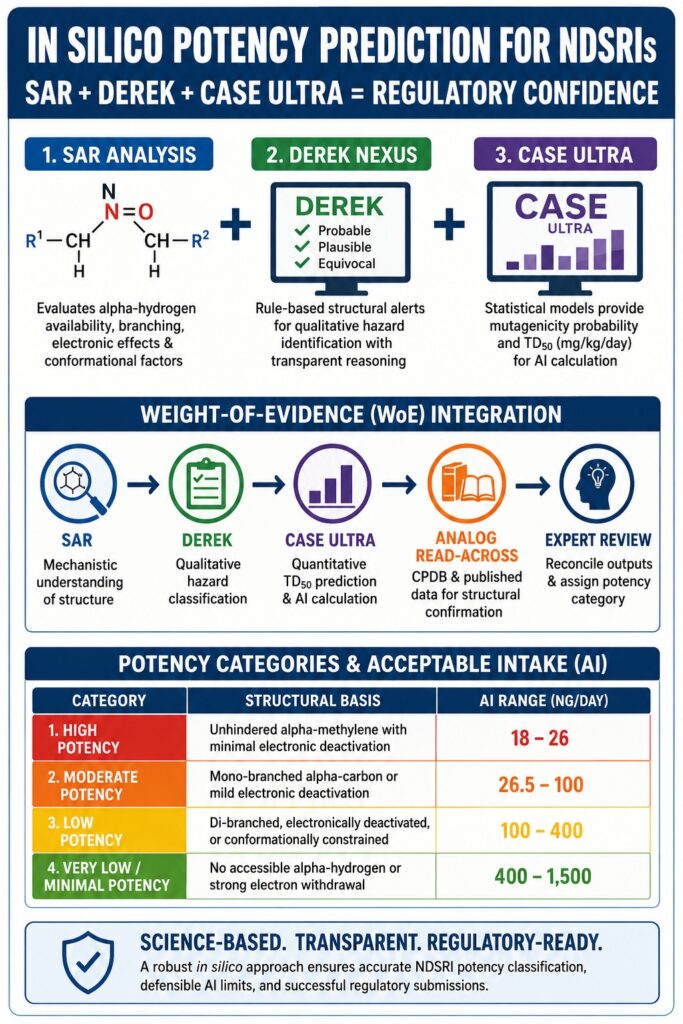
Neither DEREK nor CASE Ultra independently provides a complete NDSRI hazard assessment. Regulatory guidance documents, including the FDA March 2023 guidance and the ICH M7 Q&A framework, support a comprehensive weight-of-evidence (WoE) strategy in which:
- SAR analysis establishes the mechanistic structural rationale underlying expected potency.
- DEREK contributes mechanism-based qualitative hazard classification.
- CASE Ultra provides statistical and quantitative predictive support.
- Structural analog read-across from CPDB or published rodent bioassay data anchors predictions to experimental evidence.
- Expert scientific interpretation reconciles any discordance between computational models.
This integrated methodology is not merely considered best practice; it has become the expected regulatory standard for submissions involving NDSRI-containing pharmaceutical products to agencies including the FDA, EMA, and Health Canada.
To see how interactive logic flows impact threshold classifications, examine the ResolveMass Nitrosamine AI Limit and CPCA framework.
Potency Categories and Acceptable Intake Limits: The Regulatory Classification Framework
The FDA and ICH M7(R2) frameworks classify NDSRIs into potency categories that directly determine acceptable intake limits. These limits range from 18 ng/day for highly potent NDMA-equivalent structures to 1,500 ng/day or greater for significantly deactivated compounds.
The current categorization system, refined through multiple FDA guidance updates and the 2023 Recommended Acceptable Intake Limits for NDSRIs guidance table, generally follows the framework below:
| Potency Category | Structural Basis | AI Range |
|---|---|---|
| High potency (Category 1) | Unhindered alpha-methylene with minimal electronic deactivation | 18–26 ng/day |
| Moderate potency (Category 2) | Mono-branched alpha-carbon or mild electronic deactivation | 26.5–100 ng/day |
| Low potency (Category 3) | Di-branched, electronically deactivated, or conformationally constrained structures | 100–400 ng/day |
| Very low/minimal potency (Category 4) | No accessible alpha-hydrogen or strong electron withdrawal | 400–1,500 ng/day |
| Cohort of Concern analog | Structural similarity to known high-potency nitrosamines | Determined case-by-case |
At ResolveMass Laboratories, every NDSRI potency assessment is explicitly mapped to this regulatory classification system, with outputs from DEREK and CASE Ultra cross-referenced against published FDA NDSRI acceptable intake tables and CPDB analog data.
For comprehensive details on translating categories into regulatory drug specifications, view ResolveMass Nitrosamine Specification Setting.
Common Failure Modes in NDSRI In Silico Assessments
Poorly designed in silico assessments remain one of the primary causes of regulatory deficiencies, review delays, and clinical hold actions. Common deficiencies observed in industry submissions include:
- Applying NDMA-derived TD₅₀ values by default without SAR-based justification, an approach increasingly rejected by regulatory authorities for structurally complex NDSRIs.
- Using only a single in silico platform without a supporting weight-of-evidence framework, which is generally considered insufficient by the FDA and EMA.
- Ignoring applicability domain limitations generated by CASE Ultra or DEREK rather than documenting and evaluating them appropriately.
- Failing to reconcile conflicting outputs between computational platforms through expert scientific interpretation.
- Introducing structural input errors involving tautomers, salt forms, or stereochemical representation, all of which may produce inaccurate predictions.
- Omitting detailed read-across documentation when analog-based arguments are used, including failure to justify structural relevance.
If you are dealing with more than one impurity type simultaneously, explore how to manage risk using the ResolveMass Acceptable Intake for Multiple Nitrosamines protocol.
ResolveMass Laboratories’ Integrated NDSRI In Silico Workflow
ResolveMass Laboratories has established a validated, multi-platform NDSRI potency assessment workflow that combines SAR analysis, DEREK Nexus, CASE Ultra, and regulatory analog review into a unified, submission-ready deliverable.
The workflow includes the following stages:
- NDSRI structure confirmation — Verification of correct tautomeric state, salt form, and stereochemical representation.
- SAR descriptor profiling — Comprehensive evaluation of alpha-carbon substitution, electronic modifiers, and conformational characteristics.
- DEREK Nexus assessment — Complete alert output generation with detailed reasoning chain documentation.
- CASE Ultra assessment — Mutagenicity probability prediction, TD₅₀ estimation, applicability domain review, and fragment contribution analysis.
- Read-across review — Structured evaluation of CPDB data and published literature for relevant structural analogs.
- Weight-of-evidence integration and potency categorization — Expert synthesis of all available evidence into a scientifically justified potency category.
- AI derivation and documentation — Final acceptable intake calculation with full regulatory traceability.
- Regulatory report preparation — Development of an ICH M7-aligned written assessment suitable for IND, NDA, ANDA, or MAA submissions.
Learn how to validate your final limits with highly accurate testing methodologies at ResolveMass Nitrosamine Analysis.
Conclusion
In silico potency prediction for NDSRIs is no longer considered an emerging methodology; it is now an established regulatory expectation for pharmaceutical organizations managing N-nitrosamine impurity control programs. The integration of SAR-based structural analysis, DEREK Nexus mechanistic hazard identification, and CASE Ultra quantitative prediction into a coherent weight-of-evidence framework distinguishes scientifically robust submissions from those subjected to prolonged regulatory scrutiny.
The structural complexity associated with NDSRIs requires a degree of scientific rigor that extends well beyond standardized template-based approaches. Factors such as alpha-hydrogen accessibility, electronic deactivation, steric hindrance, and conformational restriction must each be evaluated independently and collectively. Furthermore, potency classifications must remain fully traceable to specific structural evidence rather than default regulatory assumptions.
ResolveMass Laboratories provides specialized expertise in pharmaceutical impurity science, computational toxicology, and ICH M7 regulatory strategy for comprehensive NDSRI assessments. Our integrated workflow is specifically designed to generate scientifically rigorous, regulatory-ready in silico potency classifications capable of withstanding detailed agency review.
Ready to initiate an NDSRI in silico potency assessment for your drug product?
Contact the regulatory science team at ResolveMass Laboratories.
Frequently Asked Questions (FAQs)
Regulatory agencies such as the FDA generally recognize the combined use of DEREK Nexus and CASE Ultra for evaluating NDSRI potency. These tools are expected to be operated using updated software versions with documented applicability domain assessments. Regulatory reviewers also expect a comprehensive weight-of-evidence (WoE) strategy that integrates SAR interpretation alongside computational outputs. Relying on a single in silico platform alone is usually considered inadequate for a scientifically defensible submission.
CASE Ultra TD₅₀ predictions may be used directly for AI derivation when the evaluated NDSRI falls within the validated applicability domain of the model. However, the prediction should also align with SAR findings and be supported by DEREK Nexus outputs. If the compound lies outside the applicability domain, the TD₅₀ result should only serve as supplemental evidence rather than the primary basis for risk assessment. In such situations, regulators generally expect either a conservative potency categorization or an appropriate analog read-across strategy.
When DEREK Nexus and CASE Ultra generate inconsistent predictions, the discrepancy must be clearly discussed within the toxicological assessment report. Resolution typically involves a detailed structural analysis focusing on mechanistic SAR principles, including alpha-hydrogen accessibility, steric hindrance, and electronic deactivation. Supporting experimental data or validated analog comparisons can further strengthen the scientific interpretation. Regulatory authorities expect transparent reconciliation rather than selective acceptance of favorable results.
Applying NDMA-derived TD₅₀ values directly to structurally complex NDSRIs is no longer considered an acceptable default approach. Current FDA guidance and ICH M7(R2) recommendations emphasize the importance of structure-specific potency assessment. Many NDSRIs possess steric or electronic features that significantly reduce metabolic activation compared to NDMA. Therefore, a dedicated in silico assessment incorporating SAR analysis, DEREK, and CASE Ultra is generally required for scientifically justified AI determination.
Alpha-carbon branching has a major influence on the mutagenic activation potential of NDSRIs. Unbranched alpha-methylene groups typically support higher metabolic activation and therefore correspond to higher potency classifications. As branching increases, steric hindrance reduces CYP-mediated alpha-hydroxylation efficiency, resulting in progressively lower potency categories. Structures with fully substituted alpha-carbons lacking accessible alpha-hydrogens may qualify for very low potency classifications due to minimal activation potential.
ICH M7(R2) and related regulatory Q&A documents support the use of in silico methodologies for NDSRI potency prediction when carcinogenicity data from animal studies are unavailable. Regulatory authorities specifically acknowledge the value of platforms such as DEREK Nexus and CASE Ultra when used within a robust weight-of-evidence framework. The assessment must include mechanistic SAR justification, applicability domain evaluation, and expert scientific interpretation. Properly documented in silico assessments are now widely accepted for AI derivation in regulatory submissions.
DEREK Nexus and CASE Ultra primarily rely on two-dimensional structural representations for their predictive algorithms. Consequently, stereochemistry at positions distant from the N-nitroso functional group often has limited influence on the primary potency prediction. However, when a stereocenter affects the spatial orientation or conformational accessibility of the alpha-carbon, additional expert evaluation may be necessary. In such cases, a three-dimensional conformational assessment accompanied by scientific commentary strengthens the overall regulatory justification.
A scientifically credible read-across assessment should contain comprehensive structural similarity documentation between the target NDSRI and the selected analog compound. This typically includes SMILES comparisons, molecular fingerprint similarity metrics such as Tanimoto coefficients, and mechanistic explanations supporting the relevance of the analog. The quality and source of the carcinogenicity or mutagenicity data must also be clearly identified. Finally, the assessment should explain how the analog data support the proposed potency category and acceptable intake limit.
Reference:
- Mukherjee, P., Yao, X., Brignol, N., Chao, M., Tuske, S., Sheikh, M. O., Brudvig, J., Sitaraman, S., Weimer, J. M., & Ramdas, S. (2025). Analytical method development strategy for controlling two new nitrosamine drug substance related impurities (NDSRIs) in a pharmaceutical drug product for treatment of a rare disease. Chromatographia, 88(5), 395–409. https://doi.org/10.1007/s10337-025-04405-8
- Patel, N., & Shukla, A. (2021). In silico toxicity prediction tools: A review of techniques and applications. International Journal of Pharmaceutical Sciences and Research, 12(2), 601–612. https://ijpsr.com/bft-article/in-silico-toxicity-prediction-tools-a-review-of-techniques-and-applications/
- U.S. Food and Drug Administration (FDA). (2024). Determining recommended acceptable intake limits for N-nitrosamine impurities in pharmaceuticals: Development and application of the carcinogenic potency categorization approach. https://www.fda.gov/drugs/spotlight-cder-science/determining-recommended-acceptable-intake-limits-n-nitrosamine-impurities-pharmaceuticals
- European Medicines Agency (EMA). (n.d.). Nitrosamine impurities. European Medicines Agency. https://www.ema.europa.eu/en/human-regulatory-overview/post-authorisation/referral-procedures-human-medicines/nitrosamine-impurities
Get In Touch With Us
About The Author


