

Introduction: Why Peptide Biosimilar Characterization Using LC-MS Requires More Than Conventional Proteomics
Peptide biosimilar characterization using LC-MS is far more than a routine analytical checkpoint. It serves as the structural and regulatory foundation upon which biosimilarity claims are established. Unlike traditional small-molecule generics, biosimilar peptides possess sequence variants, post-translational modifications (PTMs), and higher-order structural characteristics that cannot be fully verified through biological assays alone. Liquid chromatography coupled with mass spectrometry (LC-MS) remains the most comprehensive analytical platform available for defining this molecular fingerprint with precision.
The current biosimilar regulatory framework, guided by ICH Q6B, FDA comparative analytical assessment guidance, and EMA quality standards, requires manufacturers to prove that a biosimilar is structurally comparable to the reference product at the amino acid and peptide level, not merely functionally similar. This requirement makes LC-MS indispensable while simultaneously introducing substantial analytical complexity.
This article examines the major technical obstacles encountered during LC-MS-based peptide biosimilar characterization and outlines practical, peer-reviewed analytical approaches that effectively address each challenge. The discussion is designed to support both development scientists and regulatory submission teams involved in biosimilar programs.
To learn more about standard workflows and analytical frameworks, read our detailed guide on Biosimilar Characterization Using Mass Spectrometry.
Share via:
Article Summary:
- Peptide biosimilar characterization using LC-MS involves a comprehensive analytical framework designed to verify amino acid sequence integrity, evaluate post-translational modifications (PTMs), and demonstrate structural similarity to the reference biologic in accordance with regulatory requirements.
- The primary analytical difficulties associated with peptide biosimilar LC-MS characterization include incomplete sequence coverage, sample preparation artifacts, challenges in distinguishing isobaric peptides, retention limitations involving highly hydrophilic or hydrophobic peptides, and the extensive complexity of glycopeptide analysis.
- Advanced analytical strategies commonly used to overcome these issues include orthogonal multi-enzyme digestion workflows, Low-Artifact Digestion Buffers (LADB), high-resolution accurate mass instruments such as Orbitrap and Q-TOF systems, Multi-Attribute Method (MAM) workflows, and multidimensional LC-MS configurations incorporating C18 and porous graphitic carbon (PGC) chromatography.
- Global regulatory authorities, including the FDA, EMA, and Health Canada, expect scientifically rigorous LC-MS/MS characterization data generated in compliance with ICH Q6B and ICH Q2(R2) guidelines to support biosimilarity assessments and regulatory submissions.
- ResolveMass Laboratories Inc. provides comprehensive LC-MS analytical support for biosimilar development programs, including peptide mapping, PTM characterization, glycopeptide analysis, disulfide bond mapping, quantitative MAM workflows, and submission-ready regulatory data packages.
Challenge 1: Achieving Greater Than 95% Sequence Coverage Without Creating Artifacts
The Core Problem
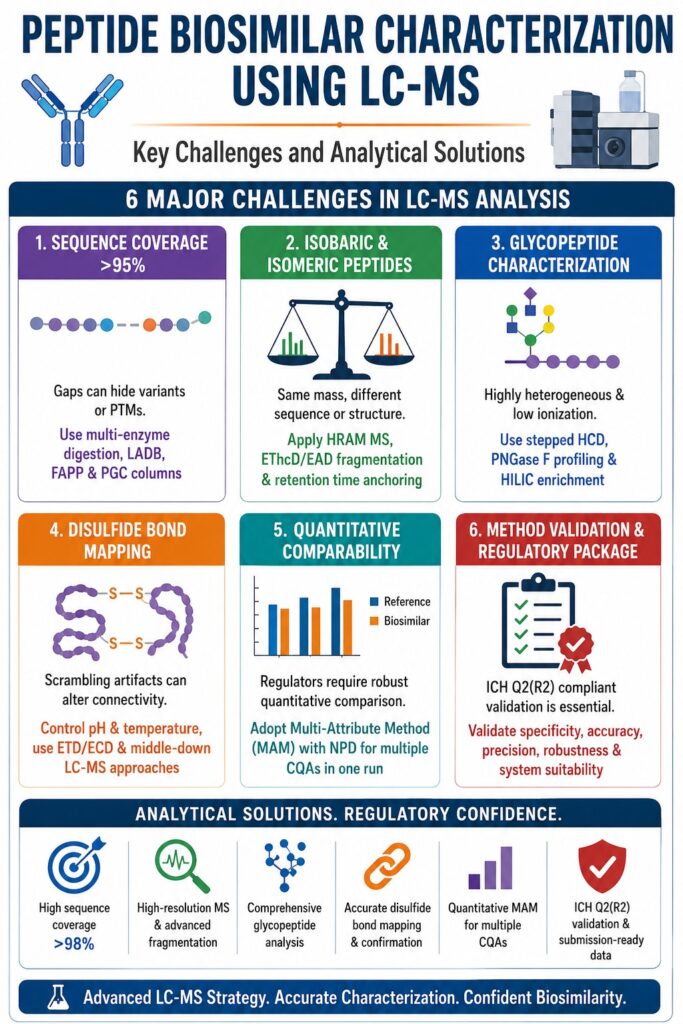
Traditional single-enzyme tryptic digestion often fails to deliver the greater than 95% sequence coverage typically expected in regulatory submissions. At the same time, prolonged digestion conditions can unintentionally introduce artificial deamidation and oxidation.
Why Sequence Coverage Gaps Cannot Be Ignored
Incomplete sequence coverage is not simply a technical limitation. Missing regions within peptide maps may conceal sequence variants, unidentified PTMs, or structural differences between the biosimilar and the reference product. ICH Q6B specifically requires confirmation of the primary amino acid sequence, and regulatory reviewers routinely identify sequence gaps as critical deficiencies.
Primary Causes of Incomplete Sequence Coverage
| Root Cause | Analytical Consequence |
|---|---|
| Highly hydrophobic peptides lost on C18 columns | Missing Fc-region and transmembrane peptides |
| Very short peptides (<5 residues) eluting in void volume | Sequence gaps within cleavage-dense regions |
| Missed cleavages caused by incomplete digestion | Increased spectral complexity and lower identification confidence |
| Artifactual deamidation at Asn residues during digestion | Artificial inflation of endogenous deamidation measurements |
| Methionine oxidation caused by trace metals in digestion buffers | False-positive oxidation signals during CQA evaluation |
Analytical Solutions
Multi-Enzyme Digestion Strategies
Combining trypsin with orthogonal enzymes such as Lys-C, Glu-C, or chymotrypsin generates complementary peptide populations that collectively improve sequence coverage. This strategy is especially useful for Pro-rich regions where trypsin cleavage efficiency is limited.
Low-Artifact Digestion Buffer (LADB)
Specially formulated digestion buffers designed to minimize Asn deamidation and Met oxidation during sample preparation significantly improve the accuracy of endogenous PTM analysis. Strict control of incubation temperature and digestion duration further reduces artifact formation.
Filter-Assisted Protein Precipitation (FAPP)
A 2023 publication in the Journal of Pharmaceutical and Biomedical Analysis demonstrated that FAPP-based sample preparation minimizes interference from extraction reagents responsible for semi-cleavages and artificial modifications. This approach improves digestion efficiency while enhancing analytical reproducibility.
Improved Retention of Short Peptides
Integrating a porous graphitic carbon (PGC) trap column with reversed-phase C18 chromatography enables simultaneous retention of both highly hydrophilic and hydrophobic peptides within a single analytical run. This significantly improves sequence coverage in regions that are traditionally difficult to analyze.
For a breakdown of advanced enzyme strategies and digestion protocols, read about Peptide Mapping in Biosimilars.
Challenge 2: Resolving Isobaric and Isomeric Peptides
Isobaric peptides possess identical or nearly identical masses while differing in sequence or structure. These peptides cannot be distinguished using MS1 measurements alone and therefore require advanced MS/MS fragmentation approaches.
This challenge is particularly important in peptide biosimilar characterization because single amino acid substitutions or sequence variants frequently generate isobaric peptide pairs. For example, an Asp→Asn substitution at a non-glycosylated site may produce a peptide indistinguishable in mass from the reference product, creating a significant regulatory concern if not properly resolved.
Common Isobaric Pairs in Peptide Biosimilar Mapping
| Modification Pair | Mass Difference (Da) | Analytical Difficulty |
|---|---|---|
| Deamidation (Asn→Asp/isoAsp) | +0.984 | High; requires high-resolution MS |
| Asp→Asn sequence variant | +0.984 | Critical; may represent a true sequence difference |
| Methionine oxidation | +15.995 | Moderate; generally resolved chromatographically |
| Leu/Ile isomers | 0 | High; requires EThcD or EAD fragmentation |
| Asn/Gln isobaric pair | 0 | High; requires detailed MS/MS ion series |
Analytical Solutions
High-Resolution Accurate Mass (HRAM) Platforms
Orbitrap-based instruments such as the Orbitrap Fusion Lumos, along with modern Q-TOF systems, routinely provide sub-5 ppm mass accuracy. This enables reliable differentiation between deamidation events and true sequence variants in most analytical scenarios.
Electron-Activated Dissociation (EAD) and EThcD Fragmentation
Advanced fragmentation techniques such as EAD and EThcD preserve labile PTMs while generating c/z ion series that outperform traditional collision-induced dissociation (CID) for distinguishing isomeric amino acids such as Leu/Ile and Asp/isoAsp. The SCIEX Zeno TOF platform equipped with EAD has shown particularly strong performance in PTM characterization and isomer differentiation.
Retention Time Anchoring
Under carefully controlled chromatographic conditions with validated system suitability criteria, deamidated peptides typically exhibit predictable retention time shifts relative to their native counterparts. These shifts, often ranging from approximately 0.5 to 2 minutes, provide an important orthogonal confirmation strategy.
Data-Independent Acquisition (DIA/MSE)
Waters MSE technology acquires fragmentation information for all co-eluting peptides simultaneously, enabling retrospective identification of isobaric species without precursor selection. This capability is particularly valuable in comparability studies where unexpected variants must not remain undetected.
Learn how to effectively manage and identify charge and structural variants by reading about Charge Variant Analysis in Biosimilars: Mass Spectrometry Approaches for Heterogeneity.
Challenge 3: Glycopeptide Characterization in Peptide Biosimilar LC-MS Workflows
N-linked and O-linked glycosylation represent some of the most critical quality attributes (CQAs) in peptide biosimilars. However, glycopeptides are also among the most analytically difficult components of any tryptic digest because of their extensive heterogeneity, weak ionization efficiency, and tendency to co-elute with non-glycosylated peptides.
Why Glycopeptides Are So Difficult to Characterize
In IgG-based biosimilars, Fc glycosylation at Asn-297 directly influences effector functions such as antibody-dependent cellular cytotoxicity (ADCC), complement-dependent cytotoxicity (CDC), and serum half-life. Even subtle variations in glycoform distribution between a biosimilar and its reference product may result in clinically meaningful functional differences.
At each glycosylation site, dozens of glycoforms with distinct masses may coexist, generating highly complex spectra that are difficult for standard database-searching algorithms to interpret accurately.
Major Glycopeptide Analytical Challenges
- Suppression of glycopeptide ionization by abundant non-glycosylated peptides during electrospray ionization (ESI)
- Poor glycan fragmentation under standard CID conditions
- Isomeric glycan structures sharing identical masses but differing in linkage architecture
- Reduced sequence coverage at glycosylated regions on conventional C18 columns
Analytical Solutions
Stepped Collision Energy HCD/CID
Applying alternating low- and high-energy collision conditions within the same MS/MS acquisition enables simultaneous generation of peptide backbone fragments and glycan oxonium ions, such as the HexNAc marker ion at m/z 204.087. This supports integrated peptide and glycan characterization.
PNGase F Treatment for N-Glycan Profiling
Enzymatic release of N-linked glycans using PNGase F, followed by fluorescent labeling with 2-AB or procainamide and subsequent RP-LC-MS/MS or HILIC analysis, provides detailed glycoform distribution profiles that can be statistically compared across biosimilar and reference product batches.
Intact Glycopeptide Analysis Using Orbitrap LC-MS
Direct analysis of intact glycopeptides at the glycosite level confirms both glycosylation site occupancy and the relative abundance of individual glycoforms. These measurements are essential for demonstrating compliance with ICH Q6B requirements.
HILIC Enrichment Prior to LC-MS
Hydrophilic Interaction Liquid Chromatography (HILIC) enrichment selectively isolates glycopeptides from complex tryptic digests before LC-MS analysis. This significantly reduces ion suppression and can improve sensitivity for low-abundance glycoforms by more than tenfold.
To explore tailored strategies for resolving complex sugar linkages and site occupancy, read our article on Glycosylation Analysis of Biosimilars.
Challenge 4: Disulfide Bond Mapping and Scrambling Artifacts
Proper disulfide bond connectivity is essential for the biological function of most peptide biosimilars. However, non-reducing peptide mapping, the standard LC-MS technique used for disulfide characterization, is highly susceptible to artificial disulfide scrambling during sample preparation.
Why Disulfide Bond Integrity Is Critical
ICH Q6B specifically requires characterization of disulfide bonds and free cysteine residues in biopharmaceutical products. Incorrect disulfide pairing can alter protein conformation, reduce biological activity, and increase immunogenicity risk, making this a highly scrutinized CQA during biosimilar comparability assessments.
Major LC-MS Challenges in Disulfide Bond Analysis
- Thiol-disulfide exchange readily occurs at alkaline pH and elevated temperatures
- Large disulfide-linked peptides produce charge-heterogeneous ions that fragment poorly using CID
- Partial reduction creates mixed reduced and non-reduced species that complicate interpretation
- Interchain disulfide peptides in monoclonal antibodies often exceed conventional instrument scan ranges
Analytical Solutions
Acidic Quenching During Non-Reducing Digestion
Maintaining digestion and sample handling conditions at pH 6.0–6.5 and temperatures ≤25°C significantly reduces thiol-disulfide exchange, minimizing artifactual scrambling. This approach is increasingly regarded as best practice for non-reduced peptide mapping.
Simplified Non-Reduced Peptide Mapping
A 2024 study by Gu et al. from Incyte’s Biologics Analytical Science group, published in the Journal of Pharmaceutical and Biomedical Analysis, demonstrated that faster enzymatic digestion under carefully controlled pH conditions generates cleaner non-reduced peptide maps with substantially fewer scrambling artifacts than traditional overnight digestion protocols.
ETD/ECD Fragmentation for Disulfide-Linked Peptides
Electron Transfer Dissociation (ETD) selectively cleaves peptide backbone bonds while preserving disulfide linkages, producing c/z ion series that directly confirm inter-peptide connectivity. This fragmentation approach is preferred for large disulfide-linked peptides.
Middle-Down LC-MS Approaches
Partial digestion using IdeS, the immunoglobulin-degrading enzyme derived from Streptococcus pyogenes, produces approximately 10–15 kDa subunit fragments while preserving disulfide-linked domains. This allows confirmation of intact disulfide architecture before detailed peptide-level mapping.
For advanced insights into resolving PTMs and spatial structural variations, read about Post-Translational Modifications (PTMs) in Biosimilars.
Challenge 5: Quantitative Comparability — Transitioning from Qualitative Data to Statistically Defensible Results
Regulatory agencies no longer accept qualitative peptide maps as sufficient evidence of biosimilarity. FDA biosimilar guidance and EMA quality expectations require quantitative comparison of modification levels across biosimilar and reference product batches, supported by rigorous statistical analysis.
Many biosimilar characterization programs generate high-quality identification data but fail to establish the quantitative framework necessary to defend CQA comparability during regulatory review.
The Multi-Attribute Method (MAM): The Modern Gold Standard
The Multi-Attribute Method (MAM), powered by high-resolution mass spectrometry, has emerged as the preferred platform for simultaneous quantitative assessment of multiple CQAs within a single LC-MS analysis.
Core Phases of the MAM Workflow
Discovery and Characterization Phase
Comprehensive LC-MS/MS analysis is performed to identify all peptides, PTMs, and sequence variants present. Accurate mass measurements and retention times are compiled into a targeted analytical workbook.
Monitoring Phase
Defined CQAs are quantitatively monitored using targeted retention time and mass information with predefined acceptance criteria for each attribute.
New Peak Detection (NPD)
Automated comparative analysis identifies any new peak present in the biosimilar but absent from the reference product. This serves as an integrated purity assessment mechanism.
Advantages of MAM in Peptide Biosimilar Characterization Using LC-MS
| Attribute | Traditional Peptide Mapping | MAM |
|---|---|---|
| Number of CQAs monitored per run | 1–3 targeted attributes | 10–20 or more simultaneously |
| Quantitative capability | Semi-quantitative UV analysis | Fully quantitative MS-based analysis |
| Detection of novel variants | Requires separate assays | Integrated NPD functionality |
| Data handling | Manual interpretation | Automated informatics workflows |
| Regulatory alignment | ICH Q6B compliant | ICH Q6B and QbD aligned |
| Regulatory acceptance | FDA/EMA accepted | FDA/EMA increasingly preferred |
The MAM framework strongly aligns with FDA Quality by Design (QbD) principles. It has also been formally discussed within EMA Biologics Working Party forums, while the EFPIA MAM Consortium continues to shape expectations for how MAM data should be presented in future BLA and MAA submissions.
To see how these quantitative strategies fit into broader equivalence paradigms, explore our guide on Biosimilar Comparability Studies.
Challenge 6: Method Validation and Regulatory Data Package Development
Even the most sophisticated LC-MS methodology provides little regulatory value without appropriate validation under ICH Q2(R2). Building a compliant analytical package from LC-MS characterization data requires strategic planning from the earliest stages of method development.
ICH Q2(R2) Validation Parameters for LC-MS Peptide Mapping
| Validation Parameter | Considerations Specific to LC-MS Peptide Mapping |
|---|---|
| Specificity | Demonstrate separation of isobaric PTMs and confirm identities through MS/MS |
| Accuracy | Use isotopically labeled peptide standards for quantitative PTM analysis |
| Precision | Perform at least six independent digestions; typical %CV targets for CQAs are <15% |
| Intermediate Precision | Evaluate variability across analysts, instruments, and analytical days |
| Range and Linearity | Perform spiking studies with defined PTM standards |
| Robustness | Assess deliberate variation in pH, enzyme ratio, incubation time, and column lots |
| System Suitability | Use isotopically labeled peptide standards to monitor retention time and peak quality |
Regulatory Expectations as of 2025
FDA
The FDA supports a fingerprint-like analytical approach involving comparison of multiple biosimilar and reference product batches. Statistical equivalence testing is expected for Tier 1 CQAs, and HRAM platforms such as Orbitrap and Q-TOF systems are preferred.
EMA
The EMA strongly endorses advanced HRAM LC-MS/MS methodologies and increasingly expects side-by-side comparability data from at least three reference product batches. MAM-generated datasets are becoming progressively more important in submissions.
Health Canada
Health Canada follows the ICH Q6B framework and accepts LC-MS/MS as primary structural evidence in peptide biosimilar comparability programs.
Review our foundational framework on identifying and safeguarding your molecule’s core properties by reading about Critical Quality Attributes (CQAs) in Biosimilars.
The ResolveMass Laboratories Approach to Peptide Biosimilar Characterization
At ResolveMass Laboratories Inc., analytical scientists operate at the intersection of advanced LC-MS science and evolving regulatory expectations. Characterization workflows are specifically designed to address every major analytical challenge discussed throughout this article.
Key capabilities include:
- Comprehensive peptide mapping using multi-enzyme workflows involving trypsin, Lys-C, and Glu-C, with sequence coverage targets exceeding 98%
- Quantitative MAM platforms capable of monitoring more than 15 CQAs simultaneously while incorporating NPD-based purity analysis
- Glycopeptide characterization through intact glycopeptide analysis and released N-glycan profiling using RP-LC-MS and HILIC-LC-FLR/MS
- Disulfide bond mapping performed under rigorously controlled non-reducing conditions combined with ETD fragmentation for complex linkage analysis
- Full ICH Q2(R2)-compliant validation packages aligned with FDA, EMA, and Health Canada expectations
Every characterization program is further supported by regulatory affairs expertise to ensure that generated data is not only scientifically rigorous but also submission-ready.
Secure definitive verification for your upcoming submission package. Discover how to Prove Biosimilarity Using LC-MS with ResolveMass.
Conclusion: LC-MS Is Only as Effective as the Strategy Supporting It
Peptide biosimilar characterization using LC-MS cannot be reduced to performing a standard tryptic digest on a high-resolution instrument. The major analytical challenges involved, including sequence coverage limitations, artifact formation, isobaric peptide resolution, glycopeptide heterogeneity, disulfide scrambling, and quantitative comparability, all require carefully selected methodological solutions.
The most effective biosimilar characterization programs approach peptide biosimilar characterization using LC-MS as a fully integrated analytical strategy. This includes selecting the optimal digestion protocol, instrument platform, fragmentation method, acquisition strategy, and validation framework while maintaining alignment with the regulatory expectations of the intended submission market.
As biosimilar development pipelines continue to expand and regulatory scrutiny becomes increasingly rigorous, the distinction between laboratories that merely perform LC-MS analyses and those that execute LC-MS as a true regulatory science discipline will continue to grow. The methodologies and analytical approaches outlined in this article represent the current benchmark for best practice.
Ready to Develop a Characterization Strategy That Withstands Regulatory Review?
Contact ResolveMass Laboratories Inc..
Frequently Asked Questions (FAQs)
For peptide biosimilar characterization, regulatory authorities expect extremely high confidence in primary amino acid sequence confirmation. Most analytical programs aim for at least 95% sequence coverage, although advanced high-resolution LC-MS workflows commonly achieve coverage above 98%. Multi-enzyme digestion approaches, combined with optimized chromatographic separation, are often necessary to reach these targets. Any remaining sequence gaps must be scientifically justified and supported with additional orthogonal analytical evidence whenever possible.
Artifact deamidation develops during sample preparation when proteins are exposed to alkaline pH, elevated temperatures, or extended digestion periods. This artificial modification creates the same +0.984 Da mass shift observed in naturally occurring in vivo deamidation, making differentiation challenging. However, artifact-related deamidation usually appears across multiple susceptible Asn sites and increases with longer incubation times. Genuine in vivo deamidation tends to occur consistently at specific sites and remains relatively stable across manufacturing batches. Careful control of digestion conditions and the use of Low-Artifact Digestion Buffers are essential for minimizing false-positive results.
In most biosimilar characterization programs, relying on trypsin alone is not considered sufficient for complete structural analysis. Certain peptide regions, especially Pro-rich sequences or highly hydrophilic fragments, are not efficiently covered by standard tryptic digestion. Regulatory agencies such as the FDA and EMA encourage the use of complementary enzymatic strategies to improve sequence confirmation and PTM assessment. Combining trypsin with additional enzymes like Lys-C or Glu-C significantly enhances peptide coverage and improves detection of critical quality attributes across the entire molecule.
The Multi-Attribute Method (MAM) is an advanced LC-MS/MS workflow designed to simultaneously monitor and quantify multiple critical quality attributes in a single analytical run. It enables direct measurement of modifications such as oxidation, deamidation, glycosylation, sequence variants, and terminal processing events. Unlike traditional peptide mapping methods that mainly provide qualitative chromatographic profiles, MAM delivers highly accurate mass-based quantification along with automated New Peak Detection capabilities. Because of its strong alignment with Quality by Design principles, MAM is increasingly recognized by regulatory agencies as a preferred analytical platform for biosimilar comparability studies.
Preventing disulfide bond scrambling requires careful control of all sample preparation conditions during non-reduced peptide mapping workflows. Maintaining an acidic pH range, limiting sample exposure to elevated temperatures, and avoiding alkaline denaturation conditions significantly reduce thiol-disulfide exchange reactions. Rapid digestion protocols using concentrated enzyme ratios also help minimize artificial bond rearrangement. In addition, immediate acid quenching and proper low-temperature storage conditions are essential for preserving native disulfide connectivity. Confirmation using ETD or ECD fragmentation techniques further strengthens confidence in final disulfide bond assignments.
N-glycan analysis typically begins with enzymatic release of glycans from the protein backbone using PNGase F. The released glycans are then fluorescently labeled, commonly with 2-AB or procainamide, before undergoing LC-MS/MS analysis using HILIC or reversed-phase chromatography. The resulting data allows quantitative comparison of individual glycoforms, including high-mannose, afucosylated, and sialylated species, across multiple biosimilar and reference product batches. Any statistically significant variation in glycan distribution may indicate potential differences in biological function and often requires additional functional assessment.
Both Orbitrap and Q-TOF systems are widely accepted by major regulatory agencies for peptide biosimilar characterization using high-resolution accurate mass analysis. Orbitrap instruments are known for exceptional resolving power and strong performance in complex intact protein studies, while Q-TOF platforms offer rapid acquisition speeds and excellent sensitivity for high-throughput peptide mapping workflows. Q-TOF systems are particularly effective in MAM applications involving automated New Peak Detection. The final platform selection generally depends on study objectives, sample complexity, throughput requirements, and the specific analytical expectations of the intended regulatory submission.
Regulatory agencies typically apply a tiered statistical framework when evaluating comparability between biosimilar and reference product critical quality attributes. Tier 1 CQAs, which are closely associated with clinical performance, usually require formal equivalence testing using predefined statistical acceptance ranges. Tier 2 attributes are assessed through quality range analysis, while Tier 3 attributes rely primarily on descriptive statistical evaluation. For LC-MS-based measurements, equivalence criteria are generally established using variability observed within reference product batches. This structured approach helps ensure that observed differences remain within scientifically acceptable limits.
Reference:
- Liu, Y., Xie, J., Li, Z., Mei, X., Cao, D., Li, S., Engle, L., Liu, S., Ebbers, H. C., & Liu, C. (2025). Comparative structure activity relationship characterization of the biosimilar BAT1806/BIIB800 to reference tocilizumab. BioDrugs, 39(2), 307–320. https://doi.org/10.1007/s40259-024-00698-7
- U.S. Food and Drug Administration. (2015). Scientific Considerations in Demonstrating Biosimilarity to a Reference Product: Guidance for Industry. https://www.fda.gov/media/82647/download
- European Medicines Agency. (2014). Guideline on Similar Biological Medicinal Products Containing Biotechnology-Derived Proteins as Active Substance: Non-Clinical and Clinical Issues. EMA/CHMP/BMWP/42832/2005 Rev1.
- International Council for Harmonisation of Technical Requirements for Pharmaceuticals for Human Use. (1999). ICH Q6B: Specifications: Test procedures and acceptance criteria for biotechnological/biological products. https://database.ich.org/sites/default/files/Q6B%20Guideline.pdf
Get In Touch With Us
About The Author


