


Introduction:
Choosing between analytical platforms is an important decision in biologic drug development because the assay ultimately determines what is being measured in a biological matrix and how confidently the resulting data can support pharmacokinetic (PK), pharmacodynamic (PD), toxicokinetic, or regulatory decisions. In the Ligand Binding Assay vs LC-MS/MS for Biologics discussion, neither technology is inherently better for every biologic; the right choice depends on the analytical question and the characteristics of the drug molecule.
Biologic therapeutics — including monoclonal antibodies, recombinant proteins, fusion proteins, enzymes, and other therapeutic proteins — can present analytical challenges that differ substantially from those of small molecules. Their larger size, structural complexity, susceptibility to degradation, endogenous counterparts, and potential for molecular modifications can all influence assay performance.
ICH M10 provides recommendations for bioanalytical method validation and study sample analysis and specifically covers quantitative analysis using ligand-binding assays and chromatographic methods such as LC or GC, typically coupled with MS detection.
For a CRO supporting biologic development, method selection should therefore begin with a scientific assessment of what the sponsor needs to measure, followed by evaluation of sensitivity, selectivity, specificity, precision, accuracy, stability, matrix effects, sample volume, throughput, and regulatory expectations. This is true whether the program is a conventional monoclonal antibody, a next-generation modality such as an AAV gene therapy candidate, or a biosimilar preparing for comparability testing.
Summary:
- Ligand binding assays (LBAs) are often preferred when a biologic can be measured with a highly specific binding reagent — an antibody, receptor, or ligand — and very high sensitivity is required.
- LC-MS/MS is particularly useful when the objective is highly specific molecular quantification, structural characterization, metabolite assessment, or measurement of analytes that may not have a suitable binding reagent.
- The choice in Ligand Binding Assay vs LC-MS/MS for Biologics depends on the biologic’s structure, required sensitivity, selectivity, matrix, pharmacokinetic objectives, available reagents, and regulatory requirements.
- LBAs can be highly sensitive and scalable for large clinical sample sets, while LC-MS/MS can provide strong molecular specificity and information about the measured species.
- For some biologics, a hybrid strategy using both LBA and LC-MS/MS provides a more complete understanding of exposure, molecular identity, and drug-related species.
- ICH M10 specifically addresses validation of both ligand-binding assays and chromatographic methods, including LC methods coupled with mass spectrometric detection.
- The most appropriate method should be selected based on the intended purpose of the bioanalytical assay, rather than assuming that one technology is universally superior.
1: What Is the Core Difference Between LBA and LC-MS/MS for Biologics?
A ligand binding assay quantifies a biologic through a specific molecular interaction, whereas LC-MS/MS generally quantifies the analyte based on chromatographic separation and mass-to-charge characteristics. This means LBAs measure binding activity, and LC-MS/MS measures molecular identity.
Ligand Binding Assay
An LBA typically uses a binding reagent such as:
- Monoclonal or polyclonal antibodies
- Receptor proteins
- Antigens
- Ligands
- Other affinity-based reagents
The binding event is converted into a measurable signal, commonly using platforms such as ELISA, electrochemiluminescence (ECL), or other immunoassay technologies.
LC-MS/MS
LC-MS/MS combines liquid chromatographic separation with tandem mass spectrometric detection. Depending on the method design, the biologic may be analyzed intact, after digestion into peptides, or through a targeted surrogate-peptide approach. LC-MS/MS can therefore provide a different level of molecular specificity and may be particularly valuable when the analytical objective extends beyond simple concentration measurement.
That distinction drives almost every downstream decision:
| Attribute | Ligand Binding Assay (ELISA/ECL) | LC-MS/MS |
|---|---|---|
| Detection principle | Antibody-antigen binding | Mass-to-charge ratio of fragments |
| Typical sensitivity | Often excellent for suitable targets (pg/mL to low ng/mL) | Can be excellent with optimized methods (ng/mL to µg/mL; lower with hybrid workflows) |
| Molecular specificity | Dependent on binding reagent — cross-reactivity possible | Generally high with appropriate separation/detection |
| Binding reagent required | Yes | No affinity reagent necessarily required |
| High-throughput testing | Excellent | Moderate to high depending on workflow |
| Structural information | Limited | Stronger potential |
| Metabolite/fragment investigation | Limited | Stronger potential |
| Large clinical sample sets | Very suitable | Suitable with optimized automation |
| Reagent dependence | High | Lower |
| Development timeline | Faster if antibodies exist | Longer (method + digestion optimization) |
| Key limitation | Cross-reactivity and reagent dependence | Sample preparation, matrix effects, sensitivity challenges |
2: Ligand Binding Assay vs LC-MS/MS for Biologics: Which One Is More Sensitive?
There is no universal winner on sensitivity. LBAs can achieve extremely low detection and quantification levels for suitable targets, while modern LC-MS/MS platforms can also provide highly sensitive quantification when sample preparation, chromatography, ionization, and detection are appropriately optimized. Sensitivity should therefore be evaluated in the context of the required lower limit of quantification (LLOQ) and expected concentration range in study samples.
An LBA may be advantageous when:
- The biologic is present at very low concentrations.
- A high-affinity antibody or receptor reagent is available.
- Large numbers of samples must be analyzed.
- The assay needs to support routine PK analysis, including Phase I first-in-human studies where sample sensitivity requirements are often tightest.
LC-MS/MS may be advantageous when:
- Molecular specificity is a major concern.
- A suitable affinity reagent is unavailable.
- The sponsor needs information about specific molecular species.
- A peptide-based quantification strategy is appropriate.
ICH M10 emphasizes that method development should consider factors such as the analyte’s physicochemical properties, protein binding, matrix, calibration standards, selectivity, specificity, sensitivity, accuracy, precision, recovery, stability, and minimum required dilution.
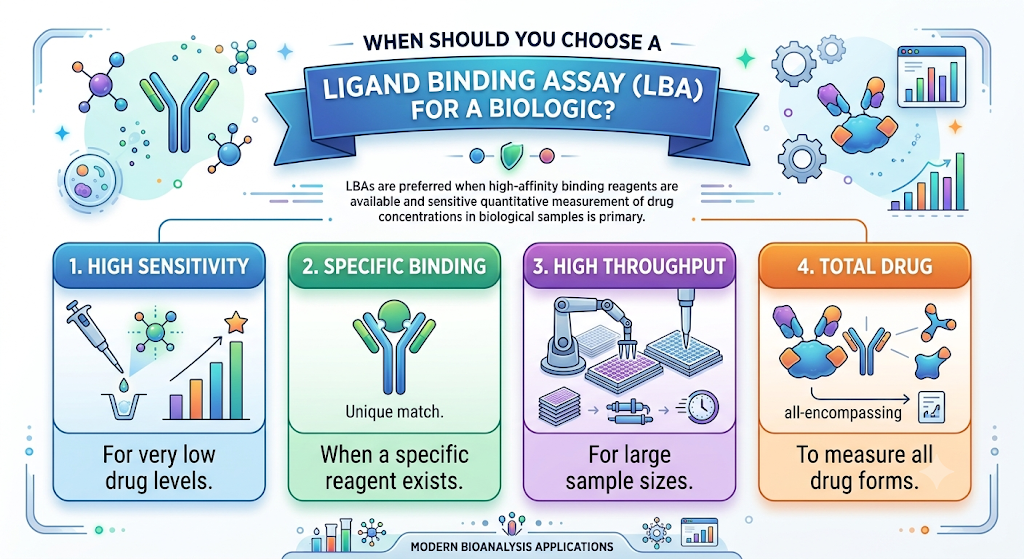
3: When Should You Choose a Ligand Binding Assay for a Biologic?
A ligand binding assay is often the preferred choice when the biologic has a suitable high-affinity binding reagent and the primary objective is sensitive quantitative measurement of drug concentrations in biological samples.
1. When Very High Sensitivity Is Required
Many biologics circulate at concentrations that can become extremely low during the terminal phase of a PK study. A well-designed LBA can provide the sensitivity necessary to quantify these concentrations. This can be particularly useful for therapeutic proteins with long half-lives where samples may need to be monitored over extended periods.
2. When a Highly Specific Binding Reagent Is Available
An antibody or receptor with appropriate affinity and specificity can provide an effective route to quantification. However, reagent quality is critical — the binding reagent itself becomes a key component of assay performance and must be characterized and controlled appropriately, consistent with the selectivity and specificity expectations built into bioanalytical method validation.
3. When High Sample Throughput Is Needed
Clinical programs can generate thousands of plasma or serum samples. LBAs can be adapted to automated microplate workflows, making them attractive for high-throughput analysis and reducing operational complexity when the same validated assay is applied across large sample sets.
4. When the Goal Is Total Drug Concentration
If the analytical question is primarily “how much drug-related material is present in the sample,” an LBA may be highly suitable, provided the assay’s binding characteristics and specificity support the intended interpretation. The exact meaning of “total drug” should nevertheless be carefully defined, because binding assays may detect molecular forms that retain the relevant epitope even when other parts of the molecule have changed.
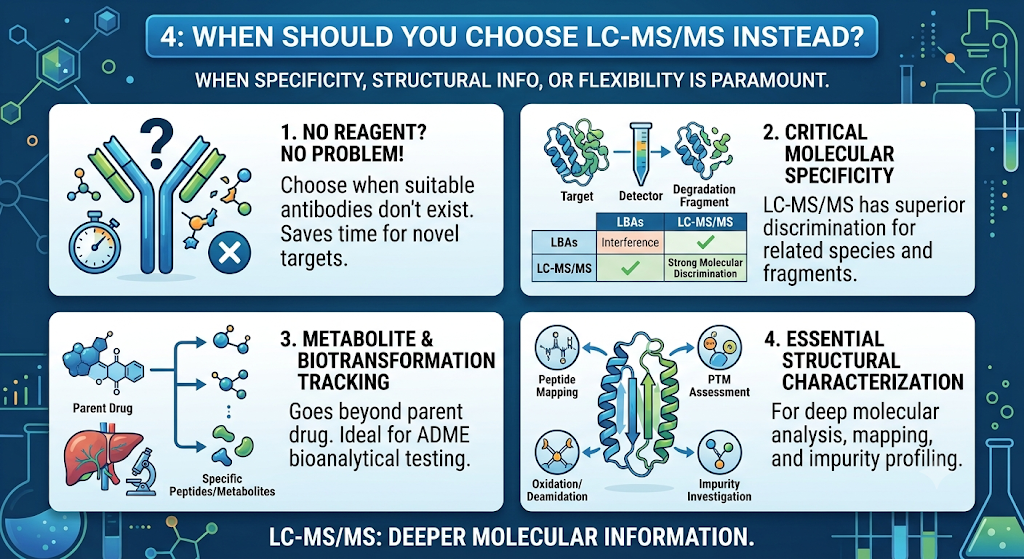
4: When Should You Choose LC-MS/MS Instead?
LC-MS/MS becomes particularly attractive when molecular specificity, structural information, or measurement flexibility is more important than simply achieving the highest possible immunoassay sensitivity, because antibody-based binding cannot always reliably distinguish closely related molecular species.
1. When No Suitable Binding Reagent Exists
Developing a highly specific antibody or receptor reagent can require considerable time and optimization. LC-MS/MS may provide an alternative when an appropriate ligand or antibody is unavailable — a common scenario for novel fusion proteins, next-generation peptides, or newly engineered scaffolds.
2. When Molecular Specificity Is Critical
An LBA measures a binding interaction, so different molecular species may potentially produce a response if they retain the relevant binding epitope. LC-MS/MS can provide stronger molecular discrimination through chromatographic separation and mass spectrometric detection, which can be important when degradation products, fragments, modified species, or related proteins may interfere with interpretation.
3. When Metabolites or Biotransformation Products Matter
LC-MS/MS can be particularly valuable when the research question extends beyond parent-drug concentration. For biologics, the analytical strategy may involve measuring specific peptides or molecular components associated with the therapeutic protein and investigating drug-related species — the kind of question that also arises in broader ADME bioanalytical testing programs.
4. When Structural Characterization Is Required
LC-MS/MS is also widely used as part of broader characterization workflows, including:
- Peptide mapping
- Sequence confirmation
- Post-translational modification assessment
- Oxidation and deamidation monitoring
- Glycopeptide analysis
- Disulfide bond characterization
- Product-related impurity investigations
These applications are different from routine PK quantification, but they illustrate the depth of molecular information that mass spectrometry can provide.
5: Can LBA and LC-MS/MS Be Used Together?
Yes. In many biologic development programs, using both technologies can provide complementary information rather than forcing a choice between them. For example, an LBA may be used for routine PK analysis while LC-MS/MS is used to investigate molecular specificity or confirm drug-related species — an approach that also lends itself well to multiplexed bioanalytical panels when several analytes need to be tracked from a single sample set.
A complementary strategy can be useful when:
- PK requires a highly sensitive assay.
- Molecular characterization is also important.
- Binding reagents may recognize multiple molecular forms.
- There is concern about degradation or fragmentation.
- Orthogonal analytical confirmation is needed.
Using orthogonal techniques can strengthen scientific understanding when each method answers a different analytical question, and this hybrid mindset is increasingly the default for complex modalities such as antibody-drug conjugates (ADCs) and bispecifics.
6: What Regulatory Guidance Says About LBA and LC-MS/MS
ICH M10 is one of the key regulatory references for bioanalytical method validation and study sample analysis. It applies to quantitative bioanalysis using both ligand-binding assays and chromatographic methods such as LC or GC, generally coupled with MS detection. The guideline emphasizes method characteristics including:
- Selectivity
- Specificity
- Accuracy
- Precision
- Sensitivity
- Calibration model
- Stability
- Recovery, where applicable
- Dilution integrity
- Matrix considerations
- Carryover, where applicable
FDA’s final M10 guidance similarly describes recommendations for validation of chromatographic and ligand-binding assays used to measure drugs and active metabolites in nonclinical and clinical studies. This means the regulatory question is not simply whether an LBA or LC-MS/MS method was selected — the critical question is whether the selected method is fit for its intended purpose and appropriately validated.
7: What Validation Challenges Should You Consider?
Both platforms require scientifically justified development and validation, and both benefit from a validation program grounded in bioanalytical method development and validation practices built for CDMO/CRO settings.
LBA Validation Considerations
Important considerations include:
- Selectivity
- Specificity
- Calibration curve performance
- Accuracy and precision
- Sensitivity
- Parallelism, when applicable
- Dilutional linearity
- Critical reagent performance
- Stability
- Drug interference
- Endogenous analyte interference
ICH M10 specifically includes considerations relevant to ligand-binding assays, including assessment of selectivity across appropriate matrix sources and parallelism where applicable.
LC-MS/MS Validation Considerations
LC-MS/MS development may require careful evaluation of:
- Chromatographic selectivity
- Ionization efficiency
- Matrix effects
- Recovery
- Carryover
- Internal standard performance
- Accuracy
- Precision
- Calibration range
- Stability
- Digestion efficiency for peptide-based workflows
- Surrogate peptide selection, when applicable
The method should demonstrate that sample preparation and analytical conditions do not compromise the accuracy of reported concentrations.
8: Can You Move a Validated Method Between Labs?
Yes, but it requires a structured approach. Whether a sponsor is consolidating testing at a single CRO or bringing a legacy assay in-house, transferring a bioanalytical method between CROs requires side-by-side comparability data, matched reference standards, and documented acceptance criteria before the receiving lab can report study samples. This applies equally to LBA and LC-MS/MS platforms, and a well-run bioanalytical method transfer program should preserve the original method’s validated performance rather than simply repeating validation experiments in a new location.
For sponsors evaluating a CRO switch mid-program, it’s worth confirming upfront that the receiving lab offers structured method transfer services covering both platform types, so a change in vendor doesn’t force a change in assay technology.
9: How Does the Choice Affect Biologic Drug Development?
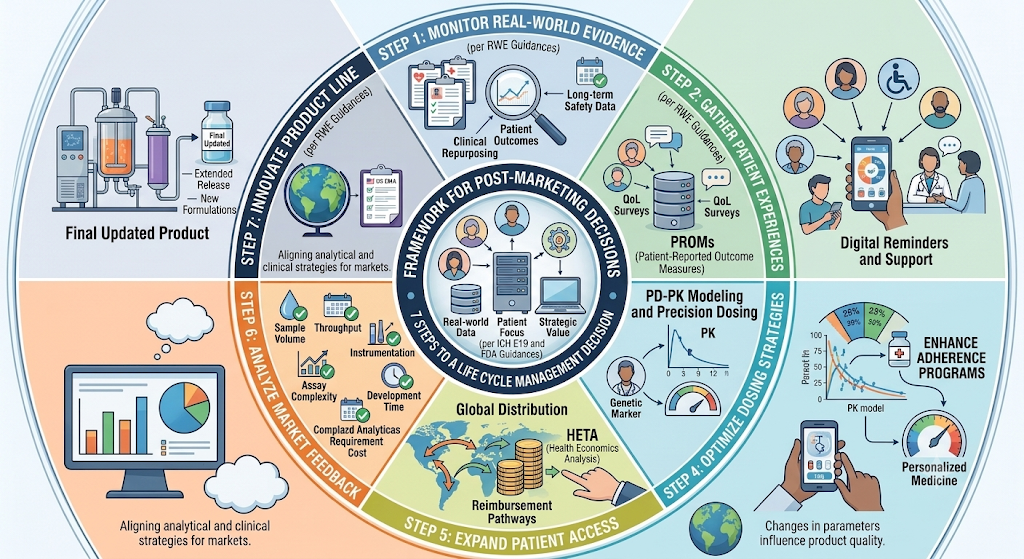
The analytical platform can influence timelines, sample requirements, assay robustness, data interpretation, and ultimately the confidence with which PK or exposure conclusions can be made. A practical decision framework is:
Step 1: Define the analytical question. Determine whether the objective is total drug concentration, active drug concentration, molecular species identification, metabolite assessment, or characterization.
Step 2: Understand the molecule. Review the biologic’s structure, mechanism, endogenous counterpart, expected degradation pathways, half-life, and potential immunogenicity-related considerations.
Step 3: Evaluate the matrix. Assess plasma, serum, or other biological matrices and identify potential endogenous or exogenous interferences.
Step 4: Assess available reagents. For LBA development, determine whether suitable antibodies, receptors, or ligands are available and sufficiently characterized.
Step 5: Establish the required sensitivity. Define the expected concentration range and required LLOQ before selecting the platform.
Step 6: Compare practical requirements. Consider sample volume, throughput, instrumentation, assay complexity, development time, and cost.
Step 7: Develop and validate the selected method. The final method should demonstrate suitability for its intended application and comply with applicable regulatory expectations.
This risk-based approach aligns with the broader scientific principles of modern analytical procedure development. FDA’s Q14 guidance describes science- and risk-based approaches intended to facilitate efficient analytical procedure development and lifecycle management.
10: Why Method Selection Matters for Biosimilars and Therapeutic Proteins
Method selection is especially important for biosimilar programs because analytical strategies must support a comprehensive comparison of the proposed product with the reference product, and often feed directly into bioequivalence study bioanalytical services used to demonstrate comparable exposure.
FDA’s September 2025 final guidance on therapeutic protein biosimilars describes comparative analytical assessment as an important component of biosimilar development and provides recommendations for CMC information supporting a 351(k) application.
In this context, LBA and LC-MS/MS may serve different purposes. A binding assay can be useful for evaluating functional or binding-related characteristics, while mass spectrometry can contribute to detailed molecular characterization. The appropriate analytical package should therefore be based on the product’s critical quality attributes and the specific scientific questions being addressed.
11: How Can a CRO Help Select Between LBA and LC-MS/MS?
An experienced analytical CRO can help sponsors evaluate the molecule, analytical objective, matrix, sensitivity requirements, and regulatory expectations before committing to a platform. For a biologic program, a robust analytical strategy may include:
- Bioanalytical method development
- LBA development and optimization
- LC-MS/MS method development
- Peptide-based quantification
- High-resolution mass spectrometry
- Selectivity and specificity assessment
- Matrix-effect evaluation
- Stability studies
- Method validation
- Study sample analysis
- Regulatory-ready documentation
At ResolveMass Laboratories Inc., analytical method selection can be approached from the perspective of the scientific question first and instrumentation second. This is particularly important for complex biologics where a single analytical technology may not answer every development question.
Conclusion:
The Ligand Binding Assay vs LC-MS/MS for Biologics decision should be driven by the biological question, required sensitivity, molecular specificity, matrix, reagent availability, throughput, and regulatory expectations — not by the assumption that one platform is universally superior. Choose an LBA when sensitive, high-throughput quantification is the primary objective and a suitable binding reagent is available. Choose LC-MS/MS when molecular specificity, drug-related species, metabolites, or structural information is especially important. In complex programs, combining both technologies can provide complementary evidence.
A scientifically justified method-selection strategy followed by appropriate validation is essential for generating reliable bioanalytical data that can support clinical development and regulatory submissions. ICH M10 provides the core framework for validation expectations for both assay types, while current FDA guidance reinforces the importance of fit-for-purpose analytical procedures and scientifically sound validation.
Frequently Asked Questions:
Yes. ICH M10 provides recommendations for bioanalytical method validation and study sample analysis for both ligand-binding assays and chromatographic methods, including LC methods coupled with mass spectrometric detection. Validation should demonstrate that the selected method is fit for its intended purpose.
Important LBA considerations include selectivity, specificity, accuracy, precision, sensitivity, calibration performance, dilutional linearity, stability, critical reagent performance, and potential interference. For biologics, the assay should also be evaluated for its ability to appropriately measure the intended molecular form.
Neither technology is universally better. LC-MS/MS can contribute detailed molecular characterization, including peptide mapping and assessment of certain modifications, while ligand-binding methods can support quantitative or functional assessments. Biosimilar analytical strategies typically require multiple complementary techniques rather than reliance on a single platform.
Biologics can undergo degradation, fragmentation, oxidation, deamidation, aggregation, or other molecular changes. A method that does not adequately distinguish the intended analyte from related species can complicate interpretation of exposure data. Molecular specificity is therefore an important consideration when selecting a bioanalytical platform.
High-throughput clinical programs often favor LBA because microplate-based workflows can efficiently process large numbers of samples. LC-MS/MS can also support substantial throughput with automation and optimized sample preparation, but workflow complexity may be greater. The expected sample volume should therefore be considered during method selection.
Start by defining what needs to be measured and why. Then evaluate the molecule, matrix, expected concentration range, required sensitivity, specificity, available reagents, sample volume, throughput, and regulatory expectations. In some programs, developing both methods may provide the most scientifically informative strategy.
Reference
- Papadimitriou A, Bansal S, Heinrich J, Staack RF. Can LC–MS/MS and ligand-binding assays live in harmony for large-molecule bioanalysis?. Bioanalysis. 2014 Jul 1;6(13):1735-7.https://www.tandfonline.com/doi/full/10.4155/bio.14.144
- Kotapati S, Deshpande M, Jashnani A, Thakkar D, Xu H, Dollinger G. The role of ligand-binding assay and LC–MS in the bioanalysis of complex protein and oligonucleotide therapeutics. Bioanalysis. 2021 Jun 1;13(11):931-54.https://www.tandfonline.com/doi/abs/10.4155/bio-2021-0009
- Bults P, van de Merbel NC, Bischoff R. Quantification of biopharmaceuticals and biomarkers in complex biological matrices: a comparison of liquid chromatography coupled to tandem mass spectrometry and ligand binding assays. Expert review of proteomics. 2015 Jul 4;12(4):355-74.https://www.tandfonline.com/doi/abs/10.1586/14789450.2015.1050384
- Zhang YJ, Olah TV, Zeng J. The integration of ligand binding and LC-MS-based assays into bioanalytical strategies for protein analysis. Bioanalysis. 2014 Jul 1;6(13):1827-41.https://www.tandfonline.com/doi/abs/10.4155/bio.14.128
- Wang Q, Guo L, Blair IA. Comparison Between LC–MS and Ligand‐Binding Assay Approaches for Biomarker Quantification. Targeted Biomarker Quantitation by LC–MS. 2017 Aug 4:65-78.https://onlinelibrary.wiley.com/doi/abs/10.1002/9781119413073.ch5
About the Author


