

Introduction
Selecting Low-Leachables Packaging Materials for critical pharmaceutical and biopharmaceutical systems requires a structured, science-driven assessment of polymer thermodynamics, migration kinetics, and global regulatory requirements. Developing a comprehensive material selection protocol helps ensure that packaging components do not compromise patient safety, reduce formulation efficacy, or interact negatively with active pharmaceutical ingredients throughout the product’s intended shelf life.
To learn more about the specific challenges and best practices in this field, visit Extractables and Leachables in Biopharma.
For high-risk dosage forms, including parenteral products, ophthalmic preparations, and inhalation therapies, the primary container-closure system functions as more than a simple protective barrier. It is considered an integral part of the drug product itself. Maintaining formulation stability and obtaining regulatory approval demand a thorough understanding of the molecular mechanisms that control the migration of chemical species from packaging materials under actual storage and distribution conditions.
The assessment of container-content interactions is founded on the relationship between extractables and leachables. Extractables are chemical compounds that can be intentionally removed from packaging components or raw polymer materials under aggressive laboratory conditions, including elevated temperatures, harsh solvents, and prolonged exposure periods. Leachables represent the subset of extractables that migrate into the drug formulation under normal storage, transportation, and clinical-use conditions. While extractables studies establish a worst-case contamination profile, actual leaching behavior is influenced by factors such as formulation pH, excipient polarity, environmental temperature fluctuations, and polymer degradation resulting from terminal sterilization processes.
Share via:
Article Summary:
- Low-leachables packaging selection requires a scientific evaluation of material chemistry, migration behavior, and regulatory requirements to protect drug quality, efficacy, and patient safety throughout product shelf life.
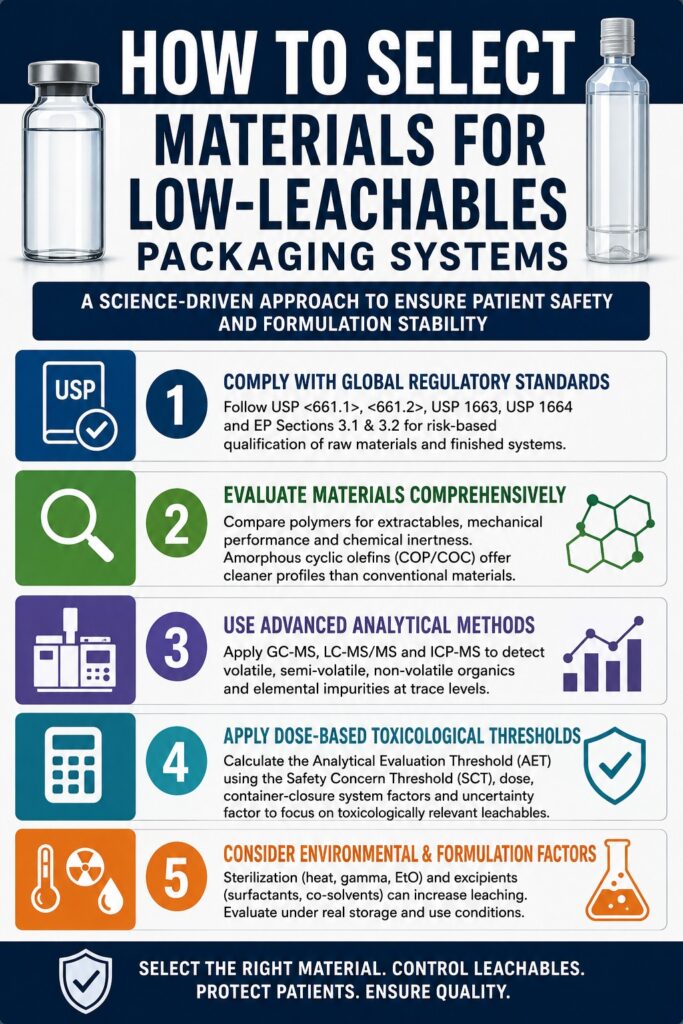
- Pharmaceutical packaging must comply with global standards such as USP <661.1>, USP <661.2>, USP 1663, USP 1664, and European Pharmacopoeia Sections 3.1 and 3.2, which establish requirements for material qualification, extractables testing, and leachables risk assessment.
- Extractables studies identify chemicals that can be released from packaging under aggressive laboratory conditions, while leachables studies determine which compounds actually migrate into drug products during normal storage and use.
- Cyclic olefin polymers (COP) and cyclic olefin copolymers (COC) are increasingly preferred over traditional borosilicate glass because they offer lower extractables, excellent chemical inertness, improved stability, and reliable performance in cryogenic storage applications.
- Conventional polyolefin materials such as polyethylene and polypropylene may contain additives and stabilizers that can degrade over time, producing compounds capable of migrating into pharmaceutical formulations and affecting product quality.
- Comprehensive extractables and leachables characterization relies on advanced analytical techniques, including GC-MS, LC-MS/MS, UPLC-QTOF, and ICP-MS, to detect volatile, non-volatile, and elemental contaminants at extremely low concentrations.
- Sterilization methods, temperature exposure, and formulation excipients can significantly influence leaching behavior, making long-term stability studies, toxicological risk assessments, and Analytical Evaluation Threshold (AET) calculations essential for ensuring regulatory compliance and patient safety.
Regulatory Frameworks for Low-Leachables Packaging Materials
Compliance with international pharmacopoeial standards requires independent qualification of both raw polymer materials and finished container-closure systems. These standards mandate risk-based chemical safety evaluations supported by comprehensive extractables and leachables studies. Packaging manufacturers must navigate an extensive network of regulatory expectations established by the United States Pharmacopeia (USP), the European Pharmacopoeia (EP), and evolving international guidance documents to successfully qualify materials for pharmaceutical applications.
Are you looking for professional support to ensure your testing meets these high standards? Explore the Best CRO for Extractables and Leachables (E&L) Testing in Canada.
Unified Standards in USP Chapters 661.1 and 661.2
USP Chapters <661.1> and <661.2> define separate testing requirements for raw polymer resins and finished pharmaceutical packaging systems, respectively. Under these standards, materials must undergo extensive identification, physicochemical characterization, and biological testing to demonstrate compliance.
Effective December 1, 2025, the legacy chapter was formally retired, eliminating historical grandfathering provisions and requiring all newly developed or modified packaging systems to demonstrate compliance under the updated split-chapter framework.
USP <661.1> focuses on raw polymer resins, including polyethylene, polypropylene, and cyclic olefin materials, prior to conversion into finished packaging articles. Testing under this chapter establishes baseline material identity and purity through methods such as Fourier-transform infrared spectroscopy (FTIR), differential scanning calorimetry (DSC), total organic carbon analysis, and extractable metals testing.
For a deep dive into these specific compliance requirements, read about USP Extractables and Leachables.
In contrast, USP <661.2> addresses completed container-closure systems and evaluates their safety and suitability for the intended pharmaceutical application. Compliance with <661.2> requires a risk-based chemical safety assessment demonstrating that the fully assembled packaging system does not release harmful leachables into the drug product during storage.
Risk Evaluation Protocols Under USP 1663 and USP 1664
USP 1663 and USP 1664 provide official guidance for the design of controlled extraction studies and the assessment of real-world leachable migration. These frameworks help manufacturers establish worst-case extractables profiles while monitoring actual leachables throughout product stability studies.
Under USP 1663, extraction studies are designed using multiple solvents representing a broad polarity range, including polar, intermediate, and non-polar systems, to simulate diverse formulation characteristics. Techniques such as sonication, reflux extraction, and sealed-vessel heating are employed to generate a comprehensive extractables profile.
Understanding the correct chemistry is vital—learn about the Solvents for Extractables Studies.
USP 1664 focuses on finished drug products stored within their final packaging systems under both accelerated and real-time stability conditions. Samples are analyzed at predefined intervals to identify and quantify migrating leachables.
Additionally, analysts must evaluate the possibility that primary leachables may react with formulation ingredients, including proteins or preservatives, resulting in secondary leachables. These reaction products may introduce unforeseen immunogenic responses or chemical degradation pathways.
European Pharmacopoeia Compliance Pathways in Section 3
Sections 3.1 and 3.2 of the European Pharmacopoeia define chemical identification requirements and extraction limits for plastic materials and pharmaceutical containers marketed in Europe. These standards require detailed material characterization to prevent the use of insufficiently understood polymer systems.
EP Section 3.1 applies to raw materials supplied as pellets, sheets, or resin forms and includes dedicated monographs for specific plastics, such as EP 3.1.3 for polyolefins, EP 3.1.5 for polyethylene containing additives, and EP 3.1.6 for polypropylene closures used in parenteral applications.
EP Section 3.2 applies to finished plastic containers and imposes requirements related to chemical compatibility, extractable content, and performance characteristics for materials such as polyethylene and polyvinyl chloride.
Both USP and EP emphasize a risk-based approach to packaging qualification. High-risk dosage forms, including injectable products, aerosols, and ophthalmic formulations, require extensive chemical characterization. In contrast, solid oral dosage forms generally present lower interaction risks and may only require verification of raw material suitability.
| Pharmacopoeial Chapter | Targeted Packaging Stage | Regulatory Objective | Primary Analytical Tests | Required Compliance Date |
|---|---|---|---|---|
| USP <661.1> | Raw polymer resins | Establish baseline material identity, composition, and biocompatibility | FTIR, DSC, TOC, extractable metals, acidity/alkalinity, and in vitro biological reactivity | Mandatory as of December 1, 2025 |
| USP <661.2> | Finished packaging systems | Confirm biological and chemical suitability for the intended formulation | Solution appearance, UV absorbance, TOC, acidity/alkalinity, and risk-based extractables and leachables assessments | Mandatory as of December 1, 2025 |
| USP 1663 | Components and materials | Systematically identify and characterize potential extractables under laboratory stress conditions | Controlled extractions using solvents of varying polarity at elevated temperatures | Applied during product development and qualification |
| USP 1664 | Finished drug formulations | Detect and quantify actual leachables throughout product shelf life | High-sensitivity targeted and non-targeted analysis under stability conditions | Applied throughout stability and registration programs |
| EP Section 3.1 | Raw resins, sheets, and pellets | Standardize chemical requirements for raw materials in Europe | Material identification, extractable acidity/alkalinity, non-volatile residue testing, and polymer-specific monographs | Active requirement for European authorization |
| EP Section 3.2 | Finished plastic containers | Regulate finished plastic packaging systems used for pharmaceutical products | Simulated extraction studies, physical integrity assessments, vapor permeability testing, and mechanical durability evaluations | Active requirement for European authorization |
Material Evaluation of Low-Leachables Packaging Materials
The selection of high-performance Low-Leachables Packaging Materials requires a detailed thermodynamic and mechanical comparison of candidate polymers against conventional packaging materials. Successful selection minimizes both polar and non-polar migrant species while maintaining strong physical barrier performance. Packaging engineers must carefully balance polymer purity, mechanical robustness, and long-term chemical compatibility.
Amorphous Cyclic Olefins as Alternatives to Borosilicate Glass
Cyclic olefin homopolymers (COP) and cyclic olefin copolymers (COC) have emerged as glass-like, high-purity alternatives capable of eliminating common container-closure issues such as delamination and pH drift. Their non-ionic and highly hydrophobic surfaces significantly reduce interactions with sensitive biopharmaceutical formulations.
Are your current packaging solutions causing issues? See why many are switching to E&L Testing for Pre-filled Syringes.
For many years, Type I borosilicate glass was considered the gold standard for primary pharmaceutical packaging. However, glass is not completely inert. During tubing-based vial manufacturing, elevated processing temperatures can introduce thermal stresses within the glass surface, potentially resulting in delamination, a phenomenon characterized by the release of microscopic glass particles into injectable products.
Glass may also release sodium ions (Na⁺) and trace metals such as aluminum and barium. These species can catalyze oxidative reactions, alter formulation pH, and contribute to protein aggregation in sensitive biologic formulations.
COP and COC materials effectively address these limitations. COP is produced through ring-opening metathesis polymerization (ROMP) of cyclic norbornene monomers, followed by complete hydrogenation to generate a transparent, amorphous polymer. COC is synthesized from norbornene and ethylene using metallocene catalyst systems, enabling precise control of the glass transition temperature (Tg) across a range of 65°C to 180°C through adjustment of monomer composition.
Both materials are manufactured without plasticizers, phthalates, or heavy-metal catalysts, resulting in exceptionally low extractables profiles. Furthermore, cyclic olefins maintain excellent container-closure integrity at cryogenic temperatures approaching −180°C.
At these temperatures, traditional elastomeric closures may undergo substantially greater volumetric shrinkage than glass, creating microscopic gaps and increasing sterility risks. Because COP exhibits shrinkage behavior comparable to elastomeric closures, cyclic olefin packaging systems preserve hermetic sealing performance during cryogenic storage and transportation.
Additive Profiles and Degradation Patterns in Polyolefins
Semicrystalline polyolefins, including HDPE, LDPE, LLDPE, and polypropylene (PP), require processing additives that may degrade when exposed to heat, radiation, or light. Identifying these degradation products is essential when qualifying these materials for pharmaceutical applications, particularly for liquid formulations.
Semicrystalline polymers contain both amorphous and crystalline regions. To prevent thermo-oxidative degradation during manufacturing, these materials are compounded with processing aids, slip agents, and antioxidant systems.
During processing and storage, primary phenolic antioxidants such as Irganox 1010 and Irganox 1076, along with secondary organophosphite stabilizers such as Irgafos 168, can degrade into mobile chemical species.
One of the most significant degradation products is 2,4-di-tert-butylphenol (Dtbp), a volatile to semi-volatile compound that readily migrates into aqueous and organic formulations. Another common degradation product is 7,9-di-tert-butyl-1-oxaspiro(4,5)deca-6,9-diene-2,8-dione (DtbO), which originates from Irganox 1076 degradation pathways.
Slip agents such as oleamide and erucamide are incorporated to prevent polymer films from adhering to processing equipment. Because these compounds possess relatively low molecular weights, they diffuse efficiently through polymer matrices and may migrate into pharmaceutical formulations.
Advanced Analytical Protocols for Migrant Characterization
Comprehensive migrant characterization requires multiple orthogonal analytical techniques capable of detecting volatile, semi-volatile, non-volatile, and elemental species. Since extractables and leachables encompass a wide range of molecular weights, polarities, and thermal stabilities, no single analytical method can provide complete characterization.
Chromatographic Screening for Volatiles, Semi-Volatiles, and Non-Volatiles
Comprehensive screening programs typically incorporate headspace GC-MS, solvent-based GC-MS/MS, and UPLC-QTOF methodologies to detect unknown compounds across a broad chemical spectrum.
Volatile organic compounds (VOCs) are commonly analyzed using static headspace gas chromatography coupled with mass spectrometry (HS-GC-MS). Packaging materials are sealed within analytical vials and heated, allowing volatile species to accumulate in the headspace prior to chromatographic analysis.
Semi-volatile organic compounds (SVOCs), including Dtbp, DtbO, phthalate plasticizers such as DEHP and DiBP, and low-molecular-weight slip agents, are typically extracted with solvents such as dichloromethane or isopropanol and analyzed using GC-MS/MS methods.
Non-volatile organic compounds (NVOCs), including intact Irganox 1010, polymer oligomers, and vulcanization additives, are characterized using ultra-performance liquid chromatography coupled with high-resolution electrospray ionization mass spectrometry (UPLC-ESI-QTOF or Orbitrap systems).
For a comparison of the key technologies used in this process, read GC-MS vs. LC-MS in Extractables and Leachables Testing.
These instruments provide mass accuracy better than 2 ppm, enabling determination of molecular formulas and structural elucidation of unknown compounds.
Elemental impurities and heavy metals, including lead, cadmium, mercury, arsenic, and catalyst residues, are quantified at parts-per-trillion levels using Inductively Coupled Plasma Mass Spectrometry (ICP-MS). This technique is critical for demonstrating compliance with USP elemental impurity requirements and ICH Q3D guidelines.
Formulation-Specific Calculation of the Analytical Evaluation Threshold
The Analytical Evaluation Threshold (AET) translates toxicological exposure limits into analytical reporting thresholds based on dosage characteristics and analytical uncertainty. This approach ensures that testing efforts focus on compounds with potential toxicological relevance.
Learn more about the critical importance of establishing the right AET for Extractables and Leachables Studies.
The AET is derived from the Safety Concern Threshold (SCT), defined as the daily exposure level below which a leachable is considered to present negligible mutagenic or non-mutagenic risk.
For different routes of administration:
SCTOINDP = 0.15 µg/day
(Orally Inhaled and Nasal Drug Products)
SCTPODP = 1.5 µg/day
(Parenteral and Ophthalmic Drug Products)
The AET is calculated using:
AET = (SCT / Dosemax) × (DosesCCS / WCCS) × UF
Where:
- AET = Analytical Evaluation Threshold, expressed as µg/g or µg/mL.
- SCT = Safety Concern Threshold (µg/day).
- Dosemax = Maximum daily patient dose.
- DosesCCS = Total labeled doses contained within the container-closure system.
- WCCS = Mass of contacting polymer material or formulation volume.
- UF = Analytical Uncertainty Factor.
For validated targeted methods, UF is typically assigned a value of 1.0. For broad non-targeted GC-MS or LC-MS screening studies, UF values of 0.5 or lower are often applied to compensate for detector response variability and ensure toxicologically relevant compounds are not overlooked.
Physicochemical and Environmental Drivers of Leaching Kinetics
Environmental stress conditions, including sterilization processes and formulation excipients, can significantly influence leaching behavior. Understanding these factors is critical for predicting packaging performance throughout the product lifecycle.
Radiolytic and Thermal Effects of Polymer Sterilization
Sterilization technologies such as gamma irradiation and steam autoclaving can alter polymer structure and increase extractable generation. Selecting the appropriate sterilization strategy is therefore essential.
Steam Autoclaving
Steam sterilization typically operates between 121°C and 124°C under pressurized conditions. Although highly effective, the process subjects polymers to substantial thermal and hydrolytic stress. Lower-temperature plastics may deform, while hydrolysis-sensitive additives may degrade. High-performance materials such as PVDF, PTFE, polysulfones, and cyclic olefins generally demonstrate acceptable compatibility.
Gamma Irradiation
Gamma irradiation, commonly performed at approximately 25 kGy, induces radiolytic degradation through polymer chain scission. This process decreases molecular weight, reduces intrinsic viscosity, and generates reactive alkyl radicals.
These radicals subsequently oxidize into aldehydes, ketones, carboxylic acids, and other low-molecular-weight species that can migrate into pharmaceutical formulations.
R-H (Polymer Chain) → R• + H•
R• + O₂ → ROO• → Chain Scission and Volatile Degradants
Ethylene Oxide (EtO) Sterilization
Ethylene oxide sterilization is widely used for temperature-sensitive products. Unlike irradiation, it generally does not cause chain scission or major crystallinity changes. However, residual EtO may be absorbed into amorphous polymer regions and therefore requires validated aeration procedures to reduce residual concentrations before product use.
Excipient-Induced Swelling and Solvation in Liquid Drug Products
Highly lipophilic excipients, including surfactants and organic co-solvents, can swell polymer matrices and accelerate the migration of embedded additives.
Leaching rates are influenced by contact duration, temperature, and solvent characteristics. Pure aqueous formulations generally exhibit limited extraction of hydrophobic additives. However, many modern pharmaceutical products contain complex excipient systems designed to improve solubility and bioavailability.
Ingredients such as Polysorbate 80, propylene glycol, and benzalkonium chloride can penetrate amorphous polymer regions and disrupt intermolecular interactions between polymer chains.
This solvent swelling effect lowers the local glass transition temperature (Tg), increases polymer chain mobility, and enhances additive diffusion.
Because the diffusion coefficient (D) depends strongly on chain mobility, solvent-induced swelling can substantially increase migration rates for compounds such as Dtbp, palmitic acid, and stearic acid.
Benzalkonium chloride, characterized by a high log P value, has demonstrated particularly strong extraction capabilities, promoting the migration of DtbO, palmitic acid, and stearic acid from HDPE packaging materials.
Diffusion Coefficient (D) = D₀ exp (−Ed / RT)
Log P ∝ Excipient Extracting Power
Solvent Swelling → Lower Local Tg → Increased Chain Mobility → Accelerated Migrant Diffusion
Conclusion
Selecting the most appropriate Low-Leachables Packaging Materials requires a multidisciplinary strategy that integrates raw material characterization, toxicological risk assessment, and long-term stability evaluation. Packaging developers must move beyond historical compliance assumptions and qualify materials according to the modern regulatory expectations established under USP <661.1> and <661.2>.
Amorphous cyclic olefin homopolymers and copolymers offer significantly cleaner extractables profiles and greater chemical inertness than conventional polyolefins or traditional borosilicate glass, making them particularly suitable for sensitive biopharmaceutical products and cryogenic drug-delivery applications.
To ensure regulatory acceptance and patient safety, packaging evaluations must consider the impact of sterilization-induced degradation as well as the extraction potential of formulation excipients. Collaboration with experienced analytical laboratories enables packaging systems to be assessed using validated high-resolution GC-MS, LC-MS/MS, and ICP-MS methodologies aligned with USP 1663 and USP 1664 requirements.
Have questions about your project requirements or budget? Find out about the Cost of Extractables and Leachables Testing.
Applying scientifically justified, dose-based Analytical Evaluation Thresholds allows manufacturers to focus resources on toxicologically meaningful compounds, accelerate development timelines, strengthen regulatory submissions, and ultimately safeguard patient health.
Frequently Asked Questions
Extractables are chemical substances that can be intentionally removed from packaging materials when subjected to aggressive laboratory conditions such as elevated temperatures, strong solvents, or prolonged exposure periods. Leachables, on the other hand, are compounds that actually migrate into the pharmaceutical product during normal storage, transportation, and usage. Extractables studies help identify all possible contaminants, while leachables assessments focus on the substances patients may realistically encounter. Together, they form the foundation of packaging safety evaluations.
The United States Pharmacopeia separated Chapter 661 to establish clearer and more specialized requirements for different stages of packaging evaluation. USP <661.1> focuses on the characterization of raw polymer materials, including their identity, composition, and biological safety. USP <661.2> evaluates finished packaging systems and their interaction with pharmaceutical products. This structured approach improves consistency, reduces uncertainty during testing, and strengthens risk-based assessments for patient protection.
Although both materials are widely used in advanced pharmaceutical packaging, they possess distinct characteristics. COP is produced from a single monomer system and offers exceptional moisture barrier performance, making it suitable for highly sensitive formulations. COC is manufactured using norbornene and ethylene, allowing manufacturers to tailor properties such as the glass transition temperature and processing behavior. As a result, COC is often preferred for complex molded devices, while COP is commonly selected for applications requiring superior barrier protection.
The Safety Concern Threshold serves as a toxicological benchmark used to evaluate the potential risk of individual leachable compounds. It represents the daily exposure level below which a substance is considered unlikely to pose a significant health concern. This value is used when calculating the Analytical Evaluation Threshold (AET), which guides analytical testing requirements. Because patient exposure risks vary by administration route, different SCT values are applied for inhalation, nasal, parenteral, and ophthalmic drug products.
Surfactants can interact with polymer packaging by penetrating and swelling the amorphous regions of the material. This process increases molecular mobility within the polymer structure and reduces resistance to chemical migration. As a result, additives such as antioxidants, processing aids, and slip agents may diffuse more rapidly into the drug formulation. The effect is particularly pronounced in formulations containing highly lipophilic surfactants such as Polysorbate 80.
Delamination occurs when the internal surface of a glass container gradually deteriorates and releases microscopic glass particles into the formulation. This issue is often associated with high-pH solutions or formulations containing complexing agents such as citrate, phosphate, or acetate buffers. Manufacturing processes used to form glass containers can create stressed surface regions that are more vulnerable to chemical attack. Over time, these interactions may weaken the glass surface and lead to particle formation.
Gamma irradiation exposes polymers to high-energy radiation that can break chemical bonds within the polymer backbone. This process, known as chain scission, reduces molecular weight and generates reactive free radicals. These radicals can further react with oxygen, producing a variety of volatile and semi-volatile degradation compounds. Consequently, irradiated materials often exhibit a broader and more complex extractables profile than non-irradiated polymers.
USP <665> establishes standardized testing requirements for plastic materials that come into contact with drug substances and drug products during manufacturing. The chapter addresses components such as single-use bioreactors, tubing systems, filtration devices, and storage bags. Its objective is to ensure that manufacturing materials do not introduce harmful contaminants into the production process. By extending qualification requirements beyond primary packaging, USP <665> supports greater consistency and product quality throughout biopharmaceutical manufacturing operations.
Non-targeted extractables and leachables studies often involve unknown compounds that are not listed in reference databases. High-resolution mass spectrometry provides highly accurate mass measurements and detailed fragmentation information, enabling scientists to determine molecular formulas and investigate chemical structures. Technologies such as Orbitrap and LC-QTOF can achieve mass accuracy within 2 ppm, making them invaluable for identifying unexpected impurities. This level of analytical precision significantly improves confidence in chemical characterization studies.
Reference:
- Basu, A., Haim-Zada, M., & Domb, A. J. (2019). Effect of ethylene oxide and gamma (γ-) sterilization on the properties of a PLCL polymer material in balloon implants. Polymers, 11(12), 1985. https://doi.org/10.3390/polym11121985
- Haim Zada, M., Kumar, A., Elmalak, O., Mechrez, G., & Domb, A. J. (2019). Effect of ethylene oxide and gamma (γ-) sterilization on the properties of a PLCL polymer material in balloon implants. ACS Omega, 4(25), 21319–21326. https://doi.org/10.1021/acsomega.9b02889
- da Cunha, V. M. G., de Medeiros, L. D., Pugliesi, F., de Oliveira, B., & Sussulini, A. (2025). Study of extractables in high-density polyethylene packaging: Evaluation of the impact of excipients propylene glycol, mint flavor, and benzalkonium chloride on the leaching process of semi-volatile additives. Brazilian Journal of Analytical Chemistry. Advance online publication. https://doi.org/10.30744/brjac.2179-3425.AR-51-2025
- United States Pharmacopeia. (n.d.). Extractables and leachables. U.S. Pharmacopeia. https://www.usp.org/impurities/extractables-and-leachables
- Weikart, C. M., Breeland, A. P., Wills, M. S., & Baltazar-Lopez, M. E. (2020). Hybrid blood collection tubes: Combining the best attributes of glass and plastic for safety and shelf life. SLAS Technology, 25(5), 496–504. https://doi.org/10.1177/2472630320936324
- European Medicines Agency. (2005). Guideline on plastic immediate packaging materials (CPMP/QWP/4359/03; EMEA/CVMP/205/04). European Medicines Agency. https://www.ema.europa.eu/en/documents/scientific-guideline/guideline-plastic-immediate-packaging-materials_en.pdf
- Murat, P., Puttaswamy, S. H., Ferret, P.-J., Coslédan, S., & Simon, V. (2020). Identification of potential extractables and leachables in cosmetic plastic packaging by microchambers-thermal extraction and pyrolysis-gas chromatography-mass spectrometry. Molecules, 25(9), 2115. https://doi.org/10.3390/molecules25092115
Get In Touch With Us
About The Author


