

Introduction:
Method validation for extractables and leachables testing is a regulatory non-negotiable — without a fully documented, ICH Q2(R2)-compliant validation package, analytical data generated during E&L studies will not be accepted by the FDA, EMA, or Health Canada. Organizations pursuing U.S. regulatory submissions should also understand the latest Extractables and Leachables (E&L) Requirements for U.S. Market Authorization and the expectations surrounding Extractables and Leachables (E&L) Testing in the United States.
In the pharmaceutical and biopharmaceutical space, leachables from container-closure systems, drug delivery devices, and primary packaging materials can pose direct safety risks to patients. Comprehensive Extractables and Leachables Testing for Container Closure Systems is essential for evaluating packaging materials, while specialized E&L Testing for Pre-Filled Syringes and Extractables and Leachables Testing for Autoinjectors address the unique challenges associated with injectable drug delivery systems.
ICH Q2(R2), the updated guideline on analytical procedure validation finalized in 2022, provides the most authoritative framework for this purpose. It expanded on the original Q2(R1) by incorporating a lifecycle approach to validation and harmonizing language with ICH Q14 (analytical procedure development). For E&L scientists, this translates to a structured obligation to validate specificity, linearity, range, accuracy, precision, LOD, LOQ, and robustness — each with defined acceptance criteria tied to the safety thresholds established under PQRI guidelines and ISO 10993-17.
This article walks through each ICH Q2(R2) validation parameter in the context of E&L testing, identifies method-specific considerations for key platforms such as GC-MS, LC-MS/MS, and ICP-MS, and explains how ResolveMass Laboratories Inc. builds compliant validation packages for submissions across global regulatory jurisdictions.
Summary:
- Method validation for extractables and leachables (E&L) testing must satisfy ICH Q2(R2) criteria — specificity, linearity, accuracy, precision, detection limit, quantitation limit, and robustness — to be accepted by regulators.
- ICH Q2(R2), updated in 2022, introduced risk-based and lifecycle approaches to analytical method validation that are directly applicable to E&L analytical workflows.
- Key analytical techniques used in E&L testing — GC-MS, LC-MS/MS, ICP-MS, and headspace GC — each require individually tailored validation packages.
- The Analytical Evaluation Threshold (AET) and Safety Concern Threshold (SCT) from PQRI/ISO 10993-17 must be factored into method LOQ determination.
- A fully ICH Q2(R2)-compliant E&L validation strategy is essential for drug approval under FDA 21 CFR, EMA guidelines, and ISO 10993 standards.
- These validation principles also complement the evolving ICH Q3E Guideline for Extractables and Leachables, which establishes a harmonized framework for E&L risk assessment and study design.
- ResolveMass Laboratories Inc. offers end-to-end E&L method development and validation services backed by USFDA-registered analytical infrastructure.
1: What ICH Q2(R2) Requires for Analytical Method Validation in E&L Studies
ICH Q2(R2) defines eight core validation characteristics that apply to quantitative impurity testing — all of which are directly relevant to E&L method validation. The updated guideline also introduced the concept of a validation lifecycle: methods should be validated at development, verified during transfer, and monitored throughout routine use.
While ICH Q2(R2) focuses on analytical procedure validation, it should be considered alongside the emerging ICH Q3E Extractables and Leachables Study Requirements, which provide broader guidance on planning and executing scientifically justified E&L studies.
For E&L studies, the following table maps each ICH Q2(R2) parameter to its E&L-specific application:
| ICH Q2(R2) Parameter | Definition | E&L-Specific Application |
|---|---|---|
| Specificity | Ability to assess the analyte in the presence of other components | Distinguish leachables from formulation components, degradants, and matrix interferences |
| Linearity | Proportional response across the concentration range | Demonstrate linearity from LOQ to 150% of AET or highest expected leachable concentration |
| Range | Concentration interval over which linearity applies | Typically LOQ to 150% of the highest target analyte concentration |
| Accuracy | Closeness of measured to true value | Spike-recovery studies at 50%, 100%, and 150% of the target concentration; typically 85–115% |
| Precision (Repeatability) | Variability under same conditions | ≤ 10% RSD at the LOQ level; ≤ 5% RSD at mid-range concentrations |
| Intermediate Precision | Variability across days, analysts, instruments | Intra-lab reproducibility data across at least two analysts and two days |
| LOD | Lowest detectable amount | Must be below the Reporting Threshold (RT); typically signal-to-noise ≥ 3:1 |
| LOQ | Lowest quantifiable amount with acceptable precision/accuracy | Must be at or below the Analytical Evaluation Threshold (AET); S/N ≥ 10:1 |
| Robustness | Resistance to small deliberate method changes | Assess pH variation, flow rate, column lot, extraction time, temperature |
2: Understanding AET and SCT: The Threshold Anchors for E&L Method LOQ
The LOQ for any E&L method must be set at or below the Analytical Evaluation Threshold (AET). The AET is the concentration below which a leachable does not require further toxicological evaluation — it is derived from the Safety Concern Threshold (SCT), which represents the daily intake level below which any leachable is unlikely to pose a carcinogenic risk.
Key threshold values used in E&L studies include:
- SCT (Safety Concern Threshold): 1.5 µg/day (PQRI; applicable to oral inhalation and nasal drug products)
- Qualification Threshold (QT): 5 µg/day for oral products (ICH Q3B framework applied to leachables)
- Reporting Threshold (RT): Varies by route; typically 0.05 µg/day for inhalation products
- AET: Calculated from SCT divided by the maximum daily dose; expressed in µg/mL or µg/container
Risk assessment should also follow the recommendations described in ICH Q3E Extractables & Leachables Risk Assessment, where toxicological thresholds, patient exposure, and analytical sensitivity are integrated into a comprehensive validation strategy.
ICH Q2(R2) does not set the AET — it only requires that the LOQ be scientifically justified and fit-for-purpose. The AET, derived from PQRI or ISO 10993-17, provides that justification anchor. A validated method with an LOQ above the AET will not be accepted in a submission, regardless of how well the other validation parameters are documented.
3: Platform-Specific Validation Considerations for E&L Analytical Methods
Different analytical platforms used in E&L testing carry distinct validation challenges. ICH Q2(R2) requires that the validation be tailored to the intended method and matrix. Here is how the key platforms differ:
GC-MS and Headspace GC-MS
GC-MS is the primary method for identifying and quantifying volatile and semi-volatile organic leachables such as residual solvents, plasticizers, and antioxidant degradation products.
- Specificity: Full scan MS spectral matching (NIST library) combined with retention time confirmation
- Linearity: Typically 5 calibration levels from LOQ to 150% of AET in representative solvent matrix
- Matrix effects: Use matrix-matched calibration or standard addition for complex drug product matrices
- Robustness: Evaluate injection volume, split ratio, inlet temperature, and oven ramp rate
Selecting the appropriate analytical platform is equally important during method development. Understanding the differences between GC-MS vs LC-MS in Extractables and Leachables Testing helps laboratories choose the most suitable technique based on analyte volatility, polarity, and sensitivity requirements.
LC-MS/MS (Liquid Chromatography-Tandem Mass Spectrometry)
LC-MS/MS is preferred for non-volatile, polar, or thermally labile leachables — including UV absorbers, antioxidants, surfactants, and polymer additives.
- Specificity: Multiple Reaction Monitoring (MRM) transitions required; confirm with ≥ 2 MRM transitions per analyte
- Matrix suppression: Mandatory post-column infusion or stable isotope-labeled internal standards for ion suppression assessment
- Carryover: Must be < 20% of LOQ signal between high-concentration and blank injections
- Precision at LOQ: ≤ 20% CV acceptable at the LOQ level per FDA bioanalytical guidelines, though ≤ 15% is preferred in E&L contexts
ICP-MS (Inductively Coupled Plasma Mass Spectrometry)
ICP-MS is the standard platform for elemental leachable analysis, covering all ICH Q3D elemental impurities including the PDE-based permitted daily exposures.
- Specificity: Isobaric interference resolution through collision/reaction cell or high-resolution instruments
- Accuracy: Certified Reference Materials (CRMs) and spiked matrix recovery studies required
- LOQ alignment: LOQ must be ≤ 30% of the J-value (AET for elemental impurities); method LOQ typically < 10% of elemental PDE
- Robustness: Assess plasma power, nebulizer gas flow, spray chamber temperature, and sample uptake rate
For elemental impurity profiling, ICP-MS in Extractables and Leachables Testing provides exceptional sensitivity for detecting trace metals while supporting compliance with ICH Q3D and global regulatory expectations.
4: How ICH Q2(R2)’s Lifecycle Approach Changes E&L Validation Strategy
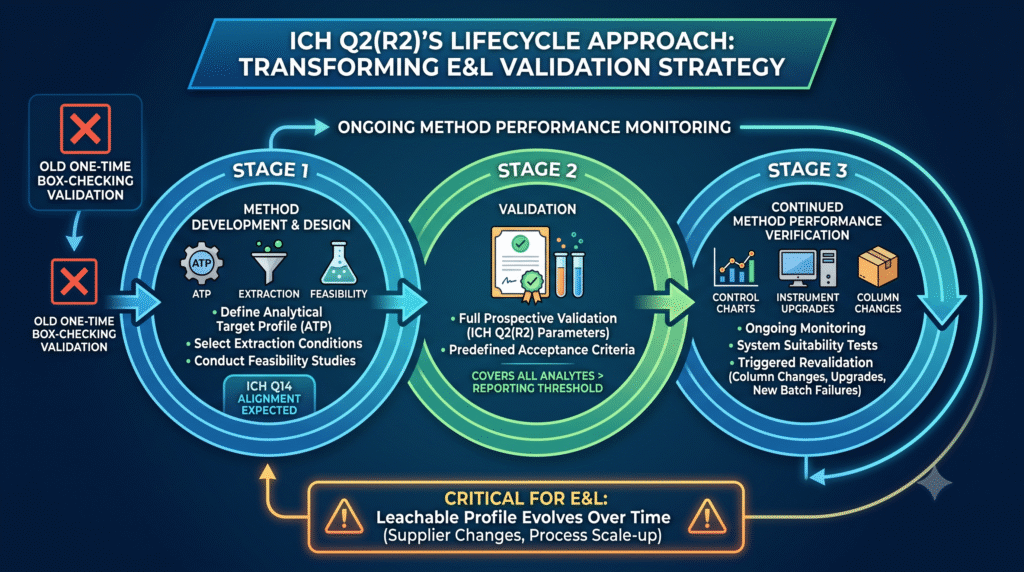
The 2022 update to ICH Q2(R2) introduced a lifecycle concept that replaces the old one-time validation paradigm. For E&L laboratories, this means validation is no longer a box-checking exercise performed once before submission — it is an ongoing commitment to method performance monitoring.
Three stages now apply:
- Stage 1 — Method Development and Design: Define the Analytical Target Profile (ATP), select extraction conditions, and conduct feasibility studies. ICH Q14 alignment is now expected.
- Stage 2 — Validation: Full prospective validation against ICH Q2(R2) parameters with predefined acceptance criteria. For E&L, this should cover all analytes above the Reporting Threshold.
- Stage 3 — Continued Method Performance Verification: Ongoing monitoring through system suitability tests, control charts, and periodic revalidation triggered by column changes, instrument upgrades, or new batch failures.
As analytical technologies continue to evolve, organizations should also stay informed about the Future of Extractables and Leachables Testing, including advances in high-resolution mass spectrometry, automation, and data-driven analytical workflows.
This lifecycle approach is particularly critical for E&L methods because the leachable profile of a drug product can evolve over time — especially when packaging suppliers change or manufacturing processes are scaled up.
5: Common Deficiencies in E&L Method Validation Submissions
Regulatory reviewers at the FDA and EMA have consistently cited E&L method validation packages for the following deficiencies. Being aware of these gaps is the first step toward avoiding a Complete Response Letter (CRL):
- LOQ not demonstrated to be at or below the AET — the most frequent and critical deficiency
- Specificity data provided for only select analytes rather than the full panel of target leachables
- Matrix interference assessment omitted or conducted only in solvent, not in actual drug product matrix
- Accuracy data presented only at 100% of target concentration, with 50% and 150% levels missing
- Intermediate precision data absent — repeatability data provided but no inter-day, inter-analyst, or inter-instrument data
- Robustness parameters not evaluated or acceptance criteria for robustness not predefined
- Stability of extracted samples not established — particularly critical for headspace and LC-MS/MS methods
- Reference standards not properly characterized — lack of purity certificates or traceability to pharmacopeial or NIST standards
Many of these validation deficiencies have been highlighted through published FDA Extractables and Leachables Case Studies and analyses of the Root Causes of Failed Extractables and Leachables (E&L) Studies, providing valuable lessons for avoiding regulatory delays.
6: Documentation Requirements for Regulatory Submissions
A complete E&L method validation package for a regulatory submission should include the following documentation elements, organized per ICH Q2(R2) and aligned with the relevant CTD module (typically Module 3.2.P.2 for container-closure and Module 3.2.P.8 for stability):
| Document | Content Required | CTD Location |
|---|---|---|
| Validation Protocol | Pre-approved acceptance criteria, analyte list, matrix definition, equipment specifications | Internal reference; referenced in validation report |
| Analytical Method | Full SOP with extraction procedures, instrument parameters, calibration approach, and QC requirements | Module 3.2.P.2 / 3.2.A.2 |
| Validation Report | Data tables, chromatograms, calibration curves, spike-recovery results, precision/accuracy statistics | Module 3.2.P.2 / 3.2.A.2 |
| AET Calculation | SCT derivation, route of administration, dose, and calculated AET with justification | Module 3.2.P.2 |
| Reference Standard COA | Purity, source, traceability (USP, EP, Sigma-Aldrich certified), expiry | Appendix to validation report |
| System Suitability Criteria | Retention time window, resolution, peak symmetry, S/N requirements | Embedded in analytical method SOP |
A comprehensive validation package also supports Extractables and Leachables (E&L) Testing for Drug Safety for NDA & ANDA Submissions, ensuring analytical data meet the expectations of FDA reviewers.
7: Method Validation for Extractables and Leachables Testing at ResolveMass Laboratories
At ResolveMass Laboratories Inc., our analytical scientists bring deep expertise in ICH Q2(R2)-compliant method validation for extractables and leachables testing across a broad range of drug product categories — including parenteral biologics, Extractables and Leachables in Biologics and ATMPs, Extractables and Leachables in Emerging Biologics and Advanced Therapies, inhalation products, prefilled syringes, and oral solid dosage forms.
Our E&L analytical capabilities include:
- GC-MS and headspace GC-MS for volatile and semi-volatile organic leachables
- LC-MS/MS and UHPLC-DAD for non-volatile organic compounds and UV-absorbing additives
- ICP-MS for elemental impurity profiling per ICH Q3D and USP <232>/<233>
- TOC analysis for total organic carbon assessment in parenteral systems
- Full validation packages compliant with ICH Q2(R2), FDA guidance on E&L studies, ISO 10993-17, and PQRI best practices
- AET-anchored LOQ establishment and formal threshold justification documentation
- Method transfer validation and continued performance verification protocols
We also provide specialized Extractables & Leachables (E&L) Testing Services for Prefilled Syringes to support injectable drug products throughout development and commercialization.
Our USFDA-registered facility and experienced regulatory affairs team ensure that every E&L validation package we deliver is submission-ready — built to withstand FDA pre-approval inspection (PAI) and technical reviewer scrutiny.
Conclusion:
Method validation for extractables and leachables testing under ICH Q2(R2) is not a formality — it is the scientific foundation on which patient safety decisions are made. The updated 2022 guideline demands a lifecycle-oriented, risk-based approach to validation, with LOQ rigorously anchored to the Analytical Evaluation Threshold, and with full documentation of specificity, linearity, accuracy, precision, and robustness across the platforms used in E&L analysis.
Organizations that treat method validation for extractables and leachables testing as a standalone checklist — rather than an integrated component of their E&L study design — consistently face regulatory delays, CRLs, and resubmissions. A forward-looking validation strategy, grounded in ICH Q2(R2) and informed by the specific safety thresholds governing the product’s route of administration, is the most reliable path to submission acceptance.
As regulatory expectations continue to evolve, manufacturers should align their validation strategies with the ICH Q3E Guideline for Extractables and Leachables while considering emerging topics such as Packaging Leachables and Nitrosamine E&L, Extractables Risk in Plastic Packaging, and Extractables and Leachables Carcinogenicity Testing to strengthen product safety assessments.
You may also reference specialized applications such as Extractables and Leachables Testing for Ophthalmic Drug Products and Solvents for Extractables Studies when designing product-specific E&L strategies. Organizations seeking external analytical expertise can benefit from Outsourcing Extractables and Leachables (E&L) Testing Laboratories in the United States and understanding the differences between E&L Testing: USA vs Europe to ensure compliance across global markets.
ResolveMass Laboratories Inc. is equipped to partner with pharmaceutical and biotech sponsors at every stage of this process — from AET calculation and method development to full prospective validation and regulatory documentation — delivering compliant, defensible results every time.
Frequently Asked Questions:
Method validation ensures that analytical results are scientifically sound and reproducible throughout E&L studies. It minimizes the risk of false positives or inaccurate quantification of potential contaminants. Reliable validation also strengthens toxicological risk assessments and regulatory documentation. Ultimately, it helps ensure that pharmaceutical products and medical devices remain safe for patients throughout their lifecycle.
ICH Q2(R2) requires analytical methods to be validated according to their intended purpose using a science- and risk-based approach. Depending on the method, validation may include specificity, accuracy, precision, linearity, detection limit, quantitation limit, working range, and robustness. The guideline also emphasizes analytical lifecycle management and continuous method performance. This approach improves consistency and regulatory compliance over time.
ICH Q2(R2) expands on the previous Q2(R1) guideline by introducing a lifecycle approach to analytical procedure validation. It places greater emphasis on risk assessment, scientific understanding, and ongoing method monitoring rather than treating validation as a one-time activity. The updated guidance aligns with modern pharmaceutical quality systems. It encourages continuous improvement and better long-term method performance.
Validation parameters typically include specificity, accuracy, precision, linearity, detection limit (LOD), quantitation limit (LOQ), working range, and robustness. These characteristics demonstrate that the analytical method performs consistently under defined conditions. Each parameter is evaluated according to the method’s intended use and regulatory expectations. Together, they provide confidence in the quality and reliability of analytical results.
Extractable and leachable compounds often occur at extremely low concentrations that may still present toxicological concerns. The detection limit (LOD) determines the smallest amount of a compound that can be detected, while the quantitation limit (LOQ) defines the lowest concentration that can be accurately measured. These parameters ensure sensitive and reliable analysis. They are essential for meeting regulatory requirements and supporting patient safety evaluations.
A risk-based approach focuses validation efforts on analytical methods that have the greatest impact on product quality and patient safety. Instead of applying the same level of validation to every procedure, laboratories evaluate the intended use and associated risks. This improves efficiency while maintaining regulatory compliance. It also helps allocate resources more effectively and supports scientifically justified validation strategies.
Method validation is widely used across the pharmaceutical, biotechnology, biopharmaceutical, medical device, packaging, and combination product industries. These sectors must demonstrate that packaging materials and manufacturing components do not introduce harmful contaminants into products. Validated analytical methods support regulatory submissions, quality assurance, and product development. They are essential for ensuring product safety and compliance with global regulations.
Reference
- Dalkılıç O, Demircioğlu İH, Çelik S, Can H, Akman TC, Atila A, Kılıç H, Kandemir L. Method development and validation for determination of N-Nitrosamines in pharmaceutical preparations by LC-MS/MS: Application to extractables and leachables studies. Journal of Chromatography A. 2025 Mar 29;1745:465741.https://www.sciencedirect.com/science/article/pii/S0021967325000901
- Scull JR, Ruberto M, Moyer KL. Extractables and leachables. InSpecification of Drug Substances and Products 2025 Jan 1 (pp. 461-473). Elsevier.https://www.sciencedirect.com/science/article/pii/B978044313466100012X
- Feilden AD, Rignall A. Analytical leachables studies. Leachables and Extractables Handbook: Safety Evaluation, Qualification, and Best Practices Applied to Inhalation Drug Products. 2012 Jan 13:417-47.https://onlinelibrary.wiley.com/doi/pdf/10.1002/9781118147672#page=420
- Qin C. Extractables, Leachables, & Elemental Impurities 2017.https://securec34.ezhostingserver.com/pharmaedresources-com/brochures/ExtractablesLeachables_2017.pdf
- Stults CL, Creasey JM. Development, optimization, and validation of methods for routine testing. Leachables and Extractables Handbook: Safety Evaluation, Qualification, and Best Practices Applied to Inhalation Drug Products. 2012 Jan 13:449-506.https://onlinelibrary.wiley.com/doi/pdf/10.1002/9781118147672#page=451
- Ramamoorthy S, Chong NS, Hotha KK. Strengthening extractable & leachable study submissions: best practices to avoid regulatory deficiencies. American Journal of Analytical Chemistry. 2024;15(12):368-94.https://www.researchgate.net/profile/Subathra-Ramamoorthy-2/publication/387503864_Strengthening_Extractable_Leachable_Study_Submissions_Best_Practices_to_Avoid_Regulatory_Deficiencies/links/678dbc981ec9f9589f51a2bb/Strengthening-Extractable-Leachable-Study-Submissions-Best-Practices-to-Avoid-Regulatory-Deficiencies.pdf
- Parker W, DeCou D. Extractables and Leachables in Drug Products: An Overview. Handbook of Validation in Pharmaceutical Processes, Fourth Edition. 2021 Oct 28:943-51.https://www.taylorfrancis.com/chapters/edit/10.1201/9781003163138-60/extractables-leachables-drug-products-william-parker-decou
About the Author


