
Introduction:
Microsampling techniques in bioanalysis have moved well beyond the dried blood spot card, because modern drug development needs smaller sample volumes, more representative samples, and collection methods that work outside the clinic. Dried blood spots (DBS) proved that a few microliters of blood could support quantitative LC-MS/MS work. Their well-known weaknesses, however, pushed analytical scientists toward volumetric absorptive microsampling (VAMS), capillary microsampling, and a growing set of emerging devices.
For sponsors running preclinical toxicokinetic studies, pediatric trials, or decentralized clinical programs, the collection format directly affects data quality. A poorly matched format can introduce bias that no amount of instrument sensitivity will fix. A well-matched one reduces animal use, eases patient burden, and produces data regulators can trust.
Microsampling is not simply about reducing sample volume. It demands careful attention to collection accuracy, hematocrit effects, analyte stability, extraction efficiency, matrix effects, and sensitivity. A method that performs well with conventional plasma samples will not automatically deliver equivalent results from microsamples, so selecting the right platform is essential for pharmaceutical companies, CROs, and bioanalytical laboratories that need reliable, reproducible data.
This article explains how each technique works, where each one fits, and what a bioanalytical laboratory must validate before the data support a regulatory submission. It reflects the way experienced bioanalytical and mass spectrometry teams at ResolveMass Laboratories Inc., a Canadian analytical CRO/CDMO, approach method selection and validation.
Summary:
- Microsampling collects very small blood or biological fluid volumes (typically 2–50 µL) for quantitative bioanalysis, reducing patient burden, simplifying sample handling, and supporting decentralized clinical studies.
- Dried blood spots (DBS) are the established approach, but hematocrit bias, uneven spot spread, and punching variability limit accuracy.
- VAMS (volumetric absorptive microsampling) collects a fixed volume with an absorptive tip, which minimizes the volume bias of DBS. Hematocrit can still affect analyte partitioning and recovery.
- Capillary microsampling collects small volumes of whole blood or plasma, typically by finger prick in humans, reducing reliance on venipuncture. It suits preclinical serial sampling.
- Emerging techniques include quantitative dried blood microsampling, dried plasma, microfluidic devices, and alternative matrices such as urine and saliva.
- Applications: pharmacokinetic (PK) and toxicokinetic (TK) studies, therapeutic drug monitoring (TDM), biomarker analysis, pediatric work, and clinical research.
- Analytical challenges: sample stability, extraction recovery, matrix effects, hematocrit variation, sensitivity, and validation must be evaluated carefully.
- Regulatory considerations: methods need fit-for-purpose validation under ICH M10, appropriate handling procedures, and demonstrated comparability when replacing conventional sampling.
- Instrumentation: LC-MS/MS and high-resolution mass spectrometry (HRMS) enable reliable quantification from very small sample volumes.
- ResolveMass Laboratories Inc. applies mass spectrometry expertise to design and validate fit-for-purpose microsampling bioanalytical methods.
1: What Are Microsampling Techniques in Bioanalysis?
Microsampling techniques in bioanalysis are collection methods that take a very small volume of blood, plasma, or another matrix, usually between 2 and 50 µL, for quantitative analysis. Most are paired with LC-MS/MS, whose sensitivity makes such small volumes workable.
Core benefits include:
- Less sample volume: a finger or heel prick, or a tail nick, replaces a venous draw.
- Animal welfare: serial sampling from the same animal supports the 3Rs principle (replace, reduce, refine).
- Better data: a full pharmacokinetic profile from one animal removes inter-animal variability.
- Easier logistics: many dried formats ship and store at ambient temperature.
- Patient-centric trials: home or remote collection reduces site visits.
2: Why Move Beyond Dried Blood Spots in Microsampling Techniques?
Laboratories move beyond DBS because the format carries three recurring sources of error: the hematocrit effect, uneven spot formation, and variability when the spot is punched. Each can bias results in ways that are hard to detect after the fact.
- Hematocrit effect: blood with higher hematocrit is more viscous and spreads less on the card. A fixed-diameter punch then contains a different blood volume, so measured concentrations shift.
- Spot homogeneity: the analyte may not distribute evenly across the spot, and a punch taken from the edge can differ from one taken from the center.
- Spot volume and application: the spot size depends on how much blood is applied and how the card absorbs it.
- Punching and carryover: manual or automated punching adds variability and can contaminate the next sample.
- Whole-blood to plasma conversion: most regulatory decisions reference plasma concentrations, so bridging data adds work.
These limits do not make DBS obsolete. They do mean that a method validated on DBS needs explicit hematocrit and homogeneity testing, and that newer formats were designed specifically to remove some of these weaknesses.
Two further DBS challenges are worth planning for:
- Extraction recovery: some analytes bind to filter paper or become hard to extract after drying, which lowers recovery.
- Environmental stability: temperature, humidity, light exposure, and storage duration can all affect analyte stability on the card.
In practice, a DBS workflow runs in these steps:
- Collect a small blood sample by finger prick or another suitable method.
- Deposit the blood on the designated area of the filter paper card.
- Dry the card under controlled conditions.
- Package the dried card in a protective pouch, often with desiccant.
- Punch out a defined portion of the spot.
- Extract the analyte with a suitable solvent.
- Analyze the extract by LC-MS/MS or another suitable technique.
3: What Is VAMS (Volumetric Absorptive Microsampling)?
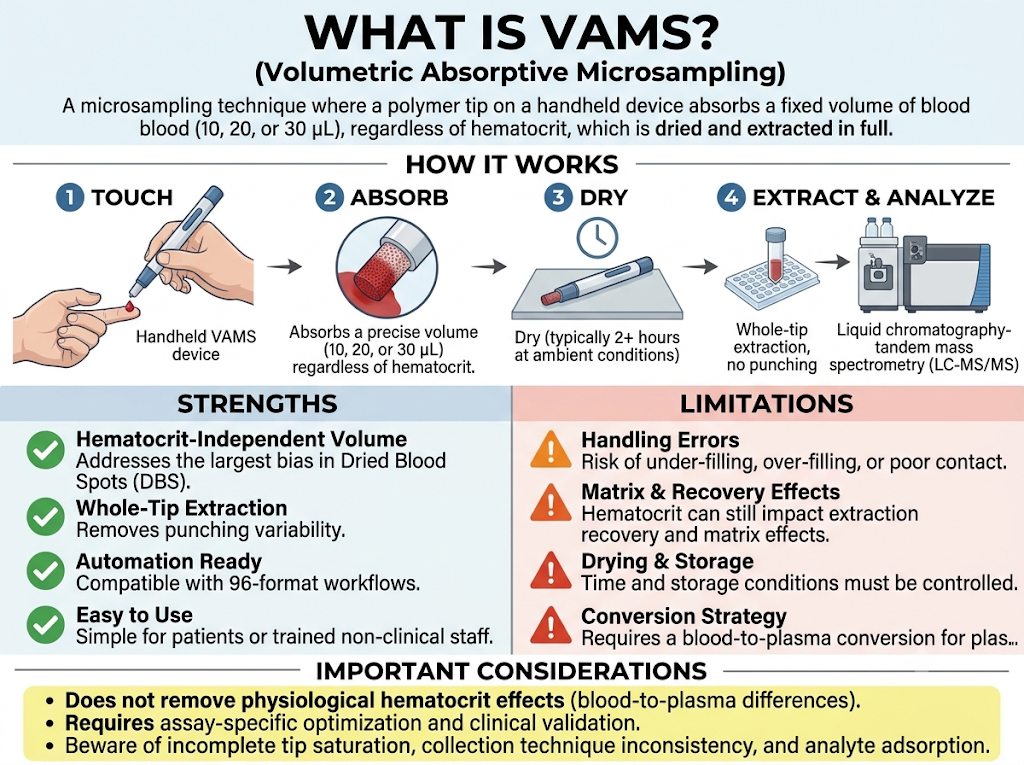
VAMS is a microsampling technique in which a polymer tip on a handheld device absorbs a fixed volume of blood, commonly 10, 20, or 30 µL, regardless of the blood’s hematocrit. The tip is dried, then extracted in full, so no punching is needed.
How it works: the analyst touches the tip to a blood drop. The porous polymer wicks up a defined volume, and the tip is dried (typically a couple of hours at ambient conditions) before storage or shipping. In the laboratory the entire tip is extracted, usually with protein precipitation or similar sample preparation, and analyzed by LC-MS/MS.
Strengths:
- Hematocrit-independent volume, which addresses the largest bias in DBS.
- Whole-tip extraction removes punching variability.
- Compatible with automated, 96-format workflows.
- Easy for trained non-clinical staff or patients to use.
Limitations:
- Under-filling or over-filling the tip, or poor contact with the drop, still produces error.
- Hematocrit can still influence extraction recovery and matrix effects, so it must be tested.
- Tip drying time and storage conditions need to be controlled and documented.
- Plasma concentrations require a blood-to-plasma conversion strategy.
Important distinction: volumetric collection does not remove physiological hematocrit effects. Hematocrit can still change the relationship between whole-blood and plasma concentrations, particularly for analytes that distribute differently between blood cells and plasma. Other VAMS considerations include incomplete tip saturation, inconsistent collection technique, analyte adsorption onto the absorbent material, and device-specific extraction procedures. A 2023 systematic review highlighted the potential of VAMS for pharmacokinetic investigations while stressing the need for assay-specific optimization and clinical validation.
4: What Is Capillary Microsampling?
Capillary microsampling collects a precise, small volume of whole blood or plasma (often 5–20 µL) in a calibrated glass capillary, then dispenses it into a tube or plate for dilution and analysis. It is widely used in rodent toxicokinetic and pharmacokinetic studies.
How it works: a capillary of known volume fills by capillary action from a tail-vein or similar small blood drop. The contents are transferred into a measured volume of buffer or a pre-filled plate. Because blood or plasma stays liquid, samples can be spiked, diluted, and processed like conventional liquid samples.
Strengths:
- Accurate, defined volume without a spreading or absorption step.
- Works with whole blood or with plasma after centrifugation of the capillary.
- Reduces animal numbers by allowing serial sampling and removing satellite groups.
- Calibration standards can be prepared in the same liquid matrix.
Limitations:
- Handling glass capillaries needs training, and fill technique affects accuracy.
- Samples are liquid, so shipping and storage usually need cold chain, unlike dried formats.
- Not well suited to unsupervised home collection.
For regulated preclinical programs, capillary microsampling is often the preferred route because it keeps the analytical workflow close to a standard plasma assay.
Capillary blood is not identical to venous blood. Differences can arise from collection conditions, tissue-fluid contamination, local blood flow, and physiological factors. Comparative studies may therefore be needed to show that capillary-derived concentrations can be interpreted with an existing venous plasma or whole-blood assay. Anticoagulant compatibility, clotting, hemolysis, sample homogeneity, and the limited volume left for repeat testing also need attention.
A typical workflow selects and cleans a collection site, performs a controlled puncture with a sterile lancet, collects blood in a calibrated capillary or microcollection device, and processes it into whole blood, plasma, or serum before the assay.
5: What Other Emerging Microsampling Techniques Are Available?
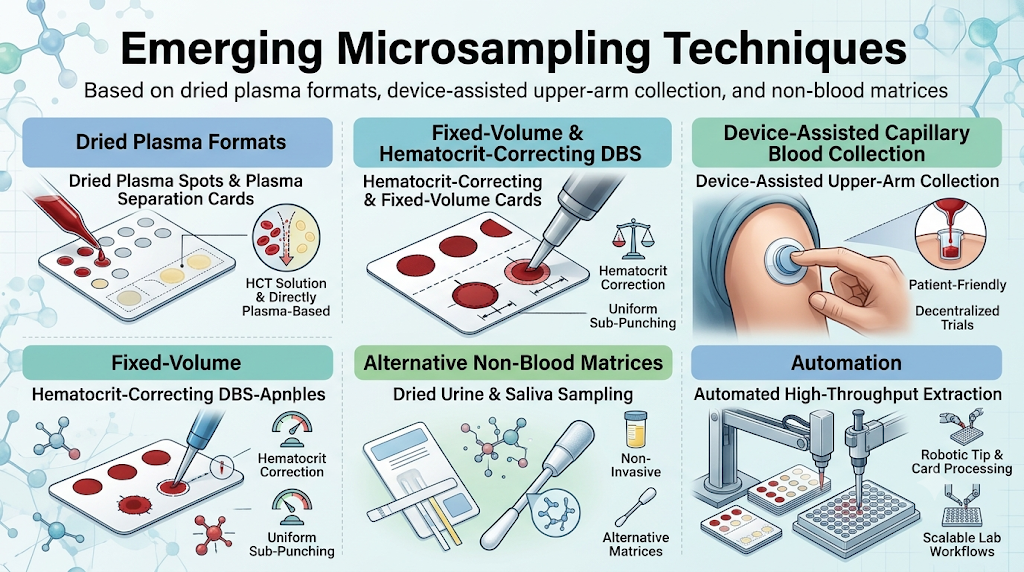
Beyond VAMS and capillary devices, the main emerging microsampling techniques are dried plasma formats, device-assisted upper-arm collection, and non-blood matrices such as dried urine or saliva. Each targets a specific gap left by DBS.
- Dried plasma spots and plasma separation cards: these separate plasma from cells on the card, which avoids the hematocrit problem and gives plasma-based concentrations directly. Separation efficiency and analyte recovery need careful verification.
- Hematocrit-correcting or fixed-volume DBS cards: modified cards and sub-punch approaches aim to reduce spread variability while keeping the familiar dried format.
- Device-assisted capillary blood collection: push-button devices that draw a small blood sample from the upper arm let participants collect samples at home with minimal training. They are attracting interest for decentralized trials.
- Dried urine and saliva sampling: non-invasive matrices useful for specific analytes, though the correlation with blood concentrations must be established for each compound.
- Automated, high-throughput extraction: robotic handling of tips and cards reduces manual steps and improves reproducibility.
Quantitative Dried Blood Microsampling
Quantitative dried blood microsampling uses devices designed to collect a controlled quantity of blood, aiming to reduce the volume and distribution variability of conventional DBS. Potential benefits include more reproducible collection, less manual punching, and easier standardization. Collection accuracy, extraction recovery, and matrix effects still have to be established during method development.
Dried Plasma Microsampling
Dried plasma microsampling places a small plasma volume on a substrate and dries it before extraction. It is relevant when plasma concentration is the intended endpoint, and it may reduce dependence on frozen plasma shipping. Plasma separation, drying effects, substrate interaction, and extraction efficiency all require validation.
Microfluidic Microsampling
Microfluidic systems use miniature channels and chambers to collect, meter, separate, and prepare very small samples. Applications include small-volume blood processing, plasma separation, point-of-care testing, integrated sample preparation, and multiplex biomarker analysis. Device reproducibility, material compatibility, and adsorption remain development considerations.
Liquid Capillary Microsampling
Liquid capillary microsampling collects blood directly into calibrated capillaries or microcollection tubes. It is useful in preclinical toxicokinetic studies where serial sampling would otherwise remove too much blood. Watch for evaporation, adsorption to surfaces, anticoagulant dilution, clotting, and sensitivity to handling.
Alternative Biological Matrices
Microsampling is also expanding beyond blood:
- Dried urine: selected drug, metabolite, and biomarker studies.
- Saliva: non-invasive measurement of selected drugs and biomarkers.
- Tear fluid: an emerging area for ocular biomarkers and therapeutic monitoring.
- Interstitial fluid: investigated for minimally invasive monitoring of selected biomarkers.
- Tissue and CSF: deeper compartments still need dedicated tissue and CSF bioanalytical services, since blood microsamples cannot stand in for them.
These matrices are not interchangeable with blood or plasma. Suitability depends on analyte distribution, matrix composition, collection efficiency, and clinical relevance.
Because the field changes quickly, each new device should be treated as a method to qualify, not as a plug-in replacement. Performance claims from a manufacturer do not substitute for validation with the analyte and matrix of interest.
6: DBS vs VAMS vs Capillary Microsampling: How Do They Compare?
VAMS and capillary microsampling remove the volume bias that affects DBS, while DBS remains the simplest and lowest-cost dried format. The table summarizes the main differences for typical bioanalytical use.
| Feature | Dried blood spot (DBS) | VAMS | Capillary microsampling | Dried plasma formats |
|---|---|---|---|---|
| Typical volume | ~10–50 µL spotted | 10, 20, or 30 µL fixed | ~5–20 µL fixed | Varies by card |
| Hematocrit effect on volume | High | Low | None (liquid volume) | Reduced by separation |
| Sample processing | Punch a sub-disc | Extract whole tip | Dilute or extract liquid | Punch or extract zone |
| Storage and shipping | Ambient | Ambient | Usually chilled or frozen | Ambient |
| Best fit | Established DBS programs | Clinical and home sampling | Preclinical PK/TK studies | Plasma-based endpoints |
| Main risk | Hematocrit bias, punching | Tip fill technique, recovery | Handling and cold chain | Separation efficiency |
Treat this table as a starting point. Final selection should follow method development data for the specific analyte.
7: What Bioanalytical Challenges Affect Microsampling Method Development?
The main challenges are hematocrit effects, extraction recovery, matrix effects, analyte stability, and sensitivity, because small volumes magnify the impact of any collection error or analyte loss. The whole process, from collection to quantification, must be evaluated.
- Hematocrit effect: hematocrit affects viscosity, spreading, and the distribution of analytes between red cells and plasma. VAMS controls volume but not partitioning.
- Extraction recovery: low recovery can come from analyte binding to paper or polymer, poor solvent choice, short extraction time, or incomplete matrix disruption. Optimize solvent, volume, agitation, and incubation time.
- Matrix effects: endogenous components can suppress or enhance ionization in LC-MS/MS. Use matrix-matched calibrators, stable isotope-labelled internal standards, multi-donor evaluation, optimized chromatography, and suitable cleanup.
- Analyte stability: test short-term, long-term, processed-sample, freeze-thaw, humidity, temperature, and transport stability under conditions that mirror real handling.
- Analytical sensitivity: limited material makes the lower limit of quantification (LLOQ) harder to reach for low-concentration drugs, active metabolites, biomarkers, and peptide analytes. Sensitive methods, optimized extraction, and good internal standards help.
8: What Is the Role of LC-MS/MS in Microsampling-Based Bioanalysis?
LC-MS/MS is the preferred platform for microsampling because it combines high selectivity and sensitivity for quantifying drugs and metabolites in very small volumes. It is also compatible with multiple matrices and high-throughput workflows. ResolveMass offers dedicated LC-MS/MS bioanalytical services for this work.
A typical workflow runs as follows:
- Collect the sample with DBS, VAMS, or another device.
- Dry or store the sample as the technique requires.
- Extract the analyte with optimized solvents.
- Add an appropriate internal standard.
- Clean up and prepare the sample.
- Separate by LC or UHPLC.
- Detect by tandem mass spectrometry.
- Quantify against a validated calibration model.
High-resolution mass spectrometry (HRMS) can add compound identification and structural confirmation. Suitability of either platform must still be shown for the specific analyte and microsampling format.
9: What Must Be Validated for Microsampling Techniques in Bioanalysis?
A microsampling method must show accuracy, precision, selectivity, recovery, and stability like any bioanalytical method, plus format-specific checks for hematocrit, volume, and sample homogeneity. Harmonized expectations for chromatographic and ligand-binding assays are set out in the ICH M10 bioanalytical method validation guideline, which regulators including the FDA and EMA have adopted.
Key parameters to design into the validation:
- Hematocrit range: test low, normal, and high hematocrit blood to show accuracy is maintained across the expected population.
- Volume and fill accuracy: confirm that the device delivers or absorbs the stated volume, and define acceptable under-fill and over-fill limits.
- Extraction recovery and matrix effects: evaluate across lots and hematocrit levels, since tips and cards add extractables that can affect ionization.
- Spot or tip homogeneity: for DBS, compare punches from different areas of the spot.
- Stability: cover drying time, ambient storage, shipping conditions, and freeze-thaw where relevant.
- Incurred sample reanalysis (ISR): confirm reproducibility using real study samples.
- Comparability to venous plasma: where the study needs plasma concentrations, show the relationship between the microsample and conventional samples.
- Documentation and traceability: record lot numbers of devices, drying conditions, and handling steps.
These checks should be defined before the study starts. Finding a hematocrit bias after clinical samples are analyzed is far more costly than testing for it during method development.
For dried matrix methods, ICH M10 flags extra considerations: hematocrit effects for blood spotted on cards, sample homogeneity, extraction efficiency from the dried matrix, enough sample for incurred sample reanalysis, and cross-validation when dried and liquid methods are used in the same study. The FDA’s bioanalytical guidance likewise stresses validating DBS approaches and running appropriate comparative studies.
| Validation parameter | Purpose in microsampling |
|---|---|
| Selectivity | Confirms endogenous components do not interfere |
| Calibration curve | Defines concentration-response relationship |
| Accuracy and precision | Evaluates quantitative reliability |
| Recovery | Measures extraction efficiency |
| Matrix effect | Evaluates ion suppression or enhancement |
| Stability | Confirms analyte integrity in storage and handling |
| Carryover | Detects contamination from prior injections |
| Dilution integrity | Checks accuracy after dilution |
| Hematocrit assessment | Tests hematocrit influence on concentrations |
| Sample homogeneity | Checks consistency within the sample |
| ISR | Confirms reproducibility with incurred samples |
Is Cross-Validation Required When Switching From Plasma to Microsampling?
Cross-validation should be considered whenever two methods or matrices generate results that will be compared. The extent depends on study design and regulatory requirements. If a sponsor moves from plasma sampling to VAMS whole-blood sampling, the whole-blood to plasma relationship must be established scientifically. A direct comparison matters most when results support pharmacokinetic interpretation, bioequivalence, or regulatory decisions.
Programs heading toward filing should plan this early with regulated bioanalytical services for NDA and BLA submission, and nonclinical studies may additionally require GLP bioanalytical services.
10: Where Are Microsampling Techniques in Bioanalysis Used?
Microsampling is used most in preclinical toxicokinetics, pediatric and neonatal studies, decentralized clinical trials, and therapeutic drug monitoring. In each case the small volume or the remote collection is what makes the study feasible or more ethical.
- Pharmacokinetic (PK) studies: drug concentrations at many time points from smaller blood volumes.
- Toxicokinetic (TK) studies: systemic exposure assessment with less blood withdrawn from laboratory animals; serial microsamples from the same rodent replace satellite groups.
- Therapeutic drug monitoring (TDM): drugs with narrow therapeutic windows can be monitored from small patient samples between visits.
- Pediatric and neonatal trials: smaller volumes reduce risk and burden for infants and children.
- Biomarker analysis: disease-associated biomarkers from limited material, including rare disease cohorts where every sample counts.
- Decentralized clinical trials: patients collect samples at home and ship them to a central laboratory.
Suitability always depends on the analyte, matrix, analytical platform, study design, and intended regulatory application.
11: How Do You Choose the Right Microsampling Technique?
Choose the technique by matching the study design and analyte properties to each format’s strengths, then confirm the choice with method development data. Work through these questions:
- Is the study preclinical or clinical? Preclinical programs often favor capillary microsampling; clinical and home collection often favor VAMS or dried formats.
- Who collects the sample? Trained staff can handle capillaries; self-collection favors simple devices.
- Is cold chain available? If not, choose a dried format.
- Is hematocrit variability expected? Pediatric, anemic, or oncology populations call for a volume-independent approach such as VAMS.
- Is the analyte stable when dried? Some compounds degrade on paper or polymer and need stabilizers or a liquid format.
- Which matrix does the regulatory endpoint need? If plasma is required, plan the blood-to-plasma bridge or use a plasma format.
- Is there bridging data to an earlier method? Changing format mid-program needs a cross-validation plan.
| Study requirement | Approach to evaluate |
|---|---|
| Cost-effective dried blood collection | DBS |
| Controlled-volume dried blood collection | VAMS |
| Small-volume liquid blood collection | Capillary microsampling |
| Remote patient sampling | DBS or VAMS |
| Plasma-specific drug quantification | Dried plasma or liquid plasma microsampling |
| Integrated sample preparation | Microfluidic sampling |
| Repeated preclinical blood collection | Validated liquid microsampling or VAMS |
Also confirm that the required LLOQ is achievable with the available volume, that the device does not add adsorption or extraction variability, and that the method meets accuracy and precision targets. A pilot study with multiple donors, relevant hematocrit ranges, and realistic handling conditions exposes limitations before a full study. Teams working on early programs can pair this with bioanalytical services for rapid proof-of-concept to test feasibility quickly.
How Does ResolveMass Support Microsampling Bioanalysis?
ResolveMass Laboratories Inc. is a Canadian analytical CRO/CDMO whose scientists apply mass spectrometry expertise to develop and validate fit-for-purpose bioanalytical methods, including methods built around microsampling formats. Our approach starts with the study question, not the device.
- LC-MS/MS analysis: sensitive quantification of drugs, metabolites, and biomarkers through our LC-MS/MS bioanalytical services.
- HRMS characterization: high-resolution mass analysis for compound identification and structural characterization.
- Method development and validation: optimized extraction, chromatography, and detection, with accuracy, precision, selectivity, recovery, stability, and hematocrit assessed up front in line with ICH M10 expectations.
- Regulated work: GLP bioanalytical services and regulated bioanalytical services for NDA and BLA submission.
- Specialized matrices and analytes: peptide bioanalytical services, tissue and CSF bioanalytical services, and bioanalytical services for rare disease.
- Early-stage programs: bioanalytical services for rapid proof-of-concept.
- Impurity profiling and troubleshooting: investigation of impurities and degradation products, plus matrix interference, ion suppression, and extraction variability.
- Transparent reporting: documented device lots, handling steps, and acceptance criteria.
Our team’s work across biosimilar characterization, mass spectrometry, PLGA-based drug delivery, and nitrosamine testing means we approach every analyte with attention to sensitivity, selectivity, and data integrity. To discuss a microsampling project, contact the ResolveMass team.
Frequently Asked Questions About Microsampling Techniques in Bioanalysis
What is the main advantage of VAMS over dried blood spots? VAMS absorbs a fixed blood volume regardless of hematocrit, which removes the main volume bias of DBS and avoids punching variability.
Is capillary microsampling suitable for clinical trials? It is used mainly in preclinical studies. Clinical work more often uses dried formats because they ship at ambient temperature and suit self-collection.
Do microsampling methods need separate validation? Yes. Beyond standard validation, they need hematocrit, volume accuracy, homogeneity, and stability testing specific to the format.
Can microsampling replace venous blood draws completely? Not always. It works well when the analyte is stable and the method is validated, but some assays still need larger volumes or plasma.
How much blood does microsampling need? Typically 2–50 µL, depending on the technique and the sensitivity of the LC-MS/MS method.
Does microsampling reduce animal use? Yes. Serial sampling from the same animal can remove satellite groups and supports the 3Rs principle.
Conclusion: Choosing Microsampling Techniques in Bioanalysis with Confidence
Microsampling techniques in bioanalysis now offer real alternatives to the dried blood spot: VAMS for hematocrit-independent volumes and simple collection, capillary microsampling for precise preclinical sampling, and newer plasma and device-assisted formats for remote studies. None is universally best, and every one depends on rigorous validation to produce data that stand up to review.
Frequently Asked Questions:
Dried plasma microsampling involves collecting a small quantity of plasma onto a suitable substrate and drying it before storage and analysis. It can support quantitative drug measurement while potentially simplifying sample transportation and storage.
No. VAMS reduces variability associated with blood spreading and volumetric sampling in conventional DBS, but it does not completely eliminate hematocrit-related effects. Differences in blood viscosity and analyte distribution between plasma and blood cells can still influence analytical results.
DBS analysis can be affected by hematocrit variation, blood spot inhomogeneity, punch location, incomplete analyte extraction, and environmental stability. These factors may influence quantitative accuracy and reproducibility.
Capillary microsampling involves collecting small quantities of blood from capillary vessels, commonly through a finger prick. The collected sample can be transferred into a microcollection tube, processed into plasma or serum, or analyzed as whole blood.
Laboratories ensure reliable results through standardized sample collection procedures, optimized extraction methods, appropriate internal standards, matrix-effect assessment, stability studies, and fit-for-purpose bioanalytical validation.
Microsampling can facilitate decentralized clinical trials by allowing patients to collect small biological samples outside conventional clinical settings. Dried sample formats such as DBS and VAMS can simplify transportation to centralized laboratories when appropriate collection and stability procedures are established.
Yes. DBS and VAMS can support therapeutic drug monitoring for selected medications. However, the analytical method must establish the relationship between microsample concentrations and clinically established reference measurements before routine clinical interpretation.
Reference
- Nys G, Kok MG, Servais AC, Fillet M. Beyond dried blood spot: current microsampling techniques in the context of biomedical applications. TrAC Trends in Analytical Chemistry. 2017 Dec 1;97:326-32.https://www.sciencedirect.com/science/article/pii/S0165993617303357
- Protti M, Mandrioli R, Santos HM, Lodeiro C, Capelo-Martínez JL, Mercolini L. How microsampling is impacting pharmacokinetic and toxicokinetic studies: volumetric absorptive microsampling (VAMS). Bioanalysis. 2025 Aug 3;17(15):997-1009.https://www.tandfonline.com/doi/abs/10.1080/17576180.2025.2546782
- Baillargeon KR, Mace CR. Microsampling tools for collecting, processing, and storing blood at the point‐of‐care. Bioengineering & Translational Medicine. 2023 Mar;8(2):e10476.https://aiche.onlinelibrary.wiley.com/doi/abs/10.1002/btm2.10476
- Thangavelu MU, Wouters B, Kindt A, Reiss IK, Hankemeier T. Blood microsampling technologies: innovations and applications in 2022. Analytical Science Advances. 2023 Jul;4(5-6):154-80.https://chemistry-europe.onlinelibrary.wiley.com/doi/abs/10.1002/ansa.202300011
- Guimaraes G, Yuan L. Recent developments in microsampling for oligonucleotides and biologics bioanalysis. Bioanalysis. 2026 Sep 2;18(12-13):1183-96.https://www.tandfonline.com/doi/abs/10.1080/17576180.2026.2739128
- Thangavelu MU, Kindt A, Wouters B, Lamont L, Elfrink HL, Harms A, Hankemeier T. Volumetric absorptive microsampling for profiling of signaling lipids: a comparative analysis with whole blood and dried blood spots. Analytical and Bioanalytical Chemistry. 2026 Apr 5:1-4.https://link.springer.com/article/10.1007/s00216-026-06413-5
About the Author