

Introduction
The minimum batch size for GMP peptide manufacturing is primarily determined by equipment working volumes, mandatory analytical release testing requirements, downstream processing losses, and facility cleaning validation constraints. These factors typically establish a functional lower limit of approximately 10 to 50 grams during early clinical development, with requirements increasing to multi-kilogram quantities for commercial supply. Compliance with current Good Manufacturing Practice (cGMP) regulations under 21 CFR Parts 210/211 and International Council for Harmonisation (ICH) Q7 standards requires pharmaceutical sponsors and Contract Development and Manufacturing Organizations (CDMOs) to select a batch scale that supports process reproducibility, structural integrity, and regulatory auditability while avoiding excessive and economically unsustainable material losses.
Transitioning a synthetic peptide from research-grade discovery to cGMP production introduces rigorous Quality Management Systems (QMS), extensive analytical characterization requirements, and operational constraints that are generally absent at laboratory scale. Although research laboratories can routinely perform synthesis at milligram scale, reproducing those quantities within a certified cleanroom environment is technically and economically impractical because of fixed process losses, equipment operating requirements, and quality control (QC) sampling demands. Establishing an appropriate batch scale therefore requires an integrated assessment of chemical reaction kinetics, equipment hold-up volumes, health-based carryover limits, and financial metrics throughout the product lifecycle.
Need support for peptide development from early synthesis through GMP manufacturing? Explore custom peptide synthesis services.
Share via:
Quick Summary:
Regulatory Frameworks and Process Validation Limits for Minimum Batch Size for GMP Peptide Manufacturing
International regulatory guidelines, including ICH Q7 and EU GMP Annex 15, do not prescribe a specific numerical mass threshold for the minimum batch size for GMP peptide manufacturing. Instead, these frameworks require the selected manufacturing scale to be appropriately validated, reproducible, and supported by documented process understanding across relevant operational unit steps. Regulatory authorities, including the U.S. Food and Drug Administration (FDA) and the European Medicines Agency (EMA), focus on process capability, consistent product quality, and quality risk management rather than imposing arbitrary minimum mass requirements.
Within global regulatory submissions, including Investigational New Drug (IND) applications, Investigational Medicinal Product Dossiers (IMPD), and Drug Master Files (DMF), sponsors must demonstrate that the selected batch size can consistently produce an Active Pharmaceutical Ingredient (API) that meets predefined Critical Quality Attributes (CQAs). Process validation frameworks also require adequate control of Critical Process Parameters (CPPs) throughout the manufacturing sequence, including solid-phase coupling, cleavage, preparative liquid chromatography, and lyophilization.
Planning a transition from development-scale synthesis to validated GMP production? Learn about GMP peptide API manufacturing.
| Development Phase | Typical GMP Batch Scale Range | Primary Regulatory Focus | Key Scale-Limiting Factors |
|---|---|---|---|
| Phase 1 Clinical Supply | 10 g – 250 g | Safety, sequence identity, basic stability, microbial control | Analytical release testing consumption, high raw material unit costs |
| Phase 2 / Phase 3 Pivotal Trials | 250 g – 5 kg | Process robustness, impurity profiling, draft acceptance criteria | Column chromatographic loading capacities, hold-time validation |
| Commercial Supply (Niche / Rare Disease) | 1 kg – 10 kg | Process Validation (PV), continuous process verification, comparability | Multi-product cleaning limits (MACO), cleanroom scheduling efficiency |
| Commercial Supply (Blockbuster / GLP-1) | 10 kg – 50+ kg | Supply chain resilience, Green Chemistry metrics, process optimization | Lyophilizer shelf surface area, solvent handling limits, continuous purification |
Selecting a batch size that is excessively small can complicate regulatory approval as a product advances into pivotal development and commercial manufacturing. Regulators generally expect process qualification batches, often involving three consecutive commercial-scale lots, to represent the operational conditions and process dynamics applicable to routine commercial supply. When a clinical process is qualified or validated at an impractically small scale, subsequent scale-up may require comparability protocols, additional stability studies, and potentially bridging clinical studies to establish that critical quality characteristics and impurity profiles remain adequately controlled.
Moving a peptide process from laboratory or clinical development into GMP production? See technology transfer to a GMP CDMO.
Equipment Constraints Defining the Minimum Batch Size for GMP Peptide Manufacturing
Physical design characteristics of manufacturing equipment—including Solid-Phase Peptide Synthesis (SPPS) vessel minimum fluidization volumes, preparative High-Performance Liquid Chromatography (HPLC) column diameter and void volumes, and lyophilizer shelf loading depths—can establish important technical constraints on batch scale. These parameters help prevent disproportionate percentage yield losses associated with operating equipment below its qualified or efficiently operable range. Using processing equipment at excessively low fill levels can adversely affect mass transfer, thermal distribution, mixing performance, and hydrodynamic flow.
During Solid-Phase Peptide Synthesis, solid support resins, including polystyrene and PEG-based resins, undergo substantial swelling when exposed to organic solvents such as N,N-dimethylformamide (DMF) or dichloromethane (DCM). Reaction vessels must therefore contain adequate solvent volume to completely wet, submerge, and suspend the resin bed throughout mechanical or nitrogen-agitated coupling cycles. Operating an SPPS reactor substantially below its qualified capacity can result in incomplete resin wetting, inefficient mixing kinetics, and increased formation of deletion sequence impurities.
Working with a complex peptide sequence or specialized synthesis requirement? View custom peptide synthesis capabilities.
Downstream purification and isolation equipment also introduce important physical loading requirements:
- Preparative HPLC Columns: Industrial purification commonly uses reverse-phase C18 or C8 columns with internal diameters ranging from approximately 5 cm to 100 cm. Loading an insufficient quantity of crude peptide onto a large-diameter column can increase chromatographic band dispersion, peak tailing, excessive dilution, and solvent consumption per gram of isolated product. These effects can reduce purification efficiency and increase material losses.
- Concentration and Evaporation Equipment: Falling-film evaporators, rotary evaporators, and precipitation reactors have minimum operating volumes needed to adequately immerse heating surfaces and temperature sensors. Operating below these volumes can interfere with heat transfer, process control, and reproducibility.
- Lyophilization Infrastructure: Tray freeze-dryers require an appropriate solution depth, typically approximately 1 to 2 cm across the trays, to maintain consistent thermal conductivity during primary and secondary drying cycles. Insufficient tray fill levels can contribute to localized thermal overheating, cake collapse, and variability in residual moisture content.
| Unit Operation | Equipment Hardware Scale | Minimum Efficient Feed Load | Yield Loss Penalty at Sub-Minimum Operating Scale |
|---|---|---|---|
| Bench/Pilot SPPS Synthesizer | 1 L – 15 L Reaction Vessel | ~50 g – 300 mmol resin load | 5% – 10% (incomplete mixing and wall adhesion) |
| Mid-Scale Prep-HPLC System | 15 cm – 30 cm Column Diameter | ~50 g – 200 g crude peptide / injection | 10% – 20% (column void volume tailing) |
| Large-Scale Prep-HPLC System | 60 cm – 100 cm Column Diameter | 1 kg – 5 kg crude peptide / injection | >30% (excessive dilution and fraction cut loss) |
| Industrial Tray Lyophilizer | 200 L – 500 L Chamber Volume | 1.5 kg – 4 kg dissolved API | 15% – 25% (unrecoverable tray wall film) |
Analytical Testing Consumption and Retention Impact on Minimum Batch Size for GMP Peptide Manufacturing
Comprehensive cGMP release testing and regulatory retain-sample requirements require a defined quantity of finished peptide Active Pharmaceutical Ingredient (API) for analytical evaluation and archival purposes. This requirement can commonly represent approximately 2 to 10 grams per batch and therefore establishes a practical lower boundary when analytical consumption represents a substantial fraction of total production. Because many quality control specifications and analytical requirements remain applicable regardless of batch size, smaller batches experience a disproportionately large material-consumption impact.
Need comprehensive characterization and release testing for a GMP peptide batch? Explore peptide analytical testing services.
Release testing of cGMP peptide drug substances under applicable ICH Q6A principles requires extensive physicochemical and microbiological characterization. The material consumed during release testing can encompass a broad range of validated analytical procedures:
- Purity, Impurity Profiling, and Identity: Reverse-Phase HPLC (RP-HPLC) coupled with Electrospray Ionization Mass Spectrometry (ESI-MS) or High-Resolution Mass Spectrometry (HRMS) is used to confirm molecular weight, establish identity, and quantify individual and total impurities.
- Assay and Composition: Amino Acid Analysis (AAA) can be used to determine absolute peptide content, while counter-ion quantification, including trifluoroacetate, acetate, or chloride, through Ion Chromatography (IC) or Nuclear Magnetic Resonance (NMR) helps establish salt stoichiometry.
- Physicochemical Parameters: Karl Fischer titration is used to determine residual moisture, while Gas Chromatography (GC-MS) can quantify residual organic solvents in accordance with applicable ICH Q3C requirements.
- Safety and Microbiological Controls: Bacterial endotoxin testing using LAL or recombinant Factor C assay, together with bioburden testing such as Total Aerobic Microbial Count, requires sufficient material for direct analysis as well as method suitability assessments where applicable.
- Trace Genotoxic Impurity Profiling: Regulatory expectations can require sensitive analytical evaluation of trace contaminants, including nitrosamines, using highly sensitive LC-MS/MS instrumentation to demonstrate compliance with applicable Health Canada and FDA threshold limits.
Assessing potential nitrosamine contamination in a peptide API? Explore nitrosamine risk assessment services.
Under 21 CFR 211.170 and ICH Q7 principles, manufacturers are required to maintain reserve or retention samples from manufactured batches for specified periods. The combined requirements for release testing, stability protocols, investigations, method suitability, and retain archives can represent a significant fraction of the output when batch sizes are very small. For example, if a cGMP batch produces only 10 grams of total API and approximately 5 grams are consumed across release testing, stability protocols, and retain archives, analytical and retention requirements could account for 50% of the total batch yield.
Need to evaluate how much peptide material should be allocated for stability programs? Explore peptide stability testing services.
Cleaning Validation and MACO Calculations Governing Minimum Batch Size for GMP Peptide Manufacturing
Facility cleaning validation protocols incorporate the minimum batch size of the subsequent product (MBSnext) into Maximum Allowable Carryover (MACO) calculations. Consequently, reducing the subsequent batch scale can lower the permissible equipment-residue threshold and increase the sensitivity required from analytical cleaning methods. In multi-product manufacturing facilities, shared equipment trains must be cleaned to scientifically justified acceptance limits to minimize the risk of cross-contamination between products.
The Active Pharmaceutical Ingredients Committee (APIC) and ISPE cleaning validation guidelines describe approaches for deriving MACO using Health-Based Exposure Limits (HBEL), including Acceptable Daily Exposure (ADE) or Permitted Daily Exposure (PDE), as applicable:
MACO = (HBELprevious × MBSnext × PF) / (TDDnext × SF)
Where:
- HBELprevious: Represents the Permitted Daily Exposure or Acceptable Daily Exposure of the previously manufactured peptide API (mg/day).
- MBSnext: Represents the minimum batch size of the subsequent product manufactured using the shared equipment (mg).
- TDDnext: Represents the maximum Therapeutic Daily Dose of the subsequent product (mg/day).
- PF: Represents the Purging Factor and reflects the downstream clearance capability.
- SF: Represents a safety factor applied according to the applicable formulation and risk considerations.
When a CDMO schedules a product with a very small minimum batch size (MBSnext), the calculated MACO for the preceding batch decreases proportionally. This can require the acceptable surface swab limit (mg/cm2) to be reduced to extremely low levels, potentially approaching or falling below the practical capabilities of standard analytical cleaning methods. Consequently, commercial CDMOs may establish contractually defined minimum batch-size floors, such as 500 g or 1 kg, to maintain operational feasibility and support reliable cleaning validation performance.
Looking for integrated peptide manufacturing capabilities in North America? Explore North American peptide CDMO services.
Economic Dynamics, Yield Loss Kinetics, and COGS Metrics at Minimum Batch Size for GMP Peptide Manufacturing
The step-wise yield reduction inherent to peptide chemical synthesis, combined with fixed cleanroom operating costs, can cause the unit cost per gram to increase substantially when manufacturing campaigns operate close to their minimum practical batch scales. Understanding the relationship between chemical efficiency, material recovery, equipment utilization, and operational overhead is therefore important when establishing economically viable manufacturing campaigns.
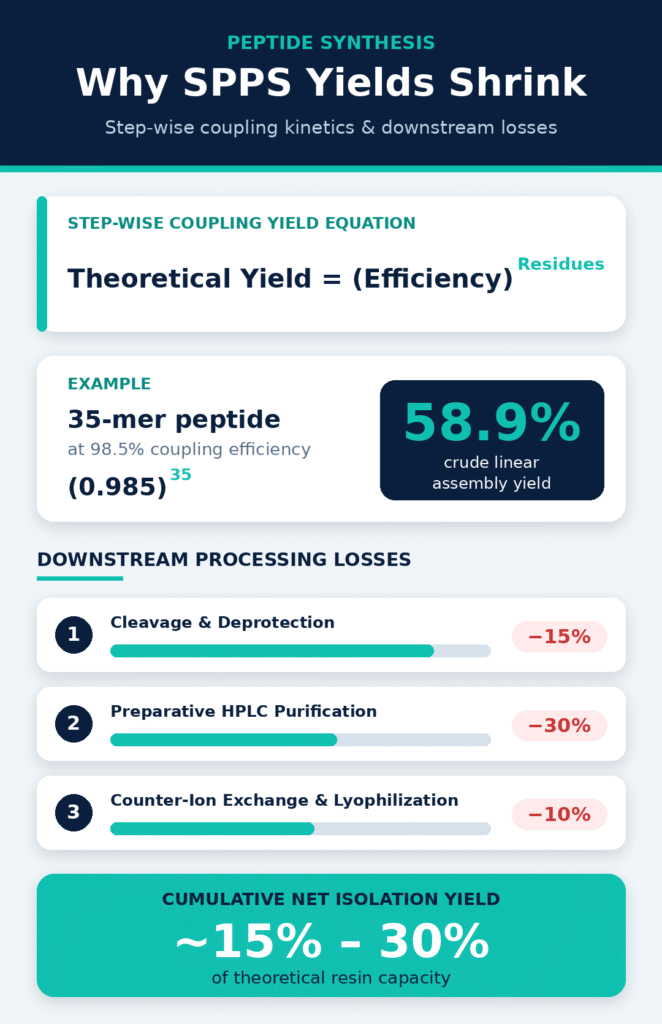
Solid-Phase Peptide Synthesis proceeds through sequential deprotection and coupling steps. The theoretical yield (Ytheoretical) of a linear peptide containing n amino acid residues, assuming a constant average step-wise coupling efficiency (E), can be expressed as:
Ytheoretical = En
For a 35-mer peptide synthesized at a high step-wise coupling efficiency of 98.5%, the theoretical crude assembly yield on resin is approximately 59.1%. Subsequent chemical cleavage, global deprotection, preparative HPLC purification, counter-ion exchange, and lyophilization can further reduce the net isolation recovery to approximately 15%–30% of the theoretical starting resin capacity.
Scaling a peptide process toward larger GMP quantities? Read about GLP-1 analog scale-up to GMP kilogram manufacturing.
The fixed cost structure of cGMP manufacturing encompasses cleanroom suite rental, qualified labor, continuous environmental monitoring, quality assurance review, and Batch Manufacturing Record (BMR) execution. Because these overhead expenses can remain relatively consistent whether a facility produces 20 grams or 1,000 grams, smaller manufacturing campaigns can experience a substantially greater Cost of Goods Sold (COGS) burden on a per-gram basis.
| Process Cost Metric | 20-Gram GMP Batch Scale | 1-Kilogram GMP Batch Scale | 25-Kilogram GMP Batch Scale |
|---|---|---|---|
| Raw Material Weight Input Ratio | ~120 g – 180 g crude synthesis equivalents | ~4 kg – 6 kg crude synthesis equivalents | ~100 kg – 140 kg crude synthesis equivalents |
| Estimated Net Isolation Yield | 12% – 18% (high hold-up impact) | 25% – 35% (optimized downstream) | 35% – 45% (fully optimized hybrid route) |
| QC Release Material Loss Share | 20% – 40% of total isolated lot | 0.5% – 1.0% of total isolated lot | <0.05% of total isolated lot |
| Fixed Overhead Share of COGS | >80% of total batch cost | ~35% – 45% of total batch cost | <15% of total batch cost |
| Relative Unit Cost per Gram | Baseline (15× – 25×) | Moderate (2× – 3×) | Optimized Baseline (1×) |
Conclusion
Establishing an appropriate Minimum Batch Size for GMP Peptide Manufacturing requires an integrated assessment of synthetic chemistry yields, analytical material consumption, equipment hold-up volumes, cleaning validation requirements, and regulatory expectations. Although regulatory frameworks such as ICH Q7 do not prescribe a universal minimum weight threshold, practical manufacturing constraints can establish a functional floor of approximately 10 to 50 grams during early clinical development, with batch requirements increasing to multi-kilogram quantities for commercial supply. By evaluating process capabilities, equipment operating limits, analytical requirements, and quality control considerations, pharmaceutical developers can establish reliable and economically sustainable manufacturing programs. Specialized analytical institutions such as ResolveMass Laboratories Inc. can support these development activities through release testing, nitrosamine risk assessments, and analytical methodology validation designed to support regulatory compliance throughout the product lifecycle.
Need GMP peptide manufacturing, analytical testing, or clinical supply support for your development program? Connect with the North American peptide CDMO team.
For specialized analytical support, release testing, and consultation regarding cGMP peptide quality control programs, visit the ResolveMass Contact Page.
Frequently Asked Questions
Increasing peptide sequence length generally increases the cumulative impact of incomplete coupling, deprotection, and side reactions, which can reduce overall process yield. Longer peptides may therefore require a greater initial synthesis scale to obtain the desired quantity of purified API. Peptides exceeding 30–40 residues may also require fragment condensation or hybrid solid-phase/liquid-phase synthesis (SPPS/LPPS) approaches.
cGMP release testing requires sufficient API for multiple analytical procedures, including identity, purity, moisture, counter-ion, bioburden, endotoxin, and trace genotoxic impurity testing. Additional material may be required for retain samples and stability programs. Consequently, analytical consumption can represent a substantial proportion of very small peptide batches.
No, ICH Q7 does not establish a fixed numerical minimum batch size for API manufacturing. Instead, it emphasizes appropriate process control, documentation, validation, and consistent production of APIs that meet predetermined quality requirements. The practical batch scale is therefore determined by process capability, equipment suitability, and product-specific manufacturing considerations.
Equipment hold-up volume refers to material retained within processing components such as transfer lines, pumps, filters, vessels, and preparative HPLC systems. When a small peptide batch is processed through relatively large equipment, these fixed residual volumes can represent a significant percentage of the total material. This can increase product losses and reduce overall process recovery.
Health-Based Exposure Limits (HBEL), including Permitted Daily Exposure (PDE) and Acceptable Daily Exposure (ADE), are used to establish scientifically justified carryover limits in shared manufacturing facilities. These limits contribute to Maximum Allowable Carryover (MACO) calculations for subsequent products. A smaller MBS<sub>next</sub> can result in a more restrictive allowable carryover limit and tighter cleaning requirements.
Research-grade peptide synthesis can be performed at milligram scale without the extensive manufacturing controls required for commercial pharmaceutical production. GMP manufacturing introduces validated processes, controlled environments, formal documentation, analytical release testing, stability requirements, and retention samples. These additional requirements increase the practical quantity needed for a compliant manufacturing batch.
Commercial batch requirements vary according to clinical demand, dosing requirements, product potency, manufacturing yield, and market size rather than therapeutic class alone. High-volume GLP-1 receptor agonists may require substantially larger production campaigns, potentially reaching tens of kilograms. Peptides for niche or rare-disease indications may be manufactured at considerably smaller commercial scales.
Lyophilization performance depends on appropriate loading of the available shelf area and maintaining suitable solution depth for controlled heat and mass transfer. Insufficient fill levels can increase the relative impact of tray and equipment losses and may affect drying uniformity. Poor loading conditions can contribute to cake collapse, variable drying behavior, and inconsistent residual moisture content.
Process optimization can reduce material losses by improving reaction efficiency, minimizing equipment dead volume, and increasing downstream recovery. Low-dead-volume micro-preparative HPLC systems, continuous chromatography such as MCSGP, optimized analytical methods, and efficient sampling strategies can reduce fixed material consumption. These improvements can make smaller GMP peptide batches more technically and economically viable.
Reference:
- U.S. Food and Drug Administration. (2011). Process validation: General principles and practices: Guidance for industry (Revision 1). https://www.fda.gov/files/drugs/published/Process-Validation–General-Principles-and-Practices.pdf
- U.S. Food and Drug Administration. (2016). Q7 good manufacturing practice guidance for active pharmaceutical ingredients: Guidance for industry. https://www.fda.gov/files/drugs/published/Q7-Good-Manufacturing-Practice-Guidance-for-Active-Pharmaceutical-Ingredients-Guidance-for-Industry.pdf
- Frederick, M. O., Boyse, R. A., Braden, T. M., Calvin, J. R., Campbell, B. M., Changi, S. M., Coffin, S. R., Condon, C., Gowran, O., Groh, J. M., Groskreutz, S. R., Harms, Z. D., Humenik, A. A., Kallman, N. J., Klitzing, N. D., Kopach, M. E., Kretsinger, J. K., Lambertus, G. R., Lampert, J. T., Maguire, L. M., Moynihan, H. A., Mullane, N. S., Murphy, J. D., O’Mahony, M. E., Richey, R. N., Seibert, K. D., Spencer, R. D., Strege, M. A., Tandogan, N., Torres Torres, F. L., Tsukanov, S. V., & Xia, H. (2021). Kilogram-scale GMP manufacture of tirzepatide using a hybrid SPPS/LPPS approach with continuous manufacturing. Organic Process Research & Development, 25(7), 1628–1636. https://doi.org/10.1021/acs.oprd.1c00108
Get In Touch With Us
About The Author


