

Introduction:
Naltrexone PLGA microsphere burst release is one of the most technically demanding problems in long-acting injectable (LAI) formulation science. When a patient receives a monthly naltrexone injection — as used in the treatment of opioid use disorder (OUD) and alcohol use disorder (AUD) — the therapeutic objective is smooth, sustained plasma drug levels over 30 days. A burst release event disrupts this entirely.
In practical terms, burst release means that a disproportionately large fraction of the encapsulated naltrexone escapes the microsphere matrix within the first 24 to 72 hours. This creates a transient supratherapeutic spike in plasma concentration, followed by a prolonged sub-therapeutic trough — the opposite of what controlled-release polymer technology is designed to deliver.
At ResolveMass Laboratories Inc., our formulation scientists have worked extensively on the design, scale-up, and characterization of PLGA-based microsphere systems for central nervous system (CNS) and addiction medicine applications. Our experience in PLGA Microsphere Formulation Development and Long-Acting Injectable Drug Delivery Technologies has enabled the successful optimization of numerous sustained-release formulations. This case study documents a structured investigation into the mechanisms of burst release in naltrexone microspheres and the polymer-level interventions we used to achieve a clinically acceptable, sustained-release profile.
Summary:
- Burst release in naltrexone PLGA microspheres refers to the rapid, uncontrolled release of drug within the first 24–48 hours of administration — a critical challenge in long-acting injectable (LAI) formulation development.
- Polymer design variables — molecular weight, end-group chemistry, copolymer ratio, and polymer concentration — are the primary levers used to modulate burst release profiles.
- ResolveMass Laboratories Inc. applies systematic polymer screening and advanced encapsulation science to engineer microsphere formulations that achieve predictable, sustained release over 30 days.
- Key strategies to control burst release include optimizing PLGA Mw, selecting acid-capped vs. ester-capped end groups, adjusting LA:GA ratio, and fine-tuning emulsification process parameters.
- This case study details how the ResolveMass R&D team identified and resolved a clinically problematic burst release profile in a naltrexone microsphere program.
- Practical decision matrices and comparative data tables are provided for formulators seeking to replicate or adapt these findings.
1: What Is Burst Release in PLGA Microspheres?
Burst release is the rapid, initial over-release of a drug from a polymer matrix — typically occurring within the first 12–48 hours — before the intended sustained-release profile takes over. In PLGA microspheres, it is caused by drug molecules located at or near the particle surface dissolving rapidly upon contact with aqueous media.
Mechanisms Behind Burst Release
Three primary mechanisms drive burst release in PLGA microsphere systems:
- Surface drug accumulation: During the solvent evaporation or solvent extraction process of microsphere fabrication, drug molecules can migrate to the particle surface before the polymer solidifies. These surface-localized drug molecules dissolve immediately upon hydration.
- Pore-mediated diffusion: Solvent removal creates pores and channels within the microsphere matrix. Drug residing in these channels is released quickly via diffusion before matrix erosion begins.
- Hydration-triggered osmotic pressure: Water ingress into the polymer matrix creates localized osmotic pressure gradients, particularly in high drug-loading formulations, which accelerates early drug efflux.
Clinical Consequences for Naltrexone LAI
| Parameter | Ideal Controlled Release | Burst Release Scenario |
|---|---|---|
| Cmax (Day 1) | Within therapeutic range | Potentially supratherapeutic |
| Trough (Day 15–28) | Sustained therapeutic level | Sub-therapeutic |
| Patient Safety | Predictable, manageable | Risk of adverse effects |
| Therapeutic Continuity | Maintained through cycle | Interrupted; relapse risk increases |
| Regulatory Compliance | Meets PK specifications | May fail BE or PD acceptance criteria |
The release behavior of biodegradable polymers is heavily influenced by their degradation mechanism. Understanding Bulk Erosion vs Surface Erosion in PLGA is essential because erosion pathways directly affect burst release magnitude, pore formation, and long-term release kinetics.
The commercially available naltrexone extended-release injectable (Vivitrol®) demonstrates a controlled release profile as a reference benchmark. Matching or improving upon this profile requires precise control of polymer architecture — which is exactly where ResolveMass Laboratories directs its formulation development efforts.
2: Understanding PLGA Polymer Design Parameters That Govern Naltrexone PLGA Microsphere Burst Release
The most direct way to control naltrexone PLGA microsphere burst release is through deliberate selection and engineering of the PLGA polymer’s molecular weight, end-group chemistry, and lactic acid-to-glycolic acid (LA:GA) copolymer ratio. Each parameter independently modulates polymer hydrophilicity, degradation kinetics, and matrix integrity — all of which influence the burst release magnitude.
1. Molecular Weight (Mw) of PLGA
Molecular weight is the single most influential polymer parameter in burst release control.
The impact of polymer molecular weight on release kinetics has been extensively documented. The Role of PLGA Polymer Grade in Long-Acting Release Formulation extends beyond degradation rate and directly affects microsphere morphology, encapsulation efficiency, and release performance.
- Low Mw PLGA (5–20 kDa): Degrades rapidly due to faster hydrolysis. Creates a more porous matrix during early incubation → higher burst release.
- Mid Mw PLGA (20–50 kDa): Balanced degradation; useful for 28–30 day release profiles with moderate burst characteristics.
- High Mw PLGA (50–100 kDa): Slower hydrolysis; denser matrix; significantly reduces burst release but may extend lag time before therapeutic levels are reached.
ResolveMass Finding: In our naltrexone microsphere program, transitioning from a 15 kDa PLGA to a 45 kDa PLGA reduced the 24-hour burst fraction from 28.4% to 9.1% of total drug load — a 68% reduction in burst magnitude without significant compromise to the sustained-release tail (Day 14–28).
2. End-Group Chemistry: Acid-Capped vs. Ester-Capped PLGA
End-group chemistry is frequently underestimated but plays a significant role in early drug release behavior.
| PLGA End Group | Hydrophilicity | Degradation Rate | Burst Release Tendency |
|---|---|---|---|
| Free carboxylic acid (-COOH) | Higher | Faster (autocatalysis) | Higher burst |
| Ester-capped (-COOC₂H₅) | Lower | Slower | Lower burst |
Successful polymer selection begins with understanding PLGA (Poly Lactic-co-Glycolic Acid) for Parenteral Use. Comprehensive PLGA Characterization Methods are often required to correlate end-group chemistry, molecular weight distribution, and degradation behavior with final product performance.
Why it matters: Acid-capped PLGA contains terminal –COOH groups that ionize in aqueous media, increasing water uptake and accelerating autocatalytic hydrolysis at the polymer chain ends. This creates a hydrophilic outer shell on the microsphere — exactly where drug accumulates during fabrication.
ResolveMass Application: Switching from acid-capped (50:50 PLGA, 25 kDa) to ester-capped (50:50 PLGA, 25 kDa) in a matched formulation resulted in a reduction of 24-hour in-vitro burst release from 21.3% to 13.8%, with no significant change in encapsulation efficiency or particle size distribution.
3. LA:GA Copolymer Ratio
The ratio of lactic acid (LA) to glycolic acid (GA) in the copolymer determines the overall hydrophobicity and degradation rate of the polymer matrix.
- 50:50 PLGA: Fastest degradation (~6–12 weeks), highest water uptake, highest burst risk.
- 65:35 PLGA: Intermediate degradation (~3–4 months), lower burst potential.
- 75:25 PLGA: Slower degradation (~4–5 months), lower water uptake, lowest burst tendency in 30-day programs.
- 85:15 PLGA and PDLA: Very slow degradation; useful for 3–6 month depot systems but can create excessive lag time for monthly formulations.
Another important material property influencing release kinetics is the PLGA Glass Transition Temperature (Tg), which affects polymer chain mobility, storage stability, drug diffusion, and matrix integrity throughout the product lifecycle.
Key Insight from ResolveMass R&D: For a 28-day naltrexone release target, a 75:25 LA:GA ratio with ester end groups at 40–50 kDa Mw provides an optimal balance between burst suppression, sustained therapeutic coverage, and complete matrix degradation within the dosing cycle.
4. Drug-to-Polymer Ratio and Loading Efficiency
Drug loading is a critical co-variable in burst release. Similar challenges have been reported in Formulating Highly Potent APIs Using PLGA Microspheres, where high drug concentrations can significantly influence release kinetics and microsphere architecture.
- Drug loadings above 30% w/w consistently demonstrate higher burst in naltrexone PLGA systems.
- Loadings in the 10–20% w/w range allow better drug distribution within the matrix, reducing surface enrichment.
- Encapsulation efficiency (EE%) should be maintained above 80% to ensure dose accuracy in clinical formulations.
3: Case Study — Step-by-Step Formulation Optimization of Naltrexone PLGA Microsphere Burst Release
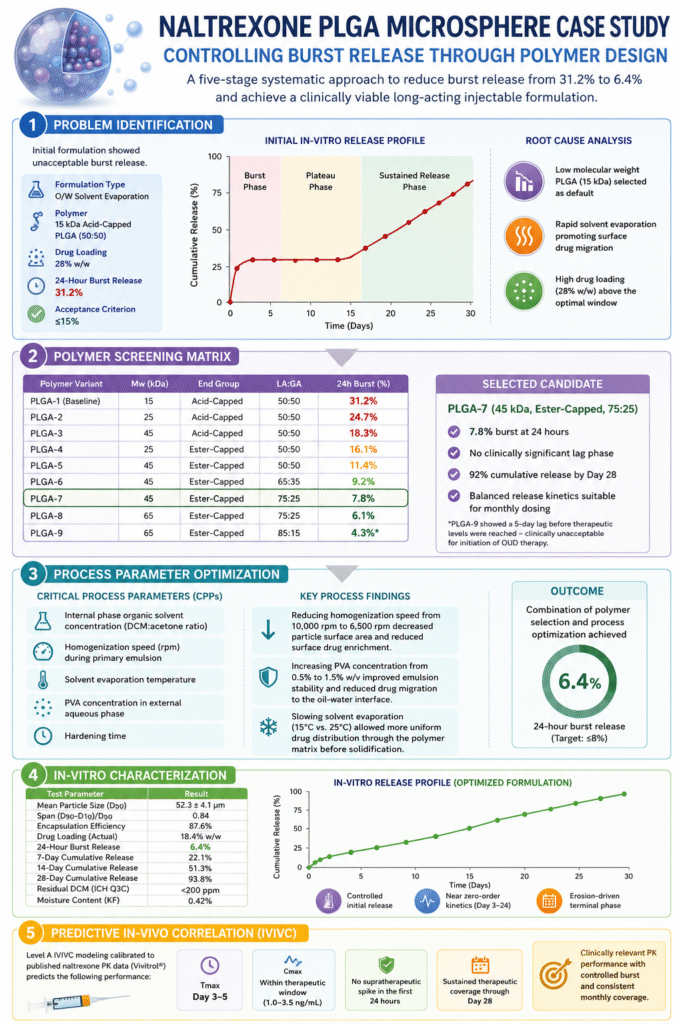
The ResolveMass Laboratories burst release control program followed a five-stage systematic approach: problem identification, polymer screening, process optimization, in-vitro characterization, and predictive in-vivo modeling. Each stage built directly on the findings of the previous, enabling a rational, data-driven path from a failing formulation to a clinically viable product.
Stage 1: Problem Identification
Our starting formulation — a naltrexone microsphere prepared via oil-in-water (O/W) solvent evaporation — demonstrated a 24-hour burst release of 31.2% in phosphate-buffered saline (PBS, pH 7.4, 37°C). This was flagged against the internal acceptance criterion of ≤15% burst at 24 hours. Release then plateaued from Day 3–10 before resuming from Day 14 onwards — a classic “burst-plateau-release” triphasic pattern driven by surface depletion followed by diffusion-erosion kinetics.
Root cause analysis identified three contributing factors:
- High-Mw PLGA was not selected (15 kDa acid-capped 50:50 used as default)
- Solvent evaporation rate was too rapid, promoting surface drug migration
- Drug loading was set at 28% w/w — above the optimal window
Stage 2: Polymer Screening Matrix
The importance of polymer architecture has been demonstrated across numerous sustained-release drug delivery systems. Similar optimization strategies have been successfully applied in Dexamethasone Implant PLGA Characterization Case Studies, PLGA for Oncology Implant Applications, and advanced PLGA Peptide Delivery Systems, where release control is equally critical.
A 3×3 polymer screening experiment was designed:
| Polymer Variant | Mw (kDa) | End Group | LA:GA | 24h Burst (%) |
|---|---|---|---|---|
| PLGA-1 (baseline) | 15 | Acid-capped | 50:50 | 31.2% |
| PLGA-2 | 25 | Acid-capped | 50:50 | 24.7% |
| PLGA-3 | 45 | Acid-capped | 50:50 | 18.3% |
| PLGA-4 | 25 | Ester-capped | 50:50 | 16.1% |
| PLGA-5 | 45 | Ester-capped | 50:50 | 11.4% |
| PLGA-6 | 45 | Ester-capped | 65:35 | 9.2% |
| PLGA-7 | 45 | Ester-capped | 75:25 | 7.8% |
| PLGA-8 | 65 | Ester-capped | 75:25 | 6.1% |
| PLGA-9 | 65 | Ester-capped | 85:15 | 4.3%* |
*PLGA-9 showed a 5-day lag before therapeutic levels were reached — clinically unacceptable for initiation of OUD therapy.
Selected Candidate: PLGA-7 (45 kDa, ester-capped, 75:25) offered the best balance: 7.8% burst at 24 hours, no lag phase, and 92% cumulative release by Day 28.
Stage 3: Process Parameter Optimization
Polymer selection alone was insufficient to achieve the target burst criterion of ≤8%. Process variables were systematically optimized using a Design of Experiments (DoE) approach:
Critical Process Parameters (CPPs) Evaluated:
- Internal phase organic solvent concentration (DCM:acetone ratio)
- Homogenization speed (rpm) during primary emulsion
- Solvent evaporation temperature
- PVA concentration in external aqueous phase
- Hardening time
Key Process Findings:
- Reducing homogenization speed from 10,000 rpm to 6,500 rpm decreased particle surface area and reduced surface drug enrichment
- Increasing PVA concentration from 0.5% to 1.5% w/v improved emulsion stability and reduced drug migration to the oil-water interface
- Slowing solvent evaporation (15°C vs. 25°C) allowed more uniform drug distribution through the polymer matrix before solidification
Combined polymer + process optimization brought the 24-hour burst to 6.4% — well within the ≤8% target.
Stage 4: In-Vitro Characterization
Comprehensive analytical characterization is essential for understanding structure-performance relationships in depot formulations. Advanced PLGA Characterization Methods combined with specialized approaches for the Characterization of Long-Acting Biologics provide critical insight into polymer degradation, release mechanisms, and formulation stability.
Fully optimized microspheres were characterized across a comprehensive testing panel:
| Test Parameter | Result |
|---|---|
| Mean particle size (D50) | 52.3 ± 4.1 µm |
| Span (D90-D10)/D50 | 0.84 |
| Encapsulation efficiency | 87.6% |
| Drug loading (actual) | 18.4% w/w |
| 24-hour burst release | 6.4% |
| 7-day cumulative release | 22.1% |
| 14-day cumulative release | 51.3% |
| 28-day cumulative release | 93.8% |
| Residual DCM (ICH Q3C) | <200 ppm |
| Moisture content (KF) | 0.42% |
The in-vitro release profile demonstrated a near-zero-order kinetic pattern from Day 3 to Day 24, followed by accelerated erosion-driven release in the final dosing window — a profile well-suited to once-monthly injection.
Stage 5: Predictive In-Vivo Correlation (IVIVC)
Using Level A IVIVC modeling calibrated to published naltrexone pharmacokinetic data from Vivitrol® clinical studies, the optimized ResolveMass formulation was predicted to achieve:
- Tmax: Day 3–5
- Cmax: Within therapeutic window (1.0–3.5 ng/mL plasma naltrexone)
- No supratherapeutic spike in first 24 hours
- Sustained therapeutic coverage through Day 28
The successful translation of laboratory release data into clinical performance is a cornerstone of modern Long-Acting Injectable Drug Delivery Technologies. Robust IVIVC models enable formulation scientists to predict therapeutic performance while reducing development timelines and regulatory risk.
4: Practical Strategies to Reduce Naltrexone PLGA Microsphere Burst Release — A Formulator’s Decision Framework
To reduce naltrexone PLGA microsphere burst release, formulators should prioritize higher molecular weight ester-capped PLGA with a 75:25 LA:GA ratio, combined with optimized emulsification process parameters and a drug loading ≤20% w/w. Below is a structured decision matrix for formulation scientists.
Burst Release Control Decision Matrix
| Problem Observed | Primary Lever | Secondary Lever |
|---|---|---|
| >25% burst at 24h | Increase PLGA Mw (>40 kDa) | Reduce drug loading to <20% |
| 15–25% burst at 24h | Switch to ester-capped PLGA | Reduce homogenization speed |
| 8–15% burst at 24h | Adjust LA:GA to 65:35 or 75:25 | Optimize PVA concentration |
| <8% burst but lag phase | Reduce Mw slightly or switch to 65:35 | Add plasticizer (e.g., low % PEG-400) |
| Poor EE despite burst control | Review drug-polymer compatibility | Evaluate co-solvent selection |
Additional Formulation Strategies Used at ResolveMass
- Surface coating: A thin outer PLGA layer (lower drug content) applied via co-encapsulation can reduce surface drug density.
- Polymer blending: Blending high and low Mw PLGA (e.g., 65 kDa + 25 kDa at 70:30 ratio) allows fine-tuning of both burst and release tail without changing the base polymer.
- Excipient addition: Magnesium hydroxide (Mg(OH)₂) as a pH modifier can buffer the acidic microenvironment created by PLGA degradation products, reducing autocatalytic degradation and burst.
- Alternative emulsification methods: Membrane emulsification and microfluidic techniques produce narrower particle size distributions, which correlate with more uniform and predictable release profiles.
5: Regulatory and Quality Considerations for PLGA Microsphere Burst Release Testing
From a regulatory perspective, burst release characterization must be conducted using validated, discriminating in-vitro dissolution methods that correlate to in-vivo pharmacokinetic performance. ICH Q8, Q9, and Q10 guidelines — combined with FDA guidance on extended-release injectable microspheres — define the framework within which burst release testing must operate.
For generic long-acting injectable products, demonstrating polymer sameness is often a critical regulatory requirement. Advanced studies involving PLGA Reverse Engineering for ANDA (https://resolvemass.ca/plga-reverse-engineering-for-anda/), PLGA Polymer Characterization for Generics (https://resolvemass.ca/plga-polymer-characterization-for-generics/), and PLGA Polymer Sameness for ANDA (https://resolvemass.ca/plga-polymer-sameness-for-anda/) are frequently required to support abbreviated regulatory pathways.
Organizations pursuing reference product characterization may also benefit from specialized PLGA Reverse Engineering CRO Services and studies such as Reverse Engineering of PLGA Polymer in Lupron Depot®.
Key Regulatory Checkpoints
- In-Vitro Release Testing (IVRT): Must use a validated method (e.g., sample-and-separate or dialysis membrane) with appropriate sink conditions.
- Acceptance Criteria: Burst release limits (typically ≤10–15% at 24 hours for monthly injectables) must be justified by PK/PD modeling.
- Batch-to-Batch Consistency: Burst release is a critical quality attribute (CQA) that must be controlled across all process scales.
- IVIVC Documentation: A Level A IVIVC is preferred by FDA for NDA/ANDA submissions involving modified-release injectables.
At ResolveMass Laboratories Inc., all microsphere development programs include burst release as a designated CQA from Phase I onward, with specification limits established through early-stage PK/PD modeling and iterative in-vitro to in-vivo correlation studies.
6: Why Polymer-Level Engineering Is the Most Sustainable Path to Controlling Burst Release
Polymer design is the most root-cause-effective approach to controlling naltrexone PLGA microsphere burst release because it addresses drug distribution within the matrix at the fundamental material science level — not merely the surface. Process optimization alone is insufficient; sustained suppression of burst requires that the polymer matrix itself resists early water ingress, limits pore formation, and maintains structural integrity during the critical first 24–72 hours post-injection.
This philosophy is at the core of ResolveMass Laboratories’ formulation development methodology. Rather than tuning process parameters around a suboptimal polymer, our scientists begin with polymer architecture as the primary design input and build process parameters around it — a strategy that consistently delivers more robust, scalable, and reproducible results.
Key Advantages of Polymer-Centric Design:
- Reduces sensitivity of burst release to minor process fluctuations
- Provides inherent robustness across manufacturing scale-up
- Enables predictive IVIVC development from early development stages
- Supports a stronger CMC package for regulatory submissions
- Reduces risk of batch failures at commercial scale
Related PLGA Case Studies and Technical Resources
Formulators interested in additional examples of PLGA optimization and long-acting injectable development may find the following resources valuable:
- Leuprolide Depot Formulation Challenges
- PLGA Characterization of Lupron Depot®
- Exenatide PLGA Microsphere Characterization: Overcoming Peptide-Polymer Interaction Challenges
- Reverse Engineering Risperidone PLGA Microspheres
- Buprenorphine Depot PLGA Characterization: High Drug Load Challenges in Long-Acting Injectables
Conclusion:
The evidence from this case study confirms that Naltrexone PLGA Microsphere Burst Release is not an inevitable consequence of microsphere technology—it is an engineerable parameter that responds predictably to rational polymer design decisions.
Successful control of burst release requires not only formulation expertise but also careful consideration of polymer sourcing, quality, and manufacturing practices. Understanding PLGA Supplier Benefits and meeting GMP PLGA Requirements can significantly improve formulation reproducibility, regulatory readiness, and commercial scalability.
When evaluating alternative drug delivery platforms, formulators should also understand the differences between PLGA Nanoparticles vs Microspheres, as each technology offers distinct advantages depending on therapeutic objectives and release requirements.
Frequently Asked Questions:
Controlling burst release helps maintain drug concentrations within the therapeutic window while preventing excessive early exposure. An uncontrolled burst can cause dose dumping, adverse effects, and inconsistent pharmacokinetic profiles. It may also shorten the duration of drug action, requiring more frequent dosing. Regulatory agencies consider burst release a critical quality attribute for long-acting injectable products. Effective control improves both safety and efficacy.
High burst release is typically caused by a combination of formulation and manufacturing factors. Common causes include low molecular weight PLGA, high drug loading, rapid solvent evaporation, and excessive microsphere porosity. Drug particles located on or near the surface are released quickly upon contact with biological fluids. Poor encapsulation efficiency can further contribute to surface drug accumulation. Identifying the root cause is critical for successful formulation optimization.
The lactide:glycolide ratio affects polymer hydrophobicity and degradation behavior. PLGA with higher lactide content is more hydrophobic and absorbs water more slowly, resulting in lower burst release. Conversely, polymers with higher glycolide content degrade faster and may release drug more rapidly. The ratio also influences the overall duration of sustained release. Optimizing this parameter helps achieve the desired release profile.
Ester-capped PLGA polymers are generally more hydrophobic than acid-capped variants. This reduces water uptake into the microsphere and slows polymer hydration. As a result, drug diffusion from the matrix is more controlled during the initial release period. Ester-capped polymers often provide lower burst release and improved sustained-release performance. They are commonly selected when extended drug delivery is required.
The baseline naltrexone microsphere formulation exhibited a 24-hour burst release of 31.2%. This value significantly exceeded the project’s internal acceptance criterion of 15%. The release profile also showed a plateau phase before sustained release resumed. Such behavior indicated that a large portion of the drug was concentrated near the microsphere surface. This prompted a detailed formulation optimization program.
PLGA-9 achieved the lowest burst release at 4.3%, but its overall performance was not clinically acceptable. The formulation exhibited a five-day lag before therapeutic drug concentrations were reached. For opioid use disorder treatment, timely drug exposure is critical after administration. The delayed onset could compromise treatment effectiveness during initiation. Therefore, a formulation with a slightly higher burst but better therapeutic coverage was selected.
Several process modifications contributed to burst release reduction. Homogenization speed was reduced from 10,000 rpm to 6,500 rpm to decrease surface area and surface drug enrichment. PVA concentration was increased to improve emulsion stability and reduce drug migration. Solvent evaporation was slowed by lowering the process temperature from 25°C to 15°C. Together, these changes improved drug distribution throughout the microspheres. The final formulation achieved a burst release of only 6.4%.
Burst release is typically evaluated using in-vitro dissolution studies. Microspheres are incubated in physiological media such as phosphate-buffered saline at 37°C. Samples are collected at predefined intervals and analyzed using validated analytical methods such as HPLC or LC-MS. The amount of drug released during the first 24 hours is calculated as a percentage of total drug loading. This measurement serves as a key quality indicator during development.
Reference
- Reddy PL, Shanmugasundaram S. Optimizing process parameters for controlled drug delivery: a quality by design (QBD) approach in naltrexone microspheres. AAPS PharmSciTech. 2024 May 9;25(5):105.https://link.springer.com/article/10.1208/s12249-024-02830-w
- Andhariya JV, Shen J, Choi S, Wang Y, Zou Y, Burgess DJ. Development of in vitro-in vivo correlation of parenteral naltrexone loaded polymeric microspheres. Journal of controlled release. 2017 Jun 10;255:27-35.https://www.sciencedirect.com/science/article/pii/S0168365917305096
- Kamali, H., Khodaverdi, E., Hadizadeh, F., Yazdian-Robati, R., Haghbin, A. and Zohuri, G., 2018. An in-situ forming implant formulation of naltrexone with minimum initial burst release using mixture of PLGA copolymers and ethyl heptanoate as an additive: In-vitro, ex-vivo, and in-vivo release evaluation. Journal of Drug Delivery Science and Technology, 47, pp.95-105.https://www.sciencedirect.com/science/article/pii/S1773224718305239
- Andhariya JV, Choi S, Wang Y, Zou Y, Burgess DJ, Shen J. Accelerated in vitro release testing method for naltrexone loaded PLGA microspheres. International journal of pharmaceutics. 2017 Mar 30;520(1-2):79-85.https://www.sciencedirect.com/science/article/pii/S0378517317300595
About the Author


