
Introduction:
Deriving an NDSRI Acceptable Intake Limit for a novel nitrosamine drug substance-related impurity with no existing toxicology data is one of the harder problems in pharmaceutical development. The impurity may lack compound-specific carcinogenicity studies, published potency values, or a regulatory limit. Yet the absence of direct toxicology data does not make a scientifically justified risk assessment impossible.
NDSRIs are structurally related to the active pharmaceutical ingredient (API) and may form during manufacturing, storage, or degradation. Because every API is different, every NDSRI is different, and no single value fits all of them. Manufacturers must combine regulatory guidance, structural analysis, predictive toxicology, experimental evidence, exposure assessment, and analytical characterization to reach a defensible limit that protects patients and reflects the evidence rather than an assumption.
This matters most when preparing ANDAs, NDAs, or other submissions in which a newly identified NDSRI has no established acceptable intake (AI).
Summary:
- An NDSRI acceptable intake limit is a scientifically justified daily exposure limit (in ng/day) for a nitrosamine drug substance-related impurity, established from toxicological, structural, mechanistic, and analytical evidence.
- With no toxicology data, the limit is derived through a weight-of-evidence approach: impurity characterization, structure-activity relationship (SAR) assessment, the Carcinogenic Potency Categorization Approach (CPCA), read-across, computational predictions, and targeted experimental testing.
- CPCA is a key first tool, assigning eligible nitrosamines to one of five potency categories (AIs from 1,500 ng/day down to 26.5 ng/day under FDA guidance), but its applicability must be confirmed for each impurity.
- If evidence is insufficient, regulators expect a conservative default limit (26.5 ng/day under FDA guidance; 18 ng/day under EMA guidance).
- Ames testing helps but does not settle the limit: a negative result does not automatically establish a safe exposure level.
- The AI must become a product limit: concentration (ppm) = AI (ng/day) ÷ maximum daily dose (mg/day).
- Analytical methods (LC-MS/MS, LC-HRMS) must quantify the NDSRI at or below that limit.
- A defensible limit needs documented rationale, managed uncertainty, regulatory alignment, and periodic reassessment.
1: What Is an NDSRI Acceptable Intake Limit?
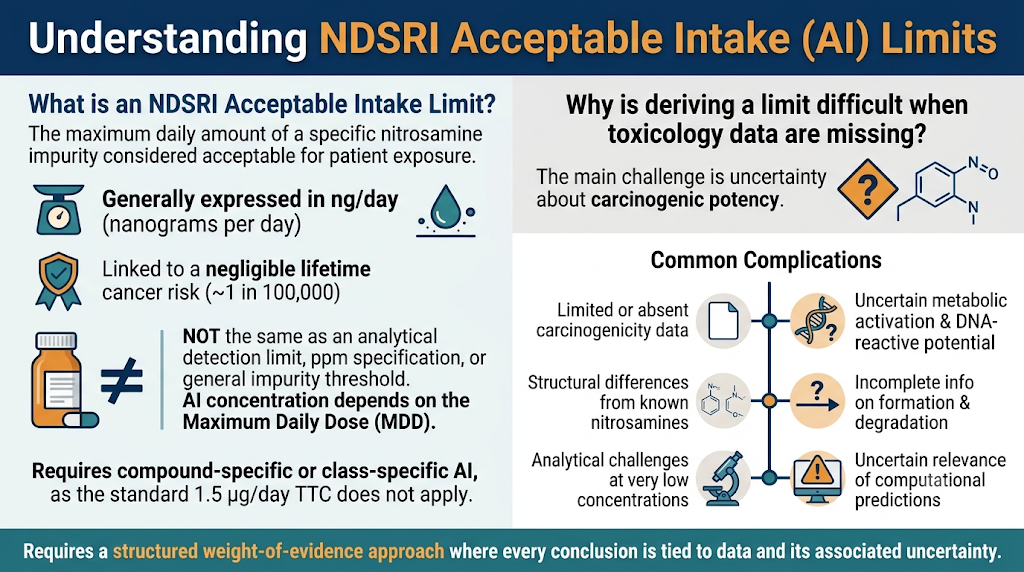
An NDSRI acceptable intake limit is the maximum daily amount of a specific nitrosamine impurity considered acceptable for patient exposure under a defined regulatory and toxicological framework, generally expressed in nanograms per day (ng/day). It is conventionally linked to a negligible lifetime cancer risk of about 1 in 100,000.
It is not the same as an analytical detection limit, a ppm specification, or a general impurity threshold. An AI of 100 ng/day means the assessed daily intake should not exceed 100 nanograms; it does not mean every product can adopt the same concentration limit, because the concentration specification depends on the maximum daily dose.
Because nitrosamines fall within the “cohort of concern” under ICH M7(R2), the standard 1.5 µg/day threshold of toxicological concern does not apply. A compound-specific or class-specific AI is required. Understanding how NDSRIs differ from simple nitrosamines is a useful starting point, since small, well-studied nitrosamines such as NDMA or NDEA have data that NDSRIs typically lack.
Why Is Deriving a Limit Difficult When Toxicology Data Are Missing?
The main challenge is uncertainty about carcinogenic potency. Without compound-specific data, assessors cannot be sure whether the NDSRI behaves like a potent known nitrosamine or has a very different profile. Common complications include:
- Limited or absent carcinogenicity data
- Uncertain metabolic activation and DNA-reactive potential
- Structural differences from known nitrosamines
- Incomplete information on impurity formation and degradation
- Analytical challenges at very low concentrations
- Uncertain relevance of computational predictions
These limitations call for a structured weight-of-evidence approach in which each conclusion is tied to data and its associated uncertainty.
2: Which Regulatory Guidance Applies to an NDSRI Acceptable Intake Limit?
The appropriate framework depends on the compound, the evidence, and the regulator, but FDA’s nitrosamine guidance, CPCA, and ICH M7(R2) form the core references.
| Guidance or framework | Relevance to NDSRI assessment |
|---|---|
| FDA guidance on controlling nitrosamine impurities in human drugs | Recommendations for identifying, assessing, and controlling nitrosamines, including NDSRIs |
| FDA / EMA Carcinogenic Potency Categorization Approach (CPCA) | Structure-based potency categories and associated AI values for eligible nitrosamines |
| ICH M7(R2) | Framework for DNA-reactive mutagenic impurities, including SAR assessment and TTC where applicable |
| ICH Q9(R1) | Risk-based quality decisions and management of scientific uncertainty |
| Regional regulatory communications | May provide compound-specific AIs or updated recommendations that supersede earlier assumptions |
Recommendations change as new data emerge, so check the current guidance and any compound-specific recommendation before finalizing a limit. A generic TTC, a CPCA value, or an AI set for another nitrosamine should never be adopted automatically without confirming it applies to your impurity.
3: How Do You Derive an NDSRI Acceptable Intake Limit Without Existing Toxicology Data?
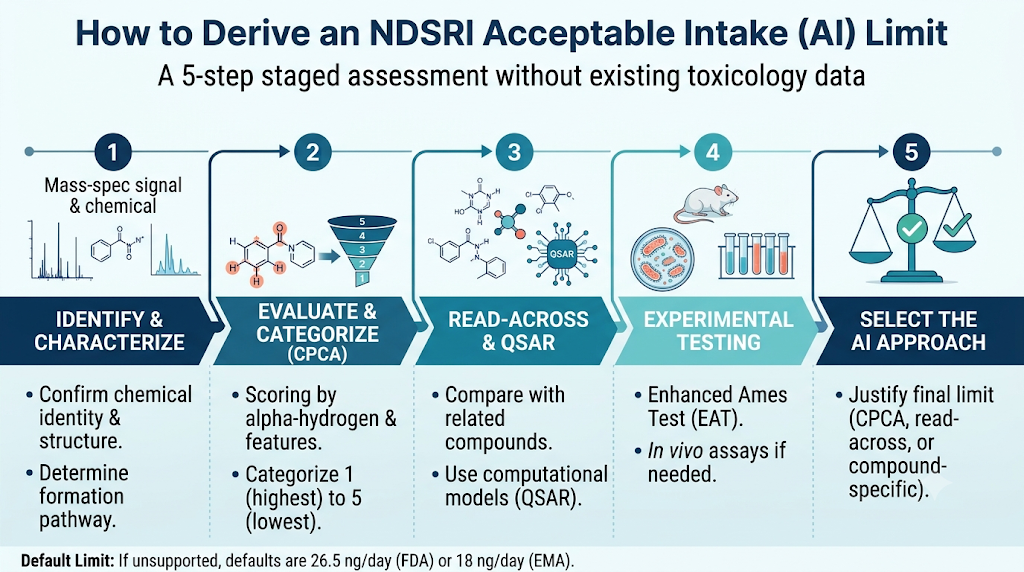
You derive it through a staged assessment: identify the impurity, evaluate its structure, assess mutagenicity and potency, determine whether a regulatory or justified read-across value exists, and convert the resulting AI into a product-specific limit.
| Step | Activity | Output |
|---|---|---|
| 1 | Identify and characterize the NDSRI | Confirmed structure and formation pathway |
| 2 | Evaluate structure and potency (CPCA) | Potency category and AI (ng/day) |
| 3 | Read-across and computational toxicology | Supporting or alternative evidence |
| 4 | Experimental testing (Ames/EAT, in vivo) | Data to confirm or refine the AI |
| 5 | Select the AI approach | Justified AI with documented rationale |
Step 1: Identify and Characterize the Novel NDSRI
Start by establishing the impurity’s chemical identity and how it forms. A tentative mass-spectrometry signal is not enough; a reliable assessment needs a confirmed structure. Characterization should address:
- Molecular formula, weight, and the nitrosamine functional group
- Relationship to the API and relevant intermediates
- Formation pathways during synthesis, degradation, or storage
- Formulation conditions, excipient-derived nitrite, and processing factors
- Positional, stereochemical, or other structural isomers
Techniques such as LC-HRMS, LC-MS/MS, and NMR support this work. A sound nitrosamine risk assessment and trace-level NDSRI testing programme anchors this step, and the amine type matters: secondary amines in peptide molecules, for example, raise distinct questions covered in nitrosamine risk assessment for peptide APIs. Drug classes with vulnerable amine groups, such as antidepressants and SSRIs, are also frequent sources of NDSRIs. The identity must be established before any structural alert, model, or read-across is interpreted. A misassigned structure leads to the wrong potency category and the wrong limit.
Step 2: Evaluate Structure and Apply the Carcinogenic Potency Categorization Approach (CPCA)
CPCA predicts carcinogenic potency from structural features that influence metabolic activation (alpha-hydroxylation), placing an NDSRI in one of five categories with pre-defined AIs.
| CPCA Category | Potency Concern | Typical AI (FDA) | Typical AI (EMA) |
|---|---|---|---|
| 1 | Highest | 26.5 ng/day | 18 ng/day |
| 2 | High | 100 ng/day | 100 ng/day |
| 3 | Moderate | 400 ng/day | 400 ng/day |
| 4 | Lower | 1,500 ng/day | 1,500 ng/day |
| 5 | Lowest | 1,500 ng/day | 1,500 ng/day |
Verify values against the current version of each agency’s guidance.
How the scoring works in practice:
- Alpha-hydrogen count: The number and type of hydrogens on carbons adjacent to the N-nitroso group is the most influential factor. With no alpha-hydrogens, the standard activation pathway is blocked, pointing to the lowest-concern category.
- Deactivating features: Steric hindrance, electron-withdrawing groups, or certain ring structures can lower predicted potency.
- Activating features: Specific substituents can raise predicted potency.
A qualified assessment should (1) identify the nitrosamine structural class, (2) confirm the compound falls within CPCA scope, (3) evaluate activating and deactivating features, (4) assign a category only where the framework supports it, and (5) document limitations and uncertainties.
Important: CPCA is not a universal formula. A novel NDSRI outside its applicability, or with unresolved structural uncertainty, may need additional evidence or a different justified approach. Linking identification, potency prediction, and confirmation in one workflow is described in more detail in NDSRI identification, potency prediction and confirmatory quantification.
Step 3: Use Read-Across and Computational Toxicology
When direct data are missing, read-across and computational toxicology estimate hazard by comparing the NDSRI with structurally or mechanistically related compounds, such as nitrosamines with TD50 values from long-term rodent studies. Read-across must go beyond surface similarity to consider the nitrosamine environment, metabolic activation, electronic properties, mechanism, and the quality of the source data.
Computational approaches may include:
- Quantitative structure-activity relationship (QSAR) models
- Expert-rule-based mutagenicity predictions
- Analogue comparisons with well-characterized nitrosamines
- Mechanistic evaluation of metabolic activation
- Weight-of-evidence integration across independent lines of evidence
Document the selected analogues, data quality, the basis for similarity, and any differences that could affect potency. Read-across is most defensible when it agrees with the CPCA result; if the two disagree, regulators generally expect the more conservative value unless experimental data justify otherwise. Predictions are evidence, not proof, and conflicting outputs or a lack of suitable analogues may justify testing or regulatory consultation.
Step 4: Generate Experimental Evidence Where Necessary
Experimental testing is warranted when predictions are inconclusive, the compound falls outside CPCA, or regulators expect more evidence. Options include:
- Enhanced Ames Test (EAT): A bacterial reverse mutation assay with conditions optimized for nitrosamines (for example, specific S9 concentrations and pre-incubation). A well-conducted negative EAT can be an important part of the evidence package.
- In vivo mutagenicity assays: Transgenic rodent (TGR) gene mutation assays assess mutagenic activity in a whole-animal system with relevant metabolism.
- Other genotoxicity or supportive studies: Selected according to the unresolved scientific question.
Design the strategy around that question. An Ames test assesses bacterial mutagenic potential; it does not quantify lifetime human cancer risk or independently set an AI. A negative result must be read alongside assay suitability, test conditions, metabolic activation, compound stability, and the full weight of evidence, while a positive result calls for careful mechanistic evaluation. Testing needs well-characterized, sufficiently pure NDSRI reference material, and should be chosen for scientific need, not to obtain a preferred limit.
Step 5: Select the Appropriate Acceptable Intake Approach
Once the evidence is evaluated, select a scientifically and regulatorily justified AI approach. Possible pathways are:
- CPCA-based AI: Use the potency category’s recommended AI when the compound is eligible.
- Compound-specific AI: Use a limit set by the regulator or supported by suitable compound-specific toxicology.
- Justified read-across: Use an appropriate analogue when similarity and limitations are documented.
- Alternative toxicological assessment: Develop a justified approach when standard methods are unsuitable.
The final AI must be traceable to its evidence, assumptions, and regulatory rationale. The generic ICH M7 TTC should not be assumed to resolve an NDSRI assessment where nitrosamine-specific recommendations apply.
What If You Cannot Support a Compound-Specific Limit?
Regulators expect the conservative default limit: 26.5 ng/day under FDA guidance or 18 ng/day under EMA guidance. This default derives from the potent nitrosamine NDEA using linear extrapolation to a 1-in-100,000 lifetime risk. It is protective but operationally demanding, requiring very sensitive methods, which is why a proper NDSRI Acceptable Intake Limit assessment often pays off.
4: How Is the Acceptable Intake Converted into a Drug Product Limit?
Divide the daily AI by the maximum daily drug product intake on a consistent mass basis.
- Maximum impurity concentration (ng/g) = AI (ng/day) ÷ maximum daily intake (g/day)
- Maximum impurity concentration (ppm) = AI (ng/day) ÷ maximum daily intake (mg/day), since 1 ng/mg equals 1 ppm by mass
Example (illustrative only): For a hypothetical NDSRI with a justified AI of 100 ng/day and a maximum daily dose of 500 mg/day: 100 ÷ 500 = 0.2 ng/mg = 0.2 ppm. This is not a recommended AI for any real NDSRI.
For multiple strengths, combination products, variable dosing, or multiple exposure sources, use the applicable maximum daily exposure scenario. Where several nitrosamines are present, consider the requirements for combined exposure and control.
5: What Role Does Analytical Testing Play in Confirming the Limit?
Analytical testing shows whether the NDSRI can be measured reliably at concentrations relevant to the proposed AI. The method must be fit for purpose, with adequate sensitivity, selectivity, accuracy, precision, and suitable controls.
| Technique | Role |
|---|---|
| LC-MS/MS | Targeted quantification using precursor and product ions |
| LC-HRMS | Accurate-mass characterization and interference investigation |
| GC-MS or GC-MS/MS | Suitable for analytes amenable to gas chromatography |
| Qualified reference standards | Identification and quantification support |
Method development should address matrix effects, recovery, carryover, stability, and the risk of impurity formation or loss during analysis. Careful sample preparation strategies for nitrosamine testing are essential to avoid artifactual nitrosamine formation. For limits in the low ng/day range, the required limit of quantitation can be very low; for example, a 26.5 ng/day AI with a 100 mg daily dose corresponds to roughly 0.27 ppm. Challenges at these levels are examined in NDSRI quantification at ultra-low levels.
A method that cannot quantify the impurity at the required control level cannot demonstrate compliance. Detecting an impurity does not by itself establish unacceptable risk, and a result below the detection limit does not prove absence.
6: How Should Uncertainty Be Managed in a Novel NDSRI Risk Assessment?
Document uncertainty explicitly, address it through weight-of-evidence assessment and proportionate testing, and reassess when new information appears. Key sources of uncertainty include:
- Incomplete chemical characterization
- Limited structural comparators
- Conflicting computational predictions
- Uncertain metabolic pathways
- Insufficient experimental data
- Analytical variability near the proposed limit
- Manufacturing or formulation changes that affect impurity formation
Distinguish established facts, reasonable inferences, and unresolved questions, and explain why the chosen approach is appropriate despite remaining uncertainty. Risk management actions may include tighter process controls, targeted degradation studies, additional monitoring, reference material qualification, or regulatory consultation.
7: What Should Be Included in the Regulatory Documentation?
A strong package lets reviewers trace the proposed AI from impurity identity through scientific rationale to the product specification.
- Impurity identification: Structure, formula, analytical evidence, formation pathway
- Regulatory assessment: Applicable guidance and justification for the approach
- Toxicological evaluation: CPCA applicability, SAR/QSAR results, analogue selection, experimental findings, uncertainty
- AI derivation: Proposed value, basis, exposure assumptions, duration considerations
- Product-specific calculation: Maximum daily dose, concentration limit, assumptions
- Analytical control strategy: Validation evidence, sensitivity, specificity, quality controls
- Lifecycle management: Monitoring, change control, reassessment triggers
The level of detail should be proportionate to the impurity’s complexity and the uncertainty about its hazard.
8: Common Mistakes When Setting an NDSRI Acceptable Intake Limit
- Skipping structural confirmation and scoring CPCA on an assumed structure
- Treating CPCA as a final answer without checking its scope
- Relying on weak read-across based on similarity alone
- Running non-optimized Ames conditions and over-interpreting a negative result
- Setting an AI the analytical method cannot measure
- Not revisiting the AI as guidance and data evolve
How Can ResolveMass Laboratories Inc. Support NDSRI Assessment?
ResolveMass Laboratories Inc., a Canadian analytical CRO/CDMO with expertise in mass spectrometry and nitrosamine testing, supplies the analytical evidence that underpins an NDSRI assessment. The final toxicological AI determination requires a qualified scientific and regulatory evaluation, but our work provides the foundation it depends on:
- LC-MS/MS method development and quantitative impurity analysis
- LC-HRMS characterization of unknown or suspected impurities
- Structural investigation using complementary techniques
- Method validation, verification, or transfer
- Investigation of impurity formation and stability-related changes
- Documentation to support quality and regulatory submissions
Analytical characterization confirms what the impurity is and how much is present; toxicological assessment determines how the evidence informs an acceptable intake. Collaboration among analytical scientists, toxicologists, process chemists, and regulatory specialists produces the most coherent evidence package.
Conclusion:
Deriving an NDSRI Acceptable Intake Limit without existing toxicology data requires a structured, evidence-based assessment rather than an automatic generic threshold. The process runs from reliable impurity identification through CPCA, read-across, computational predictions, and experimental testing where needed, to a justified AI that is translated into a product-specific concentration limit and supported by a fit-for-purpose analytical method. Clear documentation of uncertainty, assumptions, and regulatory rationale makes the conclusion defensible.
Frequently Asked Questions:
Yes. Quantitative structure–activity relationship (QSAR) models can help predict potential mutagenicity or identify structural alerts when experimental data are unavailable. However, predictions must be evaluated alongside structural similarity, model applicability, expert assessment, and other available evidence.
Read-across estimates the potential toxicity of an impurity using data from a sufficiently similar, better-characterized compound. A defensible assessment should explain the structural and mechanistic similarities, differences in metabolic behavior, and limitations of the available analogue data.
No. The bacterial reverse mutation (Ames) test provides evidence about mutagenic potential but does not independently establish a lifetime carcinogenic risk or an acceptable intake limit. Results should be interpreted alongside structural assessment, computational predictions, applicable regulatory guidance, and other relevant toxicological evidence.
An acceptable intake limit for a nitrosamine is generally expressed as the amount of impurity that may be taken daily under a defined risk-based framework. A permitted daily exposure (PDE) is a toxicologically derived daily exposure limit commonly used for pharmaceutical impurities and residual substances. The appropriate terminology and derivation depend on the specific impurity and applicable guidance.
Divide the acceptable intake in ng/day by the maximum daily drug product intake in mg/day. The resulting value is expressed in ng/mg, numerically equivalent to ppm by mass.
For example, an illustrative AI of 100 ng/day and a maximum daily dose of 500 mg/day produce a concentration limit of 0.2 ppm, subject to the applicable regulatory requirements and exposure assumptions.
Reference
- Novello C, De Marzi L, Mastrocola E, Bassan A, Zucchi S, Boltri L, Pavan M. Application of read-across to data-poor N-nitrosamines: N-nitroso-ulifloxacin, a case study. Regulatory Toxicology and Pharmacology. 2026 Jun 7:106155.https://www.sciencedirect.com/science/article/pii/S0273230026001285
- Jolly RA, Cornwell PD, Noteboom J, Sayyed FB, Thapa B, Buckley LA. Estimation of acceptable daily intake values based on modeling and in vivo mutagenicity of NDSRIs of fluoxetine, duloxetine and atomoxetine. Regulatory Toxicology and Pharmacology. 2024 Sep 1;152:105672.https://www.sciencedirect.com/science/article/pii/S0273230024001132
- Fine J, Allain L, Schlingemann J, Ponting DJ, Thomas R, Johnson GE. Nitrosamine acceptable intakes should consider variation in molecular weight: the implication of stoichiometric DNA damage. Regulatory Toxicology and Pharmacology. 2023 Dec 1;145:105505.https://www.sciencedirect.com/science/article/pii/S0273230023001733
- Bercu J, Dirat O, Dobo K, Jolly R, Kenyon M, Harvey J, Nudelman R, Smith G, Trejo-Martin A, Urquhart M. N-Nitrosamine drug substance related impurities (NDSRIs)–A proposal for the addition of subcategories to carcinogenic potency categorization approach categories 1 and 2 for NDSRIs with a molecular weight> 200 Da. Regulatory Toxicology and Pharmacology. 2024 Dec 1;154:105704.https://www.sciencedirect.com/science/article/pii/S0273230024001454
About the Author