

Introduction
NDSRI Quantification at Ultra-Low Levels requires advanced liquid chromatography-tandem mass spectrometry (LC-MS/MS) methodologies capable of detecting mutagenic impurities at single-digit parts-per-billion (ppb) concentrations within complex active pharmaceutical ingredient (API) matrices. When regulatory authorities establish an Acceptable Intake (AI) limit of 10 ng/day based on the Carcinogenic Potency Categorization Approach (CPCA), analytical methods must achieve lower limits of quantitation (LOQ) significantly below conventional detection thresholds to support patient safety and meet regulatory expectations. Nitrosamine Drug Substance-Related Impurities (NDSRIs) comprise a complex class of structural nitrosamines that can form when secondary or tertiary amine moieties within API molecules react with trace nitrosating agents originating from excipients, solvents, or water systems. Since NDSRIs retain structural characteristics that are identical or closely related to those of their parent drug molecules, developing selective, highly sensitive, and matrix-resilient analytical assays presents substantial chromatographic and mass spectrometric challenges. Specialized testing laboratories employ high-sensitivity triple quadrupole mass spectrometers, fluorinated stationary phases, and stable isotope dilution techniques to address severe matrix suppression, artifactual nitrosation during extraction, and rotameric peak splitting.
Understand the fundamentals behind these compounds with our guide on what are nitrosamines.
Share via:
Article Summary:
- Ultra-low NDSRI quantification is essential for drugs with very low Acceptable Intake (AI) limits, such as 10 ng/day, requiring highly sensitive LC-MS/MS methods capable of sub-ppb detection.
- For a 2000 mg/day maximum daily dose, a 10 ng/day AI corresponds to an API specification limit of 5 ppb, with a target LOQ well below this level to meet regulatory expectations.
- Major analytical challenges include matrix suppression from high API concentrations, artifactual nitrosamine formation during sample preparation, and rotameric peak splitting caused by restricted N–N bond rotation.
- Effective method development combines PFP/phenyl-hexyl chromatographic separation, triple-quadrupole/QTRAP MS in MRM mode, and stable isotope-labeled internal standards to improve selectivity and quantitative accuracy.
- The case study achieved an LOQ of 0.25 ng/mL (0.7 ppb in API), with excellent linearity (R² = 0.9991), accuracy of 94.2–106.8%, and precision below 5% RSD.
- A 14-minute PFP gradient separated NDSRIs from the parent API, while diverting the high-concentration API peak to waste significantly reduced ion-source contamination and matrix suppression.
- A four-phase compliance strategy—risk assessment → confirmatory testing → formulation/process remediation → regulatory filing—helps control NDSRIs below the AI limit and supports compliance with ICH Q2(R2), USP, and regulatory requirements.
Regulatory Framework for NDSRI Quantification at Ultra-Low Levels
The regulatory framework for establishing specifications for nitrosamine drug substance-related impurities is based on determining the Analytical Evaluation Threshold (AET) in relation to the drug’s Maximum Daily Dose (MDD) and toxicological Acceptable Intake (AI). For pharmaceutical products subject to a highly conservative AI limit of 10 ng/day, regulatory expectations require analytical methods to be validated at levels corresponding to 30% to 50% of the calculated specification limit under International Council for Harmonisation (ICH) Q2(R2) and USP standards.
The maximum permitted concentration of an NDSRI in an active pharmaceutical ingredient or finished drug product can be determined using the following mathematical relationship:
Specification Limit (ppm) = Acceptable Intake (ng/day) ÷ Maximum Daily Dose (mg/day)
When assessing a high-dose active pharmaceutical ingredient, such as Trientine or similar polyamine therapies administered at doses of up to 2000 mg/day, an AI limit of 10 ng/day results in the following specification limit for the solid API:
Specification Limit = 10 ng/day ÷ 2000 mg/day = 0.005 ppm = 5 ppb (or 5 ng/mg)
For robust method validation under ICH Q2(R2) and USP standards, the lower limit of quantitation (LOQ) should reliably reach approximately 30% to 50% of the established specification threshold:
Target LOQ = 0.30 × 5 ppb = 1.5 ppb (1.5 ng/g or 0.15–0.25 ng/mL in solution)
| CPCA Potency Category | Predicted Carcinogenic Potency (TD50 Range) | Standard Acceptable Intake (AI) Limit | Required API LOQ Range (MDD = 100 mg/day) | Required API LOQ Range (MDD = 2000 mg/day) |
|---|---|---|---|---|
| Category 1 | TD50 ≤ 0.15 mg/kg/day | 26.5 – 100 ng/day | 0.080 – 0.300 ppm | 0.004 – 0.015 ppm |
| High-Risk Category 1 / Case Study | Highly Potent Mutagenic Structure | 10 ng/day | 0.030 ppm (30 ppb) | 0.0015 ppm (1.5 ppb) |
| Category 2 | 0.15 < TD50 ≤ 1.5 mg/kg/day | 100 – 400 ng/day | 0.300 – 1.200 ppm | 0.015 – 0.060 ppm |
| Category 3 | 1.5 < TD50 ≤ 15 mg/kg/day | 400 – 1500 ng/day | 1.200 – 4.500 ppm | 0.060 – 0.225 ppm |
| Category 4 / 5 | TD50 > 15 mg/kg/day | 1500 – 12000 ng/day | 4.500 – 36.00 ppm | 0.225 – 1.800 ppm |
Technical Challenges in NDSRI Quantification at Ultra-Low Levels
Technical challenges associated with quantifying complex nitrosamines at ultra-trace concentrations are largely driven by the substantial dynamic range difference between high-concentration drug active ingredients and parts-per-billion impurities, resulting in significant electrospray ionization signal suppression. Other analytical complications include the formation of artifactual nitrosamines during sample extraction and conformational rotamer peak splitting caused by restricted rotation around the nitrogen-nitrogen bond.
Learn more about impurity classifications through our comparison on NDSRI vs simple nitrosamines.
Dynamic Range Mismatch and Matrix Suppression Mechanisms
When active pharmaceutical ingredients are prepared at high working concentrations, such as 0.1 mg/mL to 10 mg/mL, to bring trace impurities into measurable concentration ranges, parent drug molecules can exceed the concentration of target NDSRIs by factors ranging from 10^6 to 10^9. During Electrospray Ionization (ESI), the highly abundant drug substance molecules compete intensely for the available charge at the surface of evaporating droplets. This competition for charge can prevent the mass spectrometer detector from adequately responding to co-eluting trace nitrosamine impurities, resulting in partial signal suppression or even false-negative results. Addressing this form of matrix suppression requires specialized chromatographic retention and separation strategies that effectively isolate the parent drug substance peak from the target analyte before the compounds enter the ion source.
In-Situ Artifactual Nitrosamine Generation
Sample preparation procedures inherently carry a potential risk of artifactual nitrosamine formation when unreacted secondary or tertiary amine groups within the parent drug react with trace nitrites originating from reagents, solvents, or atmospheric air under acidic extraction conditions. This chemical reaction can generate additional NDSRI molecules within the sample vial, resulting in artificially elevated measured concentrations or false-positive quality control failures. Minimizing artifactual formation requires the incorporation of targeted nitrite scavenging agents, including ascorbic acid, sulfamic acid, or ammonium hydroxide, together with extraction procedures conducted under neutral or basic pH conditions and controlled chilled temperatures.
Restricted Rotation and Rotameric Isomer Splitting
The N-nitroso functional group possesses partial double-bond character along the N-N bond axis, which can result in stable syn and anti conformational rotamers at ambient laboratory temperatures. With conventional reversed-phase columns, including standard C18 chemistries, these rotamers can separate into asymmetrical doublets or broad, split peaks. If chromatographic parameters such as mobile phase pH, column temperature, or stationary phase selectivity are not appropriately optimized to either bring the rotamers together into a single peak or provide complete baseline separation of the individual isomers, both peak integration accuracy and signal-to-noise (S/N) ratios can be substantially affected.
Dive deeper into impurity definitions with our insight on nitrosamine impurity vs nitrosamine leachable difference.
Method Development Strategy and LC-MS/MS Optimization
Method development for ultra-trace nitrosamine assays depends on orthogonal liquid chromatography separation approaches, including fluorinated pentafluorophenyl (PFP) stationary phases, combined with triple quadrupole or hybrid QTRAP mass spectrometers operated in multiple reaction monitoring (MRM) mode. The use of Stable Isotope-Labeled Internal Standards (SIL-IS) supports accurate recovery measurements and compensates for ionization variability resulting from co-eluting drug substance matrices.
Build robust testing parameters with our dedicated nitrosamine method development and validation services.
Chromatographic Separation and Column Selection
Conventional octadecylsilane (C18) columns often do not provide sufficient retention or selectivity for polar and structurally complex NDSRIs, which can result in co-elution with high-concentration drug matrix components. Stationary phases based on Pentafluorophenylpropyl (PFP) or Phenyl-Hexyl chemistry provide orthogonal separation mechanisms through dipole-dipole, π-π, and aromatic charge-transfer interactions. These specialized stationary phase chemistries can distinguish subtle structural differences between the parent API and its corresponding nitrosated derivatives, providing clean baseline separation and enabling the high-concentration main API peak to be diverted to waste through a switching valve.
Mass Spectrometry Source Optimization and MRM Transitions
Tandem mass spectrometry analysis of NDSRIs is generally conducted using positive ionization mode. Although Atmospheric Pressure Chemical Ionization (APCI) is highly effective for small and volatile nitrosamines such as NDMA, Electrospray Ionization (ESI) or low-temperature APCI is typically more appropriate for larger, non-volatile, thermally labile NDSRIs that may degrade when exposed to elevated gas temperatures. Multiple Reaction Monitoring (MRM) transition selection focuses on collision-induced dissociation (CID) fragmentation pathways that include:
- Primary Loss of Nitric Oxide Radical (NO•): A characteristic neutral mass loss of 30 Da that generates quantifier ion transitions, [M+H]+ → [M+H – 30]+.
- Secondary Loss of Nitrous Acid (HNO2): A neutral loss of 47 Da that provides structural qualifier transition pathways, [M+H]+ → [M+H – 47]+.
- Amine Cleavage Fragments: Cleavage of the alkyl or aromatic backbone connected to the nitroso group provides distinctive secondary transitions that can help differentiate isobaric interferences.
Stable Isotope Dilution Strategy
To maintain quantitative reliability in the presence of variable matrix suppression, synthesizing and adding a Stable Isotope-Labeled Internal Standard (SIL-IS), generally a deuterated (D3, D4) or 13C-labeled counterpart of the target NDSRI, is essential. The SIL-IS co-elutes with the target analyte at the same retention time and demonstrates highly similar physical and chemical behavior. Consequently, ionization suppression and extraction losses affecting the analyte are also reflected in the internal standard response, allowing these variations to be effectively compensated during quantitation.
Learn more about evaluation pathways through do all drugs need nitrosamine risk assessment.
Case Study Results: NDSRI Quantification at Ultra-Low Levels Validation
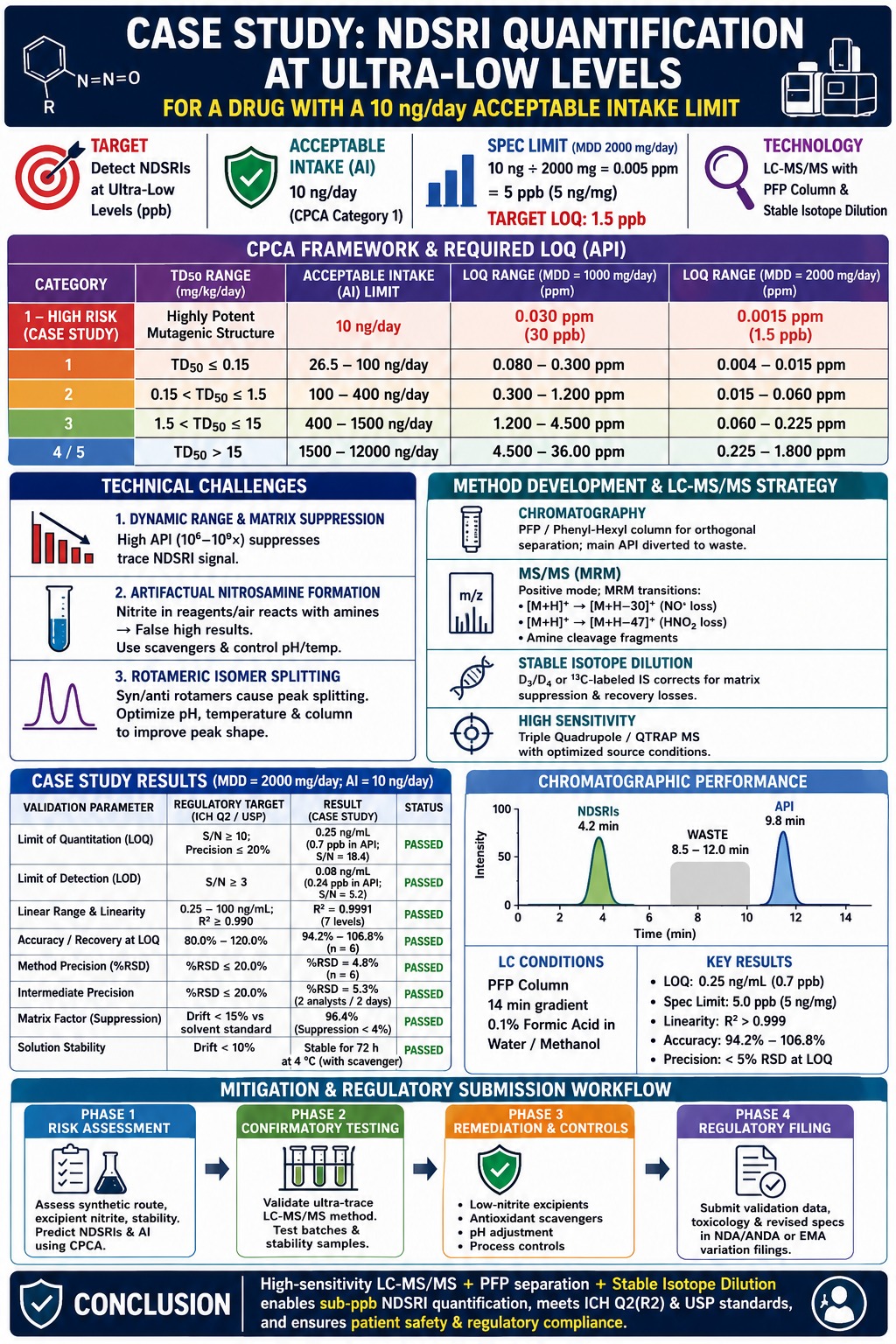
A comprehensive validation study involving a drug with a 2000 mg Maximum Daily Dose and a 10 ng/day Acceptable Intake limit demonstrated a Limit of Quantitation (LOQ) of 0.25 ng/mL, equivalent to 0.7 ppb in the active pharmaceutical ingredient, using an LC-MS/MS platform equipped with a PFP column. The analytical method satisfied the specified ICH Q2(R2) criteria, demonstrating linearity with R2 > 0.999, accuracy ranging from 94.2% to 106.8%, and precision below 5% RSD.
For this case study, a high-dose active pharmaceutical ingredient with an MDD of 2000 mg/day was assessed under the CPCA framework and assigned a Category 1 AI limit of 10 ng/day. The corresponding API specification limit was established at 5.0 ng/mg, equivalent to 5.0 ppb. To meet validation expectations under ICH Q2(R2) and USP standards, the analytical assay needed to demonstrate reliable quantification at an LOQ of 0.25 ng/mL, corresponding to 0.7 ppb in a 0.1 mg/mL API working solution.
Using an ExionLC AD system coupled with a high-sensitivity SCIEX 7500+ QTRAP mass spectrometer, analytical methods developed by ResolveMass Laboratories Inc. achieved complete chromatographic separation of the active drug substance from its mono- and di-nitroso derivatives.
| Validation Parameter | Regulatory Target (ICH Q2 / USP) | Experimental Case Study Result | Status / Assessment |
|---|---|---|---|
| Limit of Quantitation (LOQ) | S/N ≥ 10; Precision ≤ 20% RSD | 0.25 ng/mL (0.7 ppb in API; S/N = 18.4) | Passed |
| Limit of Detection (LOD) | S/N ≥ 3 | 0.08 ng/mL (0.24 ppb in API; S/N = 5.2) | Passed |
| Linear Range & Linearity | Range: 0.25 – 100 ng/mL (R2 ≥ 0.990) | R2 = 0.9991 across 7 calibration levels | Passed |
| Accuracy / Recovery at LOQ | Mean recovery within 80.0% – 120.0% | 94.2% – 106.8% (n = 6 spiked preparations) | Passed |
| Method Precision (%RSD) | %RSD ≤ 20.0% at LOQ level | %RSD = 4.8% at LOQ (n = 6) | Passed |
| Intermediate Precision | %RSD ≤ 20.0% across separate days | %RSD = 5.3% across 2 analysts / 2 days | Passed |
| Matrix Factor (Suppression) | Recovery drift < 15% vs solvent standard | 96.4% (Matrix suppression < 4%) | Passed |
| Solution Stability | Analyte response drift < 10% over time | Stable for 72 hours at 4 °C (with scavenger) | Passed |
By applying a 14-minute linear gradient on a PFP column using 0.1% formic acid in water and methanol, the target NDSRIs eluted cleanly at 4.2 minutes, whereas the parent API eluted later at 9.8 minutes. Diverting the high-concentration API peak to waste between 8.5 and 12.0 minutes protected the mass spectrometer ion source from contamination and effectively eliminated matrix suppression effects.
Check our insights on timeline expectations with nitrosamine testing timeline.
Mitigation and Regulatory Submission Workflow
Moving from initial impurity detection toward full regulatory compliance requires a structured four-phase workflow encompassing risk assessment, confirmatory LC-MS/MS testing, formulation remediation, and regulatory variation filing. Incorporating nitrite scavengers such as ascorbic acid or transitioning to low-nitrite excipient grades can reduce NDSRI formation and support successful regulatory approval processes.
Explore specialized product analysis categories such as nitrosamine testing for OTC pro
Phase 1: Chemical & Synthetic Risk Assessment
Drug sponsors assess raw material synthetic routes, excipient nitrite content specifications, and available storage stability data to identify possible nitrosation pathways. Computational tools and CPCA scoring frameworks are used to predict potential NDSRI structures and estimate their corresponding AI thresholds.
Phase 2: Ultra-Trace Confirmatory Testing
Products identified as presenting elevated risk undergo confirmatory testing using validated ultra-trace LC-MS/MS assays capable of quantifying impurities at sub-ppb concentrations. Testing multiple commercial and stability batches helps establish baseline contamination levels and provides insight into impurity behavior under real-world storage conditions.
Phase 3: Formulation Remediation and Process Controls
When NDSRI concentrations exceed 10% of the daily AI limit, manufacturers can implement targeted process and formulation modifications, including:
- Excipient Sourcing: Replacing high-nitrite excipients with low-nitrite grades, such as low-nitrite microcrystalline cellulose or crospovidone.
- Antioxidant Scavengers: Incorporating scavengers such as ascorbic acid, alpha-tocopherol, or ferulic acid into the formulation to competitively react with trace nitrites.
- pH Adjustment: Modifying granulating solutions or finished product micro-environments toward basic pH conditions to reduce nitrosation kinetics.
Phase 4: Regulatory Filing and Amendment
Comprehensive analytical method validation reports, toxicological justifications, and revised drug specifications are compiled for inclusion in NDA/ANDA amendments or EMA variation filings. Demonstrating effective control of NDSRIs below the 10 ng/day threshold supports continued product distribution and ongoing commercial compliance.
Partner with industry specialists by reviewing options for outsourcing nitrosamine testing to a CRO.
Conclusion
NDSRI Quantification at Ultra-Low Levels is an essential analytical requirement for demonstrating drug safety and maintaining regulatory compliance for pharmaceutical products subject to a 10 ng/day Acceptable Intake limit. By integrating high-sensitivity tandem mass spectrometry, fluorinated stationary phase separation, and stable isotope dilution, analytical scientists can address matrix suppression and minimize the risk of artifactual nitrosation. Validated LOQs reaching sub-nanogram per milliliter concentrations can support regulatory expectations under ICH Q2(R2) and USP standards while contributing to the protection of commercial drug supply chains and public health.
Explore broader therapeutic testing capabilities through nitrosamine drug recalls analysis.
To consult with analytical specialists regarding ultra-trace nitrosamine method development and regulatory compliance solutions, visit: ResolveMass Contact Us.
Frequently Asked Questions
Acceptable intake limits are established according to the estimated carcinogenic potency of an NDSRI, using approaches such as the Carcinogenic Potency Categorization Approach (CPCA) or available TD50 data. Structural characteristics that indicate a greater potential for metabolic activation can result in classification within a high-potency category. For such compounds, a conservative AI limit of 10 ng/day may be applied to minimize potential lifetime carcinogenic risk.
The specification concentration is determined by relating the 10 ng/day AI limit to the drug’s Maximum Daily Dose (MDD). Analytical sensitivity is then established by selecting an LOQ below the resulting specification, commonly targeting approximately 30% to 50% of that concentration. For example, an MDD of 2000 mg/day corresponds to a 5 ppb specification limit, making an LOQ in the range of approximately 1.5 to 2.5 ppb appropriate for sensitive analytical control.
Matrix suppression occurs when abundant components from the API, excipients, or other sample constituents interfere with the ionization of the target NDSRI during LC-MS/MS analysis. In Electrospray Ionization (ESI), highly concentrated co-eluting compounds compete with trace analytes for available charge within the droplets. This reduces the analyte response and can compromise sensitivity, accuracy, and the reliability of results near the LOQ.
Atmospheric Pressure Chemical Ionization (APCI) is generally well suited to smaller and more volatile nitrosamines because the ionization process is less dependent on droplet formation. Electrospray Ionization (ESI) is often more suitable for larger, polar, or thermally sensitive NDSRIs that may not tolerate the elevated temperatures associated with conventional APCI conditions. The final source selection should be based on the physicochemical characteristics and stability of the target analyte.
Artifactual nitrosamine formation can be minimized by carefully controlling sample preparation conditions that could promote reactions between amine-containing drug molecules and trace nitrites. Extraction procedures may use neutral or basic pH conditions, controlled chilled temperatures around 4 °C, and suitable nitrite scavengers such as ascorbic acid or sulfamic acid. These precautions help reduce the possibility of generating NDSRIs after the sample has been collected.
NDSRIs can exhibit multiple or broadened chromatographic peaks because restricted rotation around the nitrogen-nitrogen bond of the N-nitroso functional group can produce stable syn and anti rotamers. These conformational forms may display different retention behavior during chromatographic analysis. Optimization of column temperature, mobile phase pH, and stationary phase chemistry can help improve peak shape or provide adequate separation of the individual rotamers.
Stable Isotope-Labeled Internal Standards (SIL-IS) are used to compensate for analytical variability during ultra-trace NDSRI measurements. Because the SIL-IS closely resembles the target analyte and generally co-elutes with it, both compounds experience similar extraction and ionization conditions. Monitoring the analyte-to-internal-standard response ratio therefore helps correct for matrix effects, recovery differences, and changes in instrument response.
The Carcinogenic Potency Categorization Approach (CPCA) classifies nitrosamines according to structural characteristics associated with carcinogenic potency. Compounds assigned to higher-potency categories may receive substantially lower Acceptable Intake limits, which directly increases the sensitivity required from the analytical method. Consequently, high-risk NDSRIs may require highly optimized LC-MS/MS methods capable of reliably quantifying concentrations at single-digit or sub-ppb levels.
When an NDSRI concentration exceeds its applicable Acceptable Intake limit, the drug sponsor must evaluate the result and determine the appropriate regulatory response based on the product, jurisdiction, and applicable requirements. The investigation generally includes confirmation of the analytical result, identification of the root cause, assessment of patient exposure, and implementation of corrective or preventive measures. Where required, regulatory authorities may need to be notified through appropriate reporting or submission mechanisms, alongside updated specifications or formulation and process controls.
When an NDSRI concentration exceeds its applicable Acceptable Intake limit, the drug sponsor must evaluate the result and determine the appropriate regulatory response based on the product, jurisdiction, and applicable requirements. The investigation generally includes confirmation of the analytical result, identification of the root cause, assessment of patient exposure, and implementation of corrective or preventive measures. Where required, regulatory authorities may need to be notified through appropriate reporting or submission mechanisms, alongside updated specifications or formulation and process controls.
Reference:
- Kruhlak, N. L., Schmidt, M., Frötschl, R., Graber, S., Haas, B., Horne, I., Horne, S., King, S. T., Koval, I. A., Kumaran, G., Langenkamp, A., McGovern, T. J., Peryea, T., Sanh, A., Siqueira Ferreira, A., van Aerts, L., Vespa, A., & Whomsley, R. (2024). Determining recommended acceptable intake limits for N-nitrosamine impurities in pharmaceuticals: Development and application of the carcinogenic potency categorization approach (CPCA). Regulatory Toxicology and Pharmacology, 150, 105640. https://doi.org/10.1016/j.yrtph.2024.105640
- Zhang, J., Dasgupta, A., Ayala, R., Bonapace, C., Kassim, S., & Faustino, P. J. (2024). Internal standard variability: Root cause investigation, parallelism for evaluating trackability and practical considerations. Bioanalysis, 16(15), 771–776. https://doi.org/10.1080/17576180.2024.2348939
- Naiffer_Host. (2024, July 11). AAPS PharmSci360 – Nitrosamines [Online forum post]. Nitrosamines Exchange. https://nitrosamines.usp.org/t/aaps-pharmsci360-nitrosamines/10657
- Kurella, K. K., & Dadhich, A. S. (2026). Development and validation of an LC-MS/MS method for determination of N-nitroso desmethyl trimebutine in trimebutine tablets. International Journal of Drug Delivery Technology, 16(27s), 211–223. https://doi.org/10.25258/ijddt.16.27s.26
- Chagarlamudi, K., Damarapurapu, R., Gurram, V. S. S., Manglige, V. K., & Boppana, S. S. S. K. (2025). High-sensitivity LC-MS/MS method for precise quantification of N-nitroso sertraline in the antidepressant sertraline drug products. Separation Science Plus, 8(5), e70048. https://doi.org/10.1002/sscp.70048
Get In Touch With Us
About The Author


