

Introduction
Executing NDSRI Identification, Potency Prediction, and Confirmatory Quantification represents an important regulatory milestone for obtaining New Drug Application (NDA) approval for pharmaceutical products containing vulnerable amine centers. This case study illustrates how an integrated approach combining computational toxicology with trace liquid chromatography-tandem mass spectrometry (LC-MS/MS) analytics can support the development of robust impurity control strategies aligned with the requirements of the United States Food and Drug Administration (FDA), European Medicines Agency (EMA), and Health Canada. Nitrosamine Drug Substance-Related Impurities (NDSRIs) constitute a structurally diverse and complex class of mutagenic impurities generated through the N-nitrosation of active pharmaceutical ingredients (APIs) or their synthetic intermediates. In contrast to small-molecule dialkyl nitrosamines such as N-nitrosodimethylamine (NDMA), NDSRIs maintain the fundamental structural scaffold of the parent drug molecule. Consequently, they generally exhibit higher molecular weights, non-volatile physicochemical characteristics, complex chromatographic behavior, and, in many cases, a lack of empirical animal carcinogenicity data.
Achieving regulatory compliance for a novel NDA requires drug sponsors to move beyond worst-case assumptions and implement data-driven toxicological and analytical workflows. Regulatory authorities require applicants to assess vulnerable amine centers, estimate carcinogenic potency through structure-activity relationship (SAR) models, and determine trace impurity concentrations at parts-per-billion (ppb) levels in complex drug product matrices. The following sections describe the complete technical lifecycle applied during a novel NDA submission, including structural risk identification, computational potency assessment, analytical method validation, and the development of an appropriate regulatory strategy.
To understand the core regulatory definitions and background of these compounds, read our guide on what nitrosamines are.
Share via:
Quick Summary:
- NDSRIs are complex mutagenic impurities formed when vulnerable amine groups in APIs or intermediates undergo nitrosation. Unlike small-molecule nitrosamines, they retain the parent drug structure and often require advanced LC-MS/MS analysis.
- Structural risk identification focuses on secondary amines, tertiary amines, and amides, while forced degradation studies confirm whether nitrosation can occur under different pH, nitrite, and thermal conditions.
- CPCA enables potency prediction for NDSRIs with limited carcinogenicity data. By assessing alpha-hydrogens and activating or deactivating structural features, it assigns potency categories and corresponding acceptable intake (AI) limits.
- Cumulative risk assessment allows multiple nitrosamines to be evaluated together. The combined exposure-to-AI ratio must remain ≤ 1.0, supporting a science-based approach to impurity control.
- Confirmatory quantification requires validated UHPLC-MS/MS or LC-HRMS methods capable of trace-level detection. Key controls include rotamer separation, matrix interference reduction, artifact prevention, and stable isotope-labeled internal standards.
- Analytical validation establishes regulatory confidence through specificity, LOQ, linearity, accuracy, precision, and solution stability, aligned with ICH Q2(R2) and applicable regulatory expectations.
- An integrated regulatory strategy connects identification, CPCA scoring, validated testing, and product specifications. Formulation scavengers and risk-based controls help maintain compliance, protect patient safety, and support timely NDA approval.
Structural NDSRI Identification and Formation Mechanism Analysis
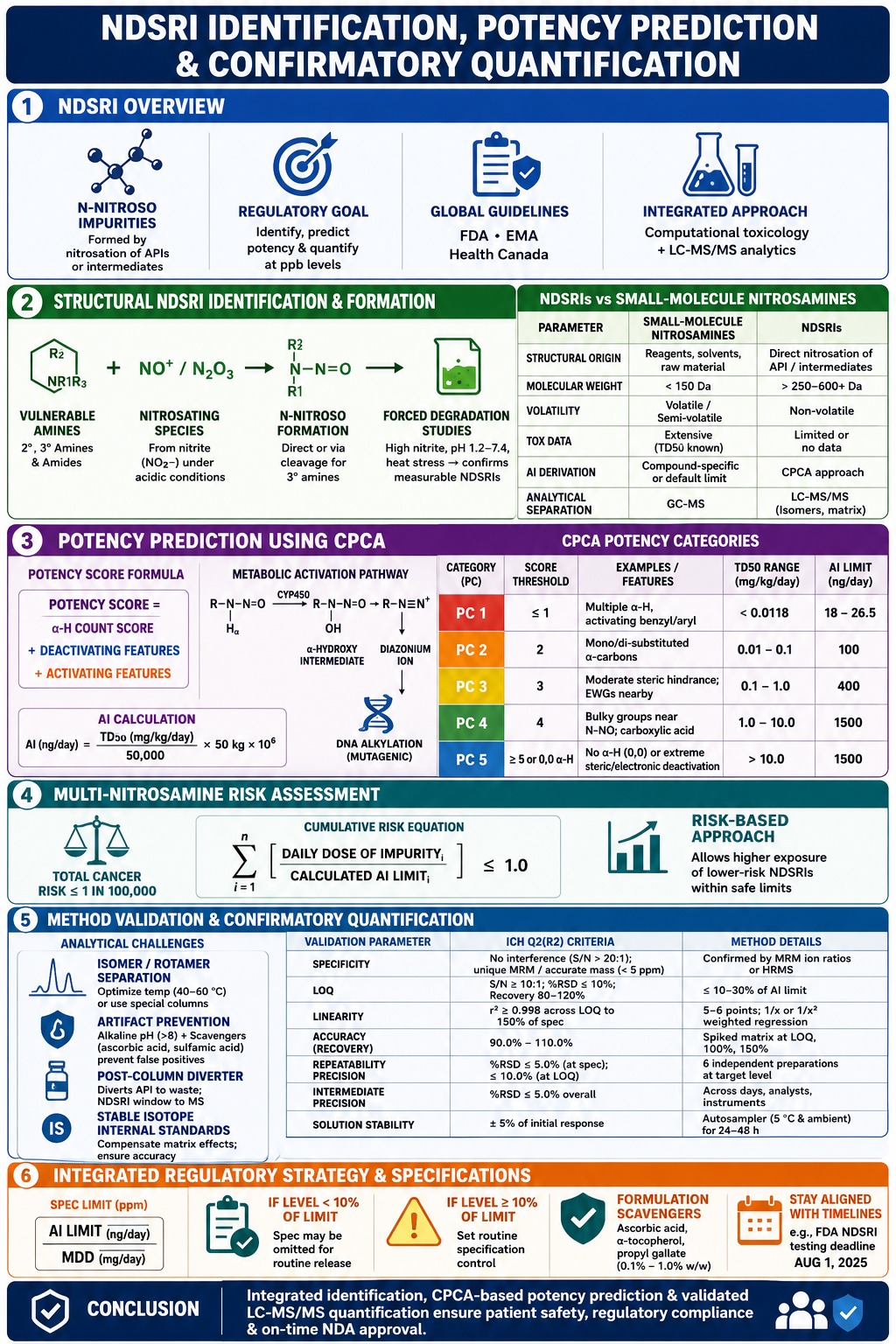
NDSRI identification involves a systematic assessment of vulnerable functional groups present within active pharmaceutical ingredients (APIs), together with the mapping of their potential reaction pathways with ambient nitrosating agents throughout the product lifecycle. This analytical assessment focuses on secondary amines, tertiary amines, and amides to identify potential N-nitroso derivatives before forced degradation experiments are initiated.
The principal chemical mechanism responsible for NDSRI formation involves the reaction of a vulnerable amine center with reactive nitrosating species, including the nitrosonium ion (NO+) or dinitrogen trioxide (N2O3). These reactive species can be generated through protonation of inorganic nitrite ions (NO2-) under acidic conditions. Although API manufacturing processes do not commonly introduce nitrites intentionally, frequently used solid oral dosage form excipients, including microcrystalline cellulose, crospovidone, and magnesium stearate, may contain trace quantities of nitrite contaminants, generally ranging from 0.1 to 10 ppm. Secondary amines can undergo rapid and direct N-nitrosation. Tertiary amines, in comparison, can undergo electrophilic nitrosative cleavage, generating secondary amine fragments that may subsequently participate in reactions leading to complex NDSRIs.
To establish whether theoretically predicted NDSRIs are actually generated at measurable concentrations, drug substances and drug products are subjected to forced degradation studies. During these studies, samples are exposed to elevated nitrite concentrations under different pH conditions, typically ranging from pH 1.2 to 7.4, as well as thermal stress conditions. These experiments enable analytical teams to determine the intrinsic susceptibility of the active molecule to N-nitrosation and provide experimental evidence to support the initial structural risk assessment.
Learn more about the chemical mechanisms driving these impurities by exploring our breakdown on nitrosamine formation pathways during API synthesis.
| Parameter | Small-Molecule Nitrosamines (e.g., NDMA, NDEA) | Nitrosamine Drug Substance-Related Impurities (NDSRIs) |
|---|---|---|
| Structural Origin | Reagents, recovered solvents, and raw material contaminants | Direct nitrosation of the parent API or synthetic intermediates |
| Molecular Weight | Low molecular weight (typically < 150 Da) | High molecular weight (> 250–600+ Da), specific to the API |
| Volatility & Volatility Profile | Volatile to semi-volatile; generally amenable to GC-MS | Non-volatile; typically requires LC-MS/MS or LC-HRMS |
| Toxicological Benchmark Data | Extensive bioassay data available (TD50 established) | Limited or non-existent empirical carcinogenicity data |
| AI Derivation Pathway | Compound-specific limits or a default conservative threshold | Carcinogenic Potency Categorization Approach (CPCA) |
| Analytical Separations | Standard reversed-phase chromatography | Isomeric separation, substantial API matrix interference, and rotamers |
Algorithmic Potency Prediction via the Carcinogenic Potency Categorization Approach (CPCA)
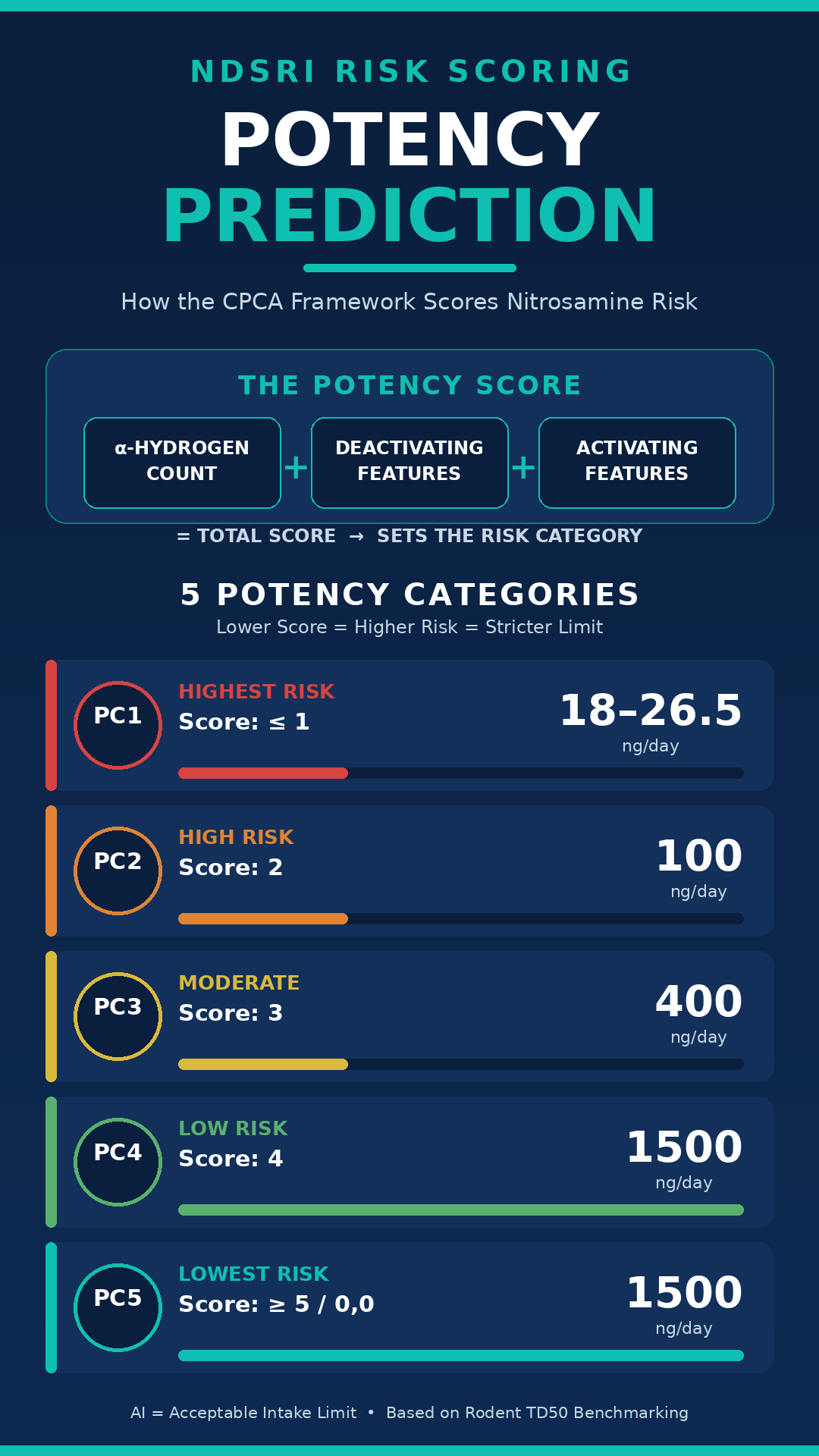
Potency prediction using the Carcinogenic Potency Categorization Approach (CPCA) provides a systematic method for assigning acceptable intake (AI) limits to previously unstudied NDSRIs based on defined structural characteristics and alpha-hydrogen counts. This computational framework places nitrosamine impurities into five distinct potency tiers, with AI limits ranging from 18 ng/day to 1500 ng/day. By using this approach, sponsors can reduce or avoid the need for lengthy rodent carcinogenicity bioassays for compounds for which sufficient empirical data are unavailable.
The CPCA model considers the metabolic activation pathway of N-nitrosamines, which commonly involves cytochrome P450-catalyzed alpha-hydroxylation. This metabolic reaction generates an unstable alpha-hydroxy-nitrosamine intermediate that can spontaneously decompose to form a reactive diazonium ion. The resulting reactive species can alkylate DNA and contribute to mutagenic and carcinogenic activity. Structural characteristics that interfere with alpha-hydroxylation, including steric obstruction caused by bulky adjacent substituents, electronic withdrawal produced by neighboring electron-withdrawing groups, or the absence of alpha-hydrogens, can decrease the potential for metabolic activation and mutagenicity. Such characteristics can therefore support assignment to a higher AI limit.
The Potency Score for an NDSRI is calculated using the following additive mathematical relationship:
Potency Score = Count Score of alpha-Hydrogens + Sum of Deactivating Structural Features + Sum of Activating Structural Features
The resulting score places the compound into one of five Potency Categories (PC 1 through PC 5). Each category corresponds to a rodent tumorigenic dose rate (TD50) benchmark, which is subsequently used to derive a human daily intake limit based on a standard 50 kg body weight and a maximum acceptable lifetime excess cancer risk of 1 in 100,000:
AI (ng/day) = [ TD50 (mg/kg/day) / 50,000 ] × 50 kg × 106 ng/mg
For a deeper dive into structural differences and regulatory classification, view our technical guide comparing NDSRIs vs. simple nitrosamines.
| Potency Category (PC) | Potency Score Threshold | Representative Structural Features | TD50 Benchmark Range (mg/kg/day) | Recommended Acceptable Intake (AI) Limit |
|---|---|---|---|---|
| Category 1 | ≤ 1 | Multiple unhindered alpha-hydrogens; activating benzyl/aryl groups | < 0.01 | 18 or 26.5 ng/day |
| Category 2 | 2 | Mono- or di-substituted alpha-carbons without strong steric hindrance | 0.01–0.1 | 100 ng/day |
| Category 3 | 3 | Moderate steric hindrance; presence of electron-withdrawing groups nearby | 0.1–1.0 | 400 ng/day |
| Category 4 | 4 | Bulky substituents adjacent to the N-nitroso group; carboxylic acid present | 1.0–10.0 | 1500 ng/day |
| Category 5 | ≥ 5 or 0,0 alpha-H | Absence of alpha-hydrogens (0,0) or extreme steric/electronic deactivation | > 10.0 | 1500 ng/day |
Multi-Nitrosamine Risk Assessments for NDSRI Identification, Potency Prediction, and Confirmatory Quantification
When an NDA product contains several nitrosamine impurities simultaneously, regulatory frameworks allow sponsors to assess the combined exposure against a total acceptable cancer risk of 1 in 100,000, as described within ICH M7(R2). This risk-based approach avoids unnecessarily restrictive product decisions by accounting for the individual toxicological potencies of the different NDSRIs present in the product.
Under updated FDA and EMA guidance, applicants can determine cumulative risk by using fractional exposure calculations rather than automatically applying the acceptable limit associated with the most potent impurity to every detected nitrosamine. The combined daily exposure from n identified nitrosamine impurities must meet the following inequality:
∑ i=1 n [ Daily Dose of Impurityi Calculated AI Limit of Impurityi ] ≤ 1.0
This multi-impurity assessment allows comparatively higher exposure levels for lower-risk Category 4 or Category 5 NDSRIs when trace quantities of a Category 1 small-molecule nitrosamine are also present, provided that the cumulative exposure remains within the established toxicological limits.
Review regulatory compliance standards and structural boundaries in our summary on genotoxic impurity testing under ICH M7 for nitrosamines.
Method Validation and Confirmatory Quantification Techniques for NDSRIs
Confirmatory quantification of NDSRIs requires fully validated UHPLC-MS/MS or LC-HRMS methods capable of achieving sub-part-per-million sensitivity while complying with ICH Q2(R2) and USP < > standards. These analytical procedures are designed to address challenges associated with broad dynamic ranges, minimize matrix interference, and resolve rotational isomerism, thereby generating accurate and reproducible quantitative data suitable for regulatory submissions.
Evaluate testing methodology requirements by reading our breakdown on nitrosamine screening vs. confirmatory methods.
Analytical Obstacles, Isomer Separation, and Artifact Prevention
The resolution of N-nitrosamine rotamers and prevention of in-situ artifactual nitrosation during sample extraction are among the most significant technical challenges associated with trace-level NDSRI quantification. Optimization of column temperature, selection of appropriate specialized stationary phases, and incorporation of alkaline nitrite scavengers can improve quantitative recovery while minimizing the potential for false-positive or artificially elevated analytical results.
Partial double-bond character within the central N-N=O bond system can result in stable syn and anti rotational isomers (rotamers) at room temperature. During reversed-phase liquid chromatography, these rotamers may appear as broad doublets, split peaks, or irregular peak shoulders. Such chromatographic behavior can negatively affect peak integration and quantitative accuracy. Analytical chemists can address this issue by increasing column operating temperatures, typically to approximately 40 °C to 60 °C, which accelerates rotational interconversion and can produce a single, sharper chromatographic peak. Alternatively, specialized stationary phases, including Phenyl-Hexyl, Fluorophenyl, or polar-embedded C18 chemistries, can be selected when separation of individual rotamers to baseline is required.
To prevent contamination of the mass spectrometer ionization source by high concentrations of API, chromatographic systems can be equipped with a post-column diverter valve. During operation, the valve directs the principal API elution window to waste while allowing the narrow retention window containing the trace NDSRI to enter the electrospray ionization (ESI) or atmospheric pressure chemical ionization (APCI) source. This configuration reduces unnecessary matrix loading and helps maintain instrument performance during highly sensitive analyses.
A significant analytical concern during sample extraction is the formation of false-positive NDSRI results when residual API reacts with trace nitrites present in acidic sample preparation solvents. To prevent such artifactual nitrosation, sample preparation procedures incorporate several control measures:
- Alkaline Extraction Buffers: Maintaining the sample solution at a pH above 8.0 using ammonium hydroxide or phosphate buffers suppresses nitrite protonation and reduces the formation of reactive nitrous acid.
- Competitive Nitrite Scavengers: Incorporating scavengers such as ascorbic acid, alpha-tocopherol, or sulfamic acid (0.1%–0.5% w/v) can rapidly quench available nitrites before sample homogenisation, thereby reducing the potential for NDSRI formation during extraction.
- Stable Isotope-Labeled Internal Standards (SIL-IS): Using deuterium (2H) or carbon-13 (13C)-labeled NDSRI analogs helps compensate for matrix-induced ionization suppression or enhancement and supports consistent quantification across different drug product batches.
Ensure your analytical protocols comply with international standards using our nitrosamine method development and validation services.
| Validation Parameter | ICH Q2(R2) Acceptance Criteria for Trace NDSRIs | Strategic Analytical Method Details |
|---|---|---|
| Specificity | No interfering matrix peaks at the NDSRI retention time (S/N > 20:1); unique MRM transitions | Confirmed using multiple reaction monitoring (MRM) ion ratios or high-resolution accurate mass (< 5 ppm) |
| Limit of Quantitation (LOQ) | S/N ≥ 10:1; precision %RSD ≤ 10%; recovery 80%–120% | Targeted at ≤ 10% to 30% of the calculated Acceptable Intake specification limit |
| Linearity | Correlation coefficient (r²) ≥ 0.998 across LOQ to 150% of the specification level | Minimum of 5–6 calibration points using 1/x or 1/x² weighted linear regression models |
| Accuracy (Recovery) | Mean recovery 90.0%–110.0% across LOQ, 100%, and 150% levels | Evaluated by spiking known NDSRI standards into drug product matrices across multiple replicates |
| Repeatability Precision | %RSD ≤ 5.0% at the specification level; %RSD ≤ 10.0% at LOQ | Calculated using six independent sample preparations at the target specification level |
| Intermediate Precision | %RSD ≤ 5.0% overall across different days, analysts, and instruments | Demonstrated through multiple analytical runs to establish inter-day method ruggedness |
| Solution Stability | Sample and standard stability verified within ±5% of the initial response | Confirmed under autosampler conditions (5 °C and ambient) for at least 24–48 hours |
Integrated Strategy for NDSRI Identification, Potency Prediction, and Confirmatory Quantification in Regulatory Filings
Integrating NDSRI identification, computational potency scoring, and validated analytical testing within Module 3 of the Common Technical Document (eCTD) provides a coherent regulatory dossier for pending NDAs. Establishing specifications based on analytical and toxicological data, together with the strategic use of formulation scavengers, supports long-term commercial batch compliance and helps sponsors meet applicable regulatory expectations within required timelines.
Within corporate NDA submissions, daily AI limits expressed in ng/day are converted into drug product concentration limits expressed in ppm by considering the Maximum Daily Dose (MDD):
Specification Limit (ppm) = Calculated AI Limit (ng/day) / Maximum Daily Dose (mg/day)
For example, an NDSRI assigned to CPCA Category 4 with an AI of 1500 ng/day in a drug product having an MDD of 100 mg/day results in a specification limit of 15 ppm. When confirmatory testing demonstrates that impurity concentrations consistently remain below 10% of this limit, corresponding to less than 1.5 ppm, across release and long-term stability testing, routine release specifications may be omitted from commercial specifications. Conversely, when impurity concentrations exceed 10% of the calculated limit, an appropriate routine control specification should be established.
To reduce the potential for NDSRI formation, manufacturers may modify product formulations through the incorporation of antioxidants such as ascorbic acid, alpha-tocopherol, or propyl gallate at concentrations ranging from 0.1% to 1.0% w/w during wet granulation. These excipients can inhibit in-situ nitrosation throughout the product shelf life. Maintaining alignment with regulatory milestones, including the FDA’s August 1, 2025 timeline for concluding NDSRI confirmatory testing, helps ensure that NDA submissions remain consistent with evolving regulatory expectations.
Plan your testing schedule effectively by referencing our guide on the nitrosamine testing timeline.
Conclusion
Comprehensive NDSRI Identification, Potency Prediction, and Confirmatory Quantification provides the scientific foundation necessary to address complex mutagenic impurity requirements associated with novel NDA submissions. Implementing an integrated strategy helps protect patient safety while reducing the potential for regulatory delays during drug product review. By connecting chemical structure assessment, CPCA-based computational potency scoring, and validated ultra-trace LC-MS/MS analysis, drug developers can establish scientifically supported specifications and maintain appropriate product quality controls throughout the drug lifecycle.
Partner with experienced analytical experts by exploring our solutions for outsourcing nitrosamine testing to a CRO.
To discuss your testing requirements or collaborate on analytical workflows, visit the ResolveMass Contact Page.
Frequently Asked Questions (FAQs)
The CPCA framework assesses the molecular structure of an NDSRI by considering the number of alpha-hydrogens and the presence of activating or deactivating structural features. These characteristics are used to calculate a Potency Score, which places the impurity into one of five potency categories. Each category is associated with a predefined Acceptable Intake (AI) limit ranging from 18 ng/day to 1500 ng/day.
GC-MS is generally less appropriate for NDSRI analysis because these API-derived impurities typically have higher molecular weights and may exhibit limited thermal stability. Exposure to the elevated temperatures used during gas chromatography can result in degradation or poor analytical performance. Therefore, LC-MS/MS or LC-HRMS is generally preferred for sensitive and reliable NDSRI quantification.
Rotational isomers, or rotamers, can develop because of restricted rotation around the central N-N bond of N-nitrosamine structures. Increasing the HPLC column temperature, typically from 40 °C to 60 °C, can accelerate rotamer interconversion and improve peak shape. Specialized stationary phases, including Phenyl-Hexyl and Fluorophenyl columns, may also be used when improved chromatographic separation is necessary.
The 10% AI threshold is used to help determine whether routine commercial batch release testing should be incorporated into the finished drug product specification. When representative release and stability data consistently demonstrate NDSRI concentrations below 10% of the calculated AI limit, routine specification testing may generally be omitted. If concentrations exceed this threshold, additional routine controls may be required.
Artifactual nitrosation can be minimized by controlling the sample preparation environment and preventing residual nitrite from reacting with the API. Competitive nitrite scavengers, including ascorbic acid and alpha-tocopherol, can be incorporated into the extraction procedure to quench reactive nitrites. Maintaining an alkaline extraction environment above pH 8.0 also helps suppress the formation of reactive nitrous acid species.
When an NDSRI concentration exceeds its CPCA-derived AI limit, applicants may pursue additional toxicological evaluation to establish a compound-specific AI limit. Appropriate studies, including transgenic rodent gene mutation assays where applicable, can provide additional evidence for risk assessment. Sponsors may also reduce NDSRI formation through reformulation, antioxidant scavengers, or the selection of excipients with lower nitrite levels.
ICH M7(R2) supports a risk-based approach for evaluating products containing multiple mutagenic impurities, including nitrosamines. Rather than assessing every impurity independently against the same limit, cumulative exposure can be evaluated in relation to the overall acceptable excess lifetime cancer risk of 1 in 100,000. This approach allows the individual potencies and exposure levels of co-occurring impurities to be considered together.
Stable Isotope-Labeled Internal Standards (SIL-IS) improve the reliability of quantitative NDSRI analysis by compensating for variations occurring during sample preparation and LC-MS/MS analysis. Deuterium (2H) or carbon-13 (13C)-labeled analogs can account for extraction variability, matrix-induced ion suppression or enhancement, and changes in instrument response. Their use supports more accurate and consistent quantification across drug product samples and analytical runs.
The FDA established August 1, 2025, as an important deadline for drug product manufacturers and NDA applicants to complete NDSRI confirmatory testing and address applicable chemistry, manufacturing, and controls (CMC) requirements. Sponsors were expected to submit necessary application amendments or CMC changes where warranted. Meeting these regulatory expectations is essential for maintaining compliance with evolving FDA requirements for nitrosamine impurities.
Reference:
- U.S. Food and Drug Administration. (2026). CDER nitrosamine impurity acceptable intake limits. https://www.fda.gov/regulatory-information/search-fda-guidance-documents/cder-nitrosamine-impurity-acceptable-intake-limits
- Limbachiya, J., Priya, S., Patel, K., & Patel, C. N. (2026). Analytical method validation framework for nitrosamine impurity qualification at trace levels: A review. International Journal of Pharmaceutical Sciences, 4(7), 4377–4387. https://doi.org/10.5281/zenodo.21484201
- Health Canada. (2026, May 29). Nitrosamine impurities in medications: Overview. Government of Canada. https://www.canada.ca/en/health-canada/services/drugs-health-products/compliance-enforcement/information-health-product/drugs/nitrosamine-impurities.html
- U.S. Food and Drug Administration. (2024, October 11). Carcinogenic potency categorization approach (CPCA). https://www.fda.gov/media/183710/download
- U.S. Food and Drug Administration. (2025, April 10). Nitrosamine related guidance [Presentation slides]. Center for Drug Evaluation and Research. FDA PDF
- Katakam, P., Tripuramallu, B. K., Kumar, E. S., & Sharma, A. (2026). Development and validation of an LC–MS/MS method for trace-level nitrosamine analysis in mexiletine formulations. Separation Science Plus, 9(4). https://doi.org/10.1002/sscp.70224
Get In Touch With Us
About The Author


