

Introduction
Peptide-oligonucleotide conjugates depend on Next-Generation Oligonucleotide Chemistries to address the limitations associated with native enzymatic degradation, inadequate cellular permeability, and rapid systemic clearance. By replacing or structurally modifying the natural phosphodiester backbone and ribose sugar, approaches such as Locked Nucleic Acids (LNA), Peptide Nucleic Acids (PNA), and Phosphorodiamidate Morpholino Oligomers (PMO) provide high sequence specificity, extended biological half-life, and controlled gene-modulating activity.
Unmodified phosphodiester DNA and RNA oligonucleotides are highly susceptible to degradation by serum endo- and exonucleases. Their substantial polyanionic charge also limits passive diffusion through lipophilic cellular membranes, while rapid renal elimination contributes to their short circulatory half-lives. Early chemical approaches, including fully phosphorothioate (PS)-modified backbones, increased resistance to nuclease-mediated degradation but could also promote non-specific protein interactions, off-target tissue accumulation, and dose-limiting cellular toxicity. To address these delivery and safety limitations, contemporary bioconjugate engineering combines advanced nucleic acid chemical modifications with synthetic peptide vectors.
By modifying the ribose sugar, substituting the phosphodiester linkage, or replacing the natural nucleic acid backbone with a completely non-natural pseudo-peptide structure, Next-Generation Oligonucleotide Chemistries determine the fundamental thermodynamic, steric, and electrostatic characteristics of the oligonucleotide payload. When these modified oligonucleotides are covalently attached to cell-penetrating peptides (CPPs), nuclear localization signals (NLS), or cell-surface receptor ligands, the resulting peptide-oligonucleotide conjugates (POCs) can achieve improved cellular internalization, selective tissue tropism, and effective steric-blocking or pre-mRNA splicing modulation. This report presents a comprehensive technical evaluation of LNA, PNA, and PMO chemistries, their incorporation into conjugate architectures, bioorthogonal conjugation approaches, and analytical strategies required for quality assessment and validation.
Learn more about modern assembly techniques and post-synthetic ligation strategies by reviewing Peptide-Oligonucleotide Conjugate Synthesis Methods.
Share via:
Article Summary:
- Next-generation oligonucleotide chemistries such as LNA, PNA, and PMO improve nuclease stability, target affinity, cellular delivery, and gene-modulating activity compared with unmodified oligonucleotides.
- LNA locks the ribose structure, increasing hybridization affinity and nuclease resistance; it is commonly used in gapmers/mixmers for RNase H-mediated or steric-blocking mechanisms.
- PNA replaces the charged sugar-phosphate backbone with a neutral pseudo-peptide backbone, providing exceptional enzymatic stability and mismatch discrimination, but its poor solubility and aggregation can limit delivery.
- PMO uses a neutral morpholine/phosphorodiamidate backbone, offering strong stability and aqueous solubility; it primarily acts through steric blocking of translation or pre-mRNA splicing.
- Bioconjugation strategies include continuous SPPS, thiol–maleimide ligation, SPAAC click chemistry, and oxime/hydrazone ligation, with cleavable or non-cleavable linkers selected according to the desired intracellular release profile.
- Peptide components such as CPPs, receptor-targeting peptides, and NLS sequences enhance membrane penetration, tissue targeting, endosomal escape, and nuclear delivery of oligonucleotide payloads.
- Advanced characterization using IP-RP-HPLC, HRMS/MS, purity profiling, residual-solvent and endotoxin testing is essential for confirming conjugate identity, purity, structural integrity, and regulatory quality.
Biophysical and Structural Architecture of Next-Generation Oligonucleotide Chemistries
Next-Generation Oligonucleotide Chemistries modify the conformational rigidity, backbone charge, and sugar composition of nucleic acid strands to optimize target hybridization thermodynamics. Structural approaches such as sugar locking in LNA or complete replacement of the conventional sugar-phosphate framework in PNA and PMO can reduce Coulombic repulsion and minimize recognition by nucleolytic enzymes.
Locked Nucleic Acids (LNA) in Next-Generation Oligonucleotide Chemistries
Locked Nucleic Acids contain a 2′-O,4′-C methylene bridge that constrains the ribose ring in a rigid C3′-endo (N-type) conformation, substantially increasing binding affinity toward complementary target sequences. This conformational pre-organization places the nucleotide in a geometry favorable for an A-form RNA helix and lowers the entropic penalty (ΔS) associated with hybridization to complementary RNA or DNA strands. Consequently, LNA modifications can raise duplex thermal melting temperature (Tm) by +2 °C to +8 °C per monomer compared with unmodified sequences while also providing strong protection against 3′-exonuclease-mediated degradation.
Within therapeutic conjugate designs, completely LNA-modified strands are generally avoided because of concerns associated with potential hepatotoxicity and excessive duplex rigidity. Instead, LNA-containing sequences are commonly designed as “gapmers” or “mixmers”. Gapmers contain a central region of 8–10 unmodified deoxyribonucleotides flanked by LNA “wings”. The LNA wings contribute high-affinity target binding and nuclease resistance, whereas the central DNA gap preserves compatibility with intracellular RNase H1-mediated cleavage. In another approach, C5-alkynyl-functionalized LNA uridine (LNA-U) building blocks can be incorporated to enable site-specific attachment of targeted peptides through bioorthogonal click reactions while preserving the structural characteristics of the A-form double helix.
Discover how conjugation chemistry influences structural stability and bioconjugate efficacy in Peptide-Oligonucleotide Conjugate Linker Chemistry.
Peptide Nucleic Acids (PNA) in Next-Generation Oligonucleotide Chemistries
Peptide Nucleic Acids replace the conventional sugar-phosphate backbone with an uncharged, achiral pseudo-peptide scaffold consisting of repeating N-(2-aminoethyl)glycine units connected through amide bonds. Because the PNA backbone has no net electrostatic charge, hybridization between a PNA oligomer and a complementary DNA or RNA sequence occurs without the Coulombic repulsion associated with negatively charged nucleic acid backbones. This neutral structural property contributes to exceptional thermodynamic stability and produces a thermal affinity hierarchy of PNA-PNA > PNA-RNA > PNA-DNA > DNA-DNA.
The neutral pseudo-peptide backbone also provides strong mismatch discrimination. A single base-pair mismatch within a PNA-RNA heteroduplex can produce a Tm decrease of up to 12 °C. Because the non-natural PNA backbone is not recognized by many naturally occurring nucleases and proteases, PNAs exhibit very high resistance to enzymatic degradation. However, the hydrophobic character of PNA can promote self-aggregation and restrict aqueous solubility. Conjugation of PNAs with hydrophilic or charged peptides, including poly-lysine tags or cationic cell-penetrating peptides, can reduce aggregation while facilitating intracellular delivery.
Phosphorodiamidate Morpholino Oligomers (PMO) in Next-Generation Oligonucleotide Chemistries
Phosphorodiamidate Morpholino Oligomers contain six-membered morpholine rings in place of conventional ribose sugars, with the rings connected through uncharged phosphorodiamidate linkages. PMOs are synthesized through conversion of ribonucleosides into 2′,3′-secodialdehydes using sodium periodate (IO4−), followed by reductive amination and cyclization to form the morpholine subunit. The resulting neutral, non-natural morpholino backbone provides PMOs with strong resistance to metabolic degradation by nucleases, phosphodiesterases, and human serum enzymes.
Unlike LNA gapmers, PMOs do not recruit RNase H1 and therefore operate primarily through steric-blocking mechanisms. By hybridizing with specific pre-mRNA sequences, PMOs can physically interfere with ribosome assembly and inhibit translation or mask splice donor and acceptor sites to modify pre-mRNA splicing patterns. PMOs generally demonstrate high aqueous solubility and low non-specific toxicity; however, their neutral charge can limit movement across lipid membranes. Covalent attachment of PMOs to cell-penetrating peptides produces peptide-conjugated phosphorodiamidate morpholino oligomers (PPMOs), which can improve cellular uptake and tissue retention.
Read about the primary synthetic, analytical, and physical challenges in Challenges in Peptide-Oligonucleotide Conjugates.
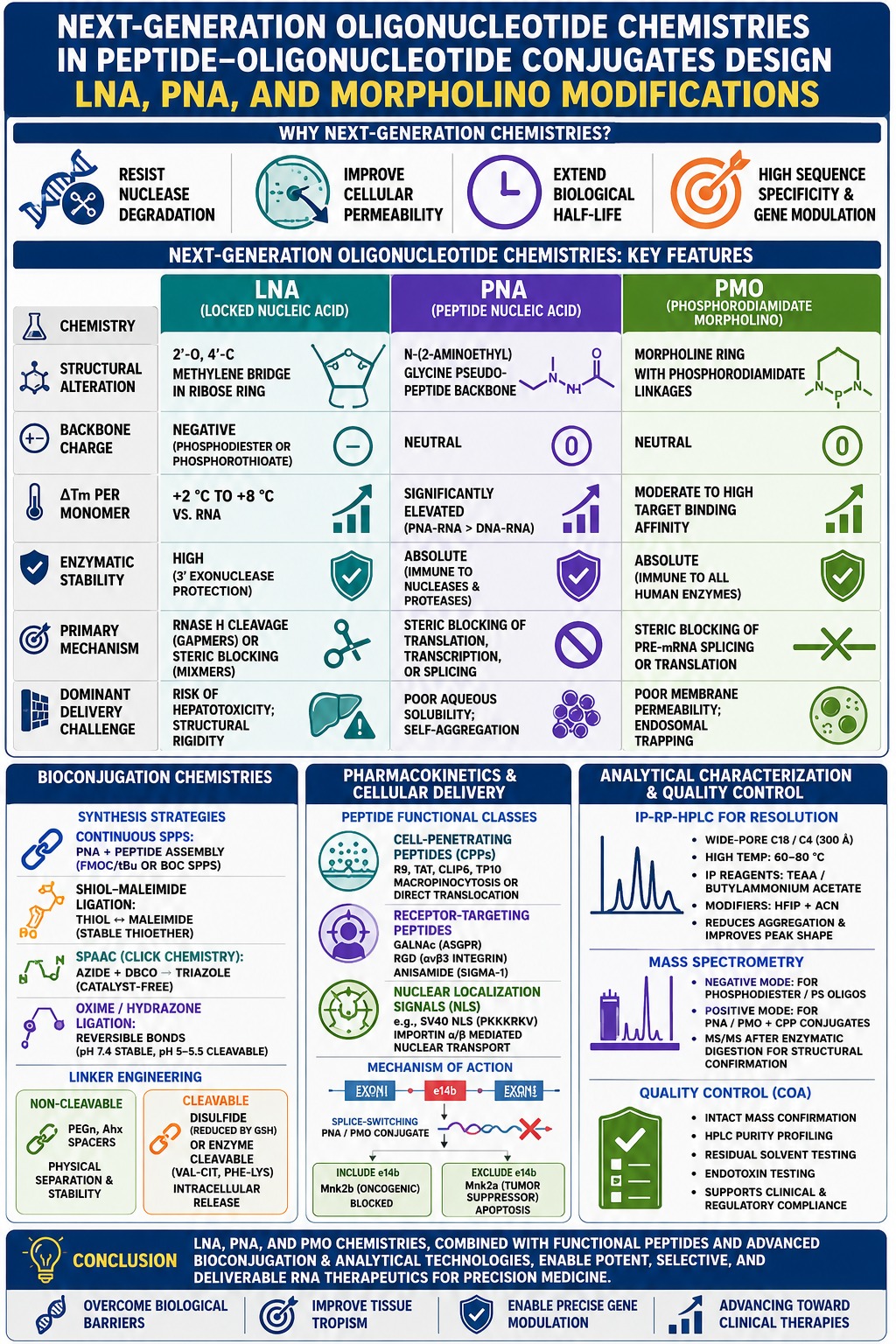
| Chemical Modification | Structural Alteration | Backbone Charge | ΔTm per Monomer | Enzymatic Stability | Primary Mechanism of Action | Dominant Delivery Challenge |
|---|---|---|---|---|---|---|
| Locked Nucleic Acid (LNA) | 2′-O, 4′-C methylene bridge in ribose ring | Negative (Phosphodiester or Phosphorothioate) | +2 °C to +8 °C vs. RNA | High (3′ exonuclease protection) | RNase H cleavage (Gapmers) or Steric Blocking (Mixmers) | Risk of hepatotoxicity; structural rigidity |
| Peptide Nucleic Acid (PNA) | N-(2-aminoethyl)glycine pseudo-peptide backbone | Neutral | Significantly elevated (PNA-RNA > DNA-RNA) | Absolute (Immune to nucleases & proteases) | Steric blocking of translation, transcription, or splicing | Poor aqueous solubility; self-aggregation |
| Phosphorodiamidate Morpholino (PMO) | Morpholine ring with phosphorodiamidate linkages | Neutral | Moderate to high target binding affinity | Absolute (Immune to all human enzymes) | Steric blocking of pre-mRNA splicing or translation | Poor membrane permeability; endosomal trapping |
Bioconjugation Chemistries for Next-Generation Oligonucleotide Chemistries
Bioconjugation of Next-Generation Oligonucleotide Chemistries with functional peptides requires careful selection between continuous solid-phase coupling and post-synthetic bioorthogonal ligation. The appropriate approach is determined by factors such as chemical compatibility with automated synthesis conditions, the required degree of site specificity, and linker stability under biological conditions.
Synthesis Strategies: Continuous SPPS vs. Bioorthogonal Post-Synthetic Ligation
Continuous solid-phase synthesis permits sequential assembly of peptide and oligonucleotide domains on a common resin support, whereas post-synthetic ligation involves coupling independently synthesized and purified fragments. Each strategy provides distinct advantages depending on the chemical architecture and stability requirements of the final conjugate.
- Continuous Solid-Phase Peptide Synthesis (SPPS): Because the PNA backbone consists of peptide amide bonds, PNA oligomers can be assembled directly alongside peptide sequences using established Fmoc/tBu or Boc SPPS protocols. The synthesis can be performed on NovaSyn TGA or PEG-based supports using HATU, HOBt, and DIPEA coupling reagents in DMF, followed by global deprotection and resin cleavage with trifluoroacetic acid (TFA) and scavenger mixtures such as TFA/m-cresol. This approach can generate full-length CPP-PNA conjugates without the need for intermediate fragment purification.
- Thiol-Maleimide Ligation: For LNAs and PMOs, which are not readily compatible with continuous peptide synthesis because of the constraints associated with phosphoramidite chemistry, post-synthetic ligation is frequently employed. A thiol group introduced through a terminal cysteine residue reacts with a maleimide functional group positioned at the 5′- or 3′-terminus of the oligonucleotide. The reaction proceeds efficiently in aqueous buffer under near-physiological conditions, typically within a pH range of 6.5–7.5, to generate a stable thioether linkage.
- Strain-Promoted Azide-Alkyne Click Chemistry (SPAAC): SPAAC offers a catalyst-free alternative to copper-catalyzed click chemistry and avoids potential copper-associated oligonucleotide degradation and residual copper-related cytotoxicity. Reaction of a dibenzocyclooctyne (DBCO)-modified peptide with an azide-functionalized LNA or PMO produces a stable triazole linkage and can provide high conversion efficiency at sub-millimolar concentrations.
- Oxime and Hydrazone Ligations: Oxime and hydrazone chemistry enables formation of reversible linkages between aliphatic aldehydes or ketones and aminooxy or hydrazide functional groups. These linkages can remain relatively stable under neutral extracellular conditions at pH 7.4 while exhibiting faster cleavage under the acidic conditions encountered in late endosomes and lysosomes, where the pH is typically approximately 5.0–5.5.
Linker Engineering: Cleavable vs. Non-Cleavable Architecture
Linker selection has a major influence on the spatial arrangement, systemic stability, and intracellular release characteristics of peptide-oligonucleotide conjugates. Non-cleavable linkers, including flexible poly(ethylene glycol) (PEGn) chains or rigid 6-aminocaproic acid (Ahx) spacers, can be used when physical separation between the peptide and nucleic acid is necessary to minimize steric interference with target hybridization or receptor recognition. Incorporating an Ahx spacer between a PNA sequence and a terminal fluorescent tag or peptide can provide additional molecular spacing, reduce steric hindrance at target-binding sites, and support efficient conjugate construction.
Cleavable linkers are engineered to facilitate oligonucleotide payload release within defined intracellular environments. Disulfide bridges, including SPDP-derived linkers, can remain stable in extracellular blood plasma while undergoing rapid reduction by cytosolic glutathione (GSH) after cellular entry. Similarly, enzyme-cleavable dipeptide sequences such as Valine-Citrulline (Val-Cit) or Phenylalanine-Lysine (Phe-Lys) can be recognized and cleaved by lysosomal cathepsin B, thereby promoting localized intracellular release of the oligonucleotide payload.
Learn how chemical modifications and linkers affect systemic durability in Peptide-Oligonucleotide Conjugate Stability.
Pharmacokinetic Optimization and Cellular Delivery Pathways
Attaching targeted peptide motifs to chemically modified oligonucleotide payloads can improve tissue tropism, cellular membrane internalization, and subcellular distribution. Functional peptide components can convert neutral or sterically constrained nucleic acid molecules into more bioavailable therapeutic constructs capable of overcoming biological delivery barriers.
Further analyze biodistribution and elimination dynamics in Peptide-Oligonucleotide Conjugates Pharmacokinetics.
Peptide Functional Classes in Bioconjugate Design
Peptide vectors conjugated to Next-Generation Oligonucleotide Chemistries can be broadly classified into three primary functional groups, with each class addressing particular biological transport barriers:
- Cell-Penetrating Peptides (CPPs): Cationic peptides, including nona-arginine (R9) and HIV-1 TAT, as well as amphipathic sequences such as CLIP6 and TP10, can promote passage across cellular membranes. Arginine-rich motifs interact with negatively charged cell-surface glycosaminoglycans and can stimulate macropinocytosis or direct energy-independent membrane translocation. Certain amphipathic peptides, including CLIP6 when conjugated to PNA, have been investigated for their ability to reduce endosomal sequestration and promote delivery of steric-blocking payloads into the cytoplasm.
- Receptor-Targeting Peptides: Peptide ligands capable of recognizing specific cell-surface receptors can promote tissue-selective internalization through receptor-mediated endocytosis. Triantennary GalNAc conjugates target asialoglycoprotein receptors (ASGPR) on hepatocytes, cyclic RGD peptides recognize αvβ3 integrins associated with tumor microvasculature, and anisamide derivatives target sigma-1 receptors that can be overexpressed on cancer cell membranes.
- Nuclear Localization Signals (NLS): Short cationic peptide sequences enriched in lysine and arginine residues, such as the SV40 large T-antigen NLS (PKKKRKV), interact with cytosolic importin α/β proteins. NLS peptides can facilitate nuclear transport of pre-mRNA-targeting splice-switching oligonucleotides through nuclear pore complexes, thereby supporting delivery to the nucleus.
Compare peptide-based delivery to antibody-based modalities in Peptide vs. Antibody Oligonucleotide Conjugates.
Mechanism of Action: Splice Modulation and Gene Regulation
Because PNA and PMO modifications do not contain a polyanionic phosphodiester backbone, they do not recruit RNase H1 for cleavage of complementary target transcripts. Instead, these uncharged chemistries function primarily as high-affinity steric blockers. When directed toward pre-mRNA junctions, splice-switching peptide-PNA or peptide-PMO conjugates hybridize with complementary target sequences and physically interfere with the spliceosomal machinery.
In the alternative splicing regulation of the MKNK2 pre-mRNA, which encodes Mnk2 isoforms associated with oncogenic signaling, splice-switching peptide-PNA conjugates directed against the intron 14 / exon e14b boundary can mask the relevant splice site. This steric obstruction prevents incorporation of exon e14b, shifting splicing away from the oncogenic Mnk2b isoform toward the tumor-suppressive Mnk2a isoform and promoting selective apoptosis in glioblastoma cells.
Read more about targeted cellular delivery pathways in Peptide-Oligonucleotide Conjugates Drug Delivery.
Analytical Characterization and Quality Control of Next-Generation Oligonucleotide Chemistries Conjugates
Comprehensive characterization of conjugates incorporating Next-Generation Oligonucleotide Chemistries requires advanced Ion-Pairing Reversed-Phase Liquid Chromatography (IP-RP-HPLC), together with High-Resolution Mass Spectrometry (HRMS), to resolve complex amphiphilic and charged molecular species. Specialized thermal conditions and mobile-phase compositions are often necessary to minimize non-specific column interactions and electrostatic aggregation.
Explore HRMS, ESI-MS, and advanced LC method development in Structural Characterization of Peptide-Oligonucleotide Conjugates.
Resolving Electrostatic Aggregation in Chromatographic Separations
Characterizing peptide-oligonucleotide conjugates containing basic cell-penetrating peptides attached to synthetic nucleic acid backbones presents significant analytical difficulties because of strong electrostatic aggregation and non-specific interactions with chromatographic surfaces. Arginine-rich CPPs can interact with residual silanol groups and hydrophobic stationary-phase surfaces, resulting in pronounced peak tailing, reduced chromatographic efficiency, or sample loss.
To achieve baseline resolution of intact conjugates, unreacted oligonucleotide intermediates, and truncated peptide-related impurities, IP-RP-HPLC methods should employ wide-pore stationary phases, such as 300 Å C18 or C4 silica, at elevated column temperatures ranging from 60 °C to 80 °C. Mobile phases can be optimized using volatile ion-pairing reagents, including triethylammonium acetate (TEAA) or butylammonium acetate, together with fluorinated organic modifiers such as hexafluoroisopropanol (HFIP) and acetonitrile. Elevated temperatures help disrupt intramolecular secondary structures and electrostatic aggregates, while ion-pairing agents reduce effective backbone charge interactions and support the generation of sharper, more reproducible chromatographic peaks.
Mass Spectrometry Analysis and Structural Validation
Electrospray Ionization Mass Spectrometry (ESI-MS) analysis of chimeric bioconjugates requires appropriate selection of the ionization mode according to the charge characteristics of the backbone. Conventional phosphodiester or phosphorothioate oligonucleotides generally ionize efficiently in negative mode ([M−nH]n−), whereas basic peptides typically demonstrate strong ionization in positive mode ([M+nH]n+). For conjugates containing uncharged PNA or PMO backbones linked to arginine-rich CPPs, positive-mode ESI-MS can provide improved sensitivity because of protonation of basic peptide side chains.
Structural confirmation and conjugation-site mapping can be performed using partial enzymatic digestion with nucleases or proteases, followed by bottom-up tandem mass spectrometry (MS/MS) fragment analysis. Comprehensive characterization programs that include intact mass confirmation, IP-RP-HPLC purity profiling, residual solvent analysis, and endotoxin testing under Certificate of Analysis (COA) standards are essential components of contract analytical testing at facilities such as ResolveMass Laboratories Inc. These analytical controls help support the quality assessment, clinical translation, and regulatory compliance of advanced peptide-oligonucleotide conjugates.
Learn about establishing critical quality attributes for regulatory filings in Peptide-Oligonucleotide Conjugates Specification Setting.
Conclusion
Next-Generation Oligonucleotide Chemistries, including LNA, PNA, and PMO modifications, provide an important biophysical foundation for addressing longstanding limitations associated with nuclease degradation, target-binding affinity, and intracellular delivery in RNA therapeutics. By combining uncharged or conformationally restricted backbones with functional peptide components, bioconjugates can achieve improved cellular uptake, more selective organ targeting, and effective modulation of pre-mRNA splicing.
As bioorthogonal conjugation technologies, AI-guided peptide engineering, and high-temperature IP-RP-LC-MS characterization approaches continue to evolve, peptide-oligonucleotide conjugates are expected to remain important components of precision medicine strategies. Addressing challenges related to synthetic scale-up, process reproducibility, and advanced analytical characterization will be essential for translating these sophisticated bioconjugates into clinically approved therapies for rare genetic disorders, oncology, and infectious diseases.
Examine the requirements for regulatory drug submissions in Peptide-Oligonucleotide Conjugates in IND Submissions.
To discuss custom analytical characterization, bioconjugate quality control, or method development services, visit the ResolveMass Contact Page.
Frequently Asked Questions
PNA and PMO are considered uncharged because their structures lack the negatively charged phosphate groups found in conventional DNA and RNA. PNA contains N-(2-aminoethyl)glycine units connected through amide bonds, while PMO contains morpholine rings joined by phosphorodiamidate linkages. Their neutral backbones reduce Coulombic repulsion during hybridization and support strong target-binding interactions.
Locked Nucleic Acids increase Tm by restricting movement within the ribose ring through a 2′-O,4′-C methylene bridge. This structural constraint favors the C3′-endo (N-type) conformation associated with A-form RNA duplex geometry. Pre-organizing the nucleotide in this manner reduces the entropic cost (ΔS) of hybridization and strengthens binding to complementary nucleic acid sequences.
Cell-Penetrating Peptides (CPPs) can enhance PMO delivery by facilitating transport across cellular membranes. Since PMOs have a neutral backbone, their ability to enter cells through passive diffusion is limited. Arginine-rich cationic CPPs can interact with negatively charged cell-surface glycosaminoglycans and promote uptake through mechanisms such as macropinocytosis or direct membrane translocation.
Common conjugation approaches include Strain-Promoted Azide-Alkyne Click Chemistry (SPAAC), thiol-maleimide coupling, and oxime or hydrazone ligation. SPAAC commonly uses DBCO and azide functional groups, while thiol-maleimide chemistry links cysteine residues with maleimide-functionalized oligonucleotides. These reactions enable selective conjugation under relatively mild conditions while preserving the integrity of peptide and oligonucleotide components.
Arginine-rich peptide-oligonucleotide conjugates can undergo electrostatic aggregation and non-specific interactions with chromatographic stationary phases. These effects may produce peak broadening, tailing, poor resolution, or sample loss during analysis. Operating IP-RP-HPLC at approximately 60 °C to 80 °C helps disrupt secondary structures and electrostatic aggregates, improving chromatographic resolution and reproducibility.
Non-cleavable linkers, including Ahx spacers and poly(ethylene glycol) chains, maintain the covalent connection between peptide and oligonucleotide during circulation and cellular targeting. Cleavable linkers are designed to separate the two components after exposure to specific intracellular conditions. Examples include disulfide bonds that respond to cytosolic reduction, acid-sensitive hydrazones, and Val-Cit dipeptides that can undergo lysosomal protease-mediated cleavage.
PNA and PMO do not recruit RNase H1 because their non-natural, uncharged backbones do not provide the structural features required for RNase H1-mediated cleavage. Instead, these chemistries generally function through sequence-specific steric blocking of target RNA. LNA-containing oligonucleotides can support RNase H1 activity when designed as gapmers containing a central DNA region flanked by LNA wings.
PNA generally provides strong discrimination against single base-pair mismatches because its neutral backbone allows mismatch-induced structural changes to produce pronounced effects on duplex stability. In a PNA-RNA heteroduplex, a single mismatch can reduce the thermal melting temperature (Tm) by as much as 12 °C. This high mismatch sensitivity supports precise recognition of complementary target sequences.
IP-RP-LC-MS combines chromatographic separation with mass-based molecular identification to characterize complex peptide-oligonucleotide conjugates. The technique can confirm intact molecular mass, assess chromatographic purity, and detect unreacted starting materials, truncated species, and conjugation-related impurities. These measurements provide important analytical evidence for identity and purity assessment and can support Certificate of Analysis documentation.
Reference:
- Benizri, S., Gissot, A., Martin, A., Vialet, B., Grinstaff, M. W., & Barthélémy, P. (2019). Bioconjugated oligonucleotides: Recent developments and therapeutic applications. Bioconjugate Chemistry, 30(2), 366–383. https://doi.org/10.1021/acs.bioconjchem.8b00761
- De, A., Kumar, V., Saltzman, W. M., Slack, F. J., Vikram, A., Gupta, A., & Bahal, R. (2026). Advances in peptide nucleic acid for targeting RNA and genomic DNA. Cell Reports Physical Science, 7(1), 103061. https://doi.org/10.1016/j.xcrp.2025.103061
- Wahane, A., Kasina, V., Pathuri, M., Marro-Wilson, C., Gupta, A., Slack, F. J., & Bahal, R. (2025). Development of bioconjugate-based delivery systems for nucleic acids. RNA, 31(1), 1–13. https://doi.org/10.1261/rna.080273.124
- Shah, N., Vedanayagam, S., Raymonde, S., Ramirez Garcia, K., Eassa, H. A., & Gupta, A. (2026). Roles and applications of peptide nucleic acid-loaded nanoparticles in cancer. Nanomedicine, 21(6), 869–884. https://doi.org/10.1080/17435889.2026.2628235 (pubmed.ncbi.nlm.nih.gov)
- Samieipour, F., Dianat-Moghadam, H., & Khanahmad, H. (2025). Recent developments in bioconjugation: From strategies to design and clinical applications. Biomedicine & Pharmacotherapy, 192, 118593. https://doi.org/10.1016/j.biopha.2025.118593 (pubmed.ncbi.nlm.nih.gov)
- Naganuma, M., Tsuji, G., Amiya, M., Hirai, R., Higuchi, Y., Hata, N., Nozawa, S., Watanabe, D., Nakajima, T., & Demizu, Y. (2025). High-resolution HPLC for separating peptide–oligonucleotide conjugates. ACS Omega, 10(20), 20578–20584. https://doi.org/10.1021/acsomega.5c01308
- Gong, L. (2017). Analysis of oligonucleotides by ion-pairing hydrophilic interaction liquid chromatography/electrospray ionization mass spectrometry. Rapid Communications in Mass Spectrometry, 31(24), 2125–2134. https://doi.org/10.1002/rcm.8004 (analyticalsciencejournals.onlinelibrary.wiley.com)
Get In Touch With Us
About The Author


