

Introduction:
A Nitrosamine Compliance Strategy for Biosimilars is fast becoming a required part of modern pharmaceutical quality and regulatory planning, because nitrosamine impurities can arise from raw materials, manufacturing processes, excipients, packaging interactions, or storage conditions — not just from the active molecule itself. Nitrosamine concerns first drew regulatory attention in small-molecule medicines, but expectations have since expanded to cover biological medicines as well, with EMA explicitly stating that its nitrosamine framework applies to both chemical and biological products.
For a biosimilar developer pursuing simultaneous FDA and EMA approval, the challenge isn’t simply proving that a particular nitrosamine is absent. It’s building a scientifically justified, risk-based strategy that identifies potential sources, evaluates formation mechanisms, confirms analytical performance, establishes appropriate controls, and maintains that control strategy throughout the product lifecycle. This case study walks through exactly how that strategy can be built, using an illustrative development scenario involving a hypothetical monoclonal-antibody biosimilar intended for simultaneous submission to the FDA and EMA.
Summary:
- A Nitrosamine Compliance Strategy for Biosimilars should begin during development, not after submission, and should cover the drug substance, excipients, manufacturing process, drug product, packaging, and storage.
- FDA’s current guidance addresses both conventional nitrosamines and nitrosamine drug substance-related impurities (NDSRIs), while EMA’s framework explicitly applies to both chemical and biological medicines.
- A single, science-based risk assessment can support simultaneous FDA and EMA submissions when it clearly documents differences in terminology, acceptable intake methodology, analytical approach, and control strategy.
- This case study presents an illustrative development scenario for a hypothetical monoclonal-antibody biosimilar. The product, results, and numerical outcomes described are illustrative and intended to demonstrate a practical regulatory and analytical approach — they are not results from an actual client project.
- Early risk-based screening, scientifically justified acceptable intake limits, process controls, supplier qualification, and lifecycle monitoring reduce regulatory uncertainty for dual filings.
1: What Is a Nitrosamine Compliance Strategy for Biosimilars?
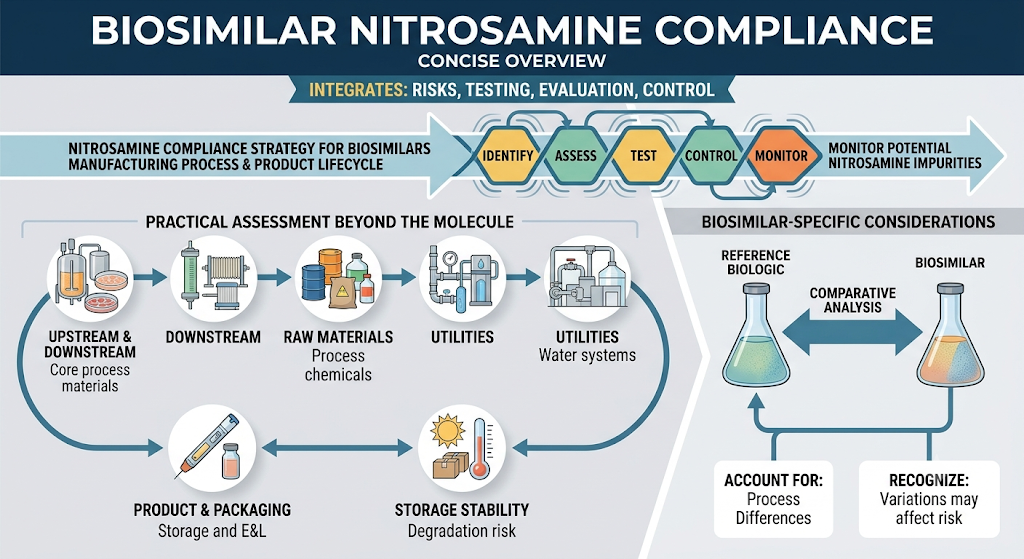
A Nitrosamine Compliance Strategy for Biosimilars is a structured, risk-based program used to identify, assess, test, control, and monitor potential nitrosamine impurities across a biosimilar’s manufacturing process and full product lifecycle. Unlike a simple “test and report” approach, it connects risk identification, formation mechanism, analytical detection, toxicological evaluation, and process control into one evidence chain.
For a biosimilar, this evaluation needs to look well beyond the active biological molecule. A practical assessment typically considers:
- Cell-culture and upstream processing materials
- Downstream processing materials, process chemicals, and buffers
- Raw materials and excipients
- Water and utility systems, where relevant
- Manufacturing equipment and process conditions
- Drug substance storage and drug product formulation
- Primary packaging components and container-closure systems
- Extractables and leachables
- Manufacturing-related degradation pathways
- Long-term and accelerated storage conditions
Because biosimilars are compared against a reference biologic rather than developed as an independent molecule, their risk assessment also has to account for process- and structure-related differences described in how a biosimilar differs from a reference biologic, since even minor manufacturing variations can influence which nitrosamine formation pathways are plausible.
2: Why This Matters for Simultaneous FDA and EMA Filings
Sponsors filing with the FDA and EMA at the same time need a nitrosamine strategy that satisfies both agencies without producing two conflicting data packages. FDA’s September 2024 final guidance recommends risk assessment, detection, prevention, and control of nitrosamine impurities, and distinguishes conventional small-molecule nitrosamines from NDSRIs. EMA’s framework similarly requires applicants and marketing authorisation holders to evaluate nitrosamine risk, but explicitly states that it applies to both chemical and biological medicines — a scope that is easy to underestimate for a biosimilar developer who assumes nitrosamine risk is a small-molecule-only concern.
Treating the FDA and EMA requirements as two unrelated exercises typically leads to:
- Duplicated analytical method development and validation
- Inconsistent risk classifications between the two dossiers
- Regulator-specific information requests that could have been anticipated
- Longer CMC review cycles overall
The more efficient path is one scientific risk assessment, one core analytical strategy, and regulator-specific justification only where genuinely required.
3: Case Background: A Biosimilar Targeting Two Regulatory Markets
What was the development scenario?
A hypothetical biotechnology company was developing a biosimilar monoclonal antibody — referred to here as Biosimilar-MAb — for a reference product already marketed in both the United States and the European Union, with CMC packages planned for both FDA and EMA/EU review.
The development team initially assumed nitrosamine risk would be minimal because the product is a biological medicine. During an expanded impurity risk assessment, however, the team identified several plausible risk pathways involving raw materials, process chemicals, formulation components, and packaging materials — prompting the company to build a dedicated Nitrosamine Compliance Strategy for Biosimilars before finalizing either dossier. Because biosimilar manufacturing introduces its own process-specific variability compared with the originator biologic, understanding the manufacturing differences between a biosimilar and its reference biologic was a necessary first input into the risk assessment.
What was the regulatory objective?
The objective was to demonstrate that:
- Potential nitrosamine sources had been systematically identified
- Scientifically credible formation pathways had been assessed
- Appropriate, sufficiently sensitive analytical methods were available
- Potential impurities were controlled to scientifically justified levels
- Manufacturing controls prevented or minimized formation
- The final control strategy was documented in a way both FDA and EMA could review
4: Step-by-Step: How the Nitrosamine Risk Assessment Was Built
Step 1: Cross-Functional Risk Assessment
The first step was a multidisciplinary risk assessment involving CMC scientists, analytical scientists, process-development experts, formulation scientists, packaging scientists, toxicology specialists, regulatory affairs, quality assurance, and supplier-quality representatives, mapping potential nitrosamine sources across the entire lifecycle.
| Potential Source | Risk Consideration | Assessment Approach |
|---|---|---|
| Raw materials | Nitrite/nitrosating species or amine precursors | Supplier information and material assessment |
| Excipients | Nitrite contamination or reactive functional groups | Supplier qualification and analytical evaluation |
| Process chemicals | Potential nitrosation chemistry | Process chemistry review |
| Water/utilities | Possible contamination or process contribution | Utility-system assessment |
| Manufacturing process | pH, temperature, residence time, reactive species | Process risk assessment |
| Drug substance | Potential degradation or reaction pathways | Structural and chemical assessment |
| Drug product | Formulation-related formation pathways | Compatibility and stability assessment |
| Container closure | Potential leachables or interaction | Extractables and leachables assessment |
| Storage | Time/temperature-dependent formation | Stability studies |
The guiding principle is mechanism-based risk assessment, not indiscriminate testing of every sample for every conceivable nitrosamine.
Step 2: Identify Formation Pathways
A meaningful assessment asks how a nitrosamine could actually form, considering the coexistence of nitrosating species, suitable amine-containing compounds, appropriate pH, elevated temperature, and sufficient reaction time. For a biological product, this should be tailored to the actual composition and process rather than borrowing a small-molecule model wholesale, with particular attention to process intermediates, buffer components, excipients, degradation products, and packaging-related substances. EMA’s framework describes approaches for establishing acceptable intake limits, including carcinogenic potency categorisation, read-across, and enhanced Ames testing where appropriate.
Step 3: Evaluate FDA and EMA Requirements in Parallel
| Area | FDA Consideration | EMA Consideration |
|---|---|---|
| Risk assessment | Risk-based evaluation and control of nitrosamine impurities | Risk evaluation and mitigation framework |
| Biological medicines | Guidance addresses human drugs, including biological-product considerations | Explicitly applies to chemical and biological medicines |
| Acceptable intake (AI) | Provides compound-specific, read-across, and CPCA-related information | Provides AI information and CPCA/read-across/EAT approaches |
| Testing | Sensitive analytical testing based on risk | Confirmatory testing based on identified risk |
| Mitigation | Process, material, and formulation controls | Risk mitigation and prevention |
| Lifecycle | Ongoing monitoring of updated scientific/regulatory information | Ongoing responsibilities continue after authorization |
FDA maintains a continuously updated resource with recommended acceptable intake limits, implementation timelines, and emerging scientific issues — most recently updated in August 2026 for certain compound-specific limits and July 2026 for certain interim limits. EMA’s current nitrosamine Q&A is Rev. 23 (updated October 10, 2025), with its acceptable-intake appendix updated June 24, 2026. Both resources should be checked against the current revision before finalizing a submission, since acceptable-intake values and timelines continue to evolve.
Step 4: Build a Sensitive Analytical Testing Strategy
Analytical testing should be driven by the risk assessment, not run indiscriminately. Depending on the compounds and matrices involved, sensitive techniques may include LC-MS/MS, LC-HRMS, GC-MS/MS, and headspace GC-MS/MS, with method development evaluating specificity, sensitivity, limit of detection/quantification, accuracy, precision, recovery, matrix effects, and robustness.
For a monoclonal-antibody biosimilar, nitrosamine testing rarely stands alone — it’s typically run alongside broader product-quality characterization. Structural confidence from peptide mapping and screening for sequence variants and misincorporation help confirm that any low-level signal observed during nitrosamine screening isn’t confounded by an unrelated process-related impurity or amino acid substitution.
A negative screening result should never be treated as automatic proof of zero risk; the conclusion has to be tied to method capability, sampling plan, detection capability, and scientific understanding of the formation pathway — targeted confirmatory testing should follow wherever the risk assessment identifies a credible pathway.
Step 5: Establish Scientifically Justified Acceptable Intake Limits
For an identified nitrosamine, the file should document chemical identity, available mutagenicity and carcinogenicity data, applicable regulatory information, read-across rationale where used, carcinogenic potency assessment where applicable, proposed acceptable intake, patient exposure calculation, analytical quantification capability, and control strategy. Where regulatory values differ between FDA and EMA, or a compound isn’t explicitly addressed by either, the scientific rationale should be clearly documented rather than defaulting to an arbitrary lower number.
Step 6: Calculate Patient Exposure
A simplified exposure calculation is:
Daily nitrosamine exposure = Nitrosamine concentration × maximum daily product dose
For example, if an illustrative product contains 2 ng of a nitrosamine per unit dose and the maximum daily dose is 3 units: 2 ng/unit × 3 units/day = 6 ng/day. This figure is then compared against the scientifically justified acceptable intake. A real submission should use actual product strength, dosing regimen, batch data, and validated analytical results rather than a simplified example.
Step 7: Implement Process and Supplier Controls
Testing alone is not a complete strategy. Preventive controls typically include supplier qualification, raw-material specifications, nitrite and amine precursor assessment, pH and temperature optimization, reduced exposure time where relevant, suitable excipient selection, packaging compatibility assessment, and periodic confirmatory testing. Because nitrosamine risk can originate upstream from suppliers rather than the sponsor’s own facility, supplier qualification is often the highest-leverage control in the entire strategy.
Step 8: Evaluate Stability and Lifecycle Risk
Nitrosamine assessment shouldn’t end at release testing. The team should evaluate whether formation could increase during long-term storage, accelerated stability, temperature excursions, manufacturing hold times, transport, or interaction with container-closure components. This is where a well-designed forced degradation testing program becomes directly relevant: if a potential nitrosamine formation pathway becomes more favorable under stress conditions, forced degradation and accelerated stability data provide direct evidence of how likely that pathway actually is, feeding results back into specifications, storage conditions, and process controls.
Step 9: Address Packaging and Leachables Risk
The container-closure system can introduce chemical substances into the drug product independent of the manufacturing process itself. A packaging assessment should include extractables screening, leachables evaluation, material composition, supplier information, and compatibility studies, with any credible nitrosamine-related pathway connected directly to the overall impurity risk assessment rather than treated as a separate, siloed exercise.
Step 10: Build the Regulatory Submission Package
The final package typically includes: (1) the risk assessment describing sources, mechanisms, and scientific rationale; (2) the analytical strategy and method performance; (3) the toxicological assessment supporting acceptable intake limits; (4) the control strategy; (5) manufacturing information explaining how the process minimizes risk; (6) stability data; and (7) a lifecycle management plan describing how future process, supplier, formulation, or packaging changes will be re-assessed.
Because a biosimilar’s overall quality package is reviewed holistically, nitrosamine data is usually presented alongside broader analytical evidence — including charge variant analysis and host cell protein analysis — so reviewers can see impurity control in the context of overall product comparability, not as an isolated data point.
5: Illustrative Case Outcome
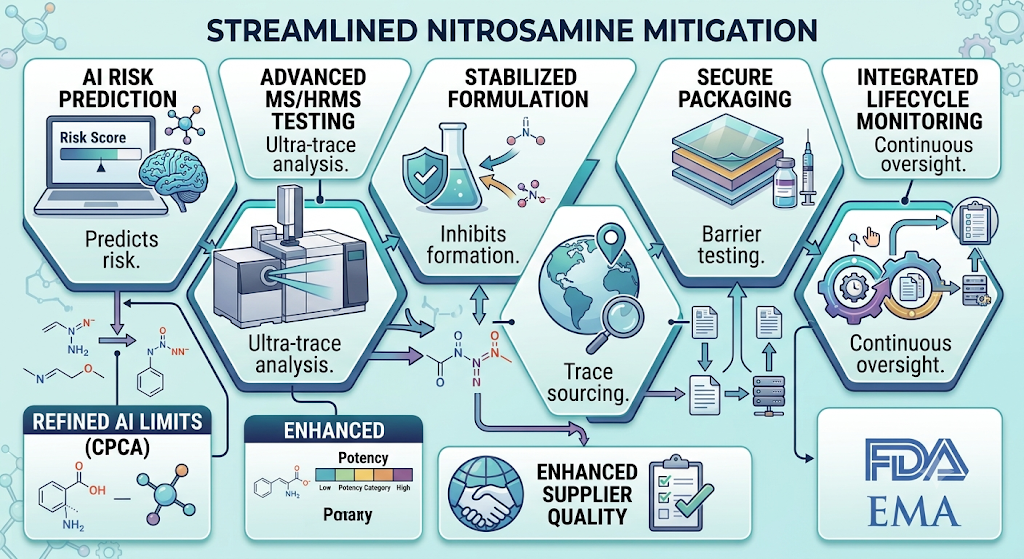
After completing the assessment, the hypothetical biosimilar developer established a consolidated nitrosamine control strategy combining material and process risk assessment, supplier qualification, targeted analytical screening, confirmatory LC-MS/MS testing, a scientific acceptable-intake assessment, process controls, packaging evaluation, stability monitoring, and lifecycle change-control procedures.
The meaningful outcome wasn’t simply a statement that “nitrosamines were not detected.” It was a connected chain of evidence showing where nitrosamines could originate, how they could form, how they would be detected, what exposure could result, how formation is prevented, and how residual risk is controlled — evidence that is far more persuasive to regulatory reviewers than an isolated analytical result.
6: Common Challenges in Nitrosamine Compliance for Biosimilars
Why is this harder for biosimilars than for small molecules? Biological manufacturing complexity, very low analytical target concentrations, and multiple potential material sources make biosimilar nitrosamine assessment inherently more demanding than a typical small-molecule evaluation.
- Limited compound-specific toxicological data
- Very low acceptable intake levels
- Complex sample matrices and potential analytical background contamination
- Multiple suppliers and raw-material sources
- Changing manufacturing processes over the product lifecycle
- Differences in global regulatory expectations
- Difficulty distinguishing theoretical risk from experimentally demonstrated risk
A scientifically sound strategy addresses these challenges through risk prioritization rather than indiscriminate testing of everything.
7: How ResolveMass Laboratories Supports Nitrosamine Risk Assessment
ResolveMass Laboratories integrates analytical testing with pharmaceutical development and regulatory requirements rather than treating nitrosamine testing as an isolated lab activity. Support areas include nitrosamine risk assessment, analytical method development and validation, LC-MS/MS and LC-HRMS testing, impurity profiling, trace-level investigations, extractables and leachables assessment, stability-related impurity investigations, and regulatory-supporting technical documentation.
For biosimilar sponsors, nitrosamine control is most effective when it’s connected to the full CMC and comparability picture — which is why many programs pair this work with our end-to-end biosimilar analytical package, so risk assessment, impurity testing, and product characterization are managed as one coordinated program rather than fragmented studies.
Key Takeaways
A successful Nitrosamine Compliance Strategy for Biosimilars should be:
- Risk-based: Focus testing on scientifically credible formation pathways
- Preventive: Control potential sources rather than relying only on finished-product testing
- Analytically sensitive: Use appropriately sensitive and selective methods
- Scientifically justified: Support acceptable intake decisions with relevant toxicological evidence
- Globally aligned: Consider FDA and EMA expectations from the start of development
- Lifecycle-focused: Continue monitoring after submission and approval
- Well documented: Clearly connect risk assessment, analytical results, mitigation, and control strategy
Conclusion:
A robust Nitrosamine Compliance Strategy for Biosimilars should be integrated into development well before regulatory submission, covering the complete product lifecycle from raw materials and manufacturing through formulation, packaging, stability, analytical testing, and post-approval change management. FDA’s current guidance emphasizes risk assessment, detection, prevention, and control of nitrosamine impurities, while EMA requires risk evaluation and appropriate management of nitrosamine risk across both biological and chemical medicines. For sponsors pursuing simultaneous FDA and EMA approval, the strongest approach isn’t simply “test for nitrosamines” — it’s demonstrating one complete chain of scientific evidence: risk identification, mechanistic assessment, analytical testing, toxicological evaluation, mitigation, control, stability monitoring, and lifecycle management. As acceptable-intake information continues to evolve on both sides of the Atlantic, sponsors should verify the latest FDA and EMA guidance immediately before finalizing a submission.
Frequently Asked Questions:
Yes, nitrosamine risk assessment can apply to biological medicines, including biosimilars.
Regulatory agencies expect manufacturers to evaluate potential sources of nitrosamine impurities based on product-specific risks.
The assessment should consider manufacturing materials, processes, formulation, and storage.
Appropriate testing and controls should be implemented when a credible risk is identified.
No, testing should generally be determined by a scientifically justified risk assessment.
If no credible formation pathway is identified, extensive routine testing may not be necessary.
However, an identified potential risk may require sensitive confirmatory analytical testing.
The testing strategy should be appropriate for the impurity, product matrix, and regulatory requirements.
NDSRIs are nitrosamine impurities that are related to the structure or chemistry of a drug substance.
They may form through interactions involving drug-substance components or manufacturing conditions.
Their potential formation should be assessed using product-specific chemical and process knowledge.
Where relevant, appropriate analytical and toxicological evaluations should be performed.
Acceptable intake limits are established using available toxicological and carcinogenicity information.
Depending on the compound, regulators may use compound-specific data, read-across, or carcinogenic potency approaches.
The applicable FDA or EMA recommendations should be reviewed for the specific nitrosamine.
The selected limit and its scientific justification should be clearly documented.
Manufacturers can prevent or minimize formation by controlling potential nitrosating agents and amine precursors.
Supplier qualification and raw-material controls can help reduce incoming risks.
Process parameters such as pH, temperature, and exposure time may also require evaluation.
Formulation, packaging, and storage conditions should be optimized where they contribute to risk.
Reference
- Hohl K. Nitrosamine risk management for medicinal products: WHO’s role and a case study of camzyos®. Master Drug Regul Aff. 2023.https://www.dgra.de/media/pdf/studium/masterthesis/master_hohl_kevin_2024.pdf
- Costa M. The regulatory challenge of determining acceptable intakes for nitrosamine drug substance-related impurities while ensuring medicinal product supply. MasterarbeitzurErlangung des Titels” Master of Drug Regulatory Affairs, MDRA. 2023.https://www.dgra.de/media/masterthesis/1415-master_costa-marianna_2023.pdf
- Mantel-Teeuwisse A, Bloem LT, Boon W, De Bruin ML, Hoekman J, Klein K, Stolk P, Vreman R. Study in support of the evaluation and impact assessment of the EU general pharmaceuticals legislation: Evaluation Report.https://research-portal.uu.nl/en/publications/study-in-support-of-the-evaluation-and-impact-assessment-of-the-e/
- Sinha A. Comparability Exercise in Biosimilar Development: Design, Data Interpretation, and Regulatory Expectations.https://resolvemass.ca/comparability-exercise-in-biosimilar-development/
About the Author


