

Introduction:
When a nitrosamine exceeds the acceptable intake limit in a drug product or active pharmaceutical ingredient (API), it triggers a cascade of regulatory, analytical, and manufacturing obligations for the sponsor. Nitrosamines are potent genotoxic impurities classified as probable or possible human carcinogens. Organizations unfamiliar with what are nitrosamines often underestimate the regulatory implications of even trace-level contamination. Even trace-level exceedances above established AI limits demand immediate, documented action. Understanding exactly what steps must be taken — and in what order — is critical for maintaining patient safety, product integrity, and regulatory compliance.
Since 2018, when nitrosamine contamination was first discovered in valsartan APIs, global health authorities including the U.S. Food and Drug Administration (FDA), European Medicines Agency (EMA), and Health Canada have continuously tightened their oversight. Multiple high-profile product withdrawals have highlighted the importance of proactive impurity control, as discussed in recent analyses of nitrosamine drug recalls. Sponsors who discover or suspect that nitrosamine levels in their products may have breached acceptable intake thresholds must navigate a well-defined response pathway — and delays can carry serious consequences.
Summary:
- When a nitrosamine exceeds the acceptable intake (AI) limit, sponsors are legally and scientifically obligated to act — from confirming the exceedance to notifying regulators and implementing corrective actions.
- Regulatory frameworks from FDA, EMA, ICH M7(R2), and Health Canada define the AI limits for each nitrosamine impurity and specify the timelines for sponsor response.
- A structured response includes root cause analysis, risk assessment, method validation, reformulation or process changes, and regulatory submissions.
- Failure to act on a confirmed nitrosamine exceedance can result in product recalls, warning letters, and market withdrawal.
- ResolveMass Laboratories Inc. provides end-to-end nitrosamine risk assessment, analytical testing, and regulatory support for pharmaceutical sponsors navigating these challenges.
1: What Are Acceptable Intake Limits for Nitrosamines?
Acceptable intake limits define the maximum daily dose of a nitrosamine impurity considered to pose an acceptable cancer risk over a lifetime of exposure.
Nitrosamine AI limits are established using the Threshold of Toxicological Concern (TTC) framework and compound-specific carcinogenicity data, primarily through the ICH M7(R2) guideline and supplementary FDA/EMA guidance documents. Sponsors often review nitrosamine AI limits comparison resources to understand differences between agency expectations. The limits are expressed in nanograms per day (ng/day) and vary significantly by compound.
Key Nitrosamine AI Limits (Regulatory Reference Values)
| Nitrosamine Impurity | FDA AI Limit (ng/day) | EMA AI Limit (ng/day) | Common Source |
|---|---|---|---|
| NDMA (N-Nitrosodimethylamine) | 96 | 96 | Sartan APIs, ranitidine, metformin |
| NDEA (N-Nitrosodiethylamine) | 26.5 | 26.5 | Sartan APIs |
| NMBA (N-Nitrosomethylaminobutyric acid) | 96 | 96 | Valsartan |
| NIPEA (N-Nitroso-N-isopropylethylamine) | 26.5 | 26.5 | Process-related |
| NDIPA (N-Nitrosodiisopropylamine) | 26.5 | 26.5 | Degradants |
| NDBA (N-Nitrosodibutylamine) | 26.5 | 26.5 | Sartan APIs |
| NDMA (short-term limits) | 3,000 (interim) | — | Temporary supply shortage allowances |
For cohort of concern (CoC) nitrosamines — compounds with exceptionally high carcinogenic potency — AI limits may be set at 1.5 ng/day or lower. Products containing multiple nitrosamines may also require evaluation using approaches described in acceptable intake for multiple nitrosamines guidance documents.
When an observed level in a batch or formulation surpasses any of these thresholds, an exceedance event is formally triggered. Understanding the typical nitrosamine testing timeline can help sponsors prepare for subsequent investigations and regulatory actions.
2: How Is a Nitrosamine Exceedance Discovered?
A nitrosamine exceedance is typically detected through routine risk assessment testing, stability studies, or regulatory-directed testing.
Sponsors may identify a potential exceedance through several pathways:
- Regulatory directive testing — FDA/EMA/Health Canada-mandated screening of finished drug products or APIs
- Stability program monitoring — nitrosamines can form or increase over time due to degradation, packaging interactions, or excipient reactions. This is why many manufacturers have incorporated dedicated nitrosamine testing in stability studies into their product lifecycle management programs.
- Third-party or contract lab results — analytical results from a CRO or testing laboratory flagging levels above limits
- Post-market surveillance — reports from international markets or recalled batches triggering investigation
- Supplier notification — an API or excipient supplier reports nitrosamine contamination in their material. Such events reinforce the importance of implementing robust nitrosamine control during supplier qualification procedures.
Once a potential exceedance is flagged, the sponsor must not assume the result is an error. Verification and escalation must begin immediately.
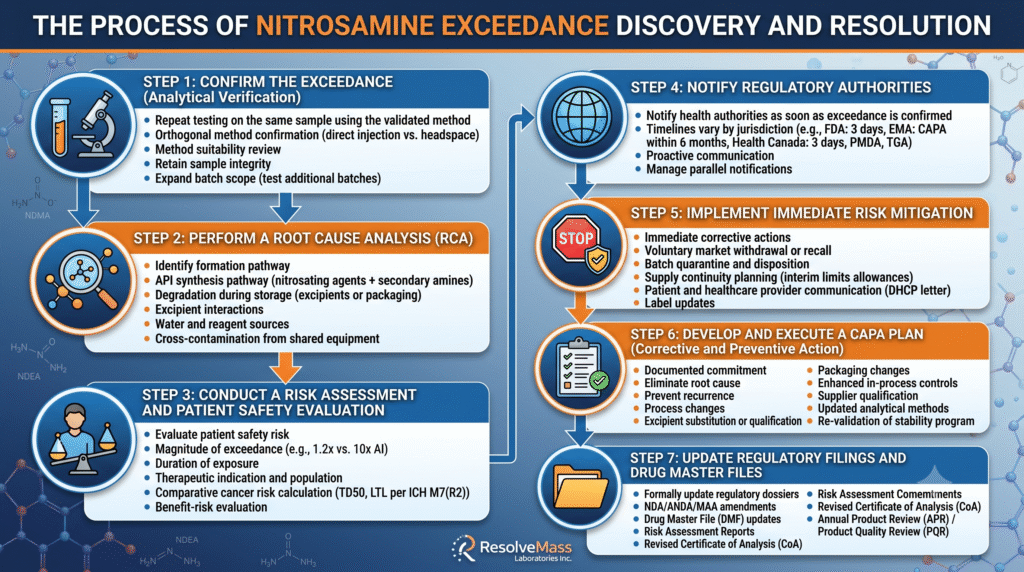
Step 1: Confirm the Exceedance — Analytical Verification
The first step when a nitrosamine exceeds the acceptable intake limit is to verify the finding analytically before escalating.
A single result above the AI limit does not automatically confirm a systemic exceedance. However, sponsors must follow a rigorous verification pathway:
- Repeat testing on the same sample using the validated method — rule out instrument error, sample contamination, or procedural anomaly
- Orthogonal method confirmation — may involve comparing analytical approaches such as direct injection vs headspace techniques for nitrosamines to ensure consistent and reliable results.
- Method suitability review — should confirm that the procedure is fit-for-purpose. In many cases, sponsors partner with laboratories offering specialized nitrosamine method development and validation services to establish matrix-specific sensitivity and specificity.
- Retain sample integrity — ensure retained samples from the same batch are stored correctly and available for re-testing
- Expand batch scope — test additional batches from the same manufacturing campaign or time period
At ResolveMass Laboratories Inc., nitrosamine confirmatory testing is performed using validated LC-MS/MS and GC-MS/MS methods. Advanced technologies such as HRMS for nitrosamine testing can provide additional structural confirmation, while achieving an ultra-low limit of quantitation (LOQ) in nitrosamine testing ensures detection well below regulatory thresholds. Particular attention is also paid to overcoming matrix effects in LC-MS/MS to improve data quality and regulatory defensibility.
Step 2: Perform a Root Cause Analysis
Once exceedance is confirmed, a root cause analysis (RCA) must identify where and how the nitrosamine formed or was introduced.
Common root causes include API synthesis pathways involving nitrosating agents and secondary amines. Understanding nitrosamine formation pathways in API synthesis is often critical to identifying the source of contamination.
- API synthesis pathway — nitrosating agents present in synthesis steps reacting with secondary amines
- Degradation during storage — nitrite-containing excipients or packaging components reacting with drug substance over time
- Water and reagent sources — quality should also be investigated. Effective nitrosamine solvent and catalyst mitigation strategies can significantly reduce impurity formation risk.
- Excipient interactions — certain tablet coatings, lubricants (e.g., magnesium stearate), or capsule materials contributing nitrosamines
- Cross-contamination from shared equipment — residual nitrosamines from other products manufactured on the same line
Packaging systems may contribute through extractables and leachables. Sponsors frequently perform assessments focused on packaging leachables and nitrosamine extractables/leachables studies when evaluating potential contamination sources.
The RCA should produce a documented investigation report, including a process map of all potential nitrosamine formation pathways and a risk ranking of each contributing factor. This report will later be submitted to regulatory authorities as part of the response package.
Step 3: Conduct a Risk Assessment and Patient Safety Evaluation
When a nitrosamine exceeds the acceptable intake limit, the sponsor must evaluate the actual patient safety risk, not just the technical exceedance.
Comparative cancer risk calculations often use TD50 or LTL approaches consistent with ICH M7(R2). Recent discussions surrounding the impact of ICH M7(R2) updates on nitrosamine risk assessment have further clarified sponsor expectations.
Patient safety evaluations should also be integrated into broader nitrosamine lifecycle management programs to ensure ongoing compliance beyond the immediate investigation.
The patient risk assessment should address:
- Magnitude of exceedance — is the observed level modestly above the AI (e.g., 1.2× the limit) or significantly higher (e.g., 10× or more)?
- Duration of patient exposure — how long has the affected product been on the market? How many patients have been exposed?
- Therapeutic indication and population — a life-sustaining medication for a vulnerable population requires a different risk-benefit calculus than a short-course OTC product
- Comparative cancer risk calculation — using the TD50 or LTL (lifetime theoretical limit) approach per ICH M7(R2), quantify the incremental lifetime cancer risk
- Benefit-risk evaluation — weigh the cancer risk from the impurity against the risk to patients if the product is withdrawn
This evaluation is not merely regulatory box-checking. It directly informs the urgency and scope of the regulatory notification and whether an immediate recall or supply continuity plan is necessary.
Step 4: Notify Regulatory Authorities
Sponsors must notify health authorities as soon as a confirmed nitrosamine exceedance is established — timelines vary by jurisdiction.
Regulatory Notification Requirements by Agency
| Regulatory Authority | Notification Timeline | Submission Vehicle |
|---|---|---|
| FDA (U.S.) | Within 3 business days (Field Alert Report) for distributed product | FAR (21 CFR 314.81(b)(1)) |
| EMA / National Competent Authorities (EU) | CAPA plan within 6 months; interim limits via variation | Type IA/IB variation, PSUSA, or RMP update |
| Health Canada | Mandatory problem reporting within 3 days if a risk to health | MedEffect reporting + regulatory submission |
| PMDA (Japan) | Safety report per local PMS regulations | PSUR or safety variation |
| TGA (Australia) | Notify within 2 business days for imminent risk | Safety advisory submission |
For products distributed in multiple markets, sponsors must manage parallel notifications — each with distinct timelines, required data packages, and response formats. Proactive communication with regulators is strongly recommended; regulatory authorities generally view forthcoming notification more favorably than reactive disclosure following a third-party report. Companies pursuing generic drug approvals should also understand the differences between NDA vs ANDA nitrosamine submission requirements and ensure that any supporting documentation aligns with expectations for a nitrosamine risk assessment for ANDA submission.
Step 5: Implement Immediate Risk Mitigation
Depending on the severity of the exceedance, immediate corrective actions may be required before a long-term solution is implemented.
Potential immediate actions include:
- Voluntary market withdrawal or recall — mandatory for exceedances at levels posing an unacceptable patient risk
- Batch quarantine and disposition — hold and investigate all potentially affected batches, pending regulatory decision
- Supply continuity planning — coordinate with regulators to obtain interim limit allowances if the product is medically necessary and alternative supplies are unavailable
- Patient and healthcare provider communication — issue a Dear Healthcare Provider (DHCP) letter or patient advisory as directed by the regulatory authority
- Label updates — if nitrosamines cannot be immediately eliminated, interim label updates may be required
The FDA and EMA have historically granted temporary acceptable limits above the standard AI where the benefit-risk balance justifies continued supply — but these allowances are time-limited and require a committed CAPA plan. Sponsors should establish clear internal thresholds consistent with nitrosamine alert limit vs action limit principles and, where necessary, evaluate a comprehensive nitrosamine reformulation strategy to permanently reduce impurity risk.
Step 6: Develop and Execute a CAPA Plan
A Corrective and Preventive Action (CAPA) plan is the sponsor’s documented commitment to eliminating the root cause and preventing recurrence.
A robust CAPA plan for a nitrosamine exceedance should include:
- Process changes — modification of synthesis routes to eliminate nitrosating agents, change of reagents or solvents, revised purification steps
- Excipient substitution or qualification — replacement of nitrite-containing excipients with qualified alternatives; qualification testing for new materials
- Packaging changes — transition from nitrite-releasing packaging components to inert materials; moisture barrier upgrades
- Enhanced in-process controls — introduction of nitrosamine-specific in-process testing at critical manufacturing steps
- Supplier qualification — auditing and requalifying API and excipient suppliers; updating supplier qualification specifications to include nitrosamine limits
- Updated analytical methods — validating and implementing routine QC testing methods for all identified nitrosamine impurities
- Re-validation of stability program — adding nitrosamine testing to ongoing and accelerated stability protocols
Enhanced manufacturing oversight frequently includes implementation of nitrosamine batch release testing requirements to verify product quality before commercial distribution. In addition, organizations often establish science-based nitrosamine specification setting strategies to support long-term compliance and regulatory acceptance.
The CAPA plan must include measurable milestones and timelines. For FDA submissions, CAPAs are typically expected to be completed within 6–12 months of the initial notification.
Step 7: Update Regulatory Filings and Drug Master Files
After implementing corrective actions, the sponsor must formally update all affected regulatory dossiers.
Required updates typically include:
- NDA/ANDA/MAA amendments — updated impurity specifications, revised analytical methods, manufacturing process changes, and updated stability data
- Drug Master File (DMF) updates — if the nitrosamine originates from the API, the API manufacturer must update the relevant DMF
- Risk Assessment Reports — submission of the completed nitrosamine risk assessment as a formal document, in accordance with FDA’s Guidance for Industry on Nitrosamine Drug Substance-Related Impurities and EMA’s Questions and Answers guidance
- Revised Certificate of Analysis (CoA) — updated specifications and limits on CoA for API and finished product
- Annual Product Review (APR) / Product Quality Review (PQR) — include nitrosamine findings, investigation outcomes, and CAPA status in the next scheduled review
For generic products, dossier updates should remain consistent with NDA vs ANDA nitrosamine submission requirements and the supporting framework for nitrosamine risk assessment for ANDA submission.
3: What Happens If a Sponsor Fails to Act?
If a sponsor fails to respond appropriately when a nitrosamine exceeds the acceptable intake limit, the regulatory and commercial consequences can be severe.
Potential consequences of inaction include:
- FDA Warning Letter — citing failure to comply with CGMP or post-market reporting obligations
- Import Alert — products from non-compliant manufacturers may be detained at the U.S. border
- Mandatory Recall — if FDA determines a health risk exists and the sponsor has not acted voluntarily
- Market Withdrawal — EMA or national competent authorities may suspend the marketing authorization
- Criminal Liability — in egregious cases, individual responsible parties may face criminal prosecution
- Reputational Damage — loss of patient, prescriber, and investor trust with long-lasting brand consequences
Many of these enforcement actions have followed major contamination events documented in published reviews of nitrosamine drug recalls analysis. Regulatory authorities across all major markets have made clear that nitrosamine impurity control is a mandatory, ongoing obligation — not a one-time remediation exercise.
Regulatory authorities across all major markets have made clear that nitrosamine impurity control is a mandatory, ongoing obligation — not a one-time remediation exercise.
4: How ResolveMass Laboratories Inc. Supports Sponsors Through Nitrosamine Exceedance Response
ResolveMass Laboratories Inc. is a Canadian contract research organization (CRO) with deep specialization in pharmaceutical impurity characterization, PLGA-based drug delivery, and regulatory analytical support. Organizations evaluating the benefits of outsourcing nitrosamine testing to a CRO often seek specialized expertise that accelerates investigations and regulatory response activities.
When a nitrosamine exceeds the acceptable intake limit in your product, our team provides:
- Validated nitrosamine testing using LC-MS/MS and GC-MS/MS platforms with LOQs well below regulatory AI thresholds, including support for nitrosamine testing for generic drugs and other regulated pharmaceutical products.
- Root cause investigation support — analytical forensics across API, excipients, packaging, and process streams, including evaluation of the nitrosamine impurity vs nitrosamine leachable difference.
- Nitrosamine risk assessment documentation aligned with FDA, EMA, ICH M7(R2), and Health Canada requirements.
- CAPA development and implementation support — from process redesign analytics to updated stability protocols.
- Regulatory submission preparation — technical writing and data packages for NDA/ANDA amendments, DMF updates, and variation filings.
- Method development and validation — fit-for-purpose nitrosamine method development and validation services built around your specific formulation matrix.
Our scientists have hands-on experience with the full spectrum of nitrosamine impurities encountered across small molecule APIs, injectable formulations, and complex drug delivery systems. We also support sponsors conducting nitrosamine testing for high-risk drug classes where degradation-related nitrosamine formation presents unique analytical and regulatory challenges.
Conclusion:
When a nitrosamine exceeds the acceptable intake limit, sponsors must move quickly and systematically — from analytical confirmation and root cause analysis through regulatory notification, patient risk evaluation, CAPA implementation, and dossier updates. Each step is interconnected, and delays at any stage can amplify both patient risk and regulatory exposure.
The ICH M7(R2) framework, FDA guidance, EMA Q&A documents, and Health Canada directives collectively define a clear path forward. Sponsors who follow this path transparently, with scientifically rigorous data and documented intent to remediate, are consistently better positioned in their regulatory relationships — and ultimately, in protecting their patients. A proactive approach built around comprehensive nitrosamine lifecycle management and adherence to a defined nitrosamine testing timeline can significantly reduce both compliance risks and future remediation costs.
ResolveMass Laboratories Inc. stands ready to partner with sponsors at any stage of this process. Whether you are responding to a confirmed nitrosamine exceedance or proactively building a robust nitrosamine control strategy, our analytical and regulatory expertise is here to support you.
Frequently Asked Questions:
Sponsors should notify the FDA as soon as they confirm that a nitrosamine exceeds the acceptable intake (AI) limit and determine that the finding may affect marketed products. The exact timeline depends on the severity of the risk and regulatory reporting requirements, but prompt communication is expected. Early notification allows the FDA to assess potential patient impact and collaborate on appropriate risk management actions.
Yes, in some cases. A product may remain on the market temporarily if regulators determine that the therapeutic benefit outweighs the potential risk and there are limited treatment alternatives. Regulatory agencies often perform a benefit-risk assessment considering factors such as patient population, duration of exposure, disease severity, and availability of alternative therapies before deciding whether a recall or market withdrawal is necessary.
Regulatory authorities generally expect validated, highly sensitive, and specific analytical methods capable of detecting nitrosamines at trace levels. Commonly accepted techniques include:
-LC-MS/MS (Liquid Chromatography–Tandem Mass Spectrometry)
-GC-MS/MS (Gas Chromatography–Tandem Mass Spectrometry)
-High-Resolution Mass Spectrometry (HRMS)
-Validated targeted nitrosamine screening methods
The selected method should demonstrate appropriate sensitivity, specificity, accuracy, precision, and robustness in accordance with regulatory expectations.
The acceptable intake (AI) limit applies to the patient’s total daily exposure, which is typically assessed in the finished drug product. However, nitrosamine levels may be evaluated in both the active pharmaceutical ingredient (API) and the finished dosage form during investigations and control strategies. Ultimately, regulators focus on the amount of nitrosamine a patient may consume daily from the marketed product to determine compliance with AI limits.
Reference
- Patel MB, Usmani A. Regulatory Framework and Standards for Nitrosamine Control in Pharmaceuticals and Food Products.https://oajmr.com/June2025/v1i311.pdf
- Costa M. The regulatory challenge of determining acceptable intakes for nitrosamine drug substance-related impurities while ensuring medicinal product supply. MasterarbeitzurErlangung des Titels” Master of Drug Regulatory Affairs, MDRA. 2023.https://www.dgra.de/media/masterthesis/1415-master_costa-marianna_2023.pdf
- Johnson GE, Dobo K, Gollapudi B, Harvey J, Kenny J, Kenyon M, Lynch A, Minocherhomji S, Nicolette J, Thybaud V, Wheeldon R. Permitted daily exposure limits for noteworthy N‐nitrosamines. Environmental and Molecular Mutagenesis. 2021 Jun;62(5):293-305.https://onlinelibrary.wiley.com/doi/abs/10.1002/em.22446
- Wolff IA, Wasserman AE. Nitrates, Nitrites, and Nitrosamines: Extensive research is needed to establish how great a food hazard these nitrogenous substances present. Science. 1972 Jul 7;177(4043):15-9.https://www.science.org/doi/abs/10.1126/science.177.4043.15
- Hohl K. Nitrosamine risk management for medicinal products: WHO’s role and a case study of camzyos®. Master Drug Regul Aff. 2023.https://www.dgra.de/media/pdf/studium/masterthesis/master_hohl_kevin_2024.pdf
About the Author


