

Introduction
A comprehensive Nitrosamine Risk Assessment for a Proton Pump Inhibitor seeking Abbreviated New Drug Application (ANDA) approval requires a structured, multi-tiered technical assessment to identify, quantify, evaluate, and mitigate carcinogenic N-nitroso impurities throughout the product lifecycle. Conducting a scientifically rigorous Nitrosamine Risk Assessment for a Proton Pump Inhibitor supports compliance with U.S. Food and Drug Administration (FDA) and International Council for Harmonisation (ICH) expectations while protecting patient safety and supporting an efficient pathway toward generic drug authorization. Proton pump inhibitors (PPIs), including substituted benzimidazole compounds such as pantoprazole, omeprazole, lansoprazole, rabeprazole, and esomeprazole, have specific structural and formulation-related vulnerabilities because nitrosation pathways may arise during active pharmaceutical ingredient (API) synthesis, drug product manufacture, and finished product storage.
Learn more about fundamental nitrosamine concepts: What Are Nitrosamines?
Following the release of FDA guidance Control of Nitrosamine Impurities in Human Drugs (Revision 2) and implementation of the Carcinogenic Potency Categorization Approach (CPCA), generic drug sponsors are expected to perform scientifically justified and defensible risk assessments before regulatory approval. This case study describes the technical implementation of the mandatory three-step regulatory framework, including CPCA Acceptable Intake (AI) calculations, high-sensitivity liquid chromatography-tandem mass spectrometry (LC-MS/MS) bioanalytical validation, and formulation and manufacturing control strategies applicable to generic PPI drug products.
Understand mandatory screening and risk requirements: Do All Drugs Need Nitrosamine Risk Assessment?
Share via:
Quick Summary:
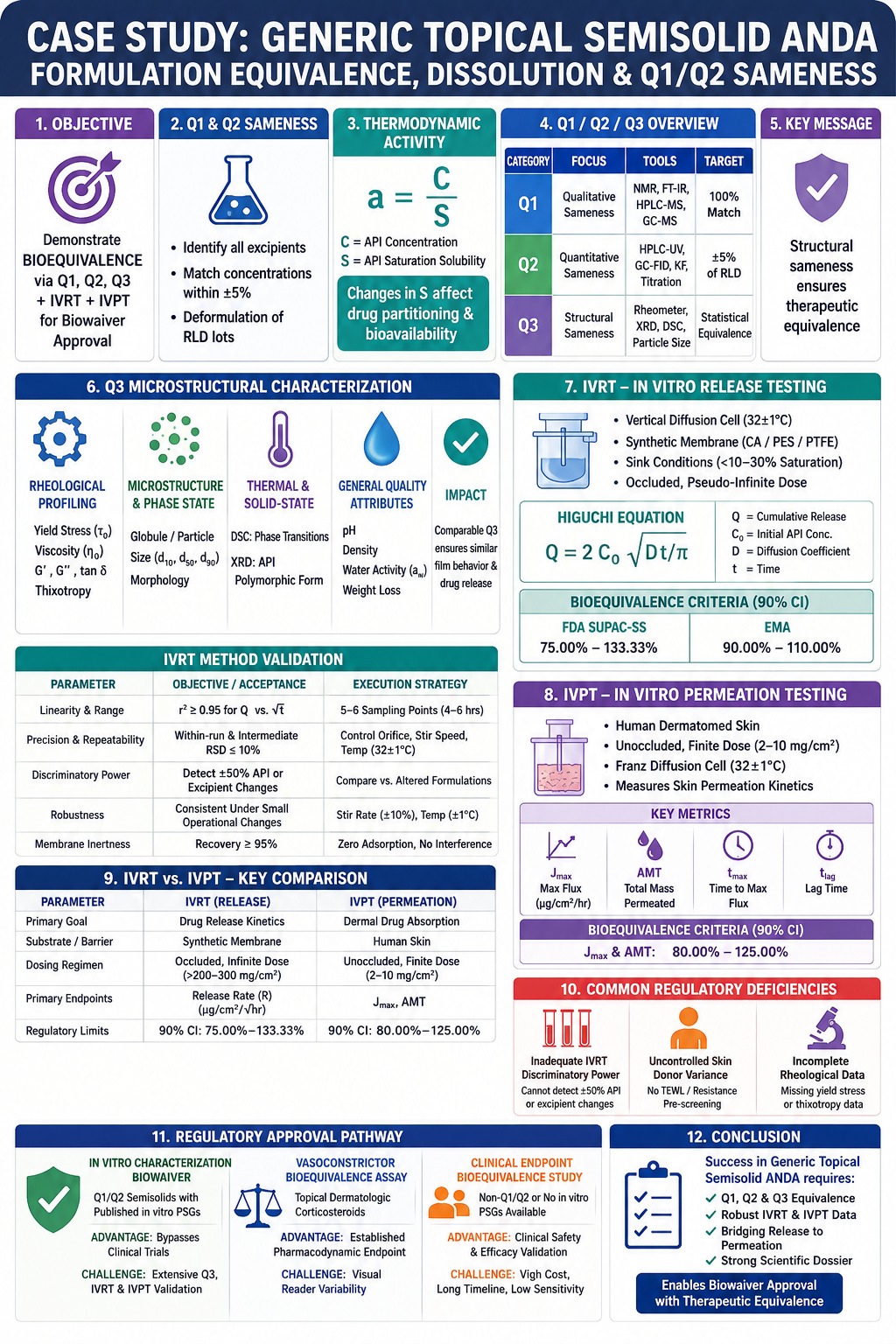
- Q1/Q2/Q3 Sameness: Generic topical semisolids must demonstrate qualitative, quantitative, and structural equivalence to the Reference Listed Drug (RLD).
- Formulation Equivalence: Deformulation and advanced analytical techniques help confirm excipient identity, concentration, grade, and composition, with Q2 targets generally within ±5% of the RLD.
- Q3 Microstructure: Rheology, particle/globule size, thermal behavior, polymorphic form, pH, density, and water activity help establish comparable microstructure and product performance.
- IVRT Performance: In Vitro Release Testing measures drug release using diffusion cells and synthetic membranes. FDA-based comparisons generally use a 90% CI of 75.00%–133.33% for release-rate ratios.
- IVPT Performance: In Vitro Permeation Testing evaluates drug movement through human dermatomed skin using metrics such as Jmax and AMT, with a typical 80.00%–125.00% bioequivalence range.
- Common Regulatory Deficiencies: Major risks include poor IVRT discriminatory power, uncontrolled skin-donor variability, inadequate skin-barrier screening, and incomplete rheological characterization.
- Regulatory Strategy: A strong Q1/Q2/Q3 + IVRT + IVPT package can support an in-vitro characterization-based biowaiver pathway, reducing dependence on costly clinical endpoint studies while supporting therapeutic equivalence.
Step 1: Technical Risk Identification for a Proton Pump Inhibitor
Step 1 risk identification involves evaluating possible N-nitroso impurity formation pathways throughout the complete manufacturing matrix. This assessment encompasses active pharmaceutical ingredient (API) chemical synthesis, excipient interactions, manufacturing process parameters, processing materials, and primary packaging components. For proton pump inhibitors, structural secondary and tertiary amine moieties associated with the benzimidazole and pyridine rings, together with trace nitrites originating from formulation excipients, may contribute significantly to the formation of nitrosamine drug substance-related impurity (NDSRI).
Active Pharmaceutical Ingredient Synthetic Chemistry and Degradation
The chemical structure of substituted benzimidazole PPIs generally contains a pyridine ring connected through a sulfinyl methyl bridge to a benzimidazole core. Synthetic routes may use starting materials such as 5-difluoromethoxy-2-mercapto-1H-benzimidazole for pantoprazole or 2-chloromethyl-3,4-dimethoxypyridine hydrochloride. Such materials and associated synthetic intermediates can potentially contribute trace secondary amine impurities. During manufacturing and subsequent processing, oxidative degradation and competing side reactions may generate amine precursors that become susceptible to N-nitrosation when they encounter nitrosating agents such as NOx, sodium nitrite, or nitrous acid in reagents, process water, or recovered solvents. Under suitable conditions, acid-catalyzed nitrosation allows secondary or tertiary amine precursors to react with nitrosating species, producing complex NDSRIs that may exhibit structural similarity to the parent API.
Explore reaction pathways during synthesis: Nitrosamine Formation Pathways in API Synthesis
Excipient-Mediated Nitrosation in Solid Oral Dosage Forms
Trace inorganic nitrites contained within commonly used tablet excipients can react with secondary amine impurities or unreacted API components, potentially producing NDSRIs during drug product manufacturing and throughout shelf-life storage. Proton pump inhibitor formulations may have increased susceptibility because micro-environmental micro-pH changes and bound moisture can influence solid-state chemical reactions. Substituted benzimidazoles are acid-labile compounds and are therefore commonly formulated as delayed-release enteric tablets or multiparticulate pellets designed to protect the API from degradation in gastric fluid. These drug product matrices may contain functional excipients such as microcrystalline cellulose, crospovidone, povidone (PVP), mannitol, and enteric polymers including hypromellose phthalate or methacrylic acid copolymers.
Depending on raw material sourcing and agricultural manufacturing background, excipients may contain trace quantities of residual nitrites (NO2−), with reported levels potentially ranging from 0.1 ppm to above 10 ppm. When bound residual moisture is present, particularly under elevated ambient temperatures during wet granulation or long-term stability storage, residual nitrites can participate in reactions with amine degradants. Continuous exposure to these conditions may therefore contribute to the generation of NDSRIs over the manufacturing and storage lifecycle of the drug product.
Solvent Degradation and Packaging Leachables
Thermal or chemical degradation of amide solvents used during API processing can produce small secondary amines that may subsequently react with nitrosating agents and generate small-molecule nitrosamines such as NDMA. In addition, certain primary packaging systems containing nitrocellulose lamination coatings may represent a potential source of volatile nitrosating species that can migrate into the finished oral drug product. Amide solvents including N,N-dimethylformamide (DMF), N,N-dimethylacetamide (DMAc), and N-methyl-2-pyrrolidone (NMP) may undergo hydrolytic degradation under acidic or thermal conditions, producing dimethylamine. In the presence of nitrites, dimethylamine can undergo N-nitrosation to form N-nitrosodimethylamine (NDMA). Similarly, primary blister packaging incorporating nitrocellulose-coated heat-seal foils may release volatile nitrogen oxides that migrate into dosage cavities and potentially promote the formation or transfer of leachable nitrosamines such as N-nitrosodibutylamine (NDBA) during product shelf life.
Differentiate process impurities from leachables: Nitrosamine Impurity vs Nitrosamine Leachable Difference
| Risk Vector | Target Precursor / Contaminant Source | Chemical Mechanism of Nitrosation | PPI-Specific Vulnerability Rating |
|---|---|---|---|
| API Synthetic Route | Secondary amine impurities, pyridinyl intermediates | Amine reactions with residual nitrites in reagents or process water | Moderate to High |
| Excipient Matrix | Microcrystalline cellulose, Povidone, Crospovidone | Trace excipient nitrite (NO2−) reacting with API amine sites in the solid state | High |
| Process Solvents | Recovered DMF, DMAc, or NMP | Solvent hydrolytic breakdown to dimethylamine followed by reaction with nitrosating agents | Moderate |
| Primary Packaging | Nitrocellulose foil laminates, vulcanized stoppers | Volatile NOx gas migration or leachable NDBA transfer into dosage units | Low to Moderate |
Step 2: Confirmatory Testing and CPCA Categorization in Nitrosamine Risk Assessment for a Proton Pump Inhibitor
Step 2 confirmatory testing uses high-sensitivity liquid chromatography-tandem mass spectrometry (LC-MS/MS) to detect and quantify identified nitrosamine impurities against regulatory Acceptable Intake (AI) limits established through the Carcinogenic Potency Categorization Approach (CPCA). This empirical testing stage determines whether measured impurity concentrations remain below applicable regulatory thresholds and provides critical information for establishing appropriate controls and specifications within an ANDA submission.
Understand structural classifications and thresholds: NDSRI vs Simple Nitrosamines
CPCA Potency Scoring Rationale
The CPCA framework is used to predict the carcinogenic potency of unstudied NDSRIs by evaluating relevant structural characteristics. The approach considers the number of α-hydrogens together with numerical modifiers associated with activating and deactivating electronic or steric features. The resulting Potency Score places a nitrosamine into one of five potency categories, each associated with a corresponding AI limit ranging from 18 ng/day to 1500 ng/day. When suitable empirical bioassay information is unavailable, this structure-activity relationship (SAR) approach can be used to calculate the overall score according to the following toxicological formula:
Potency Score = Count of α-Hydrogens + Deactivating Feature Scores + Activating Feature Scores
Evaluation of a candidate NDSRI originating from a substituted benzimidazole PPI involves three primary structural considerations:
- Count of α-Hydrogens: Determine the number of hydrogens attached to carbon atoms directly adjacent to the N-nitroso group. Substituted benzimidazoles may have sterically restricted configurations, with typical α-hydrogen counts producing initial scores of 1 or 2.
- Deactivating Features (+): Assign positive values to deactivating structural characteristics, including bulky aromatic rings such as pyridinium or benzimidazole rings and electron-withdrawing groups positioned near the α-carbon. These characteristics may restrict metabolic α-hydroxylation.
- Activating Features (-): Subtract points for activating structural characteristics, including unhindered alkyl chains or activating functional groups that can facilitate bioactivation.
The calculated Potency Score corresponds to one of five regulatory CPCA categories and establishes the associated default daily exposure threshold:
| CPCA Category | Potency Score Criteria | Default AI Limit (ng/day) | Target LOQ at 40 mg MDD (ppm) | Carcinogenic Risk Profile |
|---|---|---|---|---|
| Category 1 | Score ≤ 1 | 18 | 0.45 | High Predicted Potency |
| Category 2 | Score = 2 | 26.5 | 0.66 | Moderate-High Potency |
| Category 3 | Score = 3 | 96 or 400 | 2.40 to 10.0 | Intermediate Potency |
| Category 4 | Score = 4 | 1500 | 37.5 | Low Potency |
| Category 5 | Score ≥ 5 | 1500 | 37.5 | Lowest Predicted Potency |
Calculation of Target Analytical Specification Limits
Analytical specification limits for nitrosamine testing are established by relating the assigned Acceptable Intake (AI) limit to the Maximum Daily Dose (MDD) of the drug substance. Establishing the corresponding concentration threshold is essential for defining the required Limit of Quantification (LOQ) of the mass spectrometry method and ensuring that the analytical procedure can reliably demonstrate regulatory compliance. The mathematical relationship used to calculate the parts-per-million ($C_{\text{limit}}$) concentration limit is:
Climit (ppm) = Acceptable Intake (ng/day) / Maximum Daily Dose (mg/day)
For a representative Pantoprazole Sodium delayed-release tablet with a 40 mg Maximum Daily Dose (MDD), assuming that the identified NDSRI is assigned to CPCA Category 2 with an AI of 26.5 ng/day, the concentration limit can be calculated as follows:
Climit = (26.5 ng/day) / (40 mg/day) = 0.6625 ppm (μg/g)
Regulatory expectations require the analytical method to demonstrate sufficient sensitivity to reliably measure concentrations below the established specification limit. Therefore, the validated Limit of Quantification (LOQ) should generally reach a level of approximately 30% to 50% of the applicable specification limit. For this example, the validated LOQ for the assay must reach $\le 0.20 \text{ ppm}$ (200 ppb) relative to the drug substance.
Learn more about testing workflows and turnaround expectations: Nitrosamine Testing Timeline
Step 3: Risk Mitigation Strategies for a Proton Pump Inhibitor ANDA Submission
Step 3 risk mitigation involves implementing an integrated control strategy designed to eliminate, reduce, or otherwise control nitrosamine formation so that impurity levels remain below applicable regulatory thresholds. The strategy may incorporate formulation re-engineering, manufacturing process optimization, raw material controls, packaging modifications, and appropriate analytical monitoring. Implementing these corrective and preventive measures helps minimize the potential for batch rejection, supports product stability, and addresses FDA Revision 2 requirements for nitrosamine control.
Explore robust regulatory control plan implementations: Nitrosamine Control Strategy Development Services
Formulation Redesign and Nitrite Scavengers
The incorporation of scavengers such as ascorbic acid or α-tocopherol into solid oral formulations can competitively inhibit nitrosation reactions by consuming reactive nitrite species before they interact with susceptible amine precursors. At the same time, maintaining an alkaline micro-environment can help stabilize the acid-labile benzimidazole structure while reducing the conditions that favor acid-catalyzed nitrosation. Antioxidant scavengers incorporated into the tablet core can interact with residual nitrite species and reduce their availability for subsequent nitrosation reactions.
Micro-environmental pH control is also an important chemical consideration for PPI formulations. Substituted benzimidazoles require alkaline excipients, such as sodium carbonate, meglumine, or disodium hydrogen phosphate, to help protect the API from acid-catalyzed degradation. Maintaining the micro-environmental pH at a slightly basic level (pH > 7.5) can suppress nitrosation kinetics because formation of active nitrosating species, including H2NO2+ or N2O3, is favored under acidic conditions. Appropriate control of formulation pH can therefore serve as an important component of the overall nitrosamine mitigation strategy.
Raw Material and Synthetic Process Controls
Establishing stringent vendor specifications for low-nitrite excipients (<0.5 ppm) can substantially reduce the availability of chemical precursors required for NDSRI formation within solid dosage forms. Optimization of the synthetic process can further minimize the use of recycled solvents and secondary amine-containing reagents that may contribute to nitrosamine formation during API manufacturing. Effective control strategies should incorporate multiple levels of raw material qualification and process oversight:
- Excipient Nitrite Auditing: Implement mandatory Certificate of Analysis (CoA) testing for relevant excipients and select high-purity grades of microcrystalline cellulose and binder materials in which nitrite concentrations are controlled below 0.5 ppm.
- API Route Optimization: Evaluate and modify synthetic steps to replace amide solvents where appropriate, eliminate unnecessary use of recycled reagents, and validate quenching operations to minimize residual nitrosating agents.
- Packaging Re-selection: Consider replacing nitrocellulose-laminated foils with high-density polyethylene (HDPE) bottles or specialized blister films that do not contain nitrosating leachables capable of contributing to nitrosamine formation or contamination.
Specification Setting Under FDA Revision 2 Guidance
Under FDA Revision 2 guidance, routine release specifications for nitrosamine impurities are required when analytical testing demonstrates levels between 10% and 100% of the assigned Acceptable Intake limit. If an impurity concentration exceeds 100% of the applicable AI threshold, the affected batch cannot be released for commercial distribution and requires appropriate root-cause investigation and remediation. The regulatory control strategy is therefore directly influenced by analytical and stability testing results in relation to the applicable AI limit:
- Impurities < 10% AI: No commercial batch release specification is required in the ANDA; process controls are considered adequate based on the applicable regulatory assessment.
- Impurities between 10% and 100% AI: A routine batch release and stability specification should be established and documented in CTD Module 3.2.P.5.
- Impurities > 100% AI: The commercial batch cannot be released and requires immediate root-cause investigation and formulation or process mitigation before ANDA submission or commercial distribution.
Bioanalytical Method Validation and LC-MS/MS Workflows
Validated bioanalytical workflows based on LC-MS/MS and Multiple Reaction Monitoring (MRM) are essential for detecting and quantifying trace-level nitrosamines within complex proton pump inhibitor matrices containing APIs, degradants, excipients, and other formulation components. Application of ICH Q2(R2) and ICH Q14 principles supports the development and validation of analytical procedures that provide accurate, sensitive, precise, and reproducible measurements at sub-ppm concentrations.
Review detailed compliance guidelines for genotoxic testing: Genotoxic Impurity Testing (ICH M7 Nitrosamines)
Chromatographic separation must effectively distinguish target nitrosamines from API degradation products, including sulfones, N-oxides, and sulfide regioisomers. In pantoprazole assays, the chromatographic procedure should provide adequate resolution between critical regioisomeric impurities, such as Impurities D and F, and the target NDSRIs. Appropriate separation helps minimize mass spectrometry cross-talk, co-elution, matrix-related effects, and potential false-positive results. Reversed-phase liquid chromatography using stationary phases with specialized selectivity, including C6-Phenyl, Phenyl-Hexyl, or octadecylsilane (C18) columns with sub-3 μm particle technology, can provide the chromatographic performance required for such demanding assays.
Mass spectrometry detection may employ Electrospray Ionization (ESI) or Atmospheric Pressure Chemical Ionization (APCI) operated in positive mode, together with stable isotope-labeled internal standards such as d3-NDSRI. These internal standards help compensate for matrix suppression and other analytical variability associated with complex PPI formulations, including matrices containing enteric polymers. Analytical testing laboratories such as ResolveMass Laboratories Inc. can perform method development and validation activities designed to align with applicable regulatory expectations.
Learn about customized method validation protocols: Nitrosamine Method Development and Validation Services
| Validation Parameter | Acceptance Criteria per ICH Q2(R2) | Technical Implementation for PPI Assay |
|---|---|---|
| Specificity | No interference (<10% of LOQ response) at analyte retention window | Baseline separation of PPI API, degradants, and isomers |
| Linearity | Correlation coefficient (R2 ≥ 0.999) across 50%–200% range | Multi-point calibration curves using isotopic internal standards |
| LOD and LOQ | S/N ≥ 3:1 (LOD) and S/N ≥ 10:1 (LOQ) | LOQ validated ≤ 0.20 ppm relative to 40 mg MDD |
| Accuracy / Recovery | Mean recovery 80%–120% across spiked placebo levels | Evaluated at 50%, 100%, and 150% specification targets |
| Precision | Repeatability and Intermediate Precision %RSD < 10% | Six independent sample preparations evaluated across multiple days |
| Robustness | Critical parameters display insignificant impact (%RSD < 5%) | Box-Behnken DoE testing column temperature, flow rate, and mobile phase pH |
Regulatory eCTD Documentation and Compliance Strategy
Regulatory compliance for an ANDA submission requires the systematic integration of nitrosamine risk assessment findings, confirmatory analytical data, mitigation measures, and specification justifications into the relevant modules of the electronic Common Technical Document (eCTD). Comprehensive documentation within Modules 2 and 3 allows regulatory assessors to evaluate the scientific rationale supporting impurity control, product quality, and patient safety. Clear cross-referencing between the risk assessment, analytical procedures, validation reports, and control strategy is important for establishing a coherent regulatory package.
eCTD Module Mapping Matrix
A successful ANDA compilation requires risk assessment reports, analytical protocols, validation documentation, and specification justifications to be placed within the appropriate CTD modules. The following matrix illustrates the principal areas in which nitrosamine-related information can be incorporated:
| eCTD Module | Required Nitrosamine Risk Documentation | Scientific Content Summary |
|---|---|---|
| Module 2.3 | Quality Overall Summary (QOS) | High-level executive summary of risk assessment, CPCA assignments, and mitigation |
| Module 3.2.S.3.2 | Impurities in Drug Substance | API synthetic evaluation, amine solvent controls, and vendor CoAs |
| Module 3.2.P.5.5 | Characterization of Impurities | Step 1 Risk Report, excipient nitrite screening, and CPCA toxicological rationale |
| Module 3.2.P.5.1 / 3.2.P.5.6 | Specifications & Analytical Methods | LC-MS/MS testing protocols and ICH Q2(R2) method validation dossiers |
Regulatory Reporting and Application Amendments
For pending ANDA applications, the nitrosamine risk assessment package and confirmatory testing results should be submitted through an appropriate Application Amendment when required. When formulation re-engineering is implemented, such as the addition of a nitrite scavenger, the applicant may need to provide comparative multi-media in vitro dissolution data and, where applicable, an in vivo bioequivalence (BE) bridging study consistent with FDA Revision 2 guidance. For approved ANDA products, updates to specifications or formulation changes may be submitted through Changes Being Effected in 30 Days (CBE-30) or Prior Approval Supplements (PAS), depending on the nature of the change and the final risk determination.
Analyze past regulatory actions and recall dynamics: Nitrosamine Drug Recalls Analysis
Conclusion: Optimizing Nitrosamine Risk Assessment for a Proton Pump Inhibitor Approval
A comprehensive Nitrosamine Risk Assessment for a Proton Pump Inhibitor provides a systematic framework for identifying potential N-nitroso impurity formation, confirming impurity levels, implementing scientifically justified mitigation measures, and supporting compliance with applicable international regulatory expectations. Combining detailed technical risk assessments, CPCA potency predictions, validated ultra-sensitive LC-MS/MS methods, controlled raw materials, optimized manufacturing processes, and robust formulation controls creates a scientifically defensible pathway toward generic drug authorization and commercial market access. A lifecycle-based approach also allows potential nitrosamine risks to be evaluated not only during API synthesis but throughout drug product manufacture, packaging, and stability storage.
Discover how partnering with specialized analytical CROs streamlines submission goals: Outsourcing Nitrosamine Testing to a CRO
Applying advanced mass spectrometry technologies and specialized analytical expertise, such as the capabilities provided by ResolveMass Laboratories Inc., can help generic drug applicants generate reliable analytical evidence and assemble scientifically supported ANDA documentation. A well-designed nitrosamine control strategy ultimately strengthens product quality oversight while addressing regulatory expectations for impurity identification, characterization, quantification, and mitigation.
For expert bioanalytical testing, CPCA toxicological assessments, and regulatory consulting for generic ANDA filings, visit the ResolveMass Contact Page.
Frequently Asked Questions (FAQs)
The Carcinogenic Potency Categorization Approach (CPCA) evaluates the molecular structure of an NDSRI using defined structural characteristics, including α-hydrogens near the N-nitroso group and activating or deactivating features. The calculated Potency Score places the compound into one of five CPCA categories. Each category is associated with a corresponding Acceptable Intake (AI) value, ranging from 18 ng/day to 1500 ng/day.
For a proton pump inhibitor with a Maximum Daily Dose (MDD) of 40 mg/day and a CPCA Category 2 NDSRI having an AI of 26.5 ng/day, the calculated concentration limit is 0.6625 ppm. The analytical procedure must provide sufficient sensitivity to quantify the impurity well below this specification. In this example, the validated LOQ should reach $\le 0.20 \text{ ppm}$ (200 ppb) relative to the drug substance.
Step 2 confirmatory testing is performed when the initial risk assessment identifies a credible possibility of nitrosamine formation. This may involve the presence of amine precursors and nitrosating agents within the API manufacturing process, excipient system, processing materials, or packaging components. LC-MS/MS testing then determines whether the suspected nitrosamine is actually present and, when detected, establishes its concentration relative to the applicable regulatory limit.
Nitrite scavengers such as ascorbic acid can reduce nitrosamine formation by reacting with available nitrite species before those species participate in N-nitrosation reactions. Their inclusion can decrease the amount of reactive nitrite available to interact with susceptible amine precursors in the formulation. This approach can therefore form part of a broader formulation-based mitigation strategy for controlling NDSRI formation.
LC-MS/MS operated in Multiple Reaction Monitoring (MRM) mode provides high molecular selectivity and sensitivity for measuring trace-level nitrosamines in complex PPI matrices. It can distinguish target analytes based on their mass-to-charge characteristics and characteristic fragmentation transitions. In comparison, HPLC-UV generally provides less specificity and sensitivity for ultra-trace nitrosamine analysis, particularly when API-related degradants have overlapping ultraviolet responses.
A routine release specification may be required when confirmatory testing demonstrates nitrosamine levels within the regulatory range that triggers additional control, including concentrations between 10% and 100% of the applicable Acceptable Intake limit. The resulting specification should be appropriately incorporated into the relevant eCTD documentation. If concentrations exceed the applicable AI, additional investigation and mitigation are necessary before commercial release.
Pantoprazole can generate structurally related degradants and regioisomeric impurities, including Impurities D and F, that may complicate chromatographic and mass spectrometric analysis. Compounds with similar or identical molecular masses can create challenges if chromatographic separation is inadequate. The validated LC-MS/MS method should therefore provide sufficient chromatographic resolution to distinguish target NDSRIs from interfering degradants and minimize the possibility of false-positive or inaccurate results.
Nitrosamine-related information should be distributed across the appropriate sections of the electronic Common Technical Document (eCTD) according to the nature of the supporting evidence. Relevant documentation may include Module 2.3 (Quality Overall Summary), Module 3.2.S.3.2 (API Impurities), Module 3.2.P.5.5 (Drug Product Characterization of Impurities), and Modules 3.2.P.5.1 / 3.2.P.5.6 (Analytical Methods and Validation Reports). Together, these sections provide the regulatory reviewer with the risk assessment, impurity characterization, analytical methodology, validation, and control strategy.
A low CPCA category does not automatically remove the need to evaluate nitrosamine behavior during stability studies. Although a higher AI, such as 1500 ng/day associated with Category 5, permits a higher exposure threshold, nitrosamine levels can still change during manufacturing and storage. Stability testing remains important for demonstrating that impurity concentrations remain appropriately controlled throughout the intended product shelf life.
Reference:
- Health Canada. (2025). Established acceptable intake limits for nitrosamine impurities. Government of Canada. https://www.canada.ca/en/health-canada/services/drugs-health-products/compliance-enforcement/information-health-product/drugs/nitrosamine-impurities/established-acceptable-intake-limits.html
- Nakka, S., Marisetti, V., & Manabolu Surya, S. B. (2025). A sustainable and novel LC-TQ-MS/MS method for quantifying mutagenic ketoconazole-NDSRIs aligned with green and white analytical chemistry principles. The Analyst, 150(24), 5457–5472. https://doi.org/10.1039/D5AN01052G
- Institute of Materia Medica of CAMS and PUMC. (2022). Method for analyzing genotoxic impurities in pantoprazole sodium and initial raw material thereof (Patent No. CN110487918B). China National Intellectual Property Administration. https://patents.google.com/patent/CN110487918B/en
- U.S. Food and Drug Administration. (2026). CDER nitrosamine impurity acceptable intake limits. https://www.fda.gov/regulatory-information/search-fda-guidance-documents/cder-nitrosamine-impurity-acceptable-intake-limits (U.S. Food and Drug Administration)
- Abuothman, M., Deeb, A. A., Hailat, M., Abuyaman, O., & Aldoqum, H. M. (2025). A novel fast analytical method for the determination of N-nitroso vonoprazan in vonoprazan tablets and raw materials using LC-ESI-MS/MS. International Journal of Environmental Analytical Chemistry, 105(17), 5970–5979. https://doi.org/10.1080/03067319.2024.2407916 (tandfonline.com)
- U.S. Food and Drug Administration. (2024). Information about nitrosamine impurities in medications. https://www.fda.gov/drugs/drug-safety-and-availability/information-about-nitrosamine-impurities-medications
- U.S. Food and Drug Administration. (2024). Control of nitrosamine impurities in human drugs: Guidance for industry (Revision 2). Center for Drug Evaluation and Research. FDA guidance PDF
Get In Touch With Us
About The Author


