

Introduction
Nitrosamine Testing for Antibiotics and Beta-Lactam APIs is a specialized analytical mandate focused on the detection, identification, and quantification of genotoxic N-nitrosamine impurities and Nitrosamine Drug Substance-Related Impurities (NDSRIs) at parts-per-billion (ppb) levels within complex antimicrobial matrices. The global regulatory requirement to screen pharmaceutical products for N-nitrosamine contamination has expanded beyond conventional small-molecule drugs such as sartans, ranitidine, and metformin to include complex antibiotic classes, particularly beta-lactams. Beta-lactam antibiotics—including penicillins, cephalosporins, carbapenems, and monobactams—constitute one of the most widely prescribed classes of human therapeutics worldwide. However, these active pharmaceutical ingredients (APIs) possess distinct structural vulnerabilities, most notably a strained four-membered beta-lactam ring coupled with complex, amine-bearing side chains. Under specific manufacturing, processing, or stability storage conditions, hydrolytic ring opening and side-chain degradation may generate reactive secondary or tertiary amine precursors that can readily react with residual nitrosating agents.
To protect patient safety while minimizing supply chain disruptions involving critical life-saving antibiotics, global regulatory authorities—including the U.S. Food and Drug Administration (FDA), the European Medicines Agency (EMA), Health Canada, and the World Health Organization (WHO)—enforce stringent risk assessment timelines, confirmatory testing requirements, and Acceptable Intake (AI) limits. Compliance with these regulatory standards requires advanced analytical methodologies capable of achieving trace-level quantification without causing thermal degradation or in-situ artifact formation during analysis. Laboratories evaluating these compounds, such as ResolveMass Laboratories Inc., deploy specialized LC-MS/MS and High-Resolution Mass Spectrometry (HRMS) protocols designed to isolate, identify, and quantify complex nitrosamines within unstable beta-lactam matrices. This technical report examines the fundamental chemical mechanisms responsible for NDSRI formation in beta-lactam APIs, explains the Carcinogenic Potency Categorization Approach (CPCA) regulatory framework, and outlines the state-of-the-art analytical workflows required to achieve compliance.
Learn more about selecting qualified analytical testing partners for complex small-molecule and API testing by reviewing the guide on CRO selection for nitrosamine testing.
Share via:
Article Summary:
- Beta-lactam antibiotics, including penicillins, cephalosporins, carbapenems, and monobactams, are vulnerable to nitrosamine formation because their unstable beta-lactam ring and reactive amine-containing side chains can degrade under manufacturing, storage, or processing conditions.
- Nitrosamine Drug Substance-Related Impurities (NDSRIs) are generated when exposed amine groups react with nitrosating agents such as nitrites, which may originate from excipients, recycled solvents, purified water systems, or other contaminated raw materials.
- Global regulatory authorities require manufacturers to evaluate nitrosamine risks, establish acceptable intake limits, and apply the Carcinogenic Potency Categorization Approach (CPCA) to estimate carcinogenic potential based on molecular structure and metabolic activation.
- LC-MS/MS and high-resolution LC-HRMS are the preferred analytical techniques for beta-lactam nitrosamine testing because they provide highly sensitive detection at trace levels while avoiding the thermal degradation and false-positive results often associated with GC-MS methods.
- Reliable testing depends on carefully controlled sample preparation, including cold extraction, neutral pH conditions, optimized ionization methods, and effective matrix cleanup to preserve the stability of beta-lactam compounds during analysis.
- Manufacturers can significantly reduce nitrosamine formation by controlling nitrite levels in excipients, improving raw material quality, maintaining suitable formulation pH, minimizing processing delays, and incorporating nitrosation scavengers such as antioxidant additives where appropriate.
- A comprehensive strategy that combines chemical risk assessment, regulatory compliance, advanced analytical technologies, and robust manufacturing controls is essential for ensuring product quality, regulatory acceptance, and patient safety in antibiotic and beta-lactam pharmaceutical products.
Structural Risks and Formation Pathways in Nitrosamine Testing for Antibiotics and Beta-Lactam APIs
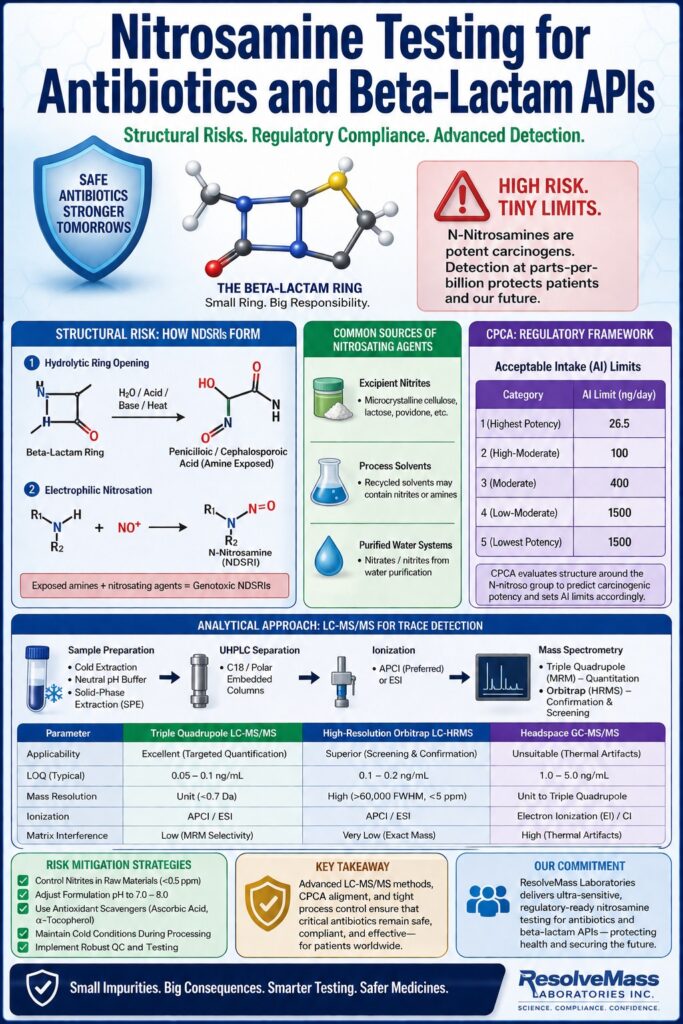
Structural risks associated with beta-lactam active pharmaceutical ingredients (APIs) arise from the chemical instability of the four-membered beta-lactam ring and the presence of reactive amine side chains. These structural features can undergo hydrolytic ring cleavage and generate secondary or tertiary amine precursors that are capable of reacting with trace nitrosating agents. The chemical architecture of beta-lactam antibiotics inherently makes them susceptible to multiple degradation pathways during synthesis, purification, processing, and long-term storage.
Hydrolytic Ring Cleavage and Degradation Kinetics
The fundamental structural motif shared by all beta-lactam compounds is the four-membered cyclic amide (beta-lactam) ring. Because of its high ring strain and reactive carbonyl group, this amide bond is particularly susceptible to nucleophilic attack, acid- or base-catalyzed hydrolysis, and enzymatic cleavage. In penicillins, ring cleavage produces penicilloic acid and penilloic acid derivatives, whereas cephalosporins can degrade into complex cephalosporoic acid species that may undergo additional fragmentation of the fused dihydrothiazine ring. These degradation processes can expose secondary or tertiary amine functional groups that were previously bound, sterically shielded, or chemically inaccessible.
For example, aminopenicillins such as amoxicillin and ampicillin contain primary aminobenzyl functional groups that, although they are not direct nitrosamine precursors themselves, may undergo self-condensation or react with synthetic reagents to generate secondary amine impurities. In comparison, advanced cephalosporins (e.g., ceftriaxone, cefaclor) and carbapenems (e.g., meropenem) contain complex heterocyclic side chains—including aminothiazole, pyrrolidine, or piperazine rings—with secondary nitrogens that may directly undergo nitrosation and form drug-specific NDSRIs.
Discover real-world analytical strategies used to identify secondary amine degradation pathways in a detailed NDMA root cause investigation case study.
Step 1: Hydrolytic Ring Opening
   Beta-Lactam Ring (Strained Cyclic Amide)
                     │
                     ▼  (H2O / Acid / Base / Heat)
   Penicilloic / Cephalosporoic Acid Intermediate
                     │
                     ▼
   Exposure of Unmasked Secondary/Tertiary Amines
Step 2: Electrophilic Nitrosation
   Exposed Amine (R1R2NH) + Reactive Nitrosating Agent (NO+, N2O3)
                     │
                     ▼  (Acidic Environment, pH < 5)
   Nitrosamine Drug Substance-Related Impurity (NDSRI)
Electrophilic Nitrosation Mechanisms
Nitrosation occurs when exposed secondary or tertiary amine precursors come into contact with electrophilic nitrosating species under acidic conditions (pH < 5). Nitrous acid (HNO2) generates reactive nitrosating agents, including the nitrosonium ion (NO+) and dinitrogen trioxide (N2O3), which react with the unshared electron pair of secondary amines. The general chemical reaction pathway associated with NDSRI formation is represented by the following equilibrium equations:
NaNO2 + HX ⇌ HNO2 + NaX
2HNO2 ⇌ N2O3 + H2O
HNO2 + H+ ⇌ NO+ + H2O
R1R2NH + NO+ → R1R2N-NO + H+
When tertiary amine functionality is present within the beta-lactam structure or is introduced through synthetic catalysts, nitrosative cleavage, also known as dealkylative nitrosation, may occur under warm, acidic conditions. This reaction removes an alkyl group from the tertiary amine and produces a secondary nitrosamine together with carbonyl byproducts.
Compare the distinct chemical profiles and risk factors between small nitrosamine molecules and complex drug-derived structures in this overview on NDSRI vs simple nitrosamines.
Cross-Contamination and Raw Material Precursors
The nitrosation reaction requires the simultaneous presence of an amine source and a nitrosating agent. During beta-lactam manufacturing, nitrosating agents may enter the process through contaminated raw materials, excipients, process solvents, and water systems.
Excipient Nitrites: Commonly used excipients, including microcrystalline cellulose, lactose, povidone, and croscarmellose sodium, may contain trace nitrite impurities ranging from 0.1 ppm to more than 10 ppm.
Process Solvents: Recycled organic solvents such as dimethylformamide (DMF) or dichloromethane (DCM) may carry trace secondary amines, including dimethylamine, or residual nitrites from previous chemical operations.
Purified Water Systems: Water purification systems that use chloramination or lack adequate deionization may introduce nitrates and nitrites into wet granulation or crystallization operations.
Preparing an abbreviated new drug application? Review the step-by-step requirements for a nitrosamine risk assessment for ANDA submission.
| Beta-Lactam Class | Representative APIs | Vulnerable Structural Precursor | Primary Nitrosation Trigger | Associated NDSRI Risk |
|---|---|---|---|---|
| Aminopenicillins | Amoxicillin, Ampicillin | Aminobenzyl side-chain degradation products; penicilloic acid fragments | Excipient nitrites under acidic microenvironments (pH < 5) | N-Nitroso-amoxicillin / N-Nitroso-ampicillin derivatives |
| Cephalosporins | Ceftriaxone, Cefaclor, Cefalexin | Aminothiazole ring nitrogens; C3-substituent piperazine moieties | Trace nitrosyl chloride or nitrites in crystallization solvents | Drug-specific NDSRIs featuring modified heterocyclic ring structures |
| Carbapenems | Meropenem, Imipenem | C2-side-chain pyrrolidine secondary nitrogens | Moisture absorption and hold-time delays during sterile bulk processing | N-Nitroso-meropenem-related degradation impurities |
| Beta-Lactamase Inhibitors | Tazobactam, Sulbactam, Avibactam | Bicyclic nitrogen-containing structures; secondary amine impurities | Co-formulation with nitrite-containing excipients in combination products | Complex NDSRIs derived from intact or degraded inhibitor cores |
Regulatory Frameworks and CPCA Implementation for Nitrosamine Testing for Antibiotics and Beta-Lactam APIs
Regulatory compliance for antibiotic NDSRIs is primarily guided by the Carcinogenic Potency Categorization Approach (CPCA), which assigns Acceptable Intake (AI) limits ranging from 26.5 ng/day to 1500 ng/day according to the electronic and steric environment surrounding the N-nitroso group. Global health authorities, particularly the FDA and EMA, established the CPCA framework to support the prediction of carcinogenic potency when empirical animal carcinogenicity data are unavailable.
Principles of the CPCA Framework
The CPCA framework assesses structure-activity relationships (SAR) with a primary focus on the alpha-hydroxylation metabolic pathway. Cytochrome P450 enzymes, specifically CYP2E1, metabolically activate nitrosamines by oxidizing the carbon atom directly adjacent to the N-nitroso group, known as the alpha-carbon. This metabolic activation produces an unstable alpha-hydroxy nitrosamine, which undergoes spontaneous decomposition to form a reactive diazonium ion. The resulting species can alkylate DNA and contribute to mutagenic effects.
The CPCA assigns structural scores based on five key parameters:
Count of alpha-Hydrogens: Carbon atoms attached to the N-nitroso group that contain multiple hydrogen atoms generally support more rapid metabolic activation, which results in a lower AI limit.
Steric Hindrance: Bulky functional groups or ring systems located near the N-nitroso group can restrict enzymatic access, thereby reducing carcinogenic potency and increasing the AI limit.
Electron-Withdrawing Groups (EWGs): Functional groups such as carbonyls, carboxylic acids, or halogen atoms can decrease electron density around the nitrogen atom and inhibit metabolic activation.
Ring Size and Conformation: Incorporation of the N-nitroso group within a stable ring system can modify the kinetics and pathways associated with metabolic cleavage.
Carboxylic Acid Deactivating Features: The presence of a carboxylic acid functional group anywhere within the molecule can substantially reduce predicted carcinogenic potency because of rapid excretion and unfavorable metabolic kinetics.
Learn how health authorities differentiate safety thresholds by reviewing the guide on nitrosamine alert limit vs action limit.
Applying CPCA to Beta-Lactam NDSRIs
Beta-lactam antibiotics frequently contain multiple carboxyl groups, such as the C3-carboxyl group in penicillins and the C4-carboxyl group in cephalosporins, in addition to highly sterically hindered ring structures. Consequently, many theoretical and identified beta-lactam NDSRIs may contain structural features associated with deactivation and may therefore fall into lower-risk CPCA categories. For example, the presence of a carboxylic acid group together with steric bulk surrounding the nitrosated nitrogen may shift the compound from Category 1 (26.5 ng/day) to Category 4 (1500 ng/day) or Category 5 (1500 ng/day).
| CPCA Potency Category | Predicted Carcinogenic Potency | Structural Feature Criteria Summary | Recommended Acceptable Intake (AI) Limit |
|---|---|---|---|
| Category 1 | Highest Potency | 2 alpha-hydrogens on both sides; unhindered aliphatic chains; no electron-withdrawing groups | 26.5 ng/day |
| Category 2 | High-Moderate Potency | 2 alpha-hydrogens on one side and 1 alpha-hydrogen on the other; low steric hindrance | 100 ng/day |
| Category 3 | Moderate Potency | 1 alpha-hydrogen on each side OR moderate steric hindrance; cyclic structures without deactivating groups | 400 ng/day |
| Category 4 | Low-Moderate Potency | Highly hindered nitrogen center; presence of electron-withdrawing groups; structural rigidity | 1500 ng/day |
| Category 5 | Lowest Potency | Absence of alpha-hydrogens OR presence of a carboxylic acid group; extreme steric hindrance | 1500 ng/day |
See how regulatory guidelines are applied to established oral formulations in this analysis of nitrosamine testing for a metformin generic.
Advanced Analytical Methodologies for Nitrosamine Testing for Antibiotics and Beta-Lactam APIs
Advanced analytical protocols for beta-lactam nitrosamine quantification primarily rely on Liquid Chromatography-Tandem Mass Spectrometry (LC-MS/MS) and High-Resolution Mass Spectrometry (LC-HRMS) to avoid the thermal degradation artifacts associated with Gas Chromatography (GC-MS). Developing analytical methods for beta-lactam APIs presents substantial technical challenges because of matrix instability, low acceptable intake limits, and the possibility of isobaric interferences.
Fundamental Limitations of Gas Chromatography (GC-MS)
Although Gas Chromatography-Mass Spectrometry (GC-MS) and Headspace GC-MS/MS are established techniques for the analysis of volatile nitrosamines, such as NDMA or NDEA, they are unsuitable for many beta-lactam analyses. Beta-lactam APIs may decompose at temperatures substantially below the injector and oven thermal profiles required for gas chromatography, which commonly exceed 200°C. Heating beta-lactam molecules can initiate thermal ring degradation and release secondary amines in the presence of trace nitrites. This may result in in-situ nitrosamine formation within the GC inlet and generate false-positive signals. This type of methodological error was previously recognized during early testing associated with compounds such as ranitidine and rifampicin.
Examine regulatory enforcement history and historical product actions in this comprehensive nitrosamine drug recalls analysis.
Liquid Chromatography-Tandem Mass Spectrometry (LC-MS/MS)
Liquid chromatography techniques generally operate at room temperature or under controlled column temperatures of 25°C–40°C, thereby helping preserve the structural integrity of the delicate beta-lactam ring.
Triple Quadrupole (QqQ) LC-MS/MS: Triple quadrupole instruments operated in Multiple Reaction Monitoring (MRM) mode serve as a primary platform for routine batch release testing and quantitative verification. By monitoring specific precursor-to-product ion mass transitions, QqQ instruments provide high analytical sensitivity and can achieve Limits of Quantification (LOQ) as low as 0.1 ng/mL, corresponding to sub-ppm levels relative to the API mass.
High-Resolution Mass Spectrometry (LC-HRMS / Orbitrap): For complex NDSRIs in which specific fragment ion transitions are unknown, or when isobaric matrix degradants overlap with target analytes, LC-HRMS using Q-Exactive Orbitrap technology is required. With mass resolving powers exceeding 60,000 FWHM and mass accuracy below 5 ppm, Orbitrap systems can differentiate trace nitrosamine signals from high-concentration API background peaks.
Learn more about specialized analytical handling and testing strategies for high-potency active ingredients in nitrosamine testing for highly potent APIs.
Sample Preparation (Cold Extraction, Neutral pH, SPE Clean-Up)
                     │
                     ▼
UHPLC Chromatographic Separation (C18 / Polar Embedded Columns)
                     │
                     ▼
Ionization Source (APCI vs. ESI Mode Selection)
                     │
                     ▼
Mass Spectrometry Detection:
   ├─ Triple Quadrupole (QqQ LC-MS/MS in MRM Mode) -> Routine Quantitation
   └─ High-Resolution Orbitrap (LC-HRMS)           -> Structural Confirmation
Ionization Source Optimization: APCI vs. ESI
The selection of the mass spectrometry ionization source directly influences assay sensitivity and the potential for artifact formation.
Atmospheric Pressure Chemical Ionization (APCI): APCI is generally preferred for low-molecular-weight nitrosamines. Because APCI uses thermal gasification followed by corona discharge ionization in the vapor phase, it is less affected by liquid-phase matrix suppression. It can also reduce the risk of certain voltage-associated nitrosation artifacts that may occur under some Electrospray Ionization conditions.
Electrospray Ionization (ESI): ESI is used for polar, non-volatile, and higher-molecular-weight NDSRIs that retain structural characteristics of the parent beta-lactam. However, source temperatures and capillary voltages must be carefully optimized to minimize in-source fragmentation of the unstable API core.
Sample Preparation and Stability Controls
Because beta-lactam molecules can undergo rapid hydrolysis in aqueous or acidic environments, sample preparation procedures must maintain strict control over environmental conditions.
Temperature Control: Extraction procedures are performed under chilled conditions, typically at 4°C, to reduce the rate of hydrolytic decomposition.
pH Buffering: Extraction solvents use neutral pH buffers, such as 10 mM ammonium formate at pH 6.8–7.2, rather than strong acid or base additions that could accelerate degradation.
Matrix Removal: Solid-Phase Extraction (SPE) or dispersive SPE (d-SPE / QuEChERS protocols) using C18 or polymeric stationary phases can remove intact API matrix components while retaining trace nitrosamine analytes. This helps reduce mass spectrometer source contamination and ion suppression.
Review the necessary testing protocols required before commercial distribution in nitrosamine batch release testing requirements.
| Instrumental Parameter | Triple Quadrupole LC-MS/MS | High-Resolution Orbitrap LC-HRMS | Headspace GC-MS/MS |
|---|---|---|---|
| Applicability to Beta-Lactams | Excellent (Targeted trace quantification) | Superior (Screening, unknown identification, confirmation) | Unsuitable (Thermal breakdown causes false positives) |
| Typical Limit of Quantification (LOQ) | 0.05–0.1 ng/mL (sub-ppm) | 0.1–0.2 ng/mL (sub-ppm) | 1.0–5.0 ng/mL (limited to stable volatiles) |
| Mass Resolution & Accuracy | Unit mass resolution (approximately 0.7 Da) | High resolution (>60,000 FWHM), mass accuracy <5 ppm | Unit mass to triple quadrupole resolution |
| Primary Ionization Modes | APCI / ESI | APCI / ESI | Electron Ionization (EI) / Chemical Ionization (CI) |
| Matrix Interference Risk | Low (minimized via MRM transitions) | Very Low (resolved via exact mass separation) | High (thermal artifacts can mimic true analytes) |
Understand stability considerations and long-term storage evaluations in the detailed overview on nitrosamine testing in stability studies.
Risk Mitigation and Process Control Strategies
Effective risk mitigation during antibiotic drug substance and drug product manufacturing requires a coordinated strategy that includes reducing nitrite levels in raw materials, adjusting formulation pH, and incorporating antioxidant nitrosation scavengers such as ascorbic acid or alpha-tocopherol. Comprehensive control of nitrosamine risks requires a lifecycle-based approach that extends across synthetic route design, excipient quality control, manufacturing operations, and formulation engineering.
Excipient and Raw Material Controls
Controlling nitrite concentrations in raw materials is one of the most effective approaches for reducing nitrosamine formation in finished drug products. Establishing vendor specifications that limit total nitrite levels to below 0.5 ppm in critical excipients, including microcrystalline cellulose, lactose, and povidone, can substantially reduce the rate of nitrosation during product storage.
Formulation Microenvironment Adjustment
Because nitrosation reactions are acid-catalyzed and can accelerate rapidly at pH < 5, modifying the formulation microenvironment to a neutral or slightly alkaline range, such as pH 7.0–8.0, can significantly reduce reaction kinetics. Incorporating alkalizing agents or neutral buffers into solid-dose or reconstituted parenteral formulations can help stabilize the beta-lactam ring while also limiting the formation of nitrous acid.
Antioxidant Scavenger Integration
The addition of small-molecule nitrosation inhibitors can provide substantial protection against NDSRI formation in drug products. Scavengers such as ascorbic acid (Vitamin C), alpha-tocopherol (Vitamin E), caffeic acid, or p-aminobenzoic acid can react rapidly with nitrosating species, including NO+ and N2O3, converting them into less reactive species such as nitric oxide (NO) or other inert products before they can react with secondary amine groups on the API.
Learn how formulation changes can effectively suppress impurity formation by reading about nitrosamine reformulation strategy.
Conclusion
Successfully executing Nitrosamine Testing for Antibiotics and Beta-Lactam APIs requires an integrated strategy that combines mechanistic chemical risk assessment, CPCA regulatory alignment, and ultra-sensitive LC-MS/MS analytical verification. The chemical sensitivity of the four-membered beta-lactam ring, together with reactive amine functional groups present in antibiotic side chains, creates unique degradation pathways that may generate genotoxic NDSRIs when these compounds are exposed to trace nitrosating agents. Global regulatory agencies require stringent control of these impurities, with Acceptable Intake limits that must be verified through validated analytical testing workflows.
By replacing thermal GC-MS methods with advanced LC-MS/MS Triple Quadrupole and Orbitrap High-Resolution Mass Spectrometry platforms, testing laboratories can reduce the risk of thermal artifact formation and achieve reliable detection at sub-ppm levels. Implementing robust cold-extraction sample preparation procedures, optimizing APCI/ESI ionization sources, and establishing effective raw material nitrite controls enables pharmaceutical manufacturers to meet regulatory expectations, maintain batch quality, and protect patient safety throughout global supply chains.
To discuss specialized analytical testing workflows, method development, or regulatory compliance strategies for antibiotic APIs, please visit our Contact Us page.
Frequently Asked Questions
GC-MS may be unsuitable for many beta-lactam nitrosamine analyses because the elevated temperatures used in the injector and chromatographic oven can destabilize the beta-lactam structure. Thermal degradation may generate secondary amines from the API or its degradation products. In the presence of residual nitrites, these newly formed amines may undergo nitrosation within the analytical system itself. Such in-situ reactions can create false-positive nitrosamine signals and compromise the reliability of the analytical result.
The Carcinogenic Potency Categorization Approach (CPCA) evaluates the molecular environment surrounding the N-nitroso group to estimate the potential carcinogenic potency of an NDSRI. Important structural factors include the number of alpha-hydrogens, steric hindrance, electron-withdrawing groups, ring characteristics, and the presence of carboxylic acid functionality. Based on these structural features, the compound is placed into one of five potency categories. The corresponding Acceptable Intake (AI) limits range from 26.5 ng/day to 1500 ng/day.
Small-molecule nitrosamines, such as NDMA, are generally low-molecular-weight compounds that may originate from process chemicals, solvents, reagents, or other manufacturing-related sources. Nitrosamine Drug Substance-Related Impurities (NDSRIs), in contrast, are chemically associated with the active pharmaceutical ingredient itself. They may form through nitrosation of amine-containing APIs or their structural degradation products. As a result, NDSRIs often have molecular structures that are more closely related to the parent antibiotic.
Beta-lactam nitrosamine testing requires highly sensitive analytical methods capable of detecting and quantifying trace impurities at concentrations relevant to regulatory Acceptable Intake limits. Validated methods generally target sub-ppm sensitivity, with the required LOQ depending on the drug product, daily dose, and applicable AI limit. In many analytical workflows, an LOQ of approximately 0.1 ng/mL or lower in solution may be necessary. The method must also demonstrate suitable specificity, accuracy, precision, and robustness at these low concentration levels.
Trace nitrites in pharmaceutical excipients, including MCC or lactose, can serve as potential sources of nitrosating species during processing or storage. Under acidic conditions, nitrites can participate in the formation of nitrous acid and other reactive nitrosating intermediates. These species may react with susceptible secondary amine groups associated with the API or its degradation products. Over time, this reaction pathway can contribute to the formation and accumulation of NDSRIs.
Sample preparation should be carefully designed to preserve the chemical stability of beta-lactam APIs and minimize the formation of degradation-related artifacts. Chilled extraction conditions, typically around 4°C, can help reduce the rate of hydrolytic degradation. Neutral pH buffers should be used where appropriate to avoid exposing the beta-lactam ring to strongly acidic or alkaline conditions. Solid-Phase Extraction (SPE) clean-up may also be incorporated to reduce matrix-related effects and improve analytical performance.
The selection between APCI and ESI depends on the chemical properties of the target nitrosamine and the characteristics of the beta-lactam matrix. APCI is commonly considered for low-molecular-weight and relatively volatile nitrosamines because it can reduce certain liquid-phase matrix suppression effects. ESI is generally more appropriate for polar, non-volatile, and higher-molecular-weight NDSRIs that retain structural features of the parent beta-lactam. Source conditions should be optimized carefully to maintain sensitivity while minimizing in-source degradation.
Manufacturers can reduce nitrosamine formation by controlling potential sources of nitrosating agents throughout the formulation and manufacturing process. This includes selecting low-nitrite excipients, with specifications such as less than 0.5 ppm where scientifically and operationally appropriate, and controlling the formulation microenvironment. Maintaining a neutral or slightly alkaline pH can help reduce acid-catalyzed nitrosation reactions. Where compatible with the formulation, antioxidant nitrosation scavengers such as ascorbic acid may provide an additional risk-control strategy.
Detection of an NDSRI above the applicable Acceptable Intake limit requires a documented and scientifically justified regulatory response. The manufacturer should initiate confirmatory testing and conduct a detailed root-cause investigation to determine how the impurity formed or entered the manufacturing process. Appropriate regulatory communication and risk assessment may also be required, depending on the applicable jurisdiction and product status. Corrective actions may include process optimization, raw material controls, formulation changes, or manufacturing variations designed to reduce the impurity to an acceptable level.
Reference:
- Paritala, S. T., Sharma, N., & Shah, R. P. (2025). In-situ formation and evaluation of N-nitrosamine drug substance related impurities in glycopeptides implying Orbitrap mass spectrometry. Journal of Pharmaceutical Sciences, 114(2), 934–948. https://doi.org/10.1016/j.xphs.2024.10.056
- Lindqvist, N., Tuhkanen, T., & Kronberg, L. (2005). Occurrence of acidic pharmaceuticals in raw and treated sewages and in receiving waters. Water Research, 39(11), 2219–2228. https://doi.org/10.1016/j.watres.2005.04.003
- Bientinesi, R., Murri, R., & Sacco, E. (2020). Efficacy and safety of levofloxacin as a treatment for complicated urinary tract infections and pyelonephritis. Expert Opinion on Pharmacotherapy, 21(6), 637–644. https://doi.org/10.1080/14656566.2020.1720647
- U.S. Food and Drug Administration. (2023, August). Recommended acceptable intake limits for nitrosamine drug substance-related impurities. FDA guidance document
- U.S. Food and Drug Administration. (n.d.). CDER nitrosamine impurity acceptable intake limits. Retrieved July 23, 2026, from FDA official page
- U.S. Food and Drug Administration. (2024, September). Control of nitrosamine impurities in human drugs: Guidance for industry. FDA guidance document
Get In Touch With Us
About The Author


