

Introduction
Nitrosamine Testing for Injectable Drug Products is a highly specialized analytical quality control procedure used to identify and quantify trace levels of carcinogenic N-nitrosamine impurities in sterile parenteral formulations. This testing serves as a critical safety and regulatory compliance requirement because injectable medications are administered directly into the bloodstream, bypassing the body’s natural protective barriers, including the gastrointestinal tract and the liver’s first-pass metabolism. Nitrosamine impurities are characterized by the N-N=O functional group and are generally produced when secondary or tertiary amines interact with nitrosating agents under favorable reaction conditions such as acidic pH, elevated temperatures, or the presence of moisture. According to the International Council for Harmonisation (ICH) M7 guideline, these impurities are classified as Class 1 mutagenic carcinogens and are included within the “cohort of concern” because of their significant carcinogenic potential. As a result, effective control of these contaminants requires an in-depth understanding of formulation chemistry, raw material quality, container closure system interactions, and advanced mass spectrometric analytical techniques.
Need to understand the regulatory landscape? Learn about genotoxic impurity testing and ICH M7 nitrosamine compliance.
Following the worldwide regulatory recalls of angiotensin II receptor blockers (sartans) in 2018, the regulatory focus on nitrosamine surveillance expanded considerably. Initial investigations primarily targeted low-molecular-weight dialkyl nitrosamines such as N-nitrosodimethylamine (NDMA) and N-nitrosodiethylamine (NDEA). However, current regulatory expectations also include the assessment of complex Nitrosamine Drug Substance-Related Impurities (NDSRIs). These impurities possess structural similarities to the active pharmaceutical ingredient (API) and exhibit distinct formation mechanisms during manufacturing as well as throughout long-term product storage. In parenteral drug products, the risk of nitrosamine contamination becomes even more significant because the formulation remains in continuous direct contact with elastomeric closures, polymer-based syringes, and flexible infusion bags. Therefore, implementing proactive risk management strategies supported by advanced analytical technologies and Quality-by-Design (QbD) principles is essential for maintaining regulatory compliance while ensuring patient safety.
Unsure of the risks for your portfolio? Check if all drugs need a nitrosamine risk assessment.
Article Summary:
- Injectable drugs require stricter nitrosamine control because they enter the bloodstream directly, making even trace levels of carcinogenic nitrosamines a significant patient safety and regulatory concern.
- Global regulatory agencies recommend a structured risk management approach that includes comprehensive risk assessment, confirmatory analytical testing, and effective mitigation strategies to ensure nitrosamine levels remain within acceptable intake limits.
- Formulation composition plays a major role in nitrosamine formation. Residual nitrites in pharmaceutical excipients, acidic conditions, elevated temperatures, and long-term storage can accelerate chemical reactions that generate nitrosamines.
- Packaging materials can introduce additional contamination risks. Rubber closures, polymer infusion bags, printed overwraps, and other container components may release amines or nitrosamines that migrate into sterile injectable products over time.
- Highly sensitive analytical techniques are essential for detecting nitrosamines at trace concentrations. Advanced LC-MS/MS and LC-HRMS methods with optimized sample preparation help achieve accurate, reliable quantification at parts-per-billion levels.
- Careful laboratory practices are necessary to avoid false-positive results. Controlling sample pH, minimizing heat exposure, and using nitrite scavengers during sample preparation help prevent artificial nitrosamine formation during analysis.
- A proactive Quality-by-Design (QbD) strategy, combined with robust analytical testing and packaging evaluation, enables pharmaceutical manufacturers to maintain regulatory compliance, reduce recall risks, and ensure the long-term safety and quality of injectable drug products.
Regulatory Requirements and Safety Limits for Nitrosamine Testing for Injectable Drug Products
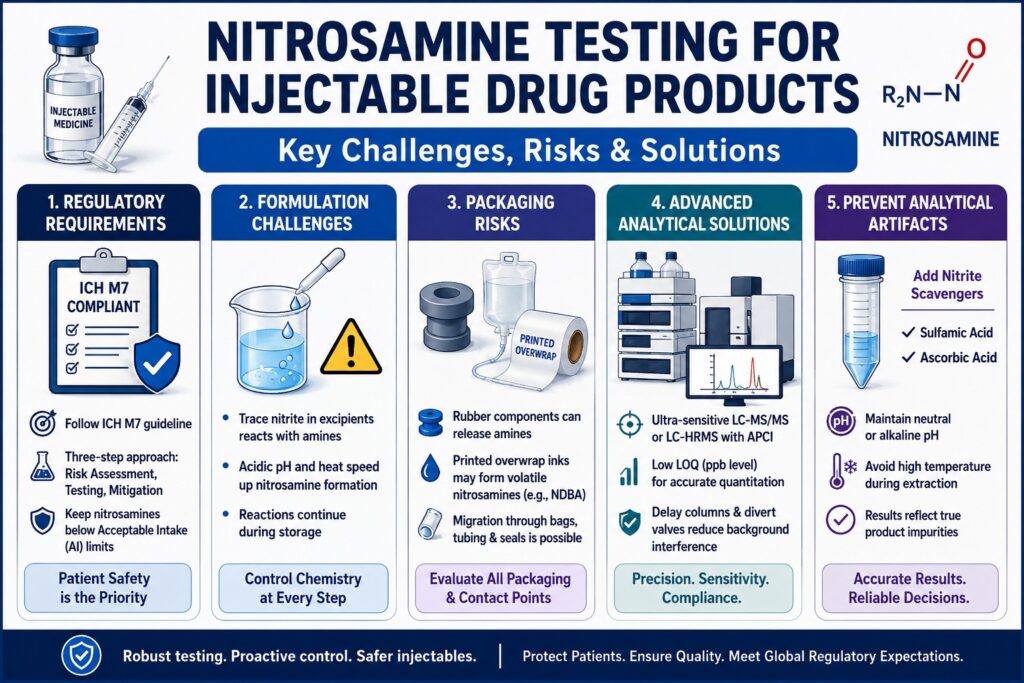
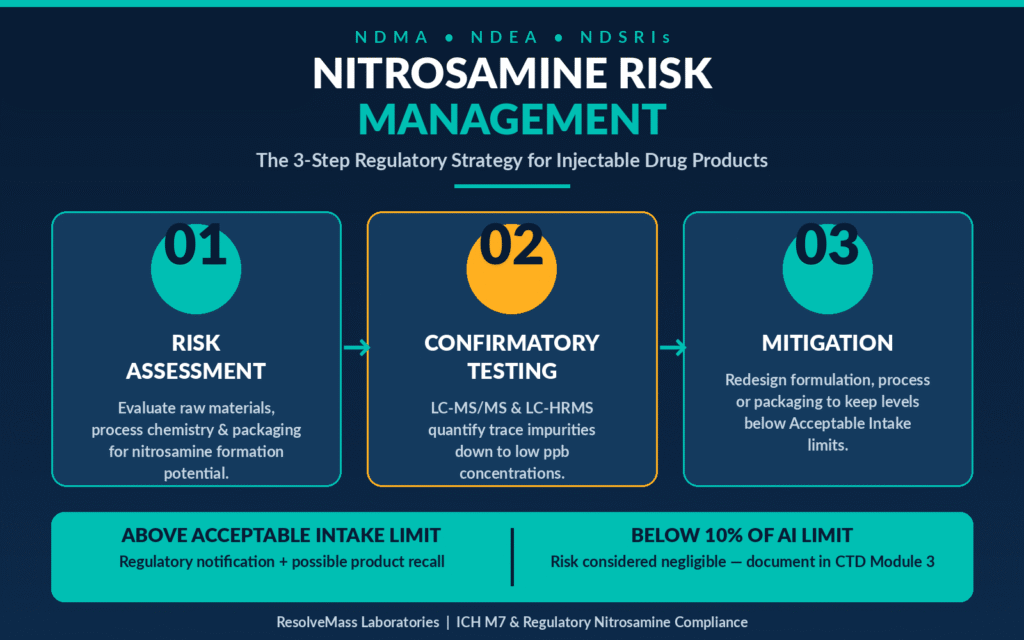
Regulatory authorities worldwide require manufacturers to implement a structured three-step risk management strategy consisting of risk assessment, confirmatory analytical testing, and appropriate mitigation measures to ensure nitrosamine concentrations remain below clinically acceptable daily exposure limits. These Acceptable Intake (AI) values are determined using compound-specific toxicological data whenever available. In situations where direct carcinogenicity data are lacking, structural read-across approaches such as the Carcinogenic Potency Categorization Approach (CPCA) are applied. The CPCA classifies nitrosamines into five separate potency categories, ranging from Category 1 through Category 5, with Category 1 representing compounds possessing the highest carcinogenic potency and therefore requiring the strictest control limits.
Clarify the fundamentals: Understand what nitrosamines are.
For each pharmaceutical product, the established acceptable daily intake must be converted into an allowable concentration expressed in ppm or ppb according to the Maximum Daily Dose (MDD) administered to the patient. This relationship is represented mathematically as:
Nitrosamine Limit (ppm) = Acceptable Intake (ng/day) ÷ Maximum Daily Dose (mg/day)
This calculation demonstrates that large-volume parenteral (LVP) products administered at high daily doses require exceptionally sensitive analytical methodologies capable of achieving limits of quantitation (LOQ) within the low parts-per-billion range to demonstrate compliance with regulatory expectations.
| Nitrosamine Impurity | Globally Aligned AI Limit (ng/day) | Potency Category / Risk Profile | Common Source / Root Cause |
|---|---|---|---|
| N-Nitrosodimethylamine (NDMA) | 96.0 | Category 1 (Highly Potent) | Degradation of solvents (e.g., DMF) or API instability |
| N-Nitrosodiethylamine (NDEA) | 26.5 | Category 1 (Highly Potent) | Transalkylation of tertiary amines or contamination of raw materials |
| N-Nitrosoethylisopropylamine (NEIPA) | 400.0 | Process-Related Synthetic Risk | Degradation of bases (e.g., DIPEA) during API synthesis |
| N-Nitrosodiisopropylamine (NDIPA) | 26.5 (FDA) / 1500.0 (EMA) | Manufacturing / Solvent Impurity | Dealkylation of tertiary amines in the presence of nitrite impurities |
| N-Nitroso-N-methyl-4-aminobutyric acid (NMBA) | 1500.0 | Process Impurity in Sartans | Reaction between MBA (generated from NMP degradation) and nitrites |
| N-Nitrosodibutylamine (NDBA) | 26.5 | Packaging / Elastomer Leachable | Rubber vulcanization accelerators or contaminants originating from printed secondary overwrap materials |
Need expert support? Discover the benefits of outsourcing nitrosamine testing to a CRO.
Current regulatory guidance states that confirmatory testing should be performed unless a scientifically justified and well-documented risk assessment clearly demonstrates that nitrosamine formation or contamination is not reasonably expected. Under existing FDA and EMA recommendations, detection of nitrosamine concentrations exceeding the established AI limits requires immediate notification of regulatory authorities and may result in product recalls. In contrast, when nitrosamine concentrations are consistently measured below 10% of the applicable AI limit, the associated risk may be regarded as negligible. Nevertheless, complete scientific justification and supporting documentation must be retained within Module 3 of the drug product’s Common Technical Document (CTD).
Parenteral Formulation Challenges: Excipient Nitrite Variability and Reaction Kinetics
One of the most significant formulation challenges encountered during parenteral drug development is the presence of trace amounts of nitrite and amine impurities in pharmacopeial-grade excipients. These residual impurities serve as reactive precursors capable of generating nitrosamines in situ during both manufacturing operations and long-term storage. Even when excipients fully comply with pharmacopeial quality specifications, residual nitrite concentrations below 1 ppm may still react with secondary or tertiary amines present within APIs or their degradation products, leading to the formation of regulated nitrosamine impurities. The kinetics governing these chemical reactions are strongly influenced by factors including formulation pH, storage temperature, and the intrinsic basicity of the amine-containing compound.
Deep dive into chemistry: Learn about nitrosamine formation pathways in API synthesis.
Within liquid injectable formulations, nitrosamine formation proceeds at a considerably faster rate under acidic conditions. At pH values below 4, nitrite (NO₂⁻) is rapidly converted into nitrous acid (HNO₂). Nitrous acid subsequently undergoes dehydration to produce dinitrogen trioxide (N₂O₃), which functions as a highly reactive nitrosating electrophile.
2HNO₂ ⇌ N₂O₃ + H₂O
Secondary amines readily react with this electrophilic species through a rapid direct reaction pathway, producing stable N-nitrosamine compounds. Although tertiary amines exhibit greater steric hindrance and lower direct reactivity, they may undergo nitrosative cleavage under elevated temperatures or in the presence of transition metal catalysts such as copper or iron. This process generates secondary amine intermediates that are subsequently converted into nitrosamines through rapid nitrosation. To effectively assess and minimize these formulation risks, pharmaceutical manufacturers should comprehensively characterize the trace nitrite content of all critical excipients used in parenteral formulations.
| Excipient Type | Average Nitrite Range (ppm) | Primary Nitrosation Pathway / Mechanism | Nitrosamine Formation Risk |
|---|---|---|---|
| Polyethylene Glycol (PEG) | 0.20 – 1.50 | Oxidative degradation produces reactive aldehydes and organic peroxides that facilitate radical-mediated nitrosation. | High |
| Polyvinylpyrrolidone (PVP) | 0.50 – 2.00 | Residual amine catalysts remaining from polymerization react with inherent nitrite impurities. | High |
| Lactose Monohydrate | 0.10 – 0.50 | Trace nitrite contamination introduced during raw material processing and crystallization through aqueous manufacturing steps. | Moderate |
The continuously evolving nature of these chemical reactions indicates that nitrosamine formation does not stop once manufacturing has been completed. Instead, the process may continue progressively throughout the product’s entire shelf life. In sterile aqueous formulations, elevated temperatures encountered during terminal sterilization or long-term storage can significantly accelerate reaction rates by increasing molecular mobility and reaction frequency. Consequently, liquid injectable products are generally more susceptible to nitrosamine formation than lyophilized formulations, where the absence of a continuous aqueous phase substantially limits precursor interaction and reduces overall chemical reactivity.
Learn about specialized protocols: See our approach to nitrosamine testing for highly potent APIs.
Packaging Risks and Leachables Affecting Nitrosamine Testing for Injectable Drug Products
Container closure systems are recognized as a major source of nitrosamine risk because elastomeric materials and printed polymer packaging components can gradually release precursor amines or pre-existing nitrosamines into sterile liquid formulations during storage. The migration of these compounds is controlled by diffusion processes and becomes more pronounced under conditions involving high-temperature terminal sterilization and prolonged contact between the product and packaging materials.
Elastomeric components incorporated into vials, prefilled syringes, and cartridges present a particularly significant concern because of the vulcanization accelerators used during rubber production. Chemicals such as thiurams, including tetrabutylthiuram disulfide, and dithiocarbamates may decompose during steam sterilization at elevated temperatures or throughout long-term storage. This degradation generates secondary amines such as dibutylamine and diethylamine. These secondary amines can subsequently react with residual nitrite impurities contained either within the rubber formulation or the sterile drug product itself, producing extractable nitrosamines that must be carefully evaluated and controlled in accordance with USP General Chapters governing extractables and leachables.
In addition, large-volume parenteral products packaged in flexible polymer infusion bags may also be exposed to contamination originating from secondary packaging materials. During August 2025, the FDA’s Center for Drug Evaluation and Research (CDER) released an emerging scientific communication describing the detection of N-nitrosodibutylamine (NDBA) in sterile saline infusion bags. Detailed root-cause investigations demonstrated that solvent-based printing inks applied to secondary overwrap materials frequently contain dialkylamines. During the high-temperature sealing process used to manufacture the secondary pouch, these amines react with nitrogen oxides (NOₓ) produced from nitrocellulose-based primers and binder systems. The volatile NDBA formed during this reaction is capable of permeating the primary polymer barrier of the infusion bag before leaching directly into the sterile saline solution.
| Packaging Component | Primary Precursors Released | Migration & Interaction Mechanism | Nitrosamine Risk Profile |
|---|---|---|---|
| Rubber Stoppers & Plungers | Thiurams, dithiocarbamates, and zinc dialkyldithiocarbamates | Vulcanization accelerators decompose into secondary amines that react with nitrite impurities during sterilization or storage. | Moderate to High |
| Printed Infusion Bag Overwraps | Dialkylamines in solvent-based inks and nitrocellulose primers | High-temperature sealing generates NOₓ from nitrocellulose, which reacts with amines in printing inks to produce volatile NDBA. | High |
| Infusion Bag Tubing | Nitrosatable plasticizers and polymer processing aids | Continuous contact between the formulation and tubing promotes extraction during clinical administration. | High |
| Printed Aluminum Foil Seals | Low-molecular-weight amines and adhesive residues | Volatile amines and nitrosating agents migrate through primary polymer layers during thermal induction sealing. | Moderate |
Distinguish the risks: Understand the difference between nitrosamine impurities and nitrosamine leachables.
Regulatory control of packaging-derived leachables is governed by USP chapters addressing extractables and leachables (E&L), which establish comprehensive expectations for evaluating packaging safety. Manufacturers are expected to assess not only the primary container closure system but also all secondary packaging materials and associated drug delivery components because volatile leachable compounds have demonstrated a significant ability to migrate through conventional low-density polyethylene (LDPE) and polypropylene barrier materials.
Read an expert analysis: Review a case study on NDMA root cause investigation.
Advanced Analytical Solutions for Nitrosamine Testing for Injectable Drug Products
Accurate quantification of trace nitrosamines at parts-per-billion concentrations within complex parenteral formulations requires highly sensitive and selective analytical technologies. The most widely employed platforms include liquid chromatography-tandem mass spectrometry (LC-MS/MS) and liquid chromatography-high-resolution mass spectrometry (LC-HRMS). These analytical systems are commonly combined with Atmospheric Pressure Chemical Ionization (APCI), which provides efficient ionization of small, volatile, and weakly polar nitrosamine compounds that generally exhibit poor response using conventional electrospray ionization (ESI).
Although electrospray ionization is highly effective for polar and non-volatile molecules, it frequently exhibits reduced efficiency when analyzing small volatile nitrosamines such as NDMA because these compounds possess relatively low proton affinity and may volatilize before efficient charge transfer occurs. APCI overcomes these limitations by employing a heated nebulizer that converts both the mobile phase and analytes into the gas phase. A high-voltage corona discharge needle subsequently ionizes the vaporized solvent molecules, initiating gas-phase ion-molecule reactions that transfer protons to nitrosamine analytes and generate stable [M+H]⁺ ions. Because APCI is considered a soft ionization technique, it minimizes fragmentation while substantially reducing susceptibility to matrix-induced ion suppression compared with ESI. This provides exceptional analytical sensitivity, reproducibility, and precision for complex injectable drug matrices.
Optimize your workflow: Explore our nitrosamine method development and validation services.
Achieving adequate chromatographic separation between highly concentrated active pharmaceutical ingredients and trace nitrosamine impurities is equally important for preventing detector saturation and minimizing severe matrix effects. These objectives are often accomplished by incorporating divert valves that redirect unwanted matrix components to waste before entering the mass spectrometer. To address the persistent analytical difficulty associated with quantifying NDBA in infusion bag formulations, where background contamination frequently co-elutes with the analyte of interest, specialized delay-column technology has become increasingly valuable. By installing a high-retention delay column, such as the Atlantis Premier BEH C18 AX, between the binary solvent manager and the sample injector, background nitrosamines present within the mobile phase are delayed sufficiently to separate them from sample-derived analytes introduced downstream.
| Parameter | LC-MS/MS (Tandem Quadrupole) | LC-HRMS (Orbitrap / Q-TOF) |
|---|---|---|
| Primary Ionization Source | APCI (Positive Ion Mode) | ESI or APCI (High Sensitivity) |
| Typical Column Phase | Biphenyl / HSS T3 | Pentafluorophenyl (PFP) / C18 AX |
| Limit of Quantitation (LOQ) | 0.035 – 0.20 ng/mL [cite: 27, 37] | 0.10 – 0.50 ng/mL [cite: 15, 38] |
| Background Control Strategy | Pre-injector delay column | Solvent divert valves |
| Software Integrity Compliance | Audit trail, electronic signatures | High-resolution mass accuracy filters |
This level of analytical rigor is essential for satisfying the expectations of global regulatory agencies. Method validation should fully comply with ICH Q2(R2) requirements by demonstrating acceptable linearity, accuracy, precision, specificity, and overall analytical reliability at trace concentration levels.
Mitigating Analytical Artifacts and In Situ Formation during Nitrosamine Testing for Injectable Drug Products
The unintended formation of nitrosamines during laboratory sample preparation can be effectively prevented by incorporating active nitrite scavengers, maintaining neutral or alkaline sample pH conditions, and avoiding excessive extraction temperatures. Implementing these precautions is essential for eliminating false-positive analytical results that may occur when residual amines present within the sample matrix react with trace nitrite impurities introduced through extraction solvents during analysis.
Meet your deadlines: Check our standard nitrosamine testing timelines.
Selection of the extraction solvent plays a particularly important role in minimizing analytical artifacts. Dichloromethane (DCM), which is widely used for liquid-liquid extraction procedures, offers excellent extraction efficiency but may simultaneously co-extract trace quantities of dimethylamine (DMA) and nitrite impurities. Under these circumstances, rapid in situ formation of NDMA may occur directly within the extraction vial. To suppress this unwanted reaction, laboratories commonly introduce chemical nitrite scavengers such as sulfamic acid or ascorbic acid into the extraction solvent before sample processing. Sulfamic acid functions as an effective nitrite scavenger by rapidly reacting with nitrous acid to produce nitrogen gas and sulfuric acid, thereby permanently removing the active nitrosating species responsible for nitrosamine formation.
HNO₂ + NH₂SO₃H → N₂ ↑ + H₂SO₄ + H₂O
Ascorbic acid provides a similar protective effect by reducing active nitrosating intermediates, including N₂O₃, into inactive nitric oxide (NO), thereby preventing further nitrosation reactions. Maintaining a neutral to slightly alkaline pH throughout sample preparation further minimizes risk by preventing the conversion of nitrite into nitrous acid, which represents the critical rate-limiting step in nitrosamine formation. Additionally, minimizing thermal exposure during extraction procedures, such as using refrigerated centrifugation and avoiding high-temperature sonication, prevents reaction conditions from reaching the activation energy necessary for nitrosation. These precautions ensure that measured nitrosamine concentrations accurately represent genuine product impurities rather than artifacts generated during laboratory analysis.
Struggling with results? Explore nitrosamine reformulation strategies.
Conclusion: Advancing Nitrosamine Testing for Injectable Drug Products
Developing scientifically robust and fully validated protocols for Nitrosamine Testing for Injectable Drug Products is fundamental to protecting patient safety, maintaining regulatory compliance, and safeguarding pharmaceutical supply chains against costly product recalls. Through comprehensive evaluation of raw materials, careful design of formulation compositions, and selection of chemically compatible primary packaging systems, pharmaceutical manufacturers can substantially reduce the potential for nitrosamine contamination throughout every stage of the product lifecycle. As global regulatory requirements continue to evolve and increasingly sophisticated analytical technologies identify previously unrecognized impurities, including emerging leachable risks associated with flexible packaging systems, pharmaceutical organizations must continue prioritizing predictive risk assessment and preventive analytical control strategies.
The implementation of Quality-by-Design (QbD) principles together with collaboration with advanced analytical testing laboratories enables highly accurate characterization of complex parenteral formulations. High-quality analytical data not only strengthens regulatory submissions, including Abbreviated New Drug Applications (ANDAs), but also reinforces confidence in the quality, safety, and reliability of sterile pharmaceutical products.
To discuss project-specific testing requirements, manufacturers are encouraged to visit the ResolveMass Laboratories Contact Page. Detailed requests regarding custom analytical method development and validation may be submitted through the ResolveMass Contact Page.
Frequently Asked Questions
Nitrosamine Testing for Injectable Drug Products is especially important because injectable medicines are delivered directly into the bloodstream without passing through the gastrointestinal tract or undergoing first-pass metabolism in the liver. This direct route of administration increases patient exposure to any contaminants present in the formulation. For this reason, regulatory agencies establish much stricter acceptable intake limits and require highly sensitive analytical methods to detect even trace amounts of nitrosamines in injectable products.
Packaging materials can release chemical substances that migrate into sterile drug formulations during manufacturing or long-term storage. Elastomeric closures often contain vulcanization accelerators that gradually degrade into secondary amines, which can react with trace nitrite impurities present in the formulation. This reaction may generate nitrosamines over time, making packaging compatibility studies and extractables and leachables assessments essential components of product development.
The reported NDBA contamination was linked to the manufacturing process of secondary packaging materials rather than the sterile solution itself. During high-temperature sealing, nitrocellulose-based primers released nitrogen oxides, which reacted with dialkylamines contained in solvent-based printing inks. The volatile NDBA formed during this reaction was able to migrate through the polymer packaging and enter the sterile infusion solution, highlighting the importance of evaluating the complete packaging system.
A delay column is used to separate unwanted background contamination originating from solvents, mobile phases, or the analytical instrument before the sample reaches the detector. By delaying these background nitrosamines, the analytical system can clearly distinguish them from NDBA actually present in the test sample. This approach improves analytical accuracy, enhances sensitivity, and minimizes the risk of reporting false-positive results.
The Carcinogenic Potency Categorization Approach (CPCA) evaluates the molecular structure surrounding the N-nitroso functional group to estimate the carcinogenic potential of individual nitrosamines. Based on structural features that either increase or reduce carcinogenic activity, each compound is assigned to a specific potency category. The assigned category is then used to determine an appropriate Acceptable Intake (AI) limit when compound-specific toxicological data are unavailable.
Certain nitrosamines, including NDMA, are small, volatile, and only weakly polar, making them difficult to ionize efficiently using Electrospray Ionization. Atmospheric Pressure Chemical Ionization overcomes this limitation by converting analytes into the gas phase before ionization through a corona discharge process. This technique provides improved ionization efficiency, reduces matrix-related ion suppression, and delivers greater sensitivity for trace-level nitrosamine analysis in complex injectable formulations.
A nitrosamine impurity is formed during pharmaceutical manufacturing or develops through degradation of the active pharmaceutical ingredient or formulation during storage. In contrast, a nitrosamine leachable originates from packaging materials such as rubber closures, adhesives, coatings, or printing inks and migrates into the drug product over time. Although their origins differ, both types require careful monitoring to ensure product quality and patient safety.
Sulfamic acid and ascorbic acid function as effective nitrite scavengers during sample preparation. These compounds rapidly react with or neutralize nitrite species before they can interact with amine-containing compounds to produce nitrosamines during laboratory analysis. Their use helps eliminate laboratory-generated artifacts, ensuring that measured nitrosamine concentrations accurately reflect the actual levels present in the pharmaceutical product.
USP General Chapter addressing elastomer materials primarily evaluates the chemical composition, biological reactivity, and safety of elastomeric components before they are incorporated into pharmaceutical packaging. The newer USP requirements extend this evaluation by examining the performance, integrity, and compatibility of elastomeric components within the fully assembled container closure system. This broader assessment provides greater assurance of product quality throughout the product lifecycle.
Reference:
- Wichitnithad, W., Nantaphol, S., Noppakhunsomboon, K., & Rojsitthisak, P. (2023). An update on the current status and prospects of nitrosation pathways and possible root causes of nitrosamine formation in various pharmaceuticals. Saudi Pharmaceutical Journal, 31(2), 295–311. https://doi.org/10.1016/j.jsps.2022.12.010
- U.S. Food and Drug Administration. (2023, August). Recommended acceptable intake limits for nitrosamine drug substance-related impurities (NDSRIs): Guidance for industry. https://www.fda.gov/media/170794/download
- U.S. Food and Drug Administration. (2024, September 4). Information about nitrosamine impurities in medications. https://www.fda.gov/drugs/drug-safety-and-availability/information-about-nitrosamine-impurities-medications
- Bayne, A.-C. V., Misic, Z., Stemmler, R. T., Wittner, M., Frerichs, M., Bird, J. K., & Besheer, A. (2023). N-nitrosamine mitigation with nitrite scavengers in oral pharmaceutical drug products. Journal of Pharmaceutical Sciences, 112(7), 1794–1800. https://doi.org/10.1016/j.xphs.2023.03.022
- Kuzmič, S., Zlobec, T., Sollner Dolenc, M., Roškar, R., & Trdan Lušin, T. (2026). Extractables and leachables in pharmaceutical products: Potential adverse effects and toxicological risk assessment. Toxics, 14(1), 92. https://doi.org/10.3390/toxics14010092
- Brown, J. (2026, June 9). Advancing nitrosamine analysis: USP frameworks and LC-MS/MS solutions [Webinar]. USP Nitrosamines Exchange. https://nitrosamines.usp.org/t/advancing-nitrosamine-analysis-usp-frameworks-and-lc-ms-ms-solutions/15522
- U.S. Food and Drug Administration. (2024, September). Control of nitrosamine impurities in human drugs: Guidance for industry (Revision 2). https://www.fda.gov/media/141720/download
Get In Touch With Us
About The Author


