

Introduction
Nitrosamines from Excipients primarily arise when trace levels of nitrite impurities present in inactive formulation components react with susceptible secondary or tertiary amines contained within the active pharmaceutical ingredient (API) or its related degradation products. This chemical reaction creates a significant contamination hazard, making it essential for pharmaceutical manufacturers to implement advanced predictive risk assessment models, highly sensitive analytical methods, and comprehensive supplier qualification programs to minimize the formation of these probable human carcinogens in finished pharmaceutical products.
The identification of N-nitrosamine impurities in widely prescribed medications has fundamentally transformed pharmaceutical formulation strategies, quality assurance practices, and global regulatory expectations. Regulatory concern first intensified in 2018 after N-nitrosodimethylamine (NDMA) was detected in the angiotensin II receptor blocker valsartan. The issue subsequently expanded to include additional therapeutic categories, including ranitidine and metformin, demonstrating that nitrosamine contamination represented a broader industry-wide challenge rather than an isolated manufacturing defect. Traditionally, pharmaceutical excipients were considered pharmacologically inactive and chemically inert materials whose primary function was to support drug delivery. However, contemporary analytical investigations have demonstrated that variability among excipients accounts for more than half of the underlying causes associated with nitrosamine contamination incidents.
Learn more about foundational concepts, chemical structures, and why these impurities pose a severe public health risk by reading our comprehensive guide: What Are Nitrosamines?
Because nitrosamines require metabolic activation by P450 cytochrome enzymes before generating DNA-reactive alkylating agents, regulatory agencies have established extremely stringent Acceptable Intake (AI) limits, often measured in nanograms per day. When assessing the potential risk of Nitrosamines from Excipients, formulation scientists must evaluate not only the API but also the complete chemical microenvironment created by fillers, binders, lubricants, disintegrants, and other inactive ingredients. In most pharmaceutical formulations, the rate-limiting factor governing the formation of these genotoxic impurities is the trace concentration of nitrite present within excipients rather than the comparatively abundant secondary amine. This report provides a detailed examination of the thermodynamic and kinetic mechanisms responsible for nitrosation, evaluates the risk associated with different excipient categories, discusses advanced analytical detection methodologies, and outlines practical mitigation strategies required to eliminate nitrosamine risks during modern pharmaceutical development.
Share via:
Article Summary:
- Nitrosamines can form when trace nitrite impurities in pharmaceutical excipients react with susceptible amine-containing APIs or their degradation products, particularly under favorable conditions such as acidic pH, elevated temperature, and moisture.
- Excipients are no longer considered chemically inert from a nitrosamine risk perspective. Their nitrite content varies significantly depending on raw materials, manufacturing processes, water quality, and supplier-specific production practices, making supplier qualification a critical quality control step.
- Superdisintegrants and certain polymeric excipients present a higher risk because they often contain elevated nitrite levels or residual amine impurities. In contrast, fillers such as microcrystalline cellulose and lactose generally have lower nitrite concentrations but may contribute substantially due to their high proportion in tablet formulations.
- Accurate detection of nitrosamines and nitrites requires highly sensitive analytical techniques such as LC-MS/MS, isotope-dilution IC-MS, HRAM, and complementary chromatographic methods capable of measuring impurities at parts-per-billion concentrations while overcoming complex excipient matrix interference.
- Predictive computational models and AI-driven risk assessment tools help identify potential nitrosamine formation early in formulation development by evaluating API chemistry, excipient composition, environmental conditions, and manufacturing variables before commercial production begins.
- A comprehensive nitrosamine risk management strategy combines API evaluation, excipient selection, manufacturing process assessment, packaging compatibility studies, and confirmatory laboratory testing to ensure compliance with evolving global regulatory expectations and Acceptable Intake (AI) limits.
- Effective mitigation relies on formulation and process optimization, including selecting low-nitrite excipients, using nitrite scavengers, controlling formulation pH, minimizing moisture and heat exposure, and adopting manufacturing approaches such as direct compression to reduce the likelihood of nitrosamine formation throughout a product’s lifecycle.
The Mechanistic Pathways of Nitrosamines from Excipients
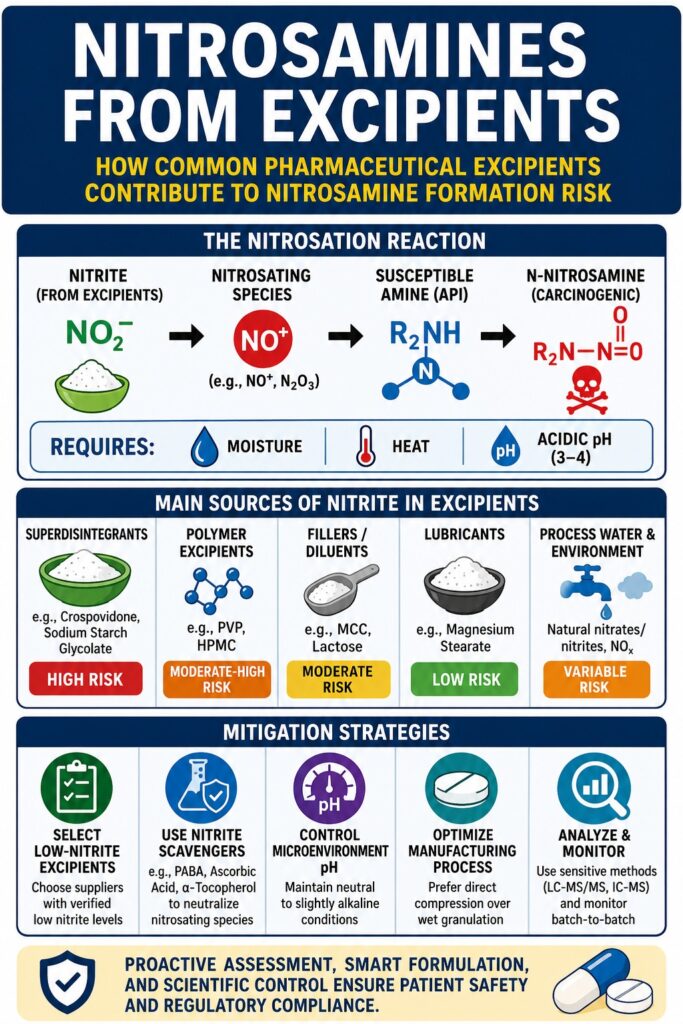
The generation of Nitrosamines from Excipients is driven by the interaction of a nitrosating species derived from excipient-associated nitrites, a susceptible amine source, and a catalytic microenvironment characterized by acidic pH, elevated temperature, and moisture. Effective control of these thermodynamic and kinetic parameters represents the foundation of successful nitrosamine risk management throughout pharmaceutical manufacturing.
The formation of nitrosamine impurities within solid oral dosage forms or liquid pharmaceutical preparations rarely occurs through a simple, single-step reaction. Instead, the principal mechanism begins with residual nitrites, which are frequently introduced through excipients such as starches and cellulose derivatives. Under mildly acidic conditions, these nitrites become protonated to form nitrous acid (HNO2). Nitrous acid subsequently undergoes dehydration, producing highly reactive nitrosating intermediates, including nitrous anhydride (N2O3) and the nitrosonium ion (NO+). These highly electrophilic species readily react with vulnerable secondary amines present within the API or its degradation products, ultimately producing stable N-nitrosamines.
Explore a breakdown of chemical precursors and manufacturing stress factors driving these reactions: Nitrosamine Formation Pathways in API Synthesis
The chemical structure of the amine significantly influences its susceptibility to nitrosation. Secondary amines represent the most reactive and direct precursors, undergoing rapid reactions with nitrosating agents. Although tertiary amines display lower intrinsic reactivity, they still present a substantial risk because they can undergo nitrosative de-alkylation or nitrosative cleavage. While these reactions occur at a slower rate, they are capable of generating highly potent low-molecular-weight nitrosamines under acidic or oxidative conditions. Research has shown that approximately 10% to 15% of tertiary amines present in drug substances may experience rapid de-alkylation following nitrosation, producing nitrosated secondary amines with efficiencies comparable to those observed during direct secondary amine nitrosation. Aromatic N-nitrosamines introduce an additional level of complexity because they may undergo the Fischer–Hepp rearrangement under strongly acidic conditions, resulting in the formation of para-nitrosoarylamines. This structural transformation can alter mutagenic potency and further complicate toxicological evaluation.
In addition to the presence of reactive chemical precursors, the surrounding physical microenvironment substantially accelerates reaction kinetics. Moisture serves as an important mobility medium by dissolving nitrite salts and promoting their interaction with amine-containing regions throughout the solid dosage matrix. Temperature acts as a powerful kinetic accelerator. Stress studies conducted under ICH Q1A storage conditions of 40°C and 75% Relative Humidity have consistently demonstrated that elevated storage temperatures dramatically increase the rate of nitrosamine formation. Reaction calorimetry has shown that temperatures exceeding 40°C, combined with a microenvironmental pH between 3 and 4, can increase nitrosamine production by as much as twelve times compared with neutral pH conditions at room temperature. Consequently, formulations manufactured using wet granulation or exposed to heated drying operations present a substantially greater risk of forming Nitrosamines from Excipients than formulations produced using direct compression techniques.
Excipient Variability and Nitrite Contamination Profiles
Trace nitrite contamination within pharmaceutical excipients exhibits considerable variability and is strongly influenced by factors including agricultural source materials, manufacturing process water, bleaching treatments, and environmental exposure during production. Since nitrites function as the rate-limiting reagent in nitrosamine formation, understanding variability between manufacturing batches and suppliers is essential for performing accurate predictive risk assessments during formulation development.
The Lhasa Nitrites database, an international data-sharing initiative established through collaboration among leading pharmaceutical companies, has systematically compiled nitrite concentration data for numerous commonly used pharmaceutical excipients. The database highlights substantial variability throughout the global supply chain. Agricultural raw materials and process water naturally contain trace quantities of nitrates and nitrites. For example, lactose monohydrate is purified from whey, a byproduct generated during cheese production, which introduces baseline nitrite contamination originating from both the natural raw material and the manufacturing water. Furthermore, processing operations such as acid titration, spray drying, and exposure to atmospheric nitrogen oxides (NOx) during drying can contribute additional external nitrite contamination.
Table 1 demonstrates the variation in nitrite concentrations among several commonly used pharmaceutical excipients, highlighting the significant differences in baseline contamination levels observed across different excipient categories.
| Excipient Class | Specific Excipient | Mean Nitrite Level (ppm / µg/g) | Maximum Observed (ppm) | Nitrosamine Risk Contribution |
|---|---|---|---|---|
| Superdisintegrant | Crospovidone | 6.50–8.30 | 14.00 | High |
| Superdisintegrant | Sodium Starch Glycolate | 2.00 | 285.60 | Moderate-High |
| Filler / Binder | Microcrystalline Cellulose (MCC) | 0.50–0.70 | 2.40 | Moderate |
| Filler | Lactose Monohydrate | 0.54 | 1.70 | Low-Moderate |
| Lubricant | Magnesium Stearate | 2.40 | 6.10 | Low (due to low use %) |
| Polymer / Binder | Hypromellose (HPMC) | 0.80 | 5.00 | Moderate |
Superdisintegrants and High-Risk Polymer Excipients
Superdisintegrants and selected polymeric excipients represent some of the highest-risk contributors to the formation of Nitrosamines from Excipients because of their elevated average nitrite concentrations and the possible presence of residual amine catalysts. Replacing superdisintegrants that contain high nitrite levels with purified, low-nitrite alternatives remains one of the most effective approaches for immediately reducing nitrosamine formation.
Information compiled within the Lhasa Nitrites database demonstrates that crospovidone contains average nitrite concentrations approximately nine to twelve times greater than conventional fillers such as microcrystalline cellulose and lactose. Croscarmellose sodium (CCS) also exhibits relatively high nitrite concentrations, with measured values frequently approaching 8 ppm. Although superdisintegrants generally account for only a small proportion of the total tablet weight, their elevated nitrite content significantly increases their contribution to the overall nitrosating capacity of the formulation. Replacing conventional crospovidone with an ultra-low-nitrite alternative, such as croscarmellose sodium verified to contain less than 0.8 ppm nitrite, can substantially reduce nitrosamine generation during product manufacture and storage.
Beyond nitrite contamination, certain polymeric excipients may also contain residual amine impurities. Specific grades of polyvinylpyrrolidone (PVP) and hydroxypropyl methylcellulose (HPMC) can retain trace quantities of tertiary amines originating from polymerization catalysts or synthesis solvents. When exposed to acidic or oxidative conditions, these residual amines may undergo nitrosative cleavage, producing volatile nitrosamines independently of the active pharmaceutical ingredient.
Read our detailed analysis of specific risk profiles across standard cardiac therapeutic formulations: Nitrosamine Testing for Beta-Blockers
Diluents, Fillers, and Low-Dose Contribution to Nitrosamines from Excipients
Although diluents and fillers generally contain relatively low concentrations of nitrite impurities, their substantial proportion within solid oral dosage forms makes them the largest cumulative source of nitrites in pharmaceutical tablets. As a result, rigorous supplier qualification and continuous monitoring of bulk excipients are essential to ensure that total nitrite levels remain within acceptable safety limits and do not contribute to excessive nitrosamine formation.
Microcrystalline cellulose (MCC) and lactose monohydrate typically exhibit average nitrite concentrations ranging from 0.50 ppm to 0.70 ppm. While these values appear relatively low, these excipients frequently account for approximately 70% to 90% of the total tablet weight. Consequently, their combined contribution often represents the primary source of nitrites within the final formulation. Supplier-to-supplier variability further increases this risk. Analytical evaluations have demonstrated that MCC obtained from one manufacturer may contain only 0.15 ppm nitrite, whereas a pharmacopeially equivalent material supplied by another manufacturer may contain 0.85 ppm.
Because the kinetics of Nitrosamine Drug Substance-Related Impurity (NDSRI) formation depend on nitrite as the rate-limiting reagent, even these seemingly minor differences in nitrite concentration can produce a substantial increase in the quantity of nitrosamines formed in the finished product. Controlled formulation studies have demonstrated that replacing a single high-risk excipient supplier or selecting the three major bulk excipients based on ultra-low nitrite specifications can decrease nitrosamine formation by as much as 89%. Consequently, pharmaceutical manufacturers are increasingly moving beyond conventional pharmacopeial compliance and now require batch-specific Certificates of Analysis (CoAs) that explicitly report trace nitrite concentrations to support comprehensive and scientifically justified risk assessments.
Review a real-world manufacturing investigation mapping trace impurities to their physical sources: NDMA Root Cause Investigation Case Study
Analytical Detection and Quantification Methods
The detection and quantification of nitrosamines and their precursor nitrites rely on highly sensitive analytical technologies, including liquid chromatography-tandem mass spectrometry (LC-MS/MS) and isotope-dilution ion chromatography, capable of measuring impurities at parts-per-billion (ppb) concentrations. These advanced analytical platforms are required because conventional compendial methods often fail to accurately quantify nitrosamines due to significant interference arising from complex excipient matrices.
Regulatory authorities worldwide require analytical methods capable of detecting nitrosamines at concentrations equal to or below established Acceptable Daily Intake (ADI) limits. Meeting these expectations typically requires Limits of Quantitation (LOQ) below 0.03 ppm (30 ppb) in the finished pharmaceutical product. Among currently available technologies, LC-MS/MS remains the preferred analytical platform because it provides exceptional sensitivity and selectivity for both conventional nitrosamines and polar, structurally complex Nitrosamine Drug Substance-Related Impurities (NDSRIs). Gas Chromatography-Tandem Mass Spectrometry (GC-MS/MS) is highly effective for analyzing volatile, low-molecular-weight nitrosamines. However, this technique presents a recognized limitation, as residual nitrites and amines may undergo thermal reactions within the heated injection port, leading to the artificial generation of nitrosamines during analysis. For structural characterization of previously unidentified NDSRIs, High-Resolution Accurate Mass Spectrometry (HRAM) employing Orbitrap or Quadrupole Time-of-Flight (QTOF) instrumentation is increasingly used during impurity profiling and pharmaceutical development.
Discover our dedicated contract testing and technical validation protocols for high-sensitivity workflows: Nitrosamine Method Development and Validation Services
Direct measurement of precursor nitrites within complex excipient matrices presents an even greater analytical challenge. Conventional Ion Chromatography with Conductivity Detection (IC-CD) frequently suffers from severe peak overlap caused by naturally occurring matrix components. For example, during the analysis of microcrystalline cellulose (MCC), high concentrations of chloride ions or other organic anions may completely obscure the trace nitrite peak, producing inaccurate quantification or false-negative results. Alternative indirect analytical approaches, including derivatization with the Griess reagent, convert nitrite into a strongly UV-absorbing azo compound that can subsequently be analyzed by LC-UV. However, the accuracy of the Griess reaction depends heavily on maintaining carefully controlled acidic conditions. Typically, hydrochloric acid concentrations between 0.1 mol/L and 0.5 mol/L HCl are required to stabilize the intermediate nitrous acid. Highly buffered excipients can interfere with this reaction, preventing complete derivatization and masking the actual nitrite concentration.
Performance Characteristics of Common Analytical Methods for Nitrite and Nitrosamine Determination
| Analytical Technique | Target Analyte | Typical LOQ | Selectivity | Primary Limitations |
|---|---|---|---|---|
| LC-MS/MS | Nitrosamines (NDSRIs) | < 0.03 ppm | Highest | Matrix suppression; high instrument complexity |
| GC-MS/MS | Volatile Nitrosamines | < 0.05 ppm | High | Risk of thermal degradation; requires analyte volatility |
| IC-CD | Trace Nitrites | 100–150 ppb | Lowest | Significant peak interference from sample matrix |
| IC-MS (Isotope Dilution) | Trace Nitrites | 20–30 ppb | Highest | Requires ¹⁵N-labeled standards; relatively expensive |
| HPLC-UV (Griess Derivatization) | Trace Nitrites | 20–30 ppb | High | Sensitive to pH variation; matrix-dependent reaction inhibition |
To overcome the limitations associated with conventional analytical methods, advanced laboratories increasingly employ Ion Chromatography coupled with Mass Spectrometry (IC-MS) operating in Selected Ion Monitoring (SIM) mode. By incorporating an isotope-labeled ¹⁵N-sodium nitrite internal standard, analysts can effectively compensate for ion suppression caused by the excipient matrix. Because ¹⁵N-nitrite exhibits chromatographic behavior identical to native nitrite, it enables highly accurate quantitative determination across a wide range of chemically complex polymeric excipients. Regardless of the analytical platform selected, all validated procedures must fully comply with ICH Q2(R2) requirements by demonstrating acceptable specificity, accuracy through matrix recovery experiments, and repeatability across multiple analytical runs.
Assess the critical steps and criteria required to screen, select, and audit an external laboratory partner: Nitrosamine Testing CRO Selection
Predictive Modeling and AI-Driven Risk Assessment
Predictive modeling and artificial intelligence provide advanced tools for assessing the risk of Nitrosamines from Excipients by integrating physicochemical characteristics with experimentally determined nitrite concentrations to estimate potential impurity formation before commercial manufacturing begins. These computational approaches transform pharmaceutical quality management from a reactive testing strategy into a proactive, data-driven formulation design process.
The complex and multivariable nature of nitrosation reactions has accelerated the integration of machine learning and advanced computational algorithms into pharmaceutical research and development. Artificial intelligence-based predictive platforms, including the Predictive Excipient-Nitrosation Algorithm (PENA) developed by ResolveMass Laboratories Inc., evaluate thousands of structural, environmental, and formulation-specific variables to predict excipient behavior under defined manufacturing and storage conditions. These predictive systems combine Quantitative Structure-Activity Relationship (QSAR) methodologies with Graph Neural Networks (GNNs) to construct chemical reaction networks capable of identifying structural vulnerabilities within APIs, including parameters such as pKa, steric hindrance, and molecular accessibility. These characteristics are subsequently integrated with the anticipated nitrite concentrations contributed by selected excipients.
By mathematically modeling the effects of temperature, humidity, and microenvironmental pH, these predictive algorithms can estimate expected nitrosamine formation with a high degree of confidence. This capability enables formulation scientists to identify potentially hazardous ingredient combinations during the design stage, significantly reducing dependence on expensive and time-consuming iterative batch manufacturing studies. In addition, specialized computational tools such as Mirabilis are used to perform impurity purge calculations, demonstrating mathematically how manufacturing operations including crystallization and Solubility-Limited Impurity Purging (SLIP) can effectively remove intermediate amine impurities before they encounter nitrosating agents during production of the finished dosage form.
Step-by-Step Nitrosamine Risk Assessment Workflows
A comprehensive nitrosamine risk assessment workflow systematically examines API susceptibility, excipient compatibility, manufacturing processes, and packaging materials to establish a scientifically defensible and regulatory-compliant safety profile. Regulatory agencies, including the European Medicines Agency (EMA) and the U.S. Food and Drug Administration (FDA), require this structured evaluation for both marketed products and pharmaceutical products under development.
An effective risk assessment follows a structured, multi-phase approach. The initial phase focuses on detailed structural evaluation of the API to identify the presence of secondary or tertiary amines while simultaneously reviewing the synthetic manufacturing pathway to determine whether nitrosating agents or susceptible degradation products may be generated during production. The second phase evaluates excipient compatibility by comparing the formulation’s bill of materials against established nitrite databases and calculating the maximum theoretical nitrite contribution based on the intended daily dosage.
Learn whether your portfolio requires mandatory regulatory testing and how to define your testing scope: Do All Drugs Need Nitrosamine Risk Assessment?
The third phase concentrates on evaluating manufacturing operations to identify processing conditions that could promote nitrosation reactions. Critical control points include assessment of process water quality to confirm the absence of nitrates, evaluation of acidic solvents used during manufacturing, identification of recycled solvents that may introduce residual amine contaminants, and review of prolonged high-temperature drying operations commonly associated with wet granulation. The final stage involves comprehensive Extractables and Leachables (E&L) studies to determine whether nitrocellulose adhesives or amine-cured polymers within the container closure system could release nitrosamine precursors into the pharmaceutical product throughout its shelf life. Whenever theoretical risk assessment identifies a potential concern, confirmatory laboratory testing using validated LC-MS/MS methods is required to verify the presence or absence of nitrosamine impurities and support regulatory compliance.
Plan your compliance and development timelines effectively by understanding standard industry milestones: Nitrosamine Testing Timeline
Regulatory Frameworks and Acceptable Intake (AI) Limits
Regulatory frameworks governing nitrosamine impurities utilize the Carcinogenic Potency Categorization Approach (CPCA) to establish stringent Acceptable Intake (AI) limits for newly identified nitrosamine impurities based on their predicted mutagenic potential. To achieve regulatory compliance and minimize the risk of product recalls, pharmaceutical manufacturers must ensure that excipient selection, formulation design, and analytical detection capabilities align with these established safety thresholds.
Following the widespread identification of nitrosamine impurities in pharmaceutical products, international regulatory agencies, including the U.S. Food and Drug Administration (FDA), the European Medicines Agency (EMA), and Health Canada, harmonized their recommendations under the principles outlined in ICH M7(R2). The current regulatory framework requires manufacturers to follow a comprehensive three-stage strategy consisting of detailed risk assessment, highly sensitive confirmatory analytical testing, and the timely implementation of Corrective and Preventive Actions (CAPA) whenever impurity levels exceed established safety limits.
Review the specific data expectations and submission protocols mandated for generic drug applications: Nitrosamine Risk Assessment for ANDA Submission
For most complex Nitrosamine Drug Substance-Related Impurities (NDSRIs), comprehensive in vivo carcinogenicity data are not available. To address this limitation, the FDA and EMA introduced the Carcinogenic Potency Categorization Approach (CPCA) in 2023. This scientific framework applies Structure-Activity Relationship (SAR) principles to estimate the carcinogenic potential of individual nitrosamines. The CPCA evaluates structural characteristics, including the number of alpha-hydrogen atoms adjacent to the N-nitroso functional group, which play a critical role in the alpha-hydroxylation pathway responsible for metabolic activation. The model also incorporates structural features capable of either enhancing or reducing mutagenic potential, such as bulky steric substituents that restrict enzymatic accessibility.
Examine how structurally complex NDSRIs differ dynamically from traditional small-molecule impurities: NDS
Based on these structural assessments, each NDSRI is assigned to one of five carcinogenic potency categories, with each category corresponding to a maximum recommended daily Acceptable Intake (AI) limit.
CPCA Potency Categories and Recommended Acceptable Intake Limits
| CPCA Potency Category | Predicted Carcinogenic Potency | Recommended AI Limit (ng/day) |
|---|---|---|
| Category 1 | Highest Risk | 26.5 |
| Category 2 | High Risk | 100.0 |
| Category 3 | Moderate Risk | 400.0 |
| Category 4 | Low-Moderate Risk | 1500.0 |
| Category 5 | Lowest Risk | 1500.0 |
Data derived from FDA Guidance on Recommended Acceptable Intake Limits for NDSRIs.
In addition to the CPCA framework, regulatory agencies establish impurity-specific AI limits using compound-specific carcinogenicity data whenever such information is available. When direct toxicological data are lacking, scientifically justified read-across assessments using validated surrogate compounds are employed to determine appropriate intake limits. Table 4 summarizes the recommended AI limits for several clinically important nitrosamine impurities.
Recommended Acceptable Intake Limits for Selected Nitrosamine Impurities
| Nitrosamine Impurity | Source Drug / Surrogate | Recommended AI Limit (ng/day) |
|---|---|---|
| N-nitroso-dimethylamine (NDMA) | Multiple (Compound Specific) | 96.0 |
| N-nitroso-diethylamine (NDEA) | Multiple (Compound Specific) | 26.5 |
| N-nitroso-atomoxetine | Atomoxetine (Surrogate: NNK) | 100.0 |
| N-nitroso-duloxetine | Duloxetine (Surrogate: NNK) | 100.0 |
| N-nitroso-fluoxetine | Fluoxetine (Surrogate: NNK) | 100.0 |
| N-nitroso-methylphenidate | Methylphenidate (Surrogate: NPIP) | 1300.0 |
| N-nitroso-desmethyl-almotriptan | Almotriptan (CPCA Category 1) | 26.5 |
| N-nitroso-amlodipine | Amlodipine (CPCA Category 5) | 1500.0 |
Data derived from FDA Guidance on Recommended Acceptable Intake Limits.
Converting these nanogram-per-day intake limits into practical formulation specifications illustrates the extraordinary level of control required during pharmaceutical development. For example, if a patient receives a 500 mg daily dose of a medication with an AI limit of 26.5 ng/day, the maximum allowable concentration of that nitrosamine within the finished dosage form is only 53 parts per billion (ppb). This specification is approximately 2,000 times lower than conventional ICH Q3B reporting thresholds for traditional impurities, highlighting the necessity for exceptional analytical sensitivity, rigorous excipient qualification, and comprehensive control of trace nitrite contamination.
Understand the operational boundaries and compliance thresholds for clinical data management: Nitrosamine Alert Limit vs Action Limit
Formulation Strategies to Mitigate Nitrosamines from Excipients
Reducing the formation of Nitrosamines from Excipients requires formulation scientists to intentionally modify the chemical microenvironment by incorporating nitrite scavengers, buffering agents, and manufacturing approaches that minimize conditions favorable to nitrosation. These formulation strategies interrupt nitrosation pathways even when trace nitrite impurities cannot be completely eliminated from excipients.
When supplier qualification and excipient substitution alone fail to reduce nitrite concentrations sufficiently, active chemical mitigation strategies become necessary. The incorporation of antioxidants or nitrite scavengers provides a protective mechanism by rapidly reacting with nitrosating species before they can interact with susceptible amine-containing APIs. Numerous investigations have demonstrated that compounds such as ascorbic acid, alpha-tocopherol, and para-aminobenzoic acid (PABA) effectively inhibit N-nitrosamine formation. Among these, PABA has demonstrated particularly strong nitrite-scavenging activity comparable to both L-cysteine and ascorbic acid, enabling efficient neutralization of reactive nitrosating intermediates within the solid dosage matrix. However, selecting an appropriate scavenger requires extensive compatibility testing to ensure that it does not adversely affect API stability, dissolution characteristics, or product bioequivalence, particularly for BCS Class III drug products.
Explore robust chemical design and technical formulation adjustment options for high-risk products: Nitrosamine Reformulation Strategy
Controlling the formulation’s microenvironmental pH provides an additional and highly effective mitigation strategy. The conversion of nitrite into highly reactive nitrous anhydride increases dramatically under acidic conditions, particularly at pH values below 5. By incorporating buffering agents or alkalizing excipients capable of maintaining a neutral or slightly alkaline microenvironment, formulators can significantly suppress the formation of reactive nitrosating intermediates and consequently reduce the likelihood of nitrosamine generation.
Modification of the manufacturing process also plays a critical role in minimizing nitrosamine formation. Reactive chemical species exhibit substantially greater mobility within liquid environments than in dry solid-state systems. Manufacturing techniques such as wet granulation, which combine aqueous solvents, nitrite-containing excipients, susceptible APIs, and elevated drying temperatures, create conditions that strongly favor nitrosation reactions. Transitioning production from wet granulation to direct compression or dry roller compaction eliminates the aqueous environment that facilitates molecular mobility, thereby significantly reducing nitrosamine formation even when precursor compounds remain present. In addition, the use of PTFE-lined reactors instead of conventional 316L stainless steel equipment has been reported to decrease catalytic surface interactions that may unintentionally enhance nitrite reactivity during API synthesis and formulation processing.
Learn how to build a robust framework to fulfill regulatory expectations and control target impurities long-term: Nitrosamine Control Strategy Development Services
Conclusion
Mitigating the risk associated with Nitrosamines from Excipients requires a fundamental shift in pharmaceutical formulation philosophy, replacing the long-standing assumption that excipients are both chemically and biologically inert. Trace concentrations of nitrites and residual amine impurities present within commonly used binders, fillers, lubricants, and disintegrants can actively participate in chemical reactions that generate highly potent probable human carcinogens when combined with susceptible APIs under favorable thermodynamic conditions.
Through comprehensive in silico risk assessments supported by advanced predictive modeling algorithms, formulation scientists can identify potential nitrosamine risks before commercial manufacturing begins. When these computational assessments are integrated with highly sensitive analytical techniques such as LC-MS/MS and isotope-dilution IC-MS, manufacturers gain the ability to accurately characterize batch-to-batch nitrite variability, strengthen supplier qualification programs, and establish robust control strategies throughout the supply chain. In addition, implementing targeted formulation interventions—including the use of chemical scavengers such as PABA, optimization of microenvironmental pH, and replacement of wet granulation with direct compression—provides multiple layers of protection that enable pharmaceutical products to consistently comply with the stringent CPCA Acceptable Intake (AI) limits established by global regulatory authorities. Maintaining long-term patient safety and sustained regulatory compliance ultimately depends on exceptional analytical accuracy, proactive formulation engineering, and complete transparency regarding the chemical composition and quality of pharmaceutical excipients.
For advanced analytical testing, predictive impurity profiling, and comprehensive regulatory compliance support, connect with industry experts through the Contact Us page.
Frequently Asked Questions (FAQs)
Certain superdisintegrants, including crospovidone and sodium starch glycolate, are generally associated with higher nitrite concentrations than many other excipients. Although fillers such as microcrystalline cellulose (MCC) and lactose monohydrate usually contain lower nitrite levels, they often represent the largest overall nitrite source because they constitute a significant proportion of the tablet’s total weight. Therefore, both nitrite concentration and excipient quantity must be considered during formulation development.
Accurate determination of trace nitrites is difficult because pharmaceutical excipients create complex analytical matrices that interfere with measurement techniques. Conventional Ion Chromatography (IC-CD) may experience overlapping peaks from other ions, making nitrite detection unreliable. In addition, derivatization methods such as the Griess reaction require carefully controlled pH conditions, and their performance may be significantly affected by the buffering capacity of certain excipients.
The Carcinogenic Potency Categorization Approach (CPCA) estimates the carcinogenic potential of Nitrosamine Drug Substance-Related Impurities (NDSRIs) by evaluating their molecular structure. The assessment considers features such as alpha-hydrogen atoms required for metabolic activation and other structural characteristics that may increase or decrease mutagenic potential. Based on these findings, each impurity is assigned to one of five potency categories, each with a corresponding Acceptable Intake (AI) limit.
Yes. Supplier selection plays a critical role in controlling nitrosamine risk because nitrite concentrations can vary considerably between manufacturers, even for pharmacopeially equivalent excipients. Choosing suppliers that consistently produce ultra-low nitrite materials can significantly reduce the availability of nitrosating agents within the formulation. In many cases, this strategy substantially lowers nitrosamine formation without requiring major changes to the formulation itself.
Heat and moisture create conditions that favor nitrosation reactions by increasing molecular mobility and reaction rates. Moisture dissolves nitrite salts, allowing them to interact more readily with susceptible amines, while elevated temperatures accelerate the underlying chemical reactions. As a result, manufacturing processes such as wet granulation generally present a greater nitrosamine risk than dry processing techniques like direct compression.
Chemical scavengers function by reacting preferentially with nitrites or reactive nitrosating intermediates before they can interact with vulnerable amine groups in the API. Compounds such as ascorbic acid and para-aminobenzoic acid (PABA) effectively intercept these reactive species, thereby interrupting the nitrosation pathway. When properly incorporated into a formulation, these additives can significantly reduce the formation of Nitrosamine Drug Substance-Related Impurities (NDSRIs).
Although secondary amines are the most reactive precursors, tertiary amines can also contribute to nitrosamine formation under suitable conditions. Exposure to acidic or oxidative environments may cause tertiary amines to undergo nitrosative de-alkylation or cleavage, generating secondary amines as intermediate products. These newly formed secondary amines can then react with nitrosating agents to produce nitrosamines, making tertiary amines an indirect but important source of risk.
In most cases, excipients contribute only trace nitrite impurities rather than pre-existing nitrosamines. However, a few exceptions have been reported. Trolamine (triethanolamine), for example, may contain trace amounts of N-nitrosodiethanolamine, a regulated nitrosamine impurity. Because of this potential risk, pharmacopeial standards impose strict concentration limits to ensure product safety and regulatory compliance.
The pH within a pharmaceutical formulation has a significant influence on nitrosamine generation because acidic conditions promote the conversion of nitrite into highly reactive nitrosating species such as nitrous acid and nitrous anhydride. Maintaining a neutral or slightly alkaline microenvironment using appropriate buffering excipients helps suppress these reactions. Consequently, effective pH control is considered an important strategy for minimizing nitrosamine formation throughout the product’s shelf life.
Reference:
- Boetzel, R., Leijten, J., Schlingmann, G., Bauer-Brandl, A., Kleinebudde, P., & Kockler, J. (2023). Modeling the impact of excipient selection on nitrosamine formation towards risk mitigation. Pharmaceutics, 15(8), 2015. https://doi.org/10.3390/pharmaceutics15082015
- U.S. Food and Drug Administration. (2024, September 4). Information about nitrosamine impurities in medications. https://www.fda.gov/drugs/drug-safety-and-availability/information-about-nitrosamine-impurities-medications
- European Medicines Agency. (2025). Nitrosamine impurities. https://www.ema.europa.eu/en/human-regulatory-overview/post-authorisation/referral-procedures-human-medicines/nitrosamine-impurities
- U.S. Food and Drug Administration. (2025). CDER nitrosamine impurity acceptable intake limits. https://www.fda.gov/regulatory-information/search-fda-guidance-documents/cder-nitrosamine-impurity-acceptable-intake-limits
- United States Pharmacopeia. (2024, November 27). Low nitrite excipients. Nitrosamines Exchange. https://nitrosamines.usp.org/t/low-nitrite-excipients/8094
- United States Pharmacopeia. (2025). Nitrites in excipients. Nitrosamines Exchange. https://nitrosamines.usp.org/t/nitrites-in-excipients/14724
- United States Pharmacopeia. (2023, June 16). FDA workshop: Mitigation strategies for nitrosamine drug substance related impurities. Nitrosamines Exchange. https://nitrosamines.usp.org/t/fda-workshop-mitigation-strategies-for-nitrosamine-drug-substance-related-impurities/6455
Get In Touch With Us
About The Author


