

Introduction:
NMR vs LC-MS for Peptide Characterization is not simply a question of choosing the more advanced instrument — it’s a question of matching the analytical technique to the quality attribute that actually needs to be demonstrated. For many synthetic therapeutic peptides, LC-MS provides highly informative data on molecular mass, identity, sequence-related impurities, modifications, and degradation products. NMR, however, provides a different level of structural information — particularly about conformation, molecular interactions, dynamics, and how the peptide behaves in solution.
Therapeutic peptides can contain truncations, oxidation products, deamidation products, epimers, process-related impurities, aggregates, and other structurally related species. Characterization programs should therefore be designed around the analytical question, not around instrument availability. FDA research has demonstrated the value of combining techniques such as NMR and LC-MS for complex peptide characterization and impurity assessment. For pharmaceutical development, this distinction matters because a peptide’s primary chemical structure and mass identity do not necessarily reveal its complete three-dimensional structure or solution behavior.
Summary:
- LC-MS is often sufficient for routine peptide identity, molecular-weight confirmation, impurity profiling, sequence-related characterization, and degradation studies — especially when the analytical question is about composition and mass differences.
- NMR becomes particularly valuable when the question involves higher-order structure, solution conformation, molecular interactions, or dynamics — information LC-MS cannot directly provide.
- NMR vs LC-MS for Peptide Characterization is not a competition; it’s a complementary, risk-based decision. LC-MS typically serves as the primary characterization platform, with NMR brought in as an orthogonal technique when structural evidence beyond mass is needed.
- The right technique depends on the peptide’s size, modification pattern, purity, concentration, formulation, stability, structural complexity, and the specific Critical Quality Attribute (CQA) under investigation.
- Regulatory and scientific literature — including FDA research and ICH guidance — supports orthogonal analytical strategies for complex peptide characterization rather than relying on a single platform to answer every structural question.
1: What Can LC-MS Tell You About a Therapeutic Peptide?
LC-MS is highly effective whenever the primary analytical questions concern molecular mass, peptide identity, related impurities, sequence-related variants, and chemical modifications. Combining liquid chromatography with mass spectrometry provides both separation and mass-based identification — making it especially useful for complex peptide mixtures.
A typical LC-MS workflow can deliver information about:
- Molecular weight and accurate mass
- Intact peptide identity
- Sequence-related impurities and truncated peptides
- Deamidation and oxidation
- Certain isomeric or stereochemical variants
- Process-related peptide impurities and degradation products
- Peptide mapping and relative abundance of related substances
- Fragment-ion information through MS/MS
This combination is powerful because LC separates chemically related components before MS detection — helping distinguish the principal peptide from structurally related impurities that share similar chromatographic behavior or molecular weight. For high-resolution intact-mass work, techniques such as native mass spectrometry for therapeutic peptide characterization can preserve non-covalent interactions and higher-order assemblies that get lost under denaturing LC-MS conditions, adding another layer of confidence to identity and impurity data. Similarly, multi-attribute monitoring (MAM) for peptide characterization uses LC-MS peptide mapping to simultaneously track multiple quality attributes — sequence variants, PTMs, and impurities — in a single, targeted method, which is increasingly favored for both development and lot-release testing.
FDA regulatory research has specifically used UPLC-HRMS and LC-MS/MS approaches to investigate peptide-related impurities and comparative peptide products. In one FDA research program, LC-MS/MS characterized impurities in calcitonin products, while NMR served as part of an orthogonal characterization strategy for complex peptide materials.
When Is LC-MS Usually Sufficient?
LC-MS is usually sufficient when the development question centers on identity, mass, impurities, or degradation rather than three-dimensional structure.
| Analytical Question | LC-MS Suitability |
|---|---|
| Is the expected peptide present? | High |
| Does measured molecular mass match the expected mass? | High |
| Are peptide-related impurities present? | High |
| Can truncation products be detected? | High |
| Can degradation products be screened broadly? | High |
| Can sequence-related fragments be investigated? | High |
| Can oxidation/deamidation-related mass changes be investigated? | High |
| Is a peptide impurity profile required? | High |
| Is detailed solution conformation required? | Limited |
| Is molecular dynamics being investigated? | Limited |
| Is higher-order structure the principal question? | Limited |
The final analytical conclusion still depends on method performance, sample characteristics, validation status, and intended use of the data.
2: What Does NMR Add to Therapeutic Peptide Characterization?
NMR provides structural information that complements mass-based measurements, particularly when the goal is to understand conformation, molecular interactions, dynamics, or solution-state behavior — questions that molecular mass alone cannot answer.
Depending on the experiment and peptide, NMR can investigate:
- Solution conformation and secondary-structure-related features
- Molecular flexibility and conformational changes
- Self-association, aggregation tendencies, and molecular interactions
- Binding behavior, dynamics, and motion
- Composition of complex peptide mixtures and structural fingerprints
- Certain stereochemical or positional differences that are difficult to distinguish by mass alone
Two peptide species can have the same nominal molecular mass but different structures. LC-MS may establish that the masses are identical or nearly identical, while NMR provides complementary evidence about their chemical environments and solution behavior. Research on therapeutic peptides and proteins has demonstrated the use of NMR diffusion and relaxation measurements to investigate flexibility, self-interactions, stress-induced conformational changes, and solution behavior.
3: NMR vs LC-MS for Peptide Characterization: What Is the Main Difference?
The central difference is that LC-MS primarily answers questions about separation, mass, composition, and molecular identity, while NMR provides information about chemical environments, conformation, interactions, and molecular dynamics.
| Feature | LC-MS | NMR |
|---|---|---|
| Molecular mass | Excellent | Indirect |
| Accurate-mass determination | Excellent with HRMS | Not primary application |
| Impurity screening | Excellent | Moderate |
| Trace-level detection | Generally excellent | Generally less sensitive |
| Peptide sequence investigation | Excellent with MS/MS | Possible, not usually primary |
| Degradation profiling | Excellent | Useful for selected applications |
| Structural isomers | Can be challenging | Potentially highly informative |
| Solution conformation | Limited/indirect | Strong capability |
| Molecular dynamics | Limited | Strong capability |
| Self-association | Limited | Strong capability |
| Sample concentration requirements | Often lower | Often higher |
| Complex mixtures | Very useful after separation | Can become spectrally complex |
| Routine impurity characterization | Highly suitable | Usually not first-line |
| Orthogonal structural confirmation | Useful | Highly complementary |
This comparison shows why the question shouldn’t be framed as NMR versus LC-MS in absolute terms. The better question is: which analytical evidence is necessary to answer this specific characterization question?
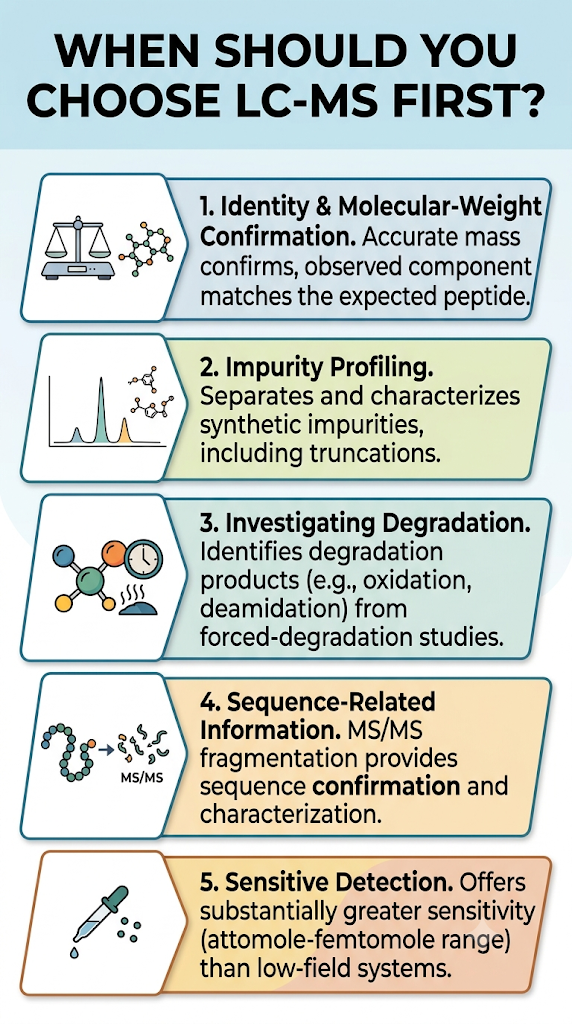
4: When Should You Choose LC-MS First?
LC-MS is generally the logical starting point when the primary objective is chemical characterization of a synthetic therapeutic peptide and its related substances — particularly during process development, impurity profiling, forced degradation, and investigation of manufacturing-related variants.
LC-MS is particularly useful when:
- You need identity and molecular-weight confirmation — accurate mass provides strong evidence that the observed principal component matches the expected peptide.
- You need impurity profiling — synthetic peptide manufacturing can generate truncations and related substances that LC-MS can separate and characterize with mass-based structural assignment.
- You are investigating degradation — forced-degradation studies produce oxidation, deamidation, hydrolysis, and fragmentation products, and LC-MS helps identify the associated mass changes.
- You need sequence-related information — MS/MS fragmentation supports sequence confirmation and characterization of sequence-related impurities.
- You need sensitive detection — mass spectrometry generally offers substantially greater sensitivity than NMR, making it more practical for low-concentration impurities.
5: When Do You Need NMR?
NMR becomes more relevant when LC-MS has already answered the mass/composition question but a remaining structural question requires information about conformation, interactions, dynamics, or chemical environments.
Consider NMR when:
- Two candidate structures have similar or identical molecular masses
- You need information about solution-state conformation
- Peptide folding or conformational changes are important to product understanding
- Self-association or aggregation behavior requires molecular-level investigation
- Binding or molecular interactions need to be investigated
- You need an orthogonal structural fingerprint
- LC-MS results do not fully explain a structural difference
- A complex peptide material requires complementary characterization
FDA’s work on complex peptide products illustrates why orthogonal approaches matter. For glatiramoids, FDA research used NMR alongside LC-MS and other analytical methods to characterize different aspects of the complex material.
6: When Is LC-MS Not Enough?
LC-MS is not enough when the key quality question concerns three-dimensional structure or solution behavior rather than simply molecular composition. Two samples can share the same molecular mass and a broadly similar impurity profile without having identical conformational behavior.
This distinction matters for peptides whose biological activity depends heavily on structural organization, since structural arrangement can influence stability, solubility, and binding behavior. In such cases, an orthogonal technique such as NMR may be needed to supply the missing evidence.
Other complementary tools may also be appropriate depending on the question, including:
- Circular dichroism (CD)
- FTIR spectroscopy
- Size-exclusion chromatography (SEC)
- Ion-exchange chromatography
- Capillary electrophoresis
- Analytical ultracentrifugation
- Light scattering and other biophysical methods
The goal is never to run every available technique — it’s to generate sufficient, scientifically justified evidence for the relevant CQAs.
7: How Do Peptide Size and Complexity Affect the Choice?
Peptide size, purity, concentration, modification, and structural complexity strongly influence whether LC-MS, NMR, or a combination is practical. Relatively straightforward synthetic peptides can often be answered by LC-MS alone, while more structurally complex peptides typically require a broader analytical package.
Important considerations include:
- Number of amino acids and linear versus cyclic structure
- Disulfide bonds
- Lipidation, PEGylation, or other conjugation
- Non-natural amino acids and terminal modifications
- Multiple stereocenters
- Aggregation tendency
- Sample concentration and formulation composition
- Expected impurity profile
Modifications that don’t produce an easily distinguishable mass change can challenge MS-only characterization, while NMR can become difficult with highly heterogeneous or insufficiently concentrated samples.
8: How Does Sample Preparation Differ Between NMR and LC-MS?
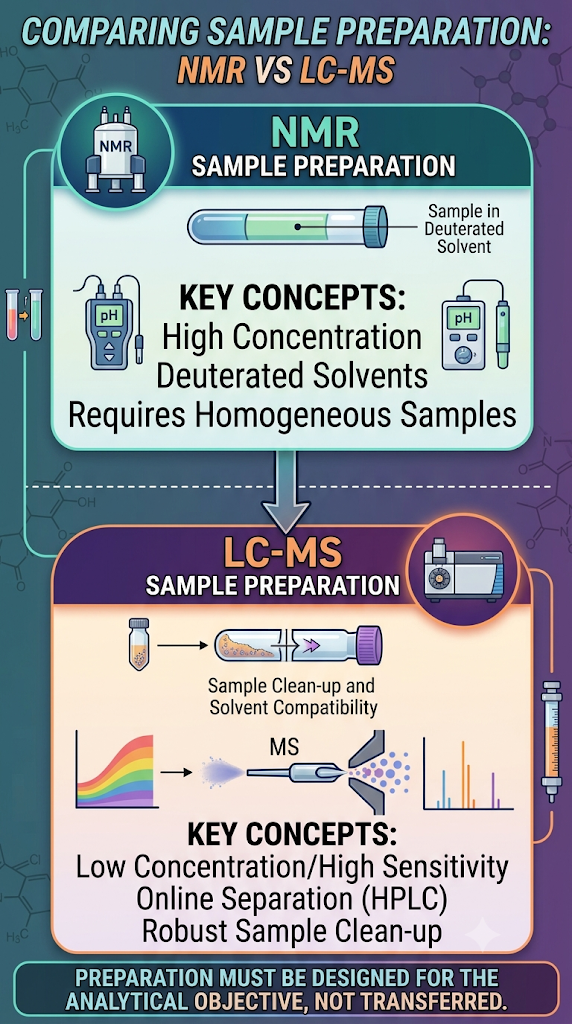
Sample preparation is an important practical factor: LC-MS generally works with much smaller sample quantities and accommodates chromatographic separation, while NMR typically benefits from relatively concentrated, clean samples.
LC-MS sample preparation may include dilution or dissolution, removal of particulates, appropriate solvent/buffer selection, filtration, chromatographic separation, MS detection, MS/MS fragmentation when required, and data processing for impurity assignment.
NMR sample preparation may require adequate peptide concentration, selection of an appropriate deuterated solvent or aqueous NMR system, pH control, buffer optimization, temperature control, minimization of interfering components, and selection of appropriate 1D or 2D NMR experiments.
Sample preparation needs to be designed around the analytical objective — not simply transferred from an LC-MS protocol into an NMR tube.
9: Can NMR and LC-MS Be Used Together?
Yes — combining NMR and LC-MS provides complementary evidence and is particularly valuable when a peptide requires deeper structural characterization. A practical workflow often looks like this:
LC-MS screening → impurity identification → structural hypothesis → targeted NMR → orthogonal confirmation
For example: LC-MS detects a previously unknown impurity; accurate mass suggests a possible chemical modification; MS/MS provides fragmentation evidence; if ambiguity remains, NMR supplies additional structural information; and results from both techniques are interpreted together before the confirmed attribute is incorporated into the development or control strategy. FDA research has used combinations of LC-MS, NMR, chromatography, and other techniques for complex API characterization.
10: What Are the Regulatory Considerations for Peptide Characterization?
Regulatory expectations should be addressed through a scientifically justified, risk-based characterization strategy rather than assuming one instrument is universally required. ICH Q6B describes characterization of biological products using multiple analytical approaches, including molecular-weight determination, peptide mapping, mass spectrometry, sequence-related analyses, and other physicochemical techniques.
This matters differently depending on your submission stage. Early-phase programs building a data package for peptide characterization CRO services for IND submission generally need robust identity, purity, and impurity data, with NMR layered in for any novel or structurally ambiguous candidate. Later-stage programs preparing therapeutic peptide characterization for NDA and ANDA filings typically require a more complete orthogonal package, since generic and complex peptide products draw closer regulatory scrutiny around impurity assessment, higher-order structure, and comparative characterization against a reference product.
FDA’s final Q14 guidance addresses science- and risk-based analytical procedure development, while Q2(R2) provides the broader framework for analytical procedure validation. The practical question during method selection is always: what quality attribute needs to be demonstrated, and which analytical technique provides sufficiently specific and reliable evidence?
Practical Decision Guide: NMR or LC-MS?
Use LC-MS when your principal questions concern mass, identity, impurities, sequence-related variants, and degradation. Consider NMR when additional information about conformation, interactions, dynamics, or structural ambiguity is required.
| Development Need | Suggested Approach |
|---|---|
| Routine identity confirmation | LC-MS |
| Accurate molecular mass | LC-HRMS |
| Peptide-related impurity profiling | LC-MS/MS |
| Sequence confirmation | LC-MS/MS |
| Forced degradation characterization | LC-MS/MS |
| Unknown impurity investigation | LC-HRMS + MS/MS |
| Structural ambiguity after MS | Consider NMR |
| Solution conformation | NMR |
| Molecular interactions | NMR |
| Self-association/dynamics | NMR |
| Complex structural characterization | LC-MS + NMR + complementary methods |
| Comparative characterization | Orthogonal analytical strategy |
This is a decision framework, not a universal testing specification. The final method set should be based on the peptide’s molecular structure, development stage, intended application, manufacturing process, and risk assessment. If you’re preparing to outsource this work, it’s worth reviewing the specifications to provide when outsourcing peptide characterization to a CRO so your lab can scope the right technique mix from the start, and checking a peptide characterization CRO deliverables checklist to confirm your data package will meet the standard your submission requires.
11: How ResolveMass Can Support Therapeutic Peptide Characterization
ResolveMass Laboratories Inc. supports peptide analytical programs by applying analytical chemistry principles to identity, impurity, degradation, and structural characterization questions, operating LC-MS, GC-MS, NMR, and HPLC in-house under a single ISO 9001:2015-certified quality management system.
Our peptide characterization services can include:
- LC-MS and LC-MS/MS characterization
- Peptide impurity profiling and accurate-mass analysis
- Method development and optimization
- Forced-degradation investigations and degradation-product characterization
- Comparative analytical studies and chromatographic method development
- Analytical data interpretation and orthogonal analytical strategy development
For synthetic peptides, analytical characterization should be connected to the manufacturing process and its potential impurity pathways, since peptide synthesis can generate structurally related impurities that may require high-resolution analytical approaches for identification and characterization.
Conclusion:
NMR vs LC-MS for Peptide Characterization is best understood as a complementary analytical decision rather than a competition between techniques. LC-MS is highly effective for molecular-weight confirmation, identity, impurity profiling, sequence-related characterization, and degradation studies, while NMR provides additional insight into solution conformation, molecular interactions, dynamics, and structural differences that mass spectrometry alone may not resolve. For many therapeutic peptide development programs, LC-MS serves as the core characterization technique, with NMR introduced when the scientific question requires additional structural or biophysical evidence; for more complex peptides, combining LC-MS with NMR and other orthogonal techniques provides a more complete understanding of the product. The right strategy ultimately depends on the specific peptide, its CQAs, manufacturing process, impurities, intended use of the data, and regulatory development stage — a fit-for-purpose analytical program provides stronger evidence while avoiding unnecessary testing.
Frequently Asked Questions:
The techniques answer different analytical questions, so accuracy should be considered in relation to the intended measurement rather than treating one technique as universally superior.
Some isomers can be difficult to distinguish using mass alone because they may have the same molecular mass. Chromatographic separation, MS/MS, specialized MS approaches, and orthogonal techniques such as NMR may be required depending on the structural difference.
Not necessarily. The appropriate analytical package depends on the product and the quality attributes that need to be demonstrated. Regulatory expectations should be assessed for the specific product and development pathway. ICH and FDA materials support the use of appropriate, complementary analytical techniques for comprehensive characterization.
LC-MS can provide strong evidence for molecular mass, sequence, and many chemical modifications, but it does not directly provide complete information about a peptide’s three-dimensional solution structure or molecular dynamics.
Yes. NMR can help characterize and distinguish certain impurities based on their chemical environments and structural features. However, LC-MS is generally more sensitive and often more practical for detecting and profiling low-level peptide-related impurities.
Reference
- Yang EJ, Kim SH, Kim A, Choi J, Jeong HJ, Na DH. Regulatory and analytical considerations for the quality assessment of peptide drugs. Journal of Pharmaceutical Investigation. 2026 Jul 15:1-23.https://link.springer.com/article/10.1007/s40005-026-00817-2
- Badgujar D, Paritala ST, Matre S, Sharma N. Enantiomeric purity of synthetic therapeutic peptides: a review. Chirality. 2024 Mar;36(3).https://onlinelibrary.wiley.com/doi/abs/10.1002/chir.23652
- Hinterholzer A, Stanojlovic V, Regl C, Huber CG, Cabrele C, Schubert M. Identification and quantification of oxidation products in full-length biotherapeutic antibodies by NMR spectroscopy. Analytical chemistry. 2020 Jun 12;92(14):9666.https://pmc.ncbi.nlm.nih.gov/articles/PMC7467420/
- Rastogi S, Shukla S, Kalaivani M, Singh GN. Peptide-based therapeutics: quality specifications, regulatory considerations, and prospects. Drug Discovery Today. 2019 Jan 1;24(1):148-62.https://www.sciencedirect.com/science/article/pii/S1359644618302514
About the Author


