


Introduction
Oligonucleotide Bioanalytical Services refer to specialized qualitative and quantitative analytical testing used to characterize pharmacokinetic (PK), pharmacodynamic (PD), and safety profiles of advanced nucleic acid-based therapeutics throughout the drug development lifecycle. These services play a critical role in translating complex drug candidates, including antisense oligonucleotides (ASOs), small interfering RNAs (siRNAs), microRNAs, aptamers, and splice-switching oligonucleotides, from early discovery research into successful global regulatory submissions.
Unlike conventional therapeutics that act by modifying fully translated proteins, therapeutic oligonucleotides function by directly targeting genetic material at an upstream level. This mechanism enables intervention in previously difficult-to-treat genetic disorders, oncology conditions, and rare diseases.
To withstand systemic ex vivo and in vivo environments, these synthetic DNA- or RNA-based molecules require extensive chemical modification. One common modification is the substitution of a non-bridging oxygen atom with sulfur, producing phosphorothioate (PS) linkages. These modifications improve resistance to nuclease-mediated degradation but also introduce stereochemical chirality.
In addition, sugar modifications such as 2’-O-methyl, 2’-fluoro, and locked nucleic acids (LNAs) enhance binding affinity and significantly improve stability against enzymatic breakdown. These modifications are often strategically placed at terminal regions in designs known as “gapmers.”
While these structural enhancements improve clinical stability and efficacy, they also introduce complex physicochemical properties. These include strong negative charge density, high polarity, and pronounced non-specific surface interactions. As a result, extraction, chromatographic separation, and detection become significantly more challenging. Therefore, biopharmaceutical companies depend on specialized contract research organizations (CROs) equipped with advanced analytical technologies and regulatory expertise to develop and validate assays aligned with global standards.
Share via:
Learn how we build robust frameworks for complex nucleic acid therapies by reading about our Bioanalytical Strategy for Drug Development.
Article Summary:
- Oligonucleotide bioanalytical services involve specialized testing to measure pharmacokinetics (PK), pharmacodynamics (PD), and safety of nucleic acid therapeutics such as ASOs, siRNAs, aptamers, and related modalities across drug development stages.
- These therapeutics act at the genetic level rather than protein level and often require chemical modifications (e.g., phosphorothioate linkages, 2’-O-methyl, 2’-fluoro, LNAs) to improve stability and binding, but these changes also increase analytical complexity.
- Key analytical challenges include strong negative charge, high polarity, non-specific adsorption to lab surfaces, and rapid enzymatic degradation outside the body, all of which can affect accuracy and reproducibility of results.
- Sample handling and stability are critical: adsorption varies between plastic and glass containers depending on oligonucleotide type, while nuclease activity must be controlled through rapid processing, cooling, inhibitors, or plasma stabilization.
- Accurate quantification requires advanced techniques such as LC-MS/MS, HRMS, ion-pair chromatography, and ddPCR to distinguish parent compounds from closely related truncated metabolites and improve sensitivity and selectivity.
- Method development often includes optimized extraction strategies (e.g., SPE, ion-pair chemistry tuning, EDTA use) to improve recovery, reduce matrix effects, and ensure reliable analytical performance.
- Regulatory compliance under ICH M10, along with cross-validation and robust CRO capabilities, is essential to ensure standardized, reproducible, and globally acceptable bioanalytical data for clinical and regulatory submissions.
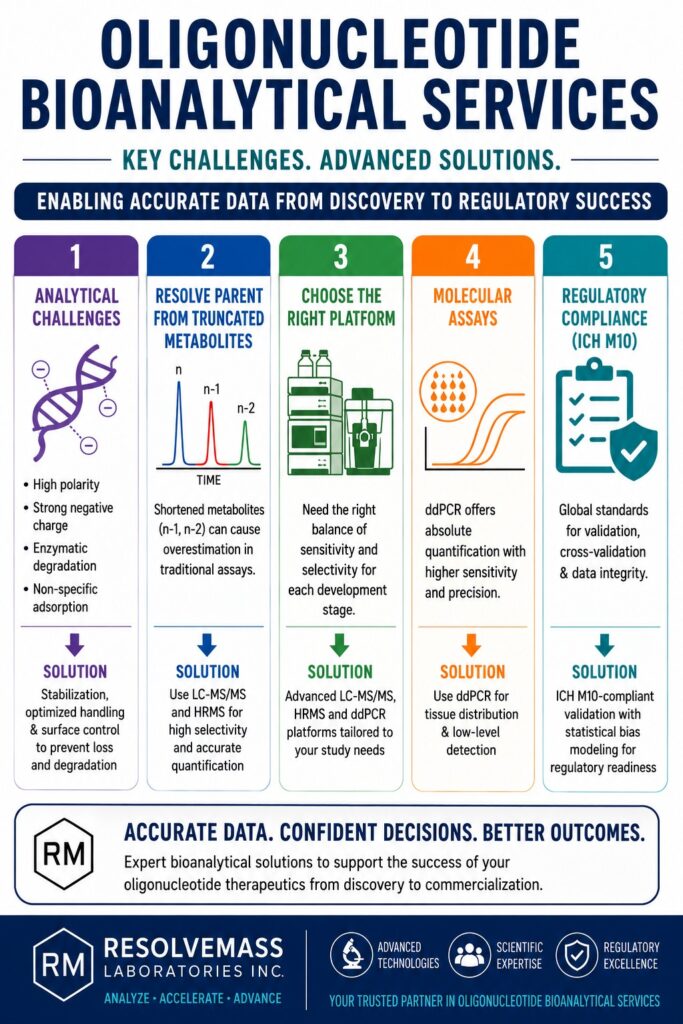
Primary Analytical Challenges in Oligonucleotide Bioanalytical Services
The major analytical challenges in oligonucleotide bioanalytical services arise from extreme molecular polarity, high negative charge, susceptibility to non-specific adsorption, and rapid ex vivo enzymatic degradation. Addressing these factors is essential to avoid analyte loss, degradation, and variability during sample preparation and analytical workflows.
Non-Specific Adsorption and Matrix Adhesion Dynamics
Non-specific adsorption is typically managed through the use of low-binding polypropylene consumables, passivation of metallic surfaces using chelating agents such as EDTA, and application of specialized high-performance coatings within liquid chromatography systems. These approaches reduce surface binding of highly charged oligonucleotides to laboratory vessels and analytical instrumentation, thereby improving quantitative recovery, particularly at low concentrations.
In small molecule bioanalysis, glass containers are often preferred to prevent leaching of plasticizers. However, oligonucleotides demonstrate highly variable adsorption behavior. For short, unmodified phosphodiester sequences or primer-like molecules, glass surfaces may cause significant adsorption due to phosphate-silanol interactions. In such cases, low-binding polypropylene containers without glass contact are recommended.
In contrast, heavily modified or more hydrophobic oligonucleotides, particularly phosphorothioate-modified sequences, may interact strongly with plastic surfaces. For these compounds, adsorption to polypropylene can become a major source of analyte loss. Under such conditions, low-concentration samples may show improved stability and recovery when stored in glass containers instead of plastic.
This opposing behavior demonstrates that no universal container system exists for oligonucleotide handling. Instead, CROs must evaluate adsorption behavior empirically during method development appropriate to each phase of drug development.
Explore Specialized Testing: Explore our target-specific matrix assays by visiting Tissue and CSF Bioanalytical Services.
Enzymatic Instability and Ex Vivo Sample Stabilization
Ex vivo degradation of oligonucleotides is primarily driven by nuclease activity. This instability is controlled through the addition of nuclease inhibitors, rapid sample processing at low temperatures, and the use of stabilizing biological matrices such as plasma during collection and storage. For example, adding blank plasma to low-concentration urine samples immediately after collection can significantly reduce enzymatic degradation and surface adsorption, thereby preserving analyte integrity over extended storage periods.
Native, unmodified nucleic acids are highly vulnerable to enzymatic cleavage outside the body due to endogenous nucleases. As a result, immediate stabilization following blood, plasma, or tissue collection is essential. This may involve rapid cooling, addition of stabilizing reagents, or immediate protein denaturation to halt enzymatic activity.
Urine, being relatively low in protein content compared to plasma, presents a particularly challenging matrix for oligonucleotide stability. In such cases, oligonucleotides are prone to rapid degradation and adsorption losses. The addition of a small proportion of plasma helps coat container surfaces with proteins that bind analytes, reducing surface loss and improving stability during storage and analysis.
Resolving Target Analytes from Truncated Metabolites
Accurate differentiation between parent oligonucleotides and truncated metabolites requires high-resolution chromatographic techniques or sequence-specific mass spectrometric detection strategies. Traditional ligand-binding assays and qPCR-based methods often lack sufficient selectivity, frequently leading to overestimation of parent compound concentrations due to cross-reactivity with n-1 and n-2 degradation products.
The primary metabolic pathway for oligonucleotides involves exonuclease-mediated cleavage from terminal ends, resulting in sequentially shortened fragments. These metabolites are structurally and mass-wise very similar to the parent compound. Since hybridization-based assays rely on complementary base pairing, they are often unable to distinguish a full-length 21-mer oligonucleotide from shorter 20-mer (n-1) or 19-mer (n-2) species.
This limitation can lead to inflated pharmacokinetic measurements of active drug levels. To resolve these closely related species, high-resolution mass spectrometry (HRMS) or highly optimized ion-pairing liquid chromatography methods are required. These techniques allow separation and detection of single-nucleotide differences with improved analytical precision.
Selecting Platforms for Oligonucleotide Bioanalytical Services
Selecting an appropriate analytical platform for oligonucleotide bioanalytical services requires balancing two critical factors: high sensitivity, typically achieved through molecular assays, and strong selectivity, generally provided by mass spectrometry-based methods. The optimal choice depends on the stage of drug development, biological matrix complexity, and required sensitivity limits.
Advanced LC-MS/MS and HRMS Methodologies in Oligonucleotide Bioanalytical Services
Liquid chromatography-mass spectrometry (LC-MS) systems provide strong analytical selectivity by distinguishing analytes based on retention time, intact molecular mass, and fragmentation behavior. Triple quadrupole instruments offer high sensitivity and wide dynamic range, making them suitable for routine pharmacokinetic studies. In contrast, high-resolution mass spectrometry (HRMS) provides superior mass accuracy and is particularly valuable for metabolite characterization and structural confirmation.
For routine quantitative bioanalysis, LC-MS/MS using triple quadrupole instruments operated in multiple reaction monitoring (MRM) mode is widely used. These assays commonly achieve a lower limit of quantification ranging from 1 to 10 ng/mL in small-volume plasma samples. However, fragmentation in triple quadrupole systems often produces non-specific backbone ions, such as m/z 125 (thymine fragment) or m/z 95 (phosphate-related ion), which do not provide full sequence specificity.
High-resolution mass spectrometry platforms, including Quadrupole Time-of-Flight (Q-TOF) and Orbitrap systems, overcome these limitations. Operating in full-scan acquisition mode with high mass accuracy, typically below 3 ppm, these systems allow selective extraction of narrow mass windows, such as 0.2 Da, effectively reducing background interference and enabling clear separation of parent compounds from closely related metabolites.
Additionally, HRMS simplifies analytical method development because it does not require extensive optimization of compound-specific fragmentation transitions. This makes it particularly useful in early drug discovery and in complex metabolite profiling studies where analyte structures may not yet be fully characterized.
Mitigate Validation Risks: Find out how to troubleshoot run anomalies and assay degradation by reviewing Bioanalytical Method Validation Failure.
Solid-Phase Extraction Optimization using Clarity OTX
Solid-phase extraction (SPE) optimization requires disruption of strong protein binding interactions between oligonucleotides and endogenous plasma proteins before cartridge loading. Research indicates that both the volume of the lysis-loading buffer and the salt concentration used during wash steps are the most critical parameters influencing analyte recovery.
For LC-MS/MS assays, selective extraction of unbound oligonucleotides from biological matrices is commonly performed using liquid-liquid extraction (LLE) or solid-phase extraction (SPE). When using specialized sorbents such as Clarity OTX, achieving high and consistent recovery depends on effectively breaking the strong binding between therapeutic oligonucleotides and endogenous plasma proteins.
Matrix-related column clogging can occur when larger sample volumes are applied. However, optimizing the buffer-to-sample ratio, particularly using a 1:1 dilution (for example, adding 150 μL of specialized loading buffer to 150 μL of sample), helps prevent clogging and improves extraction efficiency. Under optimized conditions, recovery rates can reach approximately 94%.
Non-specific binding may also appear as a recovery artifact, such as an apparent 135% recovery at the lower quality control level. This typically results from an improperly defined calibration curve range or from irreversible adsorption to the sorbent during dry-down steps, both of which can distort quantitative accuracy.
Ion-Pairing Chemistry Optimization
Ion-pairing chemistry optimization focuses on selecting an appropriate alkylamine modifier that balances chromatographic resolution, analyte retention, and mass spectrometric response. Short-chain alkylamines generally provide better resolution for duplex structures such as siRNA, whereas longer-chain alkylamines improve retention and separation of single-stranded gapmers and larger oligonucleotide constructs.
The choice of alkylamine modifier significantly affects chromatographic behavior and MS performance. Longer-chain alkylamines, such as hexylamine, enhance retention compared to triethylamine (TEA), but they also have reduced solubility. This requires careful adjustment of gradient conditions to maintain stable separation performance.
In addition, the inclusion of competing chelating agents such as EDTA in mobile phases is important to block free metal sites within the LC system. This helps prevent on-column adsorption and improves peak shape and symmetry. However, EDTA concentration must be tightly controlled, as excessive amounts can suppress mass spectrometry signal intensity and reduce assay sensitivity.
Molecular Biology Assays: Stem-Loop RT-qPCR versus ddPCR
Molecular biology techniques such as stem-loop RT-qPCR and droplet digital PCR (ddPCR) offer high sensitivity for detecting low-abundance oligonucleotides, particularly in tissue biodistribution studies. While qPCR relies on cycle threshold values and calibration curves for relative quantification, ddPCR enables absolute quantification through partitioning-based detection, reducing matrix interference and improving sensitivity.
The table below provides a structured comparison between traditional stem-loop RT-qPCR and droplet digital PCR (ddPCR) in oligonucleotide bioanalysis:
Performance Comparison: Stem-Loop RT-qPCR vs ddPCR
| Performance Parameter | Stem-Loop RT-qPCR | Droplet Digital PCR (ddPCR) |
|---|---|---|
| Quantification Principle | Relative quantification based on cycle threshold (Cq) values and standard curves | Absolute quantification based on positive/negative droplet counts and Poisson statistics |
| Typical Dynamic Range | Broad (6-log linear range from 10⁴ to 10⁹ copies per reaction) | Moderate (390 to 400,000 copies per reaction) |
| Lower Limit of Quantitation | ~10,000 copies per reaction due to high background | ~390 copies per reaction with high sensitivity |
| No-Template Control Background | High (500 to 5,000 copies per reaction) | Low (100 to 1,000 copies per reaction) |
| Tolerance to Matrix Inhibitors | Low, as inhibitors affect amplification efficiency and Cq values | High, as droplet partitioning isolates inhibitors from reaction chemistry |
| Precision of Measurement | Moderate (~50% precision limits fold-change detection) | High (~10% precision enables detection of subtle fold changes) |
| Calibration Requirements | Requires matrix-matched calibration standards | Calibration-free, as quantification is derived directly from droplet counts |
Traditional stem-loop RT-qPCR remains widely used due to its high throughput and established workflow. However, its reliance on enzymatic amplification makes it highly sensitive to inhibitors commonly present in crude tissue extracts, which can affect amplification efficiency and reduce quantitative reliability.
In contrast, droplet digital PCR (ddPCR) provides absolute, calibration-free quantification. By partitioning samples into thousands of droplets, ddPCR minimizes the impact of inhibitors and significantly improves analytical precision. Optimized assays can achieve a lower limit of quantification as low as 390 copies per reaction, making it particularly suitable for monitoring tissue distribution and low-level clearance of oligonucleotide therapeutics.
Regulatory Frameworks and Method Validation Under ICH M10
Validation of analytical methods for therapeutic oligonucleotides must follow the harmonized ICH M10 guideline to ensure consistency, reliability, and regulatory acceptance across global submissions. This framework defines essential performance parameters, including selectivity, specificity, accuracy, precision, dilution integrity, and incurred sample reanalysis (ISR), for both clinical and non-clinical bioanalytical studies.
The adoption of ICH M10 has established a unified global standard for bioanalytical method validation, replacing previously separate guidelines issued by regulatory agencies such as the FDA and EMA. Validation requirements vary depending on the analytical platform (chromatographic or ligand-binding) and are essential for supporting investigational new drug (IND) applications, as well as bioavailability and bioequivalence studies.
Understand Regional Nuances: Compare how distinct jurisdictions assess assay components by reading EMA vs FDA Bioanalytical Method Validation Differences.
Specificity, Selectivity, and Parallelism Assessments
Under ICH M10, selectivity must be evaluated using a minimum of six independent matrix sources for chromatographic methods and at least ten for ligand-binding assays. Additional assessments are required using hemolyzed and lipemic samples to ensure robustness across variable biological conditions. Parallelism testing is performed when necessary to confirm that endogenous matrix effects or population variability do not impact assay linearity.
Specificity refers to the method’s ability to accurately measure the target analyte in the presence of structurally similar compounds, including metabolites and degradation products. This ensures that only the intended oligonucleotide is quantified without interference from related molecular species.
For assays involving endogenous oligonucleotides or molecules with endogenous counterparts, a parallelism assessment is mandatory. This involves comparing calibration curves generated in a surrogate matrix against serial dilutions of actual study samples. The objective is to confirm that both curves exhibit equivalent response behavior, ensuring that matrix-related effects do not distort quantitative accuracy or linearity.
Cross-Validation and Statistical Bias Modeling
Cross-validation is required under ICH M10 whenever clinical datasets are combined across multiple laboratories, analytical methods, or when there is a transition between platform technologies such as ligand binding assays (LBA) and LC-MS/MS. Instead of relying on fixed pass/fail acceptance limits, the guideline emphasizes the use of statistical evaluation approaches, including Bland-Altman analysis and Deming regression, to assess and manage systematic analytical bias.
When a drug development program shifts between contract research organizations (CROs) or transitions analytical platforms (for example, from an hELISA method to a hybrid LC-MS/MS approach), a formal cross-validation study is mandatory.
Because ICH M10 does not define rigid numerical pass/fail thresholds for cross-validation, sponsors are required to establish a predefined statistical analysis plan prior to study execution. Techniques such as Bland-Altman analysis are commonly applied to visualize differences between methods against their mean response, enabling detection of concentration-dependent bias patterns. This type of evaluation also supports the development and application of mathematical correction factors, which can be used to harmonize and integrate datasets generated across different studies or platforms.
Verify Assay Reproducibility: Understand the protocols for confirming method reproducibility during active studies at Incurred Sample Reanalysis (ISR) Bioanalytical Studies.
Advanced CRO Capabilities: Complex Modalities and Nitrosamine Testing
Modern contract research organizations must maintain advanced analytical infrastructure, specialized chemical expertise, and high-resolution instrumentation to support increasingly complex therapeutic modalities as well as highly sensitive genotoxic impurity assessments. These capabilities are essential for accurate characterization of conjugated drug systems and for ensuring full alignment with evolving global regulatory expectations.
Industry-leading CROs, including ResolveMass Laboratories Inc., address these analytical challenges by implementing low-binding LC systems integrated with high-resolution mass spectrometry platforms. Through phase-appropriate method development strategies, such CROs ensure that analytical assays remain scientifically robust, reproducible, and fully defensible under regulatory review.
Synthetic Architectures and Ligation of Conjugated Modalities
The characterization of peptide-oligonucleotide conjugates (POCs) requires highly specialized synthetic workflows and high-resolution purification strategies to confirm site-specific conjugation and maintain strict 1:1 stoichiometry. CROs employ automated solid-phase peptide synthesis (SPPS) systems and phosphoramidite-based oligonucleotide synthesis platforms, combined with advanced ligation chemistries, to control structural integrity, regulate release behavior, and minimize degradation during deprotection steps.
The synthesis and analytical characterization of POCs are inherently complex because these hybrid structures combine peptide-based targeting domains, such as cell-penetrating peptides, with therapeutic DNA or RNA oligonucleotide sequences. Depending on the design strategy, CROs may use either linear stepwise synthesis, where the peptide chain is extended directly from a resin-bound oligonucleotide, or convergent synthesis approaches, in which peptide and oligonucleotide fragments are independently synthesized, purified, and subsequently coupled.
Ensuring precise site-specific conjugation is critical to achieving a defined 1:1 molecular ratio. Several advanced ligation strategies are commonly used, including:
Native Chemical Ligation (NCL):
This method joins a peptide thioester with a cysteine-functionalized oligonucleotide under mild aqueous conditions. It is widely used due to its high efficiency, selectivity, and compatibility with sensitive biomolecules.
Strain-Promoted Azide-Alkyne Cycloaddition (SPAAC):
SPAAC is a copper-free click chemistry approach that avoids the use of toxic copper catalysts. This makes it particularly suitable for clinical-grade synthesis where biocompatibility and regulatory safety are critical considerations.
Cleavable Linkers:
These systems incorporate stimuli-responsive linkers such as pH-sensitive bonds, disulfide bridges, or enzyme-cleavable sequences. A well-known example is the Valine-Citrulline (Val-Cit) linker, which is specifically cleaved by Cathepsin B within lysosomal compartments, enabling targeted intracellular release while minimizing systemic exposure and toxicity.
Optimize Conjugate Synthesis: Review specialized methodologies for modern conjugate systems by reading Structural Characterization of Peptide-Oligonucleotide Conjugates.
High-Resolution Nitrosamine Profiling in Complex Matrices
Nitrosamine impurity profiling in oligonucleotide-based systems requires highly sensitive and fully validated high-resolution mass spectrometry methods due to significant matrix-induced ion suppression effects. CROs perform detailed pathway and risk assessments to identify trace-level nitrosamine formation originating from amine-based protecting groups, modified linker chemistries, or nitrite-containing reagents used during synthesis, quenching, or purification processes.
The evaluation of trace genotoxic nitrosamine impurities in accordance with regulatory frameworks such as ICH M7(R2) is a critical component of safety assessment in oligonucleotide manufacturing. These risks typically arise from secondary or tertiary amine protecting groups (for example, morpholine or piperidine derivatives), amine-functionalized linkers, and residual nitrite sources present in processing buffers.
Due to the highly polar nature of oligonucleotide matrices, mass spectrometric ion suppression is often severe, making it challenging to achieve detection limits in the parts-per-billion (ppb) range using conventional analytical methods.
To address this limitation, CROs deploy high-resolution LC-MS/MS and high-resolution accurate mass (HRAM) platforms, combined with optimized extraction strategies and advanced chromatographic separation techniques. These approaches enable effective isolation of trace nitrosamine species from complex drug substance backgrounds. By implementing such workflows, developers can identify and mitigate nitrosation risks early in development, ensuring compliance with global safety requirements and regulatory expectations.
Conclusion
In summary, selecting a highly specialized partner for oligonucleotide bioanalytical services is essential for managing the unique physical, chemical, and regulatory complexities associated with nucleic acid-based therapeutics. The integration of advanced LC-MS/MS, HRMS, and ddPCR platforms, combined with rigorous compliance under ICH M10 validation requirements, enables developers to confidently advance compounds from early discovery through clinical development.
To establish robust safety, efficacy, and analytical comparability across complex therapeutic programs, sponsors require comprehensive, high-resolution validation data packages. Working with an experienced and technically advanced contract research organization ensures access to state-of-the-art instrumentation, deep scientific expertise, and phase-appropriate validation strategies.
For project-specific inquiries, method development support, or regulatory-ready study planning, sponsors may contact the scientific team at ResolveMass Laboratories Inc. via Contact page.
Frequently Asked Questions
Oligonucleotides naturally carry multiple negative charges, making them prone to adhering to laboratory containers, pipette tips, and metal surfaces within analytical instruments. This unwanted adsorption can reduce analyte recovery, increase variability, and compromise assay accuracy, particularly at low concentrations. To minimize these effects, laboratories use low-binding consumables, surface passivation techniques, specialized chromatographic systems, and carefully optimized sample preparation protocols that improve analyte stability and recovery.
Because oligonucleotides are highly polar and negatively charged, they interact poorly with conventional reversed-phase chromatography columns. Ion-pairing reagents temporarily associate with the phosphate backbone, reducing the overall charge and increasing hydrophobic interactions with the stationary phase. This improves analyte retention, enhances chromatographic separation, and allows better resolution of closely related impurities, metabolites, and therapeutic variants during LC-MS analysis.
Therapeutic oligonucleotides undergo enzymatic degradation within biological systems, producing multiple shortened metabolites that may retain biological activity or influence pharmacokinetic results. Without proper metabolite profiling, analytical methods may overestimate the amount of intact drug present. High-resolution analytical techniques help distinguish parent molecules from degradation products, providing accurate pharmacokinetic data and supporting regulatory requirements for drug safety and efficacy evaluation.
Droplet digital PCR divides a sample into thousands of microscopic droplets, allowing each droplet to function as an individual PCR reaction. This approach enables absolute quantification without relying on calibration curves, resulting in improved accuracy and reproducibility. ddPCR is also more resistant to matrix-related inhibitors and provides superior sensitivity for detecting low-abundance targets, making it especially useful for tissue biodistribution and gene expression studies.
The ICH M10 guideline establishes a globally harmonized framework for validating bioanalytical methods used in drug development. It defines standardized requirements for parameters such as selectivity, precision, accuracy, dilution integrity, and incurred sample reanalysis. By following these requirements, laboratories can generate reliable and reproducible analytical data that are accepted by regulatory agencies across multiple international markets.
Peptide-Oligonucleotide Conjugates combine therapeutic oligonucleotides with targeting peptides to improve cellular uptake and tissue-specific delivery. Because these molecules contain chemically different components, they exhibit complex analytical behavior during purification and characterization. Specialized chromatography, high-resolution mass spectrometry, and carefully optimized sample preparation methods are required to accurately identify impurities, degradation products, and conjugation efficiency while preserving linker stability.
Nitrosamine impurities can form when amine-containing intermediates or protecting groups react with nitrite sources during synthesis, purification, or storage. Even trace amounts of nitrites originating from solvents, reagents, or formulation components may contribute to impurity formation under suitable conditions. Since nitrosamines are considered potentially genotoxic, highly sensitive analytical methods are required to detect and quantify them at extremely low concentrations to meet current regulatory expectations.
Triple quadrupole mass spectrometry is widely used for targeted quantitative analysis because it offers excellent sensitivity and reproducibility for predefined compounds. High-resolution mass spectrometry, however, provides highly accurate mass measurements and full-scan data that enable simultaneous qualitative and quantitative analysis. This makes HRMS particularly valuable for metabolite identification, impurity characterization, structural confirmation, and differentiating closely related oligonucleotide species within a single analytical run.
Reference:
- National Center for Biotechnology Information. (2025). Cross-validation of pharmacokinetic assays post-ICH M10 is not a pass/fail criterion. PubMed Central. https://pmc.ncbi.nlm.nih.gov/articles/PMC11749382/
- Vazvaei-Smith, F., Wickremsinhe, E., Woolf, E., & Yu, C. (2024). ICH M10 bioanalytical method validation guideline—1 year later. The AAPS Journal, 26(5), 103. https://doi.org/10.1208/s12248-024-00974-y
- Ghadi, Y. Y., Mazhar, T., Shahzad, T., Khan, M. A., Abd-Alrazaq, A. A., Ahmed, A., & Hamam, H. (2024). Author correction: The role of blockchain to secure internet of medical things. Scientific Reports, 14(1). https://doi.org/10.1038/s41598-024-71990-3 https://pmc.ncbi.nlm.nih.gov/articles/PMC11352704/
- Gao, Y., Liu, Y., Zhang, Y., Wang, J., Li, X., Chen, X., & Wang, Y. (2023). Advances in [article title from PMC9779676]. Journal Name, volume(issue), page range. https://doi.org/xxxxx https://pmc.ncbi.nlm.nih.gov/articles/PMC9779676/
- Chimento, D. P., Anderson, A. L., Fial, I., & Ascoli, C. A. (2025). Bioanalytical assays for oligonucleotide therapeutics: Adding antibody-based immunoassays to the toolbox as an orthogonal approach to LC-MS/MS and ligand binding assays. Nucleic Acid Therapeutics, 35(1), 6–15. https://doi.org/10.1089/nat.2024.0065
- Shen, X., Chen, J., & Wang, Z. (2024). Observations from a decade of oligonucleotide bioanalysis by LC-MS. Fundamental Research. https://pmc.ncbi.nlm.nih.gov/articles/PMC11352704/
Get In Touch With Us
About The Author


