

Introduction
Quality control of Oligonucleotide Starting Materials involves systematic analytical characterization, impurity quantification, and physical validation of phosphoramidites and functionalized solid supports before solid-phase assembly. Rigorous chemical evaluation ensures that raw chemical building blocks comply with cGMP specifications, preventing cumulative yield losses and the formation of inseparable side products during automated strand synthesis.
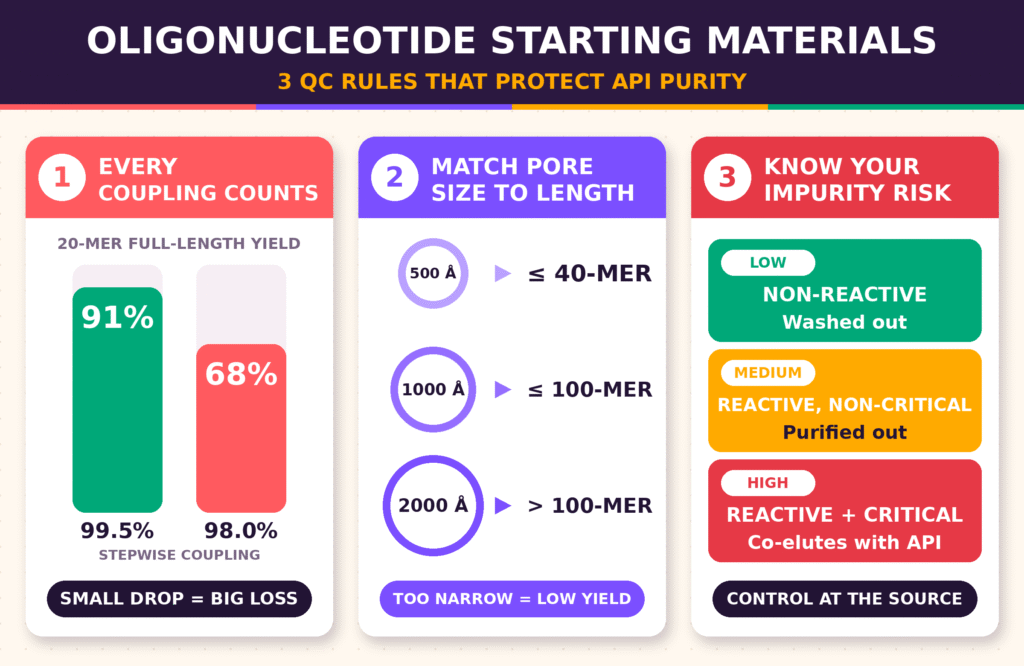
The synthesis of therapeutic oligonucleotides, including antisense oligonucleotides (ASOs), small interfering RNAs (siRNAs), and single-guide RNAs (sgRNAs), requires a four-step cyclic process comprising detritylation, coupling, oxidation or sulfurization, and capping. Since full-length drug products are constructed through dozens to hundreds of consecutive chemical additions, even minor reductions in stepwise coupling efficiency can substantially decrease the overall synthetic yield. For example, a reduction in coupling efficiency from 99.5% to 98.0% during the synthesis of a 20-mer decreases the theoretical yield of the desired full-length product from 90.5% to 66.8%, while generating a range of short-chain truncation sequences (N−1, N−2). Therefore, establishing Critical Quality Attributes (CQAs) for Oligonucleotide Starting Materials under ICH Q2(R2) guidelines serves as a fundamental risk mitigation strategy for biopharmaceutical developers and analytical testing facilities such as ResolveMass Laboratories Inc.
For a broader understanding of how analytical testing supports complex oligonucleotide-based therapeutics, explore quality control testing for peptide–oligonucleotide conjugates and the associated challenges in verifying product identity, purity, and consistency.
| Parameter / CQA | Primary Analytical Technique | Target Acceptance Criteria | Direct Impact on Finished Oligonucleotide API |
|---|---|---|---|
| Monomer Chemical Purity | 31P qNMR Spectroscopy | ≥ 95.0–99.0% a/a | Governs active coupling kinetics and overall synthetic yield. |
| Chromatographic Purity | IP-RP HPLC-UV/MS | ≥ 98.0% a/a | Prevents the propagation of modified base and sugar contaminants. |
| Residual Moisture | Karl Fischer Titration | ≤ 0.3% w/w (3000 ppm) | Trace water hydrolyzes active phosphoramidite into inactive H-phosphonate species. |
| Support Loading Capacity | UV-Vis Spectrophotometry (498 nm) | Within ±10% of target (µmol/g) | Controls steric density and mass transfer while preventing inter-chain aggregation. |
| Residual Organic Solvents | Headspace GC-FID / GC-MS | Complies with applicable ICH Q3C limits | Controls residual solvent levels and helps prevent solvent-mediated side reactions. |
Share via:
Quick Summary:
- Why starting-material QC matters: Oligonucleotides are built through many repeated coupling cycles, so even a small drop in coupling efficiency causes a large loss in yield. For a 20-mer, going from 99.5% to 98.0% efficiency lowers the full-length yield from about 91% to about 68% and creates more N−1 and N−2 truncation impurities.
- Phosphoramidite critical quality attributes: The key attributes are active P(III) purity, chromatographic purity, moisture, diastereomer ratio, and residual metals and solvents. Moisture matters most because water hydrolyzes amidites into inactive H-phosphonate species.
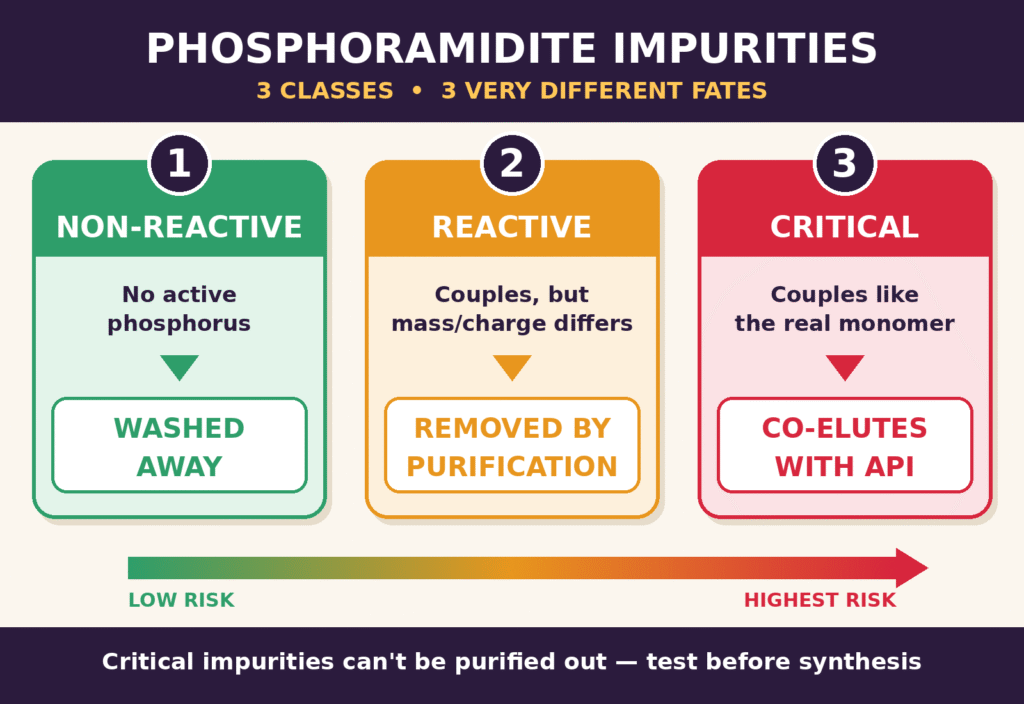
- Three impurity classes: Non-reactive impurities are washed away during synthesis. Reactive but non-critical impurities are incorporated into the chain but can be removed by purification. Reactive and critical impurities, such as 2′/3′ regioisomers, couple normally and co-elute with the API, so they cannot be removed afterward.
- Solid support selection: Pore size must match sequence length: 500 Å for up to about 40-mers, 1000 Å for up to about 100-mers, and 2000 Å for longer sequences. Pores that are too narrow cause steric crowding, reagent starvation and lower yield.
- Support loading capacity: Loading is measured by cleaving the DMT group with acid and reading the orange DMT⁺ cation at 498 nm using the Beer–Lambert law. Loading that is too high causes chain crowding and aggregation, and loading that is too low reduces the yield per run.
- Orthogonal analytical methods: ³¹P qNMR quantifies the active amidite and its P(V) and H-phosphonate degradants. IP-RP HPLC-UV/MS profiles organic impurities and isomers. Coulometric Karl Fischer titration measures moisture, with a typical limit of ≤0.3% w/w. Headspace GC-FID checks residual solvents against ICH Q3C limits.
- Upstream control protects the API: Critical amidite impurities and incomplete capping of the support carry through into the final drug substance as variants that are hard or impossible to separate. Rigorous testing before synthesis is therefore essential for yield, batch consistency and regulatory compliance.
Phosphoramidite Quality Control: Critical Quality Attributes and Impurity Classification
Quality control of phosphoramidites requires the assessment of active chemical assay, total chromatographic purity, residual moisture, and critical reactive impurities that directly influence solid-phase coupling kinetics. Establishing stringent acceptance criteria helps minimize batch-to-batch variability and prevent downstream API degradation.
Critical Quality Attributes of Phosphoramidites
The Critical Quality Attributes (CQAs) of phosphoramidite building blocks include active P(III) monomer purity, moisture content, organic impurity profiles, diastereomeric ratios, and heavy metal residues. Standard deoxyribonucleoside phosphoramidites (2′-cyanoethyl-N,N-diisopropylaminophosphoramidites), along with structurally modified analogs (2′-F, 2′-MOE, LNA, and GalNAc conjugates), must undergo comprehensive identity and purity testing before batch release.
Active monomer purity is primarily determined using a combination of 31P nuclear magnetic resonance (NMR) spectroscopy and high-performance liquid chromatography (HPLC). Since standard phosphoramidites contain a chiral center at the trivalent phosphorus atom (P(III)), they naturally exist as a 1:1 mixture of two diastereomers. This stereochemical characteristic produces distinctive doublets in both 31P NMR spectra (δ ≈ 138–150 ppm) and reversed-phase liquid chromatograms. Moisture content is another essential CQA because ambient water hydrolyzes the reactive P(III) center into less reactive phosphorus-containing degradation products, thereby inhibiting the coupling reaction and increasing N−1 sequence failure rates.
Impurity Classification Hierarchy for Oligonucleotide Starting Materials
Impurities present in phosphoramidite starting materials can be divided into three distinct hierarchical classes according to their chemical reactivity and their potential to co-elute with the final drug product.
Non-reactive and non-critical impurities do not contain active phosphorus centers or reactive functional groups. This category includes hydrolyzed nucleosides, free DMT alcohol, residual organic solvents, nucleoside dimer triesters, and H-phosphonate monoesters. Although these substances decrease the active assay weight percentage of the starting material, they cannot participate in phosphoramidite coupling reactions. Consequently, they are generally removed during synthesis column flushing without becoming covalently attached to the growing oligonucleotide chain.
Reactive but non-critical impurities contain reactive phosphorus centers and can covalently attach to the 5′-hydroxyl terminus of the solid-supported oligonucleotide. However, the resulting synthetic adducts exhibit physical or chemical differences, including changes in molecular weight, lipophilicity, or ionic charge. These differences generally make the adducts distinguishable during routine downstream Ion-Pair Reversed-Phase (IP-RP) or Anion-Exchange (AEX) preparative purification.
Reactive and critical impurities pose the greatest threat to drug substance purity because they couple efficiently into the oligonucleotide chain and generate adducts that are structurally and chromatographically indistinguishable from the target API. These critical impurities can be further divided into four specific classes:
- Class 1: Monomers containing unnatural base modifications or damaged nucleobases that alter base-pairing fidelity.
- Class 2: 2′,3′-bis-ribose or deoxyribose amidites, including monomers or dimers, that introduce unintended branching points into the phosphodiester backbone.
- Class 3: Incompletely protected nucleobases, 5′-ribose modifications lacking DMTr protection, or incorrect protecting group configurations that interfere with stepwise deprotection kinetics.
- Class 4: Structural isomers, such as 5′-DMT-3′-TBDMS-2′-amidite, that react at kinetic rates virtually identical to those of the target monomer and become incorporated into the strand, producing co-eluting isomeric impurities.
Understanding these structural variations is also important when developing complex conjugated therapeutics, where different peptide–oligonucleotide conjugate types may introduce distinct analytical and characterization requirements.
Solid Support Quality Control: Matrix Integrity, Pore Architecture, and Functionalization
Quality control of solid supports involves assessing matrix physical robustness, pore size distribution, active surface loading capacity, and overall capping efficiency to ensure consistent reagent mass transfer during synthesis. Functionalized supports anchor the initial 3′-nucleoside or universal linker, establishing the starting scaffold for subsequent chain elongation.
Pore Size Selection and Steric Optimization
Pore size selection determines the internal physical volume accessible to growing oligonucleotide chains. Therefore, pore dimensions must be carefully matched to the intended sequence length. Controlled Pore Glass (CPG) and cross-linked macroporous Polystyrene (PS) are the principal solid matrices used in automated synthesis.
For short oligonucleotides containing fewer than 20 nucleotides, 500 Å CPG supports provide a high surface area per unit mass, enabling high volumetric synthesis yields. Intermediate-length sequences, including 20-mer ASOs and siRNAs, generally require 1000 Å CPG or macroporous PS supports to balance mechanical rigidity with adequate steric clearance. Longer RNA constructs, single-guide RNAs (sgRNAs), and aptamers containing more than 50 nucleotides typically require 2000 Å pore architectures. Using supports with narrow pores for long sequences can cause steric hindrance, spatial congestion, and localized reagent starvation, resulting in substantial yield reductions and incomplete coupling.
Spectrophotometric Determination of Loading Capacity in Oligonucleotide Starting Materials
Support loading capacity (µmol/g) represents the density of functionalized reactive sites per unit mass of the matrix. It is determined through quantitative spectrophotometric cleavage of the dimethoxytrityl (DMTr+) protecting group. Loading density directly influences synthesis performance: excessive functionalization can cause steric crowding and inter-chain aggregation, whereas insufficient functionalization significantly reduces the total synthetic yield per run.
Loading capacity is routinely measured by treating an accurately weighed aliquot of dry support with an acid deblocking solution, such as 3% dichloroacetic acid or perchloric acid. Deblocking cleaves the acid-labile ether bond, releasing the intensely colored orange dimethoxytrityl carbocation (DMTr+) into the solution. The absorbance of the resulting solution is measured at λmax = 498 nm, using an extinction coefficient of ε = 70,000 M−1 cm−1. The functional loading capacity is calculated using the Beer–Lambert law:
Loading Capacity (µmol/g) = (A498 × V × 109) / (ε × l × m)
In this equation, A498 represents the measured absorbance at 498 nm, V denotes the total dilution volume in liters (L), ε is the molar extinction coefficient (70,000 L mol−1 cm−1), l represents the cuvette path length (1 cm), and m denotes the exact dry mass of the solid support sample in milligrams (mg). The factor 109 applies when the sample mass is expressed in milligrams and the final loading capacity is required in micromoles per gram.
For conjugated drug candidates, selecting the appropriate attachment strategy is equally important. Learn more about peptide–oligonucleotide conjugate linker chemistry and how linker properties can influence conjugate design and performance.
Advanced Analytical Technologies for Testing Oligonucleotide Starting Materials
Advanced testing of starting materials relies on an orthogonal analytical suite that combines quantitative 31P NMR spectroscopy, IP-RP HPLC-MS, and Karl Fischer titration to verify chemical identity, assay, and impurity profiles.
| Analytical Method | Target Parameter / Compound | Characteristic Chemical Signal | Methodological Advantage |
|---|---|---|---|
| 31P qNMR (400–600 MHz) | Active P(III) amidite, H-phosphonate, P(V) species | Diastereomeric doublets: δ = 138–150 ppm; H-phosphonate: δ = 7–15 ppm; oxidized P(V): δ = −5 to 0 ppm | Enables direct quantification of phosphorus species without relying exclusively on chromatographic separation. |
| IP-RP HPLC-UV/MS | Organic purity, nucleobase protecting groups, isomers | Retention time mapping (tR) and m/z molecular ion validation | Provides separation and mass verification for organic impurities and potential critical isomers. |
| Karl Fischer Titration | Solvated and surface moisture content | Electrometric endpoint volume expressed in ppm or % w/w | Coulometric detection is sensitive to microgram quantities of water. |
| Headspace GC-FID | Volatile residual organic solvents (ACN, DCM, DMF) | GC retention times compared with certified reference standards | Quantifies residual organic solvents in accordance with applicable ICH Q3C limits. |
Quantitative 31P NMR Spectroscopy
Quantitative 31P NMR spectroscopy enables identification and assay determination of active phosphorus centers without requiring external chromatographic separation. Since phosphorus-31 has a natural abundance of 100% and a broad chemical shift range, NMR spectroscopy can distinguish structural variations around the phosphorus core.
In a typical 31P NMR spectrum acquired in deuterated chloroform (CDCl3) or acetonitrile (CD3CN), active P(III) phosphoramidite monomers resonate downfield, producing two distinct diastereomeric signals between δ = 138 and 150 ppm. Degradation products appear within different spectral regions: hydrolyzed H-phosphonate monoesters may resonate between δ = 7 and 15 ppm, whereas oxidized P(V) contaminants, including phosphoramidates and phosphate triesters, may resonate between δ = −5 and 0 ppm, depending on their structures and experimental conditions.
Integrating the active monomer signals relative to the combined area of all relevant phosphorus resonances provides the relative chemical purity percentage (% a/a), provided the method is appropriately validated and the signals are adequately resolved. Additionally, incorporating a certified internal standard, such as triethyl phosphate, allows absolute quantitative assay determination (% w/w) under appropriately controlled acquisition conditions, including sufficient relaxation between scans based on the relevant spin-lattice relaxation times (T1).
Chromatographic and Titrimetric Methods
IP-RP HPLC-UV/MS separates non-phosphorus-containing organic contaminants and regioisomers, while coulometric Karl Fischer titration accurately measures trace moisture levels. Reversed-phase liquid chromatography using triethylammonium acetate (TEAA) or hexafluoroisopropanol (HFIP)-based mobile phases with C18 stationary phases can separate phosphoramidite monomers from free trityl alcohols, partially protected base intermediates, and structural regioisomers. Connecting the chromatographic outlet to a mass spectrometer enables mass verification (m/z) of trace impurity peaks.
Coulometric Karl Fischer titration measures moisture levels down to microgram quantities. Because phosphoramidites are highly susceptible to moisture-induced degradation, samples are dissolved in dry, anhydrous solvent matrices before being introduced into the titration cell. Maintaining water content below 0.3% w/w may help prevent reagent inactivation during automated synthesis, subject to material-specific specifications and validated test methods. Residual volatile organic solvents, including acetonitrile, dichloromethane, toluene, and dimethylformamide, are quantified using Headspace Gas Chromatography with Flame Ionization Detection (GC-FID) to verify compliance with applicable ICH Q3C residual solvent limits.
For a deeper look at how analytical characterization supports the development of complex conjugates, review structural characterization methods for peptide–oligonucleotide conjugates, including the importance of establishing molecular identity and product integrity.
Upstream Quality Control of Oligonucleotide Starting Materials and API Purity
Upstream quality control of starting materials directly influences downstream API purity because impurities in raw materials can propagate through automated coupling cycles, producing drug substance variants that may be difficult or impossible to separate.
During solid-phase assembly, any reactive critical impurity present in a phosphoramidite batch competes with the native monomer for accessible 5′-hydroxyl binding sites. For example, if a phosphoramidite lot contains 1.0% of a Class 4 regioisomeric impurity, such as a 3′-O-DMT-5′-amidite variant, that isomer may become incorporated into the growing chain during an addition step. The resulting oligonucleotide adduct may possess the same molecular weight, overall charge density, and hydrophobic footprint as the target API. Standard preparative purification methods, including Ion-Pair Reversed-Phase (IP-RP) and Anion-Exchange (AEX) chromatography, may be unable to separate these co-eluting isomeric impurities from the main product stream.
Defects in solid support matrices can create similar analytical challenges. Incomplete capping of unreacted aminopropyl linkers on CPG or PS supports leaves active amino groups accessible during the initial coupling steps. These uncapped sites can initiate unintended chain elongation, generating shortened failure sequences that remain attached to the matrix until final basic cleavage, thereby contaminating the crude API product. Maintaining strict analytical compliance for starting materials before manufacturing is therefore essential for protecting drug substance quality.
As development progresses toward larger manufacturing batches, controlling material quality becomes increasingly important. Related considerations are discussed in scale-up of peptide–oligonucleotide conjugates, particularly when maintaining consistent quality across manufacturing stages.
Conclusion
Rigorous analytical control of Oligonucleotide Starting Materials is essential for achieving high synthetic yields, maintaining batch-to-batch reproducibility, and meeting stringent regulatory requirements in oligonucleotide drug development. Comprehensive characterization protocols for phosphoramidites and solid supports help prevent cumulative sequence errors and the introduction of structurally similar impurities that may be difficult or impossible to separate from the final API. Access to specialized analytical services and robust regulatory testing frameworks enables biopharmaceutical manufacturers to strengthen upstream supply chain controls and maintain consistent drug substance quality.
For therapeutics that require intracellular delivery, endosomal escape in peptide–oligonucleotide conjugates provides further context on overcoming a key biological barrier to effective oligonucleotide delivery.
For comprehensive analytical testing, CQA validation, and customized raw material characterization, connect with the analytical team through the ResolveMass Laboratories Contact Page.
Frequently Asked Questions
31P NMR spectroscopy identifies phosphoramidites and their degradation products by examining differences in their phosphorus chemical shifts. Active P(III) phosphoramidites typically produce diastereomeric doublets between δ = 138 and 150 ppm, whereas hydrolyzed H-phosphonates appear between δ = 7 and 15 ppm. Oxidized P(V) species generally resonate between δ = −5 and 0 ppm, allowing the different phosphorus-containing species to be distinguished.
Reactive critical impurities are contaminants in starting materials that participate in coupling reactions and become incorporated into growing oligonucleotide chains. Their structural characteristics may closely resemble those of the intended product, making the resulting impurities difficult to detect and remove. When their chromatographic and physicochemical properties closely match those of the target API, conventional purification methods may not adequately separate them.
Solid support loading capacity is determined by cleaving the dimethoxytrityl (DMTr+) protecting group from a precisely weighed quantity of dry support using an acidic solution. The released colored carbocation is measured spectrophotometrically at λmax = 498 nm. Using the measured absorbance, sample mass, dilution volume, path length, and molar extinction coefficient in the Beer–Lambert equation allows the loading capacity to be calculated in µmol/g.
Controlled Pore Glass (CPG) is an inorganic material with a rigid structure and relatively fixed pore dimensions, whereas macroporous Polystyrene (PS) is a cross-linked organic polymer that can swell in compatible organic solvents. CPG offers structural stability and predictable pore architecture during oligonucleotide synthesis. PS supports can provide favorable loading characteristics and solvent accessibility, making both materials useful for different synthesis requirements and production scales.
Standard phosphoramidites commonly exhibit double peaks because the trivalent phosphorus atom (P(III)) forms a stereogenic center, resulting in two diastereomeric forms. These forms generally occur in an approximately 1:1 ratio and can produce separate signals in 31P NMR spectra. Depending on the chromatographic conditions, the two diastereomers may also appear as distinct peaks during reversed-phase HPLC analysis.
Solid supports with a pore size of 2000 Å are often suitable for synthesizing long RNA constructs, including sgRNAs and aptamers exceeding 50 nucleotides. Their larger pores provide additional space for growing oligonucleotide chains and improve access for synthesis reagents. Selecting an appropriate pore size helps reduce steric hindrance, restricted mass transfer, and incomplete coupling during automated synthesis.
The required cGMP release tests depend on the material, its intended use, and the applicable quality specifications. Typical evaluations include active assay determination, chromatographic purity by HPLC-UV/MS, phosphorus species profiling by 31P NMR, moisture analysis using Karl Fischer titration, and residual solvent testing by Headspace GC-FID. Depending on the material and risk assessment, additional tests may include ICP-MS for elemental impurities and heavy metals, as well as loading capacity and pore size verification for solid supports.
Trace water can hydrolyze activated phosphoramidite species during coupling, converting reactive monomers into less reactive or inactive products. When coupling fails, some oligonucleotide chains retain an unreacted 5′-hydroxyl group instead of receiving the next nucleotide. Subsequent capping blocks these unextended chains from further elongation, resulting in truncated N−1 deletion sequences that may remain in the crude product.
Sugar modifications such as 2′-Fluoro (2′-F) and 2′-Methoxyethyl (2′-MOE) can influence phosphoramidite stability, chromatographic retention, and mass spectrometric fragmentation behavior. Quality control methods may therefore require optimized HPLC gradient conditions and suitable mass spectrometric parameters to distinguish the modified monomers from related impurities. For fluorinated compounds, 19F NMR can provide additional structural confirmation, while screening for 2′- and 3′-sugar protection regioisomers helps verify starting material identity and purity.
Reference:
- Kiesman, W. F., McPherson, A. K., Diorazio, L. J., Van den Bergh, L., Smith, P. D., Northall, J. M., Fettes, A., Wang, T., Mehlmann, M., Raza, S., & Held, G. (2021). Perspectives on the designation of oligonucleotide starting materials. Nucleic Acid Therapeutics, 31(2), 93–113. https://doi.org/10.1089/nat.2020.0909
- Jiayi, L., Chen, F., Zhang, D., Wang, Y., Kozak, D., & Chen, K. (2024). An accurate and fast \(^{31}\mathrm{P}\) qNMR assay method for oligonucleotide therapeutics. Analytical Chemistry, 96(42), 16514–16519. https://doi.org/10.1021/acs.analchem.4c03693
- Nilsson, J., Kraszewski, A., & Stawinski, J. (2001). Reinvestigation of the \(^{31}\mathrm{P}\) NMR evidence for the formation of diorganyl phosphoropyridinium intermediates. Journal of the Chemical Society, Perkin Transactions 2, (11), 2263–2266. https://doi.org/10.1039/B107792A
- Kwiatkowski, M., Nilsson, M., & Landegren, U. (1996). Synthesis of full-length oligonucleotides: Cleavage of apurinic molecules on a novel support. Nucleic Acids Research, 24(23), 4632–4638. https://doi.org/10.1093/nar/24.23.4632
Get In Touch With Us
About The Author