

Introduction
Oral Peptide Drug Products rely on advanced permeation enhancers such as salcaprozate sodium (SNAC) to protect macromolecular payloads from gastrointestinal proteolysis and promote transcellular transport across the epithelial barrier. The development of commercially viable Oral Peptide Drug Products requires overcoming substantial physiological barriers, including highly acidic gastric conditions, aggressive luminal endo- and exopeptidases, and tightly organized epithelial membrane structures. For decades, therapeutic peptides were largely confined to parenteral administration because of these challenges. However, the clinical and commercial success of oral semaglutide and oral octreotide has demonstrated that non-invasive systemic delivery of macromolecular payloads can be achieved when appropriate formulation architecture is combined with chemical permeation-enhancement technology.
At the center of this paradigm shift is salcaprozate sodium (SNAC), together with medium-chain fatty acid (MCFA) salts such as sodium caprate (C₁₀) and sodium caprylate (C₈). These permeation enhancers do more than modify mucosal membrane fluidity; they also help protect the peptide payload from proteolytic degradation by creating localized microenvironmental pH gradients. Translating these sensitive co-formulations from bench-scale chemistry to commercial-scale manufacturing introduces substantial process engineering challenges. Major considerations include managing extreme molar ratios between excipients and active ingredients, minimizing powder segregation, and maintaining rapid and synchronized tablet erosion kinetics. Understanding the mechanistic principles of SNAC and related enhancers, characterizing their solid-state physical chemistry, and establishing robust critical unit operations are therefore essential for the scalable manufacture of Oral Peptide Drug Products.
Need peptide development support from synthesis through formulation? Explore our custom peptide synthesis services.
Share via:
Quick Summary:
- Oral peptide delivery overcomes major barriers such as gastric acidity, proteolytic enzymes, and poor epithelial permeability, enabling systemic delivery without injections.
- Permeation enhancers such as SNAC, sodium caprate (C10), and sodium caprylate (C8) improve peptide absorption through local pH modulation, peptide monomerization, and transient membrane fluidization.
- SNAC-based formulations can promote gastric absorption by raising the local pH above 5, reducing pepsin activity, and facilitating peptide transport across the gastric mucosa.
- Manufacturing is challenging because peptide APIs may represent only 0.5–3% of the formulation while permeation enhancers can account for 70–80%, creating risks of segregation and poor blend uniformity.
- Dual-granulation and roller compaction help separate high-dose enhancer and low-dose peptide streams, control particle properties, reduce segregation, and support consistent tablet production.
- Quality control requires specialized testing, including micro-volume dissolution, XRPD/FTIR/DSC solid-state analysis, LC-based peptide quantification, and ex vivo transport/TEER studies to evaluate release and permeability.
- Next-generation approaches focus on improved SNAC derivatives, C8/C10 enhancer platforms, continuous manufacturing, and real-time PAT monitoring to improve scalability, manufacturing efficiency, and oral peptide bioavailability.

Mechanistic Principles of Permeation Enhancers in Oral Peptide Drug Products
Permeation enhancers facilitate systemic absorption of Oral Peptide Drug Products by modifying the local gastrointestinal pH, disrupting self-aggregated peptide structures, and transiently increasing the fluidity of the apical mucosal membrane. The physiological delivery of therapeutic peptides is limited by a dual barrier: enzymatic degradation by gastric pepsin or intestinal brush-border proteases and poor passive diffusion through lipophilic enterocyte membranes caused by the high molecular weight and hydrophilic nature of peptide molecules. Permeation enhancers address these limitations through distinct, multimodal mechanisms that operate in close proximity to the mucosal surface.
In SNAC-based oral formulations, absorption occurs predominantly in the stomach rather than in the conventional site of intestinal absorption, the small intestine. Following erosion of the immediate-release solid dosage form, SNAC rapidly dissolves and produces a high localized concentration of enhancer directly adjacent to the gastric mucosa. SNAC functions as a localized buffer, increasing the microenvironmental pH to above 5.0. This transient increase in pH suppresses the conversion of pepsinogen into active pepsin, thereby reducing enzymatic proteolysis within the immediate release zone without significantly interfering with overall gastric digestive processes. At the same time, acylated GLP-1 analogues such as semaglutide naturally tend to form bulky oligomeric structures. SNAC shifts this equilibrium toward monomeric species that are more capable of passive membrane permeation. After monomerization, SNAC interacts with the apical cell membrane and produces localized fluid defects. This behavior has been described using the “quicksand” model and reduces the thermodynamic energy barrier associated with transcellular transport.
Permeation Enhancers and Their Mechanistic Characteristics
| Permeation Enhancer | Chemical Structure / Class | Primary Mechanism of Action | Site of Absorption | Benchmark Product / Status |
|---|---|---|---|---|
| Salcaprozate Sodium (SNAC) | N-acetylated synthetic salicylic acid derivative (C₁₅H₂₀NO₄Na) | Local gastric pH elevation (pepsin inactivation), peptide monomerization, and transcellular membrane fluidization | Gastric mucosa (stomach) | Rybelsus® (Oral Semaglutide) |
| Sodium Caprate (C₁₀) | 10-carbon saturated medium-chain fatty acid salt (C₁₀H₁₉O₂Na) | Transcellular membrane surfactant insertion, local pH buffering, and transient lipid bilayer perturbation | Intestinal / Colonic epithelium | Clinical Phase I/II trials (Exenatide, Semaglutide IR) |
| Sodium Caprylate (C₈) | 8-carbon saturated medium-chain fatty acid salt (C₈H₁₅O₂Na) | Paracellular ZO-1/claudin tight junction reorganization and transcellular surfactant perturbation | Small intestine | Mycapssa® (Oral Octreotide) |
Unlike traditional paracellular permeation enhancers that disrupt tight junction proteins such as zonula occludens-1, SNAC and MCFAs primarily promote transcellular transport without producing sustained tissue damage. However, this enhancement effect is strongly concentration-dependent and transient. Rapid dilution of SNAC by gastric fluids or its continued systemic clearance can quickly reduce the local concentration below the effective threshold, causing membrane fluidization to reverse within minutes. Consequently, solid dosage forms must provide a high molar excess of the enhancer and maintain close spatial co-localization with the mucosal tissue. For example, formulations may contain approximately 300 mg of SNAC together with 3 to 14 mg of semaglutide.
Planning a complex oral peptide program? Connect with our peptide CDMO team for development and scale-up support.
Physicochemical and Solid-State Dynamics of SNAC in Oral Peptide Drug Products
Salcaprozate sodium (SNAC) enhances Oral Peptide Drug Products through its amphiphilic molecular structure, pH-dependent solubility, and ability to establish weak, non-covalent interactions with peptide payloads. Structurally, SNAC contains a lipophilic eight-carbon aliphatic chain connected through an amide bond to a hydrophilic salicylic acid head group. In its free acid form, salcaprozoic acid (HNAC) crystallizes in the monoclinic space group P2₁/c and contains two distinct molecules within the asymmetric unit. These molecules are stabilized by extensive intra- and intermolecular hydrogen-bonding networks. This molecular packing contributes to the high thermal stability and predictable mechanical behavior of the raw bulk material.
The functional performance of SNAC in aqueous environments is strongly influenced by pH and ionic strength. As the sodium salt of a weak carboxylic acid (pKₐ ≈ 5.01), SNAC has relatively poor solubility under strongly acidic gastric conditions (pH < 3), where protonation promotes formation of HNAC. However, as SNAC begins to erode within the gastric microenvironment, its localized buffering action increases the immediate pH and promotes more rapid dissolution. Under physiological conditions, SNAC exhibits amphiphilic characteristics comparable to surface-active agents. Luminal electrolytes further decrease its Critical Micelle Concentration (CMC), which is important for maintaining the un-aggregated, monomeric, membrane-active form required to promote membrane fluidization.
Biophysical Interactions Between SNAC and Peptide Payloads
Biophysical characterization using Affinity Capillary Electrophoresis (ACE), Surface Plasmon Resonance (SPR), and Isothermal Titration Calorimetry (ITC) demonstrates that SNAC and C₁₀ interact with peptide payloads through weak, non-covalent associations. For example, studies involving exenatide and semaglutide have demonstrated low-affinity binding constants (K_D ≈ 10 – 100 μM), with favorable entropic changes compensating for unfavorable enthalpic contributions. These weak interactions allow SNAC to transiently stabilize the peptide without producing covalent adducts or permanently modifying the native biological conformation of the therapeutic macromolecule.
Need advanced characterization of your peptide formulation? Explore our peptide analytical testing services.
Advanced Manufacturing and Process Engineering for Oral Peptide Drug Products
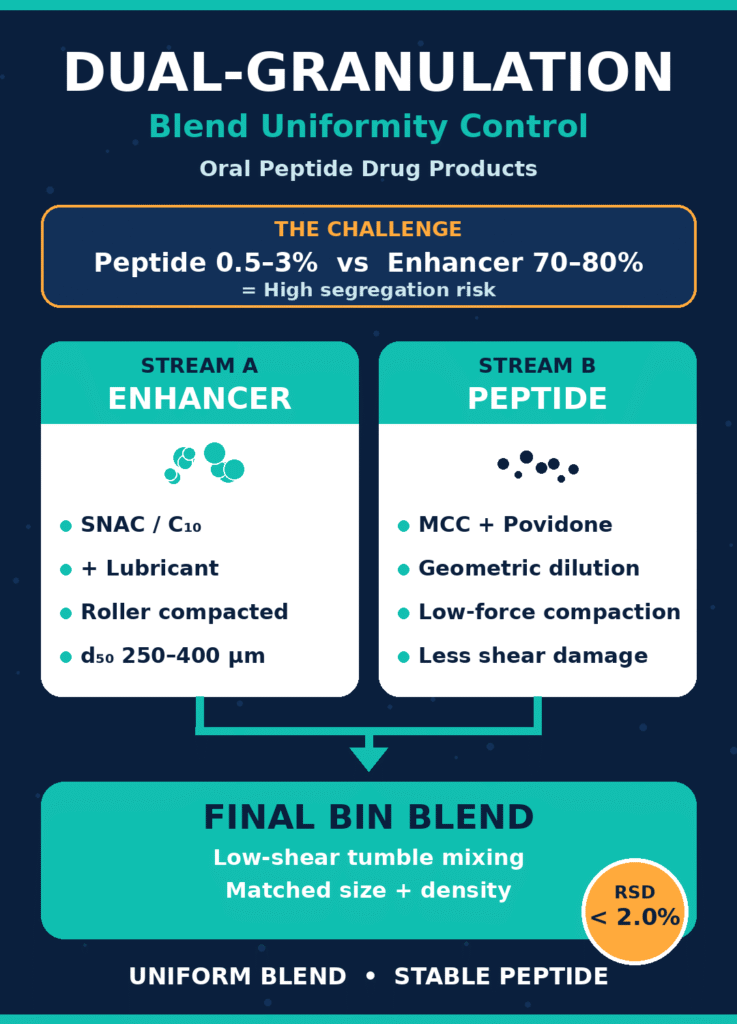
Manufacturing Oral Peptide Drug Products requires specialized unit operations, particularly multi-stream dry granulation and roller compaction, to minimize blend segregation and establish rapid, synchronized erosion kinetics. Scaling an oral peptide formulation from laboratory bench-scale production to commercial-scale tablet compression introduces several complex processing challenges. The extreme stoichiometric imbalance between the active peptide, which typically represents 0.5% to 3% w/w of the formulation, and the permeation enhancer, which can account for approximately 70% to 80% w/w, creates a significant risk of powder segregation, inconsistent flowability, and tablet weight variation during direct compression.
Moving a peptide program toward commercial scale? See our GLP-1 analog scale-up and GMP manufacturing capabilities.
Dual-Granulation Architecture and Blend Uniformity Control in Oral Peptide Drug Products
Dual-granulation processing separates the high-dose permeation enhancer from the low-dose active peptide into independent granulation streams. This approach minimizes particle segregation while helping preserve API stability. Because SNAC is cohesive, dense, and sensitive to moisture, processing the entire formulation through a single granulation batch can result in non-uniform binder distribution and increased risk of peptide degradation.
Enhancer Granule Stream (Granule A)
Pure SNAC or C₁₀ is blended with a lubricant such as magnesium stearate and, when required, an optional filler. This high-dose stream undergoes roller compaction to produce dense ribbons, which are subsequently milled into coarse, free-flowing granules with a controlled particle size distribution (d₅₀ ≈ 250 – 400 μm).
Peptide Granule Stream (Granule B)
The active peptide payload is geometrically diluted using dry binders such as microcrystalline cellulose and povidone and is then roller compacted separately under a low compaction force. This approach helps minimize shear-induced degradation of the peptide.
Final Bin Blending
Granule Stream A and Granule Stream B are subsequently combined using a low-shear tumble blender. Matching the particle size distributions and bulk densities of the two granule streams promotes a homogeneous final blend, with a target Relative Standard Deviation (RSD) of less than 2.0% before compression.
Looking for GMP-scale peptide API manufacturing? Explore our GMP peptide API manufacturing services.
Roller Compaction and Tableting Compression Parameters for Oral Peptide Drug Products
Optimization of roller compaction force and tablet compression parameters is essential to ensure that Oral Peptide Drug Products have adequate mechanical strength while retaining rapid disintegration and erosion characteristics. Roller compaction is generally preferred as a dry granulation technology because it avoids aqueous solvents and elevated thermal drying conditions, both of which can promote peptide hydrolysis or aggregation.
Critical Process Parameters and Their Impact on Critical Quality Attributes
| Unit Operation | Critical Process Parameter (CPP) | Target Operational Range | Impact on Critical Quality Attribute (CQA) |
|---|---|---|---|
| Roller Compaction (SNAC Granulation) | Specific Compaction Force / Roll Pressure | 3.0 – 8.0 kN/cm | Controls ribbon solid fraction (0.65 – 0.75), granule yield, and downstream flowability. |
| Dry Milling & Granule Sizing | Screen Mesh Aperture & Rotor Speed | 0.8 – 1.2 mm; 500 – 1000 RPM | Establishes granule size distribution (d₅₀) and removes fines that could contribute to particle segregation. |
| Bin Blending | Turret Speed & Blending Duration | 10 – 15 RPM for 10 – 15 min | Supports final blend uniformity (RSD < 2.0%) across extreme mass ratios. |
| Tablet Compression | Main Compression Force & Speed | 8.0 – 15.0 kN; 20 – 40 rpm | Establishes tablet breaking force (70 – 110 N), friability (< 0.5%), and disintegration rate. |
| Continuous Manufacturing | Twin-Screw Granulation Feed Rate | Gravimetric loss-in-weight feed control | Maintains a precise continuous stoichiometric ratio of enhancer to peptide API. |
Tablet Compression and Gastric Erosion Considerations
Tablet compression dynamics must balance mechanical durability with immediate gastric disintegration. Excessively high main compression force increases tablet density and can slow erosion within the stomach. This may allow fluid dilution to dissipate the localized SNAC microenvironment before the peptide has sufficient opportunity to permeate the tissue. In contrast, inadequate compression force can produce friable tablets that may fracture during handling, packaging, or transportation. The tablet architecture must therefore provide rapid erosion, typically within 10 minutes under low-liquid-volume conditions, so that a concentrated gel-like erosion layer can form directly against the gastric mucosa.
Developing a peptide dosage form for oral or parenteral delivery? Discuss formulation and manufacturing requirements with our team.
Analytical Characterization and Quality Control Imperatives for Oral Peptide Drug Products
Quality control for Oral Peptide Drug Products depends on specialized micro-volume dissolution testing, solid-state polymorphic monitoring, and ex vivo epithelial transport models. Conventional small-molecule testing procedures are not sufficient to fully characterize complex peptide-enhancer matrix formulations. Quality control strategies must therefore combine advanced physical characterization techniques with specialized biopharmaceutical assays to evaluate both formulation performance and permeation behavior.
Need comprehensive analytical characterization for your peptide product? Explore our peptide analytical testing services.
Biorelevant Dissolution and Co-Release Kinetics
Conventional USP Dissolution Apparatus 1 or 2 operated with 900 mL of dissolution medium does not accurately reproduce the physiological environment relevant to oral peptide delivery. Specialized micro-volume dissolution testing using approximately 50 – 100 mL of medium can simulate the limited fluid volume associated with a single sip of water and is used to monitor the simultaneous release profiles of both the peptide API and SNAC. Dual-wavelength High-Performance Liquid Chromatography (HPLC-UV) or LC-MS/MS can be used to quantify co-release rates and verify that the permeation enhancer and active pharmaceutical ingredient dissolve in a synchronized manner.
Solid-State Crystallinity and Polymorph Monitoring
X-Ray Powder Diffraction (XRPD), Fourier-Transform Infrared Spectroscopy (FTIR), and Differential Scanning Calorimetry (DSC) are used to monitor the crystalline-phase integrity of SNAC or HNAC free acid during processing and compaction. Process-induced transformations from crystalline to amorphous states can modify dissolution behavior and potentially compromise the localized buffering efficiency required for effective permeation enhancement.
Ex Vivo Epithelial Transport and TEER Measurement
Ussing chamber systems containing isolated human or animal intestinal or gastric tissues can be used to quantify the Apparent Permeability Coefficient (Pₐₚₚ) of the peptide payload. Real-time TransEpithelial Electrical Resistance (TEER) monitoring provides an assessment of epithelial barrier integrity and helps confirm that the permeability-enhancing effect is transient and does not produce significant cytotoxic or irreversible barrier disruption.
Concerned about formulation-related impurities or degradation products? Review our impurity control strategies for pharmaceutical development.
Strategic Outlook and Next-Generation Enhancement Platforms for Oral Peptide Drug Products
Next-generation Oral Peptide Drug Products are progressing beyond conventional SNAC-based monocomponent systems toward synthetic phenolate derivatives, optimized medium-chain fatty acid matrices, and continuous manufacturing strategies. Although SNAC has demonstrated clinical validation through oral semaglutide, its relatively low overall oral bioavailability, approximately 1%, indicates that substantial opportunities remain for further formulation optimization.
Emerging SNAC Derivatives and Medium-Chain Fatty Acid Platforms
Emerging research is investigating novel chemical derivatives, including SNAC phenolate salts, which are designed to retain absorption-enhancing capabilities while reducing hygroscopicity and improving solid-state stability. At the same time, medium-chain fatty acids such as sodium caprate (C₁₀) are being incorporated into immediate-release monolayer and bilayer tablet architectures. Preclinical pharmacokinetic studies in dogs have indicated that optimized C₁₀ monolayer tablets can achieve exposure levels, including Cₘₐₓ and AUC, comparable to SNAC reference formulations while potentially providing simpler synthetic routes and lower raw material costs.
Continuous Manufacturing and Process Analytical Technology
Concurrently, the implementation of continuous manufacturing technologies, including continuous twin-screw dry granulation, is transforming manufacturing approaches for these complex formulations. Continuous processing can substantially reduce manufacturing lead times, with reported reductions of up to 80%, while also lowering energy consumption and enabling real-time Process Analytical Technology (PAT) monitoring through near-infrared (NIR) spectroscopy. These manufacturing innovations support precise control of the enhancer-to-peptide stoichiometric ratio throughout production, helping ensure that individual tablets maintain the formulation characteristics required for consistent clinical performance.
Ready to advance your oral peptide program toward development and commercialization? Connect with our North American peptide CDMO team.
Conclusion
Successful commercialization of Oral Peptide Drug Products requires the integration of biophysical permeation mechanisms with robust solid-state engineering and carefully controlled dry granulation operations. Chemical permeation enhancers such as SNAC, C₁₀, and C₈ have expanded the possibilities for macromolecular drug delivery by addressing gastric proteolysis and epithelial transport barriers. However, converting these sophisticated formulations into robust solid oral dosage forms requires careful management of several manufacturing challenges, including extreme particle mass ratios, dual-granulation processing, ribbon density control during dry compaction, and rapid gastric erosion profiles.
As the biopharmaceutical industry continues to advance oral biologics, controlling these critical process parameters and applying appropriate analytical characterization tools will remain essential. ResolveMass Laboratories Inc. provides advanced technical capabilities in formulation design, solid-state testing, and process optimization to support the development of next-generation Oral Peptide Drug Products. Discover how our analytical expertise can support your oral peptide manufacturing pipeline by visiting our contact page at https://resolvemass.ca/contact/.
Frequently Asked Questions
SNAC produces a temporary increase in pH immediately around the dissolving dosage form rather than neutralizing the entire stomach. The resulting localized environment can reduce pepsin activity near the tablet surface while the surrounding gastric contents remain acidic. This site-specific effect allows peptide protection without functioning as a systemic antacid.
SNAC-based formulations are designed to promote peptide absorption primarily through the gastric mucosa after rapid tablet erosion. In contrast, C₈-based systems can use pH-dependent enteric coatings to prevent release in the stomach and shift delivery toward the small intestine. Thus, the two approaches rely on different gastrointestinal regions for absorption.
Dual-granulation separates the high-dose permeation enhancer from the very low-dose peptide API before final blending. This reduces the risk of segregation caused by the large difference in component concentrations and physical properties. Separate granulation also improves powder handling, blend uniformity, and consistency during subsequent tablet compression.
SNAC does not generally form a permanent covalent modification of the peptide payload. Its association with peptide molecules occurs through relatively weak and reversible non-covalent interactions, including hydrophobic and electrostatic forces. This transient interaction allows the peptide to separate from SNAC and retain its intended molecular structure during systemic exposure.
Roller compaction force directly influences ribbon density, granule structure, particle-size distribution, and downstream powder behavior. Excessive force can produce overly dense ribbons and granules that may resist subsequent erosion and disintegration. Conversely, inadequate force can generate weak ribbons and excessive fines, increasing segregation, flow problems, and tablet weight variability.
Biorelevant media are formulated to reproduce important characteristics of physiological gastrointestinal fluids, including components such as bile salts and lecithin. These components can interact with permeation enhancers such as SNAC or C₁₀ and alter their availability and activity. Testing in such media can therefore provide a more physiologically relevant assessment of dissolution and permeation behavior than simple aqueous buffers.
Sodium caprate (C₁₀) can enhance peptide absorption through mechanisms involving membrane interaction and localized physicochemical effects. Experimental studies have investigated C₁₀ in immediate-release oral peptide formulations as an alternative permeation-enhancement strategy. Its performance depends on factors such as dose, formulation architecture, peptide properties, and gastrointestinal conditions, so direct comparison with SNAC requires controlled formulation-specific studies.
A small volume of water helps limit dilution of the permeation enhancer immediately after tablet administration. Overnight fasting also reduces the amount of food and gastrointestinal contents that could interfere with tablet erosion and enhancer localization. These conditions are intended to support close contact between the dissolving formulation and the gastric mucosa during the absorption window.
Continuous manufacturing approaches such as continuous twin-screw dry granulation are being investigated for producing oral peptide tablets with improved process control. These systems can incorporate real-time Process Analytical Technology (PAT), including monitoring of material attributes and blend composition during production. Continuous processing can also support stable enhancer-to-peptide feed ratios and reduce the need for multiple batchwise processing steps.
Reference:
- Burshtein, G., Itin, C., Tang, J. C. Y., Galitzer, H., Fraser, W. D., & Schwartz, P. (2021). The combined effect of permeation enhancement and proteolysis inhibition on the systemic exposure of orally administrated peptides: Salcaprozate sodium, soybean trypsin inhibitor, and teriparatide study in pigs. International Journal of Pharmaceutics: X, 3, 100097. https://doi.org/10.1016/j.ijpx.2021.100097
- Maher, S., Ryan, B., Duffy, A., & Brayden, D. J. (2014). Formulation strategies to improve oral peptide delivery. Pharmaceutical Patent Analyst, 3(3), 313–336. https://doi.org/10.4155/ppa.14.15
- Kim, J. C., Park, E. J., & Na, D. H. (2022). Gastrointestinal permeation enhancers for the development of oral peptide pharmaceuticals. Pharmaceuticals, 15(12), 1585. https://doi.org/10.3390/ph15121585
- Hughes, S., & Neumiller, J. J. (2020). Oral semaglutide. Clinical Diabetes, 38(1), 109–111. https://doi.org/10.2337/cd19-0079
- Roy, P., Waddell, P. G., Dey, R., & Kavanagh, O. N. (2025). Crystallographic and physicochemical characterization of salcaprozoic acid: A structural basis for SNAC-enabled drug delivery systems. Acta Crystallographica Section C: Structural Chemistry, 81(11), 607–613. https://doi.org/10.1107/S2053229625008691
- Dinkov, B., Koleva, N., & Stavreva, G. (2026). Salcaprozate sodium as a permeation enhancer—Mechanism, applications and unresolved questions. Pharmaceutics, 18(9), 1171. https://doi.org/10.3390/pharmaceutics18091171
Get In Touch With Us
About The Author


