
Introduction:
Peptide Acylation Impurity Analysis is the targeted detection, identification and, where possible, quantitation of peptide variants carrying unwanted acyl groups. It is a key quality check for PLGA-based long-acting injectables, because the polymer can chemically modify the peptide it is meant to protect.
PLGA (poly(lactic-co-glycolic acid)) degrades by hydrolysis of its ester bonds, producing lactic and glycolic acid-derived species. Local pH, moisture, peptide structure and storage time all influence whether a peptide undergoes acylation or other degradation. For background on the polymer itself, see our overview of PLGA in drug delivery.
At ResolveMass Laboratories Inc., a Canadian analytical CRO/CDMO working in mass spectrometry and PLGA-based drug delivery, we treat detection as only the first step. Developers need answers to five questions:
- Is the impurity a covalent modification of the peptide?
- Which residue or functional group is involved?
- What is the likely source of the modification?
- Does it increase during storage or polymer degradation?
- Which formulation or process changes could reduce it?
Summary:
- Peptide acylation impurities can form when a peptide interacts with PLGA degradation products during manufacture, storage or release from a long-acting injectable depot.
- Acylation typically involves the free N-terminus or lysine side-chain amines, which can react with lactic acid- or glycolic acid-derived species.
- LC-HRMS combines chromatographic separation, accurate-mass measurement and MS/MS fragmentation to detect these impurities and locate the modification site.
- A sound Peptide Acylation Impurity Analysis compares unformulated peptide, fresh and aged depot samples, and blank PLGA extracts, so real impurities can be told apart from artifacts.
- The main challenges are polymer interference, low-abundance species, isomers, extraction bias and uncertain quantitation without reference standards.
- Reliable characterization guides formulation optimization, stability monitoring and impurity control strategy.
Note on this case study: This is an illustrative case built on established analytical principles. The observations are hypothetical and are not measurements from an actual ResolveMass Laboratories Inc. client project.
1: What Causes Peptide Acylation in PLGA Depot Formulations?
Peptide acylation occurs when reactive acyl-containing species meet nucleophilic groups on the peptide. How much forms depends on the peptide’s structure, the polymer’s degradation behavior and the microenvironment inside the depot.
Key mechanisms
- Polymer degradation. Hydrolysis generates acidic products that can lower the microenvironmental pH and affect peptide stability.
- Reactive acylating species. Direct attachment of a free carboxylic acid to an amine is not necessarily favorable in aqueous conditions, so the actual reaction pathway must be established rather than assumed.
- Susceptible peptide residues. Likely sites include the free N-terminal amine, lysine side-chain amines and other nucleophilic groups, depending on the sequence.
- Formulation-dependent effects. These include the factors in the table below.
| Factor | Why it matters |
|---|---|
| Lactide-to-glycolide ratio | Changes degradation rate and the type of acyl species released |
| Polymer molecular weight and end groups | Influence hydrolysis speed and acidity (see PLGA molecular weight and end-group chemistry) |
| Peptide sequence | Determines how many reactive amines are accessible |
| Water content | Drives hydrolysis and peptide mobility |
| Microenvironmental pH | Affects both amine reactivity and polymer breakdown |
| Manufacturing and storage | Process conditions, temperature and duration alter reaction extent |
Not every peptide-PLGA formulation shows measurable acylation. A formulation-specific investigation is needed to know whether it occurs and why.
2: Illustrative Case: Investigating an Unknown Peptide-Related Impurity
A development team sees an additional chromatographic peak during stability testing of a peptide-loaded PLGA depot. The peak is larger in aged samples than in the initial sample. Retention time alone cannot show whether it is a covalent peptide modification.
| Investigation element | Illustrative observation or objective |
|---|---|
| Formulation | Peptide encapsulated in a PLGA depot |
| Initial observation | Additional peak in an aged sample |
| Primary concern | Peptide modification during storage |
| Technique | LC-HRMS with targeted MS/MS |
| Objective | Determine whether the impurity is consistent with acylation |
| Outcome | Evidence-based assignment and recommendations for confirmation |
The scenario does not assume the peak is an acylated peptide. Oxidation, hydrolysis, deamidation, aggregation effects and sample-preparation artifacts must also be considered.
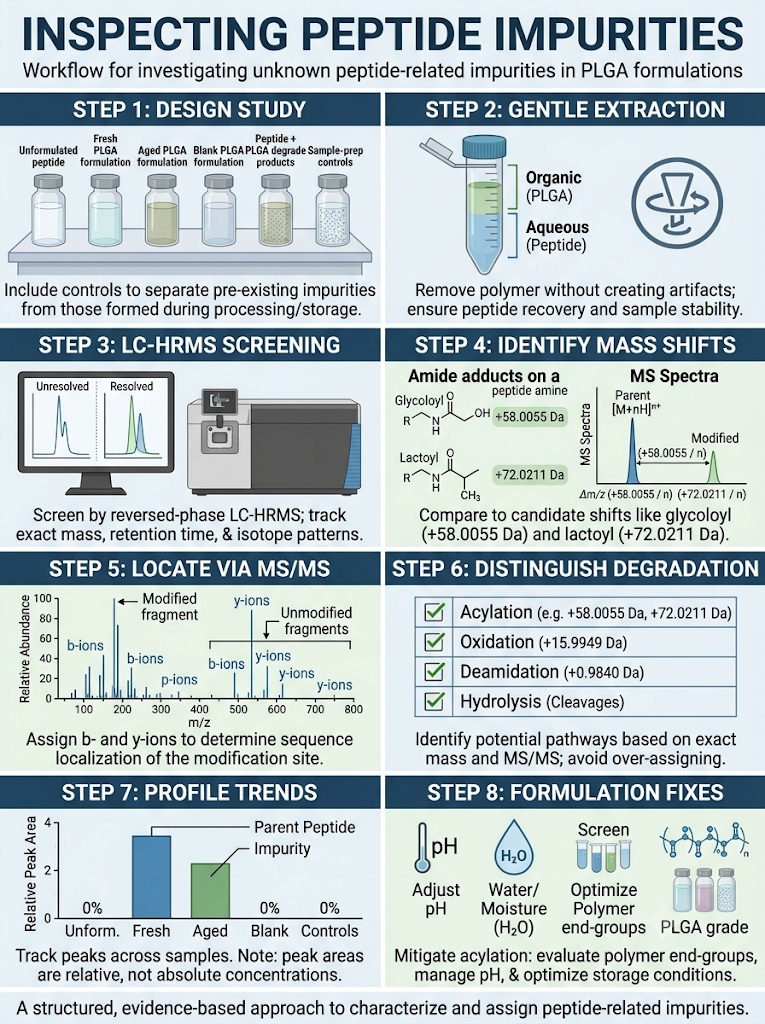
Step 1: How Should a Peptide Acylation Impurity Analysis Be Designed?
A sound design uses controls that separate pre-existing impurities from those formed during processing or storage. Analyzing only an aged sample is not enough, because the impurity may already have been present or may form during sample preparation.
Recommended sample groups:
- Unformulated peptide: the starting impurity profile
- Fresh peptide-loaded PLGA formulation: changes from formulation and encapsulation
- Aged peptide-loaded PLGA formulation: time-dependent impurity formation
- Blank PLGA formulation: polymer-derived signals and matrix interference
- Peptide exposed to relevant degradation products: plausible reaction pathways
- Sample-preparation controls: whether extraction itself creates the impurity
Where practical, examine several time points under defined storage conditions. A trend between fresh and aged samples is informative, but it does not prove the polymer caused the modification.
Step 2: How Is the Peptide Extracted Without Creating Artifacts?
The peptide is extracted with gentle, controlled conditions that recover both parent and modified forms without introducing new chemistry. Poor recovery, residual polymer and extraction-induced degradation can all compromise LC-HRMS results.
- Polymer removal: PLGA can interfere with separation, ionization and spectral interpretation.
- Peptide recovery: Acylated and unmodified peptides may differ in solubility, hydrophobicity and polymer interaction.
- Sample stability: Control pH, temperature, solvent and processing time to avoid hydrolysis or other reactions.
- Adsorption and precipitation: Peptides may stick to containers or be trapped in polymer residue.
- Blank evaluation: A blank PLGA extract reveals matrix peaks that could be mistaken for impurities.
Recovery, reproducibility and sample stability should be demonstrated before drawing conclusions about low-level impurities. For the wider analytical picture, see our guide to characterizing peptides in PLGA microsphere and depot formulations.
Step 3: How Does LC-HRMS Screen for Peptide Acylation Impurity Analysis Targets?
LC-HRMS separates peptide-related species by reversed-phase chromatography and measures their mass-to-charge ratios with high resolution and mass accuracy. Modifications often shift retention time, which helps resolve them from the parent peptide.
| LC-HRMS capability | What it contributes |
|---|---|
| Chromatographic separation | Distinguishes parent from impurities |
| Accurate-mass measurement | Molecular-mass evidence for proposed modifications |
| Charge-state assignment | Reconstructs neutral mass of multiply charged ions |
| Isotope-pattern assessment | Checks consistency with proposed elemental composition |
| Data-dependent or targeted MS/MS | Fragment ions for structural investigation |
| Comparative profiling | Trends across fresh, aged and control samples |
UV-based HPLC can detect peaks but usually cannot identify them. A peak may be a modified peptide, a co-eluting excipient or an unrelated degradant. HRMS narrows the possibilities, but accurate mass alone cannot confirm a specific site or pathway.
Step 4: Which Accurate-Mass Shifts Suggest Acylation?
Mass shifts consistent with lactoyl or glycoloyl additions suggest acylation, but they must be compared against chemically plausible structures rather than assigned from a nominal mass difference.
| Candidate modification | Theoretical monoisotopic shift |
|---|---|
| Glycoloyl | +58.0055 Da |
| Lactoyl | +72.0211 Da |
| Glycoloyl-lactoyl dimer | +130.0266 Da |
| Di-lactoyl | +144.0423 Da |
These are theoretical examples, not universal markers. Hydrolysis, alternative adducts and secondary reactions can produce other mass changes.
| Potential observation | Interpretation | Follow-up |
|---|---|---|
| Parent peptide mass | Consistent with unmodified peptide | Confirm charge states and isotope pattern |
| Mass increase near a candidate shift | May indicate an added chemical group | Check elemental composition and alternatives |
| Multiple modified species | Several sites or pathways possible | Investigate site localization |
| Same mass, different retention time | Possible isomer or other change | Compare MS/MS and chromatography |
| Signal in blank PLGA extract | Likely matrix interference | Examine fragmentation and sample specificity |
Step 5: How Does MS/MS Locate the Modification Site?
MS/MS fragments a selected precursor ion so that product ions reveal the peptide sequence and where the modification sits. Fragmentation of the suspected impurity is compared with that of the unmodified peptide.
- Select the precursor ion for the suspected impurity.
- Acquire MS/MS spectra across suitable collision energies.
- Assign sequence-related b- and y-type ions where appropriate.
- Compare modified and unmodified fragmentation patterns.
- Identify fragments that retain or exclude the modification.
- Judge whether the data support a specific site.
If N-terminal fragments carry the modification and complementary fragments do not, the evidence may support N-terminal localization. For peptides with several lysines, separating positional isomers may need extensive fragmentation, complementary fragmentation methods, chromatographic resolution or reference materials. A defensible assignment accounts for competing structures and states its confidence level.
Step 6: How Is Acylation Distinguished from Other Degradation Pathways?
Acylation is distinguished by weighing the full evidence package, since not every extra peptide peak is an acylation product.
| Potential impurity or artifact | Typical clue | Limitation |
|---|---|---|
| Acylation | Mass shift consistent with a covalent modification, with supporting MS/MS fragments | Mass shift alone does not establish site or pathway |
| Oxidation | About +15.9949 Da per added oxygen | Other modifications can overlap |
| Deamidation | About +0.9840 Da | Site assignment needs extra evidence |
| Hydrolysis | Fragments consistent with bond cleavage | Mass depends on cleavage site |
| Noncovalent adduct | Varies with mobile phase or source conditions | Some adducts persist |
| In-source fragmentation | Unexpected lower-mass ions tied to source settings | Needs source parameter evaluation |
| Polymer interference | Signal also present in blank extract | Needs matrix controls and fragmentation |
Where structural evidence is incomplete, the result should be reported as a tentative identification, not a confirmed acylation impurity.
Step 7: How Are Fresh and Aged Formulations Compared?
The same method is applied across fresh, aged and control samples to see whether the impurity tracks with processing, storage or polymer degradation. Relative peak areas are useful for screening but should not be read as absolute concentrations, because different peptide species ionize with different efficiency. Quantitation may need a reference standard, a validated response model or another justified approach.
Comparative profiling asks:
- Was the impurity present before formulation?
- Did it increase during storage?
- Does a similar signal appear in the blank polymer extract?
- Did the parent peptide fall as the impurity rose?
- Did pH, moisture or polymer characteristics correlate with the trend?
Polymer behavior matters here. Molecular weight and end groups affect degradation rate, so it helps to understand PLGA molecular weight and drug release when interpreting time-dependent results. A time-dependent increase supports an association but does not by itself prove causality.
Step 8: How Are Results Turned into Formulation Improvements?
Results are turned into a qualified conclusion and a testable development strategy. In the illustrative case, suppose the impurity is absent or below the reporting level initially, appears in aged extracts, and shows accurate-mass and MS/MS evidence consistent with a peptide modification. That would justify investigating an acylation pathway, but it would not establish the exact mechanism.
Depending on the confirmed mechanism, teams may consider:
- Evaluating PLGA molecular weight, lactide-to-glycolide ratio and end-group chemistry
- Assessing polymer-related changes in microenvironmental pH
- Screening buffers and compatible stabilizing excipients
- Optimizing encapsulation, drying and storage conditions
- Reducing residual moisture where appropriate
- Evaluating alternative polymer grades or formulation approaches
- Monitoring the impurity in accelerated and long-term stability studies
Every intervention must be tested experimentally and must preserve drug loading, release behavior and peptide integrity. Process changes can also shift impurity levels at larger batch sizes, so it helps to consider scaling PLGA microsphere manufacturing early. The same polymer-peptide questions apply beyond human products, as discussed in our article on PLGA and PLA veterinary long-acting injectables.
3: Analytical Challenges in Peptide Acylation Impurity Analysis
The main challenge is detecting a low-abundance analyte in a chemically complex matrix.
| Challenge | Why it matters |
|---|---|
| Low-level detection | Impurity may sit near detection or quantitation limits |
| Matrix effects | Polymer and excipients may suppress or enhance ionization |
| Incomplete structural coverage | Some peptides fragment poorly |
| Isomeric products | Identical masses require chromatographic or complementary evidence |
| Extraction bias | Modified and unmodified peptides may recover differently |
| Quantitative uncertainty | Ionization differences make uncorrected peak areas misleading |
Appropriate controls, method optimization, repeatability assessment and transparent reporting of identification confidence address these risks.
Regulatory and Quality Considerations
Peptide impurity work should follow a risk-based strategy matched to the development stage. ICH Q2(R2) provides a framework for validating analytical procedures, and ICH Q14 addresses analytical procedure development. Both can inform fit-for-purpose methods for peptide impurity characterization.
Depending on intended use, relevant method characteristics include:
- Specificity for the parent peptide and suspected impurity
- Detection and, where required, quantitation capability
- Accuracy and precision for quantitative use
- Repeatability and intermediate precision
- Robustness to reasonable variations
- Sample and solution stability
- Control of carryover and matrix interference
Where no authentic reference standard exists, identification and quantitation are related but separate tasks. Accurate mass and fragmentation can support an identity, while quantitative reporting may need response-factor or reference-standard considerations. The level of validation should fit the purpose, whether exploratory characterization, formulation screening, stability monitoring or a formal stability-indicating procedure.
4: How ResolveMass Laboratories Inc. Supports Peptide Impurity Characterization
ResolveMass Laboratories Inc. is a Canadian analytical CRO/CDMO with experience in mass spectrometry, biosimilar characterization, PLGA-based drug delivery and nitrosamine testing. For peptide-loaded PLGA depot projects, a program can combine chromatography, mass-spectrometric detection and evidence-based interpretation. Depending on feasibility, it may include:
- LC-HRMS screening of peptide-related impurities
- Accurate-mass assessment of candidate modifications
- MS/MS-based structural investigation
- Comparative profiling of control, fresh and aged samples
- Evaluation of extraction recovery and matrix effects
- Analytical method development and optimization
- Investigation of formulation-related degradation pathways
The scope is agreed based on the peptide sequence, polymer composition, available samples and intended use of the data. Identification confidence, method limitations and remaining uncertainties are documented clearly.
Conclusion:
Peptide Acylation Impurity Analysis is central to understanding peptide stability in PLGA-based long-acting injectables. Polymer degradation, microenvironmental changes and peptide reactivity can all contribute to impurity formation, so systematic characterization is essential during formulation development.
LC-HRMS combines separation, accurate-mass measurement and MS/MS. With suitable extraction methods, formulation controls and comparative stability data, it helps distinguish acylation products from other degradants and artifacts. The strongest investigations never rely on a single mass shift or peak. They integrate accurate mass, fragmentation evidence, controls, time-dependent trends and appropriate quantitative assessment.
Frequently Asked Questions:
The free N-terminal amino group and lysine side-chain amino groups are potential sites for peptide acylation because of their nucleophilic properties. Susceptibility depends on the peptide’s sequence, local chemical environment, and accessibility of these functional groups. Other reactive groups may also be relevant for particular peptide structures. MS/MS fragmentation can help localize the modification when sufficient diagnostic fragment ions are available.
These impurities can be differentiated by combining accurate-mass measurements, chromatographic behavior, and MS/MS fragmentation. Oxidation commonly produces a mass increase of approximately 15.9949 Da per oxygen addition, while deamidation commonly produces a mass increase of approximately 0.9840 Da. Acylation produces a mass shift determined by the specific chemical group and reaction pathway. Accurate mass alone is not sufficient for definitive identification, so additional structural evidence is important.
Useful controls include unformulated peptide, freshly prepared peptide-loaded PLGA formulation, aged formulation, blank PLGA extract, and sample-preparation controls. These samples help distinguish pre-existing impurities from formulation-related changes, polymer interference, and extraction artifacts. Where appropriate, peptide exposed to relevant degradation products can help investigate possible reaction pathways. A well-designed control strategy improves the reliability of impurity identification.
Potential strategies include selecting an appropriate PLGA grade, optimizing formulation pH and excipients, controlling moisture, and refining encapsulation and storage conditions. The most suitable intervention depends on the confirmed impurity structure and the underlying reaction mechanism. Any formulation change should also preserve drug loading, sustained-release performance, peptide integrity, and other critical quality attributes. Comparative stability studies can help establish whether the intervention is effective.
Reference
- Sheikh AR, Vitore JG, Bhalekar VS, Jain S, Kukreja D, Giri T, Sharma N, Benival D, Shah RP. Reactivity of N terminal histidine of peptides towards excipients/impurity of excipients: A case study of liraglutide excipient compatibility study. Journal of Pharmaceutical Sciences. 2024 Nov 1;113(11):3246-54.https://www.sciencedirect.com/science/article/pii/S0022354924003083
- Malgave A, Akbar S, Joseph A, Aishwarya D, Peraman R, Malayandi R. Effect of pH, buffers, molarity, and temperature on solution state degradation of semaglutide using LC-HRMS: A preformulation protocol for peptide drug delivery. European Journal of Pharmaceutics and Biopharmaceutics. 2025 Sep 1;214:114780.https://www.sciencedirect.com/science/article/pii/S0939641125001572
- Rizzarelli P, Rapisarda M. Matrix-Assisted Laser Desorption and Electrospray Ionization Tandem Mass Spectrometry of Microbial and Synthetic Biodegradable Polymers. Polymers. 2023 May 18;15(10):2356.https://www.mdpi.com/2073-4360/15/10/2356
About the Author