

Introduction
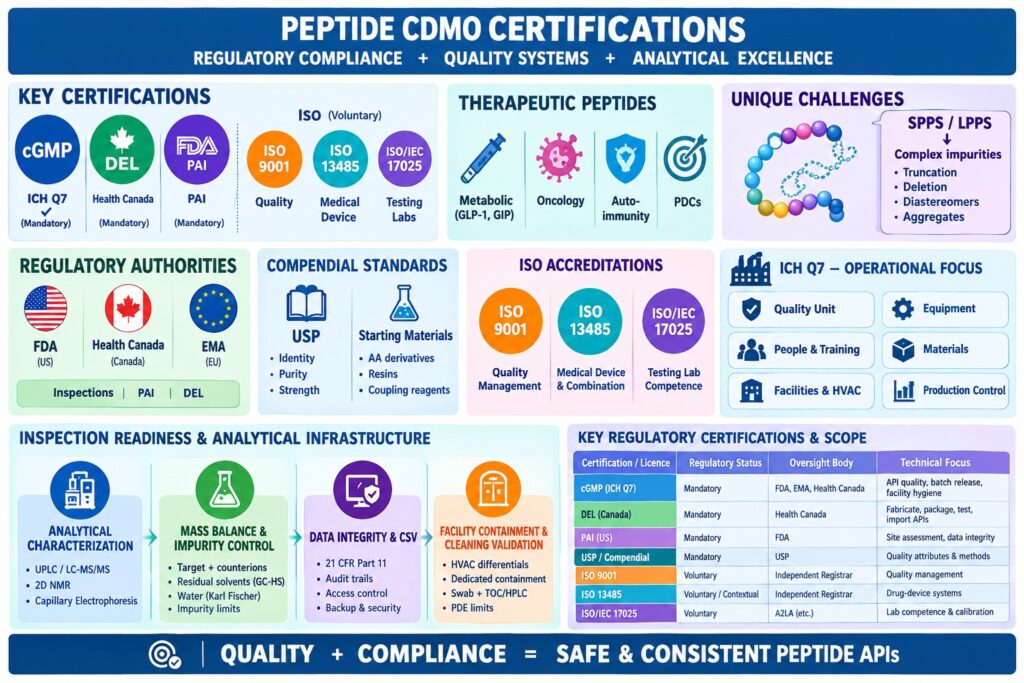
Essential Peptide CDMO Certifications encompass mandatory regulatory accreditations, including Current Good Manufacturing Practice (cGMP) compliance under ICH Q7 guidelines, Health Canada Drug Establishment Licences (DEL), and FDA Pre-Approval Inspection (PAI) readiness, together with voluntary quality management accreditations such as ISO 9001, ISO 13485, and ISO/IEC 17025. Collectively, these certifications and regulatory authorizations demonstrate that a contract development and manufacturing organization (CDMO) has established the quality governance systems, facility containment measures, and advanced analytical testing infrastructure necessary to manufacture complex synthetic and recombinant peptide active pharmaceutical ingredients (APIs) safely, consistently, and under controlled conditions.
The therapeutic peptide market is undergoing significant expansion, supported by advances in treatments for metabolic disorders, including GLP-1 and GIP receptor agonists, as well as applications in oncology, auto-immunity, and targeted peptide-drug conjugates (PDCs). However, synthetic peptides occupy a distinctive regulatory and chemical position between conventional small-molecule pharmaceuticals and biological macromolecules. These compounds are manufactured predominantly through Solid-Phase Peptide Synthesis (SPPS) or Liquid-Phase Peptide Synthesis (LPPS), both of which can generate highly complex impurity profiles. Such profiles may include truncation sequences, deletion peptides, diastereomers, and aggregation products, creating a need for specialized analytical control strategies. Consequently, selecting a qualified CDMO requires comprehensive due diligence covering regulatory inspection history, quality management systems (QMS), and compendial compliance to support product safety, efficacy, consistency, and successful regulatory approval.
Looking for a qualified partner for peptide development and manufacturing? Explore custom peptide synthesis services to support synthesis, scale-up, and development requirements.
Share via:
Quick Summary:
- Peptide CDMO certifications demonstrate regulatory compliance, quality governance, facility control, and analytical capabilities needed for safe and consistent peptide API manufacturing.
- cGMP and ICH Q7 form the core regulatory foundation, requiring independent Quality Unit oversight, validated processes, controlled facilities, trained personnel, equipment qualification, and strong material controls.
- Regulatory authorizations and inspections such as FDA Pre-Approval Inspections (PAI), Health Canada Drug Establishment Licences (DEL), and EU Qualified Person (QP) requirements verify manufacturing readiness, documentation, traceability, and data integrity.
- USP and compendial standards support control of peptide identity, purity, strength, sequence-related impurities, and starting-material quality using complementary techniques such as HPLC/UPLC, LC-MS/MS, and NMR.
- ISO certifications complement cGMP: ISO 9001 supports quality management, ISO 13485 applies to relevant drug-device combination systems, and ISO/IEC 17025 demonstrates testing-laboratory competence.
- Inspection readiness depends on strong analytical and quality infrastructure, including method validation, impurity and mass-balance assessment, computerized system validation, 21 CFR Part 11 controls, audit trails, HVAC containment, and cleaning validation.
- Overall, a qualified peptide CDMO should combine regulatory compliance, robust quality systems, advanced analytical testing, data integrity, and effective containment to support consistent peptide API quality and global regulatory expectations.
Primary Regulatory Baselines for Peptide CDMO Certifications: cGMP and ICH Q7
The fundamental requirement for Peptide CDMO Certifications is compliance with current Good Manufacturing Practice (cGMP) requirements that are closely aligned with International Council for Harmonisation (ICH) Q7 guidelines. This framework establishes requirements for independent Quality Unit oversight, comprehensive process validation, controlled manufacturing operations, and appropriate facility containment to ensure that synthetic peptide APIs consistently meet predefined purity, identity, and quality specifications.
An independent Quality Unit, incorporating Quality Assurance and Quality Control functions, is a central component of ICH Q7 compliance. This unit retains the authority to approve or reject raw materials, intermediates, reagents, and final peptide APIs. In synthetic peptide manufacturing, where repeated coupling and deprotection reactions can generate numerous process-related side-products, the Quality Unit is responsible for overseeing process validation, Out-of-Specification (OOS) investigations, and Product Quality Reviews (PQRs). In addition, SPPS manufacturing involves potent reagents, hazardous solvents such as dimethylformamide, N-methylpyrrolidone, and dichloromethane, as well as specialized cleavage cocktails containing trifluoroacetic acid. Therefore, ICH Q7 compliance requires stringent containment measures, equipment cleaning validation, and environmental monitoring to minimize the potential for cross-contamination within multi-product manufacturing facilities.
Need GMP-compliant peptide API manufacturing support? Learn about GMP peptide API manufacturing services for development and commercial manufacturing requirements.
| ICH Q7 Functional Domain | Peptide CDMO Operational Mandate | Technical Compliance Deliverables |
|---|---|---|
| Quality Management | Independent Quality Unit oversight of all synthetic, purification, and lyophilization steps. | Approved Master Batch Records (MBRs), annual PQRs, vendor qualification, and CAPA management. |
| Personnel & Hygiene | Qualified personnel trained in chemical hazard handling, SPPS automation, and cleanroom gowning. | Documented training matrices, hygiene compliance, and data integrity governance. |
| Buildings & Facilities | Environmental controls, air handling (HVAC), and dedicated containment for highly potent or sensitizing agents. | Facility qualification (IQ/OQ/PQ), differential pressure monitoring, and cleaning validation protocols. |
| Process Equipment | Chemical compatibility of synthesis reactors, preparative HPLC systems, and freeze-dryers. | Equipment cleaning validation, surface swab testing, maintenance, and calibration logs. |
| Materials Management | Qualification of amino acid derivatives, resin matrices, coupling reagents, and solvents. | Certificate of Analysis (CoA) verification, raw material identity testing, and quarantine controls. |
| Production Controls | Monitoring of coupling completeness, resin cleavage, preparative chromatographic purification, and freeze-drying. | In-process controls (IPCs), validated synthesis protocols, and automated process analytical technology (PAT). |
Critical Regulatory Authority Licences and Pre-Approval Inspections
A peptide CDMO must maintain the appropriate drug establishment authorizations and demonstrate readiness for rigorous on-site regulatory inspections, including FDA Pre-Approval Inspections (PAIs) and Health Canada inspections, when applicable to the intended market. These regulatory oversight mechanisms assess whether the facility’s physical infrastructure, batch documentation, manufacturing processes, and quality systems comply with the commitments established in the filed Chemistry, Manufacturing, and Controls (CMC) dossiers.
Preparing peptide CMC documentation for regulatory submission? Review peptide Drug Master File preparation support for structured technical and regulatory documentation requirements.
FDA Pre-Approval Inspections (PAI) and Audit Readiness
FDA Pre-Approval Inspections evaluate whether a peptide CDMO is capable of reproducibly manufacturing commercial-scale peptide APIs in accordance with the application’s CMC commitments and applicable cGMP requirements. During these inspections, investigators may examine raw chromatographic data, yield calculations, impurity-tracking records, laboratory documentation, and data integrity controls associated with automated synthesis and analytical systems. Important areas of evaluation include the CDMO’s ability to consistently control sequence-related impurities, maintain complete traceability of raw materials, and demonstrate reliable data integrity throughout electronic laboratory notebooks (ELN) and Chromatography Data Systems (CDS).
Health Canada Drug Establishment Licence (DEL) Compliance
A Health Canada Drug Establishment Licence (DEL) is a mandatory regulatory authorization under Division 1A of the Food and Drugs Regulations for facilities involved in fabricating, packaging, testing, or importing APIs for the Canadian market. The authorization demonstrates that the CDMO’s quality management system and physical manufacturing facilities satisfy applicable Canadian cGMP requirements. Health Canada may issue a DEL following an appropriate inspection or through recognition of relevant trusted mutual recognition evidence demonstrating compliance with Canadian Good Manufacturing Practice requirements.
EMA Compliance and Qualified Person (QP) Declaration Standards
Supplying synthetic peptide APIs to the European Union requires compliance with applicable requirements under EudraLex Volume 4 Part II and appropriate certification by a Qualified Person (QP). The QP is responsible for formally confirming that the relevant manufacturing and quality operations have been conducted under appropriate validated cGMP conditions, supported by facility assessments and batch release verification. Within the EU regulatory framework, QP declarations are supported by continuous supply chain oversight, validated analytical methods, and documented batch release procedures.
Compendial Quality Standards: Adherence to USP and USP
Adherence to United States Pharmacopeia chapters USP and USP establishes an important analytical testing framework for confirming the identity, purity, and strength of synthetic therapeutic peptides and their amino acid starting materials. These standards provide analytical expectations and methodologies that support the detection and quantification of sequence-related peptide impurities and other relevant quality attributes.
Need comprehensive characterization of peptide identity, purity, and impurities? Explore peptide analytical testing services for specialized analytical support.
USP : Quality Attributes of Synthetic Peptide Drug Substances
USP establishes critical quality attributes (CQAs) and analytical specifications used for evaluating synthetic peptide APIs, with particular emphasis on sequence confirmation and comprehensive impurity characterization. Synthetic peptide impurities can closely resemble the intended peptide in molecular weight and physicochemical characteristics, making reliance on a single analytical technique insufficient for comprehensive characterization. USP therefore supports the use of complementary analytical approaches, including high-performance liquid chromatography (HPLC/UPLC), mass spectrometry (LC-MS/MS), and nuclear magnetic resonance (NMR), to differentiate and characterize co-eluting truncation, deletion, insertion, and diastereomeric impurities.
USP : Quality Attributes of Starting Materials for Synthetic Peptides
USP establishes quality criteria for protected amino acid derivatives, functionalized resins, and coupling reagents used during chemical peptide synthesis to reduce the risk of impurity propagation into the final product. Impurities contained within starting amino acid derivatives, including D-amino acid enantiomers, unprotected amino acids, dipeptides, and beta-alanyl contaminants, can become incorporated into the peptide backbone during synthesis and subsequently contribute to the final impurity profile. CDMOs must therefore conduct rigorous incoming-material testing using validated chiral separation and chromatographic techniques to minimize the formation of non-target sequences.
Concerned about impurity formation and control throughout peptide manufacturing? Review impurity control strategies under ICH Q3A for additional guidance on impurity assessment and control.
ISO Accreditation Standards for Peptide CDMO Quality Management
Voluntary ISO accreditations complement statutory cGMP requirements by providing standardized frameworks for organization-wide quality management, risk control, analytical testing competence, and medical device integration. Important certifications and accreditations include ISO 9001 for quality governance, ISO 13485 for medical device and drug-device combination product quality systems, and ISO/IEC 17025 for demonstrating technical competence within testing laboratories.
ISO 9001 provides an internationally recognized framework for quality management and supports controlled operations across areas such as client project management, procurement, equipment maintenance, documentation, and continuous improvement. For peptide therapeutics administered through specialized auto-injector pens or micro-infusion pumps, ISO 13485 can provide a structured quality framework relevant to medical device components, including medical device risk management under ISO 14971 and applicable cleanroom assembly requirements. In addition, ISO/IEC 17025 accreditation demonstrates that a testing laboratory has established the technical competence and quality controls necessary to generate reliable, precise, and scientifically valid analytical data.
| Certification / Licence | Regulatory Status | Oversight Body | Technical Focus & Application Scope |
|---|---|---|---|
| cGMP (ICH Q7) | Mandatory | FDA, EMA, Health Canada, PMDA | API quality management, batch release, facility hygiene, and process validation. |
| Drug Establishment Licence (DEL) | Mandatory (Canada) | Health Canada | Authorization to fabricate, package, label, test, or import APIs in Canada. |
| Pre-Approval Inspection (PAI) | Mandatory (US/FDA) | US FDA | Commercial site assessment verifying application alignment and data integrity. |
| USP / | Compendial Standard | US Pharmacopeial Convention | Quality attributes for synthetic peptides and protected amino acid starting materials. |
| ISO 9001 | Voluntary | Independent Registrar | Enterprise-wide quality management system and continuous improvement framework. |
| ISO 13485 | Voluntary / Contextual | Independent Registrar | Quality systems for drug-device combination products, such as auto-injectors. |
| ISO/IEC 17025 | Voluntary | Accreditation Body (e.g., A2LA) | Technical competence of testing laboratories, method validation, and instrument calibration. |
Essential Inspection Readiness and Analytical Infrastructure
Maintaining continuous inspection readiness at a peptide manufacturing site requires an integrated digital quality system, fully validated analytical technologies, and demonstrated facility containment capabilities. Regulatory inspectors may conduct detailed assessments of raw chromatographic data, deviation management workflows, laboratory records, cleaning validation documentation, and computerized systems to establish whether the facility consistently operates within a state of documented control.
Want to strengthen the analytical component of your peptide program? Access specialized peptide analytical testing capabilities for characterization, impurity profiling, and method-related requirements.
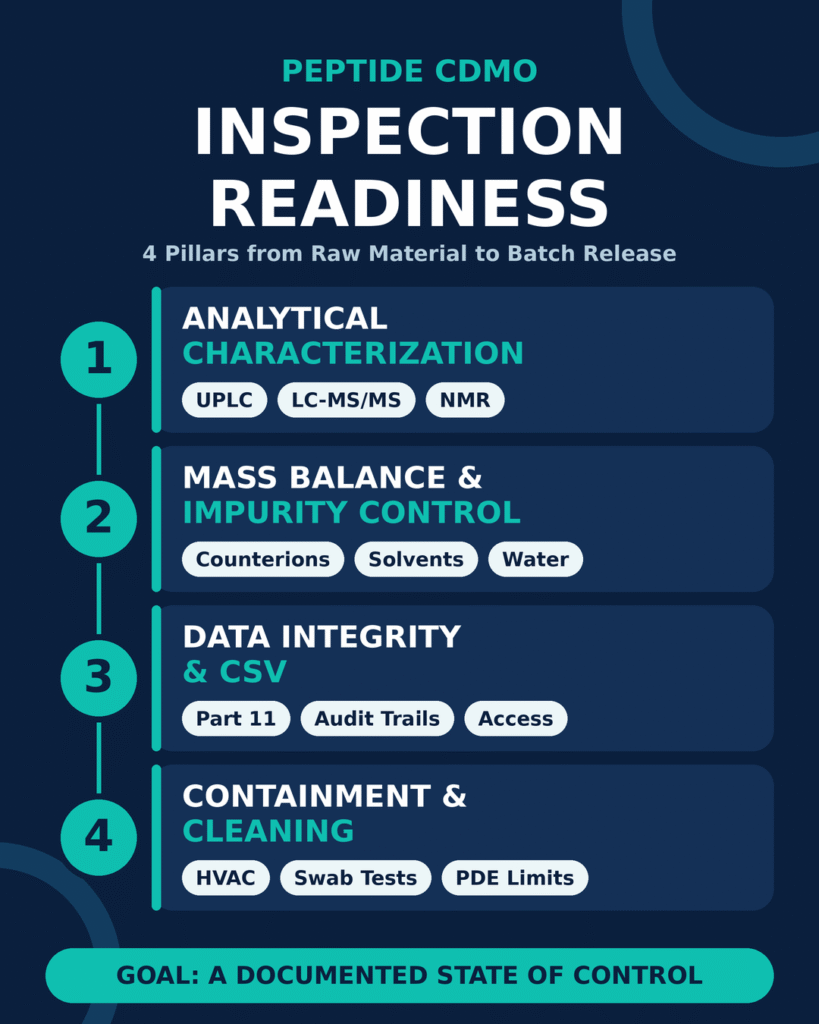
The operational transition from raw material qualification through final API batch release can be understood through four interconnected technical pillars:
- Analytical Characterization & Method Validation: High-resolution UPLC, LC-MS/MS, 2D NMR, and capillary electrophoresis are utilized to characterize complex peptide structures and their associated impurities. Analytical procedures must undergo appropriate validation in accordance with ICH Q2(R1) guidelines, covering parameters such as specificity, linearity, accuracy, precision, limit of detection (LOD), limit of quantitation (LOQ), and robustness.
- Mass Balance & Impurity Control: Comprehensive mass balance evaluations must account for target peptide content, counterions such as acetate and trifluoroacetate, residual solvents measured using GC-HS, water content determined through Karl Fischer analysis, and related impurities. The impurity profile should establish clearly defined acceptance criteria for specified identified impurities, specified unidentified impurities, and total impurities to support comprehensive control of product quality.
- Data Integrity & Computerized System Validation (CSV): Compliance with 21 CFR Part 11 and applicable Health Canada electronic record requirements is essential for computerized manufacturing and analytical systems. Automated synthesizers, LIMS, and Chromatography Data Systems should incorporate secure, computer-generated, time-stamped audit trails, appropriate multi-level access controls, and robust backup governance. These controls help ensure that electronic records remain attributable, traceable, secure, and reliable throughout the product lifecycle.
- Facility Containment & Cleaning Validation: HVAC pressure differentials and dedicated containment systems must be appropriately implemented to minimize the potential for cross-contamination during synthesis, purification, and other manufacturing activities. Cleaning validation protocols should incorporate suitable swabbing approaches and TOC/HPLC testing to demonstrate that residue carryover remains within established limits, including applicable Permitted Daily Exposure (PDE) limits.
Evaluating a peptide injectable manufacturing program? Review sterile fill-finish services for peptide injectables to understand the manufacturing considerations beyond API production.
Conclusion
Partnering with an organization possessing verified Peptide CDMO Certifications helps ensure that a therapeutic development program is supported by applicable global regulatory expectations, statutory cGMP requirements, and relevant compendial quality standards. Alignment with ICH Q7 guidelines, active drug establishment authorizations such as a Health Canada Drug Establishment Licence (DEL), readiness for FDA Pre-Approval Inspections, and compliance with USP and USP collectively demonstrate important aspects of a facility’s technical and operational preparedness. In addition, advanced analytical capabilities, including LC-MS/MS mass balance assessment, UPLC purity determination, and NMR structural verification, provide essential tools for supporting batch consistency, characterization, and product safety.
Planning the transition from development to commercial-scale peptide production? Review GLP-1 analog scale-up considerations for development-to-GMP manufacturing considerations.
Developing and maintaining a robust analytical control strategy requires experienced scientific oversight, reliable data integrity practices, and consistent adherence to applicable regulatory standards throughout every stage of peptide synthesis, purification, characterization, and testing. Biopharmaceutical organizations requiring specialized analytical characterization, method validation, or regulatory compliance support can work with qualified technical experts to address the specific requirements of their peptide programs.
Looking for integrated peptide development, manufacturing, and regulatory support in North America? Explore North American peptide CDMO services to discuss your program requirements.
To discuss your specific peptide characterization, analytical testing, or regulatory compliance requirements, connect with the technical team at ResolveMass Laboratories Contact Page.
Frequently Asked Questions (FAQs)
ICH Q7 provides an internationally harmonized framework for Good Manufacturing Practice requirements applicable to active pharmaceutical ingredient manufacturing. In peptide production, it addresses quality management, personnel, facilities, equipment, documentation, materials, and process controls. The guideline supports controlled execution of Solid-Phase Peptide Synthesis (SPPS), Liquid-Phase Peptide Synthesis (LPPS), purification, lyophilization, and Quality Unit activities.
USP provides quality and analytical considerations for synthetic peptide drug substances, including the evaluation of identity, purity, and related impurities. USP addresses quality requirements associated with starting materials used in synthetic peptide manufacturing, such as protected amino acid derivatives. Together, these standards support control of sequence-related impurities, chiral contaminants, and other quality attributes across the manufacturing process.
An FDA Pre-Approval Inspection (PAI) may be conducted when a marketing application identifies a manufacturing or testing facility that requires regulatory assessment before approval. The inspection evaluates whether the peptide CDMO can consistently manufacture the API according to the submitted Chemistry, Manufacturing, and Controls (CMC) information. Investigators may also assess cGMP compliance, manufacturing records, analytical data, and data integrity controls.
A Health Canada Drug Establishment Licence (DEL) is a regulatory authorization required for establishments conducting specified activities involving drugs in Canada. Depending on the licensed activities, these may include fabrication, packaging, labelling, testing, or importing. The DEL framework helps confirm that the establishment maintains appropriate facilities, personnel, procedures, and quality systems consistent with applicable Canadian cGMP requirements.
CDMOs establish scientifically justified health-based limits, including Permitted Daily Exposure (PDE) or Acceptable Daily Exposure (ADE), to control potential residue carryover between products. Cleaning validation may involve representative surface swab and rinse samples collected from product-contact equipment. Validated HPLC or Total Organic Carbon (TOC) methods are then used to demonstrate that residues remain within established acceptance limits before subsequent manufacturing operations.
Peptide API release testing commonly incorporates HPLC or UPLC for assay, purity, and related-substance evaluation, while LC-MS/MS can support molecular and sequence-related characterization. GC-HS may be used to determine residual solvents, and Karl Fischer titration can assess water content. Depending on the product and specification, testing may also include counterion determination, endotoxin, bioburden, and appearance.
Control begins with appropriate specifications and qualification of starting materials, followed by optimization of peptide synthesis conditions to minimize incomplete coupling and related sequence impurities. Preparative HPLC can then separate target peptides from closely related impurities generated during synthesis. Validated analytical HPLC and LC-MS methods are used by Quality Control laboratories to identify, quantify, and monitor impurities against established specifications.
An EMA Qualified Person (QP) is responsible for certifying that applicable batches meet the relevant regulatory and quality requirements before release within the European framework. The QP reviews manufacturing and testing documentation, including batch records, analytical results, deviations, and relevant quality information. The review provides documented assurance that the batch has been manufactured and tested in accordance with applicable cGMP requirements and the approved regulatory framework.
Data integrity is a fundamental component of regulatory compliance because manufacturing and analytical decisions must be supported by complete, accurate, and traceable records. Regulators may examine audit trails, electronic records, laboratory data, and practices such as repeat testing during inspections. Peptide CDMOs should therefore maintain validated computerized systems and apply ALCOA+ principles, including data that are Attributable, Legible, Contemporaneous, Original, and Accurate.
Reference:
- McCarthy, D., Han, Y., Carrick, K., Schmidt, D., Workman, W., Matejtschuk, P., Duru, C., & Atouf, F. (2023). Reference standards to support quality of synthetic peptide therapeutics. Pharmaceutical Research, 40(6), 1317–1328. https://doi.org/10.1007/s11095-023-03493-1
- International Conference on Harmonisation of Technical Requirements for Registration of Pharmaceuticals for Human Use. (2015, June 10). ICH Q7 guideline: Good manufacturing practice guide for active pharmaceutical ingredients: Questions and answers. https://database.ich.org/sites/default/files/Q7%20Q%26As%20Questions%20%26%20Answers.pdf
- United States Pharmacopeia. (n.d.). Peptide standards. U.S. Pharmacopeia. PDF source
- Health Canada. (n.d.). Drug establishment licences. Government of Canada. Health Canada source
- United States Pharmacopeia. (n.d.). Reference standards to support quality of synthetic peptide therapeutics. U.S. Pharmacopeia. USP source
Get In Touch With Us
About The Author


