

Introduction:
A Peptide CDMO is a Contract Development and Manufacturing Organization that provides specialized development, analytical, process, and manufacturing services for peptide-based pharmaceutical products. Unlike a general-purpose pharmaceutical outsourcing organization, a peptide-focused partner requires expertise in peptide chemistry, purification, impurity characterization, structural confirmation, analytical method development, and peptide-specific quality considerations.
Peptides occupy an important position between traditional small-molecule drugs and larger biological molecules. Their development can therefore require a combination of synthetic chemistry, analytical chemistry, mass spectrometry, chromatography, structural characterization, and pharmaceutical development expertise.
For pharmaceutical and biotechnology companies, working with a qualified Peptide CDMO can reduce the need to build every specialized capability internally while providing access to experienced scientists, analytical platforms, development infrastructure, and project-specific technical knowledge.
Summary:
- A Peptide CDMO is a Contract Development and Manufacturing Organization that supports peptide drug development, analytical characterization, process development, manufacturing, and scale-up.
- Peptide development requires specialized expertise because peptides can present challenges involving sequence-related impurities, stereochemistry, aggregation, oxidation, deamidation, degradation, and structural characterization.
- Typical Peptide CDMO services can include peptide synthesis, purification, analytical method development, peptide characterization, impurity profiling, stability studies, scale-up, and regulatory-supporting documentation.
- Analytical technologies such as LC-MS/MS, HRMS, RP-HPLC, NMR, peptide mapping, and orthogonal chromatography can be important for establishing peptide identity, purity, impurities, and structural attributes.
- A Peptide CDMO differs from a traditional small-molecule CDMO because peptide projects require specialized synthesis strategies, impurity characterization, sequence confirmation, and structural assessment.
- Regulatory expectations for generic peptide development continue to evolve, making current product-specific regulatory guidance important when planning a development program.
- ResolveMass Laboratories Inc. supports peptide projects through specialized analytical characterization, mass spectrometry, peptide sequencing, impurity profiling, and related research services.
1: What Does a Peptide CDMO Do?
A Peptide CDMO typically supports one or more stages of the peptide development lifecycle, from early research through process development, analytical characterization, scale-up, and manufacturing.
Depending on the organization and project scope, services may include:
- Peptide route and process development
- Solid-phase peptide synthesis (SPPS)
- Solution-phase or hybrid synthesis approaches
- Peptide purification
- Preparative chromatography
- Analytical method development
- Peptide identity and purity testing
- LC-MS and LC-MS/MS analysis
- High-resolution mass spectrometry (HRMS)
- Peptide sequencing
- Impurity identification and characterization
- Peptide mapping
- Structural characterization
- Stability and degradation studies
- Scale-up, process optimization, and technology transfer from an innovator or originator site
- Technology transfer
- Documentation and CMC support
The exact service portfolio varies between providers. Therefore, companies should evaluate whether a prospective CDMO has the specific chemistry, analytical, quality, and regulatory capabilities required for their peptide.
2: Key Capabilities of a Peptide CDMO
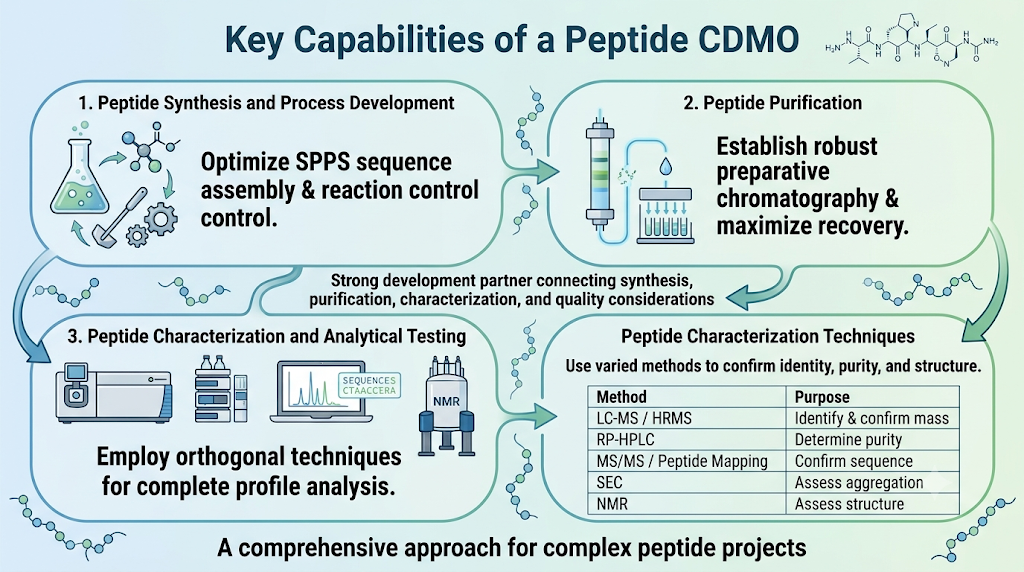
The most important capabilities of a Peptide CDMO extend beyond simply producing a peptide. A strong development partner should be able to connect synthesis, purification, characterization, analytical testing, process understanding, and quality considerations.
1. Peptide Synthesis and Process Development
Peptide synthesis involves assembling amino acids in the required sequence while controlling side reactions and protecting-group chemistry.
For synthetic peptides, solid-phase peptide synthesis (SPPS) is widely used, although the appropriate synthetic strategy depends on peptide size, sequence, chemistry, scale, and product requirements.
Critical development considerations may include:
- Amino-acid sequence
- Protecting-group strategy
- Coupling efficiency
- Reaction completeness
- Racemization control
- Side-reaction management
- Cleavage and deprotection
- Crude peptide profile
- Purification strategy
- Process scalability
A peptide process that works at laboratory scale may require significant optimization before it can be transferred to larger-scale manufacturing.
2. Peptide Purification
Purification is a critical part of peptide development because crude synthesis mixtures can contain closely related impurities that may be chemically similar to the desired peptide.
Preparative reverse-phase chromatography is commonly used for peptide purification. Process development may focus on optimizing:
- Mobile-phase composition
- Gradient conditions
- Column selection
- Loading capacity
- Resolution
- Recovery
- Product concentration
- Solvent consumption
The goal is not simply to achieve high purity but to establish a robust and scalable purification process that consistently delivers the required quality.
3. Peptide Characterization and Analytical Testing
Analytical characterization is one of the most important capabilities to evaluate when selecting a Peptide CDMO. Peptide identity and purity should be supported by appropriate analytical evidence rather than relying on a single analytical technique.
Analytical characterization can include:
- Identity testing
- Purity determination
- Molecular-mass determination
- Related-substance profiling
- Sequence confirmation
- Peptide mapping
- Structural characterization
- Impurity identification
- Degradation-product characterization
- Stability-indicating analysis
A combination of orthogonal analytical techniques can provide a stronger understanding of a peptide than any single method.
Peptide Characterization Techniques
Common techniques used in peptide characterization include:
| Analytical Area | Common Techniques | Purpose |
|---|---|---|
| Identity | LC-MS, HRMS, MS/MS | Molecular confirmation |
| Purity | RP-HPLC, LC-MS | Quantification of related substances |
| Sequence | MS/MS, peptide mapping | Sequence confirmation |
| Molecular mass | HRMS | Accurate mass determination |
| Structure | NMR, MS/MS | Structural assessment |
| Impurities | LC-MS/MS, HRMS, chromatography | Identification and characterization |
| Aggregation | SEC and related techniques | Assessment of higher molecular species |
| Stability | HPLC, LC-MS, MS/MS | Monitoring degradation |
For complex peptide projects, analytical data needs to demonstrate that the intended molecule has the correct molecular mass, sequence, purity profile, and relevant structural attributes — a scope of work closely tied to bioanalytical method development and validation at a CDMO.
Formulation and Fill-Finish
Peptides are prone to aggregation, oxidation, and deamidation, so formulation development usually focuses on pH optimization, buffer selection, and stabilizing excipients to protect the molecule through manufacturing, shipping, and shelf life. Fill-finish and packaging decisions also depend on appropriate container closure system selection and qualification to confirm compatibility with the peptide formulation. For long-acting peptide products, formulation work may extend into depot or sustained-release systems, such as PLGA-based microspheres or implants, which introduce additional polymer characterization requirements.
3: Why Is Mass Spectrometry Important for a Peptide CDMO?
Mass spectrometry is particularly valuable for peptide projects because it can provide molecular-mass information and help investigate sequence-related and chemical modifications that may not be fully resolved by chromatography alone.
LC-MS/MS and HRMS can complement chromatographic methods by helping identify peptide-related impurities, confirm molecular mass, investigate modifications, and support sequence characterization.
Potential applications include:
- Molecular-weight confirmation
- Sequence verification
- Oxidation identification
- Deamidation assessment
- Deletion-sequence impurity characterization
- Truncation-product investigation
- Modification-site identification
- Unknown impurity investigation
- Peptide mapping
- Comparative characterization
For example, LC-MS/MS fragmentation can provide sequence information by producing characteristic fragment ions. HRMS can provide accurate-mass measurements that can help distinguish possible molecular compositions.
This combination is especially useful when investigating unknown or low-level peptide-related impurities.
4: Peptide CDMO vs. Small-Molecule CDMO: What Is the Difference?
A Peptide CDMO and a small-molecule CDMO can both provide synthesis, process development, analytical testing, and manufacturing support, but the scientific challenges and analytical requirements can be substantially different.
| Factor | Peptide CDMO | Small-Molecule CDMO |
|---|---|---|
| Molecular type | Chains of amino acids | Organic chemical molecules |
| Typical synthesis | SPPS, solution-phase or hybrid approaches | Organic synthesis |
| Key impurities | Sequence variants, deletion products, truncations, oxidation, deamidation, stereochemical impurities | Starting materials, intermediates, reaction by-products, degradation products |
| Purification | Often chromatography-intensive | Crystallization, extraction, chromatography and other techniques |
| Characterization | LC-MS/MS, HRMS, peptide mapping, HPLC, NMR | LC-MS, GC-MS, NMR, HPLC, GC and other techniques |
| Structural complexity | Sequence and conformation can be important | Structure and stereochemistry are important |
| Analytical challenge | Closely related peptide impurities can be difficult to resolve | Chemical impurities require targeted analytical strategies |
| Process considerations | Coupling efficiency, aggregation, purification recovery | Reaction yield, selectivity, impurity control, crystallization |
| Regulatory considerations | May involve peptide-specific characterization requirements | Depends on drug substance and product |
| Specialized expertise | Peptide chemistry + advanced analytical characterization | Synthetic organic chemistry + pharmaceutical process development |
The distinction is important because experience with conventional small-molecule chemistry does not automatically translate into expertise in complex peptide analytical characterization.
5: What Are the Main Peptide CDMO Services?
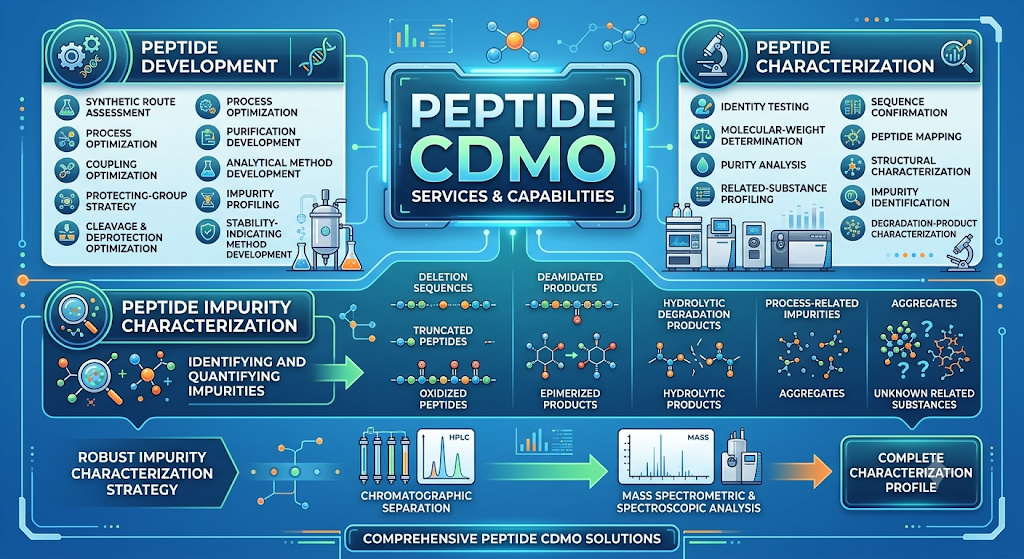
A comprehensive Peptide CDMO service portfolio can cover several stages of development.
Peptide Development
Development services may include:
- Synthetic route assessment
- Process optimization
- Coupling optimization
- Protecting-group strategy
- Cleavage and deprotection optimization
- Purification development
- Analytical method development
- Impurity profiling
- Stability-indicating method development
Peptide Characterization
Characterization may involve:
- Identity testing
- Molecular-weight determination
- Purity analysis
- Related-substance profiling
- Sequence confirmation
- Peptide mapping
- Structural characterization
- Impurity identification
- Degradation-product characterization
Peptide Impurity Characterization
Peptide impurities can originate from multiple stages of synthesis, purification, storage, and handling.
Potential impurity categories include:
- Deletion sequences
- Truncated peptides
- Oxidized peptides
- Deamidated products
- Epimerized products
- Hydrolytic degradation products
- Process-related impurities
- Aggregates
- Unknown related substances
A robust impurity-characterization strategy can combine chromatographic separation with mass spectrometric and spectroscopic information.
6: Stability and Degradation Studies
Peptides can undergo chemical and physical changes during storage and processing. Depending on the molecule, studies may investigate oxidation, deamidation, hydrolysis, aggregation, or other degradation mechanisms.
A scientifically designed stability program can help identify degradation pathways and establish appropriate analytical controls.
Important considerations can include:
- Temperature
- Humidity where applicable
- Light exposure
- pH
- Buffer composition
- Container-closure system
- Storage duration
- Freeze-thaw exposure
- Oxidative conditions
Analytical testing at appropriate intervals helps establish the degradation profile of the peptide and supports dissolution or release-testing strategies for related generic oral solid dosage forms when a peptide program includes an oral or combination component.
7: Technology Transfer and Scale-Up
Moving from laboratory development to larger-scale production introduces additional challenges. Mixing, mass transfer, reaction kinetics, purification loading, solvent consumption, equipment configuration, and process reproducibility can all influence performance.
A suitable Peptide CDMO should therefore demonstrate a controlled approach to:
- Process definition
- Scale-up assessment
- Risk identification
- Analytical comparability
- Technology transfer
- Process verification
- Change control
This is especially relevant for peptide technology transfer to a CDMO from an innovator site, where technology transfer should include sufficiently detailed process and analytical information to allow the receiving site to reproduce the intended process and quality attributes. Sponsors moving a broader generic program should also review outsourcing your first generic drug project to a CDMO for the operational considerations that apply alongside peptide-specific transfer requirements.
Technology transfer should include sufficiently detailed process and analytical information to allow the receiving site to reproduce the intended process and quality attributes.
8: What Regulatory Considerations Apply to Peptide CDMO Projects?
Regulatory expectations depend on the type of peptide, development stage, manufacturing route, jurisdiction, and intended application.
Analytical procedures used for pharmaceutical development and registration should be scientifically appropriate and fit for purpose.
Relevant considerations can include:
- Identity
- Assay
- Purity
- Related substances
- Process-related impurities
- Degradation products
- Structural characterization
- Biological activity or potency, where applicable
- Stability
- Analytical procedure validation
- Reference standards
- Specifications
For analytical procedures, ICH Q2(R2) provides a framework for validation characteristics such as specificity/selectivity, accuracy, precision, and other performance characteristics according to the analytical procedure’s intended purpose.
Regulatory Considerations for Generic Peptides
Generic peptide development requires careful attention to current regulatory expectations.
FDA has published product-specific guidances for certain generic peptide products addressing scientific considerations relevant to demonstrating pharmaceutical equivalence, and these programs often begin with reference listed drug (RLD) sourcing and reverse engineering to establish a baseline characterization profile.
Because regulatory guidance can change, companies should verify the current guidance applicable to the specific peptide, dosage form, route of administration, and development pathway before finalizing their analytical strategy.
For a generic peptide program, a CDMO or analytical laboratory should therefore be able to work within a development strategy that connects analytical characterization with the applicable regulatory requirements.
Sponsors planning submissions outside North America should also account for CDMO support for EU generic drug registrations, since analytical and documentation expectations can differ from FDA and Health Canada pathways. For complex generic injectable peptide programs specifically, reviewing CDMO capabilities for generic injectable ANDA submissions can help sponsors map out the full analytical and CMC scope expected by reviewers. For a generic peptide program, a CDMO or analytical laboratory should be able to work within a development strategy that connects analytical characterization with the applicable regulatory requirements.
9: How Should You Choose a Peptide CDMO?
The best Peptide CDMO is not necessarily the organization offering the largest manufacturing capacity. The appropriate partner should match the project’s scientific, analytical, quality, regulatory, and scalability requirements.
Before selecting a provider, consider the following:
Scientific Expertise
Ask whether the organization has demonstrated experience with peptide chemistry and peptide-specific analytical challenges.
Analytical Infrastructure
Determine whether the provider has appropriate access to:
- LC-MS/MS
- HRMS
- RP-HPLC
- NMR
- Peptide mapping
- Chromatographic techniques
- Stability-indicating analytical methods
Impurity Characterization
A strong provider should be capable of investigating unknown peaks and characterizing peptide-related impurities rather than simply reporting chromatographic purity.
Method Development
Evaluate whether the laboratory can develop or optimize methods specifically for your peptide rather than relying exclusively on generic methods.
Data Quality and Documentation
Reliable analytical projects require appropriate documentation, traceability, controlled data handling, clear reporting, and scientifically justified conclusions.
Regulatory Awareness
The provider should understand the analytical expectations relevant to the intended development pathway and market.
Communication
Clear technical communication is essential when interpreting complex analytical results, especially during impurity investigations, method development, and troubleshooting.
10: Why Choose ResolveMass Laboratories for Peptide Analytical Projects?
ResolveMass Laboratories Inc. brings together analytical chemistry, mass spectrometry, custom synthesis, polymer science, and pharmaceutical research capabilities.
For peptide programs, ResolveMass supports specialized analytical activities involving:
- LC-MS/MS
- High-resolution mass spectrometry
- HPLC
- Peptide sequencing
- Peptide mapping
- NMR
- Impurity characterization
- Structural characterization
- Stability-related investigations
- Analytical method development
ResolveMass’s peptide-focused analytical capabilities can help pharmaceutical and biotechnology teams investigate peptide identity, purity, molecular mass, sequence, related substances, and structural characteristics.
The company’s multidisciplinary approach is particularly relevant when a peptide project requires more than routine purity testing and needs advanced analytical investigation.
For example, LC-MS/MS can be used to investigate peptide fragmentation and sequence information, while HRMS can provide accurate-mass information for molecular and impurity characterization. HPLC can establish chromatographic purity and monitor related substances, while NMR may provide complementary structural information where appropriate.
Importantly, the exact analytical package should be selected according to the peptide, project objective, development stage, and applicable regulatory requirements.
Conclusion:
A Peptide CDMO provides specialized scientific and development capabilities that go beyond conventional pharmaceutical outsourcing. Successful peptide development requires integration of synthesis, purification, analytical characterization, impurity profiling, structural assessment, stability understanding, process development, and an appropriate regulatory strategy.
For companies developing innovative or generic peptides, choosing a partner with strong analytical depth can be particularly valuable because peptide quality cannot always be demonstrated through a single assay or chromatographic method.
Combining complementary techniques such as LC-MS/MS, HRMS, HPLC, peptide mapping, and NMR can provide a more comprehensive understanding of peptide identity, purity, structure, and impurities.
With its analytical chemistry and mass spectrometry capabilities, ResolveMass Laboratories Inc. can support organizations with peptide sequencing, peptide characterization, impurity investigations, and related pharmaceutical analytical research requirements.
Frequently Asked Questions:
A Peptide CDMO provides both development and manufacturing support for peptide products, while a CMO traditionally focuses primarily on manufacturing.
A Peptide CDMO may support peptide synthesis, purification, analytical method development, characterization, and process optimization.
It can become involved from early development through scale-up and manufacturing.
A CMO may receive an already-established process and focus mainly on production.
For complex peptide projects, a CDMO can therefore provide broader technical and development support.
Peptide impurities can be structurally very similar to the desired peptide, making them difficult to separate and identify.
Common impurities include deletion sequences, truncated peptides, oxidation products, deamidation products, and stereochemical variants.
Some impurities may have similar chromatographic retention characteristics to the target peptide.
Techniques such as LC-MS/MS, HRMS, peptide mapping, HPLC, and NMR can provide complementary information.
Using orthogonal analytical techniques can improve confidence in impurity identification and characterization.
Yes, Peptide CDMO services can support generic peptide development by providing synthesis, analytical characterization, impurity profiling, method development, and process-development expertise.
A specialized partner can help establish the identity, purity, molecular mass, sequence, and relevant quality attributes of the peptide.
Advanced analytical techniques can also support investigation of peptide-related impurities and degradation products.
The specific analytical and development requirements depend on the product and regulatory pathway.
Companies should always evaluate the current applicable regulatory guidance for their specific generic peptide product.
When selecting a Peptide CDMO, evaluate its experience with peptide chemistry, purification, analytical characterization, and process development.
Check whether it has access to advanced technologies such as LC-MS/MS, HRMS, HPLC, peptide mapping, and NMR.
Experience with peptide impurity identification and characterization is particularly important for complex projects.
Also assess documentation, data integrity, quality systems, communication, scalability, and technology-transfer capabilities.
The ideal partner should match its technical capabilities to your molecule, development stage, and project objectives.
Peptide impurity profiling is the systematic detection, assessment, identification, and characterization of impurities associated with a peptide drug substance or product.
It can include process-related impurities, deletion sequences, truncated peptides, oxidation products, deamidation products, and degradation products.
Chromatographic techniques such as RP-HPLC can help separate related substances.
LC-MS/MS and HRMS can then provide molecular-mass and structural information for further investigation.
A comprehensive impurity profile helps researchers understand product quality and potential degradation pathways.
High-resolution mass spectrometry (HRMS) provides accurate molecular-mass measurements that are valuable for peptide identity and impurity characterization.
It can help distinguish the expected peptide from closely related molecular species based on accurate mass.
HRMS can also support investigation of modifications such as oxidation, deamidation, truncation, and other peptide-related changes.
When combined with LC separation and MS/MS fragmentation, it can provide additional information about peptide sequence and structural modifications.
This makes HRMS a powerful complementary technique within a comprehensive peptide characterization strategy.
Reference
- Krueger J, Dieskau AP, Hassfeld J, Gries J, Block O, Weinmann H, Kaufmann D, Hildbrand S, Kraft V, Moeckel R, Dehli JR. Chemical process development in the pharmaceutical industry in Europe—Insights and perspectives from industry scientists. Angewandte Chemie. 2025 May;137(19):e202420719.https://onlinelibrary.wiley.com/doi/abs/10.1002/ange.202420719
- Barry CS. The Role of Contract Manufacturing in Antibody–Drug Conjugate (ADC) Drug Substance Development–Strategies for Successful Engagement. AAPS PharmSciTech. 2026 Jul 9;27(5):255.https://link.springer.com/article/10.1208/s12249-026-03466-8
- Sengoku S, Kawata Y. Sustainability considerations and research in the biopharmaceutical industry. InSustainability in the Manufacturing of Pharmaceuticals 2025 Jan 1 (pp. 259-279). Academic Press.https://www.sciencedirect.com/science/chapter/edited-volume/pii/B9780443289217000026
- Kurata H, Ishino T, Ohshima Y, Yohda M. CDMOs play a critical role in the biopharmaceutical ecosystem. Frontiers in bioengineering and biotechnology. 2022 Mar 21;10:841420.https://www.frontiersin.org/journals/bioengineering-and-biotechnology/articles/10.3389/fbioe.2022.841420/full
- Mayer K. CDMOs Forge Links to Next-Gen Antibody Conjugates: To offer even more comprehensive ADC capabilities, CDMOs are pioneering site-specific linker technologies, broadening their payload options, and preparing for indications beyond oncology. Genetic Engineering & Biotechnology News. 2020 Dec 1;40(12):24-8.https://journals.sagepub.com/doi/abs/10.1089/gen.40.12.08
About the Author


