
Introduction
Understanding the peptide characterization timeline is essential for pharmaceutical companies preparing an Investigational New Drug (IND) application or an Abbreviated New Drug Application (ANDA). Peptide characterization provides the analytical evidence on a peptide’s identity, structure, purity, and impurities that supports product quality and regulatory decisions. How long it takes varies considerably with the peptide’s molecular characteristics, the analytical questions being addressed, and the stage of development.
Sponsors often budget weeks for work that takes months, then discover the gap when a submission date is already fixed. A delay in analytical characterization can ripple into formulation development, manufacturing decisions, stability studies, and submission readiness. A well-planned analytical strategy, by contrast, surfaces problems early and prevents avoidable rework.
ResolveMass Laboratories Inc. supports pharmaceutical analytical needs through mass spectrometry-based characterization and related investigations, using high-resolution mass spectrometry and orthogonal methods. This guide explains how long each pathway typically takes, what drives the schedule, and how to shorten it without cutting scientific corners. Knowing these variables helps you plan realistic timelines and choose the right analytical approach.
Summary:
- IND (Phase 1): a realistic peptide characterization timeline is about 6 to 12 weeks, because early-phase CMC focuses on identity, purity, and basic structure.
- ANDA: expect roughly 4 to 9 months, since the generic must show sameness to the reference product, including impurity and immunogenicity risk assessment.
- Biggest drivers of delay: reference-product sourcing, method development for complex or modified peptides, impurity identification, and re-testing after unexpected findings.
- Biggest time savers: early FDA engagement, a pre-defined characterization plan, orthogonal methods run in parallel, and one lab handling every analytical workstream.
- Important: these durations are indicative planning ranges, not guarantees. Your molecule, sample availability, and regulatory strategy decide the real schedule.
The peptide characterization timeline is one of the most underestimated items in a regulatory plan. Sponsors often budget weeks for work that takes months, then discover the gap when a submission date is already fixed. Whether you are preparing an Investigational New Drug (IND) application for a first-in-human study or an Abbreviated New Drug Application (ANDA) for a generic peptide, the analytical package must be complete, defensible, and ready before the filing clock starts.
This guide explains how long each pathway typically takes, what drives the schedule, and how to shorten it without cutting scientific corners. It is written from the perspective of an analytical laboratory that supports peptide, biosimilar, and complex-drug programs using high-resolution mass spectrometry and orthogonal characterization methods.
A delay in analytical characterization can ripple into formulation development, manufacturing decisions, stability studies, and submission readiness. A well-planned analytical strategy, by contrast, surfaces problems early and prevents avoidable rework.
1: What Is the Typical Peptide Characterization Timeline for an ANDA or IND?
A typical peptide characterization timeline is 6 to 12 weeks for an early-phase IND and 4 to 9 months for an ANDA. The IND package needs to show the peptide is what you say it is and is pure enough for human dosing. The ANDA package must go further and prove the generic is the same as the reference listed drug (RLD), with its impurities understood.
| Factor | IND (early phase) | ANDA (generic peptide) |
|---|---|---|
| Typical duration | 6 to 12 weeks | 4 to 9 months |
| Core question | Is the peptide correctly identified and sufficiently pure and stable for clinical use? | Is the generic the same as the RLD, and are any new impurities safe? |
| Reference product needed | No | Yes, multiple lots |
| Impurity depth | Identify and control significant impurities | Identify and assess peptide-related impurities and justify differences from the RLD |
| Immunogenicity work | Usually limited at this stage | Often required for new or higher impurities |
These ranges assume samples arrive on time and the molecule is a standard linear or cyclic peptide. Modified peptides, such as lipidated, PEGylated, or multi-disulfide molecules, sit toward the longer end.
Planning Estimates by Characterization Activity
| Characterization activity | Indicative planning estimate |
|---|---|
| Initial analytical assessment and project scoping | 2 to 5 business days |
| Basic identity and molecular mass confirmation | 1 to 3 weeks |
| Chromatographic purity and impurity profiling | 1 to 3 weeks |
| Peptide mapping and sequence confirmation | 2 to 4 weeks |
| Detailed impurity identification and structural investigation | 3 to 8 weeks or longer |
| Integrated characterization and technical reporting | 1 to 3 weeks |
| Comprehensive characterization program | About 4 to 12 weeks or longer |
These estimates are indicative, not universal turnaround times. Activities overlap, and a project needing only mass confirmation can finish far sooner than one needing extensive impurity identification and orthogonal structural evidence.
It also helps to separate analytical turnaround from total regulatory readiness. Characterization is only one part of a broader program that may include method validation or qualification, stability testing, and manufacturing documentation.
2: What Does Peptide Characterization Include?
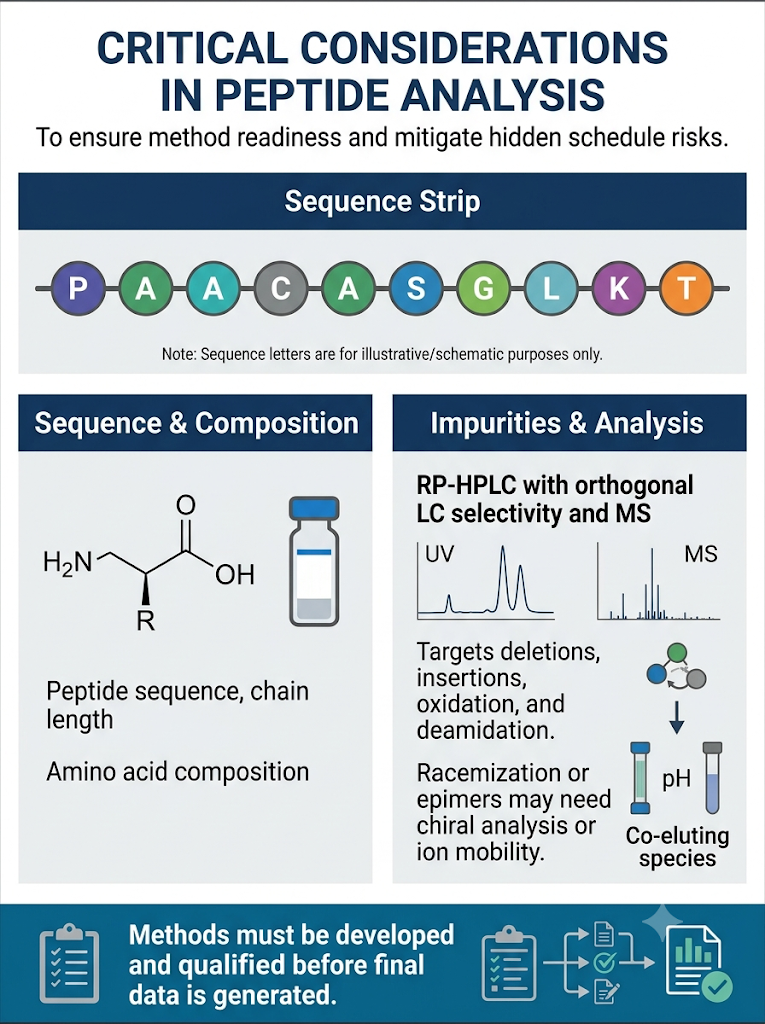
Peptide characterization is the full analytical description of a peptide’s identity, structure, purity, impurities, and biological relevance. Each element adds time, and several can run in parallel.
- Primary structure: intact mass, peptide mapping, and MS/MS sequence confirmation.
- Composition: amino acid analysis and net peptide content.
- Purity and impurities: orthogonal chromatography (RP-HPLC and alternatives) coupled with high-resolution mass spectrometry to find deletion, insertion, oxidation, deamidation, and racemization variants.
- Higher-order structure: circular dichroism, FTIR, or NMR, depending on the peptide.
- Physicochemical properties: counter-ion content, water content, aggregation, and solubility behavior.
- Biological activity: a relevant potency or binding assay where the program requires it.
The sequence matters. Methods must be developed and qualified before the final data set can be generated, which is why method readiness is often the first hidden schedule risk.
3: Which Analytical Techniques Influence the Peptide Characterization Timeline?
The techniques you select decide what evidence you get and how much follow-up work is needed. No single method answers every structural and purity question, so an integrated strategy combines complementary tools.
Liquid Chromatography-Mass Spectrometry (LC-MS)
LC-MS pairs chromatographic separation with mass-based detection to confirm peptide identity and profile impurities. The timeline depends on whether suitable LC conditions already exist or must be optimized to resolve closely related species. For rapid mass confirmation, MALDI-TOF mass spectrometry for peptide characterization can complement LC-MS workflows.
High-Resolution Mass Spectrometry (HRMS)
HRMS delivers accurate-mass measurements that support molecular formula assessment and help distinguish species with small mass differences, such as modified or impurity forms. Accurate mass alone cannot settle every structural question, because isomeric species share the same mass. Sponsors weighing orthogonal approaches can review NMR vs LC-MS for peptide characterization.
Tandem Mass Spectrometry (MS/MS)
MS/MS fragmentation supports amino acid sequence confirmation and localization of certain modifications. Extra fragmentation experiments may be needed when initial data cannot separate related sequences or positional variants.
Peptide Mapping
Peptide mapping cleaves the peptide enzymatically or chemically and analyzes the fragments to give sequence coverage and reveal modifications. The timeline depends on digestion optimization, fragment separation, and the interpretation required. For routine monitoring of product quality attributes, see multi-attribute monitoring (MAM) for peptide characterization.
Ion Mobility and Electron-Transfer Dissociation (ETD)
Ion mobility separates gas-phase ions by mobility differences, while ETD adds complementary fragmentation data. Together they can help resolve co-eluting isomeric impurities. They are used when the analytical question justifies the extra evidence, not for every project.
4: Peptide Characterization Timeline for an IND Submission
For an IND, peptide characterization usually takes 6 to 12 weeks, because FDA scales CMC expectations to the phase of the study. Under 21 CFR 312.23(a)(7)(i), an IND must include enough chemistry, manufacturing, and controls information to ensure the proper identity, strength, quality, and purity of the drug substance and drug product, and the depth depends on the phase of investigation.
IND Peptide Characterization Timeline by Workstream
| Workstream | Indicative duration | Notes |
|---|---|---|
| Method development and qualification | 3 to 6 weeks | Longer for modified or poorly behaved peptides |
| Identity and sequence confirmation | 2 to 4 weeks | Intact mass, peptide mapping, MS/MS |
| Purity and impurity profiling | 2 to 4 weeks | Can overlap with identity work |
| Higher-order structure and physicochemical tests | 2 to 4 weeks | Run in parallel where sample allows |
| Data review and report writing | 1 to 2 weeks | Aligned to CTD Module 3 format |
Because several workstreams overlap, the elapsed time is shorter than the sum of the rows. For a first-in-human IND, the emphasis falls on the new drug substance, so a well-planned program can move quickly. The pre-IND meeting is also the right moment to confirm with FDA that your characterization scope is adequate.
As development continues into Phase 2 and Phase 3, characterization is refined and updated. Completing process and product understanding early reduces the risk of costly changes later.
5: Peptide Characterization Timeline for an ANDA Submission
For an ANDA, the peptide characterization timeline is typically 4 to 9 months, because the applicant must demonstrate sameness to the RLD and address impurity and immunogenicity questions. FDA’s May 2021 guidance on certain highly purified synthetic peptides (glucagon, liraglutide, nesiritide, teriparatide, and teduglutide) shows how demanding this can be for products that reference rDNA-origin drugs.
Under that guidance, applicants are expected to identify and describe peptide-related impurities and justify any new specified impurity, including with respect to immunogenicity and effectiveness. Published FDA-related literature also notes that impurities present above 0.10% should be identified and described. Peptides outside that list may not follow the same framework, so applicants are advised to use controlled correspondence or a pre-ANDA meeting to confirm expectations.
ANDA Peptide Characterization Timeline by Workstream
| Workstream | Indicative duration | Notes |
|---|---|---|
| RLD sourcing and receipt | 2 to 8 weeks | Can start the clock late if delayed |
| Method development and qualification | 4 to 8 weeks | Needs sensitivity for low-level impurities |
| Side-by-side characterization of test and RLD lots | 6 to 12 weeks | Structure, purity, HOS, physicochemical |
| Impurity identification and comparison | 4 to 8 weeks | HRMS and orthogonal separations |
| Immunogenicity risk assessment | 6 to 12 weeks | In silico and in vitro assays where needed |
| Report preparation and internal review | 2 to 4 weeks | Feeds directly into the CTD |
Work overlaps, so the end-to-end schedule is shorter than the total, but the dependency on RLD lots and impurity findings makes the ANDA path less predictable than an IND.
For certain complex peptide products, sameness cannot be shown by molecular mass confirmation alone. The evidence required depends on the specific product, applicable FDA guidance, and overall development strategy. For a broader view of expectations across both pathways, see therapeutic peptide characterization for NDA and ANDA. Identifying potential differences early lets sponsors prioritize investigations before submission deadlines approach.
6: What Factors Extend the Peptide Characterization Timeline?
The factors that most often extend a peptide characterization timeline are reference-product availability, molecular complexity, impurity findings, and method readiness. Knowing them upfront lets you build buffer where it matters.
- Peptide complexity: cyclic structures, multiple disulfide bonds, lipidation, or PEGylation need more method work.
- Low-level impurities: identifying species near the reporting threshold needs high sensitivity and often repeat runs.
- Sample logistics: late RLD lots, limited material, or customs delays can stall a program for weeks.
- Unexpected results: an unknown impurity or a mismatch with the RLD triggers investigation and possible re-testing.
- Immunogenicity questions: additional in silico or in vitro work adds a full workstream.
- Regulatory feedback: agency comments or a request for more data can reopen completed sections.
Impurity complexity deserves special attention. Closely related impurities can share near-identical masses or chromatographic behavior, which makes them harder to identify. Typical species include:
- Deletion and truncation sequences.
- Oxidized or deamidated peptide species.
- Epimers and other stereochemical variants.
- Residual synthesis-related impurities.
- Aggregates or other higher-molecular-weight species, where relevant.
When impurities co-elute or have similar mass-to-charge ratios, further chromatographic separation, HRMS, ion mobility, or MS/MS may be needed. Method readiness matters too: a research-stage method is not automatically suitable for a release specification or a validated regulatory procedure. Structurally demanding molecules, such as those covered in cyclic peptide characterization, often need extra experiments to establish sequence and modification sites.
7: How Can You Shorten the Peptide Characterization Timeline?
You can shorten the peptide characterization timeline by planning the full analytical scope before work starts and running independent workstreams in parallel. Time saved this way comes from better sequencing, not from skipping tests.
- Engage FDA early: use a pre-IND meeting, controlled correspondence, or a pre-ANDA meeting to confirm scope.
- Write a characterization plan first: define methods, acceptance criteria, and sample needs up front.
- Secure samples early: order RLD lots and retain test batches before method work begins.
- Run orthogonal methods in parallel: do not wait for one assay to finish before starting an independent one.
- Choose one integrated partner: a single laboratory covering mass spectrometry, chromatography, structural analysis, and reporting reduces hand-off delays.
- Build in a contingency window: plan for at least one investigation cycle on complex molecules.
Two further habits help. Share the sequence, expected molecular mass, known modifications, and formulation details up front, and confirm sample quantity, concentration, storage, and shipping conditions with the laboratory. Also agree on report format, interpretation scope, and review milestones, since technical review and sponsor feedback time reduce last-minute revisions before submission.
Why Work with ResolveMass Laboratories for Peptide Characterization?
ResolveMass Laboratories Inc. is a Canadian analytical contract research and development organization focused on complex molecules, including biosimilars, peptides, PLGA-based drug delivery systems, and nitrosamine testing. Our work centers on high-resolution mass spectrometry and orthogonal analytical strategies that regulators expect to see in a submission-ready package.
- Specialized expertise: hands-on experience in mass spectrometry-driven characterization of complex therapeutics.
- Regulation-aware planning: studies are designed around current FDA guidance and CTD Module 3 expectations.
- Transparent timelines: scope, milestones, and risks are agreed before work starts.
- Documented, traceable data: reports are structured so your regulatory team can move them straight into the filing.
No laboratory can promise a fixed regulatory outcome. What a capable partner can do is give you realistic timelines, clear data, and early warning when a result will affect your schedule.
Conclusion:
The peptide characterization timeline for an IND typically runs 6 to 12 weeks, while an ANDA more often needs 4 to 9 months. The difference reflects what each pathway must prove. Teams that define scope early, secure samples ahead of time, and work with an experienced analytical partner are the ones that protect their filing dates.
Frequently Asked Questions:
Peptide impurities can have similar molecular masses, closely related sequences, or identical molecular formulas. Identifying them may require additional chromatographic separation, fragmentation analysis, and complementary analytical techniques.
The characterization data needed depend on the investigational product, its development stage, and applicable regulatory requirements. Sponsors should establish an appropriate analytical package to support product identity, quality, and relevant impurity assessments.
The required data depend on the specific drug product and applicable FDA recommendations. Relevant evidence may include identity, purity, impurity profiles, structural attributes, and comparative information supporting the applicable active-ingredient sameness assessment.
Not necessarily. Peptide characterization, analytical method development, qualification, and validation are distinct activities. The laboratory’s scope of work should specify which activities and deliverables are included.
Laboratories typically need the peptide sequence, expected molecular mass, sample quantity and concentration, known modifications, storage conditions, available reference materials, and the intended purpose of the analysis. Regulatory submission requirements should also be discussed during project planning.
Reference
- Giri T, Sakharwade S, Subbappa P, Chinnakadoori SR, Sharma N. Regulatory considerations in synthetic peptide characterization: Techniques and compliance. Separation Science Plus. 2025 Jun;8(6):e70057.https://analyticalsciencejournals.onlinelibrary.wiley.com/doi/abs/10.1002/sscp.70057
- Kuril AK, Saravanan K, Subbappa PK. Analytical considerations for characterization of generic peptide product: A regulatory insight. Analytical Biochemistry. 2024 Nov 1;694:115633.https://www.sciencedirect.com/science/article/pii/S0003269724001775
- Rastogi S, Shukla S, Kalaivani M, Singh GN. Peptide-based therapeutics: quality specifications, regulatory considerations, and prospects. Drug Discovery Today. 2019 Jan 1;24(1):148-62.https://www.sciencedirect.com/science/article/pii/S1359644618302514
- Krull IS, Rathore AS. Analytical tools for characterization of biotechnology products and processes. LC-GC North America. 2010 Jun 1;28(6):454-62.https://go.gale.com/ps/i.do?id=GALE%7CA233123881&sid=googleScholar&v=2.1&it=r&linkaccess=abs&issn=15275949&p=AONE&sw=w
- De Groot AS, Mattei A, Gabriel B, Calderini J, Roberts BJ, Lelias S, McAllister M, Boyle C, Martin W, Richard G. Immunogenicity of generic peptide impurities: current orthogonal approaches. Pharmaceutical research. 2025 May;42(5):805-18.https://link.springer.com/article/10.1007/s11095-025-03843-1
About the Author