


Introduction
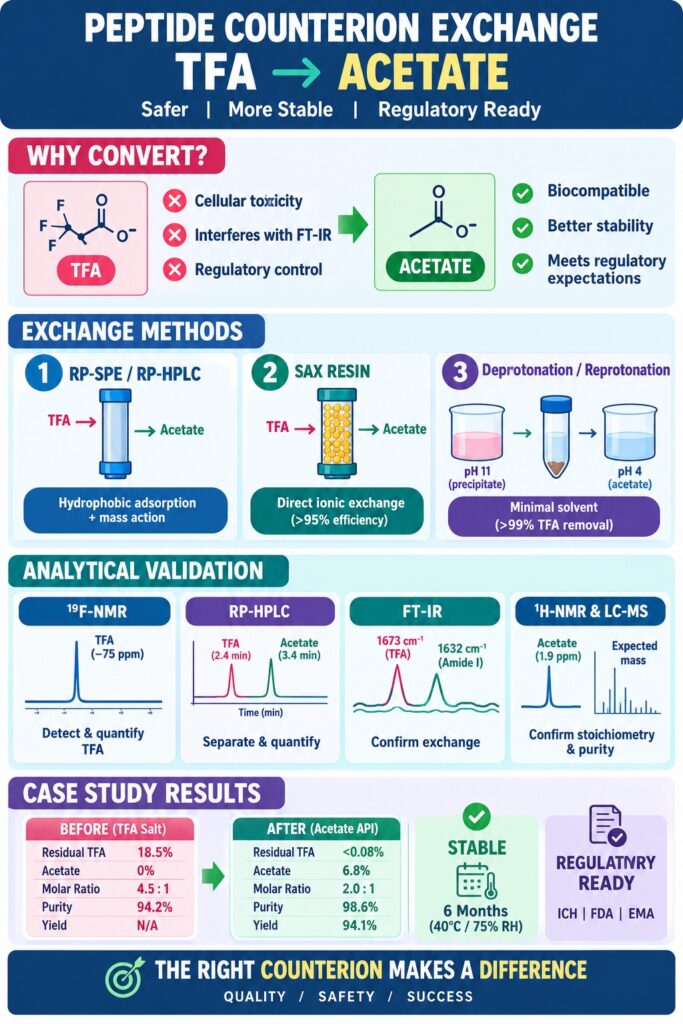
Converting a peptide active pharmaceutical ingredient (API) from the trifluoroacetate (TFA) form to an acetate salt is an important development step intended to address potential cellular toxicity, improve physical stability, and meet international regulatory expectations. This Peptide Counterion Exchange Case Study examines the practical methodologies, analytical validation approaches, and process optimization strategies required to perform an effective counterion conversion while maintaining drug substance purity and maximizing overall batch recovery. Solid-Phase Peptide Synthesis (SPPS) using Fmoc/tBu protecting group chemistry commonly employs high concentrations of trifluoroacetic acid (92.5%–95% v/v) during the final resin cleavage and side-chain deprotection stages. As a result, basic amino acid residues, including Lysine, Arginine, and Histidine, together with the N-terminal amine, become protonated and interact ionically with TFA anions. This process can consequently result in substantial amounts of residual TFA being retained in the crude peptide lyophilizate.
Explore custom peptide synthesis services for peptide development and manufacturing requirements.
The presence of trifluoroacetate counterions can introduce important biological and analytical considerations during clinical drug development. From a pharmacological perspective, TFA has been associated with documented cellular toxicity, including effects on osteoblast proliferation, potential damage to articular chondrocytes, and possible acute hepatic risks. From an analytical perspective, TFA generates a prominent infrared absorption peak at 1673 cm−1, which can interfere with the critical amide I region (1600–1700 cm−1) used to assess peptide secondary structure through Fourier-Transform Infrared (FT-IR) spectroscopy. Regulatory authorities, including the U.S. Food and Drug Administration (FDA) and the European Medicines Agency (EMA), expect appropriate control of residual TFA in finished drug substances. Replacing TFA with a more biocompatible counterion, most commonly acetate, is therefore an important strategy for supporting drug safety, maintaining solution stability, and meeting regulatory requirements.
Share via:
Quick Summary:
- TFA-to-acetate conversion is an important peptide API development step to reduce residual TFA concerns, improve physicochemical stability, and support regulatory expectations.
- TFA is commonly introduced during SPPS cleavage/deprotection, where it associates with basic residues such as Lys, Arg, His, and the N-terminal amine.
- Three major counterion-exchange approaches are discussed: RP-SPE/RP-HPLC, strong anion-exchange (SAX) resin chromatography, and deprotonation/reprotonation precipitation.
- SAX resin chromatography offers an efficient, scalable, low-solvent approach, while precipitation can achieve >99% TFA removal for suitable peptides; RP methods can integrate exchange with purification but may consume more solvent.
- Orthogonal analytical methods—including ¹⁹F-NMR, ion-pairing RP-HPLC, FT-ATR/FT-IR, ¹H-NMR, and LC-MS—help confirm TFA removal, acetate stoichiometry, peptide identity, purity, and structural integrity.
- In the industrial case study, strong anion exchange reduced residual TFA from 18.5% to <0.08%, increased purity from 94.2% to 98.6%, achieved a 2.0:1 acetate-to-peptide ratio, and delivered 94.1% API recovery.
- Six-month accelerated stability testing showed no significant counterion degradation, aggregation, or increase in related impurities, supporting acetate salt selection for further clinical and regulatory development.
Regulatory Imperatives and Physicochemical Drivers for Counterion Conversion
Regulatory agencies require appropriate control and, where scientifically justified, replacement of residual trifluoroacetate in synthetic peptide drug substances to support patient safety, consistent biological activity, and reliable drug product quality throughout its intended lifecycle. Establishing control of counterion identity and demonstrating suitable residual TFA levels are important elements of Chemistry, Manufacturing, and Controls (CMC) documentation submitted to regulatory authorities worldwide.
Learn more about GMP peptide API manufacturing services for controlled peptide drug-substance production and quality requirements.
The European Medicines Agency (EMA) Guideline on the Development and Manufacture of Synthetic Peptides requires developers to provide an appropriate scientific justification for the selected counterion and demonstrate adequate control of residual TFA. Under FDA regulatory frameworks, synthetic peptides containing 40 or fewer amino acids are regulated as small-molecule drug substances under Abbreviated New Drug Applications (ANDAs) or New Drug Applications (NDAs). For these synthetic peptides, unspecified impurities are generally expected to remain at or below 0.10%, while residual reagents such as TFA are subject to appropriate safety-based controls. Standardized frameworks described in USP General Chapter (Quality Considerations for Synthetic Peptide Drug Substances) and USP Chapter (Starting Materials for Synthetic Peptides) provide manufacturers with guidance for defining appropriate quality attributes and counterion specifications.
See how CMC documentation at a CDMO for ANDA can support the documentation and quality requirements associated with pharmaceutical development.
| Regulatory Standard / Body | Scope & Governance Focus | Regulatory Threshold / Expectation | Analytical & Clinical Impact |
|---|---|---|---|
| EMA Synthetic Peptide Guideline | CMC specifications, synthetic peptide impurities, and salt form selection | Explicit justification of salt form; residual TFA typically targeted below 0.1%–1.0% w/w | Supports control of potential clinical toxicity and helps satisfy CHMP regulatory filing requirements. |
| FDA ANDA / NDA Requirements | Regulates peptides (≤40 amino acids) as small-molecule drug substances | Unspecified impurities ≤0.10%; residual solvents and acids strictly controlled | Supports timely progression through generic or innovative peptide approval pathways. |
| USP General Chapter | Quality attributes and testing of synthetic peptide APIs | Stoichiometric counterion confirmation and residual acid quantification | Establishes peptide-specific quality considerations beyond conventional small-molecule assumptions. |
| USP General Chapter | Starting materials and cleavage reagent control | Monitoring residual cleavage reagents, scavengers, and acid counterions | Supports consistency in starting material quality and downstream processing. |
| ICH Q1A (R2) & Q6B | Stability testing and characterization of biomolecules | Stability across long-term (5°C) and accelerated conditions (40°C/75% RH) | Helps confirm that the selected salt form does not contribute to hygroscopicity or chemical degradation. |
From a physicochemical perspective, changing a peptide from its TFA salt form to an acetate salt can provide meaningful benefits for formulation and handling characteristics. TFA-containing peptide salts can contribute to a lower micro-environmental pH in aqueous systems, potentially promoting acid-catalyzed degradation, side-chain deamidation, or irreversible peptide aggregation. Replacing TFA with acetate can help bring the solution environment closer to physiological pH, support preservation of native tertiary interactions, and decrease non-covalent peptide association during liquid or lyophilized storage.
Read more about formulating a lyophilized peptide injectable and the development considerations involved in peptide injectable formulations.
Technical Evaluation of Counterion Exchange Methodologies in a Peptide Counterion Exchange Case Study
The appropriate counterion conversion strategy in a Peptide Counterion Exchange Case Study is influenced by several peptide-specific characteristics, including sequence length, pKa values, solubility behavior, and manufacturing scale. Three principal technological approaches—reversed-phase solid-phase extraction or high-performance liquid chromatography (RP-SPE/RP-HPLC), strong anion-exchange (SAX) resin chromatography, and deprotonation/reprotonation precipitation cycles—provide different balances of process efficiency, API recovery, and solvent consumption.
The counterion exchange workflow generally starts with characterization of the crude peptide API obtained following SPPS cleavage. The peptidyl-TFA salt may be processed using RP-SPE/RP-HPLC through mass-action displacement, introduced onto an equilibrated SAX resin column for direct counterion exchange, or processed through a pH-controlled deprotonation/reprotonation precipitation cycle. After the exchange operation, orthogonal analytical techniques, including Fluorine-19 Nuclear Magnetic Resonance (¹⁹F-NMR) and ion-pairing RP-HPLC, can be applied to demonstrate TFA depletion and confirm acetate stoichiometry before the final isolation of the acetate API.
Compare manufacturing models and capabilities through Peptide CDMO vs CMO considerations when selecting a development and manufacturing partner.
1. Reversed-Phase HPLC and Solid-Phase Extraction (RP-SPE / RP-HPLC)
Reversed-phase counterion exchange relies on hydrophobic interactions between peptide side chains and C18 or C8 silica-based stationary phases. The peptide TFA salt is introduced onto the column and retained by the stationary phase. The column is subsequently washed using a dilute aqueous solution containing a high molar excess of acetic acid or ammonium acetate, such as 1%–2% v/v acetic acid. The resulting mass-action effect promotes replacement of trifluoroacetate anions with acetate anions. The resulting acetate-associated peptide is then recovered using an organic elution gradient, for example, aqueous acetonitrile containing acetic acid. Although RP-SPE/RP-HPLC can incorporate counterion exchange into the peptide purification workflow, the approach can require relatively large quantities of organic solvent and may result in product losses during column loading, washing, and recovery.
2. Strong Anion-Exchange (SAX) Resin Chromatography
Strong anion-exchange procedures employ columns containing quaternary ammonium resin, such as AG1-X8 or Dowex, that has been pre-equilibrated in the acetate form. An aqueous solution containing the peptide TFA salt is loaded onto the resin. Because the quaternary ammonium resin can exhibit greater affinity toward trifluoroacetate anions than acetate anions, TFA is retained on the resin while acetate ions are released into the mobile phase and become associated with the basic residues of the peptide. Operation within a mild pH range (~3.0 to 4.5) helps minimize acid-induced peptide degradation. Under suitable process conditions, SAX resin chromatography can achieve >95% exchange efficiency and support processing at relatively high peptide concentrations while requiring limited organic solvent.
3. Deprotonation / Reprotonation Precipitation Cycles
For basic peptides with limited solubility under elevated-pH conditions, a deprotonation/reprotonation cycle can provide an effective route for removing TFA with minimal solvent requirements. In this approach, the peptide TFA salt is dissolved in purified water and treated with dilute sodium hydroxide (NaOH) until the pH reaches 11 at 4°C. Deprotonation of the basic amino acid side chains converts the peptide into an uncharged free-base form with low solubility, causing it to precipitate from the solution. At the same time, sodium trifluoroacetate remains soluble in the aqueous supernatant. The precipitated peptide is subsequently separated by centrifugation and washed before the free base is re-suspended and treated with dilute acetic acid to form the acetate salt. This approach can achieve >99% TFA removal; however, its use is limited to peptides that maintain chemical integrity at pH 11 and demonstrate sufficient precipitation of the uncharged free-base form.
| Process Parameter | RP-SPE / RP-HPLC Method | SAX Resin Chromatography | Deprotonation / Reprotonation Cycle |
|---|---|---|---|
| Primary Mechanism | Hydrophobic adsorption and mass-action displacement | Direct ionic exchange on quaternary ammonium resin | Isoelectric precipitation of peptide free base |
| TFA Exchange Efficiency | 85%–95% | 95%–98% | >99% |
| API Recovery Yield | 80%–90% | 90%–96% | 85%–93% |
| Operating pH Range | pH 2.5–4.0 | pH 3.0–5.0 | pH 3.0–11.0 |
| Solvent Intensity | High (Acetonitrile / Water) | Low (Aqueous acetic buffer) | Very Low (Water, NaOH, AcOH) |
| Sequence Limitations | Broad applicability across sequences | Potential steric limitations for large peptides | Limited to base-stable, insoluble peptides |
Process Optimization and Analytical Validation Protocols
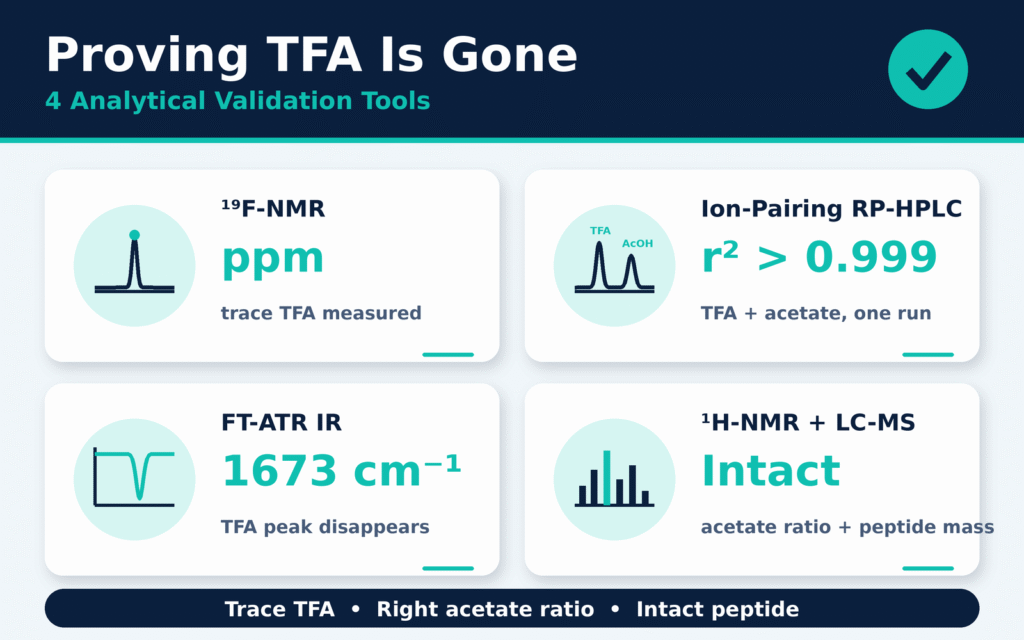
Validation of a peptide counterion conversion process requires orthogonal analytical techniques that can accurately measure trace residual TFA, establish acetate stoichiometry, and demonstrate that the peptide sequence remains intact. Implementing validated analytical procedures is essential for confirming that drug substance batches consistently satisfy stringent international pharmacopeial and regulatory quality requirements.
Explore one-stop CDMO analytical services for ANDA for integrated analytical testing and characterization requirements.
- Fluorine-19 Nuclear Magnetic Resonance (¹⁹F-NMR): ¹⁹F-NMR spectroscopy provides a highly selective approach for detecting and quantifying residual trifluoroacetate without the need for chemical derivatization of the sample. When a known fluorine-containing internal reference standard, such as trifluoroethanol (TFE), is introduced, the TFA singlet resonance (δ ≈ −75.5 ppm to −76.5 ppm) can be integrated against the reference signal. This allows residual TFA to be quantified at trace levels, including concentrations in the ppm range.
- Ion-Pairing Reversed-Phase High-Performance Liquid Chromatography (RP-HPLC): Residual trifluoroacetate and free acetic acid can be quantified simultaneously using polar-endcapped C18 stationary phases, such as Synergi Hydro-RP, combined with UV detection at 210 nm or Charged Aerosol Detection (CAD). Under the described chromatographic conditions, the trifluoroacetate anion (tR ≈ 2.4 min) can be separated from free acetic acid (tR ≈ 3.4 min). The method can provide high linearity (r2 > 0.999), making it suitable for routine batch release testing and process monitoring.
- Fourier-Transform Attenuated Total Reflectance IR (FT-ATR): FT-ATR spectroscopy provides a rapid analytical method for assessing counterion replacement. In an unexchanged TFA salt, the strong carbonyl absorption band around 1673 cm−1 can interfere with interpretation of the peptide’s amide I region. Following successful counterion exchange, this interference is reduced, allowing the native amide I band to be observed within the 1620–1650 cm−1 region. Characteristic symmetric acetate carboxylate stretching bands can also appear at approximately 1400 cm−1 and 1550 cm−1, providing additional evidence of acetate incorporation.
- Proton NMR (¹H-NMR) and Mass Spectrometry (LC-MS): ¹H-NMR spectroscopy can be used to determine the molar relationship between acetate counterions and the peptide by integrating the acetate methyl singlet (δ ≈ 1.9 ppm) against suitable non-exchangeable aromatic or aliphatic backbone proton signals. High-resolution LC-MS can then confirm the expected monoisotopic mass and help establish that processing has not introduced chemical changes such as oxidation, deamidation, or racemization.
Learn about peptide CDMO scale-up services for transitioning peptide processes from development toward larger-scale manufacturing.
Industrial Case Study Findings: Downstream Implementation and API Quality Outcomes
A commercial-scale development campaign was conducted using a synthetic dicationic peptide API to assess the replacement of a conventional TFA-salting procedure with a scalable strong anion-exchange resin process. The target peptide contained an N-terminal amine and an internal Lysine side chain. Based on these two basic sites, a theoretical ratio of two acetate counterions per peptide molecule was required to provide complete electrical neutrality.
The unpurified peptide lyophilizate obtained after SPPS resin cleavage contained 18.5% w/w bound trifluoroacetate, corresponding to a molar ratio of 4.5 TFA molecules per peptide molecule. The peptide API was subsequently processed using a column packed with AG1-X8 strong anion-exchange resin that had been pre-equilibrated with dilute acetic acid. The resin treatment was followed by aqueous washing and lyophilization. The resulting process generated measurable improvements in the principal Critical Quality Attributes (CQAs) evaluated during the campaign.
Review impurity control strategies under ICH Q3A for considerations related to impurity identification, qualification, and control during pharmaceutical development.
| Quality Attribute / Parameter | Pre-Exchange (Crude TFA Salt) | Post-Exchange (Final Acetate API) | Analytical Testing Method |
|---|---|---|---|
| Residual TFA Content | 18.5% w/w | <0.08% w/w (<800 ppm) | ¹⁹F-NMR & Ion-Pairing RP-HPLC |
| Acetate Counterion Content | 0.0% w/w | 6.8% w/w | ¹H-NMR & RP-HPLC |
| Stoichiometric Molar Ratio | 4.5 TFA : 1 Peptide | 2.0 Acetate : 1 Peptide | ¹H-NMR Peak Integration |
| Chromatographic Purity | 94.2% | 98.6% | RP-HPLC (214 nm) |
| FT-IR Amide I Band Resolution | Obscured by 1673 cm−1 TFA peak | Resolved at 1632 cm−1 | FT-ATR Spectroscopy |
| Overall Isolated API Yield | N/A (Starting Material) | 94.1% Recovery | Gravimetric Mass Balance |
The final peptide drug substance demonstrated an acetate-to-peptide molar ratio of 2.0 ± 0.1, which corresponded closely with the theoretical stoichiometric requirement. Residual TFA was reduced to below 0.1% w/w. Accelerated stability testing was performed according to ICH Q1A (R2) conditions at 40°C ± 2°C / 75% RH ± 5% RH for 6 months. The study showed no evidence of counterion degradation, peptide aggregation, or an increase in related impurities. These results supported the suitability of the final acetate salt form for regulatory submission.
See stability batches required for an ANDA submission for additional considerations around stability planning and regulatory submission requirements.
Conclusion
A comprehensive Peptide Counterion Exchange Case Study demonstrates that converting synthetic peptide active pharmaceutical ingredients from TFA salts to acetate salts can represent an important quality milestone during pharmaceutical development. Replacing trifluoroacetate with acetate can address concerns associated with the presence of residual TFA while supporting appropriate regulatory control, peptide stability, and drug substance quality. The implementation of strong anion-exchange resin chromatography or RP-SPE, supported by orthogonal analytical techniques such as ¹⁹F-NMR, ¹H-NMR, and ion-pairing RP-HPLC, can provide effective counterion conversion, high API recovery, and consistent control of critical batch quality attributes. Establishing and validating an appropriate counterion exchange strategy early in development can help reduce potential regulatory concerns and support the clinical development and commercialization of synthetic peptide therapeutics.
Explore peptide CDMO services in Canada for integrated peptide development, manufacturing, and pharmaceutical support.
To consult with analytical specialists regarding counterion exchange protocols, API impurity profiling, or custom analytical development, contact ResolveMass Laboratories Inc. directly at https://resolvemass.ca/contact/.
Frequently Asked Questions (FAQs)
Residual TFA can create important biological and formulation concerns in therapeutic peptide products. It has been associated with cellular toxicity and can influence formulation pH, peptide aggregation, and overall product stability. Controlling residual TFA is therefore important when establishing the quality and safety profile of a peptide API.
Residual TFA specifications are established based on the specific peptide, route of administration, dose, toxicological assessment, and applicable regulatory requirements. In development programs, manufacturers commonly establish appropriately justified low residual-TFA specifications, with tighter controls often considered for injectable products. The final acceptance criterion should be scientifically justified and supported by regulatory and safety assessments.
Strong anion-exchange chromatography uses positively charged quaternary ammonium groups that are initially associated with acetate anions. When the peptidyl-TFA solution passes through the resin, trifluoroacetate is retained by the stationary phase while acetate is released into the solution. The liberated acetate then associates with the protonated basic sites of the peptide.
HCl-based counterion exchange can expose peptide molecules to highly acidic conditions that may increase the risk of acid-mediated chemical degradation. Depending on the sequence, prolonged exposure may contribute to peptide bond cleavage, side-chain hydrolysis, deamidation, or other degradation pathways. Acetate exchange can generally be performed under milder conditions, which may provide better compatibility with acid-sensitive peptide sequences.
The deprotonation/reprotonation approach can be useful for basic peptides that remain chemically stable under alkaline conditions and readily precipitate as neutral free bases. The peptide is deprotonated to separate it from soluble trifluoroacetate species and subsequently reprotonated using acetic acid. This method can achieve >99% TFA removal while minimizing chromatographic resin and organic solvent requirements.
¹⁹F-NMR provides a selective analytical method because fluorine is present in the trifluoroacetate group but is absent from most peptide structures. The integrated TFA resonance, typically observed around −75.5 ppm to −76.5 ppm, is compared with a known fluorine-containing internal reference such as trifluoroethanol. This enables quantitative determination of residual TFA at trace and ppm levels.
The trifluoroacetate species generates a strong infrared absorption around 1673 cm⁻¹. This signal can overlap with the peptide backbone amide I region, which is commonly evaluated for structural information. Consequently, substantial residual TFA can complicate interpretation of peptide secondary-structure characteristics by FT-IR spectroscopy.
Counterion selection can influence several physicochemical properties of a peptide API, including solution pH, solubility, hygroscopicity, aggregation behavior, and storage stability. The selected counterion can alter the peptide’s intermolecular interactions and micro-environmental conditions. Acetate may therefore be selected when its physicochemical and formulation properties provide an appropriate profile for the intended peptide product.
Reference:
- Segovia, R., Díaz-Lobo, M., Cajal, Y., Vilaseca, M., & Rabanal, F. (2023). Linker-free synthesis of antimicrobial peptides using a novel cleavage reagent: Characterisation of the molecular and ionic composition by nanoESI-HR MS. Pharmaceutics, 15(4), 1310. https://doi.org/10.3390/pharmaceutics15041310
- Sikora, K., Neubauer, D., Jaśkiewicz, M., & Kamysz, W. (2018). Citropin 1.1 trifluoroacetate to chloride counter-ion exchange in HCl-saturated organic solutions: An alternative approach. International Journal of Peptide Research and Therapeutics, 24(2), 265–270. https://doi.org/10.1007/s10989-017-9611-7
- Liu, Y., Huang, Y., Yang, L., Gao, Y., Jia, Z., Liu, T., Su, B., Wang, C., Jin, L., & Zhang, D. (2025). The effects of counter-ions on peptide structure, activity, and applications. Biomolecules, 15(11), 1567. https://doi.org/10.3390/biom15111567
- United States Pharmacopeia. (n.d.). USP peptide standards [Brochure]. U.S. Pharmacopeia. USP Peptide Standards PDF
- U.S. Food and Drug Administration. (2026, July 28). FDA publishes revised draft product-specific guidances for certain generic peptide products. FDA official page
- Elsayed, Y. Y., Kühl, T., & Imhof, D. (2025). Regulatory guidelines for the analysis of therapeutic peptides and proteins. Journal of Peptide Science, 31(3), e70001. https://doi.org/10.1002/psc.70001
Get In Touch With Us
About The Author


