

Introduction
Peptide-Drug Conjugate (PDC) Characterization Services deliver specialized analytical testing that uses high-resolution mass spectrometry and liquid chromatography to confirm structural identity, site-specific payload attachment, drug loading stoichiometry, and plasma stability of peptide bioconjugates. By assessing critical quality attributes at intact, subunit, and peptide digest levels, these services establish the analytical framework required to support therapeutic safety, batch-to-batch consistency, and regulatory compliance. PDCs are an increasingly important class of targeted therapeutics that use low-molecular-weight peptides, generally consisting of 5 to 30 amino acids, to transport potent cytotoxic or bioactive small molecules directly toward disease-specific targets. In comparison with traditional Antibody-Drug Conjugates (ADCs), PDCs can provide improved tissue permeability, reduced immunogenicity, and more streamlined synthetic manufacturing through Solid-Phase Peptide Synthesis (SPPS). However, the smaller molecular mass and conformational flexibility of peptide scaffolds also mean that covalent incorporation of linkers and payloads may substantially influence secondary structure, aqueous solubility, target affinity, and metabolic degradation pathways.
Developing comprehensive characterization frameworks requires orthogonal bioanalytical strategies that can effectively address complex microheterogeneity. Covalent bioconjugation reactions may generate positional isomers, variable payload loading levels, and trace quantities of residual reactants. In addition, in vivo stability is strongly influenced by the chemical integrity of the linker moiety, which must remain intact during systemic circulation while enabling release of the active payload after the conjugate reaches its intended biological target. Compliance with international regulatory expectations under ICH Q6B guidelines requires characterization strategies incorporating ultra-high-resolution liquid chromatography-tandem mass spectrometry (LC-MS/MS), native mass spectrometry, and automated multi-attribute monitoring (MAM). The following technical report describes state-of-the-art analytical workflows used for site-specific conjugation mapping, Drug-to-Peptide Ratio (DPR) determination, and in vitro linker stability assessment in complex biological matrices.
Explore advanced peptide physicochemical characterization services for comprehensive analytical assessment of therapeutic peptides and bioconjugates.
Share via:
Quick Summary:
- What PDCs are: Peptide-Drug Conjugates use short peptides (5–30 amino acids) to carry potent drugs to disease targets. Compared with ADCs, they offer better tissue penetration, lower immunogenicity and simpler synthetic manufacturing.
- Why characterization is challenging: Attaching a linker and payload to a small peptide can change its structure, solubility, target binding and stability. Conjugation also creates mixtures of positional isomers, varying drug loads and leftover reactants.
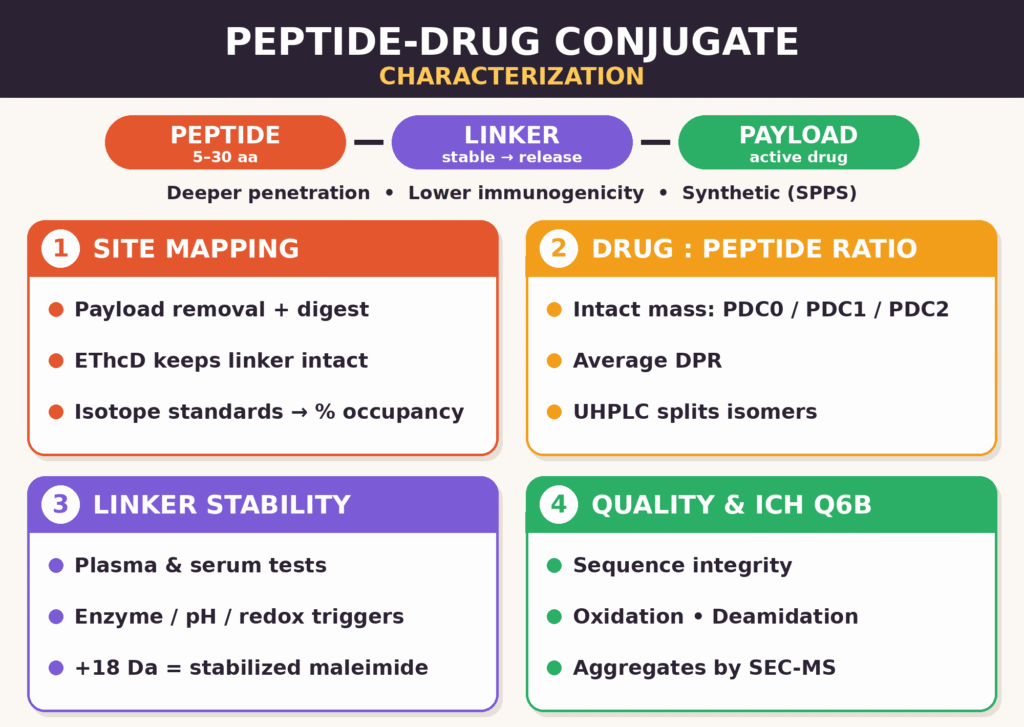
- Conjugation site mapping: Bottom-up LC-MS/MS shows which amino acids carry the payload. Removing the payload before digestion and using gentle fragmentation (EThcD) keeps fragile linkers intact. Isotope-labeled standards then give accurate site occupancy percentages.
- Drug-to-Peptide Ratio (DPR): Because peptides are small, intact mass spectrometry can clearly resolve unconjugated, mono- and di-conjugated species and calculate the average DPR. Optimized UHPLC separates positional isomers that have identical masses.
- Linker stability: Plasma and serum studies check that the linker stays intact in circulation but releases the drug at the target. This applies to enzyme-cleavable, pH-sensitive, redox-cleavable and non-cleavable linkers. Maleimide conjugates are watched for payload transfer to albumin, and a +18 Da mass shift shows the stabilizing ring hydrolysis.
- Bioanalysis in plasma: Hybrid immunoaffinity LC-MS/MS measures three fractions: total peptide, payload still attached and prematurely released free payload.
- Multi-Attribute Monitoring and compliance: A single high-resolution MS workflow tracks sequence integrity, oxidation and deamidation, payload degradation and aggregation. This supports ICH Q6B compliance and IND-enabling submissions.
Precision Conjugation Site Mapping and Occupancy Quantification
Conjugation site mapping identifies the specific amino acid residues that are covalently attached to payload linkers and determines the percentage occupancy at each position within heterogeneous PDC populations. High-resolution bottom-up LC-MS/MS, when combined with targeted enzymatic deconjugation, allows positional isomers to be identified and quantified with high confidence.
Learn more about peptide characterization CRO deliverables and the analytical documentation typically included in a comprehensive characterization package.
Peptide-Drug Conjugate (PDC) Characterization Services for Site Mapping
Peptide-Drug Conjugate (PDC) Characterization Services use bottom-up peptide mapping to address the analytical complexity associated with site-specific bioconjugation chemistries. PDCs produced through cysteine maleimide-thiol alkylation, lysine amide coupling, N-terminal acylation, or non-canonical amino acid insertion can display substantial microheterogeneity because multiple reactive sites may participate in the conjugation reaction. Direct digestion of intact PDCs using conventional proteases, including trypsin or Lys-C, can generate large and highly hydrophobic peptide-linker-payload fragments. These species may experience significant electrospray ionization (ESI) suppression and inadequate chromatographic recovery.
Drug deconjugation-assisted peptide mapping can reduce spectral complexity and ionization suppression by separating the underlying peptide sequence from the attached payload before tandem MS analysis. For PDC constructs containing protease-cleavable linkers, such as Valine-Citrulline-p-aminobenzyloxycarbonyl (Val-Cit-PABC), targeted enzymatic pre-treatment with papain can remove the bulky small-molecule payload while retaining a small and chemically defined residual tag at the conjugated amino acid residue. Subsequent proteolytic digestion generates modified peptides of a more manageable size, allowing efficient separation using reverse-phase ultra-high-performance liquid chromatography (RP-UHPLC) columns.
Review specialized peptide sequencing CRO services for LC-MS/MS-based sequence confirmation and structural characterization.
Tandem Mass Spectrometry Fragmentation Protocols
The selection of an appropriate MS/MS fragmentation strategy is essential for retaining labile linker-payload connections while producing adequate peptide backbone fragmentation for comprehensive sequence coverage. Conventional Collision-Induced Dissociation (CID) and Higher-energy Collisional Dissociation (HCD) introduce vibrational energy that can preferentially break fragile linker bonds, including carbamates, esters, or hydrazones, before cleavage of the peptide amide backbone. Such preferential fragmentation can make precise identification of the conjugation site more difficult.
High-resolution Orbitrap mass spectrometers operated using Electron-Transfer and Higher-Energy Collision Dissociation (EThcD) or optimized low-energy HCD conditions can preserve fragile attachments during analysis. EThcD transfers electrons to multiply charged peptide cations, producing non-ergodic cleavage of the peptide N-Cα backbone bonds while maintaining non-covalent interactions and labile covalent modifications. This mechanism produces comprehensive series of c– and z-type fragment ions. Detection of single-amino-acid mass shifts, such as a +258.11 Da shift associated with a residual linker fragment, enables analytical workflows to definitively determine the modification site even when multiple reactive residues are located in close proximity.
Site Occupancy Ratio Calculation via Stable Isotope Labeling
Site occupancy (Socc) represents the proportion of a particular amino acid residue that has been modified by the linker-payload within a given sample population. Determining occupancy solely from raw Extracted Ion Chromatogram (XIC) peak areas may introduce quantitative bias because payload conjugation can substantially modify the hydrophobicity and ionization behavior of the parent peptide.
Stable isotope labeling peptide mapping (SIL-LC-MS/MS) can improve quantitative accuracy by using isotopically labeled (13C / 15N) reference peptides that correspond to both modified and unmodified sequence fragments. Known quantities of these internal standards are spiked into the digested sample matrix, allowing the absolute site occupancy ratio at amino acid position k to be determined using the following equation:
Socc,k = [(Iconjugated,k / ISIL-conjugated,k) / ((Iconjugated,k / ISIL-conjugated,k) + (Iunmodified,k / ISIL-unmodified,k))] × 100%
where I denotes the integrated XIC peak area of the target peptide or its corresponding stable isotope-labeled standard.
| Analytical Technique | Primary Application | Key Operational Strengths | Technical Limitations |
|---|---|---|---|
| Drug Deconjugation LC-MS/MS | Backbone mapping & site localization | Removes hydrophobic payload and reduces ESI suppression. | Requires linkers that are susceptible to enzymatic pre-cleavage. |
| EThcD / Tuned HCD MS/MS | Precise site pinpointing on labile linkers | Preserves fragile modifications while fragmenting the peptide backbone. | Lower duty cycle and longer acquisition times than CID. |
| SIL-LC-MS/MS Mapping | Absolute site occupancy quantification | Minimizes ionization efficiency bias and provides high reproducibility. | Requires custom synthetic stable-isotope labeled peptides. |
| RP-UHPLC-UV/MS | Positional isomer separation | Provides high-resolution chromatographic differentiation of structural isomers. | Requires method development for polar/hydrophobic gradient optimization. |
Payload Ratio Determination: Drug-to-Peptide Ratio (DPR) and Heterogeneity Profiling
Drug-to-Peptide Ratio (DPR) determination assesses the stoichiometry and distribution of attached small-molecule payloads throughout a PDC population to establish batch homogeneity. Through intact mass spectrometry deconvolution and reverse-phase UHPLC analysis, characterization services can determine both the average DPR and the relative abundance of individual drug-loaded species.
Evaluating Payload Ratio via Peptide-Drug Conjugate (PDC) Characterization Services
Peptide-Drug Conjugate (PDC) Characterization Services determine drug loading stoichiometry at both intact conjugate and subunit levels, providing important information for precise manufacturing control. In contrast to large monoclonal antibodies (approximately 150 kDa), where drug-to-antibody ratios (DAR) typically generate broad and overlapping mass envelopes, smaller peptides in the 1–5 kDa range enable high-resolution mass spectrometers to resolve monoisotopic peaks within intact conjugate profiles. Deconvolution of intact mass spectra can distinguish individual species corresponding to unreacted peptide (PDC0), mono-conjugated (PDC1), di-conjugated (PDC2), and higher-order adducts.
The average Drug-to-Peptide Ratio (DPRavg) can be mathematically calculated from the deconvoluted relative abundance (fi) of each conjugated species:
DPRavg = ∑i=0n i · fi = ∑i=0n i · (Ii / ∑j=0n Ij)
where i represents the number of payload molecules attached to the peptide, n is the maximum theoretical number of conjugation sites, and Ii corresponds to the integrated MS intensity of species i.
Explore native mass spectrometry for therapeutic peptide characterization to understand how intact molecular measurements can support structural and compositional assessment.
Chromatographic Separation of Positional Isomers and Hydrophobic Impacts
The attachment of hydrophobic small-molecule payloads, including monomethyl auristatin E (MMAE), SN-38, or exatecan derivatives, can substantially change the chromatographic behavior of the hydrophilic peptide scaffold. On reverse-phase columns, each additional payload attachment generally increases conjugate retention time and can produce distinct peak clusters representing PDC0, PDC1, and PDC2 species. Unconjugated native peptides typically elute first during the organic gradient, followed by mono-conjugated species. Conjugates carrying higher levels of drug loading generally elute later because their increased hydrophobicity strengthens their interaction with the stationary phase.
Separating positional isomers within the same charge state, such as two different PDC1 species carrying modifications at different amino acid positions, requires specialized chromatographic optimization. Positional isomers possess identical monoisotopic molecular weights and therefore cannot be reliably distinguished using single-stage mass spectrometry alone. Differentiation of these species requires UHPLC separation using polar-embedded C18 phases, micro-pillar array columns, or volatile ion-pairing additives such as trifluoroacetic acid or heptafluorobutyric acid. These approaches exploit subtle differences in secondary conformation and hydrodynamic radius to achieve chromatographic resolution.
In Vitro Linker Stability Profiling and Biotransformation Analysis
Linker stability profiling assesses the structural integrity of the peptide-linker-payload complex in biological matrices to determine whether the conjugate remains intact during blood circulation while releasing its payload at the intended target site. In vitro studies use hybrid immunoaffinity LC-MS/MS approaches to monitor intact conjugates, deconjugated peptides, and free payloads over defined time periods in plasma and serum.
Linker Stability Assays in Peptide-Drug Conjugate (PDC) Characterization Services
Peptide-Drug Conjugate (PDC) Characterization Services assess linker cleavage kinetics in human and animal plasma, serum, and tissue homogenates to provide insight into potential in vivo behavior. The chemical architecture of the linker influences both systemic stability and the mechanism through which the payload is released intracellularly:
- Enzymatically Cleavable Linkers: Dipeptide sequences such as Valine-Citrulline (Val-Cit) or Valine-Alanine (Val-Ala) are designed for targeted cleavage by lysosomal cathepsin B within target cells. Characterization assays determine whether circulating plasma proteases or carboxypeptidases cause unintended cleavage before cellular internalization.
- pH-Sensitive and Redox-Cleavable Linkers: Acid-labile hydrazone or acetal linkers undergo preferential hydrolysis within acidic endosomes (pH 4.5–5.5), while disulfide linkers are reduced by intracellular glutathione. Stability studies compare degradation behavior under physiological blood pH (7.4) with conditions representative of lysosomal pH (4.8).
- Non-Cleavable Linkers: Thioether or maleimidocaproyl linkers are designed to remain stable in plasma and depend on complete lysosomal proteolysis of the peptide backbone to generate a bioactive amino acid-linker-payload metabolite.
See GLP-1 peptide stability and analytical methods for additional information on analytical approaches used to evaluate peptide stability and degradation behavior.
Thiol-Maleimide Succinimide Hydrolysis Dynamics
PDCs generated through maleimide-thiol chemistry may undergo retro-Michael elimination in plasma, resulting in transfer of the payload-linker complex to circulating human serum albumin. This unintended transfer can reduce target therapeutic efficacy and contribute to systemic toxicity.
Spontaneous or forced hydrolysis of the succinimide ring transforms the reversible maleimide adduct into a more stable succinimidic acid derivative that is less susceptible to retro-Michael cleavage. High-resolution mass spectrometry can monitor this stabilization process by detecting a precise +18.0105 Da mass shift, corresponding to the addition of a water molecule across the succinimide ring as hydrolysis progresses.
Hybrid IA-LC-MS/MS Bioanalytical Workflows
Determining PDC integrity in complex plasma matrices requires hybrid immunoaffinity liquid chromatography-tandem mass spectrometry (IA-LC-MS/MS). Targeted magnetic beads or capture columns are used to isolate the PDC from matrix proteins, after which LC-MS/MS analysis quantifies three distinct molecular fractions:
- Total Peptide Concentration: Determines the concentration of both conjugated and deconjugated peptide scaffolds using surrogate backbone peptides.
- Conjugated Payload Concentration: Measures small-molecule payloads that remain structurally attached to the peptide backbone.
- Free Payload Concentration: Quantifies prematurely released payload present in plasma supernates following extraction.
| Linker Class | Cleavage Trigger | Representative Structure | Primary Stability Assay | In Vivo Risk Factor |
|---|---|---|---|---|
| Enzyme-Cleavable | Lysosomal Cathepsin B | Val-Cit-PABC | Hybrid IA-LC-MS/MS plasma incubation | Premature cleavage by circulating proteases |
| pH-Sensitive | Endosomal Acidification | Hydrazone / Acetal | Differential pH degradation kinetics | Premature systemic release at physiological pH 7.4 |
| Thiol-Maleimide | Stable or Lysosomal | Maleimidocaproyl (MC) | Mass shift (+18 Da ring hydrolysis) | Retro-Michael payload transfer to serum albumin |
| Redox-Cleavable | Intracellular Glutathione | Hindered Disulfide | Reduction kinetics via DTT/GSH LC-MS | Extracellular reduction by plasma thiols |
Learn how multi-attribute monitoring (MAM) supports peptide characterization by integrating multiple quality attributes into a high-resolution analytical workflow.
Multi-Attribute Monitoring (MAM) and ICH Q6B Regulatory Compliance
Multi-Attribute Monitoring (MAM) combines high-resolution mass spectrometry workflows into an integrated analytical protocol that can simultaneously monitor sequence integrity, post-translational modifications, payload stability, and aggregation state under ICH Q6B guidelines. This strategy simplifies quality control activities and supports IND-enabling regulatory submissions by consolidating multiple individual attribute assays into an automated, high-throughput analytical workflow.
Review the regulatory requirements for GLP-1 peptide characterization to understand analytical considerations relevant to peptide development and regulatory submissions.
Automated Quality Attribute Surveillance
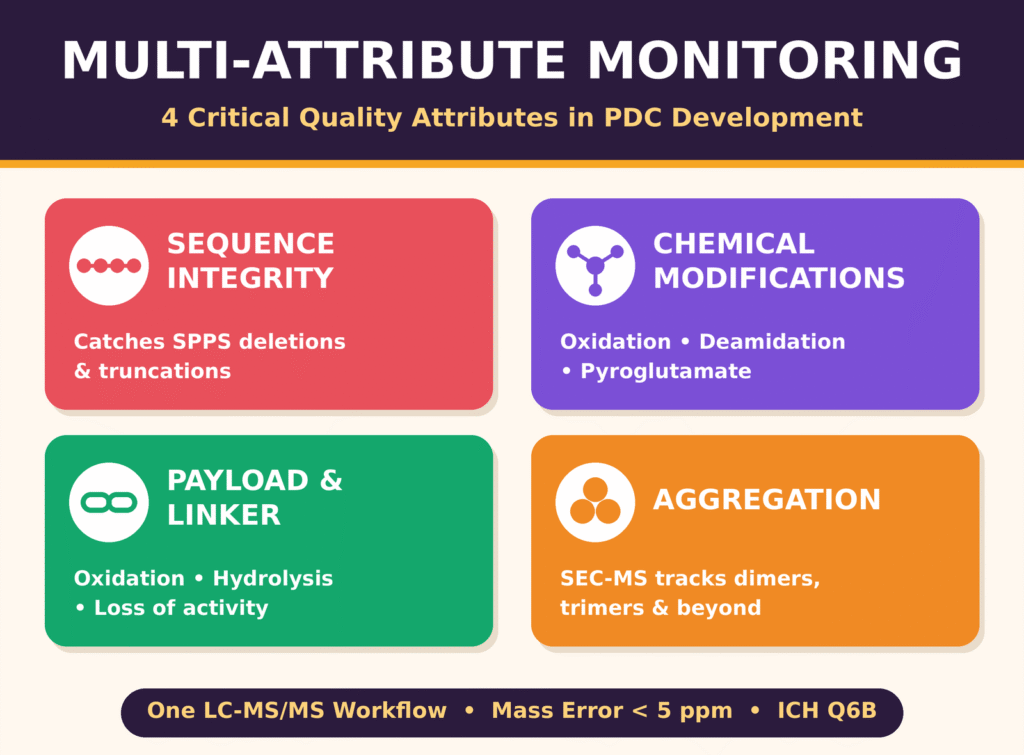
MAM workflows use high-mass-accuracy LC-MS/MS platforms, with mass error below 5 ppm, to automate quality control surveillance throughout development programs. Important critical quality attributes assessed during PDC development include:
- Primary Sequence Integrity: Confirming target sequence fidelity and detecting deletion or truncation sequences that may originate during Solid-Phase Peptide Synthesis (SPPS).
- Chemical & Post-Translational Modifications: Measuring methionine/tryptophan oxidation, asparagine deamidation, and N-terminal pyroglutamate formation.
- Payload & Linker Degradation: Identifying payload oxidation, ester/amide hydrolysis, and loss of active functional groups.
- Aggregation Profiling: Applying Size-Exclusion Chromatography coupled with native Mass Spectrometry (SEC-MS) to detect and quantify soluble dimers, trimers, and higher-order aggregates.
Explore peptide aggregation analysis for analytical approaches used to identify and characterize peptide aggregation and higher-order species.
Analytical Execution at ResolveMass Laboratories Inc.
ResolveMass Laboratories Inc. provides advanced bioconjugate characterization services using ultra-high-performance LC-MS/MS instrumentation, including Thermo Scientific Q Exactive Hybrid Quadrupole-Orbitrap and Orbitrap Ascend systems integrated with multidimensional UHPLC platforms. By combining top-down intact mass analysis, middle-down subunit characterization, and bottom-up peptide mapping, ResolveMass delivers regulatory-ready analytical packages intended to support IND applications and late-stage clinical development programs.
See the full characterization data package for a GLP-1 receptor agonist ANDA for an example of how comprehensive analytical characterization can be organized for regulatory support.
Conclusion
Comprehensive Peptide-Drug Conjugate (PDC) Characterization Services generate essential analytical information regarding bioconjugate identity, site occupancy, drug loading stoichiometry, and plasma stability, all of which are important for successful drug development. Establishing precise control over conjugation sites, DPR distribution, and linker cleavage behavior can help address systemic toxicity risks while supporting optimized target bioactivity in vivo.
As biopharmaceutical development pipelines progress toward increasingly sophisticated bioconjugate designs, comprehensive multi-attribute characterization workflows continue to play an important role in development risk management and compliance with international regulatory standards. ResolveMass Laboratories Inc. combines advanced Orbitrap LC-MS/MS platforms with specialized bioanalytical expertise to support PDC programs from early lead candidate selection through clinical-stage filings. To explore customized characterization strategies or consult with senior analytical specialists, visit the ResolveMass Contact Us Page.
Frequently Asked Questions
PDC site mapping focuses on relatively small and conformationally flexible peptide backbones, typically containing 5–30 residues, where positional isomers can be closely related chromatographically. ADCs have much larger molecular masses and generally require extensive subunit or enzymatic cleavage before detailed mapping. PDC analysis may also use enzymatic deconjugation-assisted mapping to reduce interference from bulky hydrophobic payloads during MS/MS analysis.
Succinimide ring hydrolysis is monitored because unhydrolyzed maleimide-thiol adducts can undergo retro-Michael elimination under systemic conditions. This reaction may promote transfer of the payload-linker complex to circulating serum albumin. Hydrolysis opens the succinimide ring and produces a more stable adduct, thereby reducing the likelihood of payload detachment.
Electron-Transfer and Higher-Energy Collision Dissociation (EThcD) and appropriately tuned low-energy HCD can provide effective preservation of labile payload-linker structures during MS/MS analysis. These approaches facilitate peptide backbone fragmentation while minimizing premature cleavage of sensitive linker bonds. Conventional CID may preferentially disrupt fragile linkages before sufficient sequence-informative fragments are generated.
PDCs are typically incubated in human plasma or serum at 37°C and analyzed at predefined time points over the study period. Hybrid IA-LC-MS/MS is then used to monitor intact conjugates, released payload, and changes in the peptide backbone. The resulting profiles provide information on linker cleavage, payload release, and overall degradation kinetics.
Stable isotope labeling LC-MS/MS (SIL-LC-MS/MS) uses synthetic peptide standards labeled with stable isotopes to improve quantitative accuracy. These standards compensate for differences in ionization efficiency between modified and unmodified peptide species. The approach enables reliable determination of conjugation site occupancy within heterogeneous PDC populations.
Hydrophobic payloads can substantially increase the retention of PDC species on reverse-phase columns and may contribute to peak broadening or non-specific interactions. Chromatographic performance can be improved by optimizing organic modifiers, column temperature, and stationary-phase chemistry. Polar-embedded stationary phases may also help achieve improved separation of hydrophobic PDC species.
PDC characterization programs aligned with ICH Q6B principles assess attributes such as sequence identity, structural homogeneity, drug loading, impurities, and stability. Analytical strategies should provide sufficient evidence to characterize the quality and consistency of the PDC. Stability studies under relevant physiological conditions can further support evaluation of product integrity during development and regulatory submissions.
Yes, hybrid IA-LC-MS/MS can distinguish conjugated payload from free payload through selective sample preparation and targeted mass spectrometric analysis. Immunoaffinity capture can enrich intact PDCs from complex serum matrices, while unbound small-molecule payload can be analyzed separately from the sample supernate. This enables independent assessment of conjugate-associated and prematurely released payload.
Reference:
- Zhu, X., Huo, S., Xue, C., An, B., & Qu, J. (2020). Current LC-MS-based strategies for characterization and quantification of antibody-drug conjugates. Journal of Pharmaceutical Analysis, 10(3), 209–220. https://doi.org/10.1016/j.jpha.2020.05.008
- Zheng, B., Wang, X., Guo, M., & Tzeng, C.-M. (2025). Therapeutic peptides: Recent advances in discovery, synthesis, and clinical translation. International Journal of Molecular Sciences, 26(11), 5131. https://doi.org/10.3390/ijms26115131
- Fu, C., Yu, L., Miao, Y., Liu, X., Yu, Z., & Wei, M. (2023). Peptide–drug conjugates (PDCs): A novel trend of research and development on targeted therapy, hype or hope? Acta Pharmaceutica Sinica B, 13(2), 498–516. https://doi.org/10.1016/j.apsb.2022.07.020
- Ieki, K., Fukuda, S., Miyawaki, S., & Hirowatari, K. (2025). Regulated bioanalysis of antibody-drug conjugates using LC-MS. Bioanalysis, 17(8), 549–560. https://doi.org/10.1080/17576180.2025.2490468
- Kristensen, D. B., Eskesen, N. S., Coll-Satue, C., Nicolas, A., Simonsen, J. K., Rasmussen, L., Sloth, T. M., Ørgaard, M., Madzharova, E., Krabbe, S., Leth, K. Z., Jensen, P. F., & Beck, A. (2026). Rapid and selective characterization of antibody-drug conjugates in complex sample matrices by native affinity liquid chromatography-mass spectrometry. mAbs, 18(1), 2618314. https://doi.org/10.1080/19420862.2026.2618314
- Goyon, A., Kim, M., Dai, L., Cornell, C., Jacobson, F., Guillarme, D., & Stella, C. (2019). Streamlined characterization of an antibody-drug conjugate by two-dimensional and four-dimensional liquid chromatography/mass spectrometry. Analytical Chemistry, 91(23), 14896–14903. https://doi.org/10.1021/acs.analchem.9b02454
Get In Touch With Us
About The Author


