

Introduction
Long-acting injectable (LAI) depot formulations based on biodegradable poly(lactide-co-glycolide) (PLGA) polymers represent one of the most effective technologies for the sustained delivery of therapeutic peptides. Despite their clinical success, the development of generic and biosimilar versions of these sophisticated drug products presents substantial bioanalytical challenges. In this context, rigorous Peptide PLGA Interaction Analysis plays a critical role in establishing pharmaceutical equivalence. Throughout manufacturing, storage, and extended degradation under physiological conditions, encapsulated peptides are susceptible to various non-enzymatic chemical modifications. Among these, covalent adduct formation, particularly peptide acylation, is recognized as one of the most significant degradation pathways. Such modifications can negatively impact therapeutic performance, alter drug release behavior, and potentially trigger immunogenic responses.
Learn more about the characterization of long-acting biologics to ensure your formulation meets regulatory standards.
By examining structural alterations, reaction kinetics, and thermodynamically favorable interaction patterns, formulation scientists can develop strategies to improve depot stability systematically. This technical review discusses the mechanistic pathways involved in peptide-PLGA acylation, the pivotal role of microenvironmental pH, and the advanced high-resolution liquid chromatography-mass spectrometry (LC-MS/MS) techniques necessary for the comprehensive characterization of these complex interactions.
Article Summary:
- PLGA-based long-acting injectable (LAI) depots are widely used for sustained peptide delivery, but peptide degradation through polymer interactions remains a major challenge when developing generic and biosimilar formulations.
- Peptide acylation is a key degradation pathway in PLGA microspheres, occurring when reactive peptide groups interact with the polymer backbone, forming covalent adducts that can affect drug stability, efficacy, release behavior, and safety.
- Multiple peptide residues can undergo acylation, including N-terminal amines, lysine, serine, tyrosine, hydroxyl-containing residues, and even arginine through specialized reaction mechanisms that generate distinct molecular modifications.
- PLGA degradation creates an acidic microenvironment inside microspheres, which influences both polymer erosion and peptide reactivity. The balance between peptide protonation, adsorption to the polymer surface, and local pH plays a critical role in determining acylation rates.
- Advanced LC-MS/MS and high-resolution mass spectrometry techniques enable scientists to detect, identify, and localize low-level acylation products, providing detailed structural information needed to assess formulation integrity and degradation pathways.
- Regulatory approval of biosimilar depot products requires extensive characterization of polymer composition, molecular weight distribution, architecture, impurities, degradation behavior, and peptide–polymer interactions to demonstrate bioequivalence with the reference product.
- Several formulation strategies can reduce peptide acylation, including the use of divalent salts, PEGylation, self-immolative protecting groups, and hydrophobic ion-pairing approaches, helping improve long-term stability while maintaining therapeutic performance.
Mechanistic Pathways of Peptide Acylation
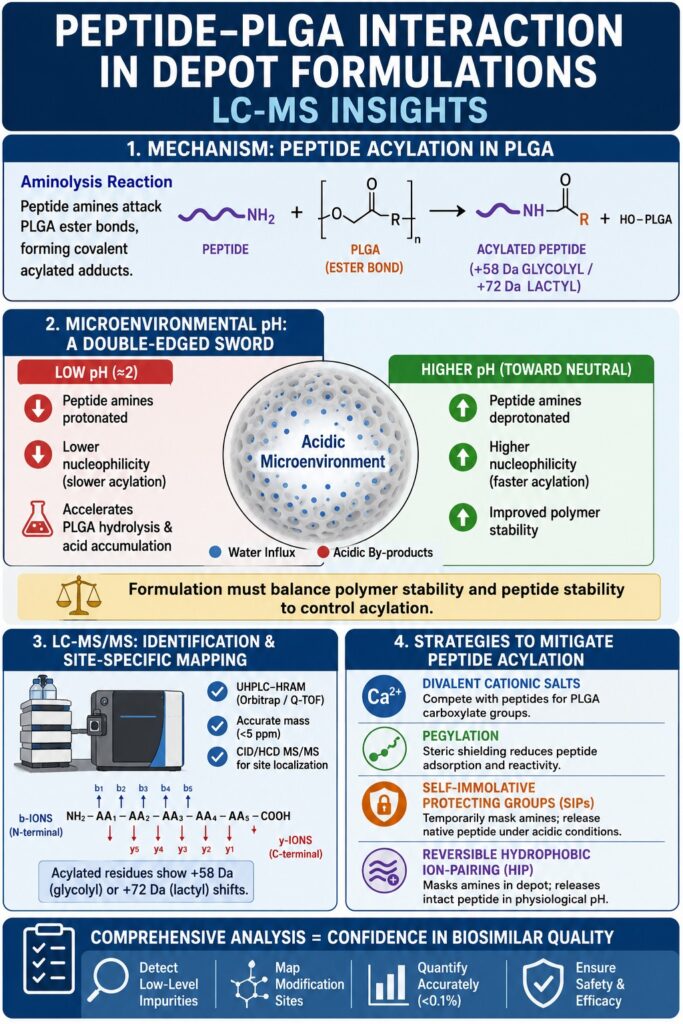
Peptide acylation within PLGA-based depot systems is a chemical degradation process initiated by the nucleophilic attack of peptide amine groups or other nucleophilic functional residues on the electrophilic carbonyl groups present within the polyester backbone. This aminolysis reaction results in covalent peptide modifications that can significantly influence the therapeutic efficacy, stability, and safety profile of the drug product.
Learn more about the characterization of long-acting biologics to ensure your formulation meets regulatory standards.
Reaction Scheme:
Peptide-NH₂ + [PLGA Ester Core] → Peptide-NH-CO-R (Acylated Peptide) + PLGA-OH
The primary sites susceptible to acylation are the highly nucleophilic primary amines located at the peptide N-terminus and within lysine side chains. In this process, the free amine attacks the ester linkage of the polymer, initiating polymer chain cleavage through aminolysis. Subsequent hydrolytic degradation of the conjugated polymer chain leaves the peptide covalently attached to either a glycolyl moiety, producing a +58 Da mass shift, or a lactyl moiety, resulting in a +72 Da mass shift. Because PLGA consists of both lactide and glycolide monomers, multiple sequential monomer additions may occur, generating a diverse population of polymeric adducts.
Explore the differences in encapsulating hydrophilic vs. hydrophobic APIs in PLGA to optimize your drug delivery system.
In addition to primary amines, other nucleophilic residues can participate in acylation under specific microenvironmental conditions. Side chains containing hydroxyl groups, including serine and tyrosine residues, as well as the primary hydroxyl group found on C-terminal amino acids such as position 8 in octreotide, have demonstrated susceptibility to acylation reactions.
Furthermore, studies have identified unconventional acylation pathways involving arginine residues. These findings are particularly important for peptides that lack free N-termini or lysine residues, such as goserelin. Mass spectrometric investigations have shown that the guanidine group of arginine can undergo nucleophilic attack on PLGA carbonyl groups. This reaction is followed by spontaneous ammonia (NH₃) loss from the guanidine functionality, leading to cyclization and formation of stable 2-oxazolin-4-one residues, corresponding to a +41 Da mass shift for glycolic acid-derived adducts, and 5-methyl-2-oxazolin-4-one residues, corresponding to a +55 Da mass shift for lactic acid-derived adducts.
The Influence of Microenvironmental pH and Hydrolysis Kinetics
Hydrolytic degradation of PLGA generates an acidic microenvironment within the depot matrix, which promotes ester bond cleavage and influences peptide-polymer interactions. Controlling this internal pH environment is particularly challenging because efforts to neutralize acidity may simultaneously increase peptide nucleophilicity and alter acylation kinetics.
For deeper insight into how bulk erosion vs. surface erosion in PLGA affects your drug release profile, consult our latest findings.
As water infiltrates the microsphere matrix, hydrolysis of ester bonds generates carboxylic-acid-terminated oligomers and monomeric degradation products, including lactic acid and glycolic acid. Due to the slow diffusion of these acidic species through the hydrophobic polymer matrix, they accumulate within internal pore structures, reducing the microenvironmental pH (μpH) to values approaching 2. This localized acidic environment accelerates autocatalytic polymer degradation and promotes the generation of highly reactive soluble oligomeric intermediates.
The relationship between μpH and acylation kinetics is governed by two competing mechanisms:
Peptide Protonation State
Successful acylation requires the presence of an unprotonated and nucleophilic free amine. Under highly acidic μpH conditions, peptide amines become protonated, reducing their nucleophilic character and theoretically slowing the acylation reaction.
Sorption as a Precursor Event
Positively charged peptides exhibit electrostatic attraction toward negatively charged, deprotonated carboxylic acid end groups generated during PLGA degradation. This sorption process acts as a critical precursor to acylation by concentrating peptides at the polymer interface where reactive ester groups are abundant.
To minimize acid-catalyzed degradation of both the polymer and peptide, formulation developers frequently incorporate neutralizing basic additives such as Ca(OH)₂. However, increasing the μpH toward neutral conditions deprotonates peptide amines and significantly enhances their nucleophilicity. As a result, acylation rates may increase substantially despite improvements in polymer stability.
Moreover, pH adjustment influences water uptake, matrix swelling behavior, and retention of degraded oligomeric intermediates within the microspheres. Consequently, formulation scientists must carefully balance polymer degradation kinetics with peptide chemical stability when designing depot systems.
Advanced Methodologies for Peptide PLGA Interaction Analysis Using LC-MS
Modern Peptide PLGA Interaction Analysis relies heavily on high-resolution accurate mass spectrometry (HRAM) integrated with advanced multi-stage fragmentation approaches. These analytical platforms enable the identification, localization, and quantification of low-level acylation impurities within degrading polymer matrices. Such methodologies facilitate residue-specific mapping of post-translational-like modifications while preserving formulation integrity.
Sample Preparation and Phase Extraction
Isolation of modified peptides from hydrophobic PLGA matrices without introducing analytical artifacts remains a significant challenge. Conventional workflows typically employ a two-phase extraction procedure.
Initially, microspheres are dissolved in a chlorinated organic solvent such as dichloromethane (DCM) or methylene chloride, which effectively solubilizes the PLGA polymer.
Subsequently, peptide analytes, including both native and acylated forms, are transferred into an aqueous extraction phase, commonly an acidic acetate buffer at pH 4.0. This environment stabilizes the peptides and minimizes additional reactions during sample preparation.
As an alternative, a single-step organic precipitation method may be utilized. In this approach, microspheres are dissolved in a tetrahydrofuran (THF) and acetonitrile (ACN) mixture. A specifically formulated salt-containing aqueous buffer is then added to selectively precipitate the PLGA polymer while retaining peptide species in the supernatant, allowing direct analysis by LC-MS.
Discover how surfactants and emulsifiers in PLGA microsphere fabrication impact overall product stability.
High-Resolution Mass Spectrometry (HRAM) and Site-Specific Mapping
For detailed characterization, researchers employ ultra-high-performance liquid chromatography (UHPLC) coupled with Orbitrap or Quadrupole Time-of-Flight (Q-TOF) mass spectrometers. These HRAM instruments routinely achieve mass accuracies below 5 ppm, enabling clear differentiation of overlapping isotopic distributions associated with closely related degradation products.
To determine the precise location of acylation events, collision-induced dissociation (CID) or higher-energy collisional dissociation (HCD) tandem MS/MS experiments are performed. These fragmentation techniques cleave the peptide backbone and generate comprehensive series of b-ions carrying the N-terminal region and y-ions carrying the C-terminal region.
Fragmentation Representation:
[ b1-b2-b3-b4-b5 ] → (N-terminal fragments)
NH₂-AA1-AA2-AA3-AA4-AA5-COOH
[ y3-y2-y1 ] → (C-terminal fragments)
Through analysis of characteristic fragment-ion mass shifts, acylation sites can be localized with high confidence.
A fragment containing an acylated lysine residue or N-terminus exhibits a distinct +58.005 Da mass shift corresponding to glycolic acid incorporation or a +72.021 Da mass shift corresponding to lactic acid incorporation.
Because PLGA contains chiral D- and L-lactide units, diastereomeric acylation products frequently appear as separate chromatographic peaks during reversed-phase separations while maintaining identical mass-to-charge (m/z) values and fragmentation patterns.
For peptides containing arginine modifications, such as goserelin, tandem MS/MS experiments verify cyclization to 2-oxazolin-4-one structures by monitoring the characteristic loss of ammonia (NH₃) from precursor ions. Diagnostic fragment shifts of +41 Da and +55 Da confirm glycolate-derived and lactate-derived modifications, respectively.
At ResolveMass Laboratories Inc., these advanced mass spectrometric platforms are utilized to characterize low-level impurities down to the 0.1% regulatory reporting threshold, providing biosimilar developers with comprehensive structural confirmation of formulation integrity.
Regulatory and Bioequivalence Considerations for Complex Biosimilars
Demonstrating bioequivalence for generic long-acting injectable products requires evidence of qualitative (Q1) and quantitative (Q2) sameness of inactive polymer components, together with comprehensive impurity characterization below the 0.1% threshold. Regulatory agencies expect validated analytical methodologies capable of confirming that the generic formulation exhibits degradation behavior, release kinetics, and safety characteristics comparable to those of the reference listed drug (RLD).
Ensure your submission complies with PLGA polymer sameness for ANDA requirements.
The FDA’s product-specific guidances (PSGs) for complex depot formulations, including leuprolide acetate and goserelin acetate suspensions, require extensive characterization of the PLGA carrier system. This necessitates the application of multiple complementary analytical techniques.
Compositional Analysis
Determination of the precise lactide-to-glycolide monomer ratio (LA:GA) and monomer sequence distribution is performed using quantitative proton and carbon Nuclear Magnetic Resonance (¹H- and ¹³C-NMR) spectroscopy.
Molecular Weight Distribution
Accurate measurement of number-average molecular weight (Mₙ), weight-average molecular weight (Mᵥ), and polydispersity index (PDI) is achieved through Gel Permeation Chromatography coupled with Multi-Angle Light Scattering and Refractive Index detection (GPC-MALS-RI).
Polymer Architecture
Analytical characterization differentiates linear polymers from star-branched architectures. Star-branched PLGAs, such as those employed in Sandostatin LAR formulations, display degradation kinetics and microclimate acidification behaviors distinct from linear polymer systems.
Purity Profiling
Residual monomers, catalyst residues such as tin octoate, and low-molecular-weight oligomeric species are quantified because these components may accelerate autocatalytic degradation and contribute to premature peptide acylation.
Learn about regulatory requirements for GLP-1 peptide characterization and other complex peptides.
Even subtle variations in polymer microstructure can influence initial burst release characteristics and subsequent lag phases. Therefore, bioequivalence assessments frequently require comparison of partial areas under the curve (pAUC) during clinical studies. Comprehensive characterization of all chemical interactions and degradation products is essential for supporting an Abbreviated New Drug Application (ANDA) submission.
Strategic Mitigation of Covalent Adduct Formation
Preventing peptide acylation within PLGA microspheres relies on formulation strategies that either disrupt electrostatic precursor interactions or temporarily shield reactive amine functionalities. These approaches help maintain formulation stability throughout prolonged drug release while preserving therapeutic activity.
Divalent Cationic Salts
Incorporation of water-soluble divalent cationic salts such as CaCl₂, MnCl₂, and ZnCl₂ represents an effective stabilization strategy. These cations compete directly with positively charged peptides for interaction with negatively charged PLGA carboxylate end groups. By reducing peptide adsorption onto polymer surfaces, which is a critical precursor to acylation, divalent salts have been shown to decrease acylation levels by more than 50% during extended incubation studies.
Chemical Modification (PEGylation)
Permanent or reversible attachment of poly(ethylene glycol) (PEG) to reactive peptide amines provides steric protection. PEGylation decreases peptide adsorption to the PLGA matrix and reduces susceptibility to nucleophilic reactions that lead to acylation during polymer erosion.
Self-Immolative Protecting Groups (SIPs)
Temporary masking of peptide amines using self-immolative protecting groups such as O-4-nitrophenyl-O’-4-acetoxybenzyl carbonate effectively prevents aminolysis. As polymer degradation progresses and internal acidity increases, these acid-sensitive groups undergo spontaneous hydrolysis, releasing the native peptide in its unmodified form.
Reversible Hydrophobic Ion-Pairing (HIP)
Complex formation between cationic peptides and hydrophobic counterions masks reactive nucleophilic amines under acidic microsphere conditions. The resulting complex remains stable during depot degradation but dissociates upon exposure to physiological conditions, releasing the intact therapeutic peptide.
Learn about regulatory requirements for GLP-1 peptide characterization and other complex peptides.
Comprehensive Summary of Peptide-Polymer Acylation and Analytical Tracking
| Reaction Parameter | Modification / Shift | LC-MS Analytical Feature | Mitigation Strategy |
|---|---|---|---|
| Primary Amine Acylation | Glycolyl (+58.005 Da) or Lactyl (+72.021 Da) adducts on N-terminus and lysine residues | Accurate mass monitoring with CID/HCD fragmentation and analysis of shifted b/y ions | Co-encapsulation of divalent cationic salts such as CaCl₂ and MnCl₂ |
| Arginine Acylation | Aminolysis followed by NH₃ loss; formation of 2-oxazolin-4-one structures (+41 Da or +55 Da shift) | Multi-stage MSⁿ ion trap analysis and NH₃-loss confirmation | Use of ester-capped polymers and blending with low-molecular-weight hydrophilic chains |
| Hydroxyl Acylation | Esterification of serine, tyrosine, or C-terminal hydroxyl groups (+58 Da or +72 Da) | Sequence mapping through enzymatic digestion and UHPLC-HRAM Orbitrap analysis | Reversible hydrophobic ion-pairing (HIP) complexation |
| Polymer Microclimate Acidification | Autocatalytic matrix degradation with internal pH reduction to approximately 2 | Comparative GPC-MALS analysis and monitoring of degraded oligomeric adduct distributions | Incorporation of basic microenvironmental pH modifiers such as Ca(OH)₂ |
Conclusion: Advancing Depot Formulations Through Peptide PLGA Interaction Analysis
Achieving bioequivalence and maintaining formulation stability in long-acting peptide depot systems requires a comprehensive molecular-level understanding of chemical degradation processes. Robust Peptide PLGA Interaction Analysis enables developers to identify, characterize, and mitigate critical degradation pathways, ensuring that biosimilar products satisfy stringent regulatory expectations.
Check our peptide characterization CRO deliverables checklist to streamline your development process.
Advanced bioanalytical technologies, including high-resolution Orbitrap mass spectrometry, quantitative NMR spectroscopy, and GPC-MALS analysis, are indispensable for the characterization of complex polymer-peptide systems. Collaboration with specialized analytical laboratories such as ResolveMass Laboratories Inc. provides generic drug developers with access to sophisticated instrumentation, validated bioanalytical methodologies, and regulatory expertise necessary to accelerate development programs and support successful clinical outcomes.
Contact ResolveMass Laboratories Inc.
To discuss your polymer characterization requirements, biosimilar bioanalysis projects, or ANDA-enabling development programs with our bioanalytical specialists, please visit our Contact Us page.
Frequently Asked Questions
The lactide-to-glycolide ratio significantly affects the degradation behavior of PLGA and, consequently, the likelihood of peptide acylation. Formulations containing a higher proportion of glycolide generally absorb water more rapidly and undergo faster hydrolysis, leading to increased acid generation within the polymer matrix. This acidic environment can enhance peptide-polymer interactions. In addition, glycolic acid units possess lower steric hindrance than lactic acid units, making them more susceptible to nucleophilic attack by peptide amines and thereby increasing acylation potential.
Goserelin lacks both a free N-terminal amine and lysine residues, making the arginine guanidine group the primary reactive site. After reacting with PLGA carbonyl groups, the resulting intermediate undergoes an intramolecular cyclization process accompanied by the loss of an ammonia molecule (NH₃). This additional transformation changes the final mass increase observed by mass spectrometry. As a result, glycolate-derived adducts produce a +41 Da shift, while lactate-derived adducts generate a +55 Da shift rather than the standard acylation masses.
LC-MS/MS identifies the exact location of glycolyl modifications by examining peptide fragmentation patterns generated through CID or HCD experiments. These fragmentation methods produce characteristic b-ion and y-ion series that reveal where the mass change occurs. If the +58.005 Da shift is present throughout the N-terminal fragment series, the modification is assigned to the peptide N-terminus. Conversely, when only fragments containing a lysine residue exhibit the mass increase, the acylation site is localized to the lysine side chain.
A carefully controlled two-phase extraction procedure is commonly used to recover acylated peptides while minimizing artificial degradation. The PLGA matrix is first dissolved in dichloromethane (DCM), allowing efficient separation of the polymer from the peptide components. The peptides are then transferred into an acidic aqueous buffer, typically acetate buffer at pH 4.0. Maintaining acidic conditions suppresses amine reactivity and helps prevent additional acylation reactions during sample preparation and analysis.
Divalent cationic salts such as CaCl₂ and MnCl₂ help reduce peptide acylation by interfering with electrostatic interactions between positively charged peptides and negatively charged PLGA carboxyl groups. By occupying these binding sites, the salts decrease peptide adsorption onto the polymer surface, which is an important preliminary step in the acylation process. Their effectiveness can be evaluated using Nano Isothermal Titration Calorimetry (NanoITC) to study binding behavior and ICP-OES to quantify retained metal ions within the microspheres.
Although pH neutralization is often used to reduce acid-induced degradation, it can unintentionally promote peptide acylation. Under highly acidic conditions, peptide amines remain protonated and therefore exhibit reduced nucleophilicity. When additives such as Ca(OH)₂ raise the internal pH, these amines become deprotonated and more chemically reactive. The increased availability of free nucleophilic amines can accelerate their interaction with PLGA ester groups, resulting in higher acylation rates.
The structural design of the polymer plays an important role in peptide binding and degradation behavior. Star-branched PLGA molecules possess a greater concentration of terminal carboxylic acid groups than comparable linear polymers. This higher end-group density creates additional electrostatic interaction sites for positively charged peptides. Consequently, peptide sorption may occur more readily, increasing the likelihood of prolonged polymer contact and subsequent acylation reactions.
Yes, MALDI-TOF MS can be applied to quantify peptide acylation without requiring a separate extraction step. The method involves adding a known concentration of an internal standard, often an isotopically labeled or structurally related peptide, directly to the microsphere sample. Following co-crystallization with a suitable matrix such as α-cyano-4-hydroxycinnamic acid, mass spectral analysis can determine the relative abundance of native and modified peptide species. This approach enables rapid assessment of degradation products within intact formulations.
For complex depot formulations, the FDA expects detailed characterization demonstrating both qualitative (Q1) and quantitative (Q2) sameness of the PLGA polymer. Required information generally includes molecular weight distribution parameters such as Mₙ, Mᵥ, Mz, and PDI, along with the precise lactide-to-glycolide ratio. Regulators also evaluate polymer architecture, end-group chemistry, residual monomer content, and catalyst-related impurities. These data collectively help establish equivalence between the proposed product and the reference listed drug.
Reference:
- Thombre, A. G., & Himmelstein, K. J. (2014). Minimizing acylation of peptides in PLGA microspheres. AAPS PharmSciTech, 15(5), 1131–1135. https://doi.org/10.1208/s12249-014-0140-6
- U.S. Food and Drug Administration, Center for Drug Evaluation and Research. (2016, March 15). Investigation of peptide-polymer interaction in poly(lactide-co-glycolide) microspheres (U01) (RFA-FD-16-012). National Institutes of Health Guide for Grants and Contracts. https://grants.nih.gov/grants/guide/rfa-files/RFA-FD-16-012.html
- Shirangi, M., Hennink, W. E., Somsen, G. W., & van Nostrum, C. F. (2015). Identification and assessment of octreotide acylation in polyester microspheres by LC–MS/MS. Pharmaceutical Research, 32(9), 3044–3054. https://doi.org/10.1007/s11095-015-1685-3
- Shirangi, M., Hennink, W. E., Somsen, G. W., & van Nostrum, C. F. (2016). Acylation of arginine in goserelin-loaded PLGA microspheres. European Journal of Pharmaceutics and Biopharmaceutics, 99, 18–23. https://doi.org/10.1016/j.ejpb.2015.11.008
- Liu, J., Xu, Y., Wang, Y., Ren, H., Meng, Z., Liu, K., Liu, Z., Huang, H., & Li, X. (2019). Effect of inner pH on peptide acylation within PLGA microspheres. European Journal of Pharmaceutical Sciences, 134, 69–80. https://doi.org/10.1016/j.ejps.2019.04.017
- Zhang, Y., Sophocleous, A. M., & Schwendeman, S. P. (2009). Inhibition of peptide acylation in PLGA microspheres with water-soluble divalent cationic salts. Pharmaceutical Research, 26(8), 1986–1994. https://doi.org/10.1007/s11095-009-9914-2
- Sophocleous, A. M., Zhang, Y., & Schwendeman, S. P. (2013). A new class of inhibitors of peptide sorption and acylation in PLGA. Journal of Controlled Release, 172(3), 662–670. https://doi.org/10.1016/j.jconrel.2013.09.019
Get In Touch With Us
About The Author


