

Introduction:
Peptide Synthesis vs Protein Manufacturing is an important distinction in pharmaceutical development, biotechnology, and analytical science, and the two processes are not the same. Both link amino acids through peptide bonds, but they differ in molecular complexity, production method, purification requirements, and quality control. Understanding these differences helps developers choose suitable production and analytical strategies for their candidates.
Peptide-based medicines can act as hormones, receptor agonists, or enzyme inhibitors. Proteins, including monoclonal antibodies, enzymes, and growth factors, perform complex functions that depend on their three-dimensional structures.
Peptide synthesis usually relies on chemically controlled reactions that assemble amino acids in a predetermined sequence. Protein manufacturing typically uses biological expression systems, followed by folding, purification, and other processing to reach the desired structure and activity.
At ResolveMass Laboratories Inc., a Canadian analytical CRO/CDMO, our work in mass spectrometry, biosimilar characterization, and related analytical science sits right where this distinction matters. This guide explains it with practical points from the analytical side.
Summary:
- Peptide synthesis and protein manufacturing are not the same. Peptide synthesis typically produces shorter amino acid chains, while protein manufacturing often involves longer, structurally complex molecules that need folding and specialized processing.
- The methods differ. Peptides are commonly made by solid-phase peptide synthesis (SPPS) or liquid-phase synthesis, whereas proteins are usually made in recombinant bacterial, yeast, or mammalian cell systems.
- Purification and characterization differ. Peptides rely on preparative HPLC and mass spectrometry, while proteins also need assessment of folding, aggregation, biological activity, and post-translational modifications.
- Both require robust analytical testing to establish identity, purity, quality, and suitability for the intended application.
- The right choice depends on the molecule: sequence length, structural complexity, biological activity, scale, and regulatory requirements decide the strategy.
- Analytical support is essential. Complementary techniques such as LC-MS, HPLC, MALDI-TOF mass spectrometry for peptide characterization, and NMR help prove what your molecule is.
1: What Is Peptide Synthesis?
Peptide synthesis is the controlled assembly of amino acids into a defined sequence, most often by chemical methods. It is widely used to produce research peptides, peptide therapeutics, reference materials, and specialized constructs.
Synthetic methods let developers control the sequence and introduce modifications such as non-natural amino acids, terminal modifications, or cyclization.
How Does Peptide Synthesis Work?
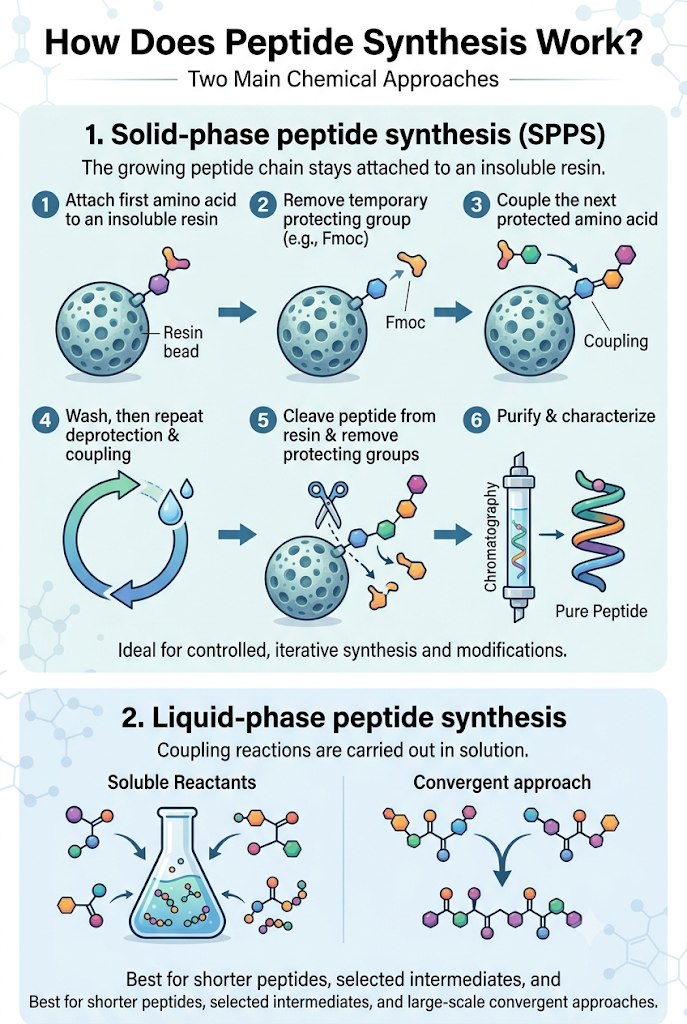
Peptide synthesis works through repeated cycles of amino acid coupling, protection of reactive groups, deprotection, and final purification. The two main chemical approaches are below.
1. Solid-phase peptide synthesis (SPPS)
SPPS is one of the most widely used approaches. The growing chain stays attached to an insoluble resin while amino acids are added in successive cycles:
- Attach the first amino acid to a suitable resin.
- Remove the temporary protecting group, such as Fmoc.
- Couple the next protected amino acid.
- Wash, then repeat the deprotection and coupling cycles.
- Cleave the peptide from the resin and remove protecting groups.
- Purify and characterize the final product.
SPPS suits controlled, iterative synthesis and the incorporation of non-natural amino acids or chemical modifications.
2. Liquid-phase peptide synthesis
Coupling reactions are carried out in solution. This can suit shorter peptides, selected intermediates, and convergent approaches that join separately prepared fragments. The best approach depends on sequence length, solubility, scale, desired purity, economics, and the chemistry of the target peptide.
What Are the Main Applications of Peptide Synthesis?
- Peptide-based therapeutics.
- Analytical reference standards.
- Peptide mapping and sequence confirmation studies.
- Modified peptides for structure-activity relationship studies.
- Peptide-drug conjugates and other specialized constructs.
- Research-grade peptides for biological assays.
Successful synthesis is only one part of the process. The product also needs suitable purification, characterization, and quality assessment, which is why many teams use dedicated peptide characterization services.
2: What Is Protein Manufacturing?
Protein manufacturing is the production of proteins in biological expression systems, followed by processing and purification to reach the required quality and function.
Therapeutic proteins frequently depend on precise folding, disulfide bond formation, and post-translational modifications. These features influence stability, activity, immunogenicity, and overall product quality.
How Does Protein Manufacturing Work?
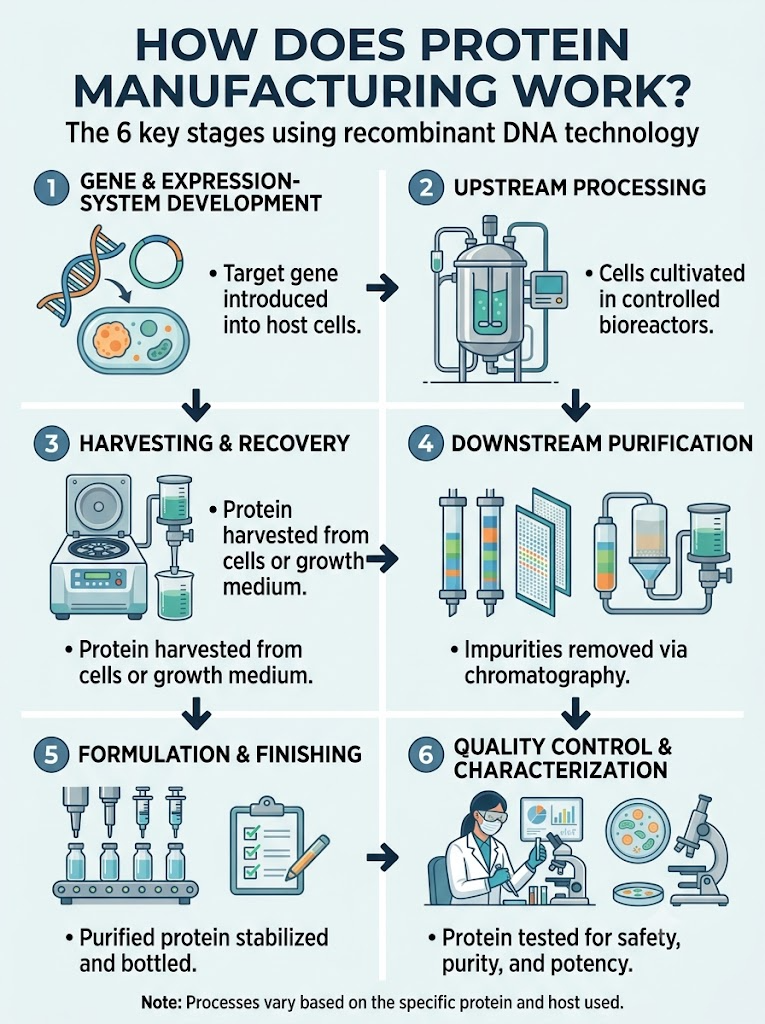
Protein manufacturing commonly uses recombinant DNA technology: a gene encoding the target protein is introduced into a host, which expresses the protein for recovery and processing. The main stages are:
- Gene and expression-system development. The gene is designed or selected and introduced into a suitable host, chosen for the protein’s structural and functional needs.
- Upstream processing. Cells are cultivated under controlled temperature, pH, dissolved oxygen, nutrients, and time.
- Harvesting and recovery. The protein is recovered from the medium or extracted from cells; intracellular proteins may need cell disruption.
- Downstream purification. Chromatography, filtration, and other operations remove host-cell proteins, residual DNA, aggregates, and process-related impurities.
- Formulation and finishing. The purified protein is formulated for stability and activity, with steps such as sterile filtration and filling where relevant.
- Quality control and characterization. Identity, purity, potency, impurities, and other product-specific attributes are assessed.
Not every protein follows exactly the same pathway. Expression systems, purification steps, and controls must be matched to the molecule and its intended use.
Which Expression Systems Are Used in Protein Manufacturing?
The most common expression systems are bacterial, yeast, mammalian, and other eukaryotic hosts, chosen by the protein’s complexity.
- Bacterial systems: useful for proteins that do not need complex eukaryotic post-translational modifications.
- Yeast systems: can support secretion and selected eukaryotic processing.
- Mammalian cell systems: commonly used for complex therapeutic proteins, including many monoclonal antibodies, because they support important folding and post-translational processing.
- Other eukaryotic systems: insect and other specialized hosts suit selected proteins.
The best system depends on the target protein, required activity, structural attributes, yield, and manufacturing constraints.
3: Peptide Synthesis vs Protein Manufacturing: What Are the Key Differences?
The key differences lie in production technology, molecular structure, purification, characterization, and scalability.
| Comparison factor | Peptide synthesis | Protein manufacturing |
|---|---|---|
| Typical production approach | Chemical synthesis, particularly SPPS or liquid-phase | Often recombinant expression, then recovery and purification |
| Molecular complexity | Frequently shorter chains with defined chemical modifications | Often longer chains with complex folding requirements |
| Production environment | Chemical reaction and synthesis equipment | Cell culture or fermentation plus downstream processing equipment |
| Folding requirements | Some need controlled folding, disulfide formation, or cyclization | Correct folding and structural integrity are frequently critical |
| Post-translational modifications | Selected modifications introduced chemically | May require biological processing, depending on the host |
| Common purification | Preparative HPLC and other separation techniques | Chromatography, filtration, and protein-specific methods |
| Typical analytical tools | HPLC, LC-MS, HRMS, amino acid analysis | LC-MS, chromatography, electrophoresis, structural analysis, functional assays |
| Common quality concerns | Truncated and deletion sequences, oxidation, incomplete deprotection | Aggregation, misfolding, fragmentation, host-cell impurities, structural variants |
| Scale-up considerations | Coupling efficiency, solvent use, purification capacity, sequence-specific challenges | Expression yield, culture performance, recovery, purification capacity, stability |
| Examples | Synthetic research peptides, selected peptide therapeutics | Monoclonal antibodies, recombinant enzymes, growth factors |
These differences are general rather than absolute. Some peptides need complex biological processing, and some smaller proteins can be made by chemical synthesis or hybrid chemical-biological approaches.
4: Are Peptides and Proteins Different in Size and Structure?
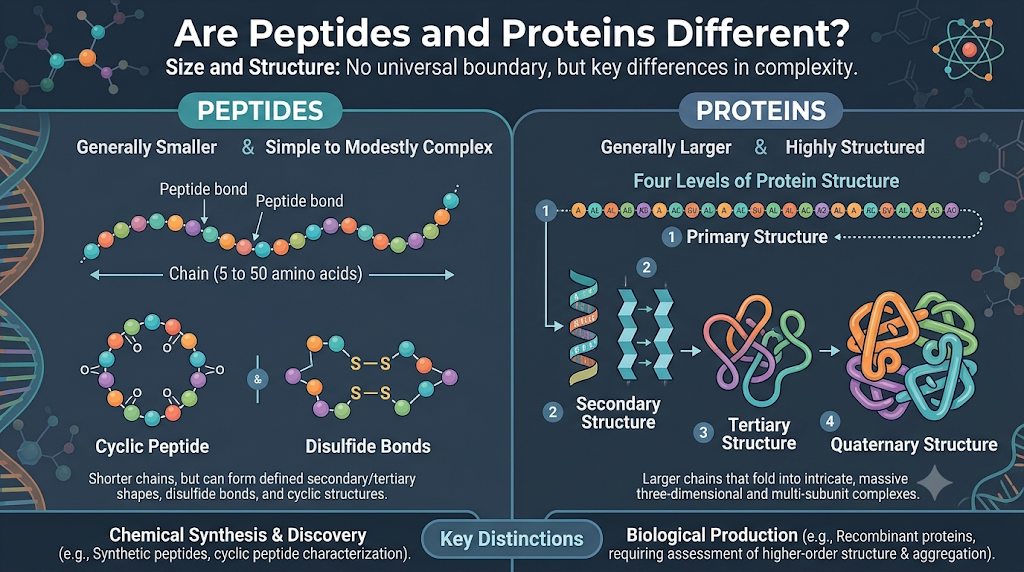
Yes, peptides are generally shorter and proteins larger and more extensively structured, but no universal length boundary cleanly separates them. The distinction is better understood by combining size, structural complexity, biological function, and production method.
Proteins can have several structural levels:
- Primary structure: the amino acid sequence.
- Secondary structure: local arrangements such as alpha helices and beta sheets.
- Tertiary structure: the overall three-dimensional arrangement of one chain.
- Quaternary structure: the assembly of multiple chains into a functional unit.
Peptides can also form defined secondary or tertiary structures, disulfide bonds, and cyclic conformations. So it is incorrect to assume every peptide is structurally simple or that every protein must be made biologically. A synthetic peptide may need careful control of disulfide connectivity, and complex ring systems call for dedicated cyclic peptide characterization. A recombinant protein, by contrast, needs assessment of higher-order structure and aggregation.
5: How Do Purification and Analytical Testing Differ?
Both need purification and testing, but peptides focus on sequence, mass and synthesis impurities, while proteins need a broader set of structural and functional assessments.
Analytical Testing for Synthetic Peptides
- HPLC or UHPLC: evaluates chromatographic purity and separates related impurities when resolution is adequate.
- LC-MS: combines separation with mass spectrometry for identity confirmation and impurity investigation.
- High-resolution mass spectrometry (HRMS): gives accurate-mass information to assess expected molecular composition.
- MALDI-TOF: a rapid option for molecular weight confirmation, explained in our guide to MALDI-TOF mass spectrometry for peptide characterization.
- NMR: provides structural detail that complements mass spectrometry; see our comparison of NMR vs LC-MS for peptide characterization.
- Amino acid analysis: supports composition assessment or quantification.
- Water and residual-solvent testing: relevant to the specification and intended use.
- Specialized structural methods: needed for cyclic, disulfide-rich, or other complex constructs.
A single chromatographic purity result does not establish every aspect of peptide quality. Identity, content, counterion composition, residual reagents, and water may each need separate methods.
Analytical Testing for Proteins
- LC-MS and HRMS: molecular-mass assessment and characterization of selected modifications.
- Size-exclusion chromatography (SEC): assesses size variants, including aggregates.
- Reversed-phase HPLC: characterizes certain proteins and variants under suitable conditions.
- Electrophoretic methods: SDS-PAGE or capillary electrophoresis, depending on the application.
- Peptide mapping: sequence confirmation and assessment of selected modifications.
- Glycan analysis: important where glycosylation affects quality or function.
- Biological activity or potency assays: evaluate relevant functional properties.
- Structural techniques: circular dichroism or other suitable methods where required.
The strategy should be risk-based and specific to the product. Not every protein needs every technique, and not every peptide can be fully characterized by HPLC and mass spectrometry alone.
6: Why Does Regulatory Planning Matter for Peptides and Proteins?
Regulatory expectations depend on molecule type, so the characterization package should be planned before process choices are locked in. For peptides, a robust data package supports submissions, and guidance on therapeutic peptide characterization for NDA and ANDA helps teams understand what evidence is typically needed. For protein biosimilars, comparability against a reference product relies on principles such as ICH Q6B and ICH Q5E, with analytical method validation framed by ICH Q2(R2).
How to Choose Between the Two Routes
Choose chemical peptide synthesis for short, well-defined sequences, and recombinant protein manufacturing for large, folded or modified molecules. Ask:
- How long is the sequence? Beyond roughly 50 residues, chemical synthesis becomes progressively harder.
- Does activity need folding or glycosylation? If yes, a cell-based system is usually required.
- Do you need non-natural residues or chemical modifications? Chemical synthesis offers more flexibility.
- What scale and timeline do you need? Peptides are usually faster at small scale; proteins need more development time.
- What are the regulatory expectations? Define the characterization package early.
Common Misconceptions
- “A peptide is just a small protein, so the process is the same.” The chemistry, equipment, impurities, and controls differ.
- “Longer peptides can simply be synthesized.” Yield and purity usually decline with length.
- “If the sequence is confirmed, the molecule is characterized.” Proteins also require structure, modification, aggregation, and process-impurity assessment.
- “Analytical methods transfer directly between the two.” Methods must be fit for the specific molecule and purpose.
Conclusion:
In the comparison of Peptide Synthesis vs Protein Manufacturing, the key takeaway is that they are related but fundamentally different disciplines. Peptide synthesis is chemically controlled and best suited to shorter, defined sequences. Protein manufacturing is biological, more complex, and typically required for large, folded, modified molecules. Each demands its own analytical package, impurity strategy, and regulatory planning.
Getting that choice right early, backed by robust characterization data, protects your timeline and the quality of your submission. ResolveMass Laboratories Inc. supports developers with mass spectrometry-driven analytical services and peptide characterization services so decisions rest on data rather than assumptions.
Frequently Asked Questions:
Peptide purity is commonly assessed using reversed-phase HPLC or UHPLC. LC-MS can help investigate related impurities and confirm molecular mass. Additional testing may be required to establish content, counterion composition, residual solvents, or other quality attributes.
Protein purity may be evaluated using size-exclusion chromatography, reversed-phase HPLC, electrophoretic methods, and other suitable analytical techniques. The testing strategy depends on whether the objective is to detect aggregates, fragments, charge variants, or other impurities.
Common peptide-related impurities include deletion sequences, truncated peptides, oxidation products, epimers, deamidated species, and residual synthesis reagents. The actual impurity profile depends on the amino acid sequence and manufacturing process.
Major challenges include maintaining consistent expression, achieving correct folding, controlling aggregation, removing host-cell impurities, maintaining biological activity, and demonstrating batch-to-batch consistency.
Reference
- Kent SB. Chemical synthesis of peptides and proteins. Annual review of biochemistry. 1988 Jul;57(1):957-89.https://www.annualreviews.org/content/journals/10.1146/annurev.bi.57.070188.004521
- Chandrudu S, Simerska P, Toth I. Chemical methods for peptide and protein production. Molecules. 2013 Apr 12;18(4):4373-88.https://www.mdpi.com/1420-3049/18/4/4373
- Zompra AA, Galanis AS, Werbitzky O, Albericio F. Manufacturing peptides as active pharmaceutical ingredients. Future medicinal chemistry. 2009 May 1;1(2):361-77.https://www.tandfonline.com/doi/abs/10.4155/fmc.09.23
- Rasmussen JH. Synthetic peptide API manufacturing: A mini review of current perspectives for peptide manufacturing. Bioorganic & Medicinal Chemistry. 2018 Jun 1;26(10):2914-8.https://www.sciencedirect.com/science/article/pii/S096808961732103X
About the Author


