

Introduction
Phase-Appropriate CMC Development at a CDMO represents a risk-managed approach to scaling that aligns Chemistry, Manufacturing, and Controls activities with the clinical, technical, and regulatory demands associated with each stage of drug development. By progressively advancing process chemistry, analytical validation, and quality oversight from preclinical research through Phase III registration trials, sponsors can improve capital utilization, maintain development timelines, and build a reliable foundation for commercial manufacturing.
Drug candidate attrition continues to be substantial across the biopharmaceutical industry, and only a limited proportion of molecules identified during discovery ultimately progress to commercial approval. Committing to complete commercial-scale process characterization, extensive analytical validation, or sophisticated finished dosage forms during early exploratory development can create significant financial exposure if a candidate is discontinued because of toxicity or insufficient efficacy. At the same time, postponing critical process chemistry optimization, impurity qualification, or solid-state characterization until late-stage development can result in technology transfer problems, supply chain constraints, or regulatory clinical holds. Working with a Contract Development and Manufacturing Organization (CDMO) enables biopharmaceutical sponsors to manage this technical balance through a structured and progressive development model. This report explains how essential CMC disciplines—including synthetic chemistry, analytical procedure validation, formulation engineering, and quality systems—progressively expand throughout each clinical development phase.
Explore comprehensive peptide analytical characterization services for advanced characterization and analytical support.
Share via:
Quick Summary:
- What it is: Phase-appropriate CMC development matches chemistry, manufacturing and controls work to each stage of drug development. This way, sponsors don’t over-invest early or under-prepare late.
- Why it matters: Most drug candidates fail before approval. Building full commercial processes too early wastes money. Delaying key work causes tech-transfer problems, supply issues or clinical holds.
- Regulatory basis: The approach rests on ICH Q8, Q9, Q10, Q11 and Q14. The FDA and EMA accept controls that are proportionate to clinical exposure and patient numbers.
- Early stages:
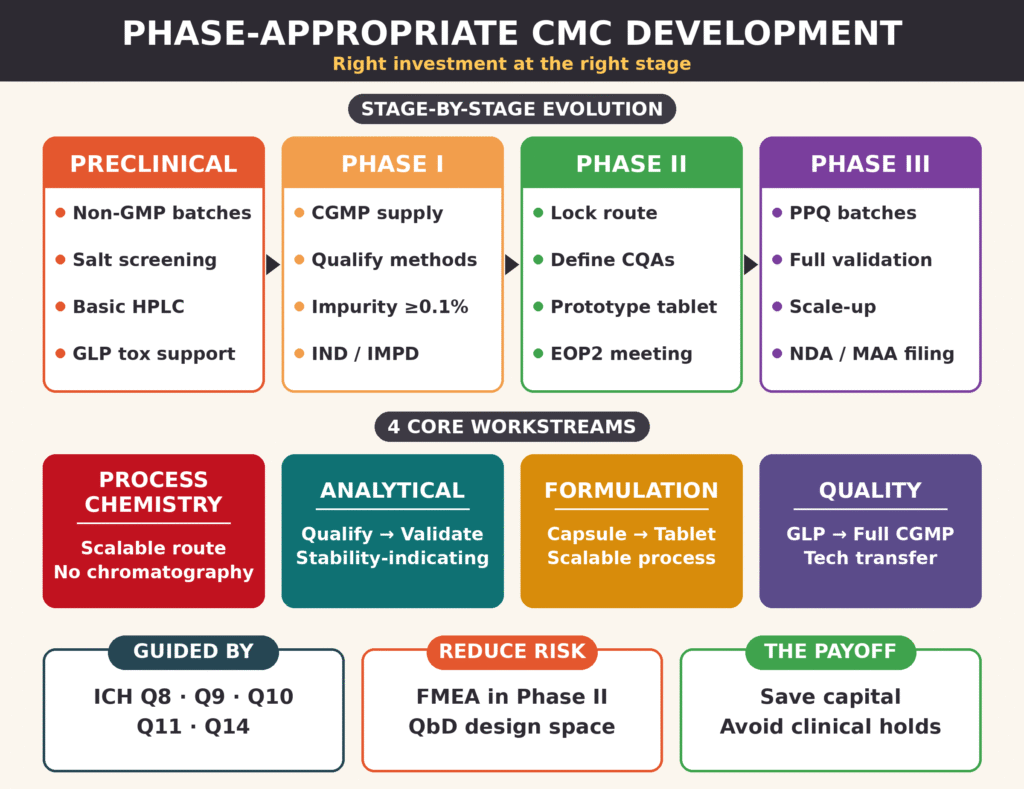
- Preclinical: non-GMP batches, salt and polymorph screening, and basic HPLC to support GLP toxicology studies.
- Phase I: CGMP clinical supplies, qualified methods, impurity tracking at 0.10% or above, and IND/IMPD filings.
- Later stages:
- Phase II: the synthetic route is near-locked, CQAs are defined, a commercial dosage form is developed, and the EOP2 meeting is held.
- Phase III: PPQ batches, full ICH Q2(R2)/Q14 validation, commercial scale-up, and NDA/MAA filing.
- Four core workstreams: These grow side by side across the phases:
- Process chemistry: a scalable route without chromatography.
- Analytical: methods move from qualified to fully validated.
- Formulation: dosage forms move from capsule to tablet.
- Quality: oversight moves from GLP to full commercial CGMP, with technology transfer.
- Risk mitigation: FMEA in Phase II and QbD design-space studies flag weaknesses before Phase III. Examples include single-source excipients, purification that can’t scale, and weak analytical methods. Catching these early avoids costly re-validation and delays.
Strategic Foundations of Phase-Appropriate CMC Development at a CDMO
Implementing Phase-Appropriate CMC Development at a CDMO creates a risk-balanced operational structure in which manufacturing investments correspond to the clinical maturity of the drug candidate. This approach limits unnecessary engineering of early-stage candidates while ensuring that assets approaching commercialization have the process robustness necessary to support commercial licensure.
The regulatory principles supporting phase-appropriate development are based on international guidance from the International Council for Harmonisation (ICH), particularly ICH Q8 (Pharmaceutical Development), ICH Q9 (Quality Risk Management), ICH Q10 (Pharmaceutical Quality System), ICH Q11 (Development and Manufacturing of Drug Substances), and ICH Q14 (Analytical Procedure Development). Regulatory authorities such as the U.S. Food and Drug Administration (FDA) and the European Medicines Agency (EMA) acknowledge that manufacturing controls and analytical documentation should be proportionate to the level of clinical exposure and the size of the patient population being studied.
In preclinical development and Phase I studies, clinical cohorts are generally limited in size, exposure periods are relatively short, and the primary focus is establishing human safety and obtaining preliminary pharmacokinetics (PK) information. Therefore, regulatory expectations primarily emphasize drug substance identity, basic purity, the absence of unexpected toxicity, and appropriate Current Good Manufacturing Practice (CGMP) compliance. As development progresses into Phase II and Phase III, where studies involve broader patient populations and longer treatment periods, regulatory attention increasingly focuses on process reproducibility, critical process parameter (CPP) control, long-term stability, and consistency of critical quality attributes (CQAs). Coordinating CDMO activities with these changing regulatory expectations helps preserve capital during early development while preventing technical gaps that could compromise pivotal clinical programs.
Learn more about peptide drug development CDMO services designed to support development programs across different stages.
Stage-by-Stage CMC Evolution: Preclinical to Phase III
The operational scope of Chemistry, Manufacturing, and Controls develops from preliminary route scouting and exploratory formulation activities during preclinical research into fully characterized, validated, and commercially scalable manufacturing processes by Phase III. Every clinical milestone introduces increasingly stringent quality specifications, more comprehensive analytical validation, and greater regulatory oversight.
Preclinical Phase: Material Integrity and Safety Benchmarks
Preclinical CMC activities are primarily directed toward producing non-GMP drug substance batches for preliminary formulation screening, salt selection, and Good Laboratory Practice (GLP) toxicology studies. The main objectives include confirming basic chemical identity, evaluating solid-state forms, and developing non-validated analytical procedures suitable for early characterization.
During preclinical development, chemical synthesis commonly uses non-optimized discovery routes established by medicinal chemists. These early pathways are designed to provide rapid access to compounds rather than maximize cost efficiency or manufacturing scalability. As a result, they may depend on expensive reagents, hazardous solvents, and preparative column chromatography. Analytical characterization generally uses non-validated, fitness-for-purpose High-Performance Liquid Chromatography (HPLC) assays to verify active pharmaceutical ingredient (API) identity and establish basic purity.
- Drug Substance: Production of initial non-GMP scale-up batches, preliminary polymorph and salt screening, and characterization of initial reference materials.
- Drug Product: Basic “fit-for-purpose” dosage presentations, including active-in-capsule (AIC), powder-in-bottle, or simple non-sterile liquid suspensions, to facilitate animal dosing without extensive excipient development.
- Analytical & Quality: Qualification of basic assay methods, development of preliminary forced degradation profiles, and non-GMP analytical release testing to support GLP toxicology studies.
Phase I Clinical Trials: Safety, Initial Characterization, and Flexible Processing
Phase I CMC development emphasizes human subject safety, fundamental Current Good Manufacturing Practice (CGMP) compliance, and flexible process controls that can accommodate first-in-human dose-escalation studies. Key activities include initial analytical method qualification, characterization of important impurities, and preparation of straightforward clinical supplies.
Manufacturing Phase I Clinical Trial Material (CTM) requires compliance with CGMP standards appropriate for early clinical development and adherence to regulatory guidance such as the FDA’s CGMP for Phase 1 Investigational Drugs. Process chemistry activities concentrate on transforming discovery routes into early process chemistry pathways by removing highly toxic reagents, replacing unsafe unit operations, and establishing crystallization procedures that can be scaled. Analytical procedures generally undergo method qualification rather than complete validation in accordance with ICH Q2(R2), with method specificity, linearity, and precision established to support batch consistency and patient safety.
- Regulatory Filings: Development of Phase I Investigational New Drug (IND) applications or Investigational Medicinal Product Dossiers (IMPD) containing Module 3 information covering API characterization, preliminary batch analysis, and safety-critical impurity profiles.
- Formulation Strategy: Use of straightforward dosage forms, such as active-in-capsule or simple oral solutions, to accelerate first-in-human (FIH) development while maintaining flexibility during dose escalation.
- Impurity Profiling: Identification and monitoring of process impurities present at ≥ 0.10%, together with early assessment of mutagenic impurities and elemental catalysts.
Phase II Clinical Trials: Process Optimization and Mid-Stage Alignment
Phase II CMC development focuses on defining Critical Quality Attributes (CQAs), establishing a stable synthetic pathway, and developing final patient-centric commercial formulation concepts. Contract Development and Manufacturing Organizations (CDMOs) implement more stringent in-process controls while expanding stability programs to support clinical studies conducted across multiple sites.
As Phase II studies evaluate clinical proof-of-concept, CDMOs place greater emphasis on improving process performance and increasing yield. The synthetic route is typically locked or brought close to a final state to minimize the possibility of major process changes later in development that could modify the impurity profile or require bridging bioequivalence studies. Raw material specifications are formalized, commercial-grade chemical suppliers are qualified, and controlled crystallization processes are optimized to achieve reproducible solid-state characteristics, including crystal habit and particle size distribution.
Review peptide API scale-up strategies for considerations involved in transitioning processes toward larger manufacturing scales.
- Formulation Evolution: Progression from basic Phase I dosage presentations toward representative commercial dosage forms, such as film-coated tablets or stable parenteral formulations, using scalable operations including wet granulation or fluid-bed drying.
- Analytical Maturity: Advancement of qualified analytical procedures into partially validated stability-indicating assays, supported by structured stress testing under accelerated and long-term storage conditions.
- Regulatory Engagements: Conducting End-of-Phase II (EOP2) CMC meetings with regulatory bodies to confirm proposed Regulatory Starting Materials (RSMs), commercial dosage form designs, and late-stage control strategies.
Phase III Clinical Trials: Process Validation and Commercial Readiness
Phase III CMC development demands readiness for commercial manufacturing, comprehensive analytical method validation in accordance with ICH Q2(R2)/Q14 guidelines, and implementation of Process Performance Qualification (PPQ) protocols. Process parameters, material attributes, and analytical procedures are finalized and controlled to support commercial launch and registration submissions.
At the Phase III stage, synthetic processes, formulations, analytical methods, and primary packaging systems are fully established. CDMOs conduct technology transfers to commercial manufacturing facilities and perform scale-up using commercial equipment trains. Critical Process Parameters (CPPs) and CQAs are evaluated and correlated through multi-factorial Design of Experiments (DoE) studies to establish the operational Design Space according to Quality by Design (QbD) principles.
Explore peptide CDMO scale-up services to support the transition from development-scale processes toward larger manufacturing operations.
- Process Validation: Execution of registration and PPQ batches under commercial CGMP conditions to demonstrate reproducibility across consecutive commercial-scale lots.
- Full Analytical Validation: Comprehensive ICH Q2(R2) and ICH Q14 validation addressing accuracy, precision, specificity, limit of detection (LOD), limit of quantitation (LOQ), linearity, range, and method robustness for release and stability assays.
- Registration Dossier: Preparation of complete New Drug Application (NDA) or Marketing Authorization Application (MAA) Module 3 documentation, including comprehensive structural elucidation packages, validated control strategies, and real-time stability data.
Core Workstreams in Phase-Appropriate CMC Development at a CDMO
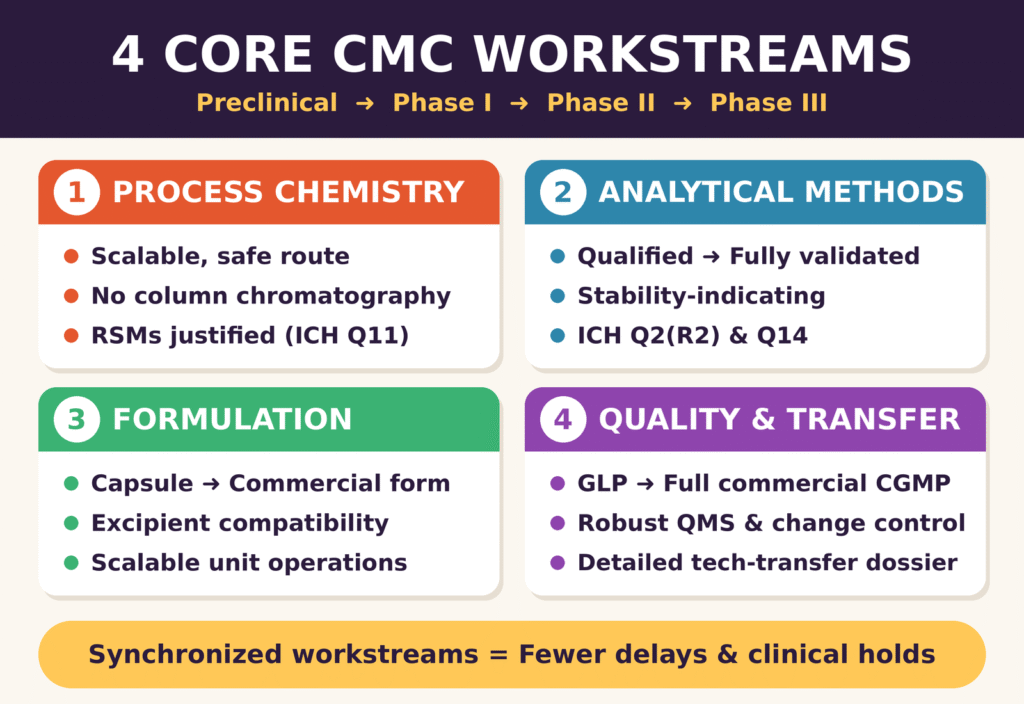
Successful progression of a drug molecule requires coordinated management of four major CMC workstreams: synthetic route chemistry, analytical procedure validation, drug product formulation engineering, and quality management. Synchronizing these activities throughout a CDMO network helps minimize technical bottlenecks and reduce the possibility of regulatory clinical holds.
Synthetic Route Development and Process Chemistry
Synthetic route development transforms rapid medicinal chemistry approaches into safe, scalable, reproducible, and economically viable commercial process chemistry. Major milestones include the selection of Regulatory Starting Materials (RSMs), elimination of column chromatography, and assessment of mutagenic impurity risks.
During early discovery, medicinal chemistry routes are primarily designed for rapid structural assembly and may involve hazardous reagents, volatile solvents, and expensive chromatographic purification. As development moves toward Phase II and Phase III, CDMO process chemists redesign these pathways to improve manufacturability. Important modifications include replacing hazardous compounds, reducing the number of linear synthetic steps, improving reaction yields, and developing robust crystallization procedures that remove the need for chromatographic separation. In addition, sponsors are expected to formally define and justify RSMs in accordance with ICH Q11 principles before Phase III registration batches are initiated.
Compare the operational differences between a peptide CDMO and CMO when evaluating external manufacturing capabilities.
Phase-Appropriate Analytical Method Validation
Analytical development progresses from initial fitness-for-purpose method qualification during early development to complete analytical validation under ICH Q2(R2) and ICH Q14 requirements for commercial submission. Throughout this progression, analytical procedures must continue to demonstrate stability-indicating performance as the drug substance synthetic route and formulation evolve.
Analytical procedures must remain aligned with changes to the manufacturing process. Methods established for early Phase I materials may not provide sufficient selectivity to distinguish newly formed degradation products or synthesis-related impurities introduced through subsequent route modifications. CDMOs therefore conduct forced degradation stress studies by exposing drug substance to acid, base, peroxide, heat, and light conditions to verify that analytical procedures remain stability-indicating throughout development. By Phase III, analytical methods used for drug release, stability monitoring, in-process control, and raw material testing undergo full ICH validation.
Discover GLP-1 peptide analytical characterization approaches for evaluating peptide identity, purity, impurities, and related analytical attributes.
Formulation Engineering and Drug Product Manufacturing
Formulation engineering progresses drug delivery from straightforward exploratory presentations, such as active-in-capsule, toward scalable and commercially suitable oral or parenteral dosage forms. Extensive excipient compatibility evaluations, dissolution testing, and container closure integrity studies are performed to support long-term stability and consistent bioavailability.
Early clinical studies often use simple dosage presentations that facilitate rapid dose-escalation changes while limiting initial formulation costs. However, such early formulations generally do not provide the long-term chemical stability, physical robustness, or high-throughput manufacturing capability necessary for commercial distribution. During Phase II, CDMOs conduct formal excipient compatibility studies, optimize bioavailability, and develop scalable unit operations, including wet granulation, roller compaction, or fluid-bed drying. By Phase III, the formulation and primary packaging system are finalized and transferred to automated commercial manufacturing lines.
Quality Systems and Technology Transfer Execution
Quality management develops from flexible, safety-oriented CGMP oversight during early clinical development into comprehensive commercial Quality Management System (QMS) controls that support process validation. Structured technology transfer protocols facilitate controlled movement of the manufacturing process from clinical pilot facilities to commercial manufacturing sites.
Quality Assurance (QA) oversight increases as clinical exposure and manufacturing complexity expand. Preclinical activities follow Good Laboratory Practice (GLP) requirements, whereas Phase I clinical trial manufacturing operates under phase-appropriate CGMP expectations. By Phase III, quality oversight follows comprehensive commercial CGMP frameworks, including 21 CFR Parts 210/211 for small molecules and Part 600 for biologics. Technology transfer packages prepared by the CDMO also become increasingly detailed, progressing from basic master batch records to comprehensive technical dossiers that include complete risk assessments, equipment equivalency studies, and defined process operating ranges.
Learn how to evaluate potential partners with this guide on how to choose a peptide CDMO in the US.
Comprehensive Stage-Specific CMC Evolution Matrix
The stage-specific CMC evolution matrix offers a side-by-side assessment of technical requirements, regulatory submissions, and quality controls associated with each stage of drug development. This structured comparison can be used to assess program maturity and determine readiness for the next phase of development.
| CMC Parameter | Preclinical Phase | Phase I Clinical Trials | Phase II Clinical Trials | Phase III / NDA Registration |
|---|---|---|---|---|
| Drug Substance Synthesis | Non-GMP discovery route; chromatography reliance. | Initial CGMP process chemistry; safety improvements. | Scalable synthetic route near-locked; RSMs proposed. | Fully locked commercial route; RSMs justified (ICH Q11). |
| Drug Product Formulation | Simple solution, AIC, or powder-in-bottle. | Active-in-capsule or simple liquid presentation. | Commercial dosage concept selected; prototype tablets/capsules. | Final commercial dosage form, strength, and presentation locked. |
| Analytical Method Status | Fitness-for-purpose assays; non-validated. | Qualified testing methods; stability-indicating proof. | Partially validated methods; expanded stability protocols. | Full validation per ICH Q2(R2) and ICH Q14. |
| Impurity Profiling | Basic purity profiling; toxicological support. | Track impurities ≥ 0.10%; mutagenic/elemental screening. | Elucidate structure of key degradants; set limits. | Complete impurity identification and qualified acceptance limits. |
| Stability Testing | Non-GMP exploratory stress testing. | Formal ICH protocols supporting FIH shelf-life. | Expanded ICH stability across pilot batches. | Formal ICH stability on PPQ/registration batches in commercial packaging. |
| Quality & Compliance | Non-GMP / GLP toxicology compliance. | CGMP phase-appropriate compliance (Phase I CTM). | Mature CGMP QMS; formal change control and vendor audits. | Full commercial CGMP compliance; PAI readiness. |
Strategic Risk Mitigation in Phase-Appropriate CMC Development at a CDMO
Proactive risk management during phase-appropriate development requires technical vulnerabilities, supply chain limitations, and analytical deficiencies to be identified before pivotal Phase III studies begin. Applying Quality by Design (QbD) tools and failure mode analyses helps prevent expensive late-stage re-validation activities and reduces the risk of clinical holds.
Late-stage drug development programs can encounter significant delays when CMC limitations established during earlier phases are carried forward into commercialization without adequate remediation. Common failure modes include continuing to use custom, single-source excipients in late-stage formulations, depending on purification procedures that cannot be scaled effectively, or relying on non-specific analytical methods that are unable to adequately distinguish degradation products during long-term stability studies.
CDMOs mitigate these risks by performing formal Failure Mode and Effects Analysis (FMEA) risk assessments before late-stage processes are finalized. Assessing raw material availability, process robustness, solid-state stability, and equipment scale-up considerations during Phase II allows technical teams to prepare more effectively for process validation and commercial technology transfer. Specialized CDMOs provide technical expertise throughout this progression, helping connect early exploratory development with eventual commercial manufacturing.
Read this peptide characterization case study of semaglutide to see how comprehensive characterization can support peptide development.
Conclusion
Phase-Appropriate CMC Development at a CDMO establishes a strategic framework for balancing scientific rigor, regulatory compliance, and capital efficiency throughout the drug development lifecycle. Through the systematic advancement of process chemistry, analytical validation, and quality oversight, biopharmaceutical sponsors can reduce development risks while establishing a structured pathway toward commercial licensure.
As a compound progresses from preclinical toxicological studies into pivotal Phase III trials, CMC priorities evolve from rapid material availability toward process reproducibility, Quality by Design (QbD) risk management, and commercial registration filing requirements. Collaboration with an experienced CDMO helps ensure that essential technical milestones—including Regulatory Starting Material (RSM) designation, stability-indicating method validation, and Process Performance Qualification (PPQ)—are completed while minimizing the potential for regulatory delays and technical complications.
Explore peptide CDMO services in Canada for development and manufacturing support across the peptide lifecycle.
To learn more about how specialized analytical development and phase-appropriate manufacturing strategies can support a drug candidate from initial feasibility through commercial launch, visit the ResolveMass Laboratories Inc. Contact Us Page.
Frequently Asked Questions
Full analytical method validation under ICH Q2(R2) is generally completed later because drug substance processes, formulations, and impurity profiles may continue to change during Phase I and Phase II. Performing extensive validation too early can require repeated validation when manufacturing or analytical procedures are modified. Phase III provides a more established process on which comprehensive validation can be based.
Phase I manufacturing follows phase-appropriate CGMP controls focused on patient safety, contamination prevention, material traceability, and essential quality testing. By Phase III, manufacturing must meet comprehensive commercial CGMP requirements, including qualified equipment, formal change control, validated analytical procedures, and Process Performance Qualification (PPQ). The controls therefore become more extensive as clinical and commercial risks increase.
Candidate Regulatory Starting Materials (RSMs) should generally be evaluated during Phase II process development as the synthetic route becomes more established. Their selection should be formally defined and justified according to ICH Q11 principles before Phase III registration manufacturing begins. Addressing RSM strategy early can reduce the possibility of significant process changes during late-stage development.
Carrying an active-in-capsule (AIC) formulation from Phase I into Phase III can create challenges related to scalability, long-term stability, dissolution performance, and commercial manufacturing efficiency. Such a presentation may also provide limited flexibility for large-scale automated production. Developing a representative commercial dosage form during Phase II allows these manufacturing and product-performance considerations to be addressed earlier.
Preclinical stability work typically uses exploratory stress studies to understand the initial chemical and physical behavior of the drug substance or product. During Phase I, formal ICH accelerated and long-term studies are introduced to generate information supporting clinical shelf-life. Stability programs are subsequently expanded during Phase II and Phase III, including evaluation of registration batches in the intended commercial container closure systems.
Quality by Design (QbD) can begin in early development by establishing an initial Quality Target Product Profile (QTPP) and identifying potential Critical Quality Attributes (CQAs). As development progresses through Phase II and Phase III, more structured QbD activities are performed using multi-factorial Design of Experiments (DoE). These studies help establish the operational Design Space and define appropriate Critical Process Parameter (CPP) limits.
Drug substance release specifications may initially allow greater flexibility during Phase I because process knowledge and manufacturing history are still limited. As additional batch, analytical, stability, and clinical data become available during Phase II and Phase III, acceptance criteria can be refined based on accumulated process understanding. Commercial specifications ultimately reflect established product quality requirements and the finalized manufacturing process.
Technology transfer between CDMO facilities may become necessary when production moves from clinical-scale manufacturing to larger commercial-scale operations. Other drivers can include the need for specialized technologies such as high-containment processing or lyophilization, increased manufacturing capacity, or implementation of dual-sourcing strategies. A structured transfer helps maintain process consistency, product quality, and supply continuity between facilities.
Sponsors can reduce the risk of CMC-related clinical holds by maintaining comprehensive impurity characterization, using appropriate stability-indicating analytical procedures, and ensuring complete batch traceability. Clinical trial materials must also be manufactured under CGMP controls appropriate to the development stage. Consistent documentation, process control, and timely resolution of identified quality risks further support regulatory readiness.
Reference:
- U.S. Food and Drug Administration. (2003). INDs for phase 2 and phase 3 studies: Chemistry, manufacturing, and controls information: Guidance for industry. U.S. Department of Health and Human Services, Center for Drug Evaluation and Research. FDA guidance document
- Kretsinger, J., Frantz, N., Hart, S. A., Kelley, W. P., Kitchen, B., Novick, S., Rellahan, B., Stranges, D., Stroop, C. J. M., Yin, P., & Gastens, M. H. (2019). Expectations for phase-appropriate drug substance and drug product specifications for early-stage protein therapeutics. Journal of Pharmaceutical Sciences, 108(4), 1442–1452. https://doi.org/10.1016/j.xphs.2018.11.042
- Kurata, H., Ishino, T., Ohshima, Y., & Yohda, M. (2022). CDMOs play a critical role in the biopharmaceutical ecosystem. Frontiers in Bioengineering and Biotechnology, 10, 841420. https://doi.org/10.3389/fbioe.2022.841420
- Zhang, L. (2024). The effects of transforming the CDMO strategy on the business performance of Porton based on financial statement analysis. In X. Li, C. Yuan, & J. Kent (Eds.), Proceedings of the 7th International Conference on Economic Management and Green Development (pp. 224–234). Springer Nature Singapore. https://doi.org/10.1007/978-981-97-0523-8_20
- Rivera Rojas, J. E. (2025). The CDMO model in lyophilization: Bridging technological gaps and postharvest losses in emerging economies (Case study: Colombia). ResearchGate. ResearchGate publication
Get In Touch With Us
About The Author


