

Introduction
Therapeutic oligonucleotide manufacturing depends on Phosphoramidite Solid-Phase Synthesis to assemble custom single-stranded and double-stranded nucleic acid sequences at scales ranging from grams to kilograms, with stepwise coupling yields exceeding 99%. This automated technology enables the reproducible incorporation of chemical monomers to produce antisense oligonucleotides (ASOs), small interfering RNAs (siRNAs), microRNA mimics, and aptamers under stringent quality control conditions. As nucleic acid therapeutics progress through clinical development, industrial manufacturing operations must optimize reaction kinetics, solid support architectures, thiolation chemistry, and post-synthetic purification processes to meet regulatory purity requirements. Advanced analytical verification, including liquid chromatography-mass spectrometry (LC-MS) characterization protocols offered by specialized institutions such as ResolveMass Laboratories Inc., is essential for identifying minor impurities and confirming full-length sequence fidelity across commercial production batches.
Explore specialized peptide-oligonucleotide conjugate preclinical services to support analytical characterization and preclinical development of advanced oligonucleotide-based therapeutics.
Share via:
Get In Touch With Us
Quick Summary:
- Purpose: Phosphoramidite solid-phase synthesis is the core method for making therapeutic oligonucleotides (ASOs, siRNAs, microRNA mimics, aptamers) at gram to kilogram scale, with coupling yields above 99% per step.
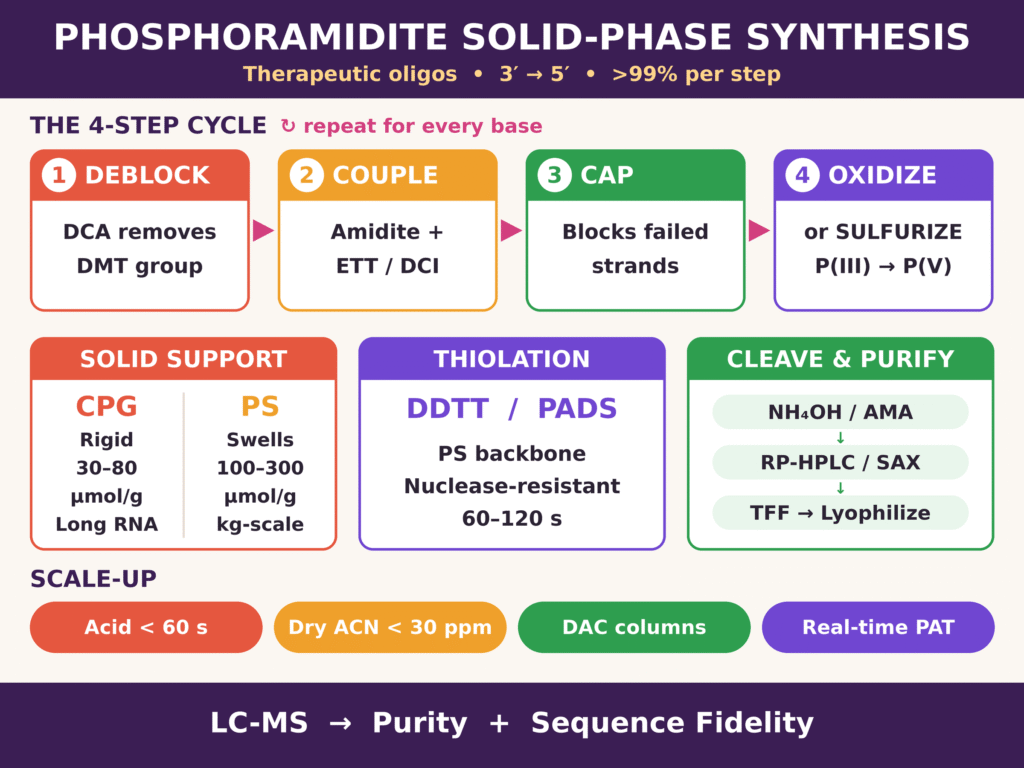
- Four-step cycle: Each base is added in the 3′ to 5′ direction through four steps. Deblocking removes the DMT group with DCA, coupling links the activated phosphoramidite using ETT or DCI, capping blocks failed strands, and oxidation or sulfurization converts P(III) to a stable P(V) linkage.
- Process control: Inline UV monitoring of the orange DMT cation (at 495 nm) tracks step yields in real time. Capping keeps (n−1) deletion impurities low.
- Solid supports: Controlled Pore Glass (CPG) is rigid and loads 30–80 µmol/g, which suits high-throughput work and long RNA. Polystyrene swells in solvent and loads 100–300 µmol/g, which suits kilogram-scale ASO and siRNA production.
- Thiolation: DDTT and PADS have replaced the older Beaucage reagent, which tended to precipitate. They form nuclease-resistant phosphorothioate linkages quickly and cleanly.
- Downstream processing: Ammonia or AMA cleaves the oligo from the support and removes protecting groups, and RNA also needs a fluoride step. RP-HPLC (often DMT-on) or SAX chromatography then purifies the product, followed by TFF and lyophilization.
- Scale-up and quality: Large-scale runs keep acid contact under 60 seconds to limit depurination, and use dry recycled acetonitrile, DAC columns and real-time PAT. LC-MS confirms purity and sequence fidelity across batches.
Cyclic Mechanism of Phosphoramidite Solid-Phase Synthesis
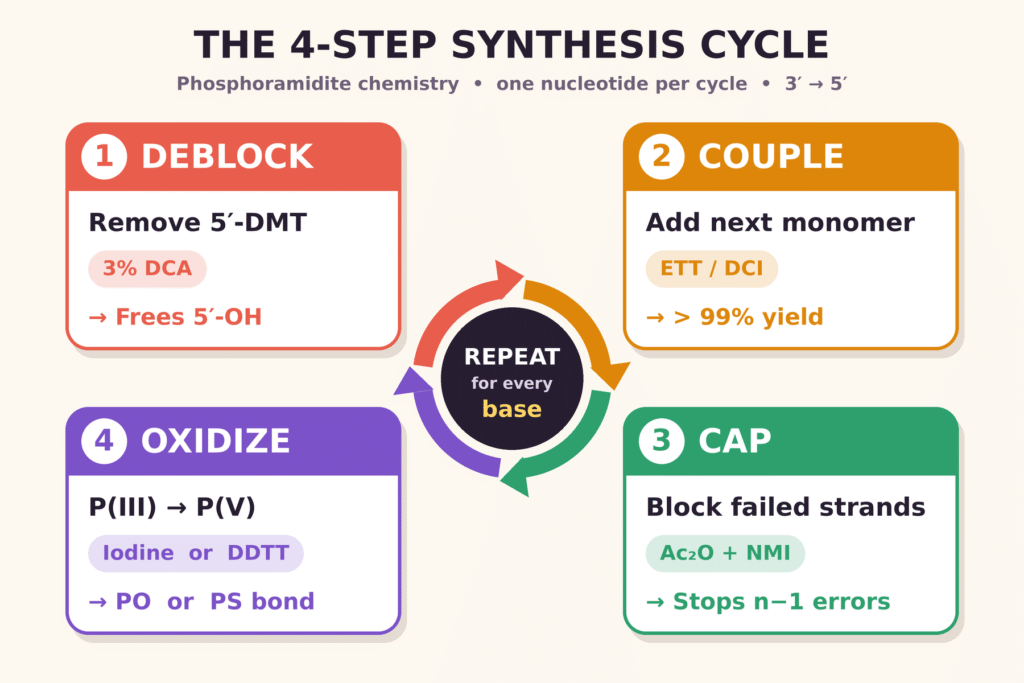
Phosphoramidite Solid-Phase Synthesis extends an oligonucleotide chain one monomer at a time in the 3′ to 5′ direction through four sequential operations: deblocking, coupling, capping, and oxidation or sulfurization. Repetition of this four-step cycle establishes the phosphorus backbone and helps control side reactions during the synthesis of long-chain nucleic acids.
Four-Step Synthesis Cycle
- Deblocking: Removal of the 5′-DMT group using dichloroacetic acid (DCA).
- Activation and Coupling: Reaction of the phosphoramidite with an azole activator, such as ETT or DCI.
- Capping: Acetylation of unreacted 5′-hydroxyl groups using acetic anhydride and N-methylimidazole (NMI).
- Oxidation or Sulfurization: Conversion of P(III) into P(V) using iodine and water for phosphodiester (PO) linkages or sulfur-transfer reagents such as DDTT and PADS for phosphorothioate (PS) linkages.
The four-step cycle is repeated for each nucleotide addition required to construct the target sequence.
Learn more about peptide-oligonucleotide conjugate synthesis methods and the chemical strategies used to construct complex oligonucleotide-based conjugates.
Step 1: Deblocking (Detritylation) in Phosphoramidite Solid-Phase Synthesis
Deblocking removes the terminal acid-labile 4,4′-dimethoxytrityl (DMT) protecting group from the 5′-hydroxyl position of the support-bound nucleoside using dilute organic acids. This reaction exposes a free nucleophilic 5′-hydroxyl group, which is necessary for coupling with the next incoming nucleotide monomer.
In standard automated manufacturing operations, deblocking is performed using 3% dichloroacetic acid (DCA) or trichloroacetic acid (TCA) dissolved in dichloromethane (DCM) or toluene, typically for approximately 50 seconds. The cleavage reaction releases an intensely orange-colored dimethoxytrityl carbocation, [DMT]+, which exhibits strong light absorption at 495 nm. Continuous inline UV-Vis spectrophotometric monitoring of the carbocation-containing effluent provides real-time quantitative information about individual step yields throughout the synthesis process.
Deblocking reaction:
Solid-Nucleoside-5′-O-DMT → Solid-Nucleoside-5′-OH + [DMT]+
Reaction conditions: DCA in toluene or another suitable organic solvent.
Step 2: Activation and Coupling Reactions
The coupling step rapidly establishes a phosphite triester P(III) bond between the exposed 5′-hydroxyl group and an incoming 3′-phosphoramidite monomer activated by an acidic azole catalyst. Reaction times generally range from 100 to 200 seconds, with coupling efficiencies exceeding 99% per step.
Standard 3′-phosphoramidite building blocks contain a 5′-DMT group, modified or unmodified nucleobases protected by acid-labile or base-labile groups, such as benzoyl, isobutyryl, or dimethylformamidine, a 2′-cyanoethyl group protecting the phosphite moiety, and a diisopropylamino leaving group. When these building blocks are combined with an acidic activator, such as 5-ethylthio-1H-tetrazole (ETT) or 4,5-dicyanoimidazole (DCI), in anhydrous acetonitrile, the diisopropylamino group becomes protonated and is converted into an effective leaving group. The support-bound 5′-hydroxyl group then performs a nucleophilic attack, displacing the amine and forming the P(III) phosphite triester internucleotide linkage.
Read about linker chemistry in peptide-oligonucleotide conjugates to understand how linker design supports conjugation, stability, and therapeutic performance.
Step 3: Capping Failure Sequences
Capping permanently blocks unreacted 5′-hydroxyl groups through acetylation with acetic or propionic anhydride, preventing unsuccessful strands from undergoing further elongation. This step reduces the accumulation of (n−1) deletion impurities, which can exhibit physical properties similar to those of the full-length therapeutic sequence.
Because the coupling efficiency of each cycle is approximately 99%, rather than an absolute 100%, around 1% of support-bound strands may fail to react during monomer addition. Without capping, these unreacted 5′-hydroxyl groups could participate in subsequent coupling reactions, generating complex mixtures of shorter deletion sequences.
Capping typically involves two reagents: Cap A, which contains acetic anhydride or propionic anhydride in tetrahydrofuran, and Cap B, which contains N-methylimidazole or 4-dimethylaminopyridine as a nucleophilic acyl-transfer catalyst. The reaction rapidly converts unreacted 5′-hydroxyl groups into inert acetate or propionate derivatives, simplifying subsequent purification.
Step 4: Oxidation or Sulfurization of the Phosphorus Backbone
Oxidation or sulfurization converts the chemically reactive trivalent phosphite triester P(III) intermediate into a stable pentavalent P(V) internucleotide linkage. Aqueous iodine solutions produce conventional phosphodiester (PO) backbones, whereas specialized sulfurization reagents generate nuclease-resistant phosphorothioate (PS) linkages.
For phosphodiester linkages, oxidation is performed using 0.02 M iodine dissolved in a mixture of tetrahydrofuran, pyridine, and water. Water serves as the oxygen donor, facilitating the conversion of phosphite triester P(III) into phosphate triester P(V).
For therapeutic oligonucleotides that require enhanced metabolic stability against plasma nucleases, sulfurization replaces the conventional oxidation step. Specialized sulfur-transfer agents introduce a sulfur atom at the phosphorus center within approximately 60 to 180 seconds, producing phosphorothioate internucleotide linkages.
Discover the mechanisms of action of peptide-oligonucleotide conjugates to learn how conjugate architecture can influence cellular uptake and the biological activity of oligonucleotide therapeutics.
Solid Support Matrices in Phosphoramidite Solid-Phase Synthesis: CPG vs. Polystyrene
Solid support selection in Phosphoramidite Solid-Phase Synthesis determines the volumetric loading capacity, fluid dynamics, and overall yield of the chemical synthesis reactor. Controlled Pore Glass (CPG) provides rigid pore structures suitable for low-swelling continuous-flow systems, whereas cross-linked Polystyrene (PS) offers higher functional loading capacities that are advantageous for large-scale manufacturing.
Controlled Pore Glass consists of uniform silica particles containing defined pore networks, typically engineered with pore sizes of 500 Å or 1000 Å. CPG maintains dimensional stability in organic solvents, preserving consistent bed volumes and minimizing column backpressure during rapid reagent exchanges. However, its inorganic surface limits the maximum functional loading capacity to approximately 30–80 µmol/g. Consequently, CPG is particularly suitable for discovery-scale synthesis, high-throughput applications, and the production of long-chain RNA.
Cross-linked Polystyrene resins generally consist of styrene cross-linked with 1–2% divinylbenzene. These materials swell considerably in organic solvents, including acetonitrile, toluene, and dichloromethane. Solvation expands the polymer network, exposing internal binding sites and enabling functional loading capacities of approximately 100–300 µmol/g. This increased capacity reduces reactor volume and solvent consumption per mole of the synthesized target, making Polystyrene a preferred support material for kilogram-scale manufacturing of short antisense oligonucleotides and siRNA therapeutics.
| Structural and Operational Parameter | Controlled Pore Glass (CPG) | Cross-Linked Polystyrene (PS) |
|---|---|---|
| Matrix Composition | Inorganic porous silica glass | Organic styrene-divinylbenzene polymer |
| Physical Behavior in Solvents | Non-swelling and dimensionally rigid | Swelling with solvent-dependent mesh volume |
| Pore Diameter / Structure | Fixed pores (500 Å–1000 Å) | Dynamic, solvated gel network |
| Functional Loading Range | 30–80 µmol/g | 100–300 µmol/g |
| Pressure and Flow Resistance | Minimal variation in backpressure | Variable backpressure due to swelling |
| Target Scale and Application | High-throughput synthesis and long RNA sequences (>50-mer) | Kilogram-scale therapeutic ASO and siRNA production |
Explore the types of peptide-oligonucleotide conjugates to compare different conjugate architectures and their potential applications in therapeutic development.
Optimization of Thiolation Kinetics for Therapeutic Oligonucleotides
Thiolation kinetics in therapeutic oligonucleotide manufacturing are optimized by replacing reagents prone to precipitation with efficient sulfur-transfer agents, such as DDTT and PADS. Rapid sulfur transfer promotes complete conversion of phosphite triesters while minimizing oxidative side reactions and sequence degradation.
Phosphorothioate linkages introduce a chiral center at each modified phosphorus atom, resulting in complex mixtures of RP and SP stereoisomers. These stereoisomers can influence therapeutic efficacy, metabolic half-life, and RNase H activation. Earlier manufacturing approaches relied on 3H-1,2-benzodithiol-3-one 1,1-dioxide, commonly known as Beaucage reagent. However, this reagent presented limitations related to solubility and an increased risk of precipitation in automated liquid-distribution lines.
Modern commercial manufacturing processes primarily employ 3-amino-1,2,4-dithiazole-5-thione (DDTT) or phenylacetyl disulfide (PADS). DDTT exhibits high solubility in pyridine/acetonitrile mixtures, exceeding 0.1 M, and can achieve quantitative sulfurization within 60 to 120 seconds without inducing nucleobase degradation. PADS offers greater chemical stability in solution during extended production cycles, although its contact time must be optimized to minimize secondary oxidation and other undesirable side reactions.
Review the challenges associated with peptide-oligonucleotide conjugates to understand the formulation, manufacturing, and characterization issues that may arise during conjugate development.
Cleavage, Base Deprotection, and Downstream Processing
Cleavage and deprotection release the synthesized oligonucleotide from its solid support and remove protecting groups from the nucleobases using alkaline solutions, such as ammonium hydroxide or methylamine. Subsequent downstream processing separates full-length target sequences from truncated side products through reverse-phase or anion-exchange chromatography.
Post-synthetic processing begins with base-catalyzed cleavage of the ester or UnyLinker linkage that attaches the 3′-terminal nucleoside to the support matrix. Standard protocols use concentrated aqueous ammonium hydroxide (28–30%) at 55 °C for 4 to 12 hours. This treatment simultaneously cleaves the solid-support tether and removes protecting groups from adenine, cytosine, and guanine bases.
To shorten processing times, industrial manufacturers frequently use an equal mixture of concentrated ammonium hydroxide and 40% aqueous methylamine, known as AMA, at 65 °C for 15 to 30 minutes. AMA treatment reduces thermal exposure and overall processing time but requires acetyl-protected cytosine monomers to prevent the formation of transamination-related side products.
For RNA sequences containing 2′-protecting groups, such as 2′-O-tert-butyldimethylsilyl (2′-TBDMS), an additional treatment with fluoride reagents, such as triethylamine trihydrofluoride (TEA·3HF), is necessary to expose the 2′-hydroxyl groups.
After deprotection, crude oligonucleotide mixtures undergo purification using preparative Reverse-Phase High-Performance Liquid Chromatography (RP-HPLC) or Strong Anion-Exchange (SAX) Chromatography. RP-HPLC frequently employs a DMT-on strategy in which the hydrophobic 5′-DMT group retained on full-length sequences promotes selective binding to the stationary phase. This allows the target product to be separated from more hydrophilic DMT-off failure sequences. On-column or post-elution detritylation using dilute acid subsequently removes the DMT group to yield the purified target sequence. The product is then desalted and concentrated through Tangential Flow Filtration (TFF) before lyophilization.
Learn about structural characterization of peptide-oligonucleotide conjugates to understand the importance of analytical verification for complex oligonucleotide-based constructs.
Industrial Scale-Up Considerations in Phosphoramidite Solid-Phase Synthesis
Scaling Phosphoramidite Solid-Phase Synthesis to multikilogram production requires addressing several physical chemistry challenges, including acid-induced depurination, solvent consumption, and mass-transfer resistance. Industrial facilities employ dynamic axial compression columns, inline process analytical technologies, and optimized solvent recirculation systems to maintain high process yields and consistent product quality.
Depurination Suppression
Repeated exposure to acidic detritylation reagents during deblocking can cause depurination, which involves the cleavage of N-glycosidic bonds connecting purine bases, including adenine and guanine, to the sugar ring. Large-scale reactors use low-temperature acid delivery systems and continuous-flow monitoring to minimize acid exposure, typically targeting contact times of less than 60 seconds.
Solvent Efficiency and Consumption
Solid-phase synthesis requires substantial volumes of anhydrous acetonitrile, with water content maintained below 30 ppm, for washing and reagent transport. Commercial manufacturing facilities use closed-loop solvent recovery units and inline moisture traps to reduce raw material costs and minimize environmental impact.
Mass Transfer and Bed Fluidization
Large-diameter packed-bed columns may experience axial channeling and uneven fluid distribution, creating localized concentration gradients within the synthesis bed. Dynamic Axial Compression (DAC) columns maintain consistent hydraulic pressure across the support bed, helping achieve uniform linear fluid velocity and improving reagent distribution throughout the reactor.
Process Analytical Technology (PAT)
Real-time UV monitoring of DMT carbocation release, inline conductivity measurements, and rapid mass spectrometry verification enable the prompt detection of coupling or thiolation deviations during production. These analytical controls support timely process adjustments and help maintain product quality and batch consistency.
Explore specification setting for peptide-oligonucleotide conjugates to learn how product quality attributes and acceptance criteria can support consistent manufacturing and quality control.
Conclusion
The commercial manufacturing of therapeutic oligonucleotides relies fundamentally on the chemical efficiency and mechanical scalability of Phosphoramidite Solid-Phase Synthesis. Continued improvements in coupling catalysts, solid support matrices, thiolation kinetics, and post-synthetic purification are essential for ensuring a reliable supply of clinical-grade nucleic acid therapeutics. Advanced analytical techniques, including high-resolution LC-MS characterization, provide the detailed verification needed to confirm sequence fidelity, identify impurities, and establish batch consistency throughout commercial scale-up operations.
Learn how peptide-oligonucleotide conjugates are addressed in IND submissions to understand the role of analytical characterization and supporting quality documentation in clinical development.
To discuss therapeutic oligonucleotide analytical characterization, impurity profiling, or quality control services, contact the technical specialist team at ResolveMass Laboratories Inc. through their Contact Us Page.
Frequently Asked Questions
Chemical oligonucleotide synthesis generally proceeds in the 3′ to 5′ direction because 5′-DMT-protected 3′-phosphoramidite building blocks provide favorable chemical stability and coupling performance. The exposed 5′-hydroxyl group also acts as an effective nucleophile during chain elongation. This approach supports efficient, reproducible synthesis through automated, sequential coupling reactions.
Depurination occurs when acidic conditions cleave the \(N\)-glycosidic bond connecting a purine base, such as adenine or guanine, to the sugar ring. This can happen during the 5′-DMT deblocking step and may compromise oligonucleotide integrity. The risk can be reduced by selecting milder acids, such as dichloroacetic acid (DCA), limiting acid exposure time, controlling temperature, and optimizing the deblocking conditions.
An azole activator, such as ETT or DCI, promotes the reaction between the incoming phosphoramidite monomer and the support-bound 5′-hydroxyl group. It activates the phosphoramidite by facilitating the displacement of the diisopropylamino leaving group. This reaction enables the formation of the phosphite triester linkage required for oligonucleotide chain elongation.
Phosphorothioate (PS) linkages contain a sulfur atom in place of one of the non-bridging oxygen atoms in the phosphate backbone, improving resistance to degradation by nucleases. In contrast, phosphodiester (PO) linkages retain the naturally occurring phosphate backbone and are generally more susceptible to enzymatic degradation. The choice between these linkages depends on the therapeutic molecule’s stability requirements and intended biological activity.
Even when coupling efficiency exceeds 99% per cycle, a small proportion of oligonucleotide strands may fail to incorporate the incoming monomer. These unreacted strands can continue through subsequent synthesis cycles and form deletion impurities of different lengths. Capping chemically blocks their free 5′-hydroxyl groups, preventing further elongation and making it easier to separate incomplete products from the full-length target during purification.
Controlled Pore Glass (CPG) typically provides functional loading capacities of approximately 30–80 µmol/g, whereas cross-linked Polystyrene (PS) can achieve approximately 100–300 µmol/g. The higher loading capacity of Polystyrene allows more oligonucleotide material to be synthesized per unit mass of support. Consequently, PS is often preferred for large-scale production of therapeutic antisense oligonucleotides and siRNA, while CPG remains useful for high-throughput and long-chain synthesis applications.
Rapid cleavage and base deprotection can be performed using AMA, a 1:1 mixture of concentrated aqueous ammonium hydroxide and 40% aqueous methylamine, at 65 °C for approximately 15–30 minutes. This approach shortens processing time compared with conventional ammonium hydroxide treatment. Alternatively, concentrated ammonium hydroxide alone can be applied at 55 °C for 4–12 hours, depending on the oligonucleotide sequence and protecting-group chemistry.
Deletion impurities can be separated from full-length oligonucleotides using Reverse-Phase High-Performance Liquid Chromatography (RP-HPLC) or Strong Anion-Exchange (SAX) Chromatography. In the DMT-on approach, the hydrophobic 5′-DMT group helps distinguish full-length products from shorter, DMT-off failure sequences. SAX chromatography separates oligonucleotides according to differences in their charge-related interactions with the stationary phase, supporting effective impurity removal.
High-resolution liquid chromatography-mass spectrometry (LC-ESI-MS) and MALDI-TOF MS are used to assess molecular mass and confirm the expected identity of synthesized oligonucleotides. Capillary gel electrophoresis (CGE) and ion-pair reverse-phase HPLC (IP-RP-HPLC) help evaluate product purity and detect truncated sequences or related impurities. Together, these analytical techniques support the assessment of sequence integrity, sulfurization completeness, and overall product quality.
Reference:
- Yakovleva, K. I., Pereverzev, I. M., Kechin, A. A., Boyarskikh, U. A., Filipenko, M. L., Shevelev, G. Y., Sherstyuk, Y. V., & Dovydenko, I. S. (2025). The influence of the capping step during solid-phase phosphoramidite synthesis of oligonucleotides on synthetic errors in oligonucleotides. Molecules, 31(1), Article 94. https://doi.org/10.3390/molecules31010094
- Ravikumar, V. T., Andrade, M., Carty, R. L., Dan, A., & Barone, S. (2006). Development of siRNA for therapeutics: Efficient synthesis of phosphorothioate RNA utilizing phenylacetyl disulfide (PADS). Bioorganic & Medicinal Chemistry Letters, 16(9), 2513–2517. https://doi.org/10.1016/j.bmcl.2006.01.081
- Rothstein, D. M. (n.d.). A novel hybrid solid support for cost-effective, large-scale oligonucleotide synthesis (Project No. 1R43GM087788-01). National Institutes of Health, NIH RePORTER. https://reporter.nih.gov/project-details/7670056
- Manoharan, M., Nair, J. K., Kandasamy, P., Matsuda, S., Kelin, A. V., Jayaraman, M., & Rajeev, K. G. (2015). Oligonucleotide-ligand conjugates and process for their preparation (International Patent Publication No. WO2015006740A2). World Intellectual Property Organization. https://patents.google.com/patent/WO2015006740A2/en
- Auer, M., et al. (2005). Methods and processes for attaching compounds to matrices (International Patent Publication No. WO2005094393A2). World Intellectual Property Organization. https://patents.google.com/patent/WO2005094393A2/en
- Osawa, T., Ren, Q., & Obika, S. (2022). Development of phosphoramidite reagents for the synthesis of base-labile oligonucleotides modified with a linear aminoalkyl and amino-PEG linker at the 3′-end. Molecules, 27(23), Article 8501. https://doi.org/10.3390/molecules27238501
- Kostov, O., Liboska, R., Páv, O., Novák, P., & Rosenberg, I. (2019). Solid-phase synthesis of phosphorothioate/phosphonothioate and phosphoramidate/phosphonamidate oligonucleotides. Molecules, 24(10), Article 1872. https://doi.org/10.3390/molecules24101872
Get In Touch With Us
About The Author